Özet
Labirent fistülü, çoğunlukla kronik kolesteatomun lateral semisirküler kanalın kemik örtüsünü aşındırmasıyla oluşan, iç kulağı orta kulak hastalığına açan bir komplikasyondur. İnce kesit kontrastsız temporal kemik BT, kanal korteksinin devamlılığını ve kolesteatomun fistül bölgesine uzanımını cerrahi öncesinde haritalar; yumuşak doku opasifikasyonundan çok kemik defektinin gösterilmesi önem taşır. Vertigo veya sensörinöral işitme kaybı olmayışı fistülü dışlamaz ve küçük defektler BT’de görünmeyebilir. Fistülün atlanması, cerrahi planlamada labirent hasarı ve işitme/denge işlevi kaybı riskinin eksik aktarılmasına neden olabilir.
Faz ve pencere
- Kontrastsız tanısal
- Yüksek çözünürlüklü temporal kemik BT'si fistülün ameliyat öncesi değerlendirilmesinde kullanılır; saptama oranı protokol ve kesit kalınlığından etkilenebilir. Temporal kemik BT'si, fistüle yol açan kemik erozyonunun değerlendirilmesinde kullanılır.
Önerilen pencereler: Kemik (G 1800 / M 400), Yumuşak doku (G 400 / M 40).
BT bulguları
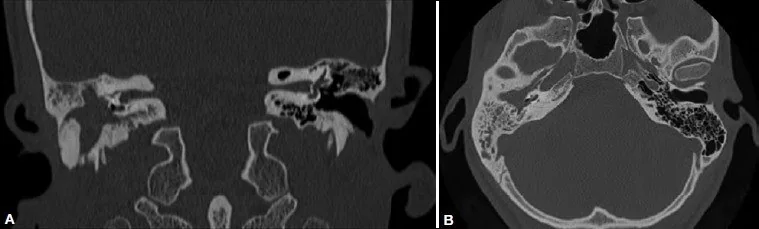
- Lateral semisirküler kanalın dış kemik duvarında komşu kolesteatomla aynı yerde fokal kortikal kayıp.
- Epitympanik veya antral yumuşak dokunun kanal konturuna dayanması; arada seçilebilir kemik çizgisinin bulunmaması.
- Aksiyel görüntüde şüpheli görülen duvar açıklığının komşu kesitlerde ve koronal MPR'de sürmesi.
- Aditus ad antrumdan lateral kanal komşuluğuna uzanan opasifikasyon ve çevre mastoid hücrelerde kolesteatomla uyumlu yayılım.
- Scutumda küntleşme veya malleus-incus kontur kaybı gibi orta kulak kolesteatomunu destekleyen eşlikçi erozyonlar.
- Daha az sıklıkla koklea ya da başka semisirküler kanal çevresinde ek otik kapsül defekti; tüm labirent konturu ayrıca taranır.
Ölçütler ve sınıflamalar
- Dornhoffer–Milewski labirent fistülü sınıflaması
- Tip I: kemik labirentte erozyon vardır, endosteum sağlamdır. Tip II: endosteum açılmış, membranöz labirent korunmuştur; IIa'da perilenfatik alan bozulmamış, IIb'de bozulmuştur. Tip III: perilenfatik alan açıktır ve membranöz labirent etkilenmiş ya da tahrip olmuştur. BT, kemik erozyonunu ve perilenfatik uzantıyı boyut ve açı ölçümleriyle öngörebilir; ancak membranöz labirent bütünlüğünün kesin evrelemesi cerrahi keşifle doğrulanmalıdır.
Normalde
Temporal kemik BT'sinde lateral semisirküler kanalın kemik örtüsünde kolesteatomla ilişkili defekt aranır. Kolesteatomla ilişkili lateral kanal kemik defektinin uzunluğu ve açısı aksiyel BT'de değerlendirilerek perilenfatik alan uzanımı öngörülebilir.
Ayırıcı tanı
- Kolesteatomsuz kronik otit
- orta kulak ve mastoid sıvı/yumuşak doku ile dolabilir; buna rağmen lateral kanal korteksinde odakla örtüşen erozyon yoksa fistül için görüntüleme kanıtı oluşmaz.
- Superior semisirküler kanal dehisansı
- defekt lateral kanalın dış duvarında değil, superior kanalın orta kafa çukuru tabanına bakan çatısındadır.
- Temporal kemik kırığı
- otik kapsülü kesen çizgisel kırık hattı ve travma bağlamı vardır; kolesteatom uzanımına komşu sınırlı kanal erozyonu görünümü beklenmez.
- Temporal kemik osteomiyeliti
- kemik destrüksiyonu kanal çevresinde yaygın ve düzensizdir; eşlik eden yumuşak doku inflamasyonu kolesteatomun tipik epitympanik yayılımından farklıdır.
- Labirentit ossifikans
- koklea veya vestibülde kemik yoğunluğunda obliterasyon görülür; lateral kanal dış korteksinde komşu kolesteatomun oluşturduğu açıklık beklenmez.
Tuzaklar
- Lateral kanal fistülü değerlendirmesinde yüksek çözünürlüklü BT'de kemik defekti aranır.
- Kolesteatomun kanala bitişik olması cerrahi açıdan önemli yakınlıktır ama tek başına kemik fistülü kanıtlamaz; aradaki otik kapsül korunuyorsa yakın komşuluğu açıkça belirt.
- BT'de kemik labirent erozyonu değerlendirilebilir; Dornhoffer–Milewski sınıflaması ise labirent tutulum derecesine göre ameliyat sırasında yapılmıştır.
- Kısmi hacim etkisi, ince kemik yapılarda yalancı açıklıklara yol açabilir; bu tür artefaktlar yüksek çözünürlüklü görüntüleme veya çok düzlemli yeniden yapılandırmalarla ayırt edilmelidir.
Kendini dene
Kronik kolesteatomlu kulakta lateral semisirküler kanalda kolesteatomla ilişkili kemik defekti görülüyor. Bu bulgu en çok hangi komplikasyonu düşündürür?
Cevabı göster
Labirent fistülü. Kolesteatomla ilişkili kemik labirent erozyonu labirent fistülünü destekler. Kolesteatomla ilişkili kemik labirent erozyonu labirent fistülünü destekler; labirentit ossifikans ise semisirküler kanallarda kemikleşmeyle ilişkilidir.
Dornhoffer–Milewski sınıflamasında Tip III labirent fistülünü hangi bulgu tanımlar?
Cevabı göster
Açık perilenfatik alanla birlikte membranöz labirent tutulumu veya tahribi. Tip III fistülde açık perilenfatik alana membranöz labirent tutulumu veya tahribi eşlik eder.
İlgili konular
- Edinsel kolesteatom, attik tipi
- Kronik otitis media
- Üst semisirküler kanal dehisansı
- Labirentit ossifikans
Kaynaklar
Bu sayfadaki 39 cümle ve 2 quiz sorusu aşağıdaki kaynaklardan alıntılarla otomatik olarak karşılaştırıldı; 17 cümle bu karşılaştırmada düzeltildi (2026-10-09).
- Post-operative hearing among patients with labyrinthine fistula as a complication of cholesteatoma using “under water technique”pmc.ncbi.nlm.nih.gov
- Diagnostic Bedside Vestibuloocular Reflex Evaluation in the Setting of a False Negative Fistula Test in Cholesteatoma of the Middle Earpmc.ncbi.nlm.nih.gov
- Surgical decision-making in cholesteatoma-induced labyrinthine fistula: hearing outcomes in a tertiary referral centerpmc.ncbi.nlm.nih.gov
- An unusual case of neglected CSOM presenting with perineural spread along seventh/eighth cranial nerves to form cerebellar peduncle abscess: A case reportpmc.ncbi.nlm.nih.gov
- Valsalva Maneuver in the Assessment of Recurrent Cholesteatoma: A Case Reportpmc.ncbi.nlm.nih.gov
- Middle ear damages.pubmed.ncbi.nlm.nih.gov
- Perilimphatic fistula test: a video clip demonstration.pubmed.ncbi.nlm.nih.gov
- Otologic disorders causing dizziness, including surgery for vestibular disorders.pubmed.ncbi.nlm.nih.gov
- [Sudden onset vertigo: imaging work-up].pubmed.ncbi.nlm.nih.gov
- Imaging of labyrinthine fistula after repair with bone pate.pubmed.ncbi.nlm.nih.gov
- Cholesteatoma labyrinthine fistula: prevalence and impact.pubmed.ncbi.nlm.nih.gov
- Management of labyrinthine fistula: hearing preservation versus prevention of residual disease.pubmed.ncbi.nlm.nih.gov
- [Perilymphatic fistula occurring spontaneously after cholesteatoma surgery].pubmed.ncbi.nlm.nih.gov
- Imaging Analysis for Cholesteatoma Extension to the Perilymphatic Space in Labyrinth Fistulae.pubmed.ncbi.nlm.nih.gov
- Surgical treatment of cholesteatomatous labyrinthine fistula by hydrodissection.pubmed.ncbi.nlm.nih.gov
- 3D printed temporal bones for preoperative simulation and planning.pubmed.ncbi.nlm.nih.gov
- [Clinical analysis of labyrinthine fistula caused by choleseatoma otitis media].pubmed.ncbi.nlm.nih.gov
- Managing cholesteatomas with labyrinthine fistula.pubmed.ncbi.nlm.nih.gov
- Labyrinthine fistulas: Surgical outcomes and an additional diagnostic strategy.pubmed.ncbi.nlm.nih.gov
- Surgical decision-making in cholesteatoma-induced labyrinthine fistula: hearing outcomes in a tertiary referral center.pubmed.ncbi.nlm.nih.gov
- Hearing Preservation After Segmental Semicircular Canal Destruction: A Report of Two Rare Cases.pubmed.ncbi.nlm.nih.gov
- Surgical Techniques and Materials Used in the Treatment of Complicated Otomastoiditis: A Systematic Review.pubmed.ncbi.nlm.nih.gov
- The preoperative temporal bone CT: a mnemonic for reducing surgical risk.pubmed.ncbi.nlm.nih.gov
- Role of the Ear in Meningitis: A Narrative Review of Neuroimaging.pubmed.ncbi.nlm.nih.gov
- Multimodal imaging in conductive hearing loss: Optimising CT, MRI and CTA for accurate diagnosis and management.pubmed.ncbi.nlm.nih.gov
- Human versus AI in audiological practice: A comparative evaluation of ChatGPT and physician treatment decisions in idiopathic sudden sensorineural hearing loss.pubmed.ncbi.nlm.nih.gov
- Interplay of Vestibular Symptoms and Intracranial Hypertension: A Diagnostic Challenge in a Patient With Tullio's Phenomenon and Elevated Intracranial Pressure.pubmed.ncbi.nlm.nih.gov
- The Challenge of Diagnosing Labyrinthine Stroke-A Critical Review.pubmed.ncbi.nlm.nih.gov
- Personalizing Cochlear Implant Care in Single-Sided Deafness: A Distinct Paradigm from Bilateral Hearing Loss.pubmed.ncbi.nlm.nih.gov
- Otic Capsule Dehiscences Simulating Other Inner Ear Diseases: Characterization, Clinical Profile, and Follow-Up-Is Ménière's Disease the Sole Cause of Vertigo and Fluctuating Hearing Loss?pubmed.ncbi.nlm.nih.gov
- Intraoperative Management of Lateral Semicircular Canal Fistula in Cholesteatoma Surgery: Retrospective Case Series and Audiovestibular Follow-Up.pubmed.ncbi.nlm.nih.gov
- Chronic otitis media with cholesteatoma: A retrospective observational study on the management of lateral semicircular canal fistulas.pubmed.ncbi.nlm.nih.gov
- Critical Steps and Common Mistakes during Temporal Bone Dissection: A Survey among Residents and a Step-by-Step Guide Analysis.pubmed.ncbi.nlm.nih.gov
- HRCT imaging of acquired cholesteatoma: a pictorial review.pubmed.ncbi.nlm.nih.gov
- Cochlear Duct Length Measurements in Computed Tomography and Magnetic Resonance Imaging Using Newly Developed Techniques.pubmed.ncbi.nlm.nih.gov
- Surgical and clinical confirmation of temporal bone CT findings in patients with otosclerosis with failed stapes surgery.pubmed.ncbi.nlm.nih.gov
- Autoincudotomy as an uncommon etiology of conductive hearing loss: Case report and review of literature.pubmed.ncbi.nlm.nih.gov
- Brazilian Society of Otology task force - Otosclerosis: evaluation and treatment.pubmed.ncbi.nlm.nih.gov
- Is Routine Use of High Resolution Computerized Tomography of Temporal Bone in Patients of Atticoantral Chronic Suppurative Otitis Media without Intracranial Complications Justified?pubmed.ncbi.nlm.nih.gov
- Prognostic Factors in Cochlear Implant in Otosclerosis: Radiologic and Clinical Variables: Cochlear Implant Predictors in Otosclerosis.pubmed.ncbi.nlm.nih.gov
- Rare Cause of Congenital Unilateral Facial Palsy: High-Resolution Computed Tomography (HRCT) Findings of Isolated Facial Canal Hypoplasia and Aplasia.pubmed.ncbi.nlm.nih.gov
- Clinical Study of Labyrinthine Fistula in Cholesteatomatous Chronic Otitis Media: A Tertiary Care Hospital-Based Retrospective Study in a South Indian Population.pubmed.ncbi.nlm.nih.gov
- Labyrinthine Fistula in Chronic Otitis Media Surgery: Management and Outcomes.pubmed.ncbi.nlm.nih.gov
- Hearing Preservation and Complications of the Middle Cranial Fossa Approach for Otolaryngological Diseases: Twelve-Year Single-Center Experience.pubmed.ncbi.nlm.nih.gov
- Different clinical presentation and management of temporal bone fibrous dysplasia in children.pubmed.ncbi.nlm.nih.gov
- International Harmonization of Nomenclature and Diagnostic Criteria (INHAND): Nonproliferative and Proliferative Lesions of the Rabbit.pubmed.ncbi.nlm.nih.gov
- Extensive Temporal Bone Necrosis in Petrous Bone Cholesteatoma Complicated by Actinomycosis: A Case Report.pubmed.ncbi.nlm.nih.gov
- Case report: endolymphatic sac tumor masquerading as Meniere's disease.pubmed.ncbi.nlm.nih.gov
- Infant hearing loss: from diagnosis to therapy Official Report of XXI Conference of Italian Society of Pediatric Otorhinolaryngology.pubmed.ncbi.nlm.nih.gov
- Brazilian Society of Otology task force - cochlear implant ‒ recommendations based on strength of evidence.pubmed.ncbi.nlm.nih.gov
- Key pre-operative CT parameters for cochlear implantation: a focused radiologic review with surgical relevance.pubmed.ncbi.nlm.nih.gov
- An unusual case of neglected CSOM presenting with perineural spread along seventh/eighth cranial nerves to form cerebellar peduncle abscess: A case report.pubmed.ncbi.nlm.nih.gov
- The Role of Stepwise Imaging in the Diagnosis and Management of Cholesteatoma in a Resource-Limited Setting: A Case Report.pubmed.ncbi.nlm.nih.gov
- Assessment of the Oval Window-Facial Canal Corridor and Mastoid Pneumatization: A Preliminary HRCT-Based Radiological-Anatomical Framework.pubmed.ncbi.nlm.nih.gov
- Cranial anatomy, palaeoneurology, palaeobiology and stratigraphic age of the large-bodied ornithopod, <i>Muttaburrasaurus langdoni</i> Bartholomai and Molnar, 1981, from the mid-Cretaceous of Australia.pubmed.ncbi.nlm.nih.gov
- Clinical High-Resolution Imaging of the Inner Ear by Using Magnetic Resonance Imaging (MRI) and Cone Beam Computed Tomography (CBCT).pubmed.ncbi.nlm.nih.gov
- Surgical Transcanal Procedure for Injection of Cells and Substances into the Human Cochlear Modiolus.pubmed.ncbi.nlm.nih.gov
- Radioanatomical assessment of the subtympanic sinus and its relationship to facial nerve position and temporal bone pneumatization in adults: CT study.pubmed.ncbi.nlm.nih.gov
- The Possible Relationship Between Sigmoid Dehiscence, Degree of Mastoid Pneumatization, and Sigmoid Sinus Position in Patients with Pulsatile Tinnitus.pubmed.ncbi.nlm.nih.gov
- Rare Disorders of the Vestibular Labyrinth: of Zebras, Chameleons and Wolves in Sheep's Clothing.pubmed.ncbi.nlm.nih.gov
- Cerebrospinal fluid otorrhea secondary to congenital inner ear dysplasia: diagnosis and management of 18 cases.pubmed.ncbi.nlm.nih.gov
- Radiological Prevalence of Superior Semicircular Canal Dehiscence with Ultra-High-Resolution Photon-Counting Detector CT.pubmed.ncbi.nlm.nih.gov
- Large Vestibular Aqueduct-Associated Symptoms: Endolymphatic Duct Blockage as a Surgical Treatment.pubmed.ncbi.nlm.nih.gov
- Eustachian Tube Dysfunction in Hearing Loss: Mechanistic Pathways to Targeted Interventions.pubmed.ncbi.nlm.nih.gov
- Imaging Studies in Otosclerosis: An Up-to-date Comprehensive Review.pubmed.ncbi.nlm.nih.gov
- Facial Nerve Hemangioma in the Internal Auditory Canal: A Rare Localization and Therapeutic Challenge.pubmed.ncbi.nlm.nih.gov
- Diagnostic and Surgical Challenges in External Auditory Canal Cholesteatoma: Experience from a Tertiary Care Centre.pubmed.ncbi.nlm.nih.gov
- Aditus ad Antrum on Normal Temporal Bone CT Scan.pubmed.ncbi.nlm.nih.gov
- There Is No Relation between Epitympanic Recess Volume and Chronic Otitis Media.pubmed.ncbi.nlm.nih.gov
- A Comprehensive Review of the Role of the Latest Minimally Invasive Neurosurgery Techniques and Outcomes for Brain and Spinal Surgeries.pubmed.ncbi.nlm.nih.gov
- Post-traumatic peripheral vestibular disorders (excluding positional vertigo) in workers following head injury.pubmed.ncbi.nlm.nih.gov
- Rare Diseases of the Orbit.pubmed.ncbi.nlm.nih.gov
- Brazilian Society of Otology task force - Vestibular Schwannoma ‒ evaluation and treatment.pubmed.ncbi.nlm.nih.gov
- Third Window Syndrome: Surgical Management of Cochlea-Facial Nerve Dehiscence.pubmed.ncbi.nlm.nih.gov
- Exploration of Automated Measurement for Ossicular Chains Based on 3-Dimensional Geometric Information.pubmed.ncbi.nlm.nih.gov
- Assessment of the Inter-Frequency Amplitude Ratio (1000/500 Hz) in cVEMP and oVEMP for the Diagnosis of Ménière's Disease.pubmed.ncbi.nlm.nih.gov
- Acute pneumolabyrinth: a rare complication after cochlear implantation in a patient with obstructive sleep apnoea on CPAP therapy.pubmed.ncbi.nlm.nih.gov
- The Conundrum of Labyrinthitis Ossificans: An Etiology-Based Case Comparison and Review of Literature.pubmed.ncbi.nlm.nih.gov
- Labyrinthine Fistulas in cholesteatoma : Surgical outcome on auditory function.pubmed.ncbi.nlm.nih.gov
- High-resolution Computed Tomography of Temporal Bone as a Diagnostic Technique for Early Diagnosis of Cholesteatoma and Prevention of Its Severe Complications.pubmed.ncbi.nlm.nih.gov
- Bezold's abscess, an uncommon complication of otitis media and cholesteatoma: a case report.pubmed.ncbi.nlm.nih.gov
- More Than Meets the Ear: Incidental Cerebrospinal Fluid Leak During Myringotomy in a Child With Common Cavity Deformity.pubmed.ncbi.nlm.nih.gov
- Nystagmus and Vertigo During Aural Toilet Using Microsuction.pubmed.ncbi.nlm.nih.gov
- Intraoperative high-resolution CT reveals electrode misplacement undetected by skull X-ray following cochlear implantation for IP-III inner ear malformation.pubmed.ncbi.nlm.nih.gov
- Inner Ear Anatomy of Caenagnathidae (Theropoda: Oviraptorosauria) Emphasizes Mosaic Evolution of the Avian Neurosensory System.pubmed.ncbi.nlm.nih.gov
- Vestibular Aqueduct and Temporal Bone Radioanatomy in Patients With and Without Meniere Disease: A Retrospective Cross-Sectional Analysis With Implications for Endolymphatic Sac Surgery.pubmed.ncbi.nlm.nih.gov
- Mastoid pouch of the sigmoid sinus- an extraordinary anatomical variant.pubmed.ncbi.nlm.nih.gov
- Radiological Perspectives in Congenital Sensorineural Hearing Loss: Insights from Cochlear Implant Candidates.pubmed.ncbi.nlm.nih.gov
- <i>Actinomyces urogenitalis</i> and <i>Peptoniphilus asaccharolyticus</i> brain abscess in an immunocompetent patient: A case report.pubmed.ncbi.nlm.nih.gov
- Mastoiditis Now Affects Adults: A Case Report of an Occurrence of the Disease in an 82-Year-Old Male.pubmed.ncbi.nlm.nih.gov
- Valsalva Maneuver in the Assessment of Recurrent Cholesteatoma: A Case Report.pubmed.ncbi.nlm.nih.gov
Eğitim amaçlıdır; hasta başında tanı ve tedavi kararının yerine geçmez, tıbbi tavsiye değildir. Metinler yapay zekâ desteğiyle yazıldı ve otomatik bir adımda kaynak alıntılarıyla karşılaştırıldı; bu bir tıbbi doğrulama değildir ve içerik uzman radyolog incelemesinden geçmedi. Klinik kararlarda güncel kılavuzları, kurum protokollerini ve radyoloji raporunu esas alın.