Özet
Konjenital orta kulak kolesteatomu, sağlam timpanik membranın arkasında gelişen keratinize skuamöz epitel kökenli bir kisttir. Temporal kemik BT’si lezyonun kadran yerleşimi, kemikçik tutulumu ve mastoid uzanımı hakkında anatomik bilgi sağlar. Konjenital kolesteatom BT’de küçük, yuvarlak veya oval bir kitle olarak görülebilir; bir seride mastoid iyi pnömatize bulunmuş ve kapalı tip lezyonların %14’ünde ossiküler erozyon bildirilmiştir. Konjenital kolesteatomun geç tanınması, işitme ve orta kulak yapılarında ciddi hasarla ilişkili olabilir.
Faz ve pencere
- Kontrastsız tanısal
- BT’de orta kulakta, sıklıkla anterosuperior kadranda küçük, yuvarlak veya oval kitle ve eşlik edebilecek ossiküler erozyon değerlendirilir; mastoid pnömatizasyonu da incelenebilir.
Önerilen pencereler G genişlik, M merkez; değerler Hounsfield birimi (HU)
- KemikG 1800 / M +400
- Yumuşak dokuG 400 / M +40
BT bulguları
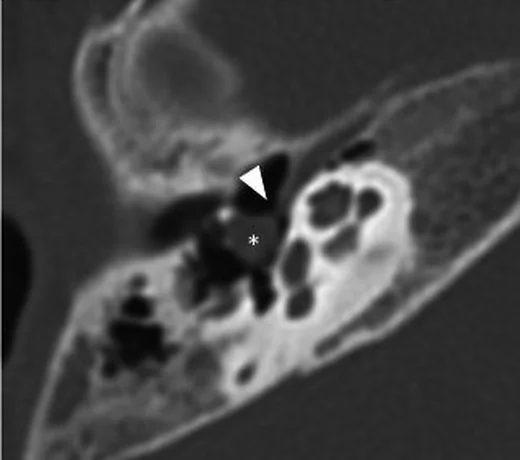
- Orta kulak boşluğunda, sağlam timpanik membranın medialinde, iyi sınırlı yuvarlak veya oval yumuşak doku kitlesi.
- Bir BT serisinde kapalı tip konjenital kolesteatom en sık anterosuperior kadranda (%74,4), açık tip ise posterosuperior kadranda (%68,4) yerleşmiştir. Konjenital kolesteatom tanısı klinik muayene, radyolojik bulgular ve gerektiğinde operatif bulgular birlikte değerlendirilerek konur.
- Konjenital kolesteatomda ossiküler erozyon görülebilir; bir seride ilk erozyona uğrayan kemikçik çoğunlukla stapes olarak bildirilmiş, başka bir seride kapalı tip lezyonların %14’ünde erozyon saptanmıştır.
- BT’de kemikçiklerin tutulumunu değerlendir; bir seride ilk erozyona uğrayan kemikçik çoğunlukla stapes olarak bildirilmiştir.
- Bir seride mastoid hava hücre sistemi intraoperatif ve radyolojik görüntülerde olguların neredeyse tamamında iyi pnömatize bulunmuştur.
- Geniş konjenital kolesteatom supralabirentin alanı veya petroz apeksi tutabilir; bu bölgeler BT’de değerlendirilir.
- Potsic evrelemesi, konjenital kolesteatom için yaygın kullanılan bir evreleme sistemidir.
Ölçütler ve sınıflamalar
- Potsic orta kulak konjenital kolesteatom evrelemesi
- Potsic evrelemesi konjenital kolesteatomun orta kulaktaki anatomik yayılımını, kemikçik tutulumunu ve mastoid uzanımını derecelendirir. Bu sistem orta kulak hastalık yayılımını evreler.
- Honnurappa ve arkadaşlarının birleşik konjenital kolesteatom sınıflaması (2022; önerilen)
- Tip 1, kemikçikleri ve mastoidi tutmayan, orta kulakla sınırlı küçük bir kesedir; tip 2 tüm orta kulağı ossiküler destrüksiyonla tutar ve mastoide uzanmaz (2a fasiyal sinir parezisi yok, 2b var); tip 3 mastoide uzanır (3a parezi yok, 3b var); tip 4 supralabirentin alandan orta kulağa ve iç akustik kanala uzanır (4a parezi yok, 4b var); tip 5 petroz apeks kaynaklıdır ve anakuziyle birliktedir (5a parezi yok, 5b var). Bu tek merkezli cerrahi seride önerilmiş kapsamlı bir sınıflamadır; Potsic orta kulak evrelemesinin yerine geçmiş evrensel bir standart olarak sunulmamalıdır.
Normalde
Bir konjenital kolesteatom serisinde timpanik membran sağlam, orta kulak mukozası çoğu olguda normal ve mastoid hava hücre sistemi neredeyse tüm olgularda iyi pnömatize olarak bildirilmiştir. Aynı düzeyde kitlenin yerini, incus uzun kolu-stapes ilişkisini ve mastoid pnömatizasyonunu diğer kulakla karşılaştır.
Ayırıcı tanı
- Edinsel attik kolesteatomda BT’de scutumda küntleşme ve attik genişlemesi görülebilir; spontan dışa drenaj sonrası attik kavite hava ile dolu olabilir.
- Orta kulak efüzyonu eşlik ettiğinde konjenital kolesteatom tanısı güçleşebilir. Klinik değerlendirmeye ek olarak, difüzyon ağırlıklı MR’da kolesteatomda difüzyon kısıtlılığı görülmesi lezyonun karakterizasyonuna yardımcı olabilir.
- Timpanosklerozda yüksek çözünürlüklü BT, ossiküler zincir fiksasyonunu değerlendirmeye yardımcı olabilir.
- Orta kulak paragangliomu vasküler bir tümördür; karakterizasyonunda MR, BT’yi tamamlayabilir.
Tuzaklar
- Konjenital tanı yalnız BT görünümüne dayanmaz; klinik muayene, radyolojik bulgular ve gerektiğinde operatif bulgular birlikte değerlendirilir.
- Erken konjenital kolesteatom kemik erozyonu olmadan bulunabilir; korunmuş ossiküller lezyonu dışlamaz.
- Orta kulak yumuşak dokusunun CT yoğunluğu tanıyı doğrulamaz; cerrahi sonrası artık veya nüks hastalık değerlendirmesinde difüzyon ağırlıklı MR daha kullanışlı olabilir.
- Orta kulak için kullanılan Potsic evrelerini petroz apeks ve supralabirentin hastalığa genellemeyin; birleşik sınıflama bu çalışmada önerilmiş farklı bir çerçevedir.
- BT’de mastoid ve antrum opasifikasyonu hastalık uzanımını olduğundan fazla gösterebilir; kapalı tip konjenital kolesteatomda ossiküler erozyon daha seyrek olduğundan erozyon yokluğu lezyonu dışlamaz.
Kendini dene
Bir seride konjenital kolesteatom kitlesinin ilk erozyona uğrattığı kemikçik çoğunlukla hangisidir?
Cevabı göster
Stapes. Bir seride ilk erozyona uğrayan kemikçik çoğunlukla stapes olarak bildirilmiştir.
Honnurappa sınıflamasına göre, orta kulağı ve kemikçikleri tutan ancak mastoide uzanmayan ve fasiyal sinir parezisi olmayan konjenital kolesteatom hangi tiptir?
Cevabı göster
Tip 2a. Tip 2 orta kulağı ve kemikçikleri tutar, mastoide uzanmaz; 2a alt tipinde fasiyal sinir parezisi yoktur.
İlgili konular
- Edinsel kolesteatom, attik tipi
- Edinsel kolesteatom, pars tensa/sinüs timpani tipi
- Kronik otitis media
Kaynaklar
Bu sayfadaki 40 cümle ve 2 quiz sorusu aşağıdaki kaynaklardan alıntılarla otomatik olarak karşılaştırıldı; 12 cümle bu karşılaştırmada düzeltildi (2026-10-12).
- A Unified Classification of Middle Ear and Petrous Bone Congenital Cholesteatomaspmc.ncbi.nlm.nih.gov
- Beyond the otoscope: an imaging review of congenital cholesteatoma.pubmed.ncbi.nlm.nih.gov
- Diagnosis and Management of Unexplained Conductive Hearing Loss With Intact Tympanic Membrane: A Systematic Review.pubmed.ncbi.nlm.nih.gov
- The Tensor Tympani Tendon: A Hypothetical Site of Origin of Congenital Cholesteatoma.pubmed.ncbi.nlm.nih.gov
- Fusion computed tomography-magnetic resonance imaging scans for pre-operative staging of congenital middle-ear cholesteatoma.pubmed.ncbi.nlm.nih.gov
- [Clinical treatment of congenital middle ear cholesteatoma in children].pubmed.ncbi.nlm.nih.gov
- [Congenital middle ear cholesteatoma].pubmed.ncbi.nlm.nih.gov
- Clinical experience of 71 cases of congenital middle ear cholesteatoma.pubmed.ncbi.nlm.nih.gov
- Treatment of congenital middle ear cholesteatoma in children using endoscopic and microscopic ear surgeries: a case series.pubmed.ncbi.nlm.nih.gov
- [Clinical analysis of ten cases of congenital middle ear cholesteatoma].pubmed.ncbi.nlm.nih.gov
- [Characteristics of diagnosis and surgical treatment of various forms of congenital temporal bone cholesteatoma].pubmed.ncbi.nlm.nih.gov
- [Etiology analysis and diagnosis of noninflammatory conductive hearing loss in children].pubmed.ncbi.nlm.nih.gov
- [Clinical analysis of 10 cases of congenital middle ear cholesteatoma with concurrent congenital ossicular malformation].pubmed.ncbi.nlm.nih.gov
- [Diagnostic value of high-resolution temporal bone CT combined with DW-MRI fusion technology in middle ear cholesteatoma].pubmed.ncbi.nlm.nih.gov
- Hidden Peril in the Ear: A Case of External Auditory Canal Cholesteatoma in a Teenager.pubmed.ncbi.nlm.nih.gov
- Adult Case of Congenital Intratympanic Membrane Cholesteatoma.pubmed.ncbi.nlm.nih.gov
- Investigation of Keratinized Squamous Epithelium from Mastoid Cortical Bone Dust in Patients with or without Cholesteatoma.pubmed.ncbi.nlm.nih.gov
- Open- and closed-type congenital cholesteatomas of the middle ear: computed tomography differentiation and correlation with surgical staging.pubmed.ncbi.nlm.nih.gov
- Transcanal Endoscopic Ear Surgery for Pediatric Bilateral Congenital Cholesteatoma: A Report of Two Cases.pubmed.ncbi.nlm.nih.gov
- Outcomes of Endoscopic Congenital Cholesteatoma Removal in South Korea.pubmed.ncbi.nlm.nih.gov
- A fluorescent photoimmunoconjugate for imaging of cholesteatoma.pubmed.ncbi.nlm.nih.gov
- Cholesteatoma Pearls: Practical Points and Update.pubmed.ncbi.nlm.nih.gov
- Updates and knowledge gaps in cholesteatoma research.pubmed.ncbi.nlm.nih.gov
- Pediatric Cholesteatoma Presenting as Persistent Otorrhea: A Case of Delayed Diagnosis Across Multiple ENT Specialists.pubmed.ncbi.nlm.nih.gov
- Bilateral Congenital Cholesteatoma in a 13-Year-Old Boy.pubmed.ncbi.nlm.nih.gov
- Key pre-operative CT parameters for cochlear implantation: a focused radiologic review with surgical relevance.pubmed.ncbi.nlm.nih.gov
- Multimodal imaging in conductive hearing loss: Optimising CT, MRI and CTA for accurate diagnosis and management.pubmed.ncbi.nlm.nih.gov
- Angioleiomyoma of the External Auditory Canal in a Pediatric Patient: A Case Report.pubmed.ncbi.nlm.nih.gov
- A case of congenital cholesteatoma in adult patient with intermittent episodes of facial palsy.pubmed.ncbi.nlm.nih.gov
- Early diagnosis and complete excision of congenital cholesteatoma in a 4-year-old boy: A case report.pubmed.ncbi.nlm.nih.gov
- Adult-onset congenital cholesteatoma in the hypotympanum initially presenting as Bell's palsy: A case report.pubmed.ncbi.nlm.nih.gov
- Isolated Congenital Ossicular Chain Anomalies.pubmed.ncbi.nlm.nih.gov
- TORP Versus PORP in Austin Type A Ossicular Defects: Which is the Right Choice?pubmed.ncbi.nlm.nih.gov
- Use of Glass Ionomer Cement for Incudostapedial Rebridging Ossiculoplasty.pubmed.ncbi.nlm.nih.gov
- Chronically Discharging Ears: Evalution with High Resolution Computed Tomography.pubmed.ncbi.nlm.nih.gov
- Emerging and re-emerging infectious disease in otorhinolaryngology.pubmed.ncbi.nlm.nih.gov
- The preoperative temporal bone CT: a mnemonic for reducing surgical risk.pubmed.ncbi.nlm.nih.gov
- Radiological Classification and Management Algorithm of Petrous Apex Cholesterol Granuloma.pubmed.ncbi.nlm.nih.gov
- Lateral Skull Base Approaches in Pediatric Skull Base Surgery.pubmed.ncbi.nlm.nih.gov
- Diagnosis and Management of Middle Ear Neuroendocrine Tumour (MeNET).pubmed.ncbi.nlm.nih.gov
- Posterior Quadrants and Malleolar Perforations as Key Predictors of Hearing Loss in Chronic Otitis Media: A Clinicoradiological Correlation.pubmed.ncbi.nlm.nih.gov
- Anatomical and audiological considerations in branchiootorenal syndrome: A systematic review.pubmed.ncbi.nlm.nih.gov
- Computed-Tomography-Structured Reporting in Middle Ear Opacification: Surgical Results and Clinical Considerations From a Large Retrospective Analysis.pubmed.ncbi.nlm.nih.gov
- EAONO/JOS, STAMCO, ChOLE & Potsic Staging of 271 Pediatric Cholesteatoma: Evidence-Based Mod-Pot Staging System.pubmed.ncbi.nlm.nih.gov
- A Unified Classification of Middle Ear and Petrous Bone Congenital Cholesteatomas.pubmed.ncbi.nlm.nih.gov
- Role of the Ear in Meningitis: A Narrative Review of Neuroimaging.pubmed.ncbi.nlm.nih.gov
- Cross Sectional Imaging of the Ear and Temporal Bone.pubmed.ncbi.nlm.nih.gov
- Imaging findings in auto-atticotomy.pubmed.ncbi.nlm.nih.gov
- Masses of developmental and genetic origin affecting the paediatric craniofacial skeleton.pubmed.ncbi.nlm.nih.gov
- Incidental finding of tuberous sclerosis complex in a woman with hematuria: A case report of renal angiomyolipoma and review of the literature.pubmed.ncbi.nlm.nih.gov
- Diagnosis and Treatment Modalities of Cholesteatomas: A Review.pubmed.ncbi.nlm.nih.gov
- Transcanal endoscopic treatment for congenital middle ear cholesteatoma in children.pubmed.ncbi.nlm.nih.gov
- Danger of Delay: A Case Report of a Hidden, Extensive, Congenital External Auditory Canal Cholesteatoma in a Pediatric Patient.pubmed.ncbi.nlm.nih.gov
- Efficacy of incus reposition ossiculoplasty in middle ear cholesteatoma surgery.pubmed.ncbi.nlm.nih.gov
- A Case of Acquired Pars Flaccida Cholesteatoma Extending to the Supralabyrinthine Petrous Apex With Preservation of the Otic Capsule.pubmed.ncbi.nlm.nih.gov
- Endoscopic assisted minimally invasive resection of petrous bone epidermoid cyst via a presigmoid burr hole approach: illustrative case.pubmed.ncbi.nlm.nih.gov
- Middle Ear and Mastoid Diseases: Literature Review and New Classification Proposal.pubmed.ncbi.nlm.nih.gov
- Endoscopic Ear Surgery: Minimally Invasive, Maximum Views.pubmed.ncbi.nlm.nih.gov
- Fast Small-Angle X-Ray Scattering Tensor Tomography: An Outlook into Future Applications in Life Sciences.pubmed.ncbi.nlm.nih.gov
- Congenital Mastoid Cholesteatoma With Giant Intracranial Extension: A Case Report.pubmed.ncbi.nlm.nih.gov
- Middle ear malformations combined with cerebrospinal fluid otorrhea: A case report.pubmed.ncbi.nlm.nih.gov
- Use of Bonebridge Implant in a Child with Congenital Cholesteatoma: A Case Report.pubmed.ncbi.nlm.nih.gov
- Incidence Rate and Determinants of Recurrent Cholesteatoma Following Surgical Management: A Systematic Review, Subgroup, and Meta-Regression Analysis.pubmed.ncbi.nlm.nih.gov
- A novel subtype classification for acute intracranial atherosclerotic disease-related occlusion.pubmed.ncbi.nlm.nih.gov
- Reliability of high-resolution CT scan in diagnosis of ossicular tympanosclerosis.pubmed.ncbi.nlm.nih.gov
- "Genetic tumor syndromes of the head and neck: Update in the genomic era".pubmed.ncbi.nlm.nih.gov
- Diagnostic Limitations, Patient Characteristics, and Confounding Factors Impacting Neurotologic Lesion Imaging: A Systematic Review.pubmed.ncbi.nlm.nih.gov
- Canal Cholesteatoma Presentation and Management: A Systematic Review and Meta-Analysis.pubmed.ncbi.nlm.nih.gov
- Clinical relevance of the new classification for mastoid progression in the staging and classification criteria for middle ear cholesteatoma proposed by the Japan Otological Society.pubmed.ncbi.nlm.nih.gov
- Surgical Techniques and Materials Used in the Treatment of Complicated Otomastoiditis: A Systematic Review.pubmed.ncbi.nlm.nih.gov
- The Current Situation and Development of Endoscopic Ear Surgery in China.pubmed.ncbi.nlm.nih.gov
- Intratympanic Membrane Cholesteatoma in a Toddler.pubmed.ncbi.nlm.nih.gov
- Neuroglial Choristoma of the Middle Ear with Massive Tympanosclerosis: A Case Report and Literature Review.pubmed.ncbi.nlm.nih.gov
- Predicting residual cholesteatoma with the Potsic staging system still lacks evidence: a systematic review and meta-analysis.pubmed.ncbi.nlm.nih.gov
- Cochlear Implantation in Down Syndrome: Functional Outcomes, Challenges, and Management Strategies.pubmed.ncbi.nlm.nih.gov
- The middle ear-nasopharyngeal microbiome axis associated with obstructive Eustachian tube dysfunction in chronic otitis media.pubmed.ncbi.nlm.nih.gov
- Efficacy of endoscopic removal of anterior malleolar ligament calcification combined with tympanic membrane repair for the treatment of conductive hearing loss.pubmed.ncbi.nlm.nih.gov
- Structural Phenotype of High-Frequency Recurrent Facial Palsy.pubmed.ncbi.nlm.nih.gov
- Characteristics of the Facial Canal-Lateral Canal Dehiscence: The Under-recognized Third Window.pubmed.ncbi.nlm.nih.gov
- Engineered oncolytic virus for the treatment of cholesteatoma: A pilot in vivo study.pubmed.ncbi.nlm.nih.gov
- Sinonasal Inflammatory Burden on Computed Tomography in Adults With Obstructive Eustachian Tube Dysfunction: A Case-Control Study.pubmed.ncbi.nlm.nih.gov
- Benchmark-Driven Clinical Decision Framework for Multi-Class Middle Ear Disease Diagnosis: Superiority of Swin Transformer in Accuracy and Stability.pubmed.ncbi.nlm.nih.gov
- Petrous Bone Cholesteatoma- A Comprehensive Management Algorithm and Outcomes.pubmed.ncbi.nlm.nih.gov
- Serous Otitis Media Secondary to a Middle Ear Neuroendocrine Tumor of Five-Year Duration.pubmed.ncbi.nlm.nih.gov
- Spontaneous Regression of a Cholesterol Granuloma in a Mushroom-Like Extension Into the Middle Cranial Fossa After Tympanoplasty.pubmed.ncbi.nlm.nih.gov
- Clinical Characteristics and Treatment Outcomes of Congenital Cholesteatoma.pubmed.ncbi.nlm.nih.gov
- Acute otitis media complicated by peripheral facial nerve palsy in an adult: A case report.pubmed.ncbi.nlm.nih.gov
- Primary Intracranial Cholesteatoma Presenting as a Cerebellar Mass Without Otologic Symptoms.pubmed.ncbi.nlm.nih.gov
- Prognostic Scoring Systems in Ossiculoplasty: A Comprehensive Review and Introduction of a Novel Predictive Index.pubmed.ncbi.nlm.nih.gov
- 3D HRCT Analysis of Supratubal Recess Volume in Chronic Otitis Media: A Case-Control Study.pubmed.ncbi.nlm.nih.gov
- Assessment of the Oval Window-Facial Canal Corridor and Mastoid Pneumatization: A Preliminary HRCT-Based Radiological-Anatomical Framework.pubmed.ncbi.nlm.nih.gov
- Gradenigo syndrome in a child: case report and literature review.pubmed.ncbi.nlm.nih.gov
- Correlation Between Preoperative HRCT Temporal Bone Findings and Intraoperative Findings in Patients with Chronic Otitis Media Active Squamosal Disease.pubmed.ncbi.nlm.nih.gov
- Fusion of Middle Ear Optical Coherence Tomography and Computed Tomography.pubmed.ncbi.nlm.nih.gov
- A brief history of otologic surgery: restoring hearing through the ages.pubmed.ncbi.nlm.nih.gov
- Tympanic Bone: Small Neglected Bone with Extreme Anatomic Importance in Lateral Skull-Base Surgery.pubmed.ncbi.nlm.nih.gov
- Pulsatile Tinnitus: A Comprehensive Clinical Approach to Diagnosis and Management.pubmed.ncbi.nlm.nih.gov
- Mid- to long-term outcomes of the surgical treatment of 20 middle ear cholesteatomas in 18 French bulldogs.pubmed.ncbi.nlm.nih.gov
- Neuroradiology of cholesteatomas.pubmed.ncbi.nlm.nih.gov
- [Staging of middle ear cholesteatoma surgery and its value for clinical decision-making].pubmed.ncbi.nlm.nih.gov
- Recurrence Rate of Congenital Cholesteatoma: A Kaplan-Meier Survival Analysis.pubmed.ncbi.nlm.nih.gov
- Immunohistochemical localization of d- β -aspartic acid in congenital and acquired middle ear cholesteatoma.pubmed.ncbi.nlm.nih.gov
- Tubotympanic cholesteatoma.pubmed.ncbi.nlm.nih.gov
- Transcanal Endoscopic Management of Squamosal Type of Chronic Otitis Media.pubmed.ncbi.nlm.nih.gov
- A Portable Pen-Shaped Otoscope for Telemedicine and Office-Based Otologic Examination: Feasibility and Patient Acceptability.pubmed.ncbi.nlm.nih.gov
- Quantitative Association Between Otorrhea Frequency and Sensorineural Hearing Risk in Pediatric Chronic Otitis Media.pubmed.ncbi.nlm.nih.gov
- Temporal Bone Cholesteatoma Presenting With Chronic Facial Nerve Palsy: A Case Report With Radiological Correlation.pubmed.ncbi.nlm.nih.gov
- Primary Mastoid Cholesteatoma: A Case Report and Review of the Literature.pubmed.ncbi.nlm.nih.gov
Eğitim amaçlıdır; hasta başında tanı ve tedavi kararının yerine geçmez, tıbbi tavsiye değildir. Metinler yapay zekâ desteğiyle yazıldı ve otomatik bir adımda kaynak alıntılarıyla karşılaştırıldı; bu bir tıbbi doğrulama değildir ve içerik uzman radyolog incelemesinden geçmedi. Klinik kararlarda güncel kılavuzları, kurum protokollerini ve radyoloji raporunu esas alın.