Özet
Gastrik nöroendokrin tümörler (gNET), biyolojik davranışı ve görüntüleme gereksinimi farklı olan iyi diferansiye tümörleri kapsar. Klinik-etyolojik sınıflamada Tip I kronik atrofik gastrit ve hipergastrinemiyle, Tip II gastrinoma ile ilişkili Zollinger–Ellison sendromu ve sıklıkla MEN1 ile, Tip III ise sporadik tümörlerle ilişkilidir; sunulan kaynaklar WHO 6. baskıda Tip IV ve Tip V’in eklendiğini doğrulamamaktadır. Bu tipler histolojik derece sınıflamasından ayrıdır: iyi diferansiye NET’ler G1–G3 olarak derecelendirilir, kötü diferansiye nöroendokrin karsinomlar (NEC) ayrı bir gruptur. Abdominal BT, Tip I ve II gNET’lerde 2 cm’den büyük lezyonlar ve tüm Tip III lezyonlar için evrelemede önerilir. Kontrastlı incelemede tümör ve karaciğer metastazı arteriyel fazda belirginleşebilir; Tip III tümörde nodal veya karaciğer yayılımı daha sık görülebilir.
Faz ve pencere
- Arteriyel tanısal
- Triphasik BT’de arteriyel fazda hiperenhansmanlı gastrik lezyon ve karaciğer metastatik depozitleri görülebilir; gNET tanısı endoskopik biyopsiyle doğrulanır.
- Portal tanısal
- Portal venöz fazda gastrik lezyonda kalıcı kontrastlanma ve karaciğer tutulumu görülebilir.
Önerilen pencereler: Batın (G 400 / M 50), Karaciğer (G 150 / M 30), Yumuşak doku (G 400 / M 40).
BT bulguları
- Tip I örüntüsünde korpus/fundusta çok sayıda küçük polipoid duvar odağı ve eşlik eden atrofik gastrit görünümü
- Tip II örüntüsünde çoklu küçük tümör odakları normal veya hipertrofik mide mukozasıyla birlikte görülebilir ve gastrinoma/Zollinger–Ellison sendromu, sıklıkla MEN1 ile ilişkilidir.
- Tip III gNET genellikle tek ve 1 cm’den büyük bir lezyon olarak görülür.
- Submukozal veya intramural başlangıçlı odağın çevre mide duvarıyla kıyaslandığında belirgin arteriyel kontrastlanması
- Derin submukoza invazyonu, retroperitoneal lenfadenopati ve vasküler tutulum (splenokaval tromboz gibi) değerlendirilir.
- Tip III gNET’lerde bölgesel lenf nodu metastazları görülebilir.
- Triphasik BT’de arteriyel fazda hiperenhansmanlı gastrik lezyonla birlikte karaciğer metastatik depozitleri görülebilir.
- Tip III lezyonlarda karaciğer, dalak ve retroperitoneal nodlara yönelik metastaz risk yüksektir; ileri evre hastalık bulguları değerlendirilir.
- Literatürde Tip IV olarak adlandırılan ve parietal hücre hipertrofisi/hiperplazisi ile karakterize varyantlar bildirilmektedir; bu varyantların BT ile tanısal ayırımı patoloji ve klinik bağlama bağlıdır.
Ölçütler ve sınıflamalar
- İyi diferansiye gastrik NET tipleri
- İyi diferansiye gastrik NET’lerin klinik-etyolojik tipleri: Tip I kronik atrofik gastrit/hipergastrinemiyle, Tip II gastrinoma ile ilişkili Zollinger–Ellison sendromu/MEN1 bağlamıyla, Tip III sporadik tümörlerle ilişkilidir. WHO sınıflamasında iyi diferansiye NET’ler G1–G3 derecelerine ayrılır; Tip IV olarak parietal hücre hipertrofisi ve hiperplazisi ile seyreden ve hipoplaziye yol açan varyantlar literatürde yer alır. Klinik tip sınıflaması histolojik sınıflamadan ayrıdır: iyi diferansiye NET’ler G1–G3 derecelerinde olabilir; kötü diferansiye NEC ayrı sınıflanır. BT, gNET’in histolojik derecesini tek başına belirlemez; dereceleme histopatolojik incelemeyle yapılır.
Normalde
Arteriyel fazda hiperenhansmanlı gastrik lezyonla birlikte karaciğer metastatik depozitleri görülebilir. Portal venöz fazda gastrik lezyonda kalıcı kontrastlanma ve karaciğer tutulumu görülebilir.
Normal BT ile kıyasla
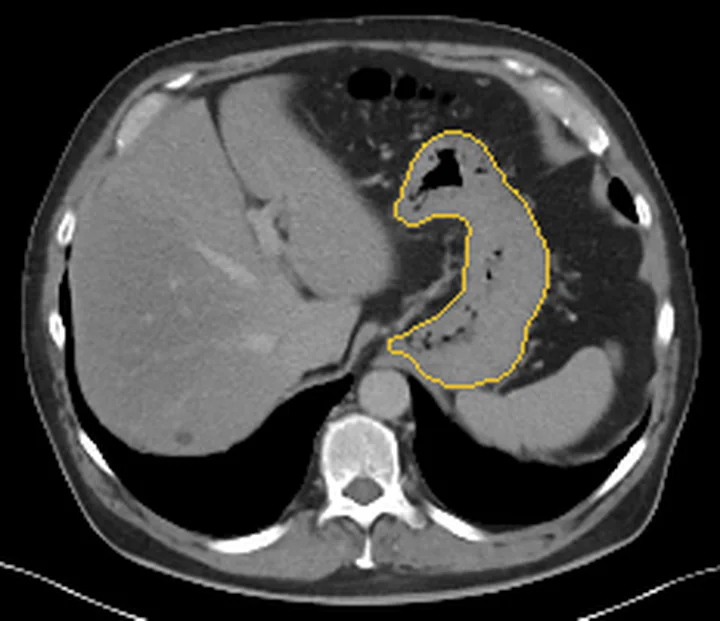
Aynı bölgenin, kaynak veri setinde patoloji içermediği belirtilen bir BT incelemesini kesit kesit kaydırın; organ sınırlarını açarak anatomiyi hasta görüntüsüyle karşılaştırın. Küçük rastlantısal bulgular tümüyle dışlanmamıştır.
Kaynak: TotalSegmentator v2.01 veri seti (Wasserthal ve ark., Radiology: Artificial Intelligence 2023), CC BY 4.0, vaka s0541; organ sınırları veri setinin otomatik segmentasyonundan, birleştirilerek sadeleştirildi. Görüntüler 2,5 mm kesit aralığına yeniden örneklendi.
Ayırıcı tanı
- Gastrik GİST
- sıklıkla dışa büyüyen duvar kitlesidir; gNET daha mukozal/submukozal odak ve tip III'te ülserli duvar kitlesi şeklinde görülebilir.
- Glomus tümörü antrumda iyi sınırlı, belirgin ve kalıcı kontrastlanan bir kitle oluşturabilir; gNET’ten klinik tip ve eşlik eden çoklu odaklar ayırt edicidir.
- Gastrik adenokarsinom ve gNET’in görüntüleme bulguları örtüşebilir; kesin tanı için histopatolojik inceleme gerekir.
Tuzaklar
- Küçük tip I odaklar BT'de görünmeyebilir; negatif BT'yi endoskopik hastalığın yokluğu şeklinde yorumlama.
- Triphasik BT’de arteriyel fazda hiperenhansmanlı gastrik lezyon ve karaciğer metastatik depozitleri görülebilir.
- Çoklu küçük polipoid odaklar Tip I ve Tip II gNET’lerde görülebilir; tip ayrımında atrofik gastrit, gastrin ve mide asidi durumu ile gastrinoma/Zollinger–Ellison sendromu ve MEN1 bağlamı değerlendirilmelidir.
- Antrumdaki yoğun kontrastlanan nodülün otomatik olarak gNET kabul edilmemesi gerekir; glomus tümörü gibi diğer alt epitelyal lezyonlar da belirgin arteriyel kontrastlanma gösterebilir.
Kendini dene
Atrofik gastrit zemininde korpusta çok sayıda küçük kontrastlanan polipoid odak var. En olası gNET tipi hangisidir?
Cevabı göster
Tip I gastrik NET. Atrofik gastrit ve çoklu küçük korpus odakları tip I örüntüsüne uyar. Tip II gastrik NET gastrinoma/Zollinger–Ellison sendromuyla ve sıklıkla MEN1 ile ilişkilidir; Tip III genellikle tek ve 1 cm’den büyük sporadik lezyondur. Bu karşılaştırma görüntüleme bulgusuyla tek başına tip tayini sağlamaz.
Tip III gastrik NET saptandığında evreleme için hangi inceleme önerilir?
Cevabı göster
Abdominal BT. Kaynak, tüm Tip III gastrik NET’lerde abdominal BT’yi evreleme amacıyla önerir.
Kaynaklar
Bu sayfadaki 42 cümle ve 2 quiz sorusu aşağıdaki kaynaklardan alıntılarla otomatik olarak karşılaştırıldı; 19 cümle bu karşılaştırmada düzeltildi (2026-10-09).
- When rare diseases crisscross within the same patient: von Hippel-Lindau and type 1 gastric neuroendocrine tumorpmc.ncbi.nlm.nih.gov
- GASTRIC NEUROENDOCRINE TUMOR: REVIEW AND UPDATEpmc.ncbi.nlm.nih.gov
- Gastric neuroendocrine tumor: A practical literature reviewpmc.ncbi.nlm.nih.gov
- When Portal Hypertension Conceals a Gastric Neuroendocrine Tumor: A Rare Mimic of Decompensated Chronic Liver Diseasepmc.ncbi.nlm.nih.gov
- Gastric Neuroendocrine Tumor: A Report of a Rare Casepmc.ncbi.nlm.nih.gov
- Unusual endoscopic findings of gastric neuroendocrine tumor.pubmed.ncbi.nlm.nih.gov
- An atypical type I gastric neuroendocrine tumor.pubmed.ncbi.nlm.nih.gov
- Pernicious Anemia: The Hematological Presentation of a Multifaceted Disorder Caused by Cobalamin Deficiency.pubmed.ncbi.nlm.nih.gov
- Endoscopic diagnosis and management of type I neuroendocrine tumors.pubmed.ncbi.nlm.nih.gov
- A case of neuroendocrine tumor G1 with unique histopathological growth progress.pubmed.ncbi.nlm.nih.gov
- Endoscopic features of gastric neuroendocrine carcinoma.pubmed.ncbi.nlm.nih.gov
- Dynamic Total-Body PET/CT Imaging Reveals Kinetic Distribution of 68 Ga-DOTATATE in Normal Organs.pubmed.ncbi.nlm.nih.gov
- Synchronous Peripancreatic Lymph Node Gastrinoma and Gastric Neuroendocrine Tumor Type 2.pubmed.ncbi.nlm.nih.gov
- Inflammatory Myofibroblastic Tumor: Findings on 68 Ga-DOTA-NOC Positron-emission Tomography-Computed Tomography.pubmed.ncbi.nlm.nih.gov
- Endoscopic ultrasonography in pediatric patients--Experience from a tertiary care center in India.pubmed.ncbi.nlm.nih.gov
- An Intestinal Type Gastric Neuroendocrine Tumor: A Case Report.pubmed.ncbi.nlm.nih.gov
- Differences in Endoscopic Features of Gastric Neuroendocrine Tumor and Neuroendocrine Carcinoma From a Clinicopathological Perspective.pubmed.ncbi.nlm.nih.gov
- Coexisting Somatostatin Receptor Expressing Gastric Neuroendocrine Tumor Primary and Lymph Nodal Tuberculosis on 68 Ga-DOTANOC Positron Emission Tomography/Computed Tomography.pubmed.ncbi.nlm.nih.gov
- Gastric Neuroendocrine Tumor With Cystic Hepatic Metastases Mimicking Hepatic Echinococcosis: A Case Report.pubmed.ncbi.nlm.nih.gov
- First Case of Mixed Poorly Differentiated Mucinous Adenocarcinoma and High-Grade Neuroendocrine Neoplasm With Amphicrine Differentiation.pubmed.ncbi.nlm.nih.gov
- Annual Report of the Committee on Gynecologic Oncology, the Japan Society of Obstetrics and Gynecology: Annual Patient Report for 2023 and Annual Treatment Report for 2018.pubmed.ncbi.nlm.nih.gov
- The impact of marital status on gastric cancer-related prognosis: A propensity-score matched study.pubmed.ncbi.nlm.nih.gov
- Gastrointestinal neuroendocrine tumors in 2020.pubmed.ncbi.nlm.nih.gov
- Mixed exocrine-neuroendocrine intraductal papillary mucinous neoplasms of the pancreas: a case series.pubmed.ncbi.nlm.nih.gov
- Mapping Misconceptions in Neuroendocrine Tumor Nomenclature: A Scoping Review of National Database Studies and Clinical Implications.pubmed.ncbi.nlm.nih.gov
- Expanded GEP-NET organoid culture for personalized therapy evaluation.pubmed.ncbi.nlm.nih.gov
- Epidemiological and clinical trends of malignant small-bowel tumors in Asia.pubmed.ncbi.nlm.nih.gov
- Recent advances, comparative performance, and data requirements of artificial intelligence-assisted technologies for the diagnosis of gastric cancer.pubmed.ncbi.nlm.nih.gov
- Ga-68 FAPI-04 PET/CT detection of repeatedly biopsy-negative poorly differentiated gastric adenocarcinoma: a case report.pubmed.ncbi.nlm.nih.gov
- Neuroendocrine neoplasms in uncommon gastrointestinal sites: A case series and literature review.pubmed.ncbi.nlm.nih.gov
- When Portal Hypertension Conceals a Gastric Neuroendocrine Tumor: A Rare Mimic of Decompensated Chronic Liver Disease.pubmed.ncbi.nlm.nih.gov
- From companion animals to patients: interspecies lessons in neuroendocrine oncology.pubmed.ncbi.nlm.nih.gov
- Segmental Atrophy of the Liver: An Increasingly Recognized Pseudotumor With Distinct Clinicopathologic and Imaging Features.pubmed.ncbi.nlm.nih.gov
- Locoregional Therapy Pressure-Enabled Drug Delivery for Liver Cancers.pubmed.ncbi.nlm.nih.gov
- The mechanisms and therapeutic advances of interactions between breast cancer and cardiovascular diseases.pubmed.ncbi.nlm.nih.gov
- Development and validation of a novel preoperative computed tomography staging model integrating Immune, Inflammatory, and nutritional biomarkers for prognostic prediction in gastric adenocarcinoma patients undergoing radical resection: a multicenter study.pubmed.ncbi.nlm.nih.gov
- ESMO/ASCO Recommendations for a Global Curriculum in Medical Oncology Edition 2023.pubmed.ncbi.nlm.nih.gov
- ESMO/ASCO Recommendations for a Global Curriculum in Medical Oncology Edition 2023.pubmed.ncbi.nlm.nih.gov
- From pre-tumor to tumor: Decoding the endoscopic-pathologic spectrum of neoplastic lesions in autoimmune gastritis.pubmed.ncbi.nlm.nih.gov
- Autoimmune Metaplastic Atrophic Gastritis Reporting: Are Pathologists and Endoscopists on the Same Page?pubmed.ncbi.nlm.nih.gov
- Step-by-Step Approach to the Incidental Diagnosis of Type I Gastric Neuroendocrine Tumors: Practical Insights.pubmed.ncbi.nlm.nih.gov
- Esophageal Perforation in Zollinger-Ellison Syndrome: A Scoping Review of Management and Outcomes.pubmed.ncbi.nlm.nih.gov
- Aggressiveness in Well-Differentiated Small Intestinal Neuroendocrine Tumors: A Rare Case and Narrative Literature Review.pubmed.ncbi.nlm.nih.gov
- Novel classification of gastric polyps: The good, the bad and the ugly.pubmed.ncbi.nlm.nih.gov
- Last decade of advances in gastric neuroendocrine tumors: Innovations, challenges, and future directions.pubmed.ncbi.nlm.nih.gov
- Small Intestine Tumors: Diagnostic Role of Multiparametric Ultrasound.pubmed.ncbi.nlm.nih.gov
- When Histology Is Unknown: Surgical Decision-Making in Small Bowel Tumors-From Preoperative Imaging to Intraoperative Findings: A Narrative Review.pubmed.ncbi.nlm.nih.gov
- Patterns of injury and violence in Yaoundé Cameroon: an analysis of hospital data.pubmed.ncbi.nlm.nih.gov
- Neuroendocrine tumors of unknown primary: a case report and review of tumors with gastroenteropancreatic features.pubmed.ncbi.nlm.nih.gov
- Expert consensus on multidisciplinary management of laparoscopic-endoscopic cooperative surgery combined with sentinel lymph node navigation surgery for early gastric cancer (2026 edition).pubmed.ncbi.nlm.nih.gov
- Role of Endoscopic Ultrasonography in Management of Pancreaticobiliary Cancers: Recent Trends and Advances.pubmed.ncbi.nlm.nih.gov
- Executive Summary of the American Radium Society Appropriate Use Criteria for the Management of Peritoneal Carcinomatosis From Different Tumor Origins: Systematic Review and Guidelines.pubmed.ncbi.nlm.nih.gov
- Correlation between laparoscopic radical resection and tumor markers in peritoneal irrigation fluid.pubmed.ncbi.nlm.nih.gov
- Neuroendocrine neoplasms of the stomach. Update on diagnostic criteria, classification, and prognostic markers.pubmed.ncbi.nlm.nih.gov
- Association between proton pump inhibitor use and upper gastrointestinal cancer: A matched case-control study accounting for reverse causation and confounding by indication.pubmed.ncbi.nlm.nih.gov
- Case Report: Two Is Not (Always) Better Than One: Pyloric Gland Adenoma of the Gastric Cardia and Concurrent Neuroendocrine Cell Dysplasia Arising From Autoimmune Gastritis.pubmed.ncbi.nlm.nih.gov
- Stomach blowout post binge-eating episode: a case report.pubmed.ncbi.nlm.nih.gov
- Beyond Description: A Functional GIUS-Based Algorithm for Enteral Feeding Decisions in the ICU.pubmed.ncbi.nlm.nih.gov
- Management of Gastrointestinal Schwannomas: A State-of-the-Art Review.pubmed.ncbi.nlm.nih.gov
- Imaging Characterization of a Cystic Duct Neuroendocrine Carcinoma in a Dog Using Contrast-Enhanced Ultrasonography and Multiphasic Computed Tomography.pubmed.ncbi.nlm.nih.gov
- Torsion of a pedunculated accessory hepatic lobe: Cross-sectional imaging and histopathological correlation.pubmed.ncbi.nlm.nih.gov
- Contrast-enhanced sonography in the diagnosis of Langerhans cell hyperplasia in children with isolated liver involvement: A case report and review of the literature.pubmed.ncbi.nlm.nih.gov
- Contrast-Enhanced CT Finding of Hot Spot Sign Secondary to Supra Hilar Mass Causing Superior Vena Cava Syndrome: A Case Report.pubmed.ncbi.nlm.nih.gov
- Triple-Phase Computed Tomography for Differentiating Canine Cutaneous and Subcutaneous Mast Cell Tumors From Benign Lesions: A Size-Based Evaluation.pubmed.ncbi.nlm.nih.gov
- Peribiliary Inflammatory Phlegmon Masquerading as Cholangiocarcinoma in Janus Kinase 2 V617F-positive Primary Myelofibrosis: A Multimodality Imaging Diagnosis.pubmed.ncbi.nlm.nih.gov
- Paraneoplastic Endocrine Changes in Gastrointestinal Tumors: A Clinical and Mechanistic Review.pubmed.ncbi.nlm.nih.gov
- Pancreatic Neuroendocrine Tumor in Lynch Syndrome: Expanding the Tumor Spectrum of Mismatch Repair Deficiency.pubmed.ncbi.nlm.nih.gov
- Benign Biliary Tumors and Precursor Neoplasms: An Updated Clinicopathological and Molecular Review Based on the 2026 WHO Classification.pubmed.ncbi.nlm.nih.gov
- Gastric neuroendocrine tumors: A review of pathology and updated roadmap to surgical management.pubmed.ncbi.nlm.nih.gov
- From Tumor Biology to Clinical Perspectives: Novel Biomarkers and Therapeutic Insights in Gastric Cancer.pubmed.ncbi.nlm.nih.gov
- Changes in the 6th edition of the World Health Organization classification of tumours of the digestive system.pubmed.ncbi.nlm.nih.gov
- EACR 2025 Congress: Innovative Cancer Science, 16-19 June 2025.pubmed.ncbi.nlm.nih.gov
- Divergent c-MYC Expression Patterns in NET and NEC: Insights from a Multicentre Cohort of 1380 Neuroendocrine Neoplasms.pubmed.ncbi.nlm.nih.gov
- Gastroenteropancreatic neuroendocrine neoplasms in children and adults: a comparative review.pubmed.ncbi.nlm.nih.gov
- Three-Tier Prognostic Stratification of Lung Carcinoids (NET G1-G2-G3) by Multivariable, Data-Driven Integration of Ki-67 and Mitotic Count.pubmed.ncbi.nlm.nih.gov
- Research progress and challenges of multimodal deep learning models for prognosis of gastric cancer.pubmed.ncbi.nlm.nih.gov
- Case Report: Alternative biopsy targets plus CEUS-guided omental puncture: enabling CLDN18.2 detection and precision therapy enrollment in pancreatic cancer.pubmed.ncbi.nlm.nih.gov
- Clinical Features and Factors Contributing to Preoperative Misdiagnosis of Gastric Gastrointestinal Stromal Tumors: A Retrospective Analysis of 27 Cases.pubmed.ncbi.nlm.nih.gov
- Gastric Glomus Tumor: A Rare Cause of Upper Gastrointestinal Bleeding.pubmed.ncbi.nlm.nih.gov
- Glomus tumor in the stomach: A case report and review of the literature.pubmed.ncbi.nlm.nih.gov
- Laparoscopic resection of a gastric glomus tumor.pubmed.ncbi.nlm.nih.gov
- When PSMA is not enough: the diagnostic blind spots of PSMA PET/CT and the added value of [¹⁸F]FDG in high-risk prostate cancer: dual-tracer cohort study.pubmed.ncbi.nlm.nih.gov
- Mixed Neuroendocrine-Non-Neuroendocrine Neoplasm of the Esophagogastric Junction with Enteroblastic Differentiation and Morphologic-Immunophenotypic Discordance: A Case Report with Five-Year Disease-Free Survival.pubmed.ncbi.nlm.nih.gov
- Case Report: pulmonary MALT lymphoma with <i>BIRC3::MALT1</i> fusion and indeterminate PET/CT findings.pubmed.ncbi.nlm.nih.gov
- Beyond the Nodes: Atypical Presentations of Non-Hodgkin's Lymphoma Across Organs.pubmed.ncbi.nlm.nih.gov
- Case Report: Gastric glomus tumor with long-term dynamic multimodal imaging findings.pubmed.ncbi.nlm.nih.gov
- The unusual first sign of presentation of hepatocellular carcinoma: a rare case report.pubmed.ncbi.nlm.nih.gov
- Diagnostic accuracy of imaging modalities for primary small-bowel tumors: a systematic review and diagnostic test accuracy meta-analysis.pubmed.ncbi.nlm.nih.gov
- Multimodal digital biopsy for preoperative prediction of occult peritoneal metastasis in gastric cancer.pubmed.ncbi.nlm.nih.gov
- First Brazilian expert consensus for video capsule endoscopy and balloon-assisted enteroscopy.pubmed.ncbi.nlm.nih.gov
- Thermal Ablation of Hypervascular Liver Tumors After Selective Intra-Arterial Lipiodol Injection (SIALI): A Technical Narrative Review of Technique, Institutional Variations, and Published Evidence.pubmed.ncbi.nlm.nih.gov
- Development and validation of a multi-parametric MRI diagnostic model for differentiating hemangioma-like metastases from small (< 3 cm) hepatic hemangiomas: a size-based subgroup analysis.pubmed.ncbi.nlm.nih.gov
- Autoimmune Gastritis Associated With a Gastric Hyperplastic Polyp: Two Case Reports and Review of its Neoplastic Potential.pubmed.ncbi.nlm.nih.gov
- Rare Coexistence of Ménétrier's Disease and Gallbladder Duplication in a Young Male Adult: A Case Report.pubmed.ncbi.nlm.nih.gov
- Controversies in EUS: Do we need miniprobes?pubmed.ncbi.nlm.nih.gov
- Imaging of pancreatic hepatoid adenocarcinoma: a scoping review.pubmed.ncbi.nlm.nih.gov
- Role of B-Mode and Contrast-Enhanced Ultrasound in the Diagnostic Workflow of Gastro-Entero-Pancreatic Neuroendocrine Tumors (GEP-NETs).pubmed.ncbi.nlm.nih.gov
- International Harmonization of Nomenclature and Diagnostic Criteria (INHAND): Non-proliferative and Proliferative Lesions of the Non-human Primate ( M. fascicularis ).pubmed.ncbi.nlm.nih.gov
- Nonproliferative and Proliferative Lesions of the Gastrointestinal Tract, Pancreas and Salivary Glands of the Rat and Mouse.pubmed.ncbi.nlm.nih.gov
- <sup>18</sup>F-FDOPA PET/CT for neuroendocrine tumors in multiple endocrine neoplasia type 1.pubmed.ncbi.nlm.nih.gov
- Marked response to dabrafenib plus trametinib in a patient with BRAF V600E-mutant pancreatic hepatoid carcinoma: a case report and systematic analysis of 57 cases.pubmed.ncbi.nlm.nih.gov
- The Use of Adjunct Therapies with Surgery for Gastroenteropancreatic Neuroendocrine Tumors: Indications, Timing, and Outcomes.pubmed.ncbi.nlm.nih.gov
- Multiple gastric tumors in patients with combined autoimmune and helicobacter pylori-associated gastritis: a case report and literature review.pubmed.ncbi.nlm.nih.gov
- Factors associated with type 1 gastric neuroendocrine tumor occurrence in autoimmune atrophic gastritis: insights from a real-world cohort.pubmed.ncbi.nlm.nih.gov
- Autoimmune Gastritis in Korean Patients with Gastric Tumors: Clinicopathologic Correlations and Diagnostic Histological Features.pubmed.ncbi.nlm.nih.gov
- An Unusual Case of Upper Digestive Bleeding-Metastatic Amelanotic Melanoma: Case Report and Literature Review.pubmed.ncbi.nlm.nih.gov
- Case Report: Ultrasonographic and computed tomographic features of presumed gastric plasmacytoma (plasma cell tumor) with ulceration in two dogs.pubmed.ncbi.nlm.nih.gov
- Tackling similarities and differences in global practice guidelines for gastric cancer: a review on the latest Taiwan guidelines with Asia-Pacific, European and US guidelines.pubmed.ncbi.nlm.nih.gov
- Case Report: Scar-Like Alterations of the Gastric Mucosa Observed Under Endoscopy in Collagenous Gastritis.pubmed.ncbi.nlm.nih.gov
- Dual-modality imaging with CEUS and MRI for early recurrence assessment in hepatocellular carcinoma following combined radiofrequency ablation and transarterial chemoembolization.pubmed.ncbi.nlm.nih.gov
- Spatial non-uniformity of liver virtual non-contrast attenuation on dual-layer spectral CT: Impact of body habitus and peripheral right-lobe error.pubmed.ncbi.nlm.nih.gov
- Liver Imaging Reporting and Data System (LI-RADS): A Comprehensive Review.pubmed.ncbi.nlm.nih.gov
- Contrast-Enhanced Low-Mechanical-Index Endoscopic Ultrasound for the Evaluation of Focal Liver Lesions.pubmed.ncbi.nlm.nih.gov
- Case Report: Multimodality imaging features and serial metabolic changes on <sup>18</sup> F-FDG PET/CT in a dog with granulomatous hepatitis.pubmed.ncbi.nlm.nih.gov
- Double Boosting Strategy for Low-Iodine-Dose Dual-Source DECT Follow-Up CT After Intervention with Raw DICOM-Level Deep Learning Iodine Boosting and Low-keV Dual-Energy-Derived Images.pubmed.ncbi.nlm.nih.gov
Eğitim amaçlıdır; hasta başında tanı ve tedavi kararının yerine geçmez, tıbbi tavsiye değildir. Metinler yapay zekâ desteğiyle yazıldı ve otomatik bir adımda kaynak alıntılarıyla karşılaştırıldı; bu bir tıbbi doğrulama değildir ve içerik uzman radyolog incelemesinden geçmedi. Klinik kararlarda güncel kılavuzları, kurum protokollerini ve radyoloji raporunu esas alın.