Özet
Parastomal herni, stoma oluşturulan fasyal açıklıktan peritoneal kesenin ve içeriğinin karın duvarı dışına ilerlemesidir; stoma yapılan her yaş grubunda görülebilir. BT, özellikle obezite veya fizik muayenenin sınırlı olduğu hastalarda kese içeriğini, stoma koluyla ilişkisini ve eşlik eden insizyonel herniyi gösterir. BT, parastomal herninin saptanması, içeriğin karakterize edilmesi ve evrelenmesinde tercih edilir; ayrıca mekanik obstrüksiyonun geçiş noktasını belirleyerek yerel (stoma veya herni) nedenleri proksimal nedenlerden ayırır. Kese içindeki bağırsak ansının geçiş noktası veya dolaşım bozukluğu gözden kaçarsa kapalı ans tıkanıklığı ve iskemi tanısı gecikebilir.
Faz ve pencere
- Portal tanısal
- BT, parastomal herni kesesinin içeriğini karakterize edip eşlik eden obstrüksiyonda geçiş noktasını ve bunun stoma kaynaklı mı yoksa daha proksimal mi olduğunu göstermeye yardımcı olur.
- Kontrastsız
- İyotlu IV kontrast kullanılamayan incelemede fasyal açıklık, herni kesesinin içeriği ve dilate bağırsak ansları değerlendirilebilir; ancak bağırsak duvarı kontrastlanması değerlendirilemediğinden iskemi güvenle dışlanamaz.
Önerilen pencereler: Batın (G 400 / M 50), Yumuşak doku (G 400 / M 40).
BT bulguları
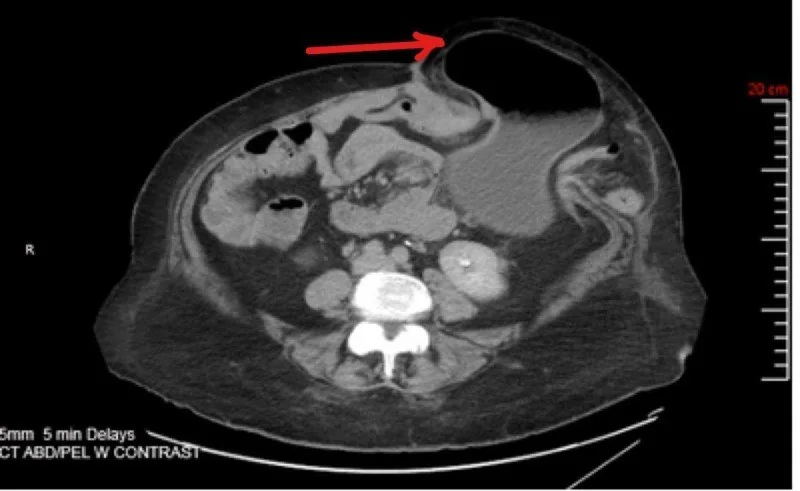
- Stoma kolunun geçtiği fasyal açıklıkta genişleme ve o açıklıktan cilt altına uzanan peritoneal kese.
- Kese içinde omental yağ, stoma kolu dışında bağırsak ansı veya her ikisinin bulunması.
- Stoma oluşturan kolon ya da ileum ile kese içindeki diğer bağırsak anslarının ayrı ayrı izlenebilmesi.
- Stoma cilt ağzı, rektus kası ve fasyal defektin birbiriyle konumu; cilt altı stoma prolapsusunun kesesiz görünümü.
- Keseye girip çıkan bağırsakta ani kalibrasyon değişimi, proksimal dilatasyon ve distal kollaps ile mekanik obstrüksiyon.
- Kapalı ans düzeni, mezenterik ödem-sıvı, duvar kalınlaşması veya azalmış kontrastlanma gibi strangülasyon/iskemi işaretleri.
- Orta hat cerrahi skarında eşlik eden insizyonel herni ve defektin stoma kesesine uzanımı.
Ölçütler ve sınıflamalar
- EHS tip I-II ile tip III-IV ayrımı
- EHS sınıflaması parastomal herniyi fasyal defektin boyutuna (<5 cm veya >5 cm) ve eşlik eden insizyonel herni varlığına göre sınıflandırır; BT tabanlı sınıflamada ise herni kesesinin boyutu kullanılır.
- BT tabanlı parastomal herni sınıflaması.
- Tip Ia’da stoma oluşturan bağırsak ansını içeren herni kesesi <5 cm, tip Ib’de ise yaklaşık 6 cm olarak gösterilmiştir. Tip II’de kese omentum, tip III’te stoma kolunu oluşturan bağırsak ansından farklı bir bağırsak ansı içerir. Kaynak sınıflamada tam 5 cm için eşik açıkça tanımlanmadığından ölçüyü ayrıca belirtin.
- European Hernia Society (EHS) sınıflaması
- Tip I: <5 cm defekt, eşlik eden insizyonel herni yok. Tip II: <5 cm defekt ve eşlik eden insizyonel herni var. Tip III: >5 cm defekt, eşlik eden insizyonel herni yok. Tip IV: >5 cm defekt ve eşlik eden insizyonel herni var. P primer, R önceki onarım sonrası nüksü belirtir.
Normalde
Normal stoma çevresinde kolon veya ileum karın duvarını oblik bir tünelden geçip cilt ağzına ulaşır; peritoneum bu stoma kolunu takip eder ve ayrı bir herni kesesi oluşturmaz. Stoma kolunun seyri paralelinde oblik-sagital rekonstrüksiyonlar oluşturarak fasyal defekti ve kese içeriğini değerlendirin. Uzun ve redundant stoma kolu tek başına herni anlamına gelmez; kese oluşmaması tip 0 görünümle uyumludur.
Normal BT ile kıyasla
Aynı bölgenin, kaynak veri setinde patoloji içermediği belirtilen bir BT incelemesini kesit kesit kaydırın; organ sınırlarını açarak anatomiyi hasta görüntüsüyle karşılaştırın. Küçük rastlantısal bulgular tümüyle dışlanmamıştır.
Kaynak: TotalSegmentator v2.01 veri seti (Wasserthal ve ark., Radiology: Artificial Intelligence 2023), CC BY 4.0, vaka s0119; organ sınırları veri setinin otomatik segmentasyonundan, birleştirilerek sadeleştirildi. Görüntüler 2,5 mm kesit aralığına yeniden örneklendi.
Ayırıcı tanı
- Stoma prolapsusu, stoma bağırsağının cilt ağzından tam kat aşırı dışarı çıkmasıdır ve parastomal herniyle birlikte görülebilir.
- Cilt altında kıvrılan uzun stoma kolu
- uzun ve redundant stoma kolu, kese oluşumu yoksa tip 0 görünümle uyumludur.
- Stoma çevresi insizyonel herni
- fasyal defekt cerrahi skar boyunca uzanır; kesenin stoma koluyla ilişkisi ve defekt merkezi takip edilir.
- Stoma çıkışında fekalom veya intraluminal tıkaç
- dışa taşan kese yerine stoma lümeninde dışkı materyali ve yukarıda dilatasyon görülür.
Tuzaklar
- Stoma kolunun uzunlamasına kıvrımı keseye benzer; aksiyel kesitleri koronal planda izleyip peritoneal kesenin stoma kolundan ayrı içerik taşıyıp taşımadığını doğrulayın.
- Stoma çevresindeki kabarıklıkta herni kesesinin varlığını değerlendirin; kese oluşmayan uzun ve redundant stoma kolu tip 0 normal görünüm olabilir.
- Herni kesesinde bağırsak bulunması tek başına strangülasyon anlamına gelmez; duvar kontrastlanması, mezenter ve ansların iki uçtaki geçişini birlikte inceleyin.
- EHS defekt ölçümü cerrahi sınıflama için önerilmiştir; BT çapını intraoperatif ölçümle eşdeğer kesinlikte raporlamayın.
- BT tabanlı sınıflamada kesenin içeriği ve boyutu değerlendirilir; kaynakta stoma oluşturan kolostomi ansını içeren kese tanımlanmıştır.
Kendini dene
Uzun ve redundant stoma kolu izleniyor; peritoneal kese oluşumu yok. Bu görünüm BT tabanlı sınıflamada hangi tip 0 görünümüyle uyumludur?
Cevabı göster
Herni kesesi olmadan cilt altı stoma kıvrımı. Stoma kolunun cilt altında kıvrılması tek başına parastomal herni değildir; sınıflandırma için fasyal açıklıktan geçen kese ve içeriği gösterilmelidir. Tip II kesede omentum, tip III kesede stoma kolundan farklı bir bağırsak ansı bulunur; prolapsus cilt ağzından dışarı uzanır.
Stoma yanındaki kesede stoma kolu dışında ince bağırsak ansı da var. Moreno-Matias sınıfı hangisidir?
Cevabı göster
Tip III. Stoma dışındaki başka bir bağırsak ansının herni kesesinde bulunması tip III tanımıdır. Tip 0'da kese yoktur; tip I yalnız stoma kolunu, tip II ise stoma koluyla birlikte omentumu içerir.
Kaynaklar
Bu sayfadaki 49 cümle ve 2 quiz sorusu aşağıdaki kaynaklardan alıntılarla otomatik olarak karşılaştırıldı; 17 cümle bu karşılaştırmada düzeltildi (2026-10-09).
- A closer look at the stoma: multimodal imaging of patients with ileostomies and colostomiespmc.ncbi.nlm.nih.gov
- European Hernia Society guidelines on prevention and treatment of parastomal hernias.pubmed.ncbi.nlm.nih.gov
- Paracolostomy Evisceration: Short Review and a New Case Report.pubmed.ncbi.nlm.nih.gov
- Colostomy on CT and fluoroscopy: What the radiologist needs to know.pubmed.ncbi.nlm.nih.gov
- Urinary diversions: a primer of the surgical techniques and imaging findings.pubmed.ncbi.nlm.nih.gov
- Parastomal Gallbladder Herniations: A Systematic Review.pubmed.ncbi.nlm.nih.gov
- A review of problems following insertion of biliary stents illustrated by an unusual complication.pubmed.ncbi.nlm.nih.gov
- Prophylactic mesh reinforcement of stomas: a cost-effectiveness meta-analysis of randomised controlled trials.pubmed.ncbi.nlm.nih.gov
- Prophylactic mesh to prevent parastomal hernia after end colostomy: a meta-analysis and trial sequential analysis.pubmed.ncbi.nlm.nih.gov
- Comparison of different modalities for the diagnosis of parastomal hernia: a systematic review.pubmed.ncbi.nlm.nih.gov
- Parastomal hernia prevention with permanent mesh in end colostomy: failure with late follow-up of cohorts in three randomized trials.pubmed.ncbi.nlm.nih.gov
- Parastomal Hernia Following Ileal Conduit Diversion: Prevention and Management.pubmed.ncbi.nlm.nih.gov
- Retromuscular (sublay) synthetic mesh reinforcement versus no mesh at end-colostomy creation to prevent parastomal hernia: a GRADE-assessed systematic review and meta-analysis of randomized controlled trials featuring subgroup analysis by CT-mandated versus clinical detection.pubmed.ncbi.nlm.nih.gov
- Parastomal Hernia Prevention Using Funnel-Shaped Intra-Abdominal Mesh Compared to No Mesh: The Chimney Randomized Clinical Trial.pubmed.ncbi.nlm.nih.gov
- Beyond the radiology report: a multi-criteria decision analysis to define essential CT parameters for abdominal wall reconstruction : STAMP-C framework for preoperative hernia imaging.pubmed.ncbi.nlm.nih.gov
- Integration of Clinical Risk Factors With Radiological Metrics Associated With PSH: The Impact of Stoma Site Features, Obesity and Muscle Atrophy.pubmed.ncbi.nlm.nih.gov
- Recurrent Ileal Conduit Obstruction Secondary to Parastomal Hernia Resulting in Bilateral Hydronephrosis and Pyelonephritis.pubmed.ncbi.nlm.nih.gov
- Prevention of Parastomal Hernia and the Prophylactic Mesh Debate: A Critical Appraisal of the Chimney Trial.pubmed.ncbi.nlm.nih.gov
- Lateral Approach Circumstomal Open Retrorectus Mesh Repair with Transversus Abdominis Release and Three-Point Stomal Pexy for an Acute-on-Chronic Complex Parastomal Hernia Causing High-Grade Gastric Outlet Obstruction: A Case Report.pubmed.ncbi.nlm.nih.gov
- Stomal Outlet Obstruction Caused by Torsion of the Stomal Limb Associated with Fecal Loading after End Colostomy: A Case Report.pubmed.ncbi.nlm.nih.gov
- A novel retro-muscular Sugarbaker technique for parastomal hernia prevention in end colostomy: combination of laparoscopic posterior component separation and extraperitoneal bowel pull-through-a prospective, single-arm study using the IDEAL framework.pubmed.ncbi.nlm.nih.gov
- Laparoscopic Sugarbaker Repair of Parastomal Hernia with Gastric Incarceration: A Case Report and Review of the Literature.pubmed.ncbi.nlm.nih.gov
- Bevacizumab-Associated Bowel Perforation Causing Evisceration.pubmed.ncbi.nlm.nih.gov
- Percutaneous ALPITube ileostomy for colorectal anastomotic protection: a multicentre feasibility study.pubmed.ncbi.nlm.nih.gov
- Comparative analysis of natural language processing methodologies for classifying computed tomography enterography reports in Crohn's disease patients.pubmed.ncbi.nlm.nih.gov
- Innovative Strategies in Hernia Mesh Design: Materials, Mechanics, and Modeling.pubmed.ncbi.nlm.nih.gov
- [Postoperative Imaging Findings of Colorectal Surgery: A Pictorial Essay].pubmed.ncbi.nlm.nih.gov
- Imaging Modalities for Evaluation of Intestinal Obstruction.pubmed.ncbi.nlm.nih.gov
- Parastomal herniation of the entire gallbladder and postoperative complications from bile leakage via a subvesical bile duct.pubmed.ncbi.nlm.nih.gov
- Spontaneous Evisceration Through Umbilical Hernia in Adult Patients: A Scoping Review of Pathophysiology, Clinical Features, Management, and Outcomes.pubmed.ncbi.nlm.nih.gov
- The Association of Coloproctology of Great Britain and Ireland consensus guidelines in emergency colorectal surgery.pubmed.ncbi.nlm.nih.gov
- Long-term follow-up of a multicentre cohort study on laparoscopic peritoneal lavage for perforated diverticulitis.pubmed.ncbi.nlm.nih.gov
- Comparison of Decompressing Stoma vs Stent as a Bridge to Surgery for Left-Sided Obstructive Colon Cancer.pubmed.ncbi.nlm.nih.gov
- The concept of Laparoscopic Intracorporeal Rectus Aponeuroplasty (LIRA) technique in complex abdominal hernias based on size and location.pubmed.ncbi.nlm.nih.gov
- Small Bowel Obstruction Caused by Meckel's Diverticulum Entrapped behind Transperitoneal Sigmoid Colostomy: A Case Report.pubmed.ncbi.nlm.nih.gov
- Adaptive surgical approach to giant inguinoscrotal hernia with enterocutaneous fistula in an adult paraplegic male with severe lordoscoliosis causing loss of domain: A case report and review of literature.pubmed.ncbi.nlm.nih.gov
- Role of a Stoma Nurse in the Management of the Specific Stoma-Related Complications.pubmed.ncbi.nlm.nih.gov
- Spontaneous Stoma Closure: A Case Report and Review of the Literature.pubmed.ncbi.nlm.nih.gov
- Incisional hernia repair using component separation with perforator preservation and onlay mesh: A pilot study.pubmed.ncbi.nlm.nih.gov
- Case Report: Combined posterior and anterior compartment separation in giant incisional hernia repair: balancing feasibility and postoperative complications.pubmed.ncbi.nlm.nih.gov
- Metabolism, Morphology and Function of the Anterior Abdominal Wall Musculature in Ventral Hernias and After Repair: A Narrative Review and Research Agenda.pubmed.ncbi.nlm.nih.gov
- Salvage VRAM Flap Reconstruction After Singapore Flap Failure Following Abdominoperineal Resection: A Case Report.pubmed.ncbi.nlm.nih.gov
- Hybrid parastomal endoscopic repair (HyPER): a retrospective case series of 200 patients treated over ten years at a single center.pubmed.ncbi.nlm.nih.gov
- Colonic Diffuse Large B-Cell Lymphoma Presenting as Fecal Peritonitis: A Case Report.pubmed.ncbi.nlm.nih.gov
- Tubo-ovarian abscess in an adolescent with uterine didelphys and prior cloacal repair: case report and literature review.pubmed.ncbi.nlm.nih.gov
- Laparoscopic Low Anterior Resection with Ureterectomy and Ileal Ureter Interposition for Ureter-Invading Locally Recurrent Rectal Cancer: A Case Report.pubmed.ncbi.nlm.nih.gov
- Lateral abdominal wall reconstruction.pubmed.ncbi.nlm.nih.gov
- Guidelines for laparoscopic treatment of ventral and incisional abdominal wall hernias (International Endohernia Society (IEHS)-part 1.pubmed.ncbi.nlm.nih.gov
- Management of complications in surgery of the colon.pubmed.ncbi.nlm.nih.gov
- Update of Guidelines for laparoscopic treatment of ventral and incisional abdominal wall hernias (International Endohernia Society (IEHS)): Part B.pubmed.ncbi.nlm.nih.gov
- Does laparoscopic surgery decrease the risk of atrial fibrillation after foregut surgery?pubmed.ncbi.nlm.nih.gov
- Characterizing a clinically significant radiographic parastomal hernia recurrence: post hoc analysis of a randomized controlled trial.pubmed.ncbi.nlm.nih.gov
- Preventing Parastomal Hernias After Radical Cystectomy with Ileal Conduit: A Systematic Review Regarding Surgical Prophylactic Techniques.pubmed.ncbi.nlm.nih.gov
- Prophylactic Operative Interventions for Preventing Parastomal Hernias after Colorectal Surgery.pubmed.ncbi.nlm.nih.gov
- Fascial incision shapes and paracolostomy hernia: cruciate vs. reinforced longitudinal (the "Hepworth hitch"): longcross randomized controlled trial (GECO2 STUDY).pubmed.ncbi.nlm.nih.gov
- Open Retromuscular Sugarbaker vs Keyhole Mesh Placement for Parastomal Hernia Repair: A Randomized Clinical Trial.pubmed.ncbi.nlm.nih.gov
- Surgical management of ostomy complications: a MISSTO-WSES mapping review.pubmed.ncbi.nlm.nih.gov
- Parastomal hernia in the difficult patient: is Tophat plasty the solution?pubmed.ncbi.nlm.nih.gov
- Parastomal hernia after robot-assisted cystectomy and ileum conduit: incidence, risk or protective factors and outcomes of minimal-invasive hernia repair-systematic review.pubmed.ncbi.nlm.nih.gov
- Effectiveness of prophylactic Sugarbaker mesh during laparoscopic abdominoperineal resection: a cohort study with 4-year follow-up.pubmed.ncbi.nlm.nih.gov
- Early Adoption of Technically Complex Robotic Ventral Hernia Repair in a Low-Volume Center: A Retrospective Comparative Analysis with Consecutive Open Cases.pubmed.ncbi.nlm.nih.gov
- Robotic parastomal hernia repair with reinforced tissue matrix; lessons learned from our 74-patient cohort.pubmed.ncbi.nlm.nih.gov
- Parastomal hernia repair using retromuscular 3D funnel mesh: the "Sugar Funnel" technique.pubmed.ncbi.nlm.nih.gov
- Open retromuscular keyhole for parastomal hernia repair after ureteroileostomy: surgical technique and long-term outcomes.pubmed.ncbi.nlm.nih.gov
- Efficacy of anastomotic reinforcement suture in laparoscopic anterior resection for middle-low rectal cancer: a propensity-score-matched cohort study.pubmed.ncbi.nlm.nih.gov
- Double-tube end ileostomy: an alternative to classical defunctioning stoma in rectal surgery.pubmed.ncbi.nlm.nih.gov
- Enhanced view/extended totally extraperitoneal plasty (eTEP) Rives-Stoppa repair versus open Rives-Stoppa repair: a single-center retrospective propensity score-matched cohort study.pubmed.ncbi.nlm.nih.gov
- Management of obstructed colorectal carcinoma in an emergency setting: An update.pubmed.ncbi.nlm.nih.gov
- Abdominal Wall in Cross-Sectional Imaging as an Essential Knowledge for Radiologists: A Pictorial Review.pubmed.ncbi.nlm.nih.gov
- Insidious Onset of Incarcerated Parastomal Hernia With Gastric Outlet Obstruction: A Case Report.pubmed.ncbi.nlm.nih.gov
- Post-Surgical Imaging Assessment in Rectal Cancer: Normal Findings and Complications.pubmed.ncbi.nlm.nih.gov
- Computed tomography for evaluation of abdominal wall hernias-what is the value of the Valsalva maneuver?pubmed.ncbi.nlm.nih.gov
- Quality of life and abdominal wall functionality after abdominal wall reconstruction: A prospective single center follow-up study.pubmed.ncbi.nlm.nih.gov
- Readmissions and Emergency Room Visits Following Outpatient and Inpatient Herniorrhaphies.pubmed.ncbi.nlm.nih.gov
- Under the Radar: A Case Report of a Missed Aortoenteric Fistula.pubmed.ncbi.nlm.nih.gov
- Abdominal and pelvic radiographs of medical devices and materials-Part 1: gastrointestinal and vascular devices and materials.pubmed.ncbi.nlm.nih.gov
- Two Cases of Secondary Anterior Perineal Hernia Repaired with a Pedicled Gracilis Muscle Flap.pubmed.ncbi.nlm.nih.gov
- Acupotomy in the management of colostomy stenosis after abdominoperineal resection: a case report.pubmed.ncbi.nlm.nih.gov
- Management and outcomes in acute symptomatic hernias: a retrospective cohort study and review of cross-over to surgery.pubmed.ncbi.nlm.nih.gov
- Circular stapled end colostomy versus conventional end colostomy creation in patients undergoing a permanent stoma: a randomized controlled trial.pubmed.ncbi.nlm.nih.gov
- Perforated gallbladder in a parastomal hernia.pubmed.ncbi.nlm.nih.gov
- Update of Guidelines for laparoscopic treatment of ventral and incisional abdominal wall hernias (International Endohernia Society (IEHS))-Part A.pubmed.ncbi.nlm.nih.gov
- Abdominal hernias: Radiological features.pubmed.ncbi.nlm.nih.gov
- Long-term outcomes of open local onlay mesh parastomal hernia repair with ostomy revision.pubmed.ncbi.nlm.nih.gov
- Spectrum of Multidetector Computed Tomography Imaging Findings in Iatrogenic Abdominopelvic Injuries: A Comprehensive Pictorial Review.pubmed.ncbi.nlm.nih.gov
- Operative management of recurrent parastomal hernias after transversus abdominis release: a single-center experience.pubmed.ncbi.nlm.nih.gov
- Risk Factors for the Development of Parastomal Hernia: A Narrative Review.pubmed.ncbi.nlm.nih.gov
- Parastomal hernia - current knowledge and treatment.pubmed.ncbi.nlm.nih.gov
Eğitim amaçlıdır; hasta başında tanı ve tedavi kararının yerine geçmez, tıbbi tavsiye değildir. Metinler yapay zekâ desteğiyle yazıldı ve otomatik bir adımda kaynak alıntılarıyla karşılaştırıldı; bu bir tıbbi doğrulama değildir ve içerik uzman radyolog incelemesinden geçmedi. Klinik kararlarda güncel kılavuzları, kurum protokollerini ve radyoloji raporunu esas alın.