Özet
Ventral herni onarımı sonrasında ön karın duvarında seröz sıvı koleksiyonu oluşabilir. BT’de seröz koleksiyon farklı şekillerde görülebilir; sıvı dansitesinde olması ve kontrastlanmaması seroma tanısını destekler. Erken postoperatif seromalarda hava-sıvı seviyeleri ve ince reaktif çevresel kontrastlanma görülebilir; apse ayrımı klinik ve laboratuvar bulgularıyla birlikte yapılmalıdır. Seroma, apse ve hematomun BT’de ayırt edilmesi, postoperatif bulguların doğru yorumlanmasına ve uygun tedavi seçimine yardımcı olur.
Faz ve pencere
- Kontrastsız tanısal
- Kontrastsız kesitlerde koleksiyonun dansitesi ve boyutu değerlendirilir; hematomlar yüksek dansiteli olabilir.
- Portal tanısal
- Koleksiyonun kontrastlanmaması seromayı destekler; erken postoperatif dönemde ince, düzgün çevresel kontrastlanma görülebilirken kalın veya düzensiz çevresel kontrastlanma enfeksiyonu düşündürür.
Önerilen pencereler G genişlik, M merkez; değerler Hounsfield birimi (HU)
- BatınG 400 / M +50
- Yumuşak dokuG 400 / M +40
BT bulguları
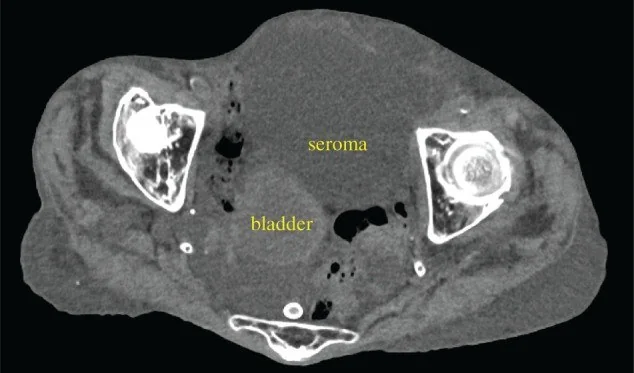
- Retromüsküler-prefasyal planda veya eski herni kesesinde yerleşen düşük dansiteli sıvı koleksiyonu
- Mesh BT’de doğrudan seçilemeyebilir; metalik zımba veya tack gibi fiksasyon elemanları görülebilir.
- Globüler, tübüler ya da multiloküle biçim; cerrahi boşluğun konturunu izleyen şekil
- Koleksiyonun kontrastlanmaması seromayı destekler; kalın veya düzensiz kontrastlanan kenar enfeksiyonu düşündürür.
- Erken postoperatif seromada az miktarda gaz kabarcığı veya ince düzgün çevresel reaktif kontrastlanma görülebilir
- Seromalar zaman içinde gerileyebilir; persistan koleksiyonlar da görülebilir.
- Açık ventral herni onarımından sonra seröz sıvı retromüsküler-prefasyal alanda, laparoskopik onarımdan sonra ise rezidüel herni kesesinde birikebilir; koleksiyonun yeri ameliyat tekniğiyle birlikte değerlendirilmelidir.
Normalde
BT ile karın duvarı cerrahisi sonrası normal yapılar ve postoperatif değişiklikler panoramik olarak izlenir; beklenen erken postoperatif görünüme hakim olmak, seroma, apse ve hematom gibi komplikasyonların doğru ayırımını sağlar. Koleksiyonun retromüsküler düzlemdeki yerleşimi, homojen sıvı dansitesi ve karşılaştırmalı kesitte iç kontrastlanmaması seroma tanısını destekler.
Normal BT ile kıyasla
Aynı bölgenin, kaynak veri setinde patoloji içermediği belirtilen bir BT incelemesini kesit kesit kaydırın; organ sınırlarını açarak anatomiyi hasta görüntüsüyle karşılaştırın. Küçük rastlantısal bulgular tümüyle dışlanmamıştır.
Kaynak: TotalSegmentator v2.01 veri seti (Wasserthal ve ark., Radiology: Artificial Intelligence 2023), CC BY 4.0, vaka s0541; organ sınırları veri setinin otomatik segmentasyonundan, birleştirilerek sadeleştirildi. Görüntüler 2,5 mm kesit aralığına yeniden örneklendi.
Ayırıcı tanı
- Hematom
- kontrastsız BT’de yüksek dansiteli, bazen heterojen bir koleksiyon olarak görülebilir.
- Apse
- kalın veya düzensiz periferik kontrastlanma enfeksiyonu düşündürür.
- Nüks hernide karın içi yağ veya bağırsak içeriği yeniden herniye olabilir.
Tuzaklar
- Erken seromada ince periferik kontrastlanma ve hava-sıvı seviyeleri görülebilir; kalın veya düzensiz kontrastlanan kenar enfeksiyonu düşündürür.
- Mesh bazı materyallerde BT'de doğrudan seçilemeyebilir; düzlemi komşu fasya, radyopak tack ve ameliyat tekniğiyle belirle.
- Tek kontrastsız kesitte koleksiyonun iç kontrastlanmadığı kanıtlanamaz; uygun karşılaştırmalı inceleme yoksa bu sınırlılığı belirt.
- Erken postoperatif seromada az miktarda gaz kabarcığı ve ince, düzgün çevresel kontrastlanma görülebilir; apse ayrımı klinik ve laboratuvar bulgularıyla birlikte yapılmalıdır.
Kendini dene
Ventral herni onarımından sonra rektus kasları arkasında düzgün sınırlı, homojen sıvı var; belirgin duvar kalınlaşması yok. En olası tanı nedir?
Cevabı göster
Seroma. Mesh düzlemindeki homojen sıvı ve belirgin enfeksiyon bulgusu olmaması seromayı destekler. Hematom genellikle daha yoğun ve heterojendir; apse duvarı kalın-düzensiz olabilir, nüks hernide fasya defektinden doku geçişi izlenir.
Erken postoperatif dönemde, enfeksiyon bulgusu olmayan hastada sıvı koleksiyonunda birkaç gaz kabarcığı ve ince düzgün çevresel kontrastlanma var. Bu bulgular en çok neyle uyumludur?
Cevabı göster
Erken seroma. Enfeksiyon bulgusu yokken ince düzgün kontrastlanma ve az gaz erken seromada görülebilir; kalın-düzensiz duvar enfeksiyonu düşündürür ve apse ayrımı klinik-laboratuvarla yapılır.
İlgili konular
Kaynaklar
Bu sayfadaki 34 cümle ve 2 quiz sorusu aşağıdaki kaynaklardan alıntılarla otomatik olarak karşılaştırıldı; 19 cümle bu karşılaştırmada düzeltildi (2026-10-12).
- Multidetector CT of expected findings and early postoperative complications after current techniques for ventral hernia repairpmc.ncbi.nlm.nih.gov
- Postoperative Seroma Deep to Mesh after Laparoscopic Ventral Hernia Repair: Computed Tomography Appearance and Implications for Treatmentpmc.ncbi.nlm.nih.gov
- Emergency laparoscopic "hybrid" intraperitoneal on-lay mesh (IPOM +) repair of incarcerated umbilical hernia in patient with BMI 62 and small bowel obstruction; a case based review.pubmed.ncbi.nlm.nih.gov
- Appearance of recurrent dermatofibrosarcoma protuberans in postoperative MRI follow-up.pubmed.ncbi.nlm.nih.gov
- Recommendations from GEC ESTRO Breast Cancer Working Group (II): Target definition and target delineation for accelerated or boost partial breast irradiation using multicatheter interstitial brachytherapy after breast conserving open cavity surgery.pubmed.ncbi.nlm.nih.gov
- Robotic total thyroidectomy with modified radical neck dissection via unilateral retroauricular approach.pubmed.ncbi.nlm.nih.gov
- Complications associated with recombinant human bone morphogenetic protein use in pediatric craniocervical arthrodesis.pubmed.ncbi.nlm.nih.gov
- Surgical and radiological behavior of MRI-depictable mesh implants after TAPP repair: the IRONMAN study.pubmed.ncbi.nlm.nih.gov
- Repair of Concomitant Incisional and Parastomal Hernias Using a Hybrid Technique: A Series of 32 Patients.pubmed.ncbi.nlm.nih.gov
- Management of chronic seromas: A novel surgical approach with the use of vacuum assisted closure therapy.pubmed.ncbi.nlm.nih.gov
- Gluteus Maximus Transfer as an Augmentation Technique for Patients With Severe Abductor Deficiency of the Hip.pubmed.ncbi.nlm.nih.gov
- Postoperative seroma formation after intraoperative radiotherapy using low-kilovoltage X-rays given during breast-conserving surgery.pubmed.ncbi.nlm.nih.gov
- Frequency of Early-Stage Lymphedema and Risk Factors in Postoperative Patients with Breast Cancer.pubmed.ncbi.nlm.nih.gov
- Aspiration of sterile post-operative spinal fluid collections using low-dose computed tomography guidance.pubmed.ncbi.nlm.nih.gov
- Traumatic lumbar hernia: clinical features and management.pubmed.ncbi.nlm.nih.gov
- The Effect of Lumpectomy Cavity Changes on Planning Dose in Breast Radiotherapy Boost.pubmed.ncbi.nlm.nih.gov
- Totally Endoscopic Sublay Anterior Repair (TESAR) for diastasis recti, primary and incisional ventral hernias: Long-term clinical outcomes and quality of life.pubmed.ncbi.nlm.nih.gov
- Approaches to Ventral Hernia Repair: A Narrative Review.pubmed.ncbi.nlm.nih.gov
- Open Ventral Hernia Repair: A Prospective Comparative Analysis of Onlay Versus Sublay Mesh Placement.pubmed.ncbi.nlm.nih.gov
- Female Hydrocele: A Rare Case of a Cyst of the Canal of Nuck in an Adult Woman.pubmed.ncbi.nlm.nih.gov
- Imaging of the Reconstructed Breast.pubmed.ncbi.nlm.nih.gov
- The Association of Coloproctology of Great Britain and Ireland consensus guidelines in emergency colorectal surgery.pubmed.ncbi.nlm.nih.gov
- Long-term safety and effectiveness of the "OptEase" vena cava filter.pubmed.ncbi.nlm.nih.gov
- Imaging Features of Soft Tissue Tumor Mimickers: A Pictorial Essay.pubmed.ncbi.nlm.nih.gov
- Pediatric emergency medicine point-of-care ultrasound: summary of the evidence.pubmed.ncbi.nlm.nih.gov
- Post-operative imaging in liver transplantation: state-of-the-art and future perspectives.pubmed.ncbi.nlm.nih.gov
- Commentary: an eye on PET quantification.pubmed.ncbi.nlm.nih.gov
- Superficial Abdominal Skin Laxity Versus Rectus Diastasis: Distinct Pathophysiological Entities With Different Functional and Reconstructive Implications in Modern Abdominoplasty.pubmed.ncbi.nlm.nih.gov
- Diagnostic Musculoskeletal Ultrasound in the Evaluation of the Rectus Abdominis.pubmed.ncbi.nlm.nih.gov
- Diastasis recti abdominis: A comprehensive review.pubmed.ncbi.nlm.nih.gov
- Morel-Lavallée lesion: A case report and literature review.pubmed.ncbi.nlm.nih.gov
- Beyond the lung: recognizing incidental breast lesions on chest computed tomography.pubmed.ncbi.nlm.nih.gov
- Computed Tomography Imaging of Thoracic Aortic Surgery: Distinguishing Life-Saving Repairs from Life-Threatening Complications.pubmed.ncbi.nlm.nih.gov
- Post-Traumatic Lymphatic Vessel Thrombosis Treated With Thrombus Removal and Lymphaticovenous Anastomosis: A Case Report.pubmed.ncbi.nlm.nih.gov
- Sigmoid colon fistulization of an infected pelvic lymphocele after pelvic lymphadenectomy: a case report.pubmed.ncbi.nlm.nih.gov
- Sigmoid Colon Perforation into an Infected Pelvic Lymphocele after Pelvic Lymphadenectomy and Radiotherapy for Recurrent Endometrial Cancer: a Rare Diagnostic and Therapeutic Challenge.pubmed.ncbi.nlm.nih.gov
- Cystic liver lesions: a pictorial review.pubmed.ncbi.nlm.nih.gov
- Primary hyperparathyroidism: targeted, focused exploration with "selective" parathyroidectomy : Minimally invasive open vs. minimally invasive video-assisted vs. endoscopic approach.pubmed.ncbi.nlm.nih.gov
- Soft tissue hematomas on ultrasound: a case-based review and practical guide to diagnosis.pubmed.ncbi.nlm.nih.gov
- Joint EANM-SNMMI guideline on the role of 2-[<sup>18</sup>F]FDG PET/CT in no special type breast cancer : (endorsed by the ACR, ESSO, ESTRO, EUSOBI/ESR, and EUSOMA).pubmed.ncbi.nlm.nih.gov
- High-resolution ultrasound in the evaluation of the adult hip.pubmed.ncbi.nlm.nih.gov
- International guidelines for groin hernia management.pubmed.ncbi.nlm.nih.gov
- Patterns of injury and violence in Yaoundé Cameroon: an analysis of hospital data.pubmed.ncbi.nlm.nih.gov
- Indocyanine Green Fluorescent Lymphography for Preservation of Spermatic Cord Lymphatic Vessels during Robotic Inguinal Hernia Repair with No Postoperative Symptomatic Seroma: A Case Report.pubmed.ncbi.nlm.nih.gov
- Laparoscopic Mesh-Salvage Fenestration for Chronic Symptomatic Seroma after Rives-Stoppa Incisional Hernia Repair: A Case Report.pubmed.ncbi.nlm.nih.gov
- Giant Postoperative Seroma after Laparoscopic Obturator Hernia Repair: A Case Report.pubmed.ncbi.nlm.nih.gov
- Advancements in biomaterials and bioactive solutions for lumbar spine fusion cages: Current trends and future perspectives.pubmed.ncbi.nlm.nih.gov
- Renal transplant evaluation: multimodality imaging of post-transplant complications.pubmed.ncbi.nlm.nih.gov
- ESUR female pelvis group approach to cystic female pelvic lesions.pubmed.ncbi.nlm.nih.gov
- Strangulated Small Bowel Within a Posterior Rectus Sheath Hernia in a Patient Without Prior Abdominal Surgery.pubmed.ncbi.nlm.nih.gov
- Population-based ultrasound reference values for inter-rectus distance: threshold prevalence, percentiles, and the limitations of fixed cutoffs.pubmed.ncbi.nlm.nih.gov
- Lateral-dock single-port robotic-assisted extended totally extraperitoneal plasty (eTEP)-Sublay-Herniotomy-Procedure- presentation of a novel technique for robotic-assisted ventral hernia surgery (with video).pubmed.ncbi.nlm.nih.gov
- Prophylactic mesh reinforcement after open aortic aneurysm repair: a prospective cohort study.pubmed.ncbi.nlm.nih.gov
- Robotic eTEP inguinal hernia repair.pubmed.ncbi.nlm.nih.gov
- Rapidly Progressive Deep Polymicrobial Suprapubic Abscess Following Radical Inguinal Orchiectomy in a Patient With Poorly Controlled Diabetes.pubmed.ncbi.nlm.nih.gov
- Third-Generation Cephalosporin Resistance Among Enterobacterales in Percutaneously Drained Pelvic Abscesses: A Single-Center Retrospective Cohort Study.pubmed.ncbi.nlm.nih.gov
- Necrotizing (Abscessing) Lymphadenopathy and the Diagnostic Value of Contrast-Enhanced Ultrasound (CEUS): A Review with Clinical Vignettes.pubmed.ncbi.nlm.nih.gov
- Semilunar line diastasis frequently coexists with rectus diastasis and may compromise outcomes after isolated midline repair.pubmed.ncbi.nlm.nih.gov
- Small Bowel Herniation Into a Post-bariatric Pannus After Cesarean Delivery Managed With Single-Stage Panniculectomy and Rives-Stoppa Repair: A Case Report.pubmed.ncbi.nlm.nih.gov
- What Is the Current Knowledge About Sublay/Retro-Rectus Repair of Incisional Hernias?pubmed.ncbi.nlm.nih.gov
- Multidetector CT of expected findings and early postoperative complications after current techniques for ventral hernia repair.pubmed.ncbi.nlm.nih.gov
- Complications after Nephron-sparing Interventions for Renal Tumors: Imaging Findings and Management.pubmed.ncbi.nlm.nih.gov
- Multidetector CT of expected findings and complications after contemporary inguinal hernia repair surgery.pubmed.ncbi.nlm.nih.gov
- Mimics of Complications in the Postsurgical Aorta at CT.pubmed.ncbi.nlm.nih.gov
- Rare Groin Hernias With Unusual Sac Contents: A Systematic Review of Anatomical Variants and Surgical Implications.pubmed.ncbi.nlm.nih.gov
- Candida glabrata vertebral osteomyelitis following L3-4 transforaminal lumbar fusion: illustrative case.pubmed.ncbi.nlm.nih.gov
- Canine Perineal Hernia Associated with Prostatic Disorders: Is Castration Really Beneficial? A Retrospective Study.pubmed.ncbi.nlm.nih.gov
- Three-dimensional reconstruction under computed tomography and myopectineal orifice measurement under laparoscopy for quality control of inguinal hernia treatment.pubmed.ncbi.nlm.nih.gov
- Laparoscopic Living Donor Nephrectomy: Learning Curve Analysis Through 1446 Cases and Outcomes from 200 Consecutive Mastery-Phase Procedures-How I Do It.pubmed.ncbi.nlm.nih.gov
- Management of multiple giant bladder diverticula: a comprehensive approach - a case report.pubmed.ncbi.nlm.nih.gov
- Giant Mesenteric Cyst in a Young Adult Mimicking Refractory Ascites: A Diagnostic and Surgical Challenge-A Case Report.pubmed.ncbi.nlm.nih.gov
- Management of Tarlov cysts: an uncommon but potentially serious spinal column disease-review of the literature and experience with over 1000 referrals.pubmed.ncbi.nlm.nih.gov
- Comparative outcomes of SCOM/SCOLA vs. IPOM PLUS in Umbilical and para-umbilical hernia repairs.pubmed.ncbi.nlm.nih.gov
- A randomized controlled comparison of sublay and onlay mesh techniques in ventral abdominal wall hernia repair.pubmed.ncbi.nlm.nih.gov
- Early Adoption of Technically Complex Robotic Ventral Hernia Repair in a Low-Volume Center: A Retrospective Comparative Analysis with Consecutive Open Cases.pubmed.ncbi.nlm.nih.gov
- Civil medical liability in general surgery: A systematic review.pubmed.ncbi.nlm.nih.gov
- Case Report: Chronic Morel-Lavallée lesion: dynamic MRI progression, histopathological findings and surgical treatment.pubmed.ncbi.nlm.nih.gov
- Chronic Expanding Hematoma of the Postmastectomy Axilla: A Pictorial Review of Long-Term Multimodality Imaging.pubmed.ncbi.nlm.nih.gov
- The Challenges of Postoperative Tissue Flap Vitality Monitoring in Obese Individuals.pubmed.ncbi.nlm.nih.gov
- Laparoscopy-assisted versus open surgery for reconstruction of abdominal wall defects following endometriosis resection: a retrospective cohort study.pubmed.ncbi.nlm.nih.gov
- Cost-Effective Reconstruction of the Anterior Chest Wall Following Resection of High-Grade Pleomorphic Sarcoma of the Sternum in an Adolescent: A Case Report.pubmed.ncbi.nlm.nih.gov
- Osteitis pubis after laparoscopic totally extraperitoneal inguinal hernia repair: An uncommon complication - Report of two cases.pubmed.ncbi.nlm.nih.gov
- Beyond the Beam: Multimodal Imaging and Surveillance of Post-Radiotherapy Changes in the Breast.pubmed.ncbi.nlm.nih.gov
- Capsular Contracture in Implant-Based Breast Reconstruction: A Comprehensive Narrative Review of Pathophysiology, Risk Factors, and Contemporary Controversies.pubmed.ncbi.nlm.nih.gov
- Electromagnetic navigation-guided TOES for parapharyngeal tumors: a comparative study on precision and safety.pubmed.ncbi.nlm.nih.gov
- Photon-Counting CT in Cardiovascular Imaging: Clinical Applications.pubmed.ncbi.nlm.nih.gov
- Postoperative Fluid Collections in Total Joint Arthroplasty: A Narrative Review.pubmed.ncbi.nlm.nih.gov
- Hepatic cysts: a survival guide.pubmed.ncbi.nlm.nih.gov
- Risk factors associated with postoperative lymphocele in patients with gynecological malignant tumors: a systematic review and meta-analysis.pubmed.ncbi.nlm.nih.gov
- Impact of Obesity and Adiposity Measures on Perioperative Outcomes in Gynecologic Malignancy Surgery: A Systematic Review.pubmed.ncbi.nlm.nih.gov
- An interpretable machine learning model for predicting symptomatic pelvic lymphocele after pelvic lymphadenectomy in cervical cancer.pubmed.ncbi.nlm.nih.gov
- Use of intraperitoneal fascial traction in robotic eTEP approach for complex ventral hernias: technique and outcomes.pubmed.ncbi.nlm.nih.gov
- Multimodality diagnostic imaging and role of interventional radiology in pancreas transplantation.pubmed.ncbi.nlm.nih.gov
- Early outcomes of umbilical hernia repair with mesh suture.pubmed.ncbi.nlm.nih.gov
- Long-term wound morbidity and hernia recurrence in diabetic patients with HbA1c ≥ 8.5% undergoing open transversus abdominis release: a descriptive longitudinal follow-up of a single-center cohort.pubmed.ncbi.nlm.nih.gov
- Decision-making in emergency colorectal surgery for cancer.pubmed.ncbi.nlm.nih.gov
- Case Report: A rare case of external iliac artery rupture and sigmoid fistula following multimodal treatment for cervical cancer.pubmed.ncbi.nlm.nih.gov
- Lymph Node Dissection for Upper Tract Urothelial Carcinoma: A Critical Appraisal of Lymph Node Mapping Studies.pubmed.ncbi.nlm.nih.gov
- Robotic-Assisted Repair of Morgagni Hernia in an Adult Patient: A Case Report.pubmed.ncbi.nlm.nih.gov
- A prospective observational study comparing conventional lateral border transfascial mesh fixation versus midline transfascial suturing in laparoscopic intraperitoneal onlay mesh repair for umbilical hernia- a pilot study.pubmed.ncbi.nlm.nih.gov
- The concept of Laparoscopic Intracorporeal Rectus Aponeuroplasty (LIRA) technique in complex abdominal hernias based on size and location.pubmed.ncbi.nlm.nih.gov
- Postoperative complication burden after ventral hernia repair stratified by modified ventral hernia working group grade: a claims-based cohort study.pubmed.ncbi.nlm.nih.gov
- Utility of POCUS (Point of Care Ultrasound) in Renal Transplantation.pubmed.ncbi.nlm.nih.gov
- Recognition to repair: Managing reservoir complications in inflatable penile prosthesis surgery.pubmed.ncbi.nlm.nih.gov
- Robotic parastomal hernia repair with reinforced tissue matrix; lessons learned from our 74-patient cohort.pubmed.ncbi.nlm.nih.gov
- Outcomes of Abdominal Panniculectomy With or Without Concomitant Ventral Hernia Repair in a High-risk Cohort.pubmed.ncbi.nlm.nih.gov
- Technique-Driven and Patient-Specific Variations in Complications of Mastectomy with Immediate Breast Reconstruction: An Evidence-Based Review.pubmed.ncbi.nlm.nih.gov
Eğitim amaçlıdır; hasta başında tanı ve tedavi kararının yerine geçmez, tıbbi tavsiye değildir. Metinler yapay zekâ desteğiyle yazıldı ve otomatik bir adımda kaynak alıntılarıyla karşılaştırıldı; bu bir tıbbi doğrulama değildir ve içerik uzman radyolog incelemesinden geçmedi. Klinik kararlarda güncel kılavuzları, kurum protokollerini ve radyoloji raporunu esas alın.