
Özet
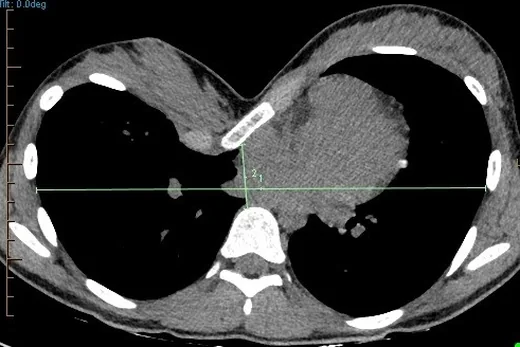
Pektus ekskavatumda sternum ve komşu kostal kıkırdaklar posteriora çöker; deformite çocuklukta fark edilse de büyüme döneminde belirginleşebilir. BT, çöküklüğün en derin seviyesini, göğüs kafesi asimetrisini ve sternum ile kalp arasındaki ilişkiyi aynı incelemede göstererek cerrahi öncesi anatomik haritalamaya katkı sağlar. Ön-arka çapın ölçülmesi deformitenin nicelenmesine katkı sağlar; Haller indeksi tek başına fizyolojik etkilenmeyi veya cerrahi gereksinimini belirlemek için yeterli değildir. BT, pektus ekskavatuma eşlik eden kardiyak bası ve yer değiştirmeyi değerlendirebilir; sternumun kalp ve akciğerler üzerindeki basısı da intratorasik etkilerin incelenmesinde dikkate alınabilir.
Faz ve pencere
- Kontrastsız tanısal
- Düşük doz göğüs BT'sinde Haller indeksi, en geniş transvers çapın en kısa ön-arka mesafeye oranı olarak hesaplanır; incelemede göğüs asimetrisi ile kardiyak bası ve yer değiştirme de değerlendirilir.
Önerilen pencereler: Kemik (G 1800 / M 400), Mediasten (G 350 / M 50), Yumuşak doku (G 400 / M 40).
BT bulguları
- Sternal gövde ve kostal kıkırdakların ön göğüs duvarından posteriora doğru konkav çökmesi.
- Deformitenin en derin seviyesinde daralmış ön-arka toraks çapı ve artmış transvers/ön-arka çap oranı.
- Sternumun sağ ventrikül ön duvarına yaklaşması veya bası oluşturarak kardiyak konturu düzleştirmesi.
- Kalbin sola ya da asimetrik çöküklüğün karşı tarafına yer değiştirmesi ve aksiyel planda rotasyonu.
- Bir hemitoraksın daha derin çökmesi, sternal torsiyon veya kaburga seviyelerinde farklılaşan anterior açı.
- Sternal çökme, kalp ve akciğerler üzerinde basıya yol açabilir.
- BT, pektus ekskavatuma eşlik eden göğüs kafesi asimetrisini ve sternal torsiyonu gösterebilir.
Ölçütler ve sınıflamalar
- Haller indeksi: en geniş iç transvers çap / en kısa ön-arka çap
- >3,25
- Düzeltme indeksi (correction index): HI ≥3,25 ile korele bulunan eşik
- ≥28%
Normalde
Normal ön göğüs duvarında sternum gövdesi kaburga ön uçlarına göre posteriora belirgin çökmez ve retrosternal mesafe korunur. En derin deformite kesitinde sternum-vertebra mesafesini, sağ ventrikülün ön konturunu ve iki hemitoraksın iç transvers çapını karşılaştır; ölçümü mutlaka aynı aksiyel seviyede yap.
Normal BT ile kıyasla
Aynı bölgenin, kaynak veri setinde patoloji içermediği belirtilen bir BT incelemesini kesit kesit kaydırın; organ sınırlarını açarak anatomiyi hasta görüntüsüyle karşılaştırın. Küçük rastlantısal bulgular tümüyle dışlanmamıştır.
Kaynak: TotalSegmentator v2.01 veri seti (Wasserthal ve ark., Radiology: Artificial Intelligence 2023), CC BY 4.0, vaka s1278; organ sınırları veri setinin otomatik segmentasyonundan, birleştirilerek sadeleştirildi. Görüntüler 2,5 mm kesit aralığına yeniden örneklendi.
Ayırıcı tanı
- Pektus karinatum
- sternum ve kostokondral bileşkeler anteriora konveks çıkıntı yapar; çökük sternal kontur yoktur.
- Pektus ekskavatum, embriyonik gelişim sırasında kaburgaların sternumla uygun olmayan birleşmesiyle ilişkilidir.
- Edinsel sternal deformite değerlendirilirken travmatik kemik yaralanmaları arasında yer alan sternal kırıklar da ayırıcı tanıda düşünülmelidir.
Tuzaklar
- İnspirasyon düzeyi göğüs biçimini ve ölçülen indeksleri değiştirebilir; pektus değerlendirmesi için çekim solunum fazını belirt ve seri karşılaştırmalarında aynı koşulları gözet.
- En ağır sternal çökme alanı önceden belirlenerek düşük doz BT çekimi bu bölgeye odaklanabilir.
- Haller indeksi en geniş transvers çapın en kısa ön-arka mesafeye oranıdır ve toraksın aksiyel biçimini niceler. BT, sternal çökme ile birlikte göğüs asimetrisini ve kardiyak bası ya da yer değiştirmeyi değerlendirmeye olanak verir.
Kendini dene
Aksiyel BT'de sternum posteriora çöküyor ve sağ ventrikül ön yüzünü düzleştiriyor. Bu BT bulgularıyla en uygun tanı hangisidir?
Cevabı göster
Pektus ekskavatum. Posterior sternal çökme ve sağ ventrikül basısı pektus ekskavatumun tipik anatomik etkisidir. Karinatumda sternum öne çıkıntı yapar; kırıkta kortikal süreksizlik, foramen varyantında ise düzgün sınırlı açıklık beklenir.
Haller indeksi tek başına fizyolojik etkilenmeyi göstermeyebilir; BT'de sternal çökme ve kardiyak bası belirginse hangi yaklaşım daha uygundur?
Cevabı göster
Çökme ve basıyı ayrıca tariflemek. Haller indeksi transvers çapı ön-arka çapa böler; dar toraksta oran belirgin çökme olsa bile düşük kalabilir. Bu nedenle sternal çökme, asimetri ve kalp üzerindeki temas ayrıca tarif edilmeli; indeks tek başına fizyolojik etkilenmeyi göstermez.
İlgili konular
Kaynaklar
Bu sayfadaki 35 cümle ve 2 quiz sorusu aşağıdaki kaynaklardan alıntılarla otomatik olarak karşılaştırıldı; 11 cümle bu karşılaştırmada düzeltildi (2026-10-09).
- Advancements in preoperative imaging of pectus excavatum: a comprehensive reviewpmc.ncbi.nlm.nih.gov
- Quantification of pectus excavatum: Anatomic indices.pubmed.ncbi.nlm.nih.gov
- Pectus Excavatum: More Than a Matter of Aesthetics.pubmed.ncbi.nlm.nih.gov
- Nuss procedure in the adult population for correction of pectus excavatum.pubmed.ncbi.nlm.nih.gov
- Surgical repair of pectus excavatum.pubmed.ncbi.nlm.nih.gov
- Research progress in the effects of pectus excavatum on cardiac functions.pubmed.ncbi.nlm.nih.gov
- Pectus excavatum: current imaging techniques and opportunities for dose reduction.pubmed.ncbi.nlm.nih.gov
- Sternal cleft and pectus excavatum: an overlooked congenital association?pubmed.ncbi.nlm.nih.gov
- Pectus Excavatum: A Review of Diagnosis and Current Treatment Options.pubmed.ncbi.nlm.nih.gov
- Current management of pectus excavatum: a review and update of therapy and treatment recommendations.pubmed.ncbi.nlm.nih.gov
- An Evidence-Based Approach to Management of Pectus Excavatum and Carinatum.pubmed.ncbi.nlm.nih.gov
- From first to latest imaging technology: Revisiting the first mummy investigated with X-ray in 1896 by using dual-source computed tomography.pubmed.ncbi.nlm.nih.gov
- Advancements in preoperative imaging of pectus excavatum: a comprehensive review.pubmed.ncbi.nlm.nih.gov
- Congenital Chest Wall Deformities in Children: A Narrative Review.pubmed.ncbi.nlm.nih.gov
- Reassessing the Application of the Haller Index as a Surgical Indicator for Pectus Excavatum.pubmed.ncbi.nlm.nih.gov
- A Scoping Review on Genetic Mutations and Single-Nucleotide Polymorphisms Associated with Pectus Excavatum.pubmed.ncbi.nlm.nih.gov
- Robotic Mitral Valve Repair With Severe Pectus Excavatum.pubmed.ncbi.nlm.nih.gov
- Comparison of surgical approaches for pectus excavatum in children and adolescents: a single-center retrospective study.pubmed.ncbi.nlm.nih.gov
- Development and validation of a prediction model for Haller index based on posteroanterior and lateral chest radiographs in pectus excavatum.pubmed.ncbi.nlm.nih.gov
- From Modified Haller Index to a Novel Patented Anatomical Measurement Device: Engineering Development, Validation, and Clinical Applications of Non-Invasive Thoracic Morphometry.pubmed.ncbi.nlm.nih.gov
- Pectus Excavatum-Induced Preload Insufficiency Presenting as Long-Standing Sinus Tachycardia.pubmed.ncbi.nlm.nih.gov
- Positional Hemodynamic Instability in a Patient With Pectus Excavatum Undergoing Lumbar Discectomy.pubmed.ncbi.nlm.nih.gov
- Exercise-Induced ECG Abnormalities in Pediatric Pectus Excavatum: Evidence of Right Ventricular Compression Beyond the Haller Index.pubmed.ncbi.nlm.nih.gov
- A percutaneous sternal elevation technique using the Tian-Ping sternal lifter for Nuss repair of pectus excavatum.pubmed.ncbi.nlm.nih.gov
- A pictorial essay of thoracic wall diseases: multiple pathologies in the same anatomical site.pubmed.ncbi.nlm.nih.gov
- A novel in silico Nuss procedure for pectus excavatum patients.pubmed.ncbi.nlm.nih.gov
- Congenital Absence of Pericardium: The Swinging Heart.pubmed.ncbi.nlm.nih.gov
- Surgical strategies for mitral valve diseases associated with pectus excavatum: a narrative review of approaches and outcomes.pubmed.ncbi.nlm.nih.gov
- Enhancing pectus excavatum diagnosis with an automated batch evaluation tool for chest computed tomography images.pubmed.ncbi.nlm.nih.gov
- Diagnosis, Treatment, and Follow-Up of Tracheo/Bronchomalacia in Children: The Italian Multicenter Experience.pubmed.ncbi.nlm.nih.gov
- Chronic respiratory disorders due to aberrant innominate artery: a case series and critical review of the literature.pubmed.ncbi.nlm.nih.gov
- Dual-source computed tomography protocols for the pediatric chest - scan optimization techniques.pubmed.ncbi.nlm.nih.gov
- Psychological Impact of Congenital Chest Wall Deformities Among Adolescents and Young Adults.pubmed.ncbi.nlm.nih.gov
- Mid- to long-term radiological and respiratory outcomes following surgery for older early-onset scoliosis patients with Marfan syndrome.pubmed.ncbi.nlm.nih.gov
- Prevalence of pectus excavatum in an adult population-based cohort estimated from radiographic indices of chest wall shape.pubmed.ncbi.nlm.nih.gov
- Extravascular Implantable Cardioverter-Defibrillator Therapy for Malignant Ventricular Arrhythmias in a Child with Congenital Long QT Syndrome: A Case Report.pubmed.ncbi.nlm.nih.gov
- Genetic Associations with Pectus Excavatum: A Systematic Review.pubmed.ncbi.nlm.nih.gov
- Heterochronic activation of TGF-β signaling drives the diversity of the avian sterna.pubmed.ncbi.nlm.nih.gov
- Recurrent Constellations of Embryonic Malformations (RCEM): Teratogenicity Linked to Transient Hypoxia and Hormone Pregnancy Tests Agrees With RCEM and Suggest a Reactive Oxygen Species Pathogenesis.pubmed.ncbi.nlm.nih.gov
- Clinical and Radiological Features in Poland Syndrome: Report of 3 Cases and Review of Literature.pubmed.ncbi.nlm.nih.gov
- Revision after prior failed pectus excavatum repair: higher risks and greater complications than primary surgery.pubmed.ncbi.nlm.nih.gov
- Effect of respiratory phase on three-dimensional quantitative parameters of pulmonary subsolid nodules in low-dose computed tomography screening for lung cancer.pubmed.ncbi.nlm.nih.gov
- The management of pectus excavatum in pediatric patients: a narrative review.pubmed.ncbi.nlm.nih.gov
- Oligodontia in the Clinical Spectrum of Syndromes: A Systematic Review.pubmed.ncbi.nlm.nih.gov
- Pectus excavatum in motion: dynamic evaluation using real-time MRI.pubmed.ncbi.nlm.nih.gov
- Extrinsic compression of coronary and pulmonary vasculature.pubmed.ncbi.nlm.nih.gov
- Another Source of Near-Fatal Bleeding-Late-Onset Hemothorax Six Weeks After Uneventful Minimally Invasive Repair of Pectus Excavatum.pubmed.ncbi.nlm.nih.gov
- "Y sign" as an anatomical finding associated with severe hypotension in the prone position: illustrative cases.pubmed.ncbi.nlm.nih.gov
- Thoracoscopy-assisted modified Nuss procedure for the treatment of pectus excavatum in children: a retrospective single-center experience.pubmed.ncbi.nlm.nih.gov
- Hypoventilation After Placement of an External Splint in a Cat With Severe Pectus Excavatum Managed With Pressure Support Ventilation.pubmed.ncbi.nlm.nih.gov
- Next-gen paediatric imaging: ultra-low dose chest photon-counting CT approaching chest radiograph doses.pubmed.ncbi.nlm.nih.gov
- Fleischner Society: Glossary of Terms for Thoracic Imaging.pubmed.ncbi.nlm.nih.gov
- Pericardial Diseases: International Position Statement on New Concepts and Advances in Multimodality Cardiac Imaging.pubmed.ncbi.nlm.nih.gov
- Anaesthetic considerations for pectus repair surgery.pubmed.ncbi.nlm.nih.gov
- Impact of Changes in the Profiles of Patients' Backgrounds on the Indications of Thoracoscopic Lobectomy for Congenital Lung Malformations: A Multicenter Retrospective Study in Southern Japan.pubmed.ncbi.nlm.nih.gov
- Fluoroscopic characterization of pectus excavatum in dogs: a cross-sectional study.pubmed.ncbi.nlm.nih.gov
- Postural Alterations in Adolescents With Pectus Excavatum and Pectus Carinatum: A Retrospective Observational Study.pubmed.ncbi.nlm.nih.gov
- Beyond the Aorta: Incidental Atrial Septal Defect in a Patient With Marfan Syndrome and Severe Aortic Dilation.pubmed.ncbi.nlm.nih.gov
- Physiological Factors of Exercise Intolerance in Patients With Pectus Excavatum: A Retrospective, Single-Center Study.pubmed.ncbi.nlm.nih.gov
- Exercise testing outcomes after pectus excavatum repair: A 16-year experience.pubmed.ncbi.nlm.nih.gov
- Prospective Evaluation of Cardiovascular, Pulmonary, and Biochemical Changes Following Minimally Invasive Repair of Pectus Excavatum in Children: Study Protocol.pubmed.ncbi.nlm.nih.gov
- Pectus Excavatum-A Frequent but Often Neglected Entity in Sports Cardiology.pubmed.ncbi.nlm.nih.gov
- The sternum in detail: a review of the anatomy and pathologies of the sternum.pubmed.ncbi.nlm.nih.gov
- Elastic stable chest repair and its hybrid variants in 86 patients with pectus excavatum.pubmed.ncbi.nlm.nih.gov
- Imaging of Thoracic Wall Abnormalities.pubmed.ncbi.nlm.nih.gov
- Evaluation of thorax and mediastinum volumes in patients with pectus excavatum by stereological methods.pubmed.ncbi.nlm.nih.gov
- Computed tomographic evaluation of pectus excavatum in 14 cats.pubmed.ncbi.nlm.nih.gov
- Body mass index and thoracic morphology parameters as predictors of pneumothorax in CT-guided lung biopsies.pubmed.ncbi.nlm.nih.gov
- Surgical adjuncts in minimally invasive repair of pectus excavatum and carinatum deformities: techniques for internal visualization, sternal elevation, and depression.pubmed.ncbi.nlm.nih.gov
- Musculoskeletal infections through direct inoculation.pubmed.ncbi.nlm.nih.gov
- A Novel Approach of Pericardial Suspension Method Combined with Tracheobronchial Stent Placement: A Life-Saving Case for Right Main Bronchial Stenosis.pubmed.ncbi.nlm.nih.gov
- Minimally invasive repair of pectus excavatum in children: insights from a large cohort at a single institution.pubmed.ncbi.nlm.nih.gov
- Lung density analysis using quantitative computed tomography in children with pectus excavatum.pubmed.ncbi.nlm.nih.gov
- Age-related outcomes of minimally invasive repair of pectus excavatum: a single-center retrospective cohort study.pubmed.ncbi.nlm.nih.gov
- Does Preliminary Chest Shape Assessment Improve the Prognostic Risk Stratification of Symptomatic Individuals with Primary Mitral Regurgitation? A Narrative Review of Traditional and Innovative Prognostic Indicators.pubmed.ncbi.nlm.nih.gov
- Long-term safety and effectiveness of the "OptEase" vena cava filter.pubmed.ncbi.nlm.nih.gov
- Efficacy and Safety of Vacuum Bell Therapy in Pectus Excavatum: A Systematic Review of Clinical Outcomes.pubmed.ncbi.nlm.nih.gov
- A scoping review of the effectiveness, appropriateness and economic efficiency of the vacuum bell for pectus excavatum within the Swiss healthcare system.pubmed.ncbi.nlm.nih.gov
- Association Between Thoracic Kyphosis and Hiatal Enlargement: A CT-Based Study Interpreted in Light of GERD-Linked Morphological Markers.pubmed.ncbi.nlm.nih.gov
Eğitim amaçlıdır; hasta başında tanı ve tedavi kararının yerine geçmez, tıbbi tavsiye değildir. Metinler yapay zekâ desteğiyle yazıldı ve otomatik bir adımda kaynak alıntılarıyla karşılaştırıldı; bu bir tıbbi doğrulama değildir ve içerik uzman radyolog incelemesinden geçmedi. Klinik kararlarda güncel kılavuzları, kurum protokollerini ve radyoloji raporunu esas alın.