Özet
Travmatik hemopnömotoraks, aynı plevral boşlukta kan ve havanın birlikte bulunmasıdır; künt veya penetran göğüs yaralanması sonrası gelişebilir. Travma BT’si toraks yaralanmalarını değerlendirir ve kanama şüphesinde psödoanevrizma ya da aktif kontrast ekstravazasyonunu gösterebilir. Tansiyon pnömotoraks ve göğüs içi kanama yaşamı tehdit edebilir. Supin AP akciğer grafisinde pnömotoraks gözden kaçabileceğinden, BT’de plevral boşluk dikkatle değerlendirilmelidir.
Okuma sırası
- Anterior plevral boşluk. Supin incelemede önce sternum arkasındaki plevral aralığı tarayın; akciğerin ön yüzünden ayrılan ince hava çizgisini bulun.
- Posterior kostofrenik reses. Aynı tarafın posterior resesine geçip hava bileşeninden ayrı, bağımlı yüksek yoğunluklu kan tabakasını belirleyin.
- Akciğer kenarı ve parankim. Plevral hava ile kollabe akciğer arasındaki viseral plevra kenarını izleyerek akciğerin kollabe görünümünü değerlendirin.
- Göğüs duvarı, damarlar ve mediasten. Kanama olasılığında kontrastlı toraks BT'de damar kaynaklı kanama odağını ve psödoanevrizma bulgularını inceleyin.
Faz ve pencere
- Kontrastsız tanısal
- Travma BT'sinde hemopnömotoraksın plevral hava ve kan bileşenleri değerlendirilir; kanama şüphesinde kontrastlı BT psödoanevrizma veya aktif kontrast ekstravazasyonunu gösterebilir.
- Arteriyel tanısal
- Kontrastlı BT veya BT anjiyografide interkostal ya da internal torasik arter psödoanevrizması ve aktif kontrast ekstravazasyonu ile aort yaralanmasının doğrudan bulguları değerlendirilir.
Önerilen pencereler G genişlik, M merkez; değerler Hounsfield birimi (HU)
- AkciğerG 1500 / M −600
- MediastenG 350 / M +50
- KemikG 1800 / M +400
- AnjiyoG 600 / M +150
BT bulguları
- Aynı hemitoraksta viseral plevra dışında plevral hava ve plevral sıvının birlikte bulunması
- Supin hastada grafide tanısı güç olan plevral hava BT ile lokalize edilebilir.
- Travma BT’sinde hemopnömotoraksa eşlik eden bağımlı plevral efüzyon görülebilir.
- Plevral hava ile kollabe akciğerin viseral plevra kenarı birbirinden ayrılır; plevral koleksiyon kollabe akciğeri komprese edip yer değiştirebilir.
- Kaburga kırıkları travma BT’sinde değerlendirilebilir.
- Künt göğüs travması sonrası BT’de travmatik pulmoner psödokist, akciğer parankiminde kistik bir lezyon olarak görülebilir.
- Büyük plevral hava ve sıvı koleksiyonu kollabe akciğeri yer değiştirebilir.
- Kontrastlı BT'de aktif kontrast ekstravazasyonu veya psödoanevrizma aktif kanama kaynağını gösterebilir.
Normalde
Normal BT'de plevral boşlukta hava-sıvı seviyesi izlenmez ve akciğer plevral yüzeye bitişiktir. Karşı hemitoraks ile karşılaştırarak plevral boşlukta hava ve bağımlı yüksek dansiteli sıvı olup olmadığını mediasten konumuyla birlikte değerlendirin.
Normal BT ile kıyasla
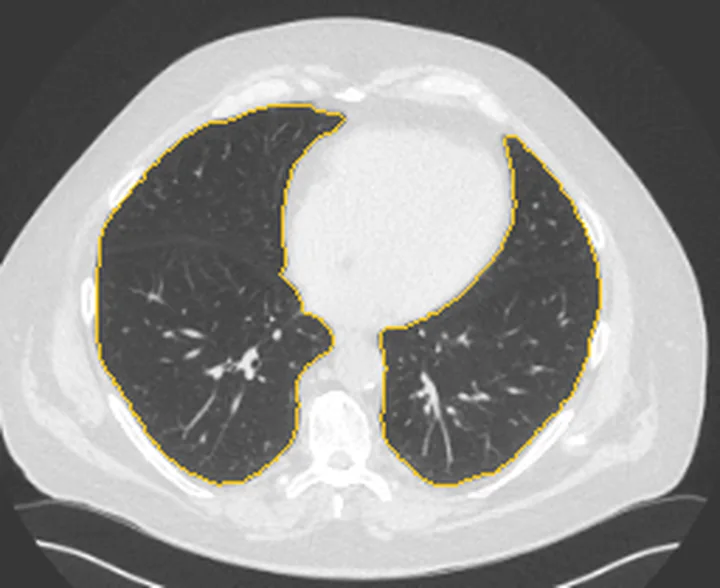
Aynı bölgenin, kaynak veri setinde patoloji içermediği belirtilen bir BT incelemesini kesit kesit kaydırın; organ sınırlarını açarak anatomiyi hasta görüntüsüyle karşılaştırın. Küçük rastlantısal bulgular tümüyle dışlanmamıştır.
Kaynak: TotalSegmentator v2.01 veri seti (Wasserthal ve ark., Radiology: Artificial Intelligence 2023), CC BY 4.0, vaka s1278; organ sınırları veri setinin otomatik segmentasyonundan, birleştirilerek sadeleştirildi. Görüntüler 2,5 mm kesit aralığına yeniden örneklendi.
Ayırıcı tanı
- İzole pnömotoraks
- plevral hava vardır ancak hemotoraks bileşeni veya bağımlı kan tabakası bulunmaz.
- İzole hemotoraks
- plevral boşlukta kan bulunur fakat hava bulunmaz.
- Akciğer laserasyonu, travmada görülebilen bir akciğer parankim yaralanmasıdır; hemopnömotoraks ise plevral boşlukta kan ve hava bulunmasıdır.
- Dev amfizematöz bül, BT’de hemitoraksı doldurup akciğer parankimini komprese edebilir.
- Ekstraplevral hematom
- kan koleksiyonu göğüs duvarı ile parietal plevra arasında bulunur, plevral boşlukta değildir.
Tuzaklar
- Supin travma hastasında küçük pnömotoraks klasik apikal hava cebi göstermeyebilir ve BT'de saptanabilir; derin sulkus işaretini arayın.
- Akciğer laserasyonu parankim yaralanmasıdır; hemopnömotoraks plevral boşlukta kan ve hava bulunmasıdır, bu nedenle BT’de bulgunun parankim içi mi plevral mi olduğunu ayırt edin.
- Kanama şüphesinde kontrastlı BT’de aktif kontrast ekstravazasyonu veya damar psödoanevrizması aranmalıdır.
- Mediastinal kayma, plevral hava veya sıvının yanı sıra dev amfizematöz bülün hemitoraksı doldurup akciğeri komprese etmesiyle de oluşabilir.
- Tansiyon pnömotoraksta belirgin mediastinal kaymaya hipoksemi, hiperkapni ve hemodinamik instabilite eşlik edebilir.
Kendini dene
Künt travma sonrası aynı hemitoraksta plevral hava ve bağımlı plevral sıvı vardır. Tanı nedir?
Cevabı göster
Hemopnömotoraks. Aynı plevral boşlukta hava ve kan bileşenlerinin birlikte bulunması travmatik hemopnömotoraksı tanımlar. İzole pnömotoraksta sıvı-kan bileşeni yoktur; apse parankim içindedir, ampiyem ise enfeksiyöz loküle plevral sıvıdır.
Travmatik hemopnömotoraks BT'de en iyi nasıl tanımlanır?
Cevabı göster
Aynı plevral boşlukta kan ve havanın birlikte bulunması. Hemopnömotoraks, plevral boşlukta kan ve havanın birlikte bulunmasıdır; izole hava veya izole sıvı tek başına bu tanımı karşılamaz, parankim içi kavite ise plevral değil parankimal bulgudur.
Kaynaklar
Bu sayfadaki 37 cümle ve 2 quiz sorusu aşağıdaki kaynaklardan alıntılarla otomatik olarak karşılaştırıldı; 11 cümle bu karşılaştırmada düzeltildi (2026-10-12).
- Delayed Hemopneumothorax and Multiple Rib Fractures Following Blunt Chest Traumapmc.ncbi.nlm.nih.gov
- Resolution is not the end: the Macklin effect after chest tube removal in a trauma patient with aging and comorbidities: a case reportpmc.ncbi.nlm.nih.gov
- Concurrent Long Thoracic and Lateral Cutaneous Intercostal Nerve Entrapment After Chest Tube Thoracostomy Causing Scapular Winging and Chest Wall Pain: Diagnosis With Ultrasound and Treatment With Hydrodissectionpmc.ncbi.nlm.nih.gov
- Progressive Supranuclear Palsy Diagnosed After a Severe Fall Trauma in a Patient Who Experienced Episodes of Easy Fallingpmc.ncbi.nlm.nih.gov
- Curative Effect Observation and Prognosis Analysis of Video-Assisted Thoracic Surgery and Thoracotomy in Patients with Hemopneumothoraxpmc.ncbi.nlm.nih.gov
- Contralateral Traumatic Hemopneumothorax.pubmed.ncbi.nlm.nih.gov
- Unilateral borderzone infarction in a young polytrauma patient.pubmed.ncbi.nlm.nih.gov
- Can Concurrent Traumatic Hemopneumothorax be Safely Observed?pubmed.ncbi.nlm.nih.gov
- Two-year experience of using pigtail catheters to treat traumatic pneumothorax: a changing trend.pubmed.ncbi.nlm.nih.gov
- Accidental chest penetration of glass foreign bodies in a 53 year old lady-The challenges with video assisted thoracoscopic extraction.pubmed.ncbi.nlm.nih.gov
- Malposition of a Central Venous Catheter in Trauma: Confirmation of Placement Prevents Complications.pubmed.ncbi.nlm.nih.gov
- Delayed Hemopneumothorax and Multiple Rib Fractures Following Blunt Chest Trauma.pubmed.ncbi.nlm.nih.gov
- Progressive Supranuclear Palsy Diagnosed After a Severe Fall Trauma in a Patient Who Experienced Episodes of Easy Falling.pubmed.ncbi.nlm.nih.gov
- Focused Assessment with Sonography for Trauma (FAST).pubmed.ncbi.nlm.nih.gov
- Traumatic Tricuspid Valve Rupture after Blunt Chest Trauma - A Case Report and Review of the Literature.pubmed.ncbi.nlm.nih.gov
- Traumatic pulmonary pseudocyst: An underreported entity.pubmed.ncbi.nlm.nih.gov
- Imaging spectrum of traumatic urinary bladder and urethral injuries.pubmed.ncbi.nlm.nih.gov
- Acute celiac artery occlusion secondary to blunt trauma: Two case reports.pubmed.ncbi.nlm.nih.gov
- Transgastric repair of transfixing gastroesophageal junction gunshot wound: video case report.pubmed.ncbi.nlm.nih.gov
- Study of 433 Operated Cases of Thoracic Trauma.pubmed.ncbi.nlm.nih.gov
- Late complications due to thoracic traumas.pubmed.ncbi.nlm.nih.gov
- Traumatic Diaphragmatic Hernia: Diagnostic Dilemma.pubmed.ncbi.nlm.nih.gov
- Are occult pneumothoraces truly occult or simply missed?pubmed.ncbi.nlm.nih.gov
- Traumatic Pseudoaneurysms of the Internal Mammary Artery: Two Cases and Percutaneous Intervention.pubmed.ncbi.nlm.nih.gov
- Pneumothorax and Hemothorax: Practical Approaches for Radiologists.pubmed.ncbi.nlm.nih.gov
- Ruptured mycotic aneurysm of intercostal arteries associated with vertebral osteomyelitis: a case report.pubmed.ncbi.nlm.nih.gov
- A case of malignant mesothelioma detected hydropneumothorax.pubmed.ncbi.nlm.nih.gov
- Pneumomediastinum and pneumopericardium following blunt thoracic trauma: much ado about nothing?pubmed.ncbi.nlm.nih.gov
- Multidetector CT for Evaluation of the Extrapleural Space.pubmed.ncbi.nlm.nih.gov
- [Pitfalls in diagnostic imaging and assessment of benign asbestos-related thoracic diseases].pubmed.ncbi.nlm.nih.gov
- Delayed retained hemopneumothorax secondary to rib fracture with pulmonary perforation treated by video-assisted thoracoscopic surgery: a case report.pubmed.ncbi.nlm.nih.gov
- War-related penetrating cervicothoracic trauma managed in a resource-limited hospital in Syria: a case series.pubmed.ncbi.nlm.nih.gov
- Large extrapleural hematoma in a patient with Stanford type B acute aortic dissection: a case report.pubmed.ncbi.nlm.nih.gov
- Fleischner Society: Glossary of Terms for Thoracic Imaging.pubmed.ncbi.nlm.nih.gov
- Fatal pedestrian injury secondary to rupture of a right coronary artery aneurysm: A case report.pubmed.ncbi.nlm.nih.gov
- Delayed presentation of left-sided penetrating diaphragmatic injury with multivisceral herniation, gastric fundal perforation, and splenic laceration leading to fatal septic shock: a case report from Ethiopia.pubmed.ncbi.nlm.nih.gov
- Tension Viscerothorax with Concomitant Pneumothorax and Associated Intrathoracic Gastric Perforation after Thoracoabdominal Stab Wound in a Resource-Limited Setting: A Case Report.pubmed.ncbi.nlm.nih.gov
- Minimally invasive management of penetrating thoracic and abdominal injuries: a case series.pubmed.ncbi.nlm.nih.gov
- Traumatic colopleural fistula presenting as tension fecohemopneumothorax and septic shock: A case report.pubmed.ncbi.nlm.nih.gov
- Effectiveness of video-assisted thoracoscopic surgery with blebectomy and mechanical pleural abrasion in the treatment of primary spontaneous pneumothorax: a retrospective long-term single-centre analysis.pubmed.ncbi.nlm.nih.gov
- A retrospective cross-sectional study of therapeutic results of single port thoracoscopy in patients with lung collapse due to trauma: comparison of entirely recovered and re-thoracoscopy needed patients.pubmed.ncbi.nlm.nih.gov
- Blunt trauma related chest wall and pulmonary injuries: An overview.pubmed.ncbi.nlm.nih.gov
- Lung parenchymal trauma biomechanics, mechanisms, and classification: a narrative review of the current knowledge.pubmed.ncbi.nlm.nih.gov
- Emergency Department Imaging of Pediatric Patients with Blunt Thoracic Trauma: A Systematic Review, Meta-Analysis, and Practice Management Guideline.pubmed.ncbi.nlm.nih.gov
- Intrathoracic Humeral Head Fracture: A Case Report.pubmed.ncbi.nlm.nih.gov
- Imaging review of procedural and periprocedural complications of central venous lines, percutaneous intrathoracic drains, and nasogastric tubes.pubmed.ncbi.nlm.nih.gov
- Chest Tubes and Pleural Drainage: History and Current Status in Pleural Disease Management.pubmed.ncbi.nlm.nih.gov
- Penetrating chest trauma in Sauer's danger zone without serious heart or lung damage: An unusual case report.pubmed.ncbi.nlm.nih.gov
- Forensic Pathologist Testimony, Part 1: Common Questions and Considerations.pubmed.ncbi.nlm.nih.gov
- Chest Wall and Diaphragmatic Injuries: Imaging Evaluation and Clinical Considerations.pubmed.ncbi.nlm.nih.gov
- Lung Parenchymal and Airway Injuries: Differential Diagnosis and Severity Grading.pubmed.ncbi.nlm.nih.gov
- Role of Interventional Radiology in the Management of Non-aortic Thoracic Trauma.pubmed.ncbi.nlm.nih.gov
- Spontaneous Pneumothorax: A Review of Underlying Etiologies and Diagnostic Imaging Modalities.pubmed.ncbi.nlm.nih.gov
- Pleuropulmonary Blastoma in a Pediatric Patient: A Case Report and Review of Current Diagnostic and Treatment Strategies.pubmed.ncbi.nlm.nih.gov
- Bilateral giant emphysematous bullae complicate severe bronchial asthma in a young patient: case report.pubmed.ncbi.nlm.nih.gov
- An Unanticipated Diagnosis in a Child with Blunt Chest Trauma.pubmed.ncbi.nlm.nih.gov
- Thoracic trauma WSES-AAST guidelines.pubmed.ncbi.nlm.nih.gov
- Transabdominal Minimally Invasive Repair of a Left Chronic Traumatic Diaphragmatic Hernia.pubmed.ncbi.nlm.nih.gov
- Surgical Outcomes of Right Traumatic Diaphragmatic Rupture with Grade 3 Liver Injury: A Report of 2 Cases.pubmed.ncbi.nlm.nih.gov
- Imaging in patients with acute dyspnea when cardiac or pulmonary origin is suspected.pubmed.ncbi.nlm.nih.gov
- Thoracic abnormal air collections in patients in the intensive care unit: radiograph findings correlated with CT.pubmed.ncbi.nlm.nih.gov
- Formation of a traumatic air cyst and ensuing hemopneumothorax during CT angiography in a patient with Ehlers-Danlos syndrome.pubmed.ncbi.nlm.nih.gov
- Blunt Traumatic Tracheobronchial Injury: a Clinical Pathway.pubmed.ncbi.nlm.nih.gov
- Full Airway Drainage by Fiber Bronchoscopy Through Artificial Airway in the Treatment of Occult Traumatic Atelectasis.pubmed.ncbi.nlm.nih.gov
- Fatal Injuries Caused by Falling Trees: Correlation Between Postmortem Computed Tomography and Forensic Autopsy Findings in Eight Cases.pubmed.ncbi.nlm.nih.gov
- Intracavitary Drainage Followed by Lobectomy for a Giant Bulla Causing Respiratory Failure due to Severe Mediastinal Compression: A Case Report.pubmed.ncbi.nlm.nih.gov
- Clinical Triage of Massive Pulmonary Embolism Masked by Giant Bullous Disease: The Diagnostic Value of Silent Hypoxia and Physical Examination.pubmed.ncbi.nlm.nih.gov
- Case Report: Multimodal ultrasound diagnosis of traumatic right coronary sinus rupture combined with atrial septal tears.pubmed.ncbi.nlm.nih.gov
- Perioperative ultrasonography in surgical stabilization of rib fractures: A single-center retrospective analysis of its utility in surgical planning and post-discharge follow-up.pubmed.ncbi.nlm.nih.gov
- Transcatheter arterial embolization for traumatic adrenal hemorrhage with contrast extravasation: case series and literature review.pubmed.ncbi.nlm.nih.gov
- A Rare Case of Traumatic Internal Mammary Artery Pseudoaneurysm Causing Hemopericardium: Endovascular Management and Literature Review.pubmed.ncbi.nlm.nih.gov
- Ultrasound-guided small-bore chest drain placement: a retrospective analysis of feasibility, safety and clinical implications in internal medicine ward.pubmed.ncbi.nlm.nih.gov
- Contemporary Pleural Drainage in Adult Practice: Image-Guided Techniques, Procedural Safety, Training Standards, and Malignant Pleural Effusion Management.pubmed.ncbi.nlm.nih.gov
- Beyond the Usual Course: A Rare Case of Persistent Traumatic Pulmonary Pneumatoceles With 8-Year Favorable Evolution.pubmed.ncbi.nlm.nih.gov
- Diffuse cystic lung diseases-a primer for radiologists.pubmed.ncbi.nlm.nih.gov
- Using point-of-care lung ultrasound to detect post-thoracentesis complications: the hydro-point case report.pubmed.ncbi.nlm.nih.gov
- Surgical stabilization of rib fractures in patients with open flail chest results in improved clinical outcomes: a report of three cases.pubmed.ncbi.nlm.nih.gov
- Aortic Injury and Hemopericardium: Key Findings and Evaluation.pubmed.ncbi.nlm.nih.gov
- A rare case of fatal delayed aortic rupture caused by repeated microtrauma from a posterior rib fracture.pubmed.ncbi.nlm.nih.gov
- Acute Traumatic Aortic Injury: What the Radiologist Needs to Know.pubmed.ncbi.nlm.nih.gov
- Tension Gastrothorax in a Child With Undiagnosed Congenital Diaphragmatic Hernia: A Case Report and Proposed Emergency Management Algorithm.pubmed.ncbi.nlm.nih.gov
- Physiological Persistence of Tension Pneumothorax After Minor Diaphragmatic Injury During Laparoscopic Adrenalectomy: A Case Report.pubmed.ncbi.nlm.nih.gov
- Life-threatening hemothorax after radiofrequency ablation for subcapsular hepatocellular carcinoma in a patient with previous rib injury.pubmed.ncbi.nlm.nih.gov
- Another Source of Near-Fatal Bleeding-Late-Onset Hemothorax Six Weeks After Uneventful Minimally Invasive Repair of Pectus Excavatum.pubmed.ncbi.nlm.nih.gov
- Clinical features and imaging findings for a mediastinal hemangiosarcoma in a dog.pubmed.ncbi.nlm.nih.gov
- Non-pulmonary postoperative complications of cardiothoracic surgery.pubmed.ncbi.nlm.nih.gov
- MDCT Imaging of Non-Traumatic Thoracic Aortic Emergencies and Its Impact on Diagnosis and Management-A Reappraisal.pubmed.ncbi.nlm.nih.gov
- Patterns of injury and violence in Yaoundé Cameroon: an analysis of hospital data.pubmed.ncbi.nlm.nih.gov
- ECPR In Penetrating Chest Trauma With Thoracic Aortic Injury: A Case Report.pubmed.ncbi.nlm.nih.gov
- Microwave technology for detecting traumatic chest injuries in a porcine model.pubmed.ncbi.nlm.nih.gov
- Feasibility of ultraportable US in detecting clinically concerning recurrent pneumothorax in patients with chest trauma.pubmed.ncbi.nlm.nih.gov
- Traumatic aortic isthmus transection with pseudoaneurysm formation and massive mediastinal hematoma: management challenges in resource-limited countries: case report.pubmed.ncbi.nlm.nih.gov
- Pneumothorax in patients with respiratory failure in ICU.pubmed.ncbi.nlm.nih.gov
- Surgical Stabilization of Rib Fractures: Current Evidence and Considerations for Posterior Rib Fractures.pubmed.ncbi.nlm.nih.gov
- Is Traumatic Anterior Stove-In Chest Truly so Rare? A Single Institution Experience.pubmed.ncbi.nlm.nih.gov
- Nuss Procedure for Surgical Stabilization of Anterior Flail Chest with Mechanical Ventilation Weaning Failure: A Case Report.pubmed.ncbi.nlm.nih.gov
- Characteristics of pediatric thoracic trauma: in view of before and after the establishment of a regional trauma center.pubmed.ncbi.nlm.nih.gov
- Multiple organ dysfunction syndrome: molecular mechanisms and therapeutic strategies.pubmed.ncbi.nlm.nih.gov
- Percutaneous Chest Tube for Pleural Effusion and Pneumothorax.pubmed.ncbi.nlm.nih.gov
- Transmediastinal penetrating trauma.pubmed.ncbi.nlm.nih.gov
- Postmortem CT: Applications in Clinical and Forensic Medicine.pubmed.ncbi.nlm.nih.gov
- Pictorial essay of radiological features of benign intrathoracic masses.pubmed.ncbi.nlm.nih.gov
- Aerosolized antibiotics therapy for infected traumatic pulmonary pseudocysts: A case report.pubmed.ncbi.nlm.nih.gov
- Multidetector computer tomography: evaluation of blunt chest trauma in adults.pubmed.ncbi.nlm.nih.gov
- Tube thoracostomy: a review for the interventional radiologist.pubmed.ncbi.nlm.nih.gov
- Fast, accurate, and cost-effective: E-FAST's breakthrough in optimizing thoracic trauma management.pubmed.ncbi.nlm.nih.gov
- Thoracic trauma in children.pubmed.ncbi.nlm.nih.gov
- Impact of Preceding Chest CT on Functional Malpositioning of Chest Tubes in Traumatic Pneumothorax and Hemopneumothorax.pubmed.ncbi.nlm.nih.gov
- A Retrospective Analysis of Needle Thoracostomies at a Tertiary Level 2 Trauma Center.pubmed.ncbi.nlm.nih.gov
- Effects of early surgery (within 48 hours) <i>vs.</i> delayed surgery on the incidence of pulmonary complications in elderly patients with multiple rib fractures.pubmed.ncbi.nlm.nih.gov
- Clinical outcomes of endovascular aortic repair in blunt traumatic aortic injury: A retrospective case series and a CARE-compliant case report.pubmed.ncbi.nlm.nih.gov
- The treatment of acute traumatic aortic injuries with TEVAR: a retrospective analysis of 19 cases in a level-1 trauma center.pubmed.ncbi.nlm.nih.gov
- Tension pneumothorax from large bowel herniation and perforation as a late presentation of traumatic diaphragmatic hernia during pregnancy: a case report.pubmed.ncbi.nlm.nih.gov
- Thoracic Spine Fractures with Blunt Aortic Injury: Incidence, Risk Factors, and Characteristics.pubmed.ncbi.nlm.nih.gov
- Unusual cavitary lesions of the lung: Analysis of patients with traumatic pulmonary pseudocyst.pubmed.ncbi.nlm.nih.gov
- pubmed.ncbi.nlm.nih.govpubmed.ncbi.nlm.nih.gov
Eğitim amaçlıdır; hasta başında tanı ve tedavi kararının yerine geçmez, tıbbi tavsiye değildir. Metinler yapay zekâ desteğiyle yazıldı ve otomatik bir adımda kaynak alıntılarıyla karşılaştırıldı; bu bir tıbbi doğrulama değildir ve içerik uzman radyolog incelemesinden geçmedi. Klinik kararlarda güncel kılavuzları, kurum protokollerini ve radyoloji raporunu esas alın.