Özet
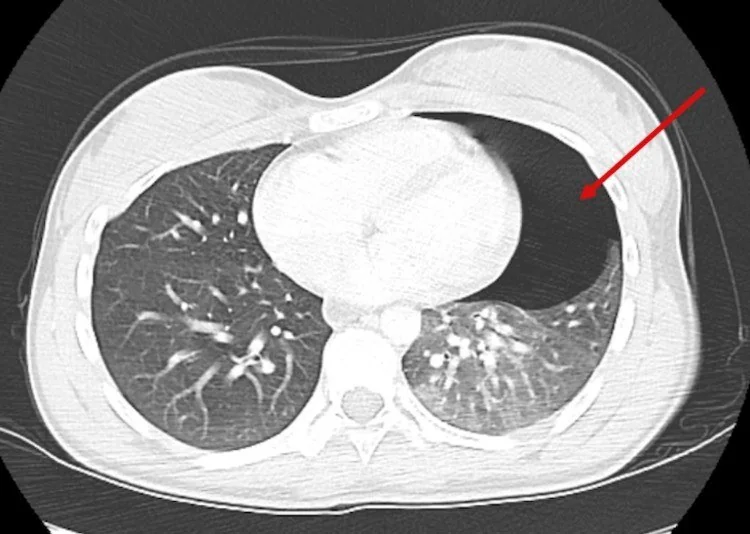
Travmatik pnömotoraks künt veya penetran göğüs yaralanmasıyla, iyatrojenik pnömotoraks ise biyopsi, santral kateter ya da cerrahi gibi bir işlemle plevral bütünlüğün bozulmasıyla gelişir. Supin hastada plevral hava anteriora, anteromediale veya bazal reseslere dağılıp doğrudan akciğer kenarı bulgusunu gizleyebilir; BT bu cepleri ve eşlik eden yaralanmaları birlikte gösterir. Akciğer parankim hastalığı ve göğüs tüpünün kıvrılması veya malpozisyonu, devam eden hava kaçağının olası nedenleri arasında olabilir. Küçük bir travmatik pnömotoraksın atlanması özellikle pozitif basınçlı ventilasyon bağlamında büyüme riskini gözden kaçırabilir
Faz ve pencere
- Kontrastsız tanısal
- Plevral hava kontrastsız incelemede, ince kesit akciğer penceresinde değerlendirilir; supin hastada plevral havanın önemli bölümü anterior, medial ve bazal reseslerde birikir. Yaralanma mekanizmasına göre eşlik eden damar veya mediastinal yaralanma sorusu varsa kontrastlı travma protokolü ayrıca gerekebilir; bu faz plevral havanın kendisi için zorunlu değildir.
Önerilen pencereler G genişlik, M merkez; değerler Hounsfield birimi (HU)
- AkciğerG 1500 / M −600
- KemikG 1800 / M +400
- Yumuşak dokuG 400 / M +40
- MediastenG 350 / M +50
BT bulguları
- Akciğer kenarını oluşturan visseral plevra ile göğüs duvarı arasında serbest hava bulunur; supin hastada bu hava anterior, medial ve bazal reseslerde toplanır.
- Supin incelemede anterior, anteromedial, paramediastinal veya bazal plevral ceplerde birikim; kardiyofrenik reseste ve derin kostofrenik olukta artmış açıklık
- Supin grafide gizli kalabilen küçük pnömotorakslar BT'de saptanabilir; supin hastada plevral hava çoğunlukla anterior, medial ve bazal reseslerde dağılır.
- Toraks BT, kaburga kırıklarını ve akciğer laserasyonlarını gösterebilir.
- Komşu akciğerde yamalı kontüzyon opasiteleri ve plevral koleksiyon içinde eşlik eden hemotoraks
- Göğüs duvarı cilt altı amfizemi, pnömomediastinum veya penetran yaralanmada yabancı cisim yolu
- İşlem sonrası incelemede kateter veya drenin pozisyonu değerlendirilir; intraparenkimal yerleşim veya malpozisyon hava kaçağına neden olabilir.
- Travma sonrası pnömotoraksa eşlik edebilen hemotoraksı, akciğer kontüzyonu veya laserasyonunu, cilt altı amfizemini ve kostal yaralanmaları toraks BT'sinde birlikte değerlendirin.
Normalde
Normal toraks BT'de plevral aralıkta ayrı bir hava koleksiyonu yoktur; plevra akciğer ile göğüs duvarını birbirinden ayırır ve boşlukta yalnız fizyolojik plevral sıvı bulunur. Kontrastlı BT'de aktif kanamanın kaynağı aranır; ayrıca göğüs tüpü pozisyonu izlenir.
Normal BT ile kıyasla
Aynı bölgenin, kaynak veri setinde patoloji içermediği belirtilen bir BT incelemesini kesit kesit kaydırın; organ sınırlarını açarak anatomiyi hasta görüntüsüyle karşılaştırın. Küçük rastlantısal bulgular tümüyle dışlanmamıştır.
Kaynak: TotalSegmentator v2.01 veri seti (Wasserthal ve ark., Radiology: Artificial Intelligence 2023), CC BY 4.0, vaka s1278; organ sınırları veri setinin otomatik segmentasyonundan, birleştirilerek sadeleştirildi. Görüntüler 2,5 mm kesit aralığına yeniden örneklendi.
Ayırıcı tanı
- Dev bül
- hava boşluğu parankim içindedir ve çevresinde attenüe akciğer bulunabilir; travmatik plevral hava ise plevra boyunca uzanıp akciğer kenarını içe iter.
- Pnömomediastinum
- mediastinum içinde serbest hava bulunmasıdır; künt veya penetran göğüs ve boyun yaralanmalarında gelişebilir ve pnömotoraks ile birlikte izlenebilir.
- Cilt altı amfizemi
- gaz toraks duvarı yumuşak dokularında kas ve fasya planlarını izler; kaburga iç yüzünün derininde plevral hava bulunmasıyla karıştırılmamalıdır.
- Travmatik pnömatosel veya laserasyon
- hava içeren kavite akciğer parankiminde, sıklıkla kontüzyon içinde merkezlenir; visseral plevra çizgisiyle ayrılmış değildir.
- Hemotoraks
- plevral boşluktaki içerik sıvı dansitesinde, çoğu kez bağımlı yerleşimli ve hematokrit düzeyine göre yüksek atenüasyonludur; hava varsa hidropnömotoraks düşünülür.
Tuzaklar
- Supin travma hastasında yalnız apeksleri incelemek anterior ve bazal pnömotoraksı kaçırabilir; plevral aralığı kardiyofrenik reseslere kadar izleyin.
- BT, pnömotoraksı ve akciğer kontüzyonunu gösterebilir; görüntüleme seçimi ilk değerlendirme bulgularına ve BT gereksinimine göre yapılır.
- Kaburga kırığı komşuluğundaki küçük akciğer laserasyonu hava içeren parankim odağı yapabilir; çok düzlemli görüntülerde kavitenin plevral boşluğa açılıp açılmadığını araştırın.
- Drenin göğüs boşluğuna girmiş görünmesi işlevsel yan delik konumunu garanti etmez; tüm kateter boyunca ucu ve yan delikleri izleyin.
- Tansiyon pnömotoraksta mediastinal yer değiştirme görülebilir; solunumsal ve hemodinamik instabilite eşlik edebilir.
Kendini dene
Künt travma sonrası supin BT'de sternum arkasında damar izi olmayan hava, onun arkasında ince akciğer kenarı seçiliyor. Tanı nedir?
Cevabı göster
Travmatik pnömotoraks. Havanın akciğer kenarının (visseral plevranın) dışında, göğüs duvarına doğru birikmesi pnömotoraksı gösterir; supin hastada bu hava anterior ve medial bölgelerde toplanır. Pnömomediastinumda gaz mediastinum içinde yer alır ve pnömotoraks ile birlikte görülebilir; bu özellik plevral boşluktaki serbest havadan ayrımını sağlar.
Künt göğüs travması sonrası akciğerde gelişebilen, nadir görülen kaviter lezyon hangisidir?
Cevabı göster
Travmatik pulmoner psödokist. Travma sonrası pulmoner psödokist, künt göğüs travmasının ardından gelişebilen nadir bir akciğer kaviter lezyonudur.
İlgili konular
Kaynaklar
Bu sayfadaki 38 cümle ve 2 quiz sorusu aşağıdaki kaynaklardan alıntılarla otomatik olarak karşılaştırıldı; 16 cümle bu karşılaştırmada düzeltildi (2026-10-09).
- [Tracheobronchial Injury].pubmed.ncbi.nlm.nih.gov
- Spontaneous Pneumothorax.pubmed.ncbi.nlm.nih.gov
- Pictorial Review of Pleural Disease: Multimodality Imaging and Differential Diagnosis.pubmed.ncbi.nlm.nih.gov
- [Hemothorax].pubmed.ncbi.nlm.nih.gov
- Aeromedical Ultrasound: The Evaluation of Point-of-care Ultrasound During Helicopter Transport.pubmed.ncbi.nlm.nih.gov
- Early whole-body CT for treatment guidance in patients with return of spontaneous circulation after cardiac arrest.pubmed.ncbi.nlm.nih.gov
- Dyspnoea and chest pain as the presenting symptoms of pneumomediastinum: two cases and a review of the literature.pubmed.ncbi.nlm.nih.gov
- Traumatic isolated perforation of lower oesophagus.pubmed.ncbi.nlm.nih.gov
- Small-bore catheter versus chest tube drainage for pneumothorax.pubmed.ncbi.nlm.nih.gov
- Delayed presentation of a carotid pseudoaneurysm following penetrating neck trauma.pubmed.ncbi.nlm.nih.gov
- Late presenting congenital diaphragmatic hernia misdiagnosed as a pleural effusion: A case report.pubmed.ncbi.nlm.nih.gov
- Criminal gunshot wound and iatrogenic tension pneumothorax detected by post-mortem computed tomography.pubmed.ncbi.nlm.nih.gov
- Chest compression-associated injuries in cardiac arrest patients treated with manual chest compressions versus automated chest compression devices (LUCAS II) - a forensic autopsy-based comparison.pubmed.ncbi.nlm.nih.gov
- Traumatic air in spinal canal (pneumorrhachis).pubmed.ncbi.nlm.nih.gov
- Anesthetic management of occult traumatic pneumothorax with one-lung ventilation avoiding prophylactic chest tube: a case report.pubmed.ncbi.nlm.nih.gov
- Lung Ultrasound in the Critically Ill Neonate.pubmed.ncbi.nlm.nih.gov
- Sonographic detection of pneumothorax by radiology residents as part of extended focused assessment with sonography for trauma.pubmed.ncbi.nlm.nih.gov
- A porcine pneumothorax model for teaching ultrasound diagnostics.pubmed.ncbi.nlm.nih.gov
- Combined left pulmonary artery sling transposition and tracheal lobe resection through a median sternotomy: a case report.pubmed.ncbi.nlm.nih.gov
- Right pneumothorax secondary to colonoscopic perforation: a case.pubmed.ncbi.nlm.nih.gov
- Extensive Odontogenic Deep Neck Infection Complicated by Necrotizing Fasciitis and Bilateral Mastitis: A Rare Case Report.pubmed.ncbi.nlm.nih.gov
- Traumatic pneumatocele in an 11-year-old boy - report of a rare case and review of the literature.pubmed.ncbi.nlm.nih.gov
- [A case of traumatic pneumatocele revealed by CT 36 years after blunt chest trauma].pubmed.ncbi.nlm.nih.gov
- An unusual case of traumatic pneumatocele in a nine-year-old girl: a bronchial tear with clear bronchial laceration.pubmed.ncbi.nlm.nih.gov
- Diagnostic Imaging in pediatric thoracic trauma.pubmed.ncbi.nlm.nih.gov
- Missed injuries in trauma patients: the value of a diagnostic thoracotomy or thoracoscopy during surgical stabilisation of rib fractures.pubmed.ncbi.nlm.nih.gov
- Computed tomography in blunt chest trauma.pubmed.ncbi.nlm.nih.gov
- ACR Appropriateness Criteria ® Suspected Physical Abuse-Child.pubmed.ncbi.nlm.nih.gov
- Risk of delayed displacement and biomechanical analysis of unstable rib fractures postsurgical.pubmed.ncbi.nlm.nih.gov
- Emergency whole-body CT scans in pediatric patients with trauma: patterns of injuries, yield of dual-phase scanning, and influence of second read on detection of injuries.pubmed.ncbi.nlm.nih.gov
- Multidetector CT and radiographic findings of lung injuries secondary to cardiopulmonary resuscitation.pubmed.ncbi.nlm.nih.gov
- [Traumatic Disruption of the Aortic Root and the Ascending Aorta with Multisystem Trauma;Report of a Case].pubmed.ncbi.nlm.nih.gov
- Determinants of Chemical Pleurodesis Recurrence in Malignant Pleural Effusion: Mechanical Apposition or Systemic Inflammation? A Retrospective Cohort Study.pubmed.ncbi.nlm.nih.gov
- Case Report: Uncommon complications of central catheters in newborns: two cases of parenteral nutrition extravasation.pubmed.ncbi.nlm.nih.gov
- Pleural effusion guidelines from ICS and NCCP Section 1: Basic principles, laboratory tests and pleural procedures.pubmed.ncbi.nlm.nih.gov
- International Society of Paediatric Surgical Oncology (IPSO) Surgical Practice Guidelines.pubmed.ncbi.nlm.nih.gov
- Pediatric emergency medicine point-of-care ultrasound: summary of the evidence.pubmed.ncbi.nlm.nih.gov
- Long-term safety and effectiveness of the "OptEase" vena cava filter.pubmed.ncbi.nlm.nih.gov
- Stepwise diagnostic algorithm for high-attenuation pulmonary abnormalities on CT.pubmed.ncbi.nlm.nih.gov
- Etiology of primary spontaneous pneumothorax.pubmed.ncbi.nlm.nih.gov
- Coexistence of Autoantibodies against the Golgi Complex and Ro52 Antigen in a Patient with Nonspecific Interstitial Pneumonia.pubmed.ncbi.nlm.nih.gov
- Fatal Injuries Caused by Falling Trees: Correlation Between Postmortem Computed Tomography and Forensic Autopsy Findings in Eight Cases.pubmed.ncbi.nlm.nih.gov
- Point-of-Care Ultrasound in Blunt Chest Trauma: Diagnostic Performance and Clinical Relevance.pubmed.ncbi.nlm.nih.gov
- The value of post-mortem computed tomography of burned victims in a forensic setting.pubmed.ncbi.nlm.nih.gov
- SPOT THE BOT: A comparative quality assessment of AI-generated written instructions for lung ultrasound training.pubmed.ncbi.nlm.nih.gov
- Ultrasound use in the ICU for interventional pulmonology procedures.pubmed.ncbi.nlm.nih.gov
- Value of point-of-care ultrasonography compared with computed tomography scan in detecting potential life-threatening conditions in blunt chest trauma patients.pubmed.ncbi.nlm.nih.gov
- Trauma-Associated Pulmonary Laceration in Dogs-A Cross Sectional Study of 364 Dogs.pubmed.ncbi.nlm.nih.gov
- Demystifying the persistent pneumothorax: role of imaging.pubmed.ncbi.nlm.nih.gov
- Multidetector computed tomography of chest trauma: indications, technique and interpretation.pubmed.ncbi.nlm.nih.gov
- Patterns of injury and violence in Yaoundé Cameroon: an analysis of hospital data.pubmed.ncbi.nlm.nih.gov
- Surgical stabilization of rib fractures (SSRF): the WSES and CWIS position paper.pubmed.ncbi.nlm.nih.gov
- Spontaneous bacteremia and spontaneous bacterial peritonitis share similar prognosis in patients with cirrhosis: a cohort study.pubmed.ncbi.nlm.nih.gov
- Chest Wall and Diaphragmatic Injuries: Imaging Evaluation and Clinical Considerations.pubmed.ncbi.nlm.nih.gov
- Prognostic Factors of Mortality and Clinical Characteristics of Patients Surgically Treated for Blunt Liver Injury-A Single-Center Experience.pubmed.ncbi.nlm.nih.gov
- War-related penetrating cervicothoracic trauma managed in a resource-limited hospital in Syria: a case series.pubmed.ncbi.nlm.nih.gov
- Lung Parenchymal and Airway Injuries: Differential Diagnosis and Severity Grading.pubmed.ncbi.nlm.nih.gov
- Pneumothorax and Hemothorax: Practical Approaches for Radiologists.pubmed.ncbi.nlm.nih.gov
- Successful Management of a Large Pediatric Traumatic Pneumothorax Using a Thoracic Vent Device After Blunt Chest Injury: A Case Report.pubmed.ncbi.nlm.nih.gov
- Contemporary Pleural Drainage in Adult Practice: Image-Guided Techniques, Procedural Safety, Training Standards, and Malignant Pleural Effusion Management.pubmed.ncbi.nlm.nih.gov
- Unexpected Air on Trauma Computed Tomography: Iatrogenic Intravascular Air After Peripheral Venous Cannulation.pubmed.ncbi.nlm.nih.gov
- Unicentric report on thoracoscopic surgery 7 cases for congenital pulmonary airway malformation combined with ipsilateral mediastinal bronchogenic cyst in children.pubmed.ncbi.nlm.nih.gov
- Video-assisted thoracoscopic surgery surgical stabilization of rib fractures: surgical technique and case report.pubmed.ncbi.nlm.nih.gov
- Pericardial tamponade during surgical ventriculoperitoneal shunt placement : a case report and review of the literature.pubmed.ncbi.nlm.nih.gov
- Millimeters from catastrophe: The pericardium as a lifesaving shield.pubmed.ncbi.nlm.nih.gov
- Penetrating dural venous sinus injury: a scoping review of clinical presentation, operative management, and prognosis.pubmed.ncbi.nlm.nih.gov
- Severe celiac trunk stenosis following blunt trauma in a patient with diabetic ketoacidosis: a diagnostic dilemma of traumatic injury versus median arcuate ligament syndrome.pubmed.ncbi.nlm.nih.gov
- Diffuse cystic lung diseases-a primer for radiologists.pubmed.ncbi.nlm.nih.gov
- Vanishing Lung Syndrome: A Case Report and Systematic Review of the Literature.pubmed.ncbi.nlm.nih.gov
- Cardiothoracic Surgery Management of Giant Bullous Lung Disease Initially Misdiagnosed as Pneumothorax: A Case Report.pubmed.ncbi.nlm.nih.gov
- Secondary Pneumomediastinum Following Bronchoscopic Interventions in Patients With Prolonged Tracheostomy Intubation: A Case Series.pubmed.ncbi.nlm.nih.gov
- Unilateral orbital surgical emphysema following laparoscopic hiatal hernia repair and Nissen fundoplication: a case report.pubmed.ncbi.nlm.nih.gov
- Post-Traumatic Subcutaneous Emphysema of the Upper Extremity Associated with an Open Scapular Fracture: A Case Report and Review of Literature.pubmed.ncbi.nlm.nih.gov
- Bilateral Lung Points without Pneumothorax: Exploring "Lung Point" Mimics.pubmed.ncbi.nlm.nih.gov
- Nuts and bolts of lung ultrasound: utility, scanning techniques, protocols, and findings in common pathologies.pubmed.ncbi.nlm.nih.gov
- Persistent Air Leak Due to Chest Drain Malposition.pubmed.ncbi.nlm.nih.gov
- Complicated placement of a nasogastric tube in the gastric mucosa: A case report and literature review.pubmed.ncbi.nlm.nih.gov
- A Multicenter Cohort Study of 3805 RibXcar Cases: Safety and Efficacy in Incisionless Rib Remodeling.pubmed.ncbi.nlm.nih.gov
- A utility of video-assisted thoracoscopy (VATS) for management of gunshot injury to the esophagus in Role 2 hospital: case report from Russia-Ukraine war.pubmed.ncbi.nlm.nih.gov
- Missed intrathoracically displaced humeral head in proximal humerus fracture dislocation: A case report.pubmed.ncbi.nlm.nih.gov
- Chest X-ray Interpretation: Detecting Devices and Device-Related Complications.pubmed.ncbi.nlm.nih.gov
- Percutaneous Chest Tube for Pleural Effusion and Pneumothorax.pubmed.ncbi.nlm.nih.gov
- Delayed Hemopneumothorax and Multiple Rib Fractures Following Blunt Chest Trauma.pubmed.ncbi.nlm.nih.gov
- Presentation and Management of High-Grade Pancreatic Injuries: Case Series.pubmed.ncbi.nlm.nih.gov
- Completely thoracoscopic surgical stabilization of rib fractures: balancing minimally invasive benefits against technique-specific complications: a single-center retrospective study.pubmed.ncbi.nlm.nih.gov
- Spontaneous Pneumothorax: A Review of Underlying Etiologies and Diagnostic Imaging Modalities.pubmed.ncbi.nlm.nih.gov
- Cystic and cavitary lung lesions in children: radiologic findings with pathologic correlation.pubmed.ncbi.nlm.nih.gov
- Ultrasonographic Examination of the Equine Neonate: Thorax and Abdomen.pubmed.ncbi.nlm.nih.gov
- Penetrating Chest Trauma With Lung Evisceration, Pneumomediastinum, Pneumocranium, and Brachial Plexus Injury: A Case Report From a Resource-Limited Setting.pubmed.ncbi.nlm.nih.gov
- Review of imaging modalities and radiological findings of calvarial lesions.pubmed.ncbi.nlm.nih.gov
- Surgical Stabilization of Rib Fractures: Indications, Techniques, and Pitfalls.pubmed.ncbi.nlm.nih.gov
- Cause of Death in Charred Bodies: Reflections and Operational Insights Based on a Large Cases Study.pubmed.ncbi.nlm.nih.gov
- Beyond the Usual Course: A Rare Case of Persistent Traumatic Pulmonary Pneumatoceles With 8-Year Favorable Evolution.pubmed.ncbi.nlm.nih.gov
- Post-traumatic pulmonary pseudocyst with hemopneumothorax following blunt chest trauma: a case report.pubmed.ncbi.nlm.nih.gov
- Myocardial Contusion Due to Ballistic Impact Force.pubmed.ncbi.nlm.nih.gov
- Pneumothorax Secondary to a Traumatic Brazilian Jiu-Jitsu Injury.pubmed.ncbi.nlm.nih.gov
- Perioperative ultrasonography in surgical stabilization of rib fractures: A single-center retrospective analysis of its utility in surgical planning and post-discharge follow-up.pubmed.ncbi.nlm.nih.gov
- Pigtail catheter found in the Lingula of a pediatric patient on VV-ECMO while performing flexible bronchoscopy: a case report on an unexpected finding.pubmed.ncbi.nlm.nih.gov
- Chest Tubes and Pleural Drainage: History and Current Status in Pleural Disease Management.pubmed.ncbi.nlm.nih.gov
- Successful lung-preserving tractotomy to treat intrathoracic wood impalement after high-fall trauma: a case report.pubmed.ncbi.nlm.nih.gov
- Diagnostic accuracy of transthoracic ultrasound for detection of pneumothorax, hemothorax, and lung contusion in trauma patients: comparison with chest radiography.pubmed.ncbi.nlm.nih.gov
- Tension Gastrothorax in a Child With Undiagnosed Congenital Diaphragmatic Hernia: A Case Report and Proposed Emergency Management Algorithm.pubmed.ncbi.nlm.nih.gov
- Tension Viscerothorax with Concomitant Pneumothorax and Associated Intrathoracic Gastric Perforation after Thoracoabdominal Stab Wound in a Resource-Limited Setting: A Case Report.pubmed.ncbi.nlm.nih.gov
- Intercostal Cryoneurolysis for Chest Wall Pain in Patients With Vertebral Osteomyelitis.pubmed.ncbi.nlm.nih.gov
- Standardized bilateral thoracic ultrasound image comparison as a tool for the diagnosis of pneumothorax: a pilot exploratory study.pubmed.ncbi.nlm.nih.gov
- Anatomy, Imaging, and Clinical Significance of the Cervicothoracic (Stellate) Ganglion.pubmed.ncbi.nlm.nih.gov
- Physiological Persistence of Tension Pneumothorax After Minor Diaphragmatic Injury During Laparoscopic Adrenalectomy: A Case Report.pubmed.ncbi.nlm.nih.gov
- Sequential Bilateral Pneumothorax Following Acupuncture Presenting as Left Tension Pneumothorax: A Case Report.pubmed.ncbi.nlm.nih.gov
- When Foreign Body Aspiration Is Not the Whole Story: Reconsidering Imaging Escalation in Infants With Apparent Tension Pneumothorax.pubmed.ncbi.nlm.nih.gov
Eğitim amaçlıdır; hasta başında tanı ve tedavi kararının yerine geçmez, tıbbi tavsiye değildir. Metinler yapay zekâ desteğiyle yazıldı ve otomatik bir adımda kaynak alıntılarıyla karşılaştırıldı; bu bir tıbbi doğrulama değildir ve içerik uzman radyolog incelemesinden geçmedi. Klinik kararlarda güncel kılavuzları, kurum protokollerini ve radyoloji raporunu esas alın.