Özet
İnmemiş testis, skrotumda beklenen gonadın bulunmadığı ve testisin iniş yolu üzerinde ya da ektopik bir konumda kaldığı durumdur. BT, inmemiş testisi saptamada güvenilir değildir ve radyasyon içerir; testis benzeri bir bulgu BT ile kesin olarak tanımlanamayabilir. İntraabdominal testis atrofik, torsiyone ya da tümörlü olabilir ve testis tümörü riski artmıştır. Bulguyu atlamak, inmemiş testisin yerinin ve olası komplikasyonlarının fark edilmemesine yol açabilir; klinik değerlendirme tanıda önemlidir.
Faz ve pencere
- Kontrastsız
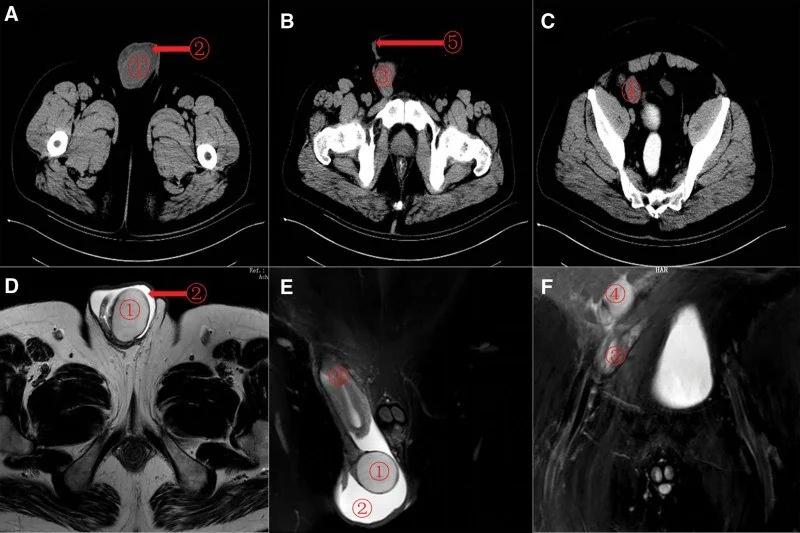
- İnmemiş testis inguinal kanalda, pubik tüberkül yakınında veya daha seyrek karında yerleşebilir; BT'de hipodens görünebilir. Küçük veya atrofik testisi lenf nodundan ayırmak mümkün olmayabilir.
Önerilen pencereler G genişlik, M merkez; değerler Hounsfield birimi (HU)
- Yumuşak dokuG 400 / M +40
- KemikG 1800 / M +400
BT bulguları
- Skrotal kesenin boş görünmesi; yalnız taranan alan içindeki taraf için yorumlanabilir
- İnguinal kanal boyunca veya iç halka yakınında oval, düzgün sınırlı yumuşak doku odağı
- Pelvis ya da alt karında, normal iniş yolu dışında yerleşmiş testis benzeri doku
- Karşı taraf testise göre küçük hacim veya belirgin incelme; atrofiyi düşündürür ancak BT tek başına işlev göstermez
- Testis dokusunda kaba heterojenite ya da solid büyüme; eşlik eden tümör açısından şüphelidir
- İnguinal kanalda yağ veya barsak içeren kese ve aynı kesede testis; eşlik eden inguinal herniyi düşündürür
Ölçütler ve sınıflamalar
- Yerleşime göre inmemiş testis
- İniş yolu üzerindeki testis abdominal, inguinal veya yüksek skrotal konumda; ektopik testis normal iniş yolundan saparak perineal, femoral ya da yüzeyel inguinal bölgede bulunabilir.
Normalde
Normalde testisler skrotal kesede bulunur; spermatik kord inguinal kanalda izlenebilir. Boş hemiskrotumda BT ile testisin yerini belirlemek güvenilir değildir.
Normal BT ile kıyasla
Aynı bölgenin, kaynak veri setinde patoloji içermediği belirtilen bir BT incelemesini kesit kesit kaydırın; organ sınırlarını açarak anatomiyi hasta görüntüsüyle karşılaştırın. Küçük rastlantısal bulgular tümüyle dışlanmamıştır.
Kaynak: TotalSegmentator v2.01 veri seti (Wasserthal ve ark., Radiology: Artificial Intelligence 2023), CC BY 4.0, vaka s0119; organ sınırları veri setinin otomatik segmentasyonundan, birleştirilerek sadeleştirildi. Görüntüler 2,5 mm kesit aralığına yeniden örneklendi.
Ayırıcı tanı
- İnguinal lenf nodu
- oval olabilir; gonadal damar boyunca devamlılık ve karşı skrotal testisin yokluğu testis lehinedir
- İnguinal herni
- yağ veya barsak ansı içeriği ve derin halkaya uzanan kese izlenir
- İnguinal kanal lipomu
- yağ dansitesindedir; testise benzer yumuşak doku yoğunluğu göstermez
- Skrotal boşlukta geçirilmiş orşiektomi
- cerrahi öykü ve klips/skar eşlik edebilir; BT tek başına nedeni belirleyemez
- Pelvik yumuşak doku kitlesi
- testis de pelviste yerleşebileceğinden, yalnız pelvik konum ayırıcı tanı için yeterli değildir.
Tuzaklar
- Küçük intraabdominal testis, retroperitoneal lenf nodu veya küçük kistik yapı sanılabilir; gonadal damarların seyrini ve karşı testisi birlikte izle.
- Skrotumun tarama alanı dışında kalması, testisin yok olduğu anlamına gelmez; yalnız kapsanan kesitler için taraflı bulgu bildir.
- Kontrastsız BT’de doku karakterizasyonu kısıtlıdır; şüpheli solid odak için BT ile testis tümörü tanısı koyma.
- Çocuklarda inmemiş testisin yerini belirlemek için BT rutin tercih edilmemelidir; testisi tanımlamada güvenilir değildir ve radyasyon içerir.
Kendini dene
BT’de inguinal kanalda hipodens, testis benzeri bir odak görülürse hangi yorum kaynakla uyumludur?
Cevabı göster
İnmemiş testis olabilir; lenf nodu veya küçük kistik yapılardan ayırmak güç olabilir. İnmemiş testis BT’de hipodens görünebilir; lenf nodu veya küçük kistik yapılardan ayırmak güç olabilir.
BT, inmemiş testisin yerini belirlemede neden rutin tercih edilmez?
Cevabı göster
Testisi tanımlamada güvenilir olmayabilir ve radyasyon içerir. BT testisi tanımlamada güvenilir olmayabilir ve çocuklarda önemli radyasyon kaygısı taşır.
İlgili konular
Kaynaklar
Bu sayfadaki 34 cümle ve 2 quiz sorusu aşağıdaki kaynaklardan alıntılarla otomatik olarak karşılaştırıldı; 15 cümle bu karşılaştırmada düzeltildi (2026-10-09).
- Abnormal descent of the testis and its complications: A multimodality imaging reviewpmc.ncbi.nlm.nih.gov
- Optimizing Care for Undescended Testicles in Children and Adolescents-Diagnosis, Management, and Outcomes: A Narrative Review of Current Evidence.pubmed.ncbi.nlm.nih.gov
- Research progress on testicular torsion secondary to inguinal cryptorchidism.pubmed.ncbi.nlm.nih.gov
- Testicular Disorders in Equids: A Case Series.pubmed.ncbi.nlm.nih.gov
- Incidental discovery of persistent Müllerian duct syndrome with transverse testicular ectopia during adult inguinal hernia repair: A case report.pubmed.ncbi.nlm.nih.gov
- A novel AMHR2 gene mutation causing transverse testicular ectopia: A rare case report and literature review.pubmed.ncbi.nlm.nih.gov
- Splenogonadal Fusion With Polysplenia Discovered During Pediatric Inguinal Hernia Repair: A Case Report.pubmed.ncbi.nlm.nih.gov
- Could miRNAs be used as markers for distinguishing undescended testes from retractile testes? A prospective controlled pilot/exploratory study.pubmed.ncbi.nlm.nih.gov
- Neonatal mature teratoma arising from an intra-abdominal cryptorchid testis with torsion: a case report and literature review.pubmed.ncbi.nlm.nih.gov
- Spigelian hernia in children: A systematic review.pubmed.ncbi.nlm.nih.gov
- Identifying the deceiver: the non-neoplastic mimickers of genital system neoplasms.pubmed.ncbi.nlm.nih.gov
- Hepatic splenosis mimicking liver metastases in a patient with history of childhood immature teratoma.pubmed.ncbi.nlm.nih.gov
- Zinner Syndrome: A Narrative Review of Imaging Findings with an Illustrative Case Report.pubmed.ncbi.nlm.nih.gov
- Profiling development of abdominal organs in the pig.pubmed.ncbi.nlm.nih.gov
- Best Practice Recommendations for Infertility Management.pubmed.ncbi.nlm.nih.gov
- Is Human Chorionic Gonadotropin a Reliable Marker for Testicular Germ Cell Tumor? New Perspectives for a More Accurate Diagnosis.pubmed.ncbi.nlm.nih.gov
- Epidemiology, Etiopathogenesis, Diagnosis, and Treatment of Male Infertility-Current Trends and Future Directions: A Narrative Review.pubmed.ncbi.nlm.nih.gov
- Gastrointestinal Stromal Tumors (GISTs) Mimicking Primary Ovarian Tumors or Metastasizing to the Ovaries: A Systematic Literature Review.pubmed.ncbi.nlm.nih.gov
- Intra-abdominal Testicular Torsion: A Case Report.pubmed.ncbi.nlm.nih.gov
- Intra-abdominal testicular torsion in an adult male: A rare mimic of appendiceal abscess on CT.pubmed.ncbi.nlm.nih.gov
- Pediatric endocrine disorders: a review of intra-abdominal findings and appropriate imaging.pubmed.ncbi.nlm.nih.gov
- Yolk sac tumor after post-detorsion changes in a torsed undescended testis: a case report.pubmed.ncbi.nlm.nih.gov
- Retractile Testis in the Pediatric Population: Clinical Outcomes, Complications, and Management Implications.pubmed.ncbi.nlm.nih.gov
- Azoospermia, Atrophy, and Asymmetry: Unilateral Sertoli Cell Tumor as a Rare and Overlooked Cause of Male Infertility: A Case Report and Literature Review.pubmed.ncbi.nlm.nih.gov
- Left-Biased Spermatogenic Failure in 129/SvJ Dnd1Ter/+ Mice Correlates with Differences in Vascular Architecture, Oxygen Availability, and Metabolites.pubmed.ncbi.nlm.nih.gov
- Re-evaluation of the risks to public health related to the presence of bisphenol A (BPA) in foodstuffs.pubmed.ncbi.nlm.nih.gov
- Differential diagnosis of testicular embryonal rhabdomyosarcoma and testicular seminoma with enhanced CT: a retrospective study.pubmed.ncbi.nlm.nih.gov
- Testicular histiocytic sarcoma: a case report and literature review of an uncommon histological type of urogenital malignancy.pubmed.ncbi.nlm.nih.gov
- Metastatic seminoma from an undescended intra-abdominal testis: Case report and review of management.pubmed.ncbi.nlm.nih.gov
- Abdominal Wall in Cross-Sectional Imaging as an Essential Knowledge for Radiologists: A Pictorial Review.pubmed.ncbi.nlm.nih.gov
- Pediatric Spigelian Hernia and Spigelian-Cryptorchidism Syndrome: An Integrative Review.pubmed.ncbi.nlm.nih.gov
- Incidental findings in and around the prostate on prostate MRI: a pictorial review.pubmed.ncbi.nlm.nih.gov
- Contrast-Enhanced Ultrasound of Spermatic Cord and Retroperitoneal Liposarcoma.pubmed.ncbi.nlm.nih.gov
- Review of vasocutaneous fistulas and other rare complications after vasectomy.pubmed.ncbi.nlm.nih.gov
- International Society of Paediatric Surgical Oncology (IPSO) Surgical Practice Guidelines.pubmed.ncbi.nlm.nih.gov
- International guidelines for groin hernia management.pubmed.ncbi.nlm.nih.gov
- 2012 CUA Abstracts.pubmed.ncbi.nlm.nih.gov
- Abdominoscrotal Hydrocele With Intra-abdominal Undescended Testis in an Elderly: A Case Report.pubmed.ncbi.nlm.nih.gov
- Primary Chemotherapy in a 47-Year-Old Patient with Giant Ulcerative and Necrotizing Nonseminomatous Testicular Germ Cell Tumor.pubmed.ncbi.nlm.nih.gov
- Imaging of the scrotum: beyond sonography.pubmed.ncbi.nlm.nih.gov
- Patterns of injury and violence in Yaoundé Cameroon: an analysis of hospital data.pubmed.ncbi.nlm.nih.gov
- A Dataset of Abdominal CT with Artery and Vein Segmentations for Colorectal Cancer Surgical Planning.pubmed.ncbi.nlm.nih.gov
- Lymph Node Dissection in Testicular Cancer: The State of the Art and Future Perspectives.pubmed.ncbi.nlm.nih.gov
- Contrast-Enhanced Ultrasonography (CEUS) in Imaging of the Reproductive System in Dogs: A Literature Review.pubmed.ncbi.nlm.nih.gov
- Diagnostic value of ultrasound in children with transverse testicular ectopia.pubmed.ncbi.nlm.nih.gov
- Benign Renal Tumors in Pediatric Age Group: Retrospective Analysis.pubmed.ncbi.nlm.nih.gov
- Metastatic Mixed Germ Cell Tumour in a Patient with Cryptorchidism and Persistent Müllerian Duct Syndrome.pubmed.ncbi.nlm.nih.gov
- Case Report: A rare case of post-traumatic intra-abdominal testicular migration mimicking torsion in a 9-year-old boy.pubmed.ncbi.nlm.nih.gov
- Spigelian-Cryptorchidism Syndrome: A Literature Review and Case Report of a Rare Clinical Entity.pubmed.ncbi.nlm.nih.gov
- Void Scrotum and Packed Perineum: A Case Report.pubmed.ncbi.nlm.nih.gov
- Orchidopexy Timing and Follow Up: From Guidelines to Clinical Practice.pubmed.ncbi.nlm.nih.gov
- Androgen insensitivity syndrome: A case report.pubmed.ncbi.nlm.nih.gov
- Benign Leydig cell tumor presenting in a solitary testis with cryptorchidism: A case report.pubmed.ncbi.nlm.nih.gov
- Beyond triorchidism: diagnostic pitfalls and an evidence-driven algorithm for pediatric supernumerary testes.pubmed.ncbi.nlm.nih.gov
- Computed Tomographic Features of Intra-Abdominal Testicular Torsion in Cryptorchid Dogs.pubmed.ncbi.nlm.nih.gov
- Case Report: Laparoscopic repair of indirect inguinal hernia combined with ipsilateral giant subcutaneous inguinoperineal lipoma.pubmed.ncbi.nlm.nih.gov
- A retrospective analysis of initial ultrasonographic misdiagnosis of fibrous hamartoma of infancy at the ultrasound center of a tertiary hospital in China.pubmed.ncbi.nlm.nih.gov
- Pediatric omental torsion: A rare radiologic diagnostic challenge.pubmed.ncbi.nlm.nih.gov
- Comparison of Scrotal Orchiopexy Versus Traditional Inguinal Orchiopexy for Palpable Undescended and Retractile Testis in Children: Insights from a Greek Surgical Center.pubmed.ncbi.nlm.nih.gov
- Pediatric testicular microlithiasis: a review of epidemiology, risk associations and management.pubmed.ncbi.nlm.nih.gov
- Uncovering the hidden burden of congenital anomalies in Ecuador: a national integrated analysis of hospital discharges, mortality records, and live birth statistics (2012-2024).pubmed.ncbi.nlm.nih.gov
- Elective Robotic Splenectomy for Wandering Spleen-Associated Pancreatitis: A Novel Case Report.pubmed.ncbi.nlm.nih.gov
- Double left sided cryptorchidism in a 3-year-old male: A case report of polyorchidism.pubmed.ncbi.nlm.nih.gov
- Post-pubertal management of undescended testes from the malignancy risk point of view: a systematic review.pubmed.ncbi.nlm.nih.gov
- A 10-Year Retrospective Single-Center Study: Are Children With Cryptorchidism Operated On at the Recommended Age?pubmed.ncbi.nlm.nih.gov
- Assessment of factors associated with delayed diagnosis of cryptorchidism and orchidopexy.pubmed.ncbi.nlm.nih.gov
- Incidental Discovery of Complications of Cryptorchidism During Laparoscopic Inguinal Hernia Surgery.pubmed.ncbi.nlm.nih.gov
- Testicular ectopia: A case report.pubmed.ncbi.nlm.nih.gov
- Persistent Mullerian duct syndrome.pubmed.ncbi.nlm.nih.gov
- Intra-abdominal seminoma in polyorchidism with ipsilateral vanishing testis syndrome: A rare case report.pubmed.ncbi.nlm.nih.gov
- Laparoscopic management of transverse testicular ectopia with spermatic cord fusion: a case report.pubmed.ncbi.nlm.nih.gov
- Loss of WNT4 in the gubernaculum causes unilateral cryptorchidism and fertility defects.pubmed.ncbi.nlm.nih.gov
- Novel and Known <i>DHX37</i> Variants in 46,XY DSD: Expanding the Genotypic and Phenotypic Spectrum.pubmed.ncbi.nlm.nih.gov
- International Harmonization of Nomenclature and Diagnostic Criteria (INHAND): Nonproliferative and Proliferative Lesions of the Rabbit.pubmed.ncbi.nlm.nih.gov
- Clinical features and imaging diagnostic challenges of fetus-in-fetu associated with abdominal cryptorchidism: a case report.pubmed.ncbi.nlm.nih.gov
- Risk factors for recurrence in pediatric urinary stone disease.pubmed.ncbi.nlm.nih.gov
- Emergence of the natural history of Myhre syndrome: 47 patients evaluated in the Massachusetts General Hospital Myhre Syndrome Clinic (2016-2023).pubmed.ncbi.nlm.nih.gov
- Splenogonadal fusion: a radiologic-pathologic correlation and review of the literature.pubmed.ncbi.nlm.nih.gov
- The independent functioning of the orchidopexied congenital undescended testis as assessed by positron emission tomography/computed tomography.pubmed.ncbi.nlm.nih.gov
- Biopsy of undescended testis mimicking a metastatic inguinal lymph node - Ouch, it hurts! Lesion: A case report.pubmed.ncbi.nlm.nih.gov
- Annulus fracture underlies radiation-induced sperm dysfunction revealed by multimodal nano-imaging.pubmed.ncbi.nlm.nih.gov
- Computed Tomography Assessment of Retained Testes in Dogs.pubmed.ncbi.nlm.nih.gov
- Artificial Intelligence in Urooncology: What We Have and What We Expect.pubmed.ncbi.nlm.nih.gov
- The Role of CT in the Staging and Follow-Up of Testicular Tumors: Baseline, Recurrence and Pitfalls.pubmed.ncbi.nlm.nih.gov
- Clinical Utility of Contrast-Enhanced Ultrasound (CEUS) in Urology: A Multisystem Review.pubmed.ncbi.nlm.nih.gov
- Testicular cancer in adolescents: clinicopathological and immunohistochemical aspects.pubmed.ncbi.nlm.nih.gov
- Neurovascular Involvement in Arterial Tortuosity Syndrome Associated with a Homozygous <i>SLC2A10</i> p.(Trp162Ter) Variant: Clinical, Molecular, and In Silico Characterization.pubmed.ncbi.nlm.nih.gov
- Bilateral testicular atrophy and hypogonadism induced by paratesticular leiomyosarcoma and untreated cryptorchidism.pubmed.ncbi.nlm.nih.gov
- Choriocarcinoma: Diagnosis, treatment and management of a rare germ cell tumour. An update review.pubmed.ncbi.nlm.nih.gov
- Aberrant Scrotal Extension of an Incarcerated Incisional Hernia With Testicular Displacement.pubmed.ncbi.nlm.nih.gov
- Northeastern Section of the American Urological Association 64(th) Annual Meeting, Niagara Falls, Ontario Scientific Program.pubmed.ncbi.nlm.nih.gov
- <i>HNF1B</i>-related disease: developmental origins, molecular mechanisms, and multisystem clinical challenges.pubmed.ncbi.nlm.nih.gov
- Approach to the patient: genetics and management of congenital hypothyroidism.pubmed.ncbi.nlm.nih.gov
- Case Report: Mixed gonadal dysgenesis with Müllerian remnants mimicking a prostatic utricle in a child with 45,X/46,XY/47,XYY mosaicism.pubmed.ncbi.nlm.nih.gov
- Are We Going to Give Up Imaging in Cryptorchidism Management?pubmed.ncbi.nlm.nih.gov
- Concomitant Presence of Spermatic Cord and Testicular Non-Hodgkin's Lymphoma With Recurrence: A Case Report on a Rare Entity.pubmed.ncbi.nlm.nih.gov
- Diagnosis and therapy of recurrent renal metastases after surgery for testicular seminoma: a rare case report and review of the literature.pubmed.ncbi.nlm.nih.gov
- A poor prognostic male choriocarcinoma with multiple systemic metastases: a case report and the literature review.pubmed.ncbi.nlm.nih.gov
- 'Burned-out' syndrome of testicular teratoma: A case report.pubmed.ncbi.nlm.nih.gov
- Obesity and cryptorchidism across development: an integrated endocrine and metabolic life course framework.pubmed.ncbi.nlm.nih.gov
- Iron overload disorders in adults: a comprehensive review of gonadal function, reproductive, and sexual health.pubmed.ncbi.nlm.nih.gov
- Diagnosis, treatment, and long-term follow-up of a 13-year-old boy with a testicular mixed germ cell tumor (yolk sac tumor and embryonal carcinoma): a case report and literature review.pubmed.ncbi.nlm.nih.gov
- Clinical value of shear wave elastography (SWE) combined with superb microvascular imaging (SMI) for the evaluation of semen abnormalities.pubmed.ncbi.nlm.nih.gov
- Ultrasound features for pediatric testicular lesions: 20 years of ultrasound practice interpreted through the 2022 WHO Classification.pubmed.ncbi.nlm.nih.gov
Eğitim amaçlıdır; hasta başında tanı ve tedavi kararının yerine geçmez, tıbbi tavsiye değildir. Metinler yapay zekâ desteğiyle yazıldı ve otomatik bir adımda kaynak alıntılarıyla karşılaştırıldı; bu bir tıbbi doğrulama değildir ve içerik uzman radyolog incelemesinden geçmedi. Klinik kararlarda güncel kılavuzları, kurum protokollerini ve radyoloji raporunu esas alın.