
Özet
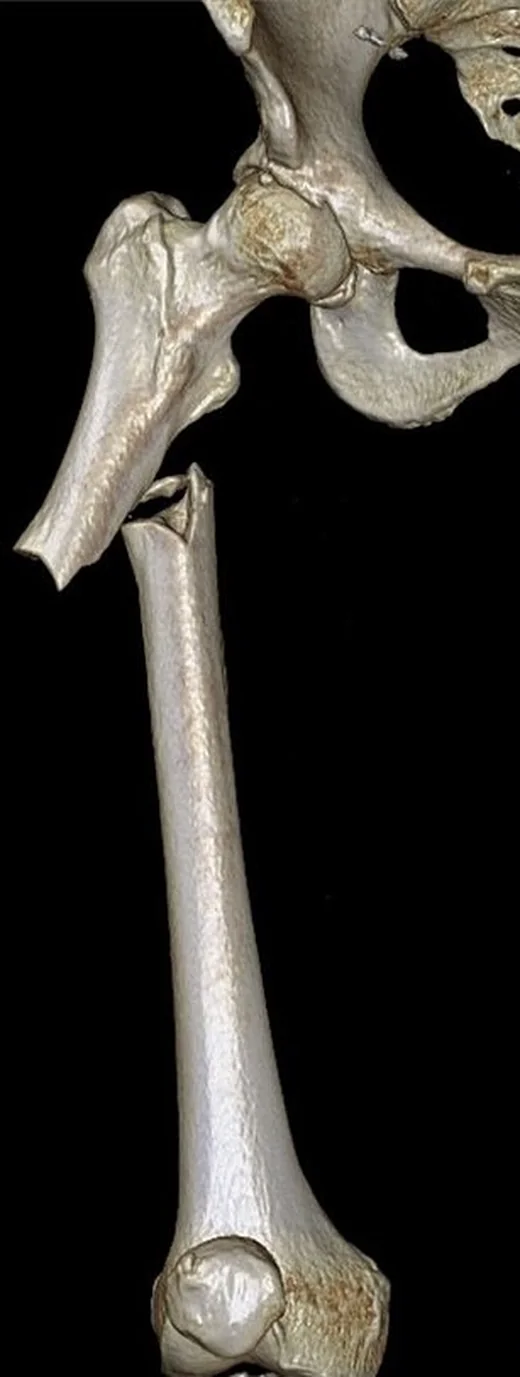
Femur cisim kırığı, diyafizin yüksek enerjili travmada parçalı ya da basit kırılmasını; kemik zayıflığında ise patolojik kırığı kapsar. Kontrastsız BT travma taraması sırasında kırık hattının yönünü, kortikal parçalanmayı, deplasmanı ve proksimal/distal uzanımı gösterebilir. Tüm femurun görüntülenmesi aynı kemikte ikinci bir kırık odağını, kemik lezyonunu veya mevcut implant ilişkisini yakalamaya yardımcı olur. Yalnız tek kırık seviyesini raporlamak eşlik eden ek yaralanma veya belirgin kısalık/rotasyonun gözden kaçmasına neden olabilir.
Faz ve pencere
- Kontrastsız tanısal
- Aksiyel ince kesit BT’nin kemik algoritmalı koronal ve sagittal rekonstrüksiyonlarında kortikal kesinti, kırık hattının yönü ve uzunluğu, serbest fragmanlar, şaft translasyonu/kısalması, angulasyon ve proksimal ya da distal ek kırık seviyeleri değerlendirilir. Kırık morfolojisi için intravenöz kontrast gerekmez; femur boyunca eşlik eden kemik lezyonu ve implant ilişkisi de taranır.
Önerilen pencereler: Kemik (G 1800 / M 400), Yumuşak doku (G 400 / M 40).
BT bulguları
- Transvers, oblik veya spiral hat — çizginin şaft uzun eksenine göre yönünü ve kortekslerden hangi sırayla çıktığını belirtin.
- Segmental örüntü — aynı diyafizde iki ayrı tam kırık seviyesi arasında serbest kemik segmenti bulunur.
- Parçalanma — kelebek fragman, çoklu kortikal kırıntı veya çevresel kemik kaybı kemik penceresinde görünür.
- Translasyon ve örtüşme — distal veya proksimal ana fragmanın yer değişikliği ve şaft kısalması tanımlanır.
- Açılanma ve rotasyon — koronal/sagittal düzlemde eksen sapması; aksiyel düzlemde kortikal kontur ve küçük trokanter yönü yardımcı olabilir.
- Tüm femurda ek odak — proksimal boyun/trokanter ve distal suprakondiler bölge dahil görüntülenen kemiğin geri kalanı taranır.
- Patolojik veya implant ilişkili kırık — kırık odağındaki litik/sklerotik değişiklik, protez sapı ya da tespit materyaliyle ilişki gösterilir.
Ölçütler ve sınıflamalar
- AO femur diyafizi sınıflaması (32)
Normalde
Normal femur diyafizinde korteks proksimalden distale kesintisiz ilerler ve medüller kanal düzenli kalibrededir; şaftın fizyolojik eğriliği iki düzlemde izlenir. Karşı femuru ve aynı femurun kırık dışındaki seviyelerini kıyaslayarak normal kontur, kemik yoğunluğu, kanal çapı ve varsa eski implant pozisyonunu ayırt edin.
Normal BT ile kıyasla
Aynı bölgenin, kaynak veri setinde patoloji içermediği belirtilen bir BT incelemesini kesit kesit kaydırın; organ sınırlarını açarak anatomiyi hasta görüntüsüyle karşılaştırın. Küçük rastlantısal bulgular tümüyle dışlanmamıştır.
Kaynak: TotalSegmentator v2.01 veri seti (Wasserthal ve ark., Radiology: Artificial Intelligence 2023), CC BY 4.0, vaka s0685; organ sınırları veri setinin otomatik segmentasyonundan, birleştirilerek sadeleştirildi. Görüntüler 2,5 mm kesit aralığına yeniden örneklendi.
Ayırıcı tanı
- Subtrokanterik kırık, femurun subtrokanterik bölgesinde yer alır ve şaft kırığından anatomik konumuyla ayrılır.
- Distal femur kırığı
- kırık suprakondiler/metafizer bölgede veya eklem yüzüne uzanır, diyafiz merkezli değildir.
- Stres veya yetersizlik kırığı
- kortikal kalınlaşma ve sınırlı periosteal reaksiyonla birlikte ince çizgi olabilir; çoğu kez belirgin akut deplasman yoktur.
- Kemik tümörü zemininde patolojik kırık
- fokal medüller lezyon kortikal yıkım veya genişlemeyle kırık hattına eşlik eder.
- Eski iyileşmiş kırık
- kallus ve kortikal yeniden şekillenme vardır; kırık uçlarında akut keskin ayrışma beklenmez.
Tuzaklar
- Kalça veya diz odaklı kısmi tarama femur şaftındaki ayrı bir kırığı dışlamaz; inceleme hacmi boyunca tüm femuru gözden geçirin.
- Tek aksiyel kesitte görülen çizgi damar oluğu veya besleyici kanal olabilir; kortikal sonlanmayı ardışık kesit ve ortogonal düzlemde doğrulayın.
- Yumuşak doku hematomu kırığın yerini destekler ancak kortikal kenarları örtebilir; kemik algoritmasıyla yeniden kurun.
- Rotasyon açısı tek bir aksiyel kesitten güvenilir belirlenmez; raporda doğrudan ölçülmüş gibi sayı vermek yerine belirgin yön değişikliğini anatomik olarak tarif edin.
Kendini dene
Diyafizde iki tam kırık hattı arasında serbest bir kemik segmenti ve belirgin parçalanma var. Bu örüntü nasıl adlandırılır?
Cevabı göster
Segmental femur cisim kırığı. İki ayrı kırık seviyesi arasında kalan serbest diyafiz segmenti segmental cisim kırığını tanımlar. Diğer seçenekler proksimal femur çıkıntısı, baş veya boyun bölgesindedir.
Şaft kırığı BT'sinde ek raporlama için en kritik tarama hangisidir?
Cevabı göster
Femurun tamamında ikinci odak. Femurun tüm uzunluğu boyunca ikinci kırık, lezyon veya implant ilişkisi aranmalıdır. Diğer yapılar tek başına aynı kemikteki ek odağı dışlamaz.
İlgili konular
Kaynaklar
Bu sayfadaki 37 cümle ve 2 quiz sorusu aşağıdaki kaynaklardan alıntılarla otomatik olarak karşılaştırıldı; 2 cümle bu karşılaştırmada düzeltildi (2026-10-09).
- Metal implantation and high-grade osteosarcoma of the femur: a case report and review of the literaturepmc.ncbi.nlm.nih.gov
- Delayed femoral artery injury caused by heterotopic ossification: a rare case report and review of the literaturepmc.ncbi.nlm.nih.gov
- Effect of the degree of displacement of the third fragment on healing of femoral shaft fracture treated by intramedullary nailingpmc.ncbi.nlm.nih.gov
- Patellar tendon ossification after retrograde intramedullary nailing for distal femoral shaft fracturepmc.ncbi.nlm.nih.gov
- A 42-year-old patient presenting with femoral head migration after hemiarthroplasty performed 22 years earlier: a case reportpmc.ncbi.nlm.nih.gov
- Purtscher's retinopathy after intramedullary nailing of a femoral shaft fracture in a 20-year old healthy female - report of a rare case and review of the literature.pubmed.ncbi.nlm.nih.gov
- Metal implantation and high-grade osteosarcoma of the femur: a case report and review of the literature.pubmed.ncbi.nlm.nih.gov
- Delayed femoral artery injury caused by heterotopic ossification: a rare case report and review of the literature.pubmed.ncbi.nlm.nih.gov
- Unusual imaging presentation of gossypiboma with pelvic bone involvement: a case report and radiologic review of the literature.pubmed.ncbi.nlm.nih.gov
- Single-Leg Spica Cast Application for Treatment of Pediatric Femoral Fracture.pubmed.ncbi.nlm.nih.gov
- Finite Element- and Design of Experiment-Derived Optimization of Screw Configurations and a Locking Plate for Internal Fixation System.pubmed.ncbi.nlm.nih.gov
- Topical cutaneous CO2 application by means of a novel hydrogel accelerates fracture repair in rats.pubmed.ncbi.nlm.nih.gov
- Motor aphasia as a rare presentation of fat embolism syndrome; a case report.pubmed.ncbi.nlm.nih.gov
- Impaired Fracture Healing after Hemorrhagic Shock.pubmed.ncbi.nlm.nih.gov
- Nrf2 deficiency impairs fracture healing in mice.pubmed.ncbi.nlm.nih.gov
- Bone loss and impaired fracture healing in spinal cord injured mice.pubmed.ncbi.nlm.nih.gov
- Femoral malrotation following intramedullary nail fixation.pubmed.ncbi.nlm.nih.gov
- Periosteal osteosarcoma and Marfan's syndrome: A case report and literature review.pubmed.ncbi.nlm.nih.gov
- Evaluation of femoral malrotation after intramedullary nailing.pubmed.ncbi.nlm.nih.gov
- Nighttime intramedullary nailing of femoral fractures is not associated with worse outcomes: a 13-year Level I trauma center cohort.pubmed.ncbi.nlm.nih.gov
- A rare traumatic triad: Open bicondylar non-conjoint Hoffa fracture with partial tibial tubercle and medial epicondyle avulsions - A case report and biomechanical analysis.pubmed.ncbi.nlm.nih.gov
- Resident autonomy in orthopedic trauma: independent femoral IMN by senior residents yields comparable outcomes to fellowship-trained surgeons.pubmed.ncbi.nlm.nih.gov
- Case Report: A case of jejunal T-cell non-Hodgkin lymphoma with secondary bone involvement presenting as gastrointestinal perforation.pubmed.ncbi.nlm.nih.gov
- Case Report: A case of surgical and enzyme replacement therapy for type I Gaucher disease complicating femoral shaft pathological fracture.pubmed.ncbi.nlm.nih.gov
- Pathologic Femur Fracture in an Immunocompetent Healthy Young Adult due to Acute Osteomyelitis.pubmed.ncbi.nlm.nih.gov
- Routine 6-Week Outpatient Visit in Patients After Osteosynthesis of Lower Extremity Fractures: Is It Truly Necessary?pubmed.ncbi.nlm.nih.gov
- Fracture Fixation Sequencing in Polyskeletal Trauma: Clinical Experience from a Five-Patient Retrospective Series.pubmed.ncbi.nlm.nih.gov
- Multiple Intramedullary and Skewer Pin Fixation for Complex Humeral and Femoral Fractures in Cats and Small-Breed Dogs.pubmed.ncbi.nlm.nih.gov
- Conservative Treatment of Pediatric Fractures-Narrative Review of Acceptable Deformity and Remodeling Potential.pubmed.ncbi.nlm.nih.gov
- Internal-locking intramedullary nails (talons, claws, wings, wedge-locks, endopins): a mechanics-guided scoping review of designs, failure signatures, and technique imperatives.pubmed.ncbi.nlm.nih.gov
- Ballistic Galeazzi Fractures: A Case Series.pubmed.ncbi.nlm.nih.gov
- Complications of osteotomies around the knee.pubmed.ncbi.nlm.nih.gov
- Trifocal femur fracture: Where should one begin? A case report and literature review.pubmed.ncbi.nlm.nih.gov
- Custom Antibiotic-Coated Intramedullary Nails for Infected Tibial and Femoral Nonunions: Retrospective Cohort Study and Surgical Technique.pubmed.ncbi.nlm.nih.gov
- The Unique Features of Pediatric Sports Injuries: The Hip.pubmed.ncbi.nlm.nih.gov
- Proximal femoral bionic nail is associated with lower postoperative complication risk and better early functional recovery in older patients with intertrochanteric fractures: a retrospective cohort study.pubmed.ncbi.nlm.nih.gov
- Intramedullary Nailing of Femoral Shaft Fractures: Implications of Interlocking Screw Breakage.pubmed.ncbi.nlm.nih.gov
- Imaging of pediatric musculoskeletal trauma: Age-specific considerations and challenges.pubmed.ncbi.nlm.nih.gov
- Finite element modeling of lag screw with plate fracture fixation: Effects of screw angle, countersinking, and plate configuration.pubmed.ncbi.nlm.nih.gov
- Nail-Schanz pin integrated external distraction technique during intramedullary nailing of comminuted femoral shaft fracture.pubmed.ncbi.nlm.nih.gov
- The outcomes of patients with segmental long bone fractures treated with SIGN nail at Addis Ababa Burn, Emergency and Trauma Hospital.pubmed.ncbi.nlm.nih.gov
- Performance of prediction models for delayed union and nonunion after fracture: a systematic review and meta-analysis.pubmed.ncbi.nlm.nih.gov
- Dilemma for Fracture Fixation of Paediatric Ipsilateral Neck with Shaft Femur Fracture.pubmed.ncbi.nlm.nih.gov
- Ultrasound and shockwave therapy for acute fractures in adults.pubmed.ncbi.nlm.nih.gov
- From episodic imaging to real-time sensor monitoring: translational advances in assessing fracture healing dynamics.pubmed.ncbi.nlm.nih.gov
- Imaging-assisted intra-operative approach to torsional alignment in paediatric femoral shaft fractures treated with hip spica.pubmed.ncbi.nlm.nih.gov
- What is the rate and degree of deformity in femoral diaphyseal nonunion? A CT-based retrospective cohort study.pubmed.ncbi.nlm.nih.gov
- Three-dimensional virtual modeling for lower limb deformity correction over intramedullary nail.pubmed.ncbi.nlm.nih.gov
- Occult cement plug causing femoral canal obstruction during nailing after TKA: a case report.pubmed.ncbi.nlm.nih.gov
- An analysis of different reconstruction techniques for the radius: a finite element analysis.pubmed.ncbi.nlm.nih.gov
- osteopoikilosis and fracture healing: the bone quantity-quality paradox-a case report and systematic review with synthesis without meta-analysis.pubmed.ncbi.nlm.nih.gov
- Clinical Characteristics of Patients with Long-Bone Fracture Nonunion and Delayed Union and Factors Associated with Infection: A Retrospective Single-Center Cohort Study.pubmed.ncbi.nlm.nih.gov
- Optimizing plate working length and screw configuration for femoral shaft plate fixation: a finite element analysis under different bone quality scenarios.pubmed.ncbi.nlm.nih.gov
- How do forelimb long bones adapt in rhinoceroses? An in-depth examination of their microanatomy.pubmed.ncbi.nlm.nih.gov
- Modified masquelet technique coupled with vascularized fibular transplantation (transposition) in the reconstruction of ultra-long structural bone defects following osteomyelitis debridement: clinical application and preliminary study on therapeutic outcomes.pubmed.ncbi.nlm.nih.gov
- Kinematic Alignment in TKA Using the Contralateral Healthy Knee as Reference: A Combined Finite Element and Clinical Analysis.pubmed.ncbi.nlm.nih.gov
- Salvage of a 5-Year Neglected Distal Femur Nonunion in a Refugee: A Case Report.pubmed.ncbi.nlm.nih.gov
- The iliotibial band revisited: surgical anatomy and imaging-based guidelines for lateral tenodesis in ACL reconstruction.pubmed.ncbi.nlm.nih.gov
- The radial nerve bridging plate technique for humeral shaft fractures: an approach facilitating plate removal without impeding fracture union - a case series.pubmed.ncbi.nlm.nih.gov
- Does Cephalomedullary Nail Design Influence Risk of Varus Collapse in Subtrochanteric Femur Fractures?pubmed.ncbi.nlm.nih.gov
- Cephalomedullary nail fixation of subtrochanteric femur fractures in older adults: Is 1 distal locking screw enough?pubmed.ncbi.nlm.nih.gov
- Comparing outcomes for retrograde intramedullary nailing vs. antegrade intramedullary nailing for Femoral fractures - a systematic review and meta-analysis.pubmed.ncbi.nlm.nih.gov
- Characteristics of Femoral Shaft Fractures That Predict Ipsilateral Femoral Neck Fractures.pubmed.ncbi.nlm.nih.gov
- Optimizing fixation in medial distal femur fractures: A biomechanical study.pubmed.ncbi.nlm.nih.gov
- Design innovation and rationale of the intramedullary implants for treating Intertrochanteric fractures: A review.pubmed.ncbi.nlm.nih.gov
- Progress of fracture mapping technology based on CT three-dimensional reconstruction.pubmed.ncbi.nlm.nih.gov
- Biomechanical advantages of double-column bridging plate-augmented PFNA for complex subtrochanteric femoral fractures: a finite element analysis.pubmed.ncbi.nlm.nih.gov
- Magnetic Resonance Imaging-Based Cohesive Extended Finite Element Modeling of Atypical Femoral Fracture.pubmed.ncbi.nlm.nih.gov
- What is the Optimal Nail Length to Treat Osteoporotic Subtrochanteric Fractures? A Finite Element Analysis.pubmed.ncbi.nlm.nih.gov
- Dysosteosclerosis: Clinical and Radiological Evolution Reflecting Genetic Heterogeneity.pubmed.ncbi.nlm.nih.gov
- Surgical interventions for treating extracapsular hip fractures in older adults: a network meta-analysis.pubmed.ncbi.nlm.nih.gov
- Bisphosphonate-Related Pathological Femoral Fracture in a Child with ACTG2-Related Intestinal Failure and Metabolic Bone Disease: A Case Report.pubmed.ncbi.nlm.nih.gov
- Sequential stress fractures of the ulna and radius in a patient with neurofibromatosis type 1: A case report.pubmed.ncbi.nlm.nih.gov
- Radiological Assessment of Atypical Femoral Fractures: A 10-Year Experience Across Two Centres.pubmed.ncbi.nlm.nih.gov
- Anterolateral approach for benign proximal femoral lesions among Indian children.pubmed.ncbi.nlm.nih.gov
- Diagnostic and Treatment Strategies for Adult Non-Ossifying Fibromas: A Case Report and Literature Review.pubmed.ncbi.nlm.nih.gov
- Case Report: Giant cell reparative granuloma of the humerus and femur-two rare cases with atypical skeletal involvement.pubmed.ncbi.nlm.nih.gov
- Novel Technique for Fracture Non-Union in Children - A Case Report.pubmed.ncbi.nlm.nih.gov
- Decortication in the Surgical Management of Complete Atypical Femoral Fractures: A Strategy to Accelerate Fracture Healing.pubmed.ncbi.nlm.nih.gov
- Biologics for bone regeneration: advances in cell, protein, gene, and mRNA therapies.pubmed.ncbi.nlm.nih.gov
- Intelligent Attention-Driven Deep Learning for Hip Disease Diagnosis: Fusing Multimodal Imaging and Clinical Text for Enhanced Precision and Early Detection.pubmed.ncbi.nlm.nih.gov
- Surgical fixation methods for tibial plateau fractures.pubmed.ncbi.nlm.nih.gov
- 3D-printed hip prostheses with regenerative integration: a state-of-the-art comprehensive review.pubmed.ncbi.nlm.nih.gov
- Heart Disease and Stroke Statistics-2023 Update: A Report From the American Heart Association.pubmed.ncbi.nlm.nih.gov
- Commentary: an eye on PET quantification.pubmed.ncbi.nlm.nih.gov
- Patterns of injury and violence in Yaoundé Cameroon: an analysis of hospital data.pubmed.ncbi.nlm.nih.gov
- Guide to lower extremity radiologic measurements: part 1 hip.pubmed.ncbi.nlm.nih.gov
- Using a Traction Table for Fracture Reduction during Minimally Invasive Plate Osteosynthesis (MIPO) of Distal Femoral Fractures Provides Anatomical Alignment.pubmed.ncbi.nlm.nih.gov
- Clinical efficacy of the lateral decubitus position in the treatment of irreducible trochanteric fractures with bisection of the lesser trochanter.pubmed.ncbi.nlm.nih.gov
- Combined Imhauser osteotomy and osteochondroplasty in slipped capital femoral epiphysis through surgical hip dislocation approach.pubmed.ncbi.nlm.nih.gov
- Salter-Harris type II fracture of the femoral bone in a 14-year-old boy - case report.pubmed.ncbi.nlm.nih.gov
- Healing sequelae following tooth extraction and dental implant placement in an aged, ovariectomy model.pubmed.ncbi.nlm.nih.gov
- Interventions for treating femoral shaft fractures in children and adolescents.pubmed.ncbi.nlm.nih.gov
- Earliest evidence of elephant butchery at Olduvai Gorge (Tanzania) reveals the evolutionary impact of early human megafaunal exploitation.pubmed.ncbi.nlm.nih.gov
- Imaging of ewing sarcoma: an updated analysis including presenting features, prognostic imaging biomarkers, and treatment response assessment.pubmed.ncbi.nlm.nih.gov
- Comparative Outcomes of Proximal Femoral Nail Antirotation Versus Conservative Treatment in Super-Elderly Patients With Intertrochanteric Fractures.pubmed.ncbi.nlm.nih.gov
- Case Report: Total hip arthroplasty via the direct anterior approach using a cementless revision stem without corrective osteotomy for fibrous dysplasia.pubmed.ncbi.nlm.nih.gov
- Retained tunneled dialysis catheter presenting with complete exit site healing: A case report.pubmed.ncbi.nlm.nih.gov
- Evidence for deliberate burial of the dead by <i>Homo naledi</i>.pubmed.ncbi.nlm.nih.gov
- Application of Virtual Reality Systems in Bone Trauma Procedures.pubmed.ncbi.nlm.nih.gov
- Radiological Outcomes of Reamed Short Proximal Femoral Nailing in Intertrochanteric Fractures in Patients Aged 50 Years and Above.pubmed.ncbi.nlm.nih.gov
- Femoral Neck Fracture With Anterior Tilt.pubmed.ncbi.nlm.nih.gov
- Area-to-Length Ratio: a significant predictor of nonunion following intramedullary nailing of comminuted femoral shaft fractures.pubmed.ncbi.nlm.nih.gov
- A Scoring System for Predicting Nonunion After Intramedullary Nailing of Femoral Shaft Fractures.pubmed.ncbi.nlm.nih.gov
- A bibliometric analysis of clinical research on fracture-related infection.pubmed.ncbi.nlm.nih.gov
- Clinical efficacy of Masquelet technique in the treatment of tibial and fibular bone defects caused by severe gunshot wounds.pubmed.ncbi.nlm.nih.gov
- Floating Knee Severity Score (FKS): A Novel Multidimensional Prognostic Model for Predicting Functional Outcomes After Floating Knee Injuries.pubmed.ncbi.nlm.nih.gov
- Application of digital classification based on AO classification in floating knee injury.pubmed.ncbi.nlm.nih.gov
- Not All Cams Are Equal: MRI-Based Statistical Shape Modeling Reveals High Variability in Cam Shape in a Large FAI Cohort.pubmed.ncbi.nlm.nih.gov
- Anatomy-driven automated subsegmentation of pelvic and proximal femoral CT into clinically relevant subregions and landmarks.pubmed.ncbi.nlm.nih.gov
- Influence of Pelvic Tilt and Bone Morphology on Extra-Articular Bony Impingement in Total Hip Arthroplasty.pubmed.ncbi.nlm.nih.gov
- Cost-effectiveness of surgical and conservative interventions for orthopaedic injuries in Malawi: a modelling study.pubmed.ncbi.nlm.nih.gov
- Subcapital Realignment of the Displaced Pediatric Radial Head-Technical Description and Early Clinical Results.pubmed.ncbi.nlm.nih.gov
- Computer Vision in Lower Limb Orthopaedics: A Scoping Review of Imaging-Based Artificial Intelligence Applications.pubmed.ncbi.nlm.nih.gov
- A Systematic Approach to the Evaluation of Acute Musculoskeletal Injuries in the Emergency Department.pubmed.ncbi.nlm.nih.gov
Eğitim amaçlıdır; hasta başında tanı ve tedavi kararının yerine geçmez, tıbbi tavsiye değildir. Metinler yapay zekâ desteğiyle yazıldı ve otomatik bir adımda kaynak alıntılarıyla karşılaştırıldı; bu bir tıbbi doğrulama değildir ve içerik uzman radyolog incelemesinden geçmedi. Klinik kararlarda güncel kılavuzları, kurum protokollerini ve radyoloji raporunu esas alın.