Özet
Ağrısı süren veya yeni başlayan kalça protezli hastada femoral stem çevresindeki kemik kaybı, implant parçacıklarına bağlı osteolizden ya da enfeksiyondan kaynaklanabilir. Metal artefakt azaltmalı kontrastsız BT, stem-kemik ara yüzünü ve radyografide üst üste binen kemik alanlarını kesitsel olarak gösterir. Gevşeme tanısı tek bir radyolüsent çizgiyle konmaz; seri incelemede artan kemik kaybı veya komponent konum değişikliği daha anlamlıdır. İlerleyen osteolizin ve kemik stoğu kaybının atlanması, stem desteğinin bozulmasını ve periprostetik kırık olasılığını gözden kaçırabilir.
Faz ve pencere
- Kontrastsız tanısal
- Metal artefakt azaltımlı kemik rekonstrüksiyonunda femoral stem boyunca kemik kaybının yerini, korteks ve çimento mantosunun bütünlüğünü, ara yüz ayrışmasını ve stemin önceki incelemeye göre yer değiştirip değiştirmediğini incele; bu kemik-implant değerlendirmesi için intravenöz kontrast gerekmez.
Önerilen pencereler: Kemik (G 1800 / M 400), Yumuşak doku (G 400 / M 40).
BT bulguları
- Periprostetik osteoliz — stem çevresinde sınırları seçilen endosteal kemik kaybı, komşu korteksi inceltebilir veya kemik stoğunda defekt oluşturabilir.
- Ara yüz radyolüsensisi — kemik-stem ya da kemik-çimento sınırını izleyen saydam bant; tek kesitteki görünümü gevşemeyi kanıtlamaz.
- Seri kemik kaybı — önceki BT ile karşılaştırıldığında aynı stem bölgesindeki defektin genişlemesi veya yeni bir bölgeye uzanması.
- Stem migrasyonu — implantın önceki incelemeye göre aşağı yer değiştirmesi, ekseninin değişmesi ya da proksimal femura göre yeni açılanması.
- Çimento mantosu ayrışması — çimentolu stemde çimento boyunca çatlak, parçalanma veya çimento-kemik temasının kaybı.
- Kortikal incelme — osteolitik alanın femur korteksini zayıflatması; özellikle büyük trokanter ve diafiz çevresinde kalan kemik stoğunu haritala.
- Enfeksiyon lehine kemik-yumuşak doku eşliği — düzensiz endosteal yıkımın periostal reaksiyon, koleksiyon veya sinüs yolu ile birlikte bulunması.
Ölçütler ve sınıflamalar
- Gruen femoral zonları
- Femoral stem çevresindeki kemik, ön-arka radyografide proksimal lateralden başlayıp distale ve medial tarafa devam eden yedi bölgeyle tariflenir; osteolizin konumunu standartlaştırır, BT'de ise kesitsel yer ve uzanım ayrıca belirtilmelidir.
Normalde
Stabil protezli kalçada femoral stemin ekseni ve ucu seri görüntülerde aynı konumdadır; stem çevresindeki korteks süreklidir ve yeni genişleyen kemik defekti yoktur. Mevcut ara yüzü önceki incelemeyle karşılaştır; ilerleme, morfoloji ve komponent göçünü birlikte değerlendir.
Normal BT ile kıyasla
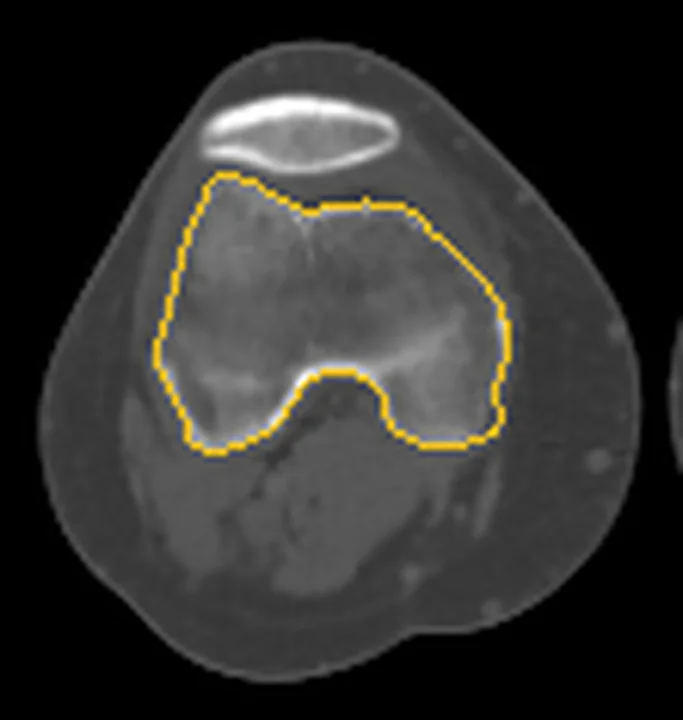
Aynı bölgenin, kaynak veri setinde patoloji içermediği belirtilen bir BT incelemesini kesit kesit kaydırın; organ sınırlarını açarak anatomiyi hasta görüntüsüyle karşılaştırın. Küçük rastlantısal bulgular tümüyle dışlanmamıştır.
Kaynak: TotalSegmentator v2.01 veri seti (Wasserthal ve ark., Radiology: Artificial Intelligence 2023), CC BY 4.0, vaka s0685; organ sınırları veri setinin otomatik segmentasyonundan, birleştirilerek sadeleştirildi. Görüntüler 2,5 mm kesit aralığına yeniden örneklendi.
Ayırıcı tanı
- Protez çevresi enfeksiyon
- kemik yıkımına periostal reaksiyon, koleksiyon veya sinüs traktı eşlik edebilir; osteoliz tek başına ayrım yaptırmaz.
- Yük aktarımına bağlı kemik yeniden şekillenmesi (stress shielding), zamanla proksimal kemik stoğunda azalmaya yol açabilir.
- Metal artefaktı periprostetik değerlendirmeyi kısıtlayabilir; artefakt azaltma yöntemleri metal artefaktını tamamen ortadan kaldırmayabilir.
- Periprostetik kırık, protez çevresindeki kemik kaybı ve gevşemeden ayrı bir komplikasyon olasılığıdır; görüntülemede kırık varlığı ayrıca değerlendirilmelidir.
- Advers lokal doku reaksiyonu
- metal aşınma ürünlerine bağlı gelişen kitle benzeri yumuşak doku (pseudotümör) protez çevresinde kemik kaybına ve gevşemeye eşlik edebilir; modüler femoral stem tasarımları risk faktörü olup yumuşak dokunun gösterilmesinde metal artefakt azaltımlı MR öne çıkar.
Tuzaklar
- Tek incelemede görülen radyolüsent hattı gevşeme diye adlandırma; önce implantın ilk ve ara dönem görüntülerindeki konumunu kıyasla.
- Proksimal femurdaki düzgün kemik incelmesini otomatik olarak osteoliz sayma; stem çevresindeki fokal sınır, korteks defekti ve dağılımı araştır.
- Metal artefaktlarının periprostetik değerlendirmeyi kısıtlayabileceğini göz önünde bulundur; artefakt azaltma teknikleri görüntüyü iyileştirse de artefaktı tamamen ortadan kaldırmayabilir.
- Aseptik gevşeme ile enfeksiyöz gevşemeyi yalnız BT görünümünden kesin ayırma; yumuşak doku yayılımı ve klinik-laboratuvar verileri ile korelasyon gerekir.
Kendini dene
BT'de 2 mm'den büyük periprostetik radyolüsensi hangi olasılığı düşündürür?
Cevabı göster
Protez gevşemesi. BT'de 2 mm'den büyük periprostetik radyolüsensi olası gevşemeyi düşündürür; değerlendirmede zaman içindeki ilerleme, morfoloji ve komponent göçü de dikkate alınır.
Protez çevresindeki kemik yıkımına periostal reaksiyon ve çevresel kontrastlanan sıvı koleksiyonu eşlik ediyor. Öncelikle hangi olasılık araştırılmalıdır?
Cevabı göster
Protez çevresi enfeksiyon. Periostal reaksiyon ve çevresel kontrastlanan protez çevresi sıvı koleksiyonu enfeksiyon olasılığının araştırılmasını destekler; BT bulguları tek başına enfeksiyonu doğrulamaz.
İlgili konular
Kaynaklar
Bu sayfadaki 35 cümle ve 2 quiz sorusu aşağıdaki kaynaklardan alıntılarla otomatik olarak karşılaştırıldı; 8 cümle bu karşılaştırmada düzeltildi (2026-10-09).
- Extensive Periprosthetic Lucencies and Acetabular Protrusio in a Hip Hemiarthroplasty: A Case Reportpmc.ncbi.nlm.nih.gov
- Iliopsoas Abscess as the Initial Manifestation of Periprosthetic Hip Joint Infection after Total Hip Arthroplasty: A Case Report and Literature Reviewpmc.ncbi.nlm.nih.gov
- Custom-Made Monoflange Acetabular Component for Revision Hip Arthroplasty in Paprosky Type IIIA Defect: A Case Reportpmc.ncbi.nlm.nih.gov
- 25-year follow-up of 102 unrevised cementless total hip arthroplasties with a second-generation metal-on-metal bearing in a young patient cohortpmc.ncbi.nlm.nih.gov
- Catastrophic Acetabular Osteolysis and Component Migration Secondary to Surgical Cup Malpositioning: A Case Reportpmc.ncbi.nlm.nih.gov
- Imaging of hip arthroplasty.pubmed.ncbi.nlm.nih.gov
- [Acetabular Osteolysis in Total Hip Replacement - When to Retain the Cup?].pubmed.ncbi.nlm.nih.gov
- Imaging of hip arthroplasty.pubmed.ncbi.nlm.nih.gov
- Cementless ceramic-on-ceramic total hip arthroplasty in post-traumatic osteoarthritis after acetabular fracture: long-term results.pubmed.ncbi.nlm.nih.gov
- Imaging of Hip Arthroplasties: Normal Findings and Hardware Complications.pubmed.ncbi.nlm.nih.gov
- Hip prosthetic loosening: A very personal review.pubmed.ncbi.nlm.nih.gov
- Stem-bone contact patterns of a long straight tapered uncemented stem for primary THA.pubmed.ncbi.nlm.nih.gov
- Mid term results of total hip arthroplasty using polyethylene-ceramic composite (Sandwich) liner.pubmed.ncbi.nlm.nih.gov
- Bearing surfaces for total disc arthroplasty: metal-on-metal versus metal-on-polyethylene and other biomaterials.pubmed.ncbi.nlm.nih.gov
- A 10- to 12-year follow-up study of delta ceramic-on-ceramic total hip arthroplasty.pubmed.ncbi.nlm.nih.gov
- Expression of XBP1s in fibroblasts is critical for TiAl 6 V 4 particle-induced RANKL expression and osteolysis.pubmed.ncbi.nlm.nih.gov
- Cimifugin Suppresses NF-κB Signaling to Prevent Osteoclastogenesis and Periprosthetic Osteolysis.pubmed.ncbi.nlm.nih.gov
- Highly Cross-Linked Polyethylene in Total Hip Arthroplasty in Patients Younger Than 50 Years With Osteonecrosis of the Femoral Head: A Minimum of 10 Years of Follow-Up.pubmed.ncbi.nlm.nih.gov
- Periprosthetic metastasis: a rare cause for prosthetic loosening.pubmed.ncbi.nlm.nih.gov
- Catastrophic Acetabular Osteolysis and Component Migration Secondary to Surgical Cup Malpositioning: A Case Report.pubmed.ncbi.nlm.nih.gov
- A Case of Catastrophic Failure of Tibial Component with Extensive Metallosis Following Total Knee Arthroplasty: A Case Report.pubmed.ncbi.nlm.nih.gov
- Key Inflammatory Pathways, Biomarkers, and Targeted Management Strategies in Primary Total Joint Arthroplasty: A Narrative Review.pubmed.ncbi.nlm.nih.gov
- Unexpected Metal Ion Elevation and Adverse Tissue Reactions in Trident II Dual Mobility Constructs With Ceramic Heads.pubmed.ncbi.nlm.nih.gov
- Catastrophic Failure of a Prosthetic Femoral Stem due to Component Malposition: A Case Report.pubmed.ncbi.nlm.nih.gov
- Custom-Made Monoflange Acetabular Component for Revision Hip Arthroplasty in Paprosky Type IIIA Defect: A Case Report.pubmed.ncbi.nlm.nih.gov
- Early-term clinical and radiographic outcomes of a new short cementless stem for primary total hip arthroplasty in young and active patients.pubmed.ncbi.nlm.nih.gov
- Autologous femoral head structural bone grafting in primary total hip arthroplasty for adult developmental dysplasia of the hip: mid-term clinical and radiographic outcomes.pubmed.ncbi.nlm.nih.gov
- Role of polyetheretherketone (PEEK) in arthroplasty and orthopaedics: a review of biomechanical properties, surface modifications, and clinical outcomes.pubmed.ncbi.nlm.nih.gov
- Favorable 17-Year Outcome of a Bulk Femoral Head Allograft Combined With a Burch-Schneider Antiprotrusio Cage in Revision Total Hip Arthroplasty for Severe Acetabular Osteolysis and Pelvic Discontinuity: A Case Report.pubmed.ncbi.nlm.nih.gov
- Bone-Sparing Hip Arthroplasty in Young and Active Patients: A Narrative Review.pubmed.ncbi.nlm.nih.gov
- Stable Lord Madreporic Femoral Stem 32 Years After Revision Total Hip Arthroplasty: A Case Report.pubmed.ncbi.nlm.nih.gov
- Failure Modes in Orthopedic Oncologic Reconstructive Surgery: A Review of Imaging Findings and Failure Rates.pubmed.ncbi.nlm.nih.gov
- Management of Bone Loss in Revision Total Knee Arthroplasty: An International Consensus Symposium.pubmed.ncbi.nlm.nih.gov
- Unusual Failure of Modular TKA Prosthesis and Screw Migration following Revision Total Knee Arthroplasty.pubmed.ncbi.nlm.nih.gov
- Management of periprosthetic fractures around cemented femoral stems: osteosynthesis and revision strategies.pubmed.ncbi.nlm.nih.gov
- Stress shielding in radial head arthroplasty: a comparative analysis of partially vs. fully grit-blasted press-fit stems.pubmed.ncbi.nlm.nih.gov
- Prosthetic Loosening in a Total Hip Arthroplasty Patient After Breast Cancer Chemotherapy and Hormonal Therapy: A Case Report.pubmed.ncbi.nlm.nih.gov
- Radiographic features of bone ingrowth in highly porous cementless total knee arthroplasty with minimum 2-year follow-up.pubmed.ncbi.nlm.nih.gov
- Satisfactory Survivorship and Clinical Outcomes After Acetabular Revision With the Three-Dimensional-Printed Porous Metal Monoblock Dual-Mobility Cup: A Retrospective Case Series With Mean 3 Years Follow-Up.pubmed.ncbi.nlm.nih.gov
- A three-dimensional method for evaluating changes in acetabular osteolytic lesions in response to treatment.pubmed.ncbi.nlm.nih.gov
- International Society of Paediatric Surgical Oncology (IPSO) Surgical Practice Guidelines.pubmed.ncbi.nlm.nih.gov
- High-affinity alphavbeta3 integrin targeted optical probe as a new imaging biomarker for early atherosclerosis: initial studies in Watanabe rabbits.pubmed.ncbi.nlm.nih.gov
- Assessment of the initial stability of the Symax femoral stem with EBRA-FCA: a multicentric study of 85 cases.pubmed.ncbi.nlm.nih.gov
- Correlation of Subsidence with Proximal Femoral Anatomy in Hydroxyapatite-Coated vs Non-hydroxyapatite-coated Collarless Femoral Stems: Radiological Results at a Mean Follow-Up of 4.5 Years.pubmed.ncbi.nlm.nih.gov
- Wiring Techniques for the Fixation of Trochanteric Fragments during Bipolar Hemiarthroplasty for Femoral Intertrochanteric Fracture: Clinical Study and Technical Note.pubmed.ncbi.nlm.nih.gov
- Cementing technique of the femur in primary THA: the French paradox.pubmed.ncbi.nlm.nih.gov
- Advances in TCP-Modified PMMA Bone Cements: Relating Microstructure to Mechanical, Biological and Functional Performance-Systematic Review.pubmed.ncbi.nlm.nih.gov
- Biomechanical impact of enoxaparin sodium-chitosan-PMMA bone cement in hip arthroplasty: a preliminary finite element analysis.pubmed.ncbi.nlm.nih.gov
- An analysis of different reconstruction techniques for the radius: a finite element analysis.pubmed.ncbi.nlm.nih.gov
- Proximal femoral defect classifications in revision total hip arthroplasty from X-rays imaging to advanced 3D imaging: a narrative review.pubmed.ncbi.nlm.nih.gov
- Case Report: Report of 2 cases of periprosthetic joint infection caused by Brucella after joint replacement and literature review.pubmed.ncbi.nlm.nih.gov
- Risk factors for prolonged hospitalization and disease course in osteomyelitis: a single-centre cohort study.pubmed.ncbi.nlm.nih.gov
- Infection in Joint Arthroplasty: Diagnosis, Prevention, and Treatment Strategies-A Comprehensive Narrative Review.pubmed.ncbi.nlm.nih.gov
- Do modular tapered long stems differ in stability and function? A prospective comparison of two stems in complex femoral revision THA.pubmed.ncbi.nlm.nih.gov
- Generalized joint hypermobility and functional recovery after THA for unilateral Hartofilakidis type C developmental dysplasia of the hip: a retrospective cohort study.pubmed.ncbi.nlm.nih.gov
- A Hybrid Automatic Model for Circle Detection in X-Ray Imagery: A Case Study on Hip Prosthesis Wear.pubmed.ncbi.nlm.nih.gov
- Preclinical evaluation of patient-specific 3D-printed PDLLA/SrHAp implants in a minipig segmental mandibular defect model.pubmed.ncbi.nlm.nih.gov
- Surgical revision in the presence of an S. aureus infection increases virulence factor expression and activates a multi-tissue inflammatory response.pubmed.ncbi.nlm.nih.gov
- Osteocytes Exposed to Titanium Particles Inhibit Osteoblastic Cell Differentiation via Connexin 43.pubmed.ncbi.nlm.nih.gov
- Preservation of periprosthetic bone with a collum-fixated short stem versus conventional metaphyseal-fixated stems in total hip arthroplasty: a randomized controlled trial with 2-year follow-up in 61 patients.pubmed.ncbi.nlm.nih.gov
- Cortical hypertrophies in cementless short stem total hip arthroplasty in young patients under 60 years and elderly patients over 75 years-analysis of outcome and risk factors for cortical hypertrophies.pubmed.ncbi.nlm.nih.gov
- Extensive Periprosthetic Lucencies and Acetabular Protrusio in a Hip Hemiarthroplasty: A Case Report.pubmed.ncbi.nlm.nih.gov
- Diagnostic and prognostic relevance of plain radiographs for periprosthetic joint infections of the hip: a literature review.pubmed.ncbi.nlm.nih.gov
- Periprosthetic hip infection: Current concepts and the Wrightington experience.pubmed.ncbi.nlm.nih.gov
- Comparison of Periprosthetic Femoral Bone Remodeling After Total Hip Arthroplasty with Zimmer VerSys Taper Stem or VerSys Midcoat Stem: Long-Term Outcomes.pubmed.ncbi.nlm.nih.gov
- A Long-Term Comparison of Periprosthetic Femoral Bone Mineral Density Between a Short and a Standard Stem Used in Total Hip Arthroplasty.pubmed.ncbi.nlm.nih.gov
- Outcome Assessment of Cementless Total Hip Arthroplasty in Patients with Late-stage Avascular Necrosis of the Femoral Head in Vietnam, 2011 - 2021.pubmed.ncbi.nlm.nih.gov
- Short-term clinical and radiographic outcomes of a 3D-printed trabecular titanium acetabular cup in primary total hip arthroplasty for Crowe type I-III developmental dysplasia of the hip with limited acetabular bone defects: a retrospective comparative study.pubmed.ncbi.nlm.nih.gov
- Custom 3D-printed split-type triflange implants for severe acetabular defects: mid-term clinical outcomes and biomechanical insights from finite element analysis.pubmed.ncbi.nlm.nih.gov
- Corrosion-Related Failures in Modular Total Knee Arthroplasty: A Narrative Review of Rare Published Clinical Cases.pubmed.ncbi.nlm.nih.gov
- The Effect of Subcutaneous Fat Tissue Length and Area on Postoperative Wound Drainage in Patients Undergoing Hemiarthroplasty for Femoral Neck Fracture.pubmed.ncbi.nlm.nih.gov
- Does the ratio of stem-to-femur length matter? A validated finite element analysis.pubmed.ncbi.nlm.nih.gov
- Automated Impaction Improves Femoral Component Canal Fit in Total Hip Arthroplasty: A Matched Study.pubmed.ncbi.nlm.nih.gov
- Inflammatory Pseudotumor After Total Hip Arthroplasty-An Increasingly Recognized Complication.pubmed.ncbi.nlm.nih.gov
- Painful Unicompartmental Knee Arthroplasty: Etiology, Diagnosis and Management.pubmed.ncbi.nlm.nih.gov
- Toward next-generation hip implants: From failure mechanisms to translational design.pubmed.ncbi.nlm.nih.gov
- Mechanobiological evaluation of solid and multiple porous humeral stem architectures in reverse shoulder arthroplasty based on design and materials: a finite element study.pubmed.ncbi.nlm.nih.gov
- 3D-Printed and Biofabricated Scaffolds for Osteoporotic Bone Defect Repair: Mechanical Adaptation, Redox Control, Senescence Modulation and Osteoimmunomodulation.pubmed.ncbi.nlm.nih.gov
- Understanding Photon-Counting CT: Physics, Detector Technology, and Image Reconstructions.pubmed.ncbi.nlm.nih.gov
- Advances in Bone Joint Imaging-Metal Artifact Reduction.pubmed.ncbi.nlm.nih.gov
- The accuracy of spectral CT with quantitative parameters in differentiating septic from aseptic periprosthetic complications.pubmed.ncbi.nlm.nih.gov
- Synovial hyperperfusion indicates low-grade periprosthetic joint infection after knee arthroplasty : contrast-enhanced ultrasound as a complementary diagnostic tool.pubmed.ncbi.nlm.nih.gov
- Prospective Comparative Analysis of Simultaneous Microbiological Assessment in Septic Revision Arthroplasty: Can We Rely on Standard Diagnostics?pubmed.ncbi.nlm.nih.gov
- Guide to lower extremity radiologic measurements: part 1 hip.pubmed.ncbi.nlm.nih.gov
- Advancements in 3D printing technologies for personalized treatment of osteonecrosis of the femoral head.pubmed.ncbi.nlm.nih.gov
- Clinical Applications of "In-Hospital" 3D Printing in Hip Surgery: A Systematic Narrative Review.pubmed.ncbi.nlm.nih.gov
- Imaging in Hip Arthroplasty Management Part 2: Postoperative Diagnostic Imaging Strategy.pubmed.ncbi.nlm.nih.gov
- Fascia Lata and Tensor Fasciae Latae in Lower-Limb Reconstruction.pubmed.ncbi.nlm.nih.gov
- Knee medial tightness after total knee arthroplasty is associated with superior clinical outcomes in Chinese patients: a retrospective cohort study.pubmed.ncbi.nlm.nih.gov
- Outcomes and short-term survivorship of fixed-bearing all-poly unicompartmental knee arthroplasty. A retrospective single-center study of 42 prostheses with a main follow-up of 32.3 months.pubmed.ncbi.nlm.nih.gov
- Imaging in shoulder arthroplasty: Current applications and future perspectives.pubmed.ncbi.nlm.nih.gov
- Microfluidics for Blood Disorders and Hematological Disease Monitoring and Modeling.pubmed.ncbi.nlm.nih.gov
- Imaging update in arthroplasty.pubmed.ncbi.nlm.nih.gov
- Long-term safety and effectiveness of the "OptEase" vena cava filter.pubmed.ncbi.nlm.nih.gov
- Invited review: Recommendations for reporting intervention studies on reproductive performance in dairy cattle: Improving design, analysis, and interpretation of research on reproduction.pubmed.ncbi.nlm.nih.gov
- Radiological Imaging Evaluation of the Failing Total Hip Replacement.pubmed.ncbi.nlm.nih.gov
- Glossary of terms for musculoskeletal radiology.pubmed.ncbi.nlm.nih.gov
- Commentary: an eye on PET quantification.pubmed.ncbi.nlm.nih.gov
- Iliopsoas Abscess as the Initial Manifestation of Periprosthetic Hip Joint Infection after Total Hip Arthroplasty: A Case Report and Literature Review.pubmed.ncbi.nlm.nih.gov
- Are short-stem prostheses superior to conventional stem prostheses in primary total hip arthroplasty? A systematic review and meta-analysis of randomised controlled trials.pubmed.ncbi.nlm.nih.gov
- Reliability of Slice-Encoding for Metal Artifact Correction (SEMAC) MRI to Identify Prosthesis Loosening in Patients with Painful Knee Arthroplasty: A Prospective, Single-Center, Surgical Validation Study.pubmed.ncbi.nlm.nih.gov
- Case Report: Total hip arthroplasty via the direct anterior approach using a cementless revision stem without corrective osteotomy for fibrous dysplasia.pubmed.ncbi.nlm.nih.gov
- 3D-printed hip prostheses with regenerative integration: a state-of-the-art comprehensive review.pubmed.ncbi.nlm.nih.gov
- Techniques for removal of well-fixed implants and cement in revision total elbow arthroplasty.pubmed.ncbi.nlm.nih.gov
- Update on Shoulder Arthroplasties with Emphasis on Imaging.pubmed.ncbi.nlm.nih.gov
- Poly (Ether-Ether-Ketone) for Biomedical Applications: From Enhancing Bioactivity to Reinforced-Bioactive Composites-An Overview.pubmed.ncbi.nlm.nih.gov
- Photon-counting CT: image quality evaluation in patients with tibial plateau fracture treated with metallic osteosynthesis material.pubmed.ncbi.nlm.nih.gov
- Metallosis and pseudotumor following total hip arthroplasty: a case report of two patients.pubmed.ncbi.nlm.nih.gov
- Role of metal artifact reduction software in computed tomography angiography of lower limb metallic prosthesis: A retrospective study.pubmed.ncbi.nlm.nih.gov
- Cemented dual mobility component in newly implanted porous tantalum shells for severe acetabular defects: medium-term outcomes from a high-volume single-surgeon series.pubmed.ncbi.nlm.nih.gov
- Acetabular Giant Cell Tumor Presenting with Protrusio Acetabuli: A Rare Case Report.pubmed.ncbi.nlm.nih.gov
- Mix and match strategies in revision total hip arthroplasty: a review of techniques and outcomes.pubmed.ncbi.nlm.nih.gov
- A modified surgical strategy for proximal femur benign tumors: a retrospective analysis of 100 patients.pubmed.ncbi.nlm.nih.gov
- Updates in postoperative imaging modalities following musculoskeletal surgery.pubmed.ncbi.nlm.nih.gov
- The Zweymüller primary stem is a reliable, effective, and less invasive implant in revision hip arthroplasty for Paprosky type I and II defects.pubmed.ncbi.nlm.nih.gov
Eğitim amaçlıdır; hasta başında tanı ve tedavi kararının yerine geçmez, tıbbi tavsiye değildir. Metinler yapay zekâ desteğiyle yazıldı ve otomatik bir adımda kaynak alıntılarıyla karşılaştırıldı; bu bir tıbbi doğrulama değildir ve içerik uzman radyolog incelemesinden geçmedi. Klinik kararlarda güncel kılavuzları, kurum protokollerini ve radyoloji raporunu esas alın.