Özet
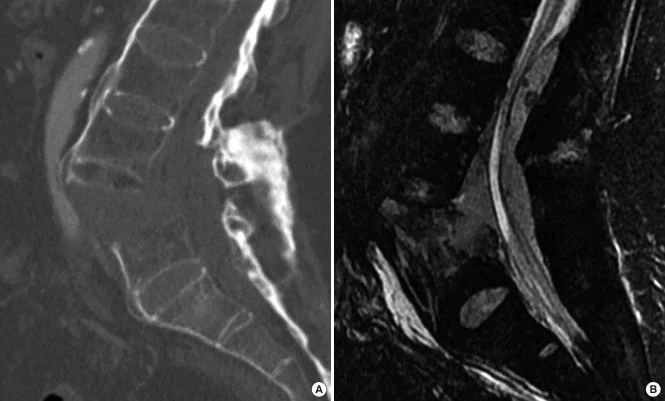
Spinal epidural hematom travma sonrasında ya da spontan gelişebilir; akut ağrıyı izleyen hızla ilerleyici nörolojik defisitlere yol açabilir. Spinal epidural hematom BT’de saptanabilir; MR, BT’ye göre daha yüksek doku kontrastı sunar ve spinal kordun değerlendirilmesinde daha uygundur. BT spinal kordu yetersiz değerlendirdiğinden, spinal epidural hematom tanısında MR en sık kullanılan görüntüleme yöntemidir. Spinal epidural hematom sfinkter tutulumu ve hızla ilerleyici miyelopatik bulgularla seyredebilir; tanıdaki gecikmeler suboptimal tedavi sonuçlarına yol açabilir.
Faz ve pencere
- Kontrastsız tanısal
- Kanal içindeki akut epidural kanama BT'de yüksek atenüasyonlu epidural koleksiyon olarak görülebilir; epidural yağ planını silebilir ve dural kese konturunu itebilir. Hematomu değerlendirmede kontrastsız inceleme akut kan yoğunluğunu göstermeye yardımcı olur.
- Kemik algoritması
- BT kemik incelemesi hematoma eşlik edebilecek vertebra kırığını gösterir; kordun ve hematomun yumuşak doku sınırlarının değerlendirilmesinde ise üstün doku kontrastına sahip MR daha uygundur.
Önerilen pencereler G genişlik, M merkez; değerler Hounsfield birimi (HU)
- Yumuşak dokuG 400 / M +40
- KemikG 1800 / M +400
BT bulguları
- Spinal epidural hematom olgularında MR en sık kullanılan görüntüleme yöntemidir; BT de bazı olgularda hematomu gösterebilir.
- Dural kese itilmesi — koleksiyonun yerleşimine bağlı olarak dural kese konturunun dıştan bası ile yer değiştirmesi veya deformasyonu.
- Epidural yağ planının silinmesi — normal yağlı boşluğun fokal olarak dolması veya asimetrik daralması.
- Kraniokaudal yayılım — Hematom birden çok spinal seviyeye uzanabilir; yayılımın değerlendirilmesinde MR kullanılır.
- Dorsal veya ventral yerleşim — hematomun epidural kompartımandaki konumu, eşlik eden kemik ve işlem bulgularıyla birlikte tarif edilir.
- Uzun segmentli yayılım — Epidural hematom birden fazla vertebra düzeyine uzanabilir ve kord basısına yol açan çok seviyeli koleksiyon olarak izlenebilir.
- Eşlik eden travma ve cerrahi bulguları — vertebra kırığı, geçirilmiş cerrahi alanı veya paraspinal hematom varlığı etiyolojik bağlam sağlar.
Normalde
Spinal epidural aralıkta normalde yağ dokusu bulunur; bu alanda gelişen hematom epidural yağ komşuluğunda dural kese üzerinde bası oluşturabilir. BT spinal kord dokusunu yetersiz değerlendirdiğinden kord parankim hasarını güvenilir biçimde değerlendiremez.
Normal BT ile kıyasla
Aynı bölgenin, kaynak veri setinde patoloji içermediği belirtilen bir BT incelemesini kesit kesit kaydırın; organ sınırlarını açarak anatomiyi hasta görüntüsüyle karşılaştırın. Küçük rastlantısal bulgular tümüyle dışlanmamıştır.
Kaynak: TotalSegmentator v2.01 veri seti (Wasserthal ve ark., Radiology: Artificial Intelligence 2023), CC BY 4.0, vaka s1338; organ sınırları veri setinin otomatik segmentasyonundan, birleştirilerek sadeleştirildi. Görüntüler 2,5 mm kesit aralığına yeniden örneklendi.
Ayırıcı tanı
- Epidural metastaz
- metastaz epidural yağ içinde yumuşak doku kitlesi olarak görülebilir; komşu vertebra odağı eşlik edebilir ve MR yumuşak doku yayılımını daha iyi karakterize eder.
- Epidural apse
- çevre kemik-disk enfeksiyonu ve paraspinal inflamasyon eşlik edebilir; kontrastlı MR'da koleksiyon ve yayılım daha iyi seçilir.
- Epidural lipomatozis
- spinal epidural aralıkta aşırı yağ dokusu birikimidir; akut kanla uyumlu hiperdens koleksiyon görünümünden farklıdır.
- Subdural hematom
- kanama dura ile araknoid arasındaki kompartımandadır; MR’da epidural yağ korunabilir ve koleksiyon dural kese konturunu dıştan epidural hematom gibi itmez.
- İntradural kitle
- kord veya sinir köküyle ilişkili olabilir; kontrastsız BT'de kompartımanı ve doku niteliği sınırlı değerlendirilir.
Tuzaklar
- BT’de koleksiyon görülmemesi spinal epidural hematomu dışlamaz; hematomun yerleşimi, yayılımı ve kord basısı MR ile daha iyi değerlendirilir.
- Akut epidural hematom BT’de hiperdens görünebilir ve epidural yağ planını silebilir; tek başına atenüasyon tanı koydurmaz, dural kese ile epidural yağ ilişkisi de değerlendirilir.
- Tek bir aksiyel kesitte koleksiyonun tüm uzunluğunu kestirme; sagittal rekonstrüksiyon boyunca komşu seviyeleri tarayın.
- Akut ve subakut hematomlarda MR sinyal özellikleri kan ürünlerinin yaşına göre değişebilir; seçilmiş olgularda yalnız görüntüleme bulguları hematomu lenfomadan ayırmaya yetmeyebilir.
Kendini dene
Ani sırt ağrısı ve güçsüzlüğü olan hastanın kontrastsız BT'sinde epidural yağın yerini alan hiperdens koleksiyon dural keseyi itiyor. En olası tanı nedir?
Cevabı göster
Spinal epidural hematom. Akut semptom ve hiperdens, kitle etkili kanal içi koleksiyon epidural hematomla uyumludur. Lipomatozis epidural yağ birikimidir; epidural metastaz yumuşak doku kitlesi olarak görülebilir ve vertebra odağından yayılabilir; disk protrüzyonu disk aralığı ile bağlantılıdır.
Nörolojik defisit sürüyor ancak BT'de belirgin kanal içi koleksiyon seçilmiyor. Hematom ve kord basısını değerlendirmede en uygun inceleme hangisidir?
Cevabı göster
Spinal MR. MR spinal kanal ve içeriğinin değerlendirilmesinde değerlidir; BT spinal kordu yetersiz değerlendirir.
İlgili konular
Kaynaklar
Bu sayfadaki 37 cümle ve 2 quiz sorusu aşağıdaki kaynaklardan alıntılarla otomatik olarak karşılaştırıldı; 16 cümle bu karşılaştırmada düzeltildi (2026-10-10).
- Spontaneous epidural and subdural hematomas of the spine: Review of anatomy and imaging findingspubmed.ncbi.nlm.nih.gov
- Spinal Hematomas: What a Radiologist Needs to Knowpubs.rsna.org
- Magnetic Resonance Imaging for Spine Emergenciespmc.ncbi.nlm.nih.gov
- Spontaneous spinal epidural hematoma with hemiparesis: A stroke mimicpubmed.ncbi.nlm.nih.gov
- MRI Features and Clinical Significance of Spinal Epidural Lipomatosis: All You Should Knowpubmed.ncbi.nlm.nih.gov
- Magnetic resonance imaging of the spinepmc.ncbi.nlm.nih.gov
- Spontaneous epidural and subdural hematomas of the spine: Review of anatomy and imaging findingsresearchgate.net
- Presumed cervical subperiosteal vertebral hemorrhage in nine greyhoundspmc.ncbi.nlm.nih.gov
- Routine Application of a Bioabsorbable Cellulose Hemostatic Agent (WoundClot TM ) in Unilateral Biportal Endoscopic Lumbar Decompression: A Retrospective Comparative Studypmc.ncbi.nlm.nih.gov
- Acute subdural hematoma in spontaneous intracranial hypotension: illustrative case and review of the literaturepmc.ncbi.nlm.nih.gov
- Challenges in diagnosing malignant lymphoma involving the spine: illustrative casespmc.ncbi.nlm.nih.gov
- Fluoroscopic Myelography-Guided Lumboperitoneal Shunt Placement to Reduce the Risk of Spinal Subdural-Extra-Arachnoid Catheter Misplacement: A Technical Note.pubmed.ncbi.nlm.nih.gov
- Spontaneous Spinal Epidural Haematoma Associated With Direct Oral Anticoagulants: A Descriptive Systematic Review.pubmed.ncbi.nlm.nih.gov
- Spontaneous Spinal Epidural Hematoma Presenting as an Acute Stroke Mimic: A Diagnostic Challenge.pubmed.ncbi.nlm.nih.gov
- Review of imaging modalities and radiological findings of calvarial lesions.pubmed.ncbi.nlm.nih.gov
- Imaging of Central Nervous System Involvement in Pediatric Hematologic Disorders.pubmed.ncbi.nlm.nih.gov
- Reliability of Preoperative MRI Findings for Differentiating Spontaneous Spinal Subdural and Epidural Hematomas: A Multi-Institutional Retrospective Study of 27 Surgically Treated Cases.pubmed.ncbi.nlm.nih.gov
- Influence of different patient positions on erector spinae plane block spread in modified radical mastectomy: a prospective randomized comparative study.pubmed.ncbi.nlm.nih.gov
- Giant Right Sphenoid Wing Meningioma as a Reversible Frontal Network Lesion: A Pseudo-bvFTD Case with Venous-Sparing Skull-Base Resection.pubmed.ncbi.nlm.nih.gov
- Intracranial Hypotension Following Spinal Manipulation: A Case Report and Scoping Review of the Literature.pubmed.ncbi.nlm.nih.gov
- Interlaminar Contralateral Endoscopic Foraminotomy Reduces Postoperative Dysesthesia in Patients With Degenerative Lumbar Deformity: A Multicenter Comparative Cohort Study.pubmed.ncbi.nlm.nih.gov
- Spontaneous Intracranial Hypotension and CSF-Venous Fistulae: from Diagnostic Imaging to Interventional Management.pubmed.ncbi.nlm.nih.gov
- Clinical presentation, magnetic resonance imaging characteristics, and short-term outcome of deep surgical site infection following thoracolumbar decompressive spinal surgery for intervertebral disc herniation in dogs.pubmed.ncbi.nlm.nih.gov
- Prediction of Postoperative Venous Thromboembolism in Patients With Traumatic Brain Injury: Model Development and Validation Study.pubmed.ncbi.nlm.nih.gov
- Development of individualized risk assessment models for predicting post-traumatic epilepsy 1 and 2 years after moderate-to-severe traumatic brain injury: A traumatic brain injury model system study.pubmed.ncbi.nlm.nih.gov
- Challenges in diagnosing malignant lymphoma involving the spine: illustrative cases.pubmed.ncbi.nlm.nih.gov
- Acute subdural hematoma in spontaneous intracranial hypotension: illustrative case and review of the literature.pubmed.ncbi.nlm.nih.gov
- Routine Application of a Bioabsorbable Cellulose Hemostatic Agent (WoundClot<sup>TM</sup>) in Unilateral Biportal Endoscopic Lumbar Decompression: A Retrospective Comparative Study.pubmed.ncbi.nlm.nih.gov
- Conservative management of spontaneous thoracolumbar epidural hematoma: a case report.pubmed.ncbi.nlm.nih.gov
- Neuroimaging for neurovascular complications of traumatic brain injury.pubmed.ncbi.nlm.nih.gov
- Cervical epidural hematoma: a case series highlighting uncommon causes.pubmed.ncbi.nlm.nih.gov
- Emergency radiology of severe acute injury in extreme alpine summer sports: a pictorial essay.pubmed.ncbi.nlm.nih.gov
- Evaluation of corticosteroid treatment in patients with post-traumatic ascending myelopathy and spinal cord injury: three case reports and review of the literature.pubmed.ncbi.nlm.nih.gov
- Presumed cervical subperiosteal vertebral hemorrhage in nine greyhounds.pubmed.ncbi.nlm.nih.gov
- Case of idiopathic cervical spinal subarachnoid hematoma mimicking an epidural hematoma: A case report.pubmed.ncbi.nlm.nih.gov
- Case Report: A patient with spontaneous spinal epidural hematoma misdiagnosed as ischemic stroke recovered after delayed surgery.pubmed.ncbi.nlm.nih.gov
- Trauma Unmasking Pituitary Apoplexy: Coexisting Epidural Hematoma and Sellar Mass - A Case Report with Selected Cases from the Literature.pubmed.ncbi.nlm.nih.gov
- Rare Lumbar Epidural Lesions: Differentiating Chronic Spontaneous Lumbar Epidural Hematoma from Lumbar Synovial Cyst-A Single-Center Comparative Study.pubmed.ncbi.nlm.nih.gov
- Microendoscopic hemilaminectomy for thoracic ligamentum flavum hematoma: A case report.pubmed.ncbi.nlm.nih.gov
- Thoracic Spontaneous Spinal Epidural Hematoma in a Young Adult: A Case Report.pubmed.ncbi.nlm.nih.gov
- Unilateral biportal endoscopic decompression for acute spontaneous spinal epidural hematoma at the cervicothoracic junction: a case report and literature review.pubmed.ncbi.nlm.nih.gov
- When Neck Pain Is Bleeding: Spontaneous Cervical Epidural Hematoma Case Following Recent Binge Alcohol Intake.pubmed.ncbi.nlm.nih.gov
- Suture-Related Delayed Epidural Hematoma Following Cervical Open-Door Laminoplasty: A Report of Two Cases and Literature Review.pubmed.ncbi.nlm.nih.gov
- Conservative Treatment of Spontaneous Spinal Epidural Hematoma: A Report of Two Cases With Severe Neurologic Deficits and a Literature Review.pubmed.ncbi.nlm.nih.gov
- Lumbar epidural haematoma after acupuncture: a case report and review of the literature.pubmed.ncbi.nlm.nih.gov
- Spontaneous spinal epidural hematoma - an uncommon cause of acute neurologic deficit in the emergency department: a case report.pubmed.ncbi.nlm.nih.gov
- Catheter-assisted evacuation through limited laminectomy for traumatic long-segment spinal epidural hematoma in ankylosing spondylitis: a technical note and two case reports.pubmed.ncbi.nlm.nih.gov
- A Stable C7 Fracture in a High School Quarterback: A Case of Clay Shoveler's Fracture.pubmed.ncbi.nlm.nih.gov
- Adverse events associated with basivertebral nerve radiofrequency ablation: A comprehensive analysis from the MAUDE database.pubmed.ncbi.nlm.nih.gov
- Diagnostic value of percutaneous paramedian small-angle lateral intervertebral foramen Kambin's triangle approach for lumbar puncture biopsy combined with tNGS-based multimodal etiological diagnosis in early spinal infection: a multicenter retrospective diagnostic yield study.pubmed.ncbi.nlm.nih.gov
- Minimally Invasive Lateral Thoracic and Lumbar Interbody Fusion with Expandable Interbody Spacers for Spine Trauma-Indications, Complications and Outcomes.pubmed.ncbi.nlm.nih.gov
- Thunderclap headache revealing dural tears with symptomatic intracranial hypotension: Report of two cases.pubmed.ncbi.nlm.nih.gov
- Unilateral biportal endoscopic decompression for thoracic intraspinal gout with ossified ligamentum flavum: a case report and literature review.pubmed.ncbi.nlm.nih.gov
- Intact Posterior Tension Band in Spinal Fractures in Patients With Spinal Ankylosing Disorders - Is it a Myth or a Reality? A Systematic Review.pubmed.ncbi.nlm.nih.gov
- Dural tears from traumatic spinal fractures: an illustrative case and systematic review of its incidence, diagnosis, risk factors, and management.pubmed.ncbi.nlm.nih.gov
- Symptomatic adjacent-segment epidural hematoma after UNSES for L4/5 lumbar disc herniation: a case report and narrative literature review.pubmed.ncbi.nlm.nih.gov
- Application of AUSS-TLIF for the treatment of a lumbar burst fracture: A case report.pubmed.ncbi.nlm.nih.gov
- Ankylosing spondylitis complicated by cervical spine fracture and cervicothoracic epidural hematoma: A case report.pubmed.ncbi.nlm.nih.gov
- Postoperative Sciatic Neuropathy Following Spinal Anesthesia in a Patient With Severe Lumbar Degenerative Disease: A Case Report.pubmed.ncbi.nlm.nih.gov
- Hemorrhagic Lumbar Synovial Cyst: Rare Mimic for Mass Lesion Causing Acute Neurological Deficit.pubmed.ncbi.nlm.nih.gov
- Manual Therapy-Associated Dural Tear Causing Intracranial Hypotension Treated with an Epidural Blood Patch: A Case Report.pubmed.ncbi.nlm.nih.gov
- Thoracic wall fascial plane blocks: a narrative review for breast, thoracic, and cardiac surgery.pubmed.ncbi.nlm.nih.gov
- CT evaluation of pediatric craniocervical distraction injuries: a comprehensive review of morphometric parameters and practical applications.pubmed.ncbi.nlm.nih.gov
- Subacute and Chronic Low-Back Pain: From MRI Phenotype to Imaging-Guided Interventions.pubmed.ncbi.nlm.nih.gov
- Deep learning fusion of multi-channel imaging from polarization-sensitive optical coherence tomography.pubmed.ncbi.nlm.nih.gov
- Cauda Equina Syndrome Due to Spinal Subdural Hematoma Mimicking Epidural Hematoma: The "Tense Bluish Dura" Intraoperative Clue.pubmed.ncbi.nlm.nih.gov
- Scrotal pain after lumbar fusion surgery: A rare case report.pubmed.ncbi.nlm.nih.gov
- Achieving Correction and Mitigating Complications in Adult Spinal Deformity through an Anterior-Posterior Combined Approach.pubmed.ncbi.nlm.nih.gov
- Laminectomy vs. laminoplasty for treating multi-segment cervical canal stenosis combined with central cord syndrome in the absence of fracture or dislocation: a retrospective study.pubmed.ncbi.nlm.nih.gov
- Pediatric abusive spine trauma: a review of whole-spine imaging essentials.pubmed.ncbi.nlm.nih.gov
- Spinal lesions: a comprehensive radiologic overview.pubmed.ncbi.nlm.nih.gov
- Cervical Pyogenic Spondylitis: A Comprehensive Review of Diagnosis and Treatment Strategy.pubmed.ncbi.nlm.nih.gov
- Schmorl's Node Mimicking Spinal Metastatic Disease: A Case Report and Review of the Literature.pubmed.ncbi.nlm.nih.gov
- Post-Traumatic Middle Cerebral Artery Pseudoaneurysm Following Depressed Skull Fracture: Case Report and PRISMA-Guided Literature Review.pubmed.ncbi.nlm.nih.gov
- Catastrophic spontaneous spinal epidural hematoma following thrombolysis: An intersection of neurosurgical and cardiological challenges - An institutional experience.pubmed.ncbi.nlm.nih.gov
- Intentional Self-Inflicted Transcranial Screwdriver Injury: A Case Report.pubmed.ncbi.nlm.nih.gov
- Sacral CSF-venous fistula: a rare entity. Illustrative case.pubmed.ncbi.nlm.nih.gov
- pubmed.ncbi.nlm.nih.govpubmed.ncbi.nlm.nih.gov
Eğitim amaçlıdır; hasta başında tanı ve tedavi kararının yerine geçmez, tıbbi tavsiye değildir. Metinler yapay zekâ desteğiyle yazıldı ve otomatik bir adımda kaynak alıntılarıyla karşılaştırıldı; bu bir tıbbi doğrulama değildir ve içerik uzman radyolog incelemesinden geçmedi. Klinik kararlarda güncel kılavuzları, kurum protokollerini ve radyoloji raporunu esas alın.