Özet
Omuz üzerine düşme sonrası klavikulanın akromiyona yakın ucunda oluşan kırıkta temel anatomik soru, kırık hattının korakoklaviküler bağların tutunma alanlarına göre nerede olduğudur. Kontrastsız BT, eklem yüzüne uzanımı, küçük alt fragmanı ve parçalanmayı radyografiden daha iyi gösterir. Korakoklaviküler bağ ilişkisi deplasman paternini ve kırığın stabilite sınıflamasını belirler. AC ekleme uzanan ya da bağ tutunma parçasını ayıran kırık fark edilmezse omuz kuşağındaki yapısal hasar eksik raporlanabilir.
Faz ve pencere
- Kontrastsız tanısal
- Distal klavikulanın kortikal kesintisi, kırık çizgisinin AC eklem yüzüne uzanımı, korakoid tabanına göre fragman konumu ve alt kortikal parçanın ana fragmandan ayrılması izlenir. Distal klavikula kırığının kemik yapısını değerlendirmek için BT kullanılabilir.
- Kemik algoritması tanısal
- Koronal ve sagittal ince kesit rekonstrüksiyonları kırık hattını konoid ve trapezoid bağların klavikuladaki tutunma bölgelerine göre konumlandırır; 3B görünüm parçalı distal fragmanı tarif etmeye yardım eder.
Önerilen pencereler: Kemik (G 1800 / M 400), Yumuşak doku (G 400 / M 40).
BT bulguları
- Kırık hattı ve AC eklem — çizginin eklem yüzüne ulaşıp ulaşmadığı ve eklem yüzünde basamak oluşturup oluşturmadığı gösterilir.
- Korakoklaviküler tutunma ilişkisi — kırık hattının konoid ve trapezoid bağ tutunma alanlarının medialinde, arasında veya lateralinde kalması tarif edilir.
- Distal fragman deplasmanı — akromiyona bağlı küçük lateral parçanın ana klavikula parçasına göre seviyesi ve yönü belirlenir.
- Alt kortikal fragman — korakoklaviküler bağların tutunduğu küçük inferior parça ana fragmandan ayrılmış olabilir.
- Parçalanma — distal metafiz ve eklem yüzüne yakın ek fragmanlar, eklem uyumunu bozabilecek biçimde sıralanabilir.
- Komşu kemik hasarı — korakoid, akromion ve skapula boynunda ayrı kortikal kırık çizgileri aranır.
- AC eklem aralığı ve korakoklaviküler mesafe, karşı omuzdaki ölçümlerle kıyaslanabilir.
Ölçütler ve sınıflamalar
- Neer (Craig modifikasyonu) distal klavikula sınıflaması
- Tip I: korakoklaviküler bağların lateralinde, az deplase ve AC ekleme uzanmaz. Tip II: bağ tutunmalarının medialindedir; IIa kırık konoid bağın medialinde, IIb kırık konoid ve trapezoid tutunmaları arasında olup konoid bağ yırtığı vardır. Tip III: tip I gibi lateraldedir ancak AC eklem yüzüne uzanır. Tip IV çocukta periostal kılıf ayrılması ve medial fragmanın yukarı yer değiştirmesidir. Tip V parçalı paternde bağlara tutunan küçük inferior fragman içerir.
Normalde
Normal karşı omuzun AC eklem aralığı ve korakoklaviküler mesafesi, yaralı tarafla karşılaştırmada referans alınabilir. Karşı AC eklemde eklem yüzü basamağını, distal fragman seviyesini ve korakoid-akromion bütünlüğünü kıyaslayın.
Normal BT ile kıyasla
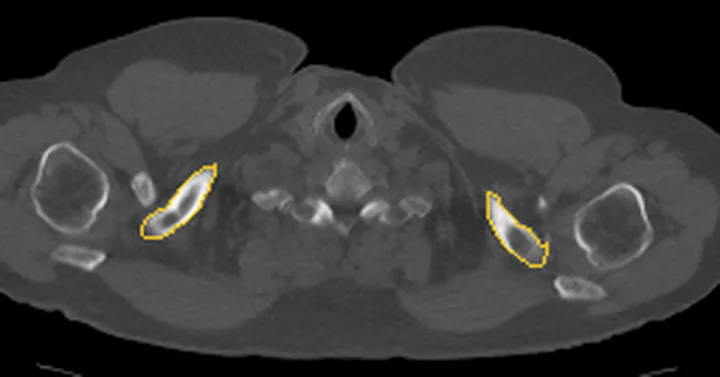
Aynı bölgenin, kaynak veri setinde patoloji içermediği belirtilen bir BT incelemesini kesit kesit kaydırın; organ sınırlarını açarak anatomiyi hasta görüntüsüyle karşılaştırın. Küçük rastlantısal bulgular tümüyle dışlanmamıştır.
Kaynak: TotalSegmentator v2.01 veri seti (Wasserthal ve ark., Radiology: Artificial Intelligence 2023), CC BY 4.0, vaka s1278; organ sınırları veri setinin otomatik segmentasyonundan, birleştirilerek sadeleştirildi. Görüntüler 2,5 mm kesit aralığına yeniden örneklendi.
Ayırıcı tanı
- AC eklem ayrışması
- klavikula korteksi süreklidir; anormallik eklem uyumunda ve korakoklaviküler aralıkta görülür.
- Akromion kırığı
- kırık hattı klavikula yerine akromion korteksini keser.
- Korakoid kırığı
- korakoid tabanı veya gövdesinde bağımsız kortikal süreksizlik bulunur.
- Distal klavikula osteolizi
- eklem yanındaki düzgün olmayan rezorpsiyon belirgin keskin travmatik kırık hattı ve akut fragman basamağı oluşturmaz.
- Çocukta distal klavikula epifiz/ periost yaralanması
- kemikleşmemiş epifiz ayrışması ve periostal kılıf ilişkisi erişkin tipi kırık görünümünü taklit edebilir.
Tuzaklar
- Küçük inferior fragmanı önemsiz kortikal parça sayma; korakoklaviküler bağ tutunmasının fragmanla birlikte kalıp kalmadığını anatomik konumla belirt.
- AC eklem açıklığını tek başına kırık deplasmanı sanma; eklem aralığını karşı tarafla kıyasla ve klavikula korteksini izleyerek eklem çıkığını ayır.
- Çocukta açık/kemikleşmemiş distal epifizi kırık hattı gibi yorumlama; periostal kılıfın ve metafiz konturunun devamlılığına bak.
Kendini dene
Üç boyutlu haritalandırma çalışmasında en sık saptanan distal klavikula kırık tipi hangisidir?
Cevabı göster
Neer IIB. S18'e göre çalışma kohortunda Neer IIB tipi kırıklar %38.27 ile en sık görülen tiptir.
Klavikula kanca plakı (hook plate) uygulanan hastalarda altakromial osteoliz gelişim riskini belirgin şekilde artıran en önemli faktör hangisidir?
Cevabı göster
Plak tutulum süresinin 5.3 aydan uzun olması. Literatür, kanca plakı tutulum süresinin 5.3 aydan uzun kalmasının altakromial osteoliz riskini belirgin şekilde artırdığını göstermektedir.
İlgili konular
Kaynaklar
Bu sayfadaki 39 cümle ve 2 quiz sorusu aşağıdaki kaynaklardan alıntılarla tek tek karşılaştırıldı; 3 cümle bu karşılaştırmada düzeltildi (2026-10-08).
- Os acromiale may be a contraindication of the clavicle hook plate: case reports and literature reviewpmc.ncbi.nlm.nih.gov
- Treatment of bipolar clavicle injury with internal plating: a case series and literature reviewpmc.ncbi.nlm.nih.gov
- Symptomatic Nonunion of the Coracoid Process Following Osteosynthesis Using a Suture Button for Coracoid Process and Distal Clavicle Fracture: A Case Reportpmc.ncbi.nlm.nih.gov
- Distal Clavicle Refracture after All-Suture Double Coracoclavicular and Acromioclavicular Stabilization: A Case Reportpmc.ncbi.nlm.nih.gov
- An unprecedented pan-brachial injury: A case report of ipsilateral floating shoulder, floating elbow, and acetabular fracture following a psychosis-induced fallpmc.ncbi.nlm.nih.gov
- Os acromiale may be a contraindication of the clavicle hook plate: case reports and literature review.pubmed.ncbi.nlm.nih.gov
- Bipolar Injury of the Clavicle.pubmed.ncbi.nlm.nih.gov
- Distal clavicle fracture radiography and treatment: a pictorial essay.pubmed.ncbi.nlm.nih.gov
- Complications and Frequency of Surgical Treatment with AO-Type Hook Plate in Shoulder Trauma: A Retrospective Study.pubmed.ncbi.nlm.nih.gov
- Evaluation of the Clavicle Hook Plate for Treatment of Acromioclavicular Joint Dislocation: A Cadaveric Study.pubmed.ncbi.nlm.nih.gov
- A Novel and Open Classification Emphasizing on Osteoligamentous Complex for Distal Clavicle Fractures.pubmed.ncbi.nlm.nih.gov
- Coracoid Process Avulsion Fracture at the Coracoclavicular Ligament Attachment Site in an Osteoporotic Patient with Acromioclavicular Joint Dislocation.pubmed.ncbi.nlm.nih.gov
- [Minimally invasive treatment for fresh acromioclavicular dislocation and the distal clavicle fracture].pubmed.ncbi.nlm.nih.gov
- Coracoclavicular Double-Button Fixation of Displaced Lateral Clavicular Fracture in a Patient without Coracoid Process.pubmed.ncbi.nlm.nih.gov
- The Floating Acromion: A Rare and Previously Unreported Injury Possibly Requiring Surgical Stabilization.pubmed.ncbi.nlm.nih.gov
- New surgical approach for distal clavicle fractures: A case report.pubmed.ncbi.nlm.nih.gov
- The Accuracy of Distal Clavicle Fracture Classifications-Do We Need an Amendment to Imaging Modalities or Fracture Typing?pubmed.ncbi.nlm.nih.gov
- Three-Dimensional Mapping of Distal Clavicle Fractures: Displacement Patterns and Clinical Implications for Surgical Management.pubmed.ncbi.nlm.nih.gov
- Outcomes and function of conoid ligament on the basis of postoperative radiographic findings of arthroscopic stabilization for the distal clavicle fractures.pubmed.ncbi.nlm.nih.gov
- The Acromioclavicular-Distal Clavicle 3-Dimensional All-Suture Stabilization Technique Without Need for Fluoroscopy and Without Metallic Hardware.pubmed.ncbi.nlm.nih.gov
- Distal Clavicle Refracture after All-Suture Double Coracoclavicular and Acromioclavicular Stabilization: A Case Report.pubmed.ncbi.nlm.nih.gov
- Arthroscopic coracoclavicular ligament reconstruction using allograft and TightRope in a patient with severe distal clavicle bone loss: A 5-year follow-up case report.pubmed.ncbi.nlm.nih.gov
- Fall-Related Extremity Injuries During a Severe Snowfall and Icing Episode in Diyarbakır, Türkiye: Injury Patterns, Treatment Characteristics, and Need for Surgery in the Emergency Department.pubmed.ncbi.nlm.nih.gov
- Surgical Outcomes of Olecranon Osteotomy Approach Combined With Submerged Kirschner Wires and Plate Fixation for Duckerley IIIB Distal Humeral Coronal Shear Fractures.pubmed.ncbi.nlm.nih.gov
- Absorbable Suture Fixation for Severely Displaced Type 4 Clavicle Fractures.pubmed.ncbi.nlm.nih.gov
- Superior shoulder suspensory complex disruptions: from injury pattern recognition to treatment decision-making-a narrative review with institutional case illustrations.pubmed.ncbi.nlm.nih.gov
- AO Spine Clinical Practice Recommendations for the Management of Spinal Tuberculosis.pubmed.ncbi.nlm.nih.gov
- Clinical impact of early postoperative routine radiology in isolated pelvic injuries: a retrospective study.pubmed.ncbi.nlm.nih.gov
- Concurrent Acute Fracture and Dysplasia-Related Fragmentation of the Medial Coronoid Process of the Ulna in a Dog-A Case Report.pubmed.ncbi.nlm.nih.gov
- Extra-articular Fractures of the Scapula.pubmed.ncbi.nlm.nih.gov
- Anatomy and Correlation of the Coracoid Process and Coracoclavicular Ligament Based on Three-Dimensional Computed Tomography Reconstruction and Magnetic Resonance Imaging.pubmed.ncbi.nlm.nih.gov
- Latarjet Procedure With Coracoclavicular Ligament Augmentation for Traumatic Coracoid Fracture and Recurrent Anterior Glenohumeral Instability in an Elite Contact Athlete.pubmed.ncbi.nlm.nih.gov
- Salvage articular reconstruction of the distal radius using a 3D simulation-guided distal clavicle osteochondral autograft after fracture-related infection: A case report.pubmed.ncbi.nlm.nih.gov
- Clinical and Radiological Assessment of Modified Weaver-Dunn Technology, Arthroscopic Single Tunnel Technique and Arthroscopic Coracoid Sling Technique Three Different Surgical Techniques in the Treatment of Acute Rockwood III-V Acromioclavicular Dislocations.pubmed.ncbi.nlm.nih.gov
- Specimen-level phylogenetic analysis and taxonomic revision of North American metoposaurids: a case for monospecific genera in vertebrate paleontology.pubmed.ncbi.nlm.nih.gov
- Analysis of the curative effect of arthroscopic coracoid process drill-free U-shaped suspension fixation in the treatment of acute acromioclavicular joint dislocation.pubmed.ncbi.nlm.nih.gov
- Finite element analysis of internal fixation with clavicular hook plate vs. adjustable loop plate for Neer Type IIB distal clavicle fractures.pubmed.ncbi.nlm.nih.gov
- Factors influencing clavicular tunnel widening after single bundle coracoclavicular ligament reconstruction.pubmed.ncbi.nlm.nih.gov
- Finite element analysis of acromioclavicular joint stress in the treatment of Neer II distal clavicular fracture.pubmed.ncbi.nlm.nih.gov
- A biomechanical comparison of hook plate vs. superolateral locking plate with coracoclavicular suture fixation for distal third clavicle fractures with coracoclavicular ligament disruption.pubmed.ncbi.nlm.nih.gov
- Innovative Anatomical Plate for Surgical Fixation of Acromial-End Clavicle Fractures: A Case Report.pubmed.ncbi.nlm.nih.gov
- Locking Plate with Cerclage Wiring Versus Hook Plate Fixation for Unstable Distal Clavicle Fractures: Is There Still a Role for Hook Plates?pubmed.ncbi.nlm.nih.gov
- Arthroscopy-Assisted Fixation of Combined Coracoid Fracture and Acromioclavicular Dislocation: A Minimalist Approach.pubmed.ncbi.nlm.nih.gov
- An unprecedented pan-brachial injury: A case report of ipsilateral floating shoulder, floating elbow, and acetabular fracture following a psychosis-induced fall.pubmed.ncbi.nlm.nih.gov
- Conservative Treatment of Pediatric Fractures-Narrative Review of Acceptable Deformity and Remodeling Potential.pubmed.ncbi.nlm.nih.gov
- Varied Reduction and Fixation Modalities for Scapula Fractures: A Case Series.pubmed.ncbi.nlm.nih.gov
- Surgical Timing After Acromioclavicular Joint Separation: Association With Clinical Outcomes.pubmed.ncbi.nlm.nih.gov
- Chronic Acromioclavicular Joint Instability: Outcomes after Stabilization without Tendon Graft Augmentation.pubmed.ncbi.nlm.nih.gov
- An Unusual Pattern of Acromioclavicular Joint Instability With Coracoid Base Fracture.pubmed.ncbi.nlm.nih.gov
- Suture stabilization of the acromioclavicular ligament plus clavicular hook plate fixation vs. total ligament repair with loop plates for acromioclavicular joint dislocation.pubmed.ncbi.nlm.nih.gov
- Arthroscopic dual-reduction fixation for acromioclavicular joint dislocation: transosseous and half-cerclage fixation outcomes.pubmed.ncbi.nlm.nih.gov
- Surgical Advances in the Treatment of Acromioclavicular Joint Injury: A Comprehensive Review.pubmed.ncbi.nlm.nih.gov
- Combined Repair and Reconstruction of Coracoclavicular and Acromioclavicular Ligaments for Acute and Chronic AC Joint Dislocations: A Technical Note and Prospective Case Series.pubmed.ncbi.nlm.nih.gov
- The Scandinavian Displaced Lateral Clavicle trial (ScanDiLaC): a study protocol for a randomized clinical trial.pubmed.ncbi.nlm.nih.gov
- [Application study of a novel locking anatomical plate in treatment of Neer type <b>Ⅱ</b>b and type <b>Ⅴ</b> distal clavicle fractures].pubmed.ncbi.nlm.nih.gov
- Treatment Strategies for Distal Clavicle Fractures: A Narrative Review.pubmed.ncbi.nlm.nih.gov
- Comparative analysis of vertical double plate versus clavicle hook plate for unstable distal clavicle fractures.pubmed.ncbi.nlm.nih.gov
- Evaluation of Combined Use of Pre-contoured Locking Distal Clavicle Plate and Tunneled Suspensory Device Fixation for Unstable Lateral End Clavicle Fracture.pubmed.ncbi.nlm.nih.gov
- What is the optimal implant removal timing following hook plate fixation in distal clavicle fractures: a retrospective analysis from subacromial osteolysis cases.pubmed.ncbi.nlm.nih.gov
- Arthroscopically Assisted Coracoclavicular (CC) Stabilization Using a Suture Button Device for Lateral Clavicle Fractures with CC Ligament Injury.pubmed.ncbi.nlm.nih.gov
- Imaging of traumatic shoulder injuries - Understanding the surgeon's perspective.pubmed.ncbi.nlm.nih.gov
- Distal Radius Plates With Coracoid Suture Anchors for the Fixation of Displaced Lateral End Clavicle Fractures.pubmed.ncbi.nlm.nih.gov
- Tendon graft through the coracoid tunnel versus under the coracoid for coracoclavicular/acromioclavicular reconstruction shows no difference in radiographic or patient-reported outcomes.pubmed.ncbi.nlm.nih.gov
- All-Arthroscopic Coracoacromial Ligament Transfer: The Modified Neviaser Procedure for Acromioclavicular Dislocations.pubmed.ncbi.nlm.nih.gov
- Residual coracoclavicular separation after plate fixation for distal clavicle fractures: comparison between fracture patterns.pubmed.ncbi.nlm.nih.gov
- Neglected acromioclavicular joint injury in coracoid process fractures: a retrospective cohort study.pubmed.ncbi.nlm.nih.gov
- Ultrasound and bone: a pictorial review.pubmed.ncbi.nlm.nih.gov
- Custom Hydroxyapatite-Coated Stem Collar With Extracortical Plate Provides Excellent Long-Term Results Against Aseptic Loosening in Revision, Including Short-Segment, Endoprosthetic Tumour Reconstruction.pubmed.ncbi.nlm.nih.gov
- Application of biodegradable implants in pediatric orthopedics: shifting from absorbable polymers to biodegradable metals.pubmed.ncbi.nlm.nih.gov
- Multimodal Imaging of Osteosarcoma: From First Diagnosis to Radiomics.pubmed.ncbi.nlm.nih.gov
- Bone marrow edema in children: chronic nonbacterial osteomyelitis and its mimickers.pubmed.ncbi.nlm.nih.gov
- Update on aneurysmal bone cyst: pathophysiology, histology, imaging and treatment.pubmed.ncbi.nlm.nih.gov
- Shoulder Anatomy and Normal Variants.pubmed.ncbi.nlm.nih.gov
- Comprehensive review of acromioclavicular joint dislocation: anatomy, mechanism, imaging, treatment and rehabilitation-narrative review.pubmed.ncbi.nlm.nih.gov
- Risk factors of loss of reduction after acromioclavicular joint dislocation treated with a hook plate.pubmed.ncbi.nlm.nih.gov
- Functional Outcomes of Bicolumnar Plating in Schatzker Type V and VI Proximal Tibial Fractures: A Prospective Study.pubmed.ncbi.nlm.nih.gov
- Analysis of the efficacy of Endobutton plate combined with high-strength suture Nice knot fixation in the treatment of distal clavicle fractures with coracoclavicular ligament injuries.pubmed.ncbi.nlm.nih.gov
- Avulsion Fracture of the Coracoid Process at the Coracoclavicular Ligament Insertion: A Report of Three Cases.pubmed.ncbi.nlm.nih.gov
- Rockwood Type VIb Acromioclavicular Joint Dislocation With Ipsilateral Proximal Humerus Fracture-Dislocation and Scapular Spine Fracture: A Case Report.pubmed.ncbi.nlm.nih.gov
- The distal acromial tip fusion: a novel procedure to mitigate acromial stress fractures in high-risk patients undergoing reverse shoulder arthroplasty.pubmed.ncbi.nlm.nih.gov
- Current concepts in management of ACJ injuries.pubmed.ncbi.nlm.nih.gov
- Fracture of distal end clavicle: A review.pubmed.ncbi.nlm.nih.gov
- Glossary of terms for musculoskeletal radiology.pubmed.ncbi.nlm.nih.gov
- Osteosynthesis of an acromion fracture using a proximal clavicle plate: a case report.pubmed.ncbi.nlm.nih.gov
- Accuracy of clinical and radiographic measurements for detecting significant shortening in acute midshaft clavicle fractures: a cross-sectional study with computed tomography scan as the reference standard.pubmed.ncbi.nlm.nih.gov
- Cerebrospinal Fluid Shunts: An Updated Radiologic Review of Devices, Malfunctions, and Complications.pubmed.ncbi.nlm.nih.gov
- Neurolymphomatosis: A Comprehensive Review of Clinical and Imaging Features.pubmed.ncbi.nlm.nih.gov
- Imaging of acute musculoskeletal infections in children and their differential diagnoses.pubmed.ncbi.nlm.nih.gov
- Management of a Complex Medial-End Clavicle Fracture With Hook Plate Fixation After Failed Prior Surgeries: A Case Report and Narrative Review of Surgical Options.pubmed.ncbi.nlm.nih.gov
- Pathological Fractures in Rare Bone Diseases: Clinical Cases.pubmed.ncbi.nlm.nih.gov
- Xanthogranulomatous Osteomyelitis as a Bone Tumor Mimic: A Systematic Review of Pre-biopsy Diagnostic Clues and Management Decision Points.pubmed.ncbi.nlm.nih.gov
- Scapular Alignment Restoration After Posterior Fixation of Displaced Scapular Fractures.pubmed.ncbi.nlm.nih.gov
- Surgical Management of an Isolated Posterior Manubrium Fracture in a Division One Collegiate Ice Hockey Athlete: A Case Report.pubmed.ncbi.nlm.nih.gov
- Modified coracoid tunnel-free suspended bridge for coracoclavicular ligament injuries leads to improved clinical and radiological outcomes: a cohort study with a minimum 2-year follow-up.pubmed.ncbi.nlm.nih.gov
- Locomotor signals in the trabecular structure of the hominoid clavicle.pubmed.ncbi.nlm.nih.gov
- The Functional Outcome of Open Reduction and Internal Fixation of Unstable Floating Shoulder Injuries: A Prospective Study with Good Short-Term and Medium-Term Outcome.pubmed.ncbi.nlm.nih.gov
- Native Coronal Acromioclavicular Joint Orientation Is Associated with Rockwood Grade in Acute Acromioclavicular Joint Dislocations.pubmed.ncbi.nlm.nih.gov
- Risk factors and management of atraumatic distal clavicular osteolysis: A scoping review.pubmed.ncbi.nlm.nih.gov
- Hajdu-Cheney Syndrome in a Two-Generation Family: Longitudinal Skeletal Progression and Differential Therapeutic Responses in a Mother and Her Son.pubmed.ncbi.nlm.nih.gov
- Pycnodysostosis Unveiled: Craniofacial and Dental Manifestations in Focus.pubmed.ncbi.nlm.nih.gov
- Comparison of hook plates vs. locking plates for Neer type IIB fractures of lateral end clavicle: A systematic review.pubmed.ncbi.nlm.nih.gov
- Minimally Invasive Percutaneous TightRope® System Fixation for an Unstable Posterior Pelvic Ring: Clinical Follow-up and Biomechanical Studies.pubmed.ncbi.nlm.nih.gov
- The most common bone tumors of the upper extremity in childhood and adolescence and their treatment: a review of the current literature.pubmed.ncbi.nlm.nih.gov
- Eponymous terms in acromioclavicular joint surgery.pubmed.ncbi.nlm.nih.gov
- Clinical outcomes and complications of four surgical techniques for tibial avulsion fractures of the posterior cruciate ligament: a retrospective comparative study.pubmed.ncbi.nlm.nih.gov
- Chronic acromioclavicular dislocations: multidirectional stabilization without grafting.pubmed.ncbi.nlm.nih.gov
- The Role of Arthroscopy As Minimal Invasive for Shoulder Trauma: Literature Review.pubmed.ncbi.nlm.nih.gov
- The state of trial registrations in the field of Orthopaedics in years 2015-2020. A meta-epidemiological study.pubmed.ncbi.nlm.nih.gov
- Acromial Stress Fractures in Reverse Total Shoulder Arthroplasty: Diagnosis, Prevention, and Treatment.pubmed.ncbi.nlm.nih.gov
- External iliac artery entrapment associated with pelvic fracture. A case report.pubmed.ncbi.nlm.nih.gov
- International Society of Paediatric Surgical Oncology (IPSO) Surgical Practice Guidelines.pubmed.ncbi.nlm.nih.gov
- Asymptomatic penetrating neck injuries: Course and outcome following CT angiography and oesophagography.pubmed.ncbi.nlm.nih.gov
- Concurrent emergency head and cervical spine CT utilization: temporal trends, diagnostic yield, and clinical implications.pubmed.ncbi.nlm.nih.gov
- Osteitis Pubis in Athletes in the Era of Pubic-Related Groin Pain: Contemporary Concepts in Diagnosis, Rehabilitation, and Surgical Decision-Making.pubmed.ncbi.nlm.nih.gov
- Early clinical outcomes of standard and 3D-planned pre-bent hook plates versus suture-button fixation for acute Rockwood IIIB-V acromioclavicular dislocation with a Bigliani type II acromion: a retrospective cohort study.pubmed.ncbi.nlm.nih.gov
Eğitim amaçlıdır; hasta başında tanı ve tedavi kararının yerine geçmez. İçerik yapay zekâ destekli bir süreçle güncel literatüre göre cümle cümle kaynaklarla karşılaştırıldı, ancak uzman radyolog incelemesinden geçmedi. Klinik kararlarda güncel kılavuzları, kurum protokollerini ve radyoloji raporunu esas alın.