Özet
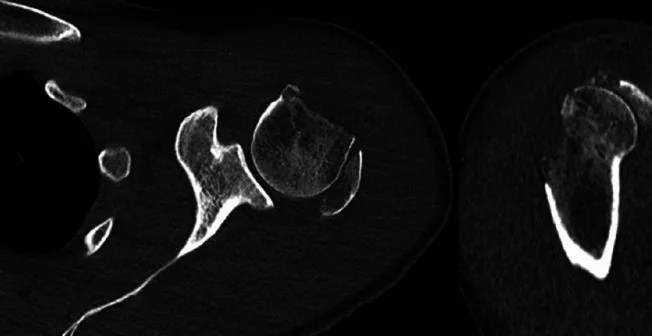
Büyük tüberkül kırığı düşme veya glenohumeral çıkıkla birlikte gelişebilir; fragman rotator manşetin supraspinatus, infraspinatus ve teres minor yapışma yüzlerini taşıdığı için omuz mekaniğiyle doğrudan ilişkilidir. Kontrastsız BT, özellikle gizli cerrahi boyun kırıklarını ortaya çıkararak ve çok parçalı kırıklarda fragman yönelimini grafiye göre daha kesin belirleyerek değerlendirme sağlar. Parçanın hangi fasetten geldiği, eklem ve biseps oluğu ile ilişkisi, rotasyonu ve deplasman yönü birlikte tarif edilmelidir. Eşlik eden cerrahi boyun kırığı veya redüksiyon sonrası kalan fragman yer değiştirmesi atlanırsa yaralanmanın kapsamı eksik kalabilir.
Faz ve pencere
- Kontrastsız tanısal
- Büyük tüberkülün superolateral korteksindeki kesinti, ayrılmış kortikospongiyöz fragman, deplasman/rotasyon ve humerus başı ile şaft ilişkisi kemik penceresinde seçilir; eşlik eden boyun kırığı ile glenohumeral eklem konumu araştırılır. Kontrast madde gerekmez.
- Kemik algoritmalı rekonstrüksiyon tanısal
- Aksiyel ve koronal kemik algoritmalı rekonstrüksiyonlar fragmanın anterior-posterior ve superior-inferior yönünü; sagittal görüntüler eklem yüzü ve biseps oluğuyla komşuluğunu gösterir. Küçük parçalar kemik yatağı boyunca ardışık kesitlerde takip edilir.
Önerilen pencereler G genişlik, M merkez; değerler Hounsfield birimi (HU)
- KemikG 1800 / M +400
BT bulguları
- Tüberkül korteks kesintisi — humerus başının lateral-superior konturundan ayrılan kırık hattını ve fragman yatağını bulun.
- Rotator manşet yapışma fasetleri — fragmanın superior, orta veya inferior yüzünün hangi tuberkül bölümünü taşıdığını ve parçalanmayı tarif edin.
- Fragman yönü — Üst-alt yer değiştirmeyi dış rotasyonlu AP görüntüde, ön-arka yer değiştirmeyi aksiller lateral ve/veya skapular Y görüntülerinde ayrı değerlendirin; yer değiştirme yönü farklı olabilir.
- BT, fragman morfolojisi ve yer değiştirmeyi gösterir; minimal deplasmanlı izole kırıklarda BT’nin ek katkısı sınırlı olabilir. Deplasmanın klinik önemini değerlendirirken fragmanın yer değiştirme yönü ve miktarıyla hastanın yaşı, aktivite düzeyi ve kemik kalitesi birlikte dikkate alınmalıdır.
- Biseps oluğu — Kırığın ön tarafta intertüberküler oluğa uzanıp uzanmadığını değerlendirin.
- Eşlik eden boyun kırığı — Humerus boynunda gizli kırık olup olmadığını ayrıca değerlendirin.
- Çıkık ilişkisi — humerus başının glenoid fossa içinde olup olmadığını ve fragmanın olası redüksiyon öncesi/sonrası konumunu belirtin.
- Deplasmanın miktarı ve yönü standart projeksiyonlarda değerlendirilmelidir; 5 mm eşiği çevresindeki ölçüm radyografilerde gözlemciler arasında düşük uyum gösterebilir.
Ölçütler ve sınıflamalar
- AO/OTA proksimal humerus sınıflaması (2018)
- AO/OTA sınıflaması, kırığın eklem yüzüne katılımı, metafizyel impaksiyon, açısal deformite veya parçalanma gibi morfolojik özelliklere dayanır. Cerrahi boyun, eklem yüzü veya başka tüberkülün de tutulması kırık grubunu değiştirir; eşlik eden uzanımlar ayrıca tarif edilir.
Normalde
Normal BT'de büyük tüberkül humerus başının superolateral konturuna kesintisiz katılır; kortikal fasetler çevre kemik yatağıyla aynı seviyededir ve intertüberküler oluk belirgindir. Kontralateral omuzla kıyaslama yerine, üst-alt deplasmanı eksternasyonlu AP görünümde ve ön-arka deplasmanı aksiller lateral veya skapular Y görünümünde ölçün.
Ayırıcı tanı
- Baş-split kırığı
- çizgi tüberkülün sınırlı avulsiyonu yerine humerus başının subkondral eklem yüzünü iki parçaya ayırır.
- Cerrahi boyun kırığı
- ana kesinti tüberküllerin altında metafiz-şaft geçişindedir; büyük tüberkül fragmanı ikincil olarak eşlik edebilir.
- Bankart/Glenoid rim lezyonu
- eklem stabilitesini sağlayan labrum ve glenoid kenar kırıkları veya yırtıkları, tüberkül kırığı ile birlikte sık görülür.
- Eski tuberkül avulsiyonu
- kronik avulsiyon yaralanmaları başka hastalık süreçlerini taklit edebilir; akut avulsiyonlar ise genellikle ayrılmış kemik fragmanı şeklinde görülür.
- Normal kortikal oluk/kemik çıkıntısı
- bazı benign kemik çıkıntıları BT'de rastlantısal olarak saptanabilir ve patolojik lezyonları taklit edebilir.
Tuzaklar
- Fragmanın yalnız öne-arkaya konumunu AP rekonstrüksiyondan çıkarmayın; aksiyel düzlem biseps oluğu ve humerus başına göre konumu gösterir.
- Çıkık redükte edilmiş olsa bile büyük tüberkül parçasının önceki travmatik yer değiştirmesini yok saymayın; keskin kırık yatağı ve parçanın yeni konumunu kaydedin.
- Tek eksendeki deplasmanı parçanın tüm yer değiştirmesi gibi sunmayın; superior-inferior ve anterior-posterior yönleri, rotasyonu ve ölçüm referansını ayrı tarif edin.
- Fragman varlığını görüp cerrahi boyun hattını kapatmayın; koronal kesitlerde medial kalcar ve baş-şaft devamlılığını ayrıca izleyin.
Kendini dene
Anterior omuz çıkığı sonrası BT’de büyük tüberkül fragmanı ayrışmış olarak görülüyor. Fragman hangi tendon grubunun yapışma alanını taşır?
Cevabı göster
Supraspinatus-infraspinatus-teres minor. Büyük tüberkül supraspinatus, infraspinatus ve teres minor yapışma fasetlerini taşır. Subscapularis küçük tüberküle tutunur; büyük tüberkülde supraspinatus, infraspinatus ve teres minor yapışır.
Grafilerde büyük tüberkül kırığının yer değiştirme miktarı belirsizse, kırık morfolojisi ve yer değiştirmeyi değerlendirmek için hangi görüntüleme yöntemi yardımcı olabilir?
Cevabı göster
BT. BT, kırık morfolojisi, boyutu, parçalanması ve yer değiştirme miktarı hakkında bilgi sağlayabilir; grafilerde yer değiştirme belirsizse yardımcı olabilir.
Kaynaklar
Bu sayfadaki 43 cümle ve 2 quiz sorusu aşağıdaki kaynaklardan alıntılarla otomatik olarak karşılaştırıldı; 18 cümle bu karşılaştırmada düzeltildi (2026-10-09).
- Current Evidence and Surgical Strategies in the Management of Greater Tuberosity Fracture–Dislocations: A Narrative Reviewpmc.ncbi.nlm.nih.gov
- Management of greater tuberosity fracture dislocations of the shoulderpmc.ncbi.nlm.nih.gov
- An Isolated Greater Tuberosity Fracture With Posterior-Superior Displacement in an Elderly Patient: Successful Fixation Using Cannulated Screws With Washers Without Rotator Cuff Repairpmc.ncbi.nlm.nih.gov
- Irreducible Anterior Shoulder Dislocation with Greater Tuberosity Fracture: Joystick Reduction and Biceps Preservation in an Elderly Female -A Case Reportpmc.ncbi.nlm.nih.gov
- Arthroscopic Revision Repair of Displaced Greater Tuberosity Fracturepmc.ncbi.nlm.nih.gov
- Hippocratic method for reduction of chronic locked anterior shoulder dislocations.pubmed.ncbi.nlm.nih.gov
- Missed fractures of the greater tuberosity.pubmed.ncbi.nlm.nih.gov
- The Reliability and Reproducibility of a New Revised Edelson Classification.pubmed.ncbi.nlm.nih.gov
- The spectrum of lesions and clinical results of arthroscopic stabilization of acute anterior shoulder instability.pubmed.ncbi.nlm.nih.gov
- Isolated fractures of the greater tuberosity: When are they treated conservatively?: A baseline study.pubmed.ncbi.nlm.nih.gov
- Arthroscopic Management of Glenoid and Greater Tuberosity Bipolar Fractures.pubmed.ncbi.nlm.nih.gov
- Arthroscopic management of occult greater tuberosity fracture of the shoulder.pubmed.ncbi.nlm.nih.gov
- Prevalence of associated injuries after anterior shoulder dislocation: a prospective study.pubmed.ncbi.nlm.nih.gov
- Treatment of Shoulder Dislocation with Greater Tuberosity and Glenoid Fractures.pubmed.ncbi.nlm.nih.gov
- Arthroscopic fixation of humeral greater tuberosity fracture using a W-shaped suture.pubmed.ncbi.nlm.nih.gov
- Associated Pathologies following Luxatio Erecta Humeri: A Retrospective Analysis of 38 Cases.pubmed.ncbi.nlm.nih.gov
- Luxatio erecta with greater tuberosity fracture: A case report.pubmed.ncbi.nlm.nih.gov
- Follow-up radiographs in isolated Greater Tuberosity fractures lead to a change in treatment recommendation; an online survey study.pubmed.ncbi.nlm.nih.gov
- Arthroscopic fixation technique for comminuted, displaced greater tuberosity fracture.pubmed.ncbi.nlm.nih.gov
- Greater Tuberosity Fractures: Does Fracture Assessment and Treatment Recommendation Vary Based on Imaging Modality?pubmed.ncbi.nlm.nih.gov
- Proximal humeral fracture-dislocations: which patterns can be reduced in the emergency department?pubmed.ncbi.nlm.nih.gov
- Biomechanical and clinical comparison of a novel dual-wing locking plate versus the PHILOS plate for neer three- and four-part proximal humeral fractures: a finite element analysis combined with a retrospective cohort study.pubmed.ncbi.nlm.nih.gov
- Fatty change in rotator cuff muscles following reverse total shoulder arthroplasty: does the humeral component design matter?pubmed.ncbi.nlm.nih.gov
- MRI Study of Trauma-Induced Rotator Cuff Injuries and Their Correlation to Mechanism of Injury.pubmed.ncbi.nlm.nih.gov
- Corrective osteotomies of malunited proximal humerus fractures with 3D patient-specific guides: a feasibility study.pubmed.ncbi.nlm.nih.gov
- Management of proximal humerus fractures: a review of contemporary treatment options.pubmed.ncbi.nlm.nih.gov
- Development of convolutional neural networks for classification and characterization of proximal humerus fractures on computed tomography.pubmed.ncbi.nlm.nih.gov
- Variations on a Theme: Morphological Variability and Insular Adaptations in the Pleistocene Hippopotamuses of the Siculo-Maltese Archipelago.pubmed.ncbi.nlm.nih.gov
- A rotator cuff sparing deltopectoral approach to intramedullary nail of humeral fractures.pubmed.ncbi.nlm.nih.gov
- Proximal humerus fractures in the elderly work up, classifications and fracture biomechanics.pubmed.ncbi.nlm.nih.gov
- Proximal Humerus Fractures - A Contemporary Narrative Review of Management Strategies.pubmed.ncbi.nlm.nih.gov
- What is the preferred timing for surgery after proximal humerus fractures: an e-modified Delphi Survey Study.pubmed.ncbi.nlm.nih.gov
- Early surgeon experience with a fracture-specific humeral stem for proximal humerus fractures: a multicenter survey of predominantly reverse shoulder arthroplasty cases with an illustrative case.pubmed.ncbi.nlm.nih.gov
- Deep-Inspiration Breath-Hold Strategy Improves Image Quality of Transthoracic Lateral Shoulder Radiography.pubmed.ncbi.nlm.nih.gov
- Rapid fracture healing of the greater tuberosity fragment after shoulder hemiarthroplasty in a patient with daily abaloparatide injection: A case report.pubmed.ncbi.nlm.nih.gov
- Case Report: Revision surgery for a missed posterior dislocation of the humeral head in a shoulder fracture-dislocation and literature review.pubmed.ncbi.nlm.nih.gov
- Distal radius T-shaped locking plate with suture anchors for humeral greater tuberosity fracture with rotator cuff injury: A case report.pubmed.ncbi.nlm.nih.gov
- 'But no living man am I': Bioarchaeological evaluation of the first-known female burial with weapon from the 10th-century-CE Carpathian Basin.pubmed.ncbi.nlm.nih.gov
- Ultrasound imaging of bone fractures.pubmed.ncbi.nlm.nih.gov
- Lower trapezius tendon transfer for posterior-superior irreparable rotator cuff tears: a comprehensive narrative review.pubmed.ncbi.nlm.nih.gov
- Arthroscopic Autologous Hamstring Tendon Graft Bridging Repair of an Irreparable Subscapularis Tear.pubmed.ncbi.nlm.nih.gov
- A technique for arthroscopic-assisted lower trapezius transfer using an Achilles tendon allograft augmented with acellular dermal matrix to treat posterior superior irreparable rotator cuff tears in the lateral decubitus position.pubmed.ncbi.nlm.nih.gov
- An Isolated Greater Tuberosity Fracture With Posterior-Superior Displacement in an Elderly Patient: Successful Fixation Using Cannulated Screws With Washers Without Rotator Cuff Repair.pubmed.ncbi.nlm.nih.gov
- Sagittal alignment and patellofemoral consequences of open wedge high tibial osteotomy: a comparative radiological and gait analysis of supratubercle and distal tibial tuberosity techniques.pubmed.ncbi.nlm.nih.gov
- External Fixation for Unstable Proximal Humerus Fractures: A Narrative Review.pubmed.ncbi.nlm.nih.gov
- Navicular and fifth metatarsal base stress fractures: An illustrated anatomical review.pubmed.ncbi.nlm.nih.gov
- Patellar Instability: A Narrative Review with an Integrated Treatment Algorithm.pubmed.ncbi.nlm.nih.gov
- Clinical outcomes of intramedullary nailing and dual-plate fixation for proximal humeral fractures: an indication-based retrospective cohort study.pubmed.ncbi.nlm.nih.gov
- Therapeutic effect of titanium locking plate combined with suture anchor repair in proximal humeral fractures.pubmed.ncbi.nlm.nih.gov
- Fast field echo resembling a CT using restricted echo-spacing (FRACTURE) sequence for shoulder joint in normal dogs.pubmed.ncbi.nlm.nih.gov
- Radiographic outcomes of a standardized versus conventional reduction technique in proximal humerus fractures: a matched cohort study.pubmed.ncbi.nlm.nih.gov
- Reverse Total Shoulder Arthroplasty After Proximal Humerus Fracture Using a Novel FiberTape Cerclage Tuberosity Fixation Technique.pubmed.ncbi.nlm.nih.gov
- Modified McLaughlin procedure combined with proximal humeral locking plate for proximal humeral fractures with posterior shoulder dislocation and reverse Hill-Sachs lesion: a retrospective case series.pubmed.ncbi.nlm.nih.gov
- Progressive Soft Tissue Release and Latarjet Procedure in the Treatment of Neglected Anterior Shoulder Dislocation After Failed ORIF in a Young Active Patient: A Case Report.pubmed.ncbi.nlm.nih.gov
- Shoulder Anatomy and Normal Variants.pubmed.ncbi.nlm.nih.gov
- Validity of humerus fracture classification in the Swedish fracture register.pubmed.ncbi.nlm.nih.gov
- The role of minimally invasive plate osteosynthesis (MIPO) technique for treating 3- and 4-part proximal humerus fractures in the elderly - a case study.pubmed.ncbi.nlm.nih.gov
- Interventions for treating proximal humeral fractures in adults.pubmed.ncbi.nlm.nih.gov
- Neurovascular injuries associated with proximal humerus fractures: a review of the current literature.pubmed.ncbi.nlm.nih.gov
- Radial Head Fractures in Adults: A Narrative Review.pubmed.ncbi.nlm.nih.gov
- Advances in Shoulder Pain Imaging: A Narrative Review of Current Practice and Emerging Trends.pubmed.ncbi.nlm.nih.gov
- Point-of-Care Ultrasound Unveiling Rotator Cuff Injuries in the Emergency Department: A Case Series.pubmed.ncbi.nlm.nih.gov
- Application of Artificial Intelligence in Shoulder Pathology.pubmed.ncbi.nlm.nih.gov
- Stop Searching under the Streetlight! A Primer and Practical Guide to the Diagnosis of Joint Pain and Inflammation.pubmed.ncbi.nlm.nih.gov
- Patterns of injury and violence in Yaoundé Cameroon: an analysis of hospital data.pubmed.ncbi.nlm.nih.gov
- Imaging of pediatric musculoskeletal trauma: Age-specific considerations and challenges.pubmed.ncbi.nlm.nih.gov
- Pre-operative predictors for conjoined tendon impingement following reverse total shoulder arthroplasty.pubmed.ncbi.nlm.nih.gov
- Anatomical morphometry of the proximal humerus in the Vietnamese population: A comparative study using multiplanar computed tomography and cadaveric dissection.pubmed.ncbi.nlm.nih.gov
- Conservative Treatment of Pediatric Fractures-Narrative Review of Acceptable Deformity and Remodeling Potential.pubmed.ncbi.nlm.nih.gov
- Current Evidence and Surgical Strategies in the Management of Greater Tuberosity Fracture-Dislocations: A Narrative Review.pubmed.ncbi.nlm.nih.gov
- Guide to lower extremity radiologic measurements: part 3 ankle and foot.pubmed.ncbi.nlm.nih.gov
- Imaging Anatomy of the Ankle in Normal and Pathological States: A Clinically Focused Pictorial Review.pubmed.ncbi.nlm.nih.gov
- Current Concepts in the Treatment of Distal Femur Fractures in Adults.pubmed.ncbi.nlm.nih.gov
- Avulsion fracture of the posterior calcaneal tuberosity: anatomy, injury patterns, and an approach to management.pubmed.ncbi.nlm.nih.gov
- Assessment of surgical management for locked fracture-dislocations of the proximal humerus in patients of different ages.pubmed.ncbi.nlm.nih.gov
- Surgical anatomy, biomechanics and clinical outcomes of latissimus dorsi transfer for irreparable rotator cuff tears: a review.pubmed.ncbi.nlm.nih.gov
- Hoffmann's two-toed sloth I: Complete myology in the thoracic limb of Choloepus (Pilosa: Xenarthra).pubmed.ncbi.nlm.nih.gov
- Updating the forelimb anatomy of the domestic cat (Felis catus, Felidae) based on evolutionary inferences of its muscles and nerves I: Shoulder and brachium.pubmed.ncbi.nlm.nih.gov
- Hip position may be associated with susceptibility to Rommens type IIIa fragility fractures of the pelvis during lateral falls: a quantitative computed tomography-based finite element analysis.pubmed.ncbi.nlm.nih.gov
- Musculoskeletal ultrasound in the emergency department: a narrative review for general radiologists.pubmed.ncbi.nlm.nih.gov
- Novel anatomically contoured locking plate shows improved anatomic conformity vs. a conventional T-shaped plate in anterior popliteus transtibial-tuberosity high tibial osteotomy: a radiologic comparison.pubmed.ncbi.nlm.nih.gov
- Osteotomies: Indications, Imaging Appearance, Surgical Techniques, and Complications.pubmed.ncbi.nlm.nih.gov
- Improving Accuracy in Reverse Total Shoulder Arthroplasty for Acute Proximal Humerus Fractures Using Virtual Surgical Planning: A Comparative Cohort Study.pubmed.ncbi.nlm.nih.gov
- Management of increased posterior tibial slope in ACL deficiency: A narrative review and recommendation of the Osteotomy Committee of the German Knee Society.pubmed.ncbi.nlm.nih.gov
- Injuries Associated with Recreational and Sport Angling: A Case Series of Mechanisms, Diagnosis, Treatment, and Rehabilitation.pubmed.ncbi.nlm.nih.gov
- Conventional radiography for the assessment of focal bone lesions of the appendicular skeleton: fundamental concepts in the modern imaging era.pubmed.ncbi.nlm.nih.gov
- Functional and clinical outcomes of propeller flaps in lower extremity reconstruction: A systematic review.pubmed.ncbi.nlm.nih.gov
- Value of MR arthrography for evaluation of children and adolescents with clinically suspected intraarticular cause of hip pain.pubmed.ncbi.nlm.nih.gov
- Cystic lesions of the humeral head on magnetic resonance imaging: a pictorial review.pubmed.ncbi.nlm.nih.gov
- The Application of Advanced Bone Imaging Technologies in Sports Medicine.pubmed.ncbi.nlm.nih.gov
- Fracture Dislocations of the Glenohumeral Joint.pubmed.ncbi.nlm.nih.gov
- Percutaneous Fixation of Pediatric Proximal Humerus Fractures.pubmed.ncbi.nlm.nih.gov
- From physical modalities to energy-responsive biomaterials: Current strategies and challenges in tendon-to-bone healing.pubmed.ncbi.nlm.nih.gov
- Current advances in animal model of meniscal injury: From meniscal injury to osteoarthritis.pubmed.ncbi.nlm.nih.gov
- Glossary of terms for musculoskeletal radiology.pubmed.ncbi.nlm.nih.gov
- Matrix Wave<sup>TM</sup> System for Mandibulo-Maxillary Fixation-Just Another Variation on the MMF Theme?-Part II: In Context to Self-Made Hybrid Erich Arch Bars and Commercial Hybrid MMF Systems-Literature Review and Analysis of Design Features.pubmed.ncbi.nlm.nih.gov
- The Unique Features of Pediatric Sports Injuries: The Hip.pubmed.ncbi.nlm.nih.gov
- Achilles Tendon Laceration and Rupture in Dromedary Camels (<i>Camelus dromedarius</i>): Clinical, Radiographic, Ultrasonographic, and Anatomical Findings.pubmed.ncbi.nlm.nih.gov
- Delayed Diagnosis of Bilateral Posterior Shoulder Fracture-Dislocation Following a Seizure: A Case Report.pubmed.ncbi.nlm.nih.gov
- Enovis SMR reverse shoulder arthroplasty for complex proximal humerus fractures in patients over 80 years of age.pubmed.ncbi.nlm.nih.gov
- Simultaneous Bilateral Lesser Tuberosity Fracture Fixation Using Suture Osteosynthesis in Porotic Bone: A Case Report.pubmed.ncbi.nlm.nih.gov
- Influence of Pelvic Tilt and Bone Morphology on Extra-Articular Bony Impingement in Total Hip Arthroplasty.pubmed.ncbi.nlm.nih.gov
- Comparison and agreement analysis of Böhler and Gissane angles on radiographs and CT in dry human calcanei.pubmed.ncbi.nlm.nih.gov
- Imaging of osteoarthritis from the ankle through the midfoot.pubmed.ncbi.nlm.nih.gov
- Insertional Achilles Tendinopathy with Haglund's Deformity: A Progressive Approach to Post-Operative Rehabilitation in Athletes.pubmed.ncbi.nlm.nih.gov
- Avulsion injuries: an update on radiologic findings.pubmed.ncbi.nlm.nih.gov
- Acromial Stress Fractures in Reverse Total Shoulder Arthroplasty: Diagnosis, Prevention, and Treatment.pubmed.ncbi.nlm.nih.gov
- Arthroscopic management of comminuted fracture of the scapular glenoid secondary to electrical shock injury: a case report and literature review.pubmed.ncbi.nlm.nih.gov
- Benign incidental do-not-touch bone lesions.pubmed.ncbi.nlm.nih.gov
- Spiked Washer-Augmented Screw Fixation for Bilateral Tibial Tuberosity Avulsion Fractures in an Adolescent: A Case Report.pubmed.ncbi.nlm.nih.gov
- Atraumatic Bilateral Anterior Shoulder Dislocation With Bilateral Greater Tuberosity Fractures Accompanied by the Diagnosis of Epilepsy: A Case Report.pubmed.ncbi.nlm.nih.gov
- Kirschner wire-assisted positioning technique reduces operative time and fluoroscopy exposure in proximal humeral PHILOS plate placement: a retrospective comparative study.pubmed.ncbi.nlm.nih.gov
- Outcomes After Minimally Invasive Intramedullary Nail Fixation and Locking Plate Fixation Among Patients With Proximal Humerus Fractures.pubmed.ncbi.nlm.nih.gov
- Delayed refixation of a lesser tuberosity avulsion fracture in a young male with open growth plate: successful repair four years after missed injury.pubmed.ncbi.nlm.nih.gov
- Neurologic Complications in Shoulder Surgery: Anatomy, Mechanisms, and Surgical Recommendations.pubmed.ncbi.nlm.nih.gov
Eğitim amaçlıdır; hasta başında tanı ve tedavi kararının yerine geçmez, tıbbi tavsiye değildir. Metinler yapay zekâ desteğiyle yazıldı ve otomatik bir adımda kaynak alıntılarıyla karşılaştırıldı; bu bir tıbbi doğrulama değildir ve içerik uzman radyolog incelemesinden geçmedi. Klinik kararlarda güncel kılavuzları, kurum protokollerini ve radyoloji raporunu esas alın.