Özet
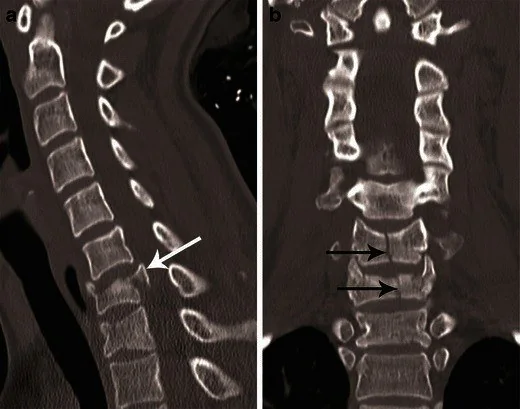
Yüksek enerjili servikal travmada korpusun posterior duvarı veya posterior elemanlardan kopan kemik parçası kanala ilerleyebilir. İnce kesit çok kesitli BT, vertebra kırık morfolojisini ve posterior korteksten kanala retropulse kemik fragmanları hızlı biçimde değerlendirir. BT travmanın kemik morfolojisini değerlendirmede ilk basamakken, spinal kord ve ligamentöz yaralanmaların incelenmesinde manyetik rezonans görüntüleme esastır. Bası ve eşlik eden kırık örüntüsü atlanırsa instabilite ile nörolojik yaralanmanın anatomik zemini eksik raporlanabilir.
Faz ve pencere
- Kontrastsız tanısal
- Posterior korpus korteksinden spinal kanala retropulse kemik fragmanı, eşlik eden lamina kırığı ve kemik kanal daralması kontrastsız BT'de izlenir.
- Kemik algoritması tanısal
- Kemik algoritmasında aksiyel görüntüler korpus komminüsyonunu ve retropülsiyonu, sagittal ve koronal rekonstrüksiyonlar ise farklı düzlemlerdeki kırık hatlarını değerlendirmeyi sağlar.
Önerilen pencereler G genişlik, M merkez; değerler Hounsfield birimi (HU)
- KemikG 1800 / M +400
- Yumuşak dokuG 400 / M +40
BT bulguları
- Retropulsiyon — vertebra korpusunun kırılmış posterior duvarından kemik parça spinal kanala doğru yer değiştirir.
- Kanal konturunda fokal daralma — korpus kırığına bağlı retropulse kemik fragmanlar sagittal ve aksiyel BT'de osseöz kanal kompromisine yol açar.
- Posterior eleman tutulumu — retropulse kemik parçaya veya travmaya eşlik eden tek taraflı lamina kırığı ve artiküler proçes kırıkları görülebilir.
- Kırık hattı uzanımı — sagittal rekonstrüksiyonda korpus kırık hattının posterior kortekse uzanımı ve buradan kopan retropulse fragman izlenebilir.
- Burst kırığında korpus komminüsyonu ve posterior korteksten spinal kanala retropulse kemik fragmanları görülebilir.
- Eşlik eden hizalanma kaybı — servikal omurga travmasında fokal kifoz, vertebral translasyon ve faset eklem dislokasyonu kırığa eşlik edebilir.
- Kord dokusu değerlendirmesi — BT kemik fragmanı ve kemik kanal geometrisini gösterir; spinal kord kontüzyonu ve ödemi değerlendirmesinde MR esastır.
- BT raporunda korpus kırığındaki komminüsyon, posterior korteks tutulumu ve fragman retropulsiyonu tariflenir.
Normalde
Normal servikal kanalda posterior vertebral çizgi düzgün bir ön sınır, laminaların oluşturduğu spinolaminar çizgi ise arka kemik sınırı oluşturur ve hatlarda kesinti izlenmez. Yaralı seviyeyi üst ve alt komşu seviyelerle, mümkünse karşı taraf faset ve lamina konturlarıyla kıyaslayıp daralmanın fragmanla aynı noktada olup olmadığını izleyin.
Normal BT ile kıyasla
Aynı bölgenin, kaynak veri setinde patoloji içermediği belirtilen bir BT incelemesini kesit kesit kaydırın; organ sınırlarını açarak anatomiyi hasta görüntüsüyle karşılaştırın. Küçük rastlantısal bulgular tümüyle dışlanmamıştır.
Kaynak: TotalSegmentator v2.01 veri seti (Wasserthal ve ark., Radiology: Artificial Intelligence 2023), CC BY 4.0, vaka s1338; organ sınırları veri setinin otomatik segmentasyonundan, birleştirilerek sadeleştirildi. Görüntüler 2,5 mm kesit aralığına yeniden örneklendi.
Ayırıcı tanı
- Dejeneratif kanal darlığı
- faset eklem osteoartriti ve intervertebral disk dejenerasyonu gibi dejeneratif değişikliklere bağlı gelişebilir.
- Gelişimsel dar kanal
- birden çok seviyede kanal darlığı görülebilir; travmatik retropulsiyon ise posterior kortekse uzanan kırık hattı ve kanala yer değiştirmiş kemik fragmanlarıyla tanımlanır.
Tuzaklar
- Kanal daralmasını yalnız tek aksiyel görüntüde ölçüp kırık hattını kaçırma; fragmanın korpustan mı fasetten mi geldiğini sagittal ve koronal planda izle.
- Kanal içindeki kemik parçanın varlığını kord hasarının kesin derecesi sayma; BT kemik yapıları değerlendirmede üstünken kord sinyal değişikliklerini saptamada MR tercih edilir.
- Retropulse kemik fragmanı dejeneratif veya gelişimsel yapılardan ayırırken dikkatli olun; iyi kortike kenarlar kronik/varyant lehineyken akut kırıkta posterior kortekste basamaklanma aranmalıdır.
Kendini dene
Travma BT'sinde C5 posterior korpus korteksinden kanala uzanan keskin fragman görülüyor. En doğru yorum hangisidir?
Cevabı göster
Travmatik retropulsiyon. Posterior korteks kırığıyla süreklilik gösteren keskin kemik parça akut retropulsiyonu destekler. Posterior kortekse uzanan kırık hattı ve retropulse fragmanlar kırığı desteklerken, iyi kortike kenarlar konjenital varyantları kırık fragmanından ayırır.
Kemik fragmanı kanalı daraltıyor; hasta kol güçsüzlüğü tarif ediyor. Kord yaralanmasını değerlendirmek için hangi inceleme gereklidir?
Cevabı göster
Manyetik rezonans görüntüleme gereklidir. BT kemik fragmanı ve kemik basısını gösterir; kord kontüzyonu, ödemi ve ligamentöz yaralanma değerlendirmesinde MR esastır.
İlgili konular
Kaynaklar
Bu sayfadaki 33 cümle ve 2 quiz sorusu aşağıdaki kaynaklardan alıntılarla otomatik olarak karşılaştırıldı; 18 cümle bu karşılaştırmada düzeltildi (2026-10-10).
- MDCT of acute subaxial cervical spine trauma: a mechanism-based approachpmc.ncbi.nlm.nih.gov
- Optimal trajectory for the occipital condyle screw.pubmed.ncbi.nlm.nih.gov
- Acute Thoracolumbar Spinal Cord Injury: Relationship of Cord Compression to Neurological Outcome.pubmed.ncbi.nlm.nih.gov
- Traumatic L5 over S1 spondyloptosis without neurological involvement managed nonoperatively: a case report.pubmed.ncbi.nlm.nih.gov
- Diagnostic Reliability of Computed Tomography in Predicting Posterior Ligamentous Complex Injury in Traumatic Lower Lumbar Fracture.pubmed.ncbi.nlm.nih.gov
- Percutaneous Instrumentation of a Complex Lumbar Spine Fracture with Bilateral Pedicle Dissociation: Case Report and Technical Note.pubmed.ncbi.nlm.nih.gov
- Timing of surgery and predictors of canal reduction after short-segment fixation for thoracolumbar burst fractures.pubmed.ncbi.nlm.nih.gov
- Emergency radiology of severe acute injury in extreme alpine summer sports: a pictorial essay.pubmed.ncbi.nlm.nih.gov
- Partial C2 corpectomy with iliac/fibula bone graft and posterior instrumented fusion for C2 vertebral body lesions: An innovative approach.pubmed.ncbi.nlm.nih.gov
- Atypical presentation of high-grade non-Hodgkin lymphoma in a child: A diagnostic challenge.pubmed.ncbi.nlm.nih.gov
- A Primer on Anatomy, Biophysics, Pathology, Imaging and Treatment of the Intervertebral Disc and the Anterior Spinal Column: The Discogenic, Intervertebral, Spinal Column (DISC) ASPN Workgroup.pubmed.ncbi.nlm.nih.gov
- Imaging features of primary tumors of the spine: A pictorial essay.pubmed.ncbi.nlm.nih.gov
- Imaging Evaluation of Acute Traumatic Brain Injury.pubmed.ncbi.nlm.nih.gov
- Risk evaluation of neck extension in patients with degenerative or ossified cervical spine undergoing extension-dependent surgical procedures: A retrospective observational study.pubmed.ncbi.nlm.nih.gov
- The Role of CT in Cervical Spine Imaging for Suspected Cervical Myelopathy.pubmed.ncbi.nlm.nih.gov
- A patient with lumbar disc herniation complicates cauda equina syndrome after epidural steroid injection: A case report.pubmed.ncbi.nlm.nih.gov
- Dural tears from traumatic spinal fractures: an illustrative case and systematic review of its incidence, diagnosis, risk factors, and management.pubmed.ncbi.nlm.nih.gov
- Complications of vertebral augmentation in metastatic spinal fractures: a systematic review of multiple study designs.pubmed.ncbi.nlm.nih.gov
- Subaxial Cervical Spine Fractures: Historical Systems and Advancements With the AO Spine Classification.pubmed.ncbi.nlm.nih.gov
- Spine Trauma Classifications: Historical, Current, and Emerging Perspectives for Radiologists.pubmed.ncbi.nlm.nih.gov
- Inter-observational analysis of computed tomography parameters to predict nonobvious posterior ligament complex injury in neurologically intact patients with thoracolumbar trauma.pubmed.ncbi.nlm.nih.gov
- Susceptibility-weighted imaging: an emerging technique for evaluation of the spine and spinal cord.pubmed.ncbi.nlm.nih.gov
- Contiguous Burst Fractures of the Lumbar Spine.pubmed.ncbi.nlm.nih.gov
- Spinal lesions: a comprehensive radiologic overview.pubmed.ncbi.nlm.nih.gov
- Indirect Spinal Decompression in Thoracolumbar Burst Fractures: Efficacy of Combined Modified Percutaneous Posterior Short-segment Fixation and Intraoperative CT Assistance.pubmed.ncbi.nlm.nih.gov
- Magnetic resonance imaging of the spine.pubmed.ncbi.nlm.nih.gov
- Navigation-Assisted Bilateral Troughing Technique for Lumbar Laminectomy: A Stepwise Approach to Safe, Teachable, and Efficient Decompression.pubmed.ncbi.nlm.nih.gov
- Finite element biomechanical evaluation of a novel double-door screw-plate system for posterior cervical laminoplasty.pubmed.ncbi.nlm.nih.gov
- Safety and Stability of a Combined C2 Screw Placement Strategy With Vertebral Artery Mobilization.pubmed.ncbi.nlm.nih.gov
- Biomaterials for vertebral body repair: interior augmentation and total replacement-a literature review of bone fusion outcomes in clinical studies.pubmed.ncbi.nlm.nih.gov
- Understanding a mass in the paraspinal region: an anatomical approach.pubmed.ncbi.nlm.nih.gov
- Klippel-Feil Syndrome with Sprengel Deformity.pubmed.ncbi.nlm.nih.gov
- Active tuberculosis of spine: Current updates.pubmed.ncbi.nlm.nih.gov
- Defining mechanical instability in tuberculosis of the spine: a systematic review.pubmed.ncbi.nlm.nih.gov
- A Proposal for a Standardized Imaging Algorithm to Improve the Accuracy and Reliability for the Diagnosis of Thoracolumbar Posterior Ligamentous Complex Injury in Computed Tomography and Magnetic Resonance Imaging.pubmed.ncbi.nlm.nih.gov
- Subacute post-traumatic ascending myelopathy after cervical spinal cord injury: a rare and fatal complication.pubmed.ncbi.nlm.nih.gov
- Management of Multilevel Mid-Cervical Fractures in an Adult With Osteopetrosis.pubmed.ncbi.nlm.nih.gov
- Magnetic resonance tractography of the cervical spine: A rapid diffusion tensor imaging protocol to serve as a clinical evaluation tool.pubmed.ncbi.nlm.nih.gov
- The value of magnetic resonance imaging and computed tomography in the study of spinal disorders.pubmed.ncbi.nlm.nih.gov
- Posterior atlantoaxial fusion: a comprehensive review of surgical techniques and relevant vascular anomalies.pubmed.ncbi.nlm.nih.gov
- Non-cardiac Manifestations in Adult Patients With Mucopolysaccharidosis.pubmed.ncbi.nlm.nih.gov
- Accessory Articulation of Elongated Anterior Tubercles of the Transverse Processes at C5-C6 in a Young Adult Female Patient: A Case Report.pubmed.ncbi.nlm.nih.gov
- Surgical Reduction Techniques and Outcomes for Cervical Spondyloptosis: A Technical Report and Case Series.pubmed.ncbi.nlm.nih.gov
- A Review of Finite Element Analysis in Spine Surgery Decision-Making.pubmed.ncbi.nlm.nih.gov
- Radiomics in spinal research: a narrative review.pubmed.ncbi.nlm.nih.gov
- MDCT of acute subaxial cervical spine trauma: a mechanism-based approach.pubmed.ncbi.nlm.nih.gov
- Anatomical Variants of the Cervical Spine and Sports-Related Injury in Athletes: A Narrative Review.pubmed.ncbi.nlm.nih.gov
- Clinical and Surgical Outcomes in Patients with Lumbar Spine Pathologies: A Retrospective Study.pubmed.ncbi.nlm.nih.gov
- Lumbar Spinal Stenosis: Pathophysiology, Biomechanics, and Innovations in Diagnosis and Management.pubmed.ncbi.nlm.nih.gov
- Lumbar microspur-related ventral cerebrospinal fluid leak localized by digital subtraction myelography: A case report.pubmed.ncbi.nlm.nih.gov
- Spontaneous hemorrhage in the spinal canal leading to Brown-Séquard syndrome: a case report and review of the literature.pubmed.ncbi.nlm.nih.gov
- Endovascular management of bilateral traumatic internal carotid artery dissections: A case report.pubmed.ncbi.nlm.nih.gov
- Role of 3D Printing in Preoperative Planning for Spine Surgery: A Scoping Review.pubmed.ncbi.nlm.nih.gov
- Insights into the Pathophysiology of Scheuermann's Kyphosis: From Structural Deformities to Genetic Predisposition and Underlying Signalling Pathways.pubmed.ncbi.nlm.nih.gov
- State-of-the-Art Imaging Techniques in Metastatic Spinal Cord Compression.pubmed.ncbi.nlm.nih.gov
- Holothoracic spinal epidural lipomatosis: Report of a rare presentation and review of literature.pubmed.ncbi.nlm.nih.gov
- High-Riding Vertebral Artery in Cervical Spine Surgery: A Review of Preoperative Identification and Surgical Implications.pubmed.ncbi.nlm.nih.gov
- Challenges and solutions in the treatment of spinal disorders in patients with skeletal dysplasia: A comprehensive review.pubmed.ncbi.nlm.nih.gov
- Atypical imaging features of tuberculous spondylitis: case report with literature review.pubmed.ncbi.nlm.nih.gov
- Fatal Injuries Caused by Falling Trees: Correlation Between Postmortem Computed Tomography and Forensic Autopsy Findings in Eight Cases.pubmed.ncbi.nlm.nih.gov
- Unveiling Primary Bone Tumors of the Spine: A Review of Essential Imaging Clues.pubmed.ncbi.nlm.nih.gov
- A pictorial essay of thoracic wall diseases: multiple pathologies in the same anatomical site.pubmed.ncbi.nlm.nih.gov
- Percutaneous Treatment of Traumatic A3 Burst Fractures of the Thoracolumbar Junction Without Neurological Impairment: The Role of Timing and Characteristics of Fragment Blocks on Ligamentotaxis Efficiency.pubmed.ncbi.nlm.nih.gov
- Determinants of lateral fusion in single-level oblique lateral lumbar interbody fusion: a retrospective analysis of fusion patterns and clinical outcomes.pubmed.ncbi.nlm.nih.gov
- Advancements in biomaterials and bioactive solutions for lumbar spine fusion cages: Current trends and future perspectives.pubmed.ncbi.nlm.nih.gov
- A Guide to Improving the Care of Patients with Fragility Fractures, Edition 2.pubmed.ncbi.nlm.nih.gov
- Long-term safety and effectiveness of the "OptEase" vena cava filter.pubmed.ncbi.nlm.nih.gov
- Differential diagnosis of benign and malignant vertebral compression fractures based on CT radiomics model.pubmed.ncbi.nlm.nih.gov
- CT and MR imaging of odontoid abnormalities: A pictorial review.pubmed.ncbi.nlm.nih.gov
- Reoperation Strategy for Failure of Cervical Disc Arthroplasty at Index and Adjacent Levels.pubmed.ncbi.nlm.nih.gov
- Surgical Stabilization of the Spine: A Clinical Review of Spinal Fractures, Spondylolisthesis, and Instrumentation Methods.pubmed.ncbi.nlm.nih.gov
- Osteoporosis in Adult Patients Undergoing Spinal Reconstructive Surgery: Associated Complications and Management.pubmed.ncbi.nlm.nih.gov
- Case Report: Repeated imaging and surgical treatment of a vascular hamartoma arising from the cervical vertebral column of a cat.pubmed.ncbi.nlm.nih.gov
- Abnormal Cervical Facet Orientation and Congenital Stenosis: Case Reports and Biomechanical Implications-Illustrative Cases.pubmed.ncbi.nlm.nih.gov
- Diagnostic decision-making, vertebral augmentation, and osteoporosis therapy in vertebral compression fractures: a narrative review.pubmed.ncbi.nlm.nih.gov
- Helcococcus kunzii as a rare etiological agent of spondylodiscitis partially managed with oral antibiotic therapy in a patient with diabetes mellitus: a case report.pubmed.ncbi.nlm.nih.gov
- Progressive Spastic Paraparesis Caused by Thoracic Spinal Epidural Lipomatosis: A Case Report and Systematic Review.pubmed.ncbi.nlm.nih.gov
- High Spinal Cord Injury After a Minor Fall in a 23-Month-Old Girl With Atlantoaxial Instability Associated With Morquio Type A: A Case Report.pubmed.ncbi.nlm.nih.gov
- Application of AUSS-TLIF for the treatment of a lumbar burst fracture: A case report.pubmed.ncbi.nlm.nih.gov
- Comparative Efficacy of Posterior Versus Lateral Endoscopic Approaches in the Management of Complex Lumbar Disc Herniation: A Retrospective Cohort Study.pubmed.ncbi.nlm.nih.gov
- Facet-Destructive Cervical Tumoral Calcinosis Causing Myelopathy in Systemic Sclerosis: A Case Report and Literature Review.pubmed.ncbi.nlm.nih.gov
- Spinal cord infarction without radiologic evidence of trauma complicated by cerebellar infarction due to vertebral artery thrombosis: A case report.pubmed.ncbi.nlm.nih.gov
- Unilateral biportal endoscopic decompression for acute spontaneous spinal epidural hematoma at the cervicothoracic junction: a case report and literature review.pubmed.ncbi.nlm.nih.gov
- A Stable C7 Fracture in a High School Quarterback: A Case of Clay Shoveler's Fracture.pubmed.ncbi.nlm.nih.gov
- Interventional radiology management of disc herniation: a narrative review.pubmed.ncbi.nlm.nih.gov
- Post-traumatic lumbar discal fracture: A case report.pubmed.ncbi.nlm.nih.gov
- Recommendations for the diagnosis and treatment of spontaneous intracranial hypotension.pubmed.ncbi.nlm.nih.gov
- Transverse Process Fractures in Athletes: Mechanisms, Management and Return-to-Play Considerations.pubmed.ncbi.nlm.nih.gov
- Spontaneous Spinal Epidural Haematoma Associated With Direct Oral Anticoagulants: A Descriptive Systematic Review.pubmed.ncbi.nlm.nih.gov
- The Utility of Routine Postoperative Radiographs Following Surgical Treatment of Traumatic Cervical Spine Injuries.pubmed.ncbi.nlm.nih.gov
- Rugby Injury Imaging.pubmed.ncbi.nlm.nih.gov
- Return to Play Criteria After Adult Lumbar Spinal Fractures: A Review of Current Literature and Expert Recommendations.pubmed.ncbi.nlm.nih.gov
- Geriatric spine fractures - Demography, changing trends, challenges and special considerations: A narrative review.pubmed.ncbi.nlm.nih.gov
- Modified Spinous Process-Splitting Approach for Thoracolumbar Burst Fractures With Neurological Deficits: Technical Description and Preliminary Clinical Outcomes.pubmed.ncbi.nlm.nih.gov
- Comparative analysis of two modified TLICS systems in guiding surgical decision-making for thoracolumbar fractures.pubmed.ncbi.nlm.nih.gov
- Congenital and Breed-Associated Vertebral Anomalies in Dogs and Cats: Developmental Anatomy, Genetic Determinants, and Biological Significance.pubmed.ncbi.nlm.nih.gov
- A New Method for Optimizing Spinal Canal Cross-Sectional Area During Laminoplasty: Lateral Mass Gutter.pubmed.ncbi.nlm.nih.gov
- Unilateral open-door laminoplasty involving C1 for developmental atlantal canal stenosis combined with multilevel cervical stenosis: a case report.pubmed.ncbi.nlm.nih.gov
- [Feasibility study of a novel preoperative planning method for predicting the increment of spinal canal cross-sectional area and opening angle in single open-door laminoplasty].pubmed.ncbi.nlm.nih.gov
- Anterior Arch Fracture of the Atlas on Postoperative Day 6 Following Unilateral C1 Laminectomy Requiring Occiput-to-C2 Fusion: A Case Report.pubmed.ncbi.nlm.nih.gov
- Conservative Treatment of Pediatric Fractures-Narrative Review of Acceptable Deformity and Remodeling Potential.pubmed.ncbi.nlm.nih.gov
- Radiological Diagnosis and Advances in Imaging of Vertebral Compression Fractures.pubmed.ncbi.nlm.nih.gov
- Pediatric spinal injuries- current concepts.pubmed.ncbi.nlm.nih.gov
- Anatomical and biological reconstruction of traumatic complete burst fractures of the thoracolumbar vertebrae using pedicle fixation combined with stent-armed kyphoplasty and intracorporeal bone grafting: technique rationale, 7-year experience and clinical, imaging, and histological outcomes.pubmed.ncbi.nlm.nih.gov
- Minimally Invasive Percutaneous Pedicle Screw Fixation in Thoracolumbar Spine Fractures: A Clinical Evaluation Study and Computed Tomography Scan Analysis of Screw Tracts.pubmed.ncbi.nlm.nih.gov
- Applications of the SpineJack device in the surgical management of type A4 lumbar burst fractures without neurological deficit: illustrative cases.pubmed.ncbi.nlm.nih.gov
- Traumatic lumbosacral instability: part 2-indications and techniques for surgical management.pubmed.ncbi.nlm.nih.gov
- A young man with Guillain-Barré syndrome, with a stroke-like presentation and physical findings suggestive of cervical myelopathy.pubmed.ncbi.nlm.nih.gov
- Nursing review section of surgical neurology international: Evaluation of cervical disc disease and when surgery is warranted.pubmed.ncbi.nlm.nih.gov
- Is Anterior-Only Fixation Adequate for Three-Column Injuries of the Cervical Spine?pubmed.ncbi.nlm.nih.gov
- Review of the Imaging Features of Benign Osteoporotic and Malignant Vertebral Compression Fractures.pubmed.ncbi.nlm.nih.gov
Eğitim amaçlıdır; hasta başında tanı ve tedavi kararının yerine geçmez, tıbbi tavsiye değildir. Metinler yapay zekâ desteğiyle yazıldı ve otomatik bir adımda kaynak alıntılarıyla karşılaştırıldı; bu bir tıbbi doğrulama değildir ve içerik uzman radyolog incelemesinden geçmedi. Klinik kararlarda güncel kılavuzları, kurum protokollerini ve radyoloji raporunu esas alın.