Özet
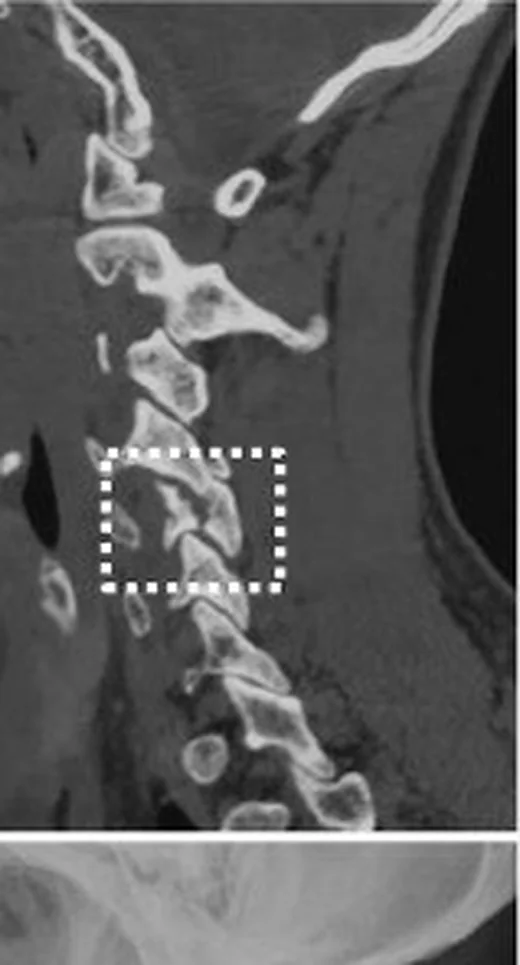
Fleksiyon ve rotasyonun birlikte etkilediği C3–C7 yaralanmasında bir vertebranın alt artiküler faseti, alttaki vertebranın üst artiküler fasetinin önüne atlayıp eklemden çıkar; karşı taraf eklem kısmen korunabilir. Kontrastsız çok düzlemli BT, atlayan faseti, segmental rotasyonu, eşlik eden kemik parçalarını ve korpus kaymasını ortaya koyar. Tek taraflı faset çıkığı, faset tutulumunun tek taraflı olmasıyla çift taraflı çıkıktan ayrılır; eşlik eden disk, bağ ve omurilik yaralanmaları ayrıca değerlendirilmelidir. Tek bir eklemi izleyip karşı tarafı ve disk aralığını incelememek yaralanmanın gerçek kapsamını ve kanal riskini eksik bırakır.
Faz ve pencere
- Kontrastsız tanısal
- Parasagittal rekonstrüksiyon atlayan alt artiküler fasetin alttaki üst artiküler faset önündeki konumunu; aksiyel kesit rotasyon ve eklem örtüşme kaybını gösterir. Korpusların yer değiştirmesi ve eşlik eden kemik parçaları BT’de değerlendirilir; disk ve bağ yaralanmaları MR ile incelenir.
- Kemik algoritması tanısal
- Her iki faset ekleminden geçen ince aksiyel, sagittal ve koronal görüntüler kilitli eklemi, karşı taraf fasetin kısmi temasını, pillar kırığını ve lamina/endplate eşlikçilerini ayırt etmeyi sağlar.
Önerilen pencereler: Kemik (G 1800 / M 400), Yumuşak doku (G 400 / M 40).
BT bulguları
- Atlamış faset — üst vertebranın alt artiküler çıkıntısı komşu alt vertebranın üst faset çıkıntısının önüne yer değiştirmiştir.
- Tek taraflı faset örtüşme kaybı — bir eklemde artiküler yüzler normal ilişkisini kaybederken karşı taraf kısmen temasını sürdürebilir.
- Segmental rotasyon — aksiyel planda spinöz çıkıntı ve korpus yönelimi asimetrik, karşı faset eklemi ise daha az yer değiştirmiştir.
- Eşlik eden korpus translasyonu — üst vertebra öne kayabilir; miktar ve yön eklem morfolojisinden ayrı tanımlanır.
- Faset pillar veya artiküler çıkıntı kırığı — kilitlenmiş eklemin kenarında kortikal kesinti ya da küçük fragman bulunabilir.
- Eşlik eden disk herniasyonu ve bağ yaralanması MRI ile değerlendirilir.
- Faset çıkığına eşlik eden spinal kanal daralması ve omurilik basısı MRI ile değerlendirilebilir.
Ölçütler ve sınıflamalar
- AO Spine F4 faset yaralanması
- Patolojik subluksasyon, perç edilmiş veya çıkmış faset F4 olarak sınıflanır; taraf belirtilir. Tek taraflı olguda karşı fasetin kilitli olmaması bilateral F4 örüntüsünden ayrımı sağlar.
- SLIC morfoloji bileşeni
- Translasyon varsa morfoloji translasyon olarak; diskoligamentöz kompleks ve nörolojik durum da ayrı bileşenler olarak kaydedilir.
Normalde
Normal faset ekleminde üst vertebranın alt artiküler yüzü, alttaki vertebranın üst artiküler yüzüyle karşılıklı örtüşür; aksiyel görünüm iki tarafta benzer eklem yönelimi sunar. Şüpheli tarafta faset atlamasını karşı taraftaki eklemle, aynı zamanda korpusların sagittal hizası ve disk aralığıyla kıyaslayın.
Normal BT ile kıyasla
Aynı bölgenin, kaynak veri setinde patoloji içermediği belirtilen bir BT incelemesini kesit kesit kaydırın; organ sınırlarını açarak anatomiyi hasta görüntüsüyle karşılaştırın. Küçük rastlantısal bulgular tümüyle dışlanmamıştır.
Kaynak: TotalSegmentator v2.01 veri seti (Wasserthal ve ark., Radiology: Artificial Intelligence 2023), CC BY 4.0, vaka s1338; organ sınırları veri setinin otomatik segmentasyonundan, birleştirilerek sadeleştirildi. Görüntüler 2,5 mm kesit aralığına yeniden örneklendi.
Ayırıcı tanı
- Çift taraflı faset çıkığı
- iki tarafta da fasetler atlamış veya kilitlenmiştir ve segmental translasyon daha simetrik belirgin olabilir.
- Faset kırığı olmadan subluksasyon
- eklem kısmi örtüşmesini koruyabilir; artiküler çıkıntının karşı faset üzerine tam atlaması gösterilemez.
- Faset çıkıntısı kırığı başlangıçta yer değiştirmesiz ve vertebra cisimlerinin hizası korunmuş görünebilir; tek taraflı servikal faset kırığına bağlı gizli instabilite ve gecikmiş çıkık gelişebilir.
- Dejeneratif faset artrozu
- eklem aralığında daralma, skleroz ve osteofitlerle görülebilir.
Tuzaklar
- Aksiyel kesitte tek tarafın rotasyonel görünümünü yeterli kanıt saymayın; atlamayı parasagittal rekonstrüksiyonda fasetlerin üst-alt ilişkisiyle doğrulayın.
- Kısmen korunmuş karşı faset temasını normal inceleme diye yorumlamayın; bu bulgu tek taraflı çıkığı bilateral kilitlenmeden ayırmaya yardım eder.
- Korpus kaymasının az olması ciddi disk ve bağ hasarını dışlamaz; BT'de görünmeyen diskoligamentöz bileşen rapor sınırlarında belirtilmelidir.
Kendini dene
C6 alt faseti C7 üst fasetinin önüne atlamış, segment dönmüş; sol fasette kısmi temas sürüyor. Hangi yaralanma örüntüsü en olasıdır?
Cevabı göster
Tek taraflı faset çıkığı. Bir fasetin atlaması ve karşı eklemde göreli temasın kalması tek taraflı çıkık örüntüsünü destekler. Bilateral çıkıkta iki faset de atlamıştır; izole kırıkta eklem kilitlenmesi olmaz; dejeneratif kaymada akut atlama ve rotasyon beklenmez.
Aksiyel BT'de C5-C6 rotasyonu var, fakat faset eklemi üst-alt yüz ilişkisi belirsiz. Kilitlenmeyi doğrulamak için hangi rekonstrüksiyon en yararlı?
Cevabı göster
Faset boyunca parasagittal. Parasagittal kemik rekonstrüksiyon atlamış artiküler çıkıntının diğer fasete göre konumunu gösterir. Yumuşak doku ya da akciğer penceresi eklem yüzlerini çözmez; gecikmiş kontrast serisinin kemik çıkık tanısına katkısı yoktur.
İlgili konular
Kaynaklar
Bu sayfadaki 41 cümle ve 2 quiz sorusu aşağıdaki kaynaklardan alıntılarla otomatik olarak karşılaştırıldı; 3 cümle bu karşılaştırmada düzeltildi (2026-10-09).
- Traumatic C6-C7 Fracture-Dislocation with Surgical Correction of Anterior Hardware Fusion Failure and Neglected Locked Facet: A Case Report and Literature Reviewpmc.ncbi.nlm.nih.gov
- Anterior Versus Posterior Stabilization of Subaxial Cervical Spine Fracture-Dislocations, Dislocations and Subluxations: A Retrospective Cohort Study of Neurological and Radiological Outcomespmc.ncbi.nlm.nih.gov
- Occipital plate-assisted posterior reduction for tumor-related severe atlantoaxial dislocation: a single-case surgical techniquepmc.ncbi.nlm.nih.gov
- Subaxial cervical spine fractures with facet joint dislocation: Surgical management, technique, and results in a retrospective series of 36 patientspmc.ncbi.nlm.nih.gov
- Optimizing surgical strategies for subaxial cervical fracture-dislocation: a facet and disc injury-based approachpmc.ncbi.nlm.nih.gov
- Treatment of cervical subaxial injury in the very young child.pubmed.ncbi.nlm.nih.gov
- Influence of graft size on spinal instability with anterior cervical plate fixation following in vitro flexion-distraction injuries.pubmed.ncbi.nlm.nih.gov
- Treatment of unilateral L5-S1 locked facet in a pediatric patient.pubmed.ncbi.nlm.nih.gov
- Clinical and radiographic outcomes of posterior cervical arthrodesis and stabilization via lateral mass screwing and rod fixation: a retrospective study at a tertiary hospital in Addis Ababa, Ethiopia.pubmed.ncbi.nlm.nih.gov
- Factors influencing feasibility of direct posterior reduction in irreducible traumatic atlantoaxial dislocation secondary to isolated odontoid fracture.pubmed.ncbi.nlm.nih.gov
- In Vitro Biomechanical Study of Epidural Pressure during the Z-shape Elevating-Pulling Reduction Technique for Cervical Unilateral Locked Facets.pubmed.ncbi.nlm.nih.gov
- Cervical Posttraumatic Unilateral Locked Facets: Clinical, Radiologic, and Surgical Remarks on a Series of 33 Patients.pubmed.ncbi.nlm.nih.gov
- Traumatic unilateral jumped facet joint in the upper thoracic spine: Case presentation and literature review.pubmed.ncbi.nlm.nih.gov
- Anterior Retropharyngeal Reduction and Sequential Posterior Fusion for Atlantoaxial Rotatory Fixation With Locked C1-C2 Lateral Facet.pubmed.ncbi.nlm.nih.gov
- Optimizing surgical strategies for subaxial cervical fracture-dislocation: a facet and disc injury-based approach.pubmed.ncbi.nlm.nih.gov
- [Study on the rotary angle, plain radiographs and CT appearance in unilateral locked facet of cervical spine].pubmed.ncbi.nlm.nih.gov
- Delayed Unilateral Facet Interlocking After a Stable Superior Articular Process Fracture of the Cervical Spine: A Case Report.pubmed.ncbi.nlm.nih.gov
- Reduction of traumatic unilateral locked facet of the subaxial cervical spine: what predicts successful closed skeletal traction, and is anterior or posterior surgery superior after unsuccessful closed reduction?pubmed.ncbi.nlm.nih.gov
- 270-Degree Decompression, Fixation, and Realignment in a Neglected Cervical Facet Dislocation : A Case Report.pubmed.ncbi.nlm.nih.gov
- The Effect of Head-Forward Posture on Lower Neck Loads and Dislocation Risk in Head-First Impact: A Computational and Experimental Investigation.pubmed.ncbi.nlm.nih.gov
- Awake closed manual reduction of cervical spine dislocation as an emergency bridge to surgery: a case report.pubmed.ncbi.nlm.nih.gov
- Subaxial cervical spine fractures with facet joint dislocation: Surgical management, technique, and results in a retrospective series of 36 patients.pubmed.ncbi.nlm.nih.gov
- Spinal ankylosis and sex-specific predisposing factors in type II odontoid fractures: a comparison with sub-axial fractures.pubmed.ncbi.nlm.nih.gov
- A Proposal for a Standardized Imaging Algorithm to Improve the Accuracy and Reliability for the Diagnosis of Thoracolumbar Posterior Ligamentous Complex Injury in Computed Tomography and Magnetic Resonance Imaging.pubmed.ncbi.nlm.nih.gov
- Accuracy and Clinical Utility of Reports from Outside Hospitals for CT of the Cervical Spine in Blunt Trauma.pubmed.ncbi.nlm.nih.gov
- Anterior Versus Posterior Stabilization of Subaxial Cervical Spine Fracture-Dislocations, Dislocations and Subluxations: A Retrospective Cohort Study of Neurological and Radiological Outcomes.pubmed.ncbi.nlm.nih.gov
- Surgical management protocol for anterior-only reduction and fixation for acute, delayed and old subaxial cervical facet dislocation: a retrospective study of 87 consecutive cases in China.pubmed.ncbi.nlm.nih.gov
- Transoral digital reduction of complete anterior odontoid dislocation followed by fiducial-based navigated transcondylar screw fixation: illustrative case.pubmed.ncbi.nlm.nih.gov
- Cranial anatomy, palaeoneurology, palaeobiology and stratigraphic age of the large-bodied ornithopod, <i>Muttaburrasaurus langdoni</i> Bartholomai and Molnar, 1981, from the mid-Cretaceous of Australia.pubmed.ncbi.nlm.nih.gov
- Catastrophic failure of anterior fusion for bilateral cervical facet dislocation: illustrative case.pubmed.ncbi.nlm.nih.gov
- The evolution of cervical spine trauma classification: a paradigm shift from morphological description to clinical decision-making.pubmed.ncbi.nlm.nih.gov
- Traumatic Bilateral Lumbosacral Jumped Facet Without Fracture in Childhood: Case Report and Systematic Review.pubmed.ncbi.nlm.nih.gov
- Safety and Stability of a Combined C2 Screw Placement Strategy With Vertebral Artery Mobilization.pubmed.ncbi.nlm.nih.gov
- No significant side-to-side differences in retropatellar load distribution using more than 7.5 years after isolated MPFL reconstruction: A CT-osteoabsorptiometry pilot study in nine patients.pubmed.ncbi.nlm.nih.gov
- The Transverse Process Cluneal Approach (TPCA): First-in-Human Proximal Radiofrequency Ablation of the Superior Cluneal Nerve in a Patient With Clinical Features Consistent With Maigne's Syndrome - A Novel Anatomy-Based Clinical Case.pubmed.ncbi.nlm.nih.gov
- Progressive Acquired Cervical Deformity With Myelopathy Managed by Occipitocervicothoracic Fusion: A Case Report.pubmed.ncbi.nlm.nih.gov
- In vivo 3D kinematic analysis of cervical facet joints under physiological loading in healthy individuals.pubmed.ncbi.nlm.nih.gov
- Complete Neurological Recovery Following Combined Anterior-Posterior Cervical Corpectomy and Circumferential Stabilization for Severe Cervical Tuberculosis with Grade IV C3-C4 Spondylolisthesis: A Rare Case Report from Somalia.pubmed.ncbi.nlm.nih.gov
- Occipital plate-assisted posterior reduction for tumor-related severe atlantoaxial dislocation: a single-case surgical technique.pubmed.ncbi.nlm.nih.gov
- Population-based incidence and demographic patterns of traumatic joint dislocations in children and adolescents.pubmed.ncbi.nlm.nih.gov
- Awake Cranial Traction and Isolated Anterior Cervical Discectomy and Fusion in the Treatment of Traumatic Subaxial Cervical Facet Joint Dislocations: Analysis of a Cohort of 70 Patients and Predictors of Surgical Failure.pubmed.ncbi.nlm.nih.gov
- Isolated Spinous Process Fracture: A Commonly Missed Diagnosis.pubmed.ncbi.nlm.nih.gov
- Treatment Strategy for Subaxial Minimal Facet/Lateral Mass Fractures: A Comprehensive Clinical Review.pubmed.ncbi.nlm.nih.gov
- Spine Trauma Classifications: Historical, Current, and Emerging Perspectives for Radiologists.pubmed.ncbi.nlm.nih.gov
- Flexion teardrop fracture of the cervical spine: a narrative review.pubmed.ncbi.nlm.nih.gov
- Recommendations of the International Consensus Meeting (ICM) 2025 on Spinal Infections: Part B Tubercular Spondylodiscitis.pubmed.ncbi.nlm.nih.gov
- Radiologically Devastating Yet Neurologically Intact: A Rare Case of Ambulatory C6-C7 Translational Injury with Bilateral Facet Dislocation and Vertebral Artery Thrombosis.pubmed.ncbi.nlm.nih.gov
- Novelty in Management of Traumatic Posterior Atlantoaxial Subluxation without Associated Fractures; A Case Report : Innovative Treatment for Atlantoaxial Subluxation.pubmed.ncbi.nlm.nih.gov
- Intact Posterior Tension Band in Spinal Fractures in Patients With Spinal Ankylosing Disorders - Is it a Myth or a Reality? A Systematic Review.pubmed.ncbi.nlm.nih.gov
- Risk Factors for Failure of Non-operative Management in Isolated Unilateral Non-displaced Facet Fractures of the Subaxial Cervical Spine: Systematic Review and Meta-Analysis.pubmed.ncbi.nlm.nih.gov
- Advancements and applications of 3D printing in pediatric orthopedics: A comprehensive review.pubmed.ncbi.nlm.nih.gov
- Association of Chiropractic Colleges Educational Conference and Research Agenda Conference 2023: Leadership in Education.pubmed.ncbi.nlm.nih.gov
- Abnormal Cervical Facet Orientation and Congenital Stenosis: Case Reports and Biomechanical Implications-Illustrative Cases.pubmed.ncbi.nlm.nih.gov
- Atlantoaxial Rotatory Fixation: Current Challenges and Advances in Diagnosis and Management.pubmed.ncbi.nlm.nih.gov
- Traumatic C6-C7 Fracture-Dislocation with Surgical Correction of Anterior Hardware Fusion Failure and Neglected Locked Facet: A Case Report and Literature Review.pubmed.ncbi.nlm.nih.gov
- An Emergency Medicine Disposition Challenge: A Scoping Review of Isolated Transverse Process Fractures of the Cervical Spine.pubmed.ncbi.nlm.nih.gov
- Elbow Microinstability: From the State of the Art to an Integrated Clinical Approach.pubmed.ncbi.nlm.nih.gov
- Infectious Spondylodiscitis of Bacterial Causes in Adults: Epidemiology, Pathophysiology, Diagnostic and Treatment Challenges.pubmed.ncbi.nlm.nih.gov
- Anterior Transoral Odontoid Reduction With Clivocervical Fusion in Revision Surgery for Craniovertebral Junction Anomalies: A Case Report and Technical Note.pubmed.ncbi.nlm.nih.gov
- C1 lateral mass reconstruction using a titanium cage following total resection of the aneurysmal bone cyst: illustrative cases and literature insights.pubmed.ncbi.nlm.nih.gov
- Accuracy of Cervical Spine CT for Detection of Craniocervical Junction Ligamentous Injury in Children.pubmed.ncbi.nlm.nih.gov
- Cervical Collar in Adult Trauma: Evidence, Controversies, and Clinical Decision-Making.pubmed.ncbi.nlm.nih.gov
- Cervical spine clearance in adult trauma patients: What you need to know.pubmed.ncbi.nlm.nih.gov
- A survey on the early management of spinal trauma in low and middle-income countries: From the scene of injury to the diagnostic phase (part II).pubmed.ncbi.nlm.nih.gov
- Correlation of blunt cervical spinal cord injury magnetic resonance imaging tractography with the American Spinal Injury Association impairment scale motor scores.pubmed.ncbi.nlm.nih.gov
- Synergetic mechanism by decompression and bone bioactive factors to induce the spontaneous resolution of lumbar disc herniation.pubmed.ncbi.nlm.nih.gov
- Anatomical Variants of the Cervical Spine and Sports-Related Injury in Athletes: A Narrative Review.pubmed.ncbi.nlm.nih.gov
- Plough Fracture (Anterior Arch Fracture Type Traumatic Posterior Atlantoaxial Dislocation, TPAD-AOT Type III): A Retrospective Study of Nine Clinical Cases With Complete Imaging Data.pubmed.ncbi.nlm.nih.gov
- Radiological findings of February 2023 twin earthquakes-related spine injuries.pubmed.ncbi.nlm.nih.gov
- The Effect of Axial Compression and Distraction on Cervical Facet Cartilage Apposition During Shear and Bending Motions.pubmed.ncbi.nlm.nih.gov
- Literature Review: Management of Primary Atlantoaxial Osteoarthritis and Associated Occipital Neuralgia.pubmed.ncbi.nlm.nih.gov
- The value of magnetic resonance imaging and computed tomography in the study of spinal disorders.pubmed.ncbi.nlm.nih.gov
- Imaging in spinal posterior epidural space lesions: A pictorial essay.pubmed.ncbi.nlm.nih.gov
- Evaluation of GPT-4 ability to identify and generate patient instructions for actionable incidental radiology findings.pubmed.ncbi.nlm.nih.gov
- Craniovertebral Junction Instability after Oncological Resection: A Narrative Review.pubmed.ncbi.nlm.nih.gov
- Incidence of traumatic carotid and vertebral artery dissections: results of cervical vessel computed tomography angiogram as a mandatory scan component in severely injured patients.pubmed.ncbi.nlm.nih.gov
- Surgical strategies in the management of atlantoaxial dislocation in Down syndrome.pubmed.ncbi.nlm.nih.gov
- MDCT of acute subaxial cervical spine trauma: a mechanism-based approach.pubmed.ncbi.nlm.nih.gov
- Non-Infectious Spinal Diseases Mimicking Infection: A Pictorial Essay.pubmed.ncbi.nlm.nih.gov
- Imaging of osteoarthritis from the ankle through the midfoot.pubmed.ncbi.nlm.nih.gov
- Surgical Reduction Techniques and Outcomes for Cervical Spondyloptosis: A Technical Report and Case Series.pubmed.ncbi.nlm.nih.gov
- Degenerative characteristics of the subaxial cervical spine in patients with degenerative lateral atlantoaxial osteoarthritis: A propensity score-matched study based on computed tomography imaging.pubmed.ncbi.nlm.nih.gov
- Anatomical and Technical Considerations of CT-Guided C1-C2 Lateral Joint Injections: Technique, Pitfalls, and Risks.pubmed.ncbi.nlm.nih.gov
- Traumatic nerve root injury due to unilateral facet fracture of the cervical spine caused by a direct external force; a case report.pubmed.ncbi.nlm.nih.gov
- Surgical outcomes in cervical spondylotic myelopathy with severe cord compression and intramedullary signal changes: a retrospective descriptive study.pubmed.ncbi.nlm.nih.gov
- Cervical Spine Pathology in the Context of Intimate Partner and Interpersonal Violence: A Case Series and Focused Narrative Review.pubmed.ncbi.nlm.nih.gov
Eğitim amaçlıdır; hasta başında tanı ve tedavi kararının yerine geçmez, tıbbi tavsiye değildir. Metinler yapay zekâ desteğiyle yazıldı ve otomatik bir adımda kaynak alıntılarıyla karşılaştırıldı; bu bir tıbbi doğrulama değildir ve içerik uzman radyolog incelemesinden geçmedi. Klinik kararlarda güncel kılavuzları, kurum protokollerini ve radyoloji raporunu esas alın.