
Özet
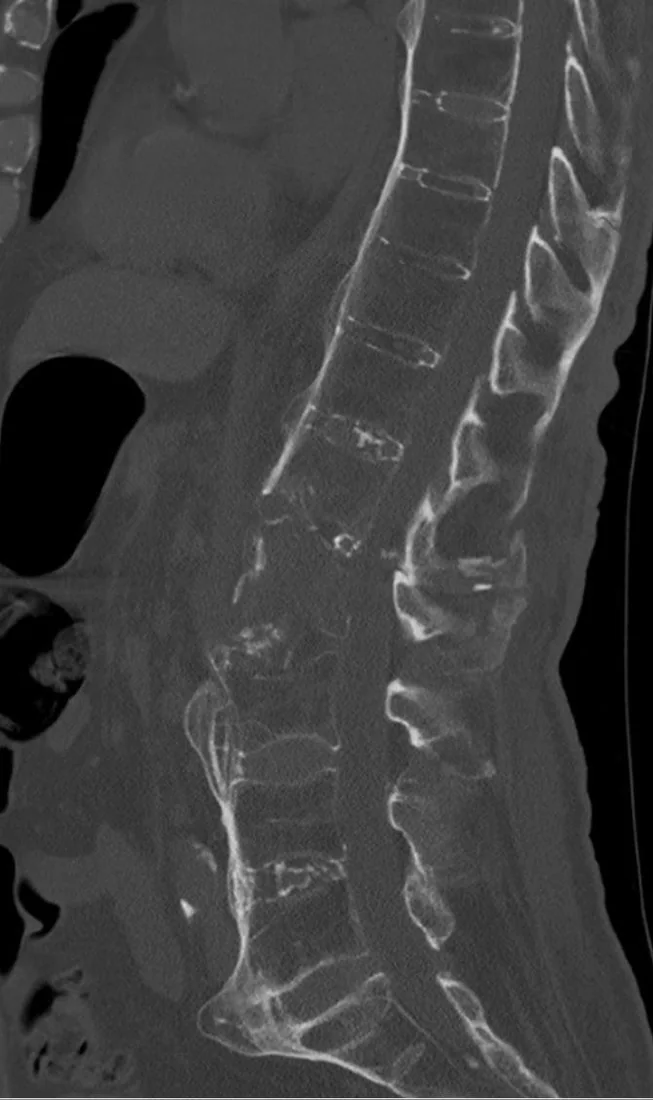
Ankilozan spondilit veya DISH nedeniyle rijitleşmiş omurgada düşük enerjili travma bile uzun kaldıraç kolu boyunca kırığa yol açabilir. İnce kesit kontrastsız BT, transdiskal ya da transvertebral hattı, posterior eleman uzanımını ve deplasmanı gösterir; inceleme tüm omurgayı kapsamalıdır çünkü ek düzey yaralanmalar olabilir. Kırık küçük deplasmanlı görünse bile mekanik olarak ciddi olabilir ve ikincil yer değiştirme nörolojik hasara neden olabilir. Yalnız ağrılı seviyeye odaklanmak veya kırığı gözden kaçırmak ek yaralanmayı ve spinal kanal riskini atlatabilir.
Faz ve pencere
- Kontrastsız tanısal
- Tüm omurgada aksiyel kesitler ve sagittal/koronal kemik rekonstrüksiyonları; köprüleşmiş segmentte diskten veya vertebra korpusundan geçen yatay-oblik kırık hattı, posterior arkus uzanımı, faset ayrışması ve hizalanma bozukluğunu gösterir. Kırık haritalaması için BT’de yaralanma düzeyinin en az üç vertebra üstünü ve altını kapsayan iki düzlemli rekonstrüksiyon veya 3B görüntüleme önerilir.
- Kemik algoritması tanısal
- İnce kemik rekonstrüksiyonları köprüleşen osteofit veya sindesmofit içinden geçen çatlağı, küçük kortikal ayrışmayı ve kırığın disk-korpus-kanal boyunca devamını görünür kılar; tüm omurga kapsamı ek kırık taramasına izin verir.
Önerilen pencereler: Kemik (G 1800 / M 400), Yumuşak doku (G 400 / M 40).
BT bulguları
- Köprüleşen segmentte kesinti — anterolateral kemik köprüsü veya sindesmofit boyunca keskin kırık aralığı.
- Transdiskal hat — füzyonlu disk aralığını kesen, vertebra son plaklarına ve posterior diskoligamentöz yapılara uzanabilen çizgi.
- Transvertebral hat — korpus trabeküllerini ve korteksini geçen, kimi zaman iki son plağı da ayıran kırık.
- Posterior eleman devamlılığı — kırık hattının pedikül, lamina, faset veya spinöz çıkıntıya kadar uzanıp uzanmadığını izleyin.
- Faset ayrışması ve translasyon — posterior eklem uyumunda açılma, subluksasyon veya vertebral dizilim kaybı.
- Spinal kanal fragmanı — korpus ya da arkus fragmanı kanal içine yer değiştirerek daralma oluşturabilir.
- Ek düzey kırık — tüm omurga taramasında ikinci kırık hattı veya başka bir segmentte akut kemik hasarı arayın.
- Prevertebral hematom — Bir DISH olgusunda kırıkla birlikte büyük prevertebral hematom bildirilmiştir.
Ölçütler ve sınıflamalar
- Ankilozan omurgada bildirilen çok seviyeli/çok segmentli yaralanma sıklığı
- %6–8
- AO Spine torakolomber sınıflaması
- Ankilozan omurga hastalığı AO Spine torakolomber sisteminde M2 durum belirteciyle belirtilir; kırığın morfolojisi yine ilgili A, B veya C yaralanma tipiyle ayrıca tanımlanır.
Normalde
Normal hareketli omurgada disk aralıkları açık ve segmentler arasında hareketli eklemler seçilir; ankilozan segmentte kemik köprüleri süreklidir. Kırık şüphesinde köprü ya da füzyonlu disk içindeki çizgiyi, normal kortikal konturun kesintisini ve aynı seviyedeki posterior elemanların hizasını karşılaştırın.
Normal BT ile kıyasla
Aynı bölgenin, kaynak veri setinde patoloji içermediği belirtilen bir BT incelemesini kesit kesit kaydırın; organ sınırlarını açarak anatomiyi hasta görüntüsüyle karşılaştırın. Küçük rastlantısal bulgular tümüyle dışlanmamıştır.
Kaynak: TotalSegmentator v2.01 veri seti (Wasserthal ve ark., Radiology: Artificial Intelligence 2023), CC BY 4.0, vaka s1338; organ sınırları veri setinin otomatik segmentasyonundan, birleştirilerek sadeleştirildi. Görüntüler 2,5 mm kesit aralığına yeniden örneklendi.
Ayırıcı tanı
- Köprüleşmiş osteofit
- kırık hattı olmaksızın akıcı anterolateral kemik oluşumu ve korunmuş vertebra korteksi vardır.
- Akut vertebral kompresyon kırığı
- Ankilozan omurga hastalarında izole basit kompresyon tipi (AO Spine A tipi) yaralanma olasılığı düşüktür ve bunu instabil B veya C tipi yaralanmalardan ayırt etmek zor olabilir.
- Andersson lezyonu, ankilozan spondilitin nadir discovertebral komplikasyonlarından biridir ve yeni mekanik ağrı inflamatuvar hastalık aktivitesine bağlandığında gözden kaçabilir.
Tuzaklar
- Düşük deplasman kırığın önemsiz olduğu anlamına gelmez; füzyonlu omurga boyunca uzun kaldıraç etkisi kırılgan bir uzun kemik yaralanması gibi davranabilir.
- Yalnız semptomatik bölgeyi taramak eş zamanlı başka seviyedeki kırığı kaçırabilir; kaynaklar ankilozan omurgada tüm omurga BT veya MR taramasını önerir.
- DISH'te anterior köprüleşen osteofit de kırılabilir; bu nedenle köprü boyunca kırık hattı aranmalıdır.
- BT nörolojik bulguya yol açan epidural hematomu veya bağ/omurilik hasarını dışlamaz; nörolojik bulgu ya da açıklanamayan kanal şüphesinde MR eklenir.
Kendini dene
DISH nedeniyle rijit omurgalı hasta küçük travma sonrası ağrılı. Bir seviyede minimal ayrışan transdiskal hat görülüyor. En uygun BT kapsamı hangisi?
Cevabı göster
Tüm omurga. Ankilozan omurgada çok seviyeli yaralanmalar bildirilmiştir ve kılavuz tüm omurga BT veya MR taramasını önerir. Ankilozan omurgada çok seviyeli yaralanmalar bildirilmiştir; bu nedenle yalnız ağrılı seviyenin görüntülenmesi ek kırığı dışlamaz.
Ankilozan vertebrada kırık hattı füzyonlu diskten geçip lamina ve fasetlere uzanıyor. Bu bulgu neyi özellikle düşündürür?
Cevabı göster
Uzun segment kırığı. Rijit segmenti diskten posterior kemik elemanlara kadar geçen hat, ankilozan omurganın kırık örüntüsünü ve mekanik ciddiyetini gösterir. Kırık hattı disk, vertebra korpusu ve posterior disko-ligamentöz veya kemik elemanlara uzanabilir; tüm vertebral kolonların tutulumu yüksek instabiliteyle ilişkilidir.
İlgili konular
Kaynaklar
Bu sayfadaki 42 cümle ve 2 quiz sorusu aşağıdaki kaynaklardan alıntılarla tek tek karşılaştırıldı; 7 cümle bu karşılaştırmada düzeltildi (2026-10-09).
- Spine Fractures in Ankylosing Diseases: Recommendations of the Spine Section of the German Society for Orthopaedics and Trauma (DGOU)pmc.ncbi.nlm.nih.gov
- Bone Involvement in Patients with Spondyloarthropathies.pubmed.ncbi.nlm.nih.gov
- Spinal fractures in patients with ankylosing spondylitis.pubmed.ncbi.nlm.nih.gov
- Research of a Safe and Simplified Intertransverse Process Approach for the Lower Thoracic Interbody Surgery.pubmed.ncbi.nlm.nih.gov
- Management of a pseudarthrosis with sagittal malalignment in a patient with ochronotic spondyloarthropathy.pubmed.ncbi.nlm.nih.gov
- Quantitative analysis of the anterolateral ossification mass in diffuse idiopathic skeletal hyperostosis of the thoracic spine.pubmed.ncbi.nlm.nih.gov
- Traumatic death in ankylosing spondylitis.pubmed.ncbi.nlm.nih.gov
- [Traumatic injuries in ankylosing spinal diseases].pubmed.ncbi.nlm.nih.gov
- Injuries to the Rigid Spine: What the Spine Surgeon Wants to Know.pubmed.ncbi.nlm.nih.gov
- [Unexpected back pain in the elderly ankylosing spondylitis patient].pubmed.ncbi.nlm.nih.gov
- Iatrogenic Spinal Cord Injury in a Trauma Patient with Ankylosing Spondylitis.pubmed.ncbi.nlm.nih.gov
- [Mid-term results of total hip arthroplasty for treatment of ankylosing spondylitis].pubmed.ncbi.nlm.nih.gov
- Cervical spine fractures in patients with ankylosing spondylitis: Importance of early management.pubmed.ncbi.nlm.nih.gov
- Posterior pedicle screw fixation to treat lower cervical fractures associated with ankylosing spondylitis: a retrospective study of 35 cases.pubmed.ncbi.nlm.nih.gov
- The Importance of Instrumentation Length in Ankylosing Spinal Disorders and Thoracolumbar Fractures.pubmed.ncbi.nlm.nih.gov
- Bechterew's Disease and the Risk of Spinal Fractures: Clinical Patterns, Imaging Correlation, and Outcomes.pubmed.ncbi.nlm.nih.gov
- Intact Posterior Tension Band in Spinal Fractures in Patients With Spinal Ankylosing Disorders - Is it a Myth or a Reality? A Systematic Review.pubmed.ncbi.nlm.nih.gov
- Sacroiliac Joint Anatomical Variants and Their Association with Spinopelvic Alignment: A Whole-Spine CT Study.pubmed.ncbi.nlm.nih.gov
- Imaging Characteristics of Diffuse Idiopathic Skeletal Hyperostosis: More Than Just Spinal Bony Bridges.pubmed.ncbi.nlm.nih.gov
- Pivotal role of the synovioentheseal complex in the imaging of arthritis and rheumatic diseasespubmed.ncbi.nlm.nih.gov
- Do All Fractures in the Ankylotic Spine Really Require Surgical Intervention?pubmed.ncbi.nlm.nih.gov
- Acute thoracolumbar fractures in patients with a rigid spine: a computed tomography study.pubmed.ncbi.nlm.nih.gov
- The Integrated Nerve, Discoligamentous Complex, and Vertebra Scoring System for Thoracolumbar Junction (TLJ) Injury.pubmed.ncbi.nlm.nih.gov
- Diagnosis and management of esophageal perforation with necrotizing fasciitis in traumatic cervical spine injuries: illustrative case.pubmed.ncbi.nlm.nih.gov
- Standalone Percutaneous Vertebroplasty for Hyperextension Injuries of the Ankylosed Thoracolumbar Spinal Kyphosis.pubmed.ncbi.nlm.nih.gov
- The Impact of Diffuse Idiopathic Skeletal Hyperostosis on Nutritional Status, Neurological Outcome, and Perioperative Complications in Patients with Cervical Spinal Cord Injury.pubmed.ncbi.nlm.nih.gov
- Management of Sub-axial Cervical Spine Injuries.pubmed.ncbi.nlm.nih.gov
- MDCT of acute subaxial cervical spine trauma: a mechanism-based approach.pubmed.ncbi.nlm.nih.gov
- Cervical spine trauma.pubmed.ncbi.nlm.nih.gov
- Epidemiology of Traumatic Cervical Spinal Cord Injury in Southeast Norway.pubmed.ncbi.nlm.nih.gov
- The evolution of cervical spine trauma classification: a paradigm shift from morphological description to clinical decision-making.pubmed.ncbi.nlm.nih.gov
- Indirect Spinal Decompression in Thoracolumbar Burst Fractures: Efficacy of Combined Modified Percutaneous Posterior Short-segment Fixation and Intraoperative CT Assistance.pubmed.ncbi.nlm.nih.gov
- Vertebral Ankylosis Is Associated with Reduced Cervical Extensor Muscle Bulk and Increased Fatty Degeneration.pubmed.ncbi.nlm.nih.gov
- National Trends and Risk Factors for Dysphagia After Anterior Cervical Discectomy and Fusion.pubmed.ncbi.nlm.nih.gov
- Rigid spine injuries - A comprehensive review on diagnostic and therapeutic challenges.pubmed.ncbi.nlm.nih.gov
- The value of magnetic resonance imaging and computed tomography in the study of spinal disorders.pubmed.ncbi.nlm.nih.gov
- Hemoptysis as the Presenting Clinical Sign of a T8-T9 Spine Fracture with Diffuse Idiopathic Skeletal Hyperostosis Changes.pubmed.ncbi.nlm.nih.gov
- Diagnostic accuracy of plain films in detection of thoracolumbar fractures in minor trauma patients: comparison with CT.pubmed.ncbi.nlm.nih.gov
- Non-Operative Management for Patients With Spinal Ankylosing Disorders Presenting With Extension Type (AOSpine B3) Fractures-Our Experience with a Cohort of 40 Patients.pubmed.ncbi.nlm.nih.gov
- Disease-specific definitions of new bone formation on spine radiographs: a systematic literature review.pubmed.ncbi.nlm.nih.gov
- Association of Inflammation, Ectopic Bone Formation, and Sacroiliac Joint Variation in Ossification of the Posterior Longitudinal Ligament.pubmed.ncbi.nlm.nih.gov
- Anterior Cervical Osteophyte Resection for Treatment of Dysphagia.pubmed.ncbi.nlm.nih.gov
- Geriatric spine fractures - Demography, changing trends, challenges and special considerations: A narrative review.pubmed.ncbi.nlm.nih.gov
- Unstable Thoracolumbar Injuries: Factors Affecting the Decision for Short-Segment vs Long-Segment Posterior Fixation.pubmed.ncbi.nlm.nih.gov
- Determinants of lateral fusion in single-level oblique lateral lumbar interbody fusion: a retrospective analysis of fusion patterns and clinical outcomes.pubmed.ncbi.nlm.nih.gov
- Axial Spondyloarthritis: Mimics and Pitfalls of Imaging Assessment.pubmed.ncbi.nlm.nih.gov
- Esophageal perforation with near fatal mediastinitis secondary to Th3 fracture.pubmed.ncbi.nlm.nih.gov
- The role of miRNAs as biomarkers in heterotopic ossification.pubmed.ncbi.nlm.nih.gov
- Post-traumatic spinal hematoma in diffuse idiopathic skeletal hyperostosis (DISH).pubmed.ncbi.nlm.nih.gov
- Treatment of Andersson lesion-complicating ankylosing spondylitis via early minimally invasive surgery.pubmed.ncbi.nlm.nih.gov
- Spinal disorders mimicking infection.pubmed.ncbi.nlm.nih.gov
- Immune cell infiltration-related clinical diagnostic model for Ankylosing Spondylitis.pubmed.ncbi.nlm.nih.gov
- Diffuse idiopathic skeletal hyperostosis: A functional enemy of vertebral stability - Case series and surgical consideration of craniovertebral junction involvement.pubmed.ncbi.nlm.nih.gov
- Hounsfield unit values in patients with diffuse idiopathic skeletal hyperostosis and thoracolumbar injuries - a single-center retrospective study.pubmed.ncbi.nlm.nih.gov
- Surgical Stabilization of the Spine: A Clinical Review of Spinal Fractures, Spondylolisthesis, and Instrumentation Methods.pubmed.ncbi.nlm.nih.gov
- Surgical Considerations in Osteoporotic Dorso-Lumbar Spine Fractures.pubmed.ncbi.nlm.nih.gov
- A case of diffuse idiopathic hyperostosis of bone (DISH) in a patient on hemodialysis.pubmed.ncbi.nlm.nih.gov
- Double non-contiguous fractures in a patient with spondylo-epiphyseal dysplasia with spinal ankylosis treated with open and percutaneous spinal fixation technique: a case report.pubmed.ncbi.nlm.nih.gov
- AO Spine Clinical Practice Recommendations for the Management of Subaxial Spine Fractures.pubmed.ncbi.nlm.nih.gov
- Treatment of Injuries to the Subaxial Cervical Spine: Recommendations of the Spine Section of the German Society for Orthopaedics and Trauma (DGOU).pubmed.ncbi.nlm.nih.gov
- Spine Fractures in Ankylosing Diseases: Recommendations of the Spine Section of the German Society for Orthopaedics and Trauma (DGOU).pubmed.ncbi.nlm.nih.gov
- Update on Imaging-Based Measurement of Bone Mineral Density and Quality.pubmed.ncbi.nlm.nih.gov
- Imaging of Sacroiliac Pain: The Current State-of-the-Art.pubmed.ncbi.nlm.nih.gov
- Subaxial cervical spine trauma.pubmed.ncbi.nlm.nih.gov
- Subaxial cervical spine trauma: evaluation and surgical decision-making.pubmed.ncbi.nlm.nih.gov
- A Rigid Spine at Risk: Chalk-Stick Fracture With Dural Sac Entrapment After Ground-Level Fall.pubmed.ncbi.nlm.nih.gov
- Indications and Limitations of Standalone Percutaneous Vertebroplasty for Reverse Chance Fractures Associated With Ankylosing Spinal Disorders.pubmed.ncbi.nlm.nih.gov
- The Complex Surgical Management of Vertebral Fracture in a Patient With Undiagnosed Ankylosing Spondylitis: A Case Report.pubmed.ncbi.nlm.nih.gov
- Spinal Involvement in Patients with Chronic Non-Bacterial Osteomyelitis (CNO): An Analysis of Distinctive Imaging Features.pubmed.ncbi.nlm.nih.gov
- Spondylodiscitis and Its Mimickers: A Pictorial Review.pubmed.ncbi.nlm.nih.gov
- Case Report: Ochronotic arthropathy mimicking spondyloarthritis: a case-based review of diagnostic pitfalls and a novel likely pathogenic HGD variant.pubmed.ncbi.nlm.nih.gov
- Imaging of Spondylodiscitis: A Comprehensive Updated Review-Multimodality Imaging Findings, Differential Diagnosis, and Specific Microorganisms Detection.pubmed.ncbi.nlm.nih.gov
- Clinical Characteristics and a New Classification System of Mono-Segmental Thoracic and Lumbar Nonfusion in Patients With Ankylosing Spondylitis.pubmed.ncbi.nlm.nih.gov
- Management of a Severe L4/5 Andersson Lesion with Three-Column Instability in Ankylosing Spondylitis Using Single-Stage Circumferential Reconstruction: A Case Report.pubmed.ncbi.nlm.nih.gov
- Non-Infectious Spinal Diseases Mimicking Infection: A Pictorial Essay.pubmed.ncbi.nlm.nih.gov
- Seronegative spondyloarthropathy-related sacroiliitis: CT, MRI features and differentials.pubmed.ncbi.nlm.nih.gov
- The Role of Magnetic Resonance Imaging to Inform Clinical Decision-Making in Acute Spinal Cord Injury: A Systematic Review and Meta-Analysis.pubmed.ncbi.nlm.nih.gov
- Management of Thoracolumbar Vertebral Fractures and Dislocations in Patients with Ankylosing Conditions of the Spine.pubmed.ncbi.nlm.nih.gov
- An exploratory multimodal imaging and clinicopathological strategy for suspected Kümmell's disease in the absence of MRI.pubmed.ncbi.nlm.nih.gov
- The role of radiography in the study of spinal disorders.pubmed.ncbi.nlm.nih.gov
Eğitim amaçlıdır; hasta başında tanı ve tedavi kararının yerine geçmez. İçerik yapay zekâ destekli bir süreçle güncel literatüre göre cümle cümle kaynaklarla karşılaştırıldı, ancak uzman radyolog incelemesinden geçmedi. Klinik kararlarda güncel kılavuzları, kurum protokollerini ve radyoloji raporunu esas alın.