Özet
Osteoporotik kompresyon kırığı, kemik dayanıklılığı azalmış hastada hafif travma ya da günlük yüklenme sonrasında vertebra korpusu ve son plakların çökmesiyle ortaya çıkabilir. Kontrastsız BT kemik korteksi, son plak impaksiyonu, trabeküler sıkışma, posterior duvar ve kanal ilişkisini gösterir; önceki incelemeler yeni kırığı kronik şekil değişikliğinden ayırmaya yardım eder. Kontrastsız BT'de görülen intraosseöz hava veya vakum yarık işareti iyi huylu kırık için güvenilir bir bulgu kabul edilir; ancak kırığın kronolojik yaşının ve altta yatan nedenin kesin belirlenmesi için klinik bilgi ve önceki görüntülemelerle uyumlu olması gerekir. Posterior duvar retropulsiyonu ve spinal kanal daralması gibi bulguların açıkça raporlanmaması, nörolojik tutulumun ve gerekli cerrahi yönetimin gecikmesine yol açabilir.
Okuma sırası
- Korpus yüksekliği ve komşu vertebralar. Sagittal kemik penceresinde ağrılı vertebrayı bulun ve üst-alt komşu korpusları referans alarak şekil farkının yeni olup olmadığını değerlendirin.
- Vertebra son plakları. Üst ve alt son plakları izleyip içe basamaklanma, çökme ya da son plağa komşu trabeküler sıkışma alanını ayrı ayrı gösterin.
- Korpus korteksi ve intravertebral cleft. Anterior kortekste kıvrılma veya keskin kesinti varsa ardışık sagittal görüntülerde devamlılığını doğrulayın; intravertebral gaz aralığını cleft olarak tanımlayın.
- Posterior korpus duvarı. Posterior duvarı kanala bakan kontur boyunca takip ederek retropulse fragman olup olmadığını ve spinal kanalın kemik sınırını inceleyin.
- Diğer vertebralar ve paravertebral alan. Son olarak aynı incelemedeki diğer korpuslarda ek kırık, posterior elemanlarda hasar ve yumuşak doku kitlesi bulunup bulunmadığını tarayın.
Faz ve pencere
- Kontrastsız BT tanısal
- Sagittal ve koronal kemik rekonstrüksiyonlarında vertebra korpus yüksekliği, son plakta çökme, kortikal basamaklanma, trabeküler impaksiyon, keskin kırık hattı ve intravertebral gaz incelenir; etiyolojik kemik değerlendirmesinde kontrast fazı gerekmez. BT'de sagittal reformasyonları değerlendirmek, vertebra kırıklarının aksiyel kesitlerde gözden kaçmasını önlemeye ve posterior eleman tutulumunu saptamaya yardımcı olur.
Önerilen pencereler: Kemik (G 1800 / M 400), Yumuşak doku (G 400 / M 40).
BT bulguları
- Son plak impaksiyonu — üst veya alt son plakta kortikal içe çökme ve komşu trabeküllerde sıkışma.
- Kortikal kırık — anterior kortekste, belirgin korpus deformitesi olmadan da görülebilir.
- Trabeküler impaksiyon bandı — son plağa komşu kemikte yoğunlaşmış, sıkışmış trabekül alanı.
- Kama biçimli yükseklik kaybı — korpusun anterior yüksekliği orta ve posterior yüksekliğe göre daha fazla azalmıştır; aynı düzey komşu vertebralarla kıyaslanır.
- Posterior duvar retropulsiyonu — kırık kortikal fragman spinal kanala doğru yer değiştirir; fokal kemik çıkıntısı, düzgün tümöral ekspansiyondan farklıdır.
- İntravertebral vakum yarığı — korpus içinde gaz içeren yarık dinamik instabilite veya gecikmiş iyileşme ile ilişkili olabilir; tek başına etiyoloji kanıtı değildir.
- Çoklu osteoporotik deformiteler — aynı incelemede başka vertebra gövdelerinde benzer son plak çökmesi ve kronik kama deformiteleri bulunabilir.
- Yeni-kronik ayrımı — yeni kortikal kesinti, impaksiyon ve önceki görüntüye göre gelişen yükseklik kaybı akut/subakut yaralanmayı destekler.
Ölçütler ve sınıflamalar
- Genant derece 1: vertebra yüksekliği kaybı
- %20–25
- Genant derece 2: vertebra yüksekliği kaybı
- %26–40
- Genant derece 3: vertebra yüksekliği kaybı
- >%40
- Genant görsel yarı-kantitatif vertebra kırığı değerlendirme yöntemi
- Derece 1 hafif (%20–25), derece 2 orta (%26–40), derece 3 ağır (>%40) yükseklik kaybını görsel olarak derecelendirir; ölçüm yerine gözlemsel tahmine dayandığı için yarı-kantitatif yöntem olarak adlandırılır.
Normalde
Normal aynı düzey korpusun ön, orta ve arka yükseklikleri komşu vertebralarla uyumludur; üst-alt son plaklar düzgün, korteks kesintisiz ve trabeküller düzenli görünür. Sagittal kıyasta yeni basamaklanma, son plakta içe çökme ve komşu gövdeye göre gelişen yükseklik farkını arayın; Genant derecesi morfometrik şiddeti tarif eder, kırığın nedenini tek başına belirlemez.
Normal BT ile kıyasla
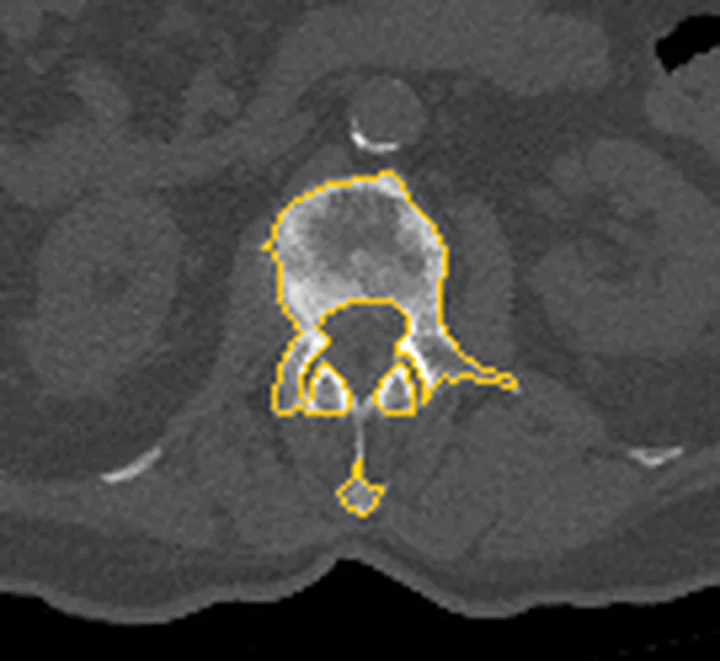
Aynı bölgenin, kaynak veri setinde patoloji içermediği belirtilen bir BT incelemesini kesit kesit kaydırın; organ sınırlarını açarak anatomiyi hasta görüntüsüyle karşılaştırın. Küçük rastlantısal bulgular tümüyle dışlanmamıştır.
Kaynak: TotalSegmentator v2.01 veri seti (Wasserthal ve ark., Radiology: Artificial Intelligence 2023), CC BY 4.0, vaka s1338; organ sınırları veri setinin otomatik segmentasyonundan, birleştirilerek sadeleştirildi. Görüntüler 2,5 mm kesit aralığına yeniden örneklendi.
Ayırıcı tanı
- Malignite ilişkili kompresyon kırığı
- litik yıkım, korpus ekspansiyonu veya epidural/paravertebral kitle benign çökmeden kuşku uyandırır.
- Akut travmatik burst kırığı
- arka duvar kırığı ve retropulsiyon, travma mekanizmasıyla birlikte değerlendirilir; osteoporotik hastada da burst morfolojisi gelişebilir.
- Kronik osteoporotik deformite
- kortikal kenarlar yeniden şekillenmiş, sklerotik ve önceki incelemelerde değişmeden kalmış olabilir.
- Schmorl nodu
- son plakta sınırlı fokal çökme ve disk materyalinin intravertebral uzanımı vardır; korpusun yaygın kama biçimli çökmesi beklenmez.
- Vertebral osteonekroz
- intravertebral cleft ve iki parçalı hareketli görünüm yapabilir; kırık iyileşmesi ve klinik zaman çizelgesiyle birlikte yorumlanır.
Tuzaklar
- Yükseklik azalmasını tek başına kırık saymayın; dejeneratif kama, gelişimsel şekil ve projeksiyon etkisi için son plak morfolojisini ve önceki görüntüleri karşılaştırın.
- Vakum yarık işareti iyi huylu kırık için güvenilir bir bulgu olarak tanımlansa da, eşlik eden yumuşak doku kitlesi, korpus genişlemesi veya posterior element tutulumu gibi tümöral bulgular ayrıca aranmalıdır.
- Aksiyel seride yalnız vertebra gövdesine odaklanmak posterior duvar retropulsiyonunu kaçırabilir; sagittal kemik rekonstrüksiyonda kanal konturunu izleyin.
- Genant yüzdelerini kırık yaşı veya etiyoloji eşiği gibi kullanmayın; akut kırıkta son plak/korteks bulguları ile klinik ve önceki inceleme önem taşır.
Kendini dene
Osteoporozlu hastada yeni sırt ağrısı var. BT'de üst son plakta kortikal çökme ve komşu trabeküllerde yoğunlaşma görülüyor. En olası bulgu nedir?
Cevabı göster
Son plak impaksiyonu. Son plak içe çökerken komşu trabeküllerin sıkışması akut/subakut osteoporotik kırığı destekler. Schmorl nodu Scheuermann hastalığında son plak düzensizliği ile birlikte görülür; malign süreçte litik yıkım ve yumuşak doku kitlesi öngörülür; vakum yarık ise kemik içi hava (intraosseöz gaz) olarak tanımlanır.
L2 kompresyonunda posterior duvardan kanala keskin kemik parçası çıkıyor; korpus içinde litik odak veya kitle yok. Bu morfoloji en çok hangisini destekler?
Cevabı göster
Benign kompresyon kırığı. Keskin retropulse kortikal fragman benign kırık lehine morfolojik bulgudur; maligniteyi tek başına dışlamasa da destrüktif lezyon ve yumuşak doku kitlesi bulunmaması bu olasılığı destekler. Diğer seçeneklerde kemik yıkımı, disk-komşu endplate değişikliği veya kitle beklenir.
İlgili konular
- Malignite ilişkili patolojik kompresyon kırığı
- Kompresyon kırığında benign–malign ayrımı
- Denis üç kolon modeli
Kaynaklar
Bu sayfadaki 45 cümle ve 2 quiz sorusu aşağıdaki kaynaklardan alıntılarla tek tek karşılaştırıldı; 8 cümle bu karşılaştırmada düzeltildi (2026-10-09).
- Imaging of vertebral fracturespmc.ncbi.nlm.nih.gov
- Red flags to screen for vertebral fracture in people presenting with low back pain.pubmed.ncbi.nlm.nih.gov
- [Progress on treatment of osteoporotic vertebral compression fracture].pubmed.ncbi.nlm.nih.gov
- New vertebral fractures after osteoporotic vertebral compression fracture between balloon kyphoplasty and nonsurgical treatment PRISMA.pubmed.ncbi.nlm.nih.gov
- Life-threatening intracardiac cement embolisms after percutaneous kyphoplasty: a case report and literature review.pubmed.ncbi.nlm.nih.gov
- Clinical and radiological subsequent fractures after vertebral augmentation for treating osteoporotic vertebral compression fractures: a meta-analysis.pubmed.ncbi.nlm.nih.gov
- Multidisciplinary and Coordinated Management of Osteoporotic Vertebral Compression Fractures: Current State of the Art.pubmed.ncbi.nlm.nih.gov
- Comparative efficacy and tolerability of three treatments in old people with osteoporotic vertebral compression fracture: a network meta-analysis and systematic review.pubmed.ncbi.nlm.nih.gov
- Comparison of the Efficacy Between Two Micro-Operative Therapies of Old Patients With Osteoporotic Vertebral Compression Fracture: A Network Meta-Analysis.pubmed.ncbi.nlm.nih.gov
- What Factors Contribute to the Poor Prognosis of Conservative Treatment for Osteoporotic Vertebral Compression Fracture (OVCF): A Systematic Review.pubmed.ncbi.nlm.nih.gov
- Role of paraspinal muscle degeneration in the occurrence and recurrence of osteoporotic vertebral fracture: A meta-analysis.pubmed.ncbi.nlm.nih.gov
- Risk factors for subsequent vertebral fractures after percutaneous vertebral augmentation in Asian populations: a systematic review and meta-analysis.pubmed.ncbi.nlm.nih.gov
- Effect of Bone Cement Volume Fraction on Adjacent Vertebral Fractures After Unilateral Percutaneous Kyphoplasty.pubmed.ncbi.nlm.nih.gov
- Distal Junctional Failures in Degenerative Thoracolumbar Hyperkyphosis.pubmed.ncbi.nlm.nih.gov
- TiRobot-assisted percutaneous vertebroplasty in the management of middle and upper thoracic osteoporotic vertebral compression fracture.pubmed.ncbi.nlm.nih.gov
- Factors Affecting Recollapse of the Augmented Vertebrae After Percutaneous Vertebral Augmentation: A Prospective Study.pubmed.ncbi.nlm.nih.gov
- Oral Food Supplement with Bio-Activated Silicium and Vitamins D3 and K2 in the Conservative Management of Osteoporotic Vertebral Compression Fractures.pubmed.ncbi.nlm.nih.gov
- Paraspinal muscle CT measurements in predicting subsequent fractures after percutaneous kyphoplasty in elderly women.pubmed.ncbi.nlm.nih.gov
- Anatomical and biological reconstruction of traumatic complete burst fractures of the thoracolumbar vertebrae using pedicle fixation combined with stent-armed kyphoplasty and intracorporeal bone grafting: technique rationale, 7-year experience and clinical, imaging, and histological outcomes.pubmed.ncbi.nlm.nih.gov
- Anatomy of the intraosseous arterial microvasculature of the adult lumbar vertebral body and its role in fracture healing: a literature review and historical perspective.pubmed.ncbi.nlm.nih.gov
- Diagnostic accuracy of plain films in detection of thoracolumbar fractures in minor trauma patients: comparison with CT.pubmed.ncbi.nlm.nih.gov
- Single-position robot-assisted lateral lumbar corpectomy with minimally invasive posterior spinal fusion for traumatic burst fracture showing MRI-demonstrated indirect decompression: illustrative case.pubmed.ncbi.nlm.nih.gov
- Evaluation of corticosteroid treatment in patients with post-traumatic ascending myelopathy and spinal cord injury: three case reports and review of the literature.pubmed.ncbi.nlm.nih.gov
- Revision surgical treatments and classification system for cage retropulsion in degenerative lumbar disease.pubmed.ncbi.nlm.nih.gov
- Spinal lesions: a comprehensive radiologic overview.pubmed.ncbi.nlm.nih.gov
- Advancements in biomaterials and bioactive solutions for lumbar spine fusion cages: Current trends and future perspectives.pubmed.ncbi.nlm.nih.gov
- Towards the diagnosis of osteoporosis - contributions from coincidental diagnostic imaging findings in chiropractors' practice.pubmed.ncbi.nlm.nih.gov
- EXPANDABLE INTRAVERTEBRAL IMPLANTS IN POST-TRAUMATIC VERTEBRAL NECROSIS - NEW CLASSIFICATION SUGGESTION.pubmed.ncbi.nlm.nih.gov
- Perioperative ultrasonography in surgical stabilization of rib fractures: A single-center retrospective analysis of its utility in surgical planning and post-discharge follow-up.pubmed.ncbi.nlm.nih.gov
- An Ultrasound Image-and-Intervention Paradigm for a Neglected Lumbar Transverse Process Fracture: A Case Report of Diagnosis and Hydrodissection Treatment.pubmed.ncbi.nlm.nih.gov
- Current State-of-the-Art 3D MRI Sequences for Assessing Bone Morphology with Emphasis on Cranial and Spinal Imaging: A Narrative Review.pubmed.ncbi.nlm.nih.gov
- Magnetic resonance bone imaging: applications to vertebral lesions.pubmed.ncbi.nlm.nih.gov
- Proton Density Fat Fraction Spine MRI for Differentiation of Erosive Vertebral Endplate Degeneration and Infectious Spondylitis.pubmed.ncbi.nlm.nih.gov
- A study on the factors influencing the improvement of spinal kyphosis after percutaneous vertebroplasty for thoracolumbar compression fractures in the elderly.pubmed.ncbi.nlm.nih.gov
- Pott's disease as the initial presentation of tuberculosis: diagnostic challenges and radiological findings in district-level care-a case report.pubmed.ncbi.nlm.nih.gov
- Single-Stage Posterior Unilateral Transpedicular Corpectomy With Circumferential Reconstructive Stabilization for the Treatment of Severe Thoracic and Lumbar Complete Burst Fractures.pubmed.ncbi.nlm.nih.gov
- Magnetic Resonance Imaging for Spine Emergencies.pubmed.ncbi.nlm.nih.gov
- Treatment of thoracolumbar burst fractures: SpineJack vs. posterior arthrodesis-comparison of clinical and radiological outcomes.pubmed.ncbi.nlm.nih.gov
- An exploratory multimodal imaging and clinicopathological strategy for suspected Kümmell's disease in the absence of MRI.pubmed.ncbi.nlm.nih.gov
- Diabetes, Osteosarcopenia, and Immobilization: A Novel Nomogram for Predicting Kümmell's Disease After Osteoporotic Vertebral Fractures.pubmed.ncbi.nlm.nih.gov
- Multilevel Revision Percutaneous Vertebroplasty in Elderly Patients With Osteoporotic Thoracolumbar Fractures: A Retrospective Cohort Study.pubmed.ncbi.nlm.nih.gov
- Intrabody Cage Augmentation in Kümmell Disease and Osteoporotic Burst Fractures: Technical Insights and Narrative Review of Current Evidence.pubmed.ncbi.nlm.nih.gov
- Radiomics in spinal research: a narrative review.pubmed.ncbi.nlm.nih.gov
- Exercise-responsive crosstalk within local muscle-bone units in osteosarcopenia: from mechanotransduction to secretome signalling.pubmed.ncbi.nlm.nih.gov
- Association of vertebral fractures with worsening degenerative changes of the spine: a longitudinal study.pubmed.ncbi.nlm.nih.gov
- A Parent Project Muscular Dystrophy-sponsored International Workshop Report on Endocrine and Bone Issues in Patients with Duchenne Muscular Dystrophy: An Ever-changing Landscape.pubmed.ncbi.nlm.nih.gov
- Vertebral Body Reshaping after Fractures: An Important Index of Recovery in Glucocorticoid-Treated Children.pubmed.ncbi.nlm.nih.gov
- Adiposity Excess and Vertebral Fractures in Patients With Breast Cancer Taking Aromatase Inhibitors.pubmed.ncbi.nlm.nih.gov
- Approach to the Pediatric Patient With Glucocorticoid-Induced Osteoporosis.pubmed.ncbi.nlm.nih.gov
- Predictors of vertebral fractures in patients with severe osteoporosis: a sub-analysis of the Japanese Osteoporosis Intervention Trial-05 (JOINT-05).pubmed.ncbi.nlm.nih.gov
- Morphological characteristics of lumbar vertebral bodies and regional distribution patterns of bone mineral density: a CT study.pubmed.ncbi.nlm.nih.gov
- Evolutionary Specializations of the Human Vertebral Body and Intervertebral Disc in Relation to Bipedalism.pubmed.ncbi.nlm.nih.gov
- 'Healthier Chinese spine': an update of osteoporotic fractures in men (MrOS) and in women (MsOS) Hong Kong spine radiograph studies.pubmed.ncbi.nlm.nih.gov
- Identifying osteoporotic vertebral endplate and cortex fractures.pubmed.ncbi.nlm.nih.gov
- The Prevalence of Undetected Vertebral Fracture in Patients with Back Pain by Dual-Energy X-ray Absorptiometry (DXA) of the Lateral Thoracic and Lumbar Spine.pubmed.ncbi.nlm.nih.gov
- Artificial Intelligence in Spine Neuroimaging: Diagnostic and Prognostic Utility of Novel Biomarkers in Lower Back Pain.pubmed.ncbi.nlm.nih.gov
- Vertebral-level discrimination of incidental vertebral fractures using volumetric BMD, texture features, and finite element-derived fracture load: an exploratory study.pubmed.ncbi.nlm.nih.gov
- The impact of vertebral fractures on pulmonary function tests in patients with interstitial lung disease: a cross-sectional study.pubmed.ncbi.nlm.nih.gov
- Paget's Disease of the Spine as a Catalyst for Osteosarcoma: A Narrative Review.pubmed.ncbi.nlm.nih.gov
- Oncologic Applications of Artificial Intelligence and Deep Learning Methods in CT Spine Imaging-A Systematic Review.pubmed.ncbi.nlm.nih.gov
- Percutaneous kyphoplasty combined with pediculoplasty for the surgical treatment of osteoporotic thoracolumbar burst fractures.pubmed.ncbi.nlm.nih.gov
- Pediatric spinal injuries- current concepts.pubmed.ncbi.nlm.nih.gov
- Armed Kyphoplasty: An Indirect Central Canal Decompression Technique in Burst Fractures.pubmed.ncbi.nlm.nih.gov
- Bone-Targeted Therapies and Spinal Morphometry in Postmenopausal Osteoporosis: A Real-World Longitudinal Retrospective Study.pubmed.ncbi.nlm.nih.gov
- Biomaterials for vertebral body repair: interior augmentation and total replacement-a literature review of bone fusion outcomes in clinical studies.pubmed.ncbi.nlm.nih.gov
- Vertebral osteomyelitis caused by Chaetomium Globosum in a young adult: A case report and literature review.pubmed.ncbi.nlm.nih.gov
- Schmorl's nodes are associated with prevalent osteoporotic vertebral fracture and low bone mineral density: a population-based thoracic spine MRI study in older men and women.pubmed.ncbi.nlm.nih.gov
- Axial Spondyloarthritis: Mimics and Pitfalls of Imaging Assessment.pubmed.ncbi.nlm.nih.gov
- Glossary of terms for musculoskeletal radiology.pubmed.ncbi.nlm.nih.gov
- Emergency radiology of severe acute injury in extreme alpine summer sports: a pictorial essay.pubmed.ncbi.nlm.nih.gov
- A Missed Clue in Plain Sight: Hyperproteinemia and Nonlytic Skeletal Disease Revealing Immunoglobulin A Multiple Myeloma.pubmed.ncbi.nlm.nih.gov
- Surgical Considerations in Osteoporotic Dorso-Lumbar Spine Fractures.pubmed.ncbi.nlm.nih.gov
- Vertebral Augmentation Involving Vertebroplasty or Kyphoplasty for Cancer-Related Vertebral Compression Fractures: A Systematic Review.pubmed.ncbi.nlm.nih.gov
- Long-term safety and effectiveness of the "OptEase" vena cava filter.pubmed.ncbi.nlm.nih.gov
- An Anatomically Guided and Optimization-Refined Radiomics Framework for Opportunistic Osteoporosis Assessment from Lumbar Spine MRI.pubmed.ncbi.nlm.nih.gov
- MDCT Morphometry of the Thoracolumbar Junction in a Turkish Cohort: Surgical, Radiological, and Forensic Implications.pubmed.ncbi.nlm.nih.gov
- Computed tomography Osteoabsorptiometry: Review of bone density, mechanical strength of material and clinical application.pubmed.ncbi.nlm.nih.gov
- Geriatric spine fractures - Demography, changing trends, challenges and special considerations: A narrative review.pubmed.ncbi.nlm.nih.gov
- Classifying thoracolumbar fractures: role of quantitative imaging.pubmed.ncbi.nlm.nih.gov
- Surgical Reduction Techniques and Outcomes for Cervical Spondyloptosis: A Technical Report and Case Series.pubmed.ncbi.nlm.nih.gov
- Bone metastases from hepatocellular carcinoma: Guidance on the management of spinal and long bone lesions.pubmed.ncbi.nlm.nih.gov
- Recommendations of the International Consensus Meeting (ICM) 2025 on Spinal Infections: Part A Pyogenic Spondylodiscitis.pubmed.ncbi.nlm.nih.gov
- Non-osteoporotic L4 vertebral compression fracture after low-voltage electrical injury without secondary trauma: A rare case report.pubmed.ncbi.nlm.nih.gov
- Emergency surgical management of nontraumatic pathologic spinal pain diagnosed in the emergency department.pubmed.ncbi.nlm.nih.gov
- Clinical Outcomes of Percutaneous Vertebroplasty and Conservative Management in Patients With Osteoporotic Vertebral Compression Fractures.pubmed.ncbi.nlm.nih.gov
- Modulation of bone homeostasis by dual drug-loaded premixed magnesium tri-magnesium phosphate bone cement for the treatment of osteoporotic vertebral compression fractures.pubmed.ncbi.nlm.nih.gov
- Evolutionary course of the femoral head osteonecrosis: Histopathological - radiologic characteristics and clinical staging systems.pubmed.ncbi.nlm.nih.gov
- Osteoporosis: The Renascent Impact of Vertebral Fractures-A Narrative Review of Diagnosis, Risk Stratification, and Integrated Management.pubmed.ncbi.nlm.nih.gov
- Association Between Adjacent Disc Vacuum Phenomenon and Adjacent Vertebral Fracture After Balloon Kyphoplasty for Osteoporotic Vertebral Fractures: A Retrospective Multicenter Study.pubmed.ncbi.nlm.nih.gov
- Rare vertebral pathological fracture in primary amyloidosis.pubmed.ncbi.nlm.nih.gov
- Beyond the Bony Fragment: A Review of Limbus Vertebra.pubmed.ncbi.nlm.nih.gov
- Bone marrow magnetic resonance imaging (MRI): morphological and functional features from reconversion to infiltration.pubmed.ncbi.nlm.nih.gov
- Seat belt syndrome is caused by a different mechanism: A case report.pubmed.ncbi.nlm.nih.gov
- Thoracolumbar spine trauma: a guide for the FRCS examination.pubmed.ncbi.nlm.nih.gov
- Management of Sub-axial Cervical Spine Injuries.pubmed.ncbi.nlm.nih.gov
- Rare Disorders of the Vestibular Labyrinth: of Zebras, Chameleons and Wolves in Sheep's Clothing.pubmed.ncbi.nlm.nih.gov
- Diagnostic decision-making, vertebral augmentation, and osteoporosis therapy in vertebral compression fractures: a narrative review.pubmed.ncbi.nlm.nih.gov
- Does Operative or Nonoperative Treatment Achieve Better Results in A3 and A4 Spinal Fractures Without Neurological Deficit?: Systematic Literature Review With Meta-Analysis.pubmed.ncbi.nlm.nih.gov
- Applications of the SpineJack device in the surgical management of type A4 lumbar burst fractures without neurological deficit: illustrative cases.pubmed.ncbi.nlm.nih.gov
- The American Society of Pain and Neuroscience (ASPN) Evidence-Based Clinical Guideline of Interventional Treatments for Low Back Pain.pubmed.ncbi.nlm.nih.gov
- Asymptomatic Multiple Bilateral Segmental Pulmonary Embolisms Caused by Cement After Multilevel Vertebroplasty: A Case Report and Literature Review.pubmed.ncbi.nlm.nih.gov
Eğitim amaçlıdır; hasta başında tanı ve tedavi kararının yerine geçmez. İçerik yapay zekâ destekli bir süreçle güncel literatüre göre cümle cümle kaynaklarla karşılaştırıldı, ancak uzman radyolog incelemesinden geçmedi. Klinik kararlarda güncel kılavuzları, kurum protokollerini ve radyoloji raporunu esas alın.