Özet
AO Spine torakolomber sınıflaması yaralanma morfolojisini A (kompresyon), B (distraksiyon) ve instabil C (deplasman) ailelerinde sınıflandırır. AO Spine sınıflaması morfolojik tipe nörolojik durumu ve hasta-özgü değiştiricileri ekler. BT kemik morfolojisini değerlendirir; posterior ligamentöz kompleks ve nöral yapılar için MR ek bilgi sağlar.
Faz ve pencere
- Kontrastsız tanısal
- Travma BT'si, vertebra kırığının kemik morfolojisini ve spinal stabiliteyle ilişkili kemik bulgularını değerlendirmeye yardımcı olur.
- Kemik algoritması tanısal
- BT, vertebra kırıklarının kemik morfolojisini ve deplasman gibi travmatik bulguları değerlendirmek için kullanılır.
Önerilen pencereler G genişlik, M merkez; değerler Hounsfield birimi (HU)
- KemikG 1800 / M +400
BT bulguları
- A morfolojisinde vertebra gövdesinde kompresyon veya burst örüntüsü aranır; burst kırığında arka duvar tutulumu görülebilir.
- A3 inkomplet, A4 komplet burst kırığı olarak sınıflandırılır; A3 ile A4 ayrımının gözlemciler arası güvenilirliği çalışmalar arasında değişkenlik gösterir.
- AO Spine torakolomber sınıflamasında Tip B yaralanmalar distraksiyon yaralanmalarıdır.
- Tip B1, AO Spine sınıflamasında Tip B yaralanmasıdır; Tip B yaralanmalar distraksiyon ailesindedir.
- Posterior gerilim bandı yaralanmasının değerlendirilmesinde BT'de faset eklemi genişlemesi, interspinöz mesafede artış ve spinöz çıkıntı avülsiyon kırığı posterior ligamentöz kompleks yaralanmasını destekleyen bulgulardır.
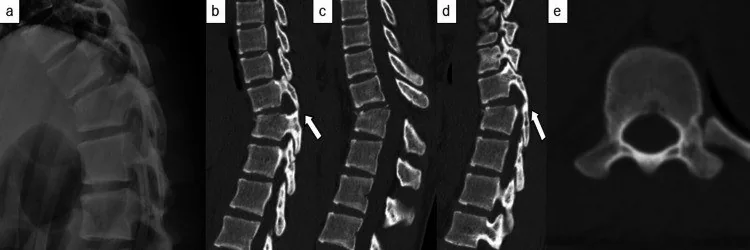
- Ankilozlu omurgadaki ekstansiyon yaralanmalarında kırık morfolojisi değerlendirilirken posterior elemanların ve ligamentöz kompleksin tutulum durumu da incelenmelidir.
- Tip C yaralanmalar deplasman içerir ve AO Spine sisteminde instabil yaralanmalar olarak tanımlanır.
- Nörolojik durum ve hastaya özgü belirleyiciler, yaralanma morfolojisi ve posterior ligamentöz kompleks bütünlüğüyle birlikte sınıflama ve tedavi kararlarında değerlendirilir.
- A3 inkomplet, A4 komplet burst kırığı olarak sınıflandırılır. B2, Tip B distraksiyon yaralanması ailesinde yer alır; posterior ligamentöz kompleks torakolomber omurganın posterior gerilim bandını oluşturur.
Ölçütler ve sınıflamalar
- AO Spine Tip A: kompresyon
- Tip A kompresyon yaralanmalarını kapsar; A3 inkomplet, A4 komplet burst kırığı olarak sınıflandırılır.
- AO Spine Tip B: tension-band
- AO Spine Tip B yaralanmaları gerilim bandı (tension-band) ve distraksiyon yaralanmalarını kapsar; posterior ligamentöz kompleks bu bölgede posterior gerilim bandı olarak işlev görür.
- AO Spine Tip C: translasyon
- AO Spine sınıflamasında Tip C, omurga segmentinde translasyon veya deplasman içeren instabil yaralanmaları kapsar.
Normalde
Normal bir hareket segmentinde faset eklem uyumsuzluğu, interspinöz mesafede artış veya vertebral translasyon izlenmez; travmada bu bulguların varlığı posterior ligamentöz kompleks hasarını düşündürür. Sınıflama yapılırken yaralanma morfolojisi, posterior ligamentöz kompleks bütünlüğü ve nörolojik durum birlikte değerlendirilir.
Normal BT ile kıyasla
Aynı bölgenin, kaynak veri setinde patoloji içermediği belirtilen bir BT incelemesini kesit kesit kaydırın; organ sınırlarını açarak anatomiyi hasta görüntüsüyle karşılaştırın. Küçük rastlantısal bulgular tümüyle dışlanmamıştır.
Kaynak: TotalSegmentator v2.01 veri seti (Wasserthal ve ark., Radiology: Artificial Intelligence 2023), CC BY 4.0, vaka s1338; organ sınırları veri setinin otomatik segmentasyonundan, birleştirilerek sadeleştirildi. Görüntüler 2,5 mm kesit aralığına yeniden örneklendi.
Ayırıcı tanı
- AO Tip A kompresyon ailesindendir; A3 ve A4 burst kırıklarında spinal kanala kemik retropülsiyonu görülebilir.
- AO A3 inkomplet burst, A4 ise komplet burst kırığı olarak sınıflandırılır.
- AO Tip A4 komplet burst kırığıdır; inkomplet burst (A3) kırıklarından farklı olarak her iki son plağın tutulumu ile karakterizedir.
- AO Spine torakolomber sınıflamasında B1, tip B distraksiyon ailesinin bir alt tipidir.
- AO Tip B distraksiyon yaralanmasıdır; posterior ligamentöz kompleks hasarı ön plandadır ve belirgin translasyon içeren Tip C yaralanmalarından ayırt edilmelidir.
- AO Spine Tip C ailesi, omurga segmentinde translasyon veya deplasman içeren instabil yaralanmaları tanımlar.
Tuzaklar
- Kompresyon ve burst morfolojisini ayırırken arka duvarı değerlendirin; burst kırığında arka duvar tutulumu görülebilir.
- Faset eklemi genişlemesi, interspinöz mesafede artış ve spinöz çıkıntı avülsiyon kırığı gibi BT bulguları PLC hasarını düşündürür ve Tip B posterior gerilim bandı yaralanması açısından değerlendirmeyi gerektirir.
- Ankilozlu omurgada gelişen ekstansiyon kırıklarında spinal stabiliteyi değerlendirmek ve sekonder deplasmanı önlemek için posterior elemanların kırığa katılıp katılmadığı dikkatle incelenmelidir.
- C tipi yaralanmalar deplasman içerir; sınıflandırmada bu morfolojik örüntüyü belirtin.
- Dikey lamina kırığı A4 burst kırıklarında A3 kırıklarına göre daha sık görülmüştür ve A4 lehine bir bulgu olabilir.
Kendini dene
AO Spine torakolomber sınıflamasına göre tip C yaralanmalar hangi biomekanik özelliği yansıtır?
Cevabı göster
Deplasman (yer değiştirme). Sistem üç hiyerarşik kategori sunar: tip A kompresyon, tip B gerilim bandı (distraksiyon) ve tip C deplasman yaralanmalarıdır.
AO Spine torakolomber sınıflamasında deplasman yaralanmaları hangi ailede yer alır?
Cevabı göster
C deplasman. AO Spine sınıflamasında A kompresyon, B distraksiyon, C ise deplasman yaralanmalarıdır.
Bu konunun yer aldığı turlar
İlgili konular
- Travmatik spinal kanal retropulsiyonu
- Torakolomber pedikül/lamina kırığı
- Torakolomber subluksasyon
- TLICS (Torakolomber Yaralanma Sınıflama ve Şiddet Skoru)
Kaynaklar
Bu sayfadaki 44 cümle ve 2 quiz sorusu aşağıdaki kaynaklardan alıntılarla otomatik olarak karşılaştırıldı; 25 cümle bu karşılaştırmada düzeltildi (2026-10-12).
- Surgical management and outcomes analysis of lower lumbar (L3–L5) burst fractures: A single-center experience and meta-analysispmc.ncbi.nlm.nih.gov
- Inter-observer reliability of osteoporotic fracture classification across imaging modalities for thoracolumbar osteoporotic fracturespmc.ncbi.nlm.nih.gov
- Surgical Treatment of Pathologic Spinal Fractures in Osteoporosis: Two Clinical Casespmc.ncbi.nlm.nih.gov
- Crosslink augmentation in posterior fixation of unstable thoracic and thoracolumbar fractures: A comparative cohort study of mechanical failure and sagittal alignmentpmc.ncbi.nlm.nih.gov
- Application of AUSS-TLIF for the treatment of a lumbar burst fracture: A case reportpmc.ncbi.nlm.nih.gov
- Surgical Outcome in Thoracolumbar Fractures Managed by Short-segment Pedicle Instrumentation.pubmed.ncbi.nlm.nih.gov
- Thoracolumbar compression fractures - experimental study and clinical case analysis.pubmed.ncbi.nlm.nih.gov
- Management of thoracolumbar spine trauma: An overview.pubmed.ncbi.nlm.nih.gov
- A simplified treatment algorithm for treating thoracic and lumbar spine trauma.pubmed.ncbi.nlm.nih.gov
- [MINIMALLY INVASIVE PASSAGE IN POSTERIOR LAMINOTOMY DECOMPRESSION AND INTERVERTEBRAL BONE GRAFTING COMBINED WITH PERCUTANEOUS PEDICLE SCREW FIXATION FOR TREATMENT OF Denis TYPE B THORACOLUMBAR BURST FRACTURES].pubmed.ncbi.nlm.nih.gov
- Treatment of thoracolumbar trauma by short-segment percutaneous transpedicular screw instrumentation: prospective comparative study with a minimum 2-year follow-up.pubmed.ncbi.nlm.nih.gov
- [Three-dimensional printed drill guide template assisting percutaneous pedicle screw fixation for multiple-level thoracolumbar fractures].pubmed.ncbi.nlm.nih.gov
- How reliable is the distinction between thoracolumbar AO type A3 and A4 fractures? A systematic literature review.pubmed.ncbi.nlm.nih.gov
- Thoracolumbar fracture dislocations treated by posterior reduction, interbody fusion and segmental instrumentation.pubmed.ncbi.nlm.nih.gov
- [Treatment of thoracolumbar burst fracture with subtotal vertebrectomy, decompression and strut grafting through posterolateral approach].pubmed.ncbi.nlm.nih.gov
- Predictive Value of Computed Tomography Scan for Posterior Ligamentous Complex Injuries in Patients with Thoracolumbar Spinal Fractures.pubmed.ncbi.nlm.nih.gov
- [Trauma of the lumbar spine and the thoracolumbar junction].pubmed.ncbi.nlm.nih.gov
- Artificial Intelligence Accurately Detects Traumatic Thoracolumbar Fractures on Sagittal Radiographs.pubmed.ncbi.nlm.nih.gov
- Can Vertical Laminar Fracture Further Discriminate Fracture Severity Between Thoracolumbar AO Type A3 and A4 Fractures?pubmed.ncbi.nlm.nih.gov
- Predicting neurological recovery after thoracolumbar spine trauma: The role of injury morphology and admission American Spinal Injury Association Impairment Scale grade.pubmed.ncbi.nlm.nih.gov
- The AO Spine TL Injury Classification System Drives Clinical Decision Making in Acute Thoracolumbar Fractures: A Retrospective Evaluation of Clinical Implementation.pubmed.ncbi.nlm.nih.gov
- Epidemiology of Traumatic Cervical Spinal Cord Injury in Southeast Norway.pubmed.ncbi.nlm.nih.gov
- Myofascial System and Physical Exercise: A Narrative Review on Stretching (Part I).pubmed.ncbi.nlm.nih.gov
- A systematic scoping review and conceptual analysis of new-onset fibromyalgia manifestations after non-hospitalized COVID-19: empirics, definitions, methodologies, pathophysiology, mapping of literature, and knowledge gaps.pubmed.ncbi.nlm.nih.gov
- Association of Chiropractic Colleges Educational Conference and Research Agenda Conference 2026: Connected Care.pubmed.ncbi.nlm.nih.gov
- A Proposal for a Standardized Imaging Algorithm to Improve the Accuracy and Reliability for the Diagnosis of Thoracolumbar Posterior Ligamentous Complex Injury in Computed Tomography and Magnetic Resonance Imaging.pubmed.ncbi.nlm.nih.gov
- Calcium Phosphate Bioceramics: A Review of Their History, Structure, Properties, Coating Technologies and Biomedical Applications.pubmed.ncbi.nlm.nih.gov
- Commentary: an eye on PET quantification.pubmed.ncbi.nlm.nih.gov
- A Primer on Anatomy, Biophysics, Pathology, Imaging and Treatment of the Intervertebral Disc and the Anterior Spinal Column: The Discogenic, Intervertebral, Spinal Column (DISC) ASPN Workgroup.pubmed.ncbi.nlm.nih.gov
- Understanding Photon-Counting CT: Physics, Detector Technology, and Image Reconstructions.pubmed.ncbi.nlm.nih.gov
- Methodological standards for body composition assessment-an expert-endorsed guide for research and clinical applications: bioimpedance, dual-energy X-ray absorptiometry, computerized tomography, and ultrasound methods.pubmed.ncbi.nlm.nih.gov
- A pictorial essay of thoracic wall diseases: multiple pathologies in the same anatomical site.pubmed.ncbi.nlm.nih.gov
- Imaging of Multiple Myeloma: Present and Future.pubmed.ncbi.nlm.nih.gov
- Monosegmental anterior column reconstruction using an expandable vertebral body replacement device in combined posterior-anterior stabilization of thoracolumbar burst fractures.pubmed.ncbi.nlm.nih.gov
- Agreement and discordance between the modified thoracolumbar injury classification and severity score and the thoracolumbar AOSpine injury score in guiding surgical decision-making for thoracolumbar fractures: a comparative study.pubmed.ncbi.nlm.nih.gov
- The evolution of cervical spine trauma classification: a paradigm shift from morphological description to clinical decision-making.pubmed.ncbi.nlm.nih.gov
- Does Size Matter? Evaluating the Impact of Intermediate Screw Length in Short-Segment Fixation of Thoracolumbar A3-A4 Fractures.pubmed.ncbi.nlm.nih.gov
- Machine Learning Algorithm to Predict Change in the Decision-Making for Thoracolumbar Fractures Without Neurological Deficit After MRI: A Multicenter Study.pubmed.ncbi.nlm.nih.gov
- A Comparative Analysis of International Classification Systems to Predict the Risk of Collapse in Single-Level Osteoporotic Vertebral Fractures.pubmed.ncbi.nlm.nih.gov
- Reliability and reproducibility of the modified thoracolumbar injury classification and severity score and the thoracolumbar AO spine injury score for guiding surgical decision-making in thoracolumbar fractures.pubmed.ncbi.nlm.nih.gov
- Intact Posterior Tension Band in Spinal Fractures in Patients With Spinal Ankylosing Disorders - Is it a Myth or a Reality? A Systematic Review.pubmed.ncbi.nlm.nih.gov
- Do All Fractures in the Ankylotic Spine Really Require Surgical Intervention?pubmed.ncbi.nlm.nih.gov
- Treatment of Injuries to the Subaxial Cervical Spine: Recommendations of the Spine Section of the German Society for Orthopaedics and Trauma (DGOU).pubmed.ncbi.nlm.nih.gov
- Subaxial Cervical Spine Fractures: Historical Systems and Advancements With the AO Spine Classification.pubmed.ncbi.nlm.nih.gov
- Acute management of spinal fractures: What you need to know.pubmed.ncbi.nlm.nih.gov
- Prospective clinical feasibility assessment of the Osteoporotic Pelvis Fracture Score (OFP-Score)-a multicenter prospective cohort study.pubmed.ncbi.nlm.nih.gov
- Recommendations of the International Consensus Meeting (ICM) 2025 on Spinal Infections: Part A Pyogenic Spondylodiscitis.pubmed.ncbi.nlm.nih.gov
- Congenital and Breed-Associated Vertebral Anomalies in Dogs and Cats: Developmental Anatomy, Genetic Determinants, and Biological Significance.pubmed.ncbi.nlm.nih.gov
- Healthcare and Psychosocial Needs in Achondroplasia Across the Lifespan: Developmental Functioning, Multidisciplinary Care, and Family-Centered Outcomes.pubmed.ncbi.nlm.nih.gov
- 4 pedicle screw mono-segment versus 6 pedicle screw short-segment fixation in the treatment of thoracolumbar endplate fractures: finite element analysis and clinical follow-up.pubmed.ncbi.nlm.nih.gov
- An innovative 2D optical navigation workflow for percutaneous pedicle screw fixation in thoracolumbar fractures: comparison with O-arm 3D navigation.pubmed.ncbi.nlm.nih.gov
- Artificial Intelligence in Spine Neuroimaging: Diagnostic and Prognostic Utility of Novel Biomarkers in Lower Back Pain.pubmed.ncbi.nlm.nih.gov
- Individualized finite element simulation integrating high-resolution magnetic resonance imaging and clinical imaging validation elucidates the effects of laminoplasty and laminectomy on postoperative mechanical stability and degeneration risk.pubmed.ncbi.nlm.nih.gov
- Deep learning and hybrid architectures for atypical and complex bone fracture diagnosis: a systematic review of performance and clinical validity.pubmed.ncbi.nlm.nih.gov
- Low early fixation failure rates with variable-angle locking plate fixation of AO/OTA 34 C patella fractures: a retrospective cohort study.pubmed.ncbi.nlm.nih.gov
- Risk Factors for Osteoporotic Vertebral Compression Fracture and Evaluation of Clinical Outcomes of Minimally Invasive Vertebral Augmentation.pubmed.ncbi.nlm.nih.gov
- Insights From the AO Spine Knowledge Forum Tumor Registries: Advancing the Understanding and Management of Primary Spine Tumors Through International Multicentric Collaboration. A Narrative Review.pubmed.ncbi.nlm.nih.gov
- Severe trauma care: advances and future directions in diagnostic and therapeutic techniques and information technology support.pubmed.ncbi.nlm.nih.gov
- The AO Spine Upper Cervical Injury Score (UCIS): Development of a Consensus-Based Scoring System Based on Perceived Injury Severity Scores.pubmed.ncbi.nlm.nih.gov
- Robot-assisted closed reduction and navigated fixation for pelvic ring injuries: a focused narrative review of a reduction-fixation-audit framework.pubmed.ncbi.nlm.nih.gov
- Occipitocervical dissociation: A narrative review and case series with a novel management algorithm proposal.pubmed.ncbi.nlm.nih.gov
- From Spatial Epigenomes to Clinical Diagnostics: Integrative Methylomics Across Scales and Modalities.pubmed.ncbi.nlm.nih.gov
- Brain-Computer Interfaces: The Dawn of a New Era in Disease Treatment.pubmed.ncbi.nlm.nih.gov
- Macrophage polarization in ischemia-reperfusion injury: from molecular mechanisms to therapeutic strategies.pubmed.ncbi.nlm.nih.gov
- Anatomical and biological reconstruction of traumatic complete burst fractures of the thoracolumbar vertebrae using pedicle fixation combined with stent-armed kyphoplasty and intracorporeal bone grafting: technique rationale, 7-year experience and clinical, imaging, and histological outcomes.pubmed.ncbi.nlm.nih.gov
- Spinal lesions: a comprehensive radiologic overview.pubmed.ncbi.nlm.nih.gov
- Anterior column reconstruction with mono-segmental fusion and lag screw fixation of sagittal split for burst-split fracture of the thoracolumbar spine.pubmed.ncbi.nlm.nih.gov
- Thoracolumbar Fractures: Historical Systems and Advancements With the AO Spine Classification.pubmed.ncbi.nlm.nih.gov
- Antioxidant malic-acid-derived lipid nanoparticles delivering secretory uricase circRNA for hyperuricemia and complication management in mice.pubmed.ncbi.nlm.nih.gov
- Multifunctional material platforms for neural interfaces: active orchestration of dynamic foreign body response across implantation lifetimes.pubmed.ncbi.nlm.nih.gov
- Transformative biomechanics and mechanobiology breakthroughs shaping the future of health and medicine.pubmed.ncbi.nlm.nih.gov
- Safe management of acute cervical spine injuries.pubmed.ncbi.nlm.nih.gov
- MDCT of acute subaxial cervical spine trauma: a mechanism-based approach.pubmed.ncbi.nlm.nih.gov
- Decoding triple negative breast cancer bone metastasis: from 3D bioprinted models to clinical translation.pubmed.ncbi.nlm.nih.gov
- A framework of biomarkers for skeletal aging: a consensus statement by the Aging Biomarker Consortium.pubmed.ncbi.nlm.nih.gov
- Biomechanical compensatory chain and residual compensation potential in aging spinal deformity: a narrative review and multimodal assessment framework.pubmed.ncbi.nlm.nih.gov
- 14. Discogenic Low Back Pain.pubmed.ncbi.nlm.nih.gov
- Adult Spinal Deformity: Current Concepts and Decision-Making Strategies for Management.pubmed.ncbi.nlm.nih.gov
- Unilateral biportal endoscopic lumbar fusion versus minimally invasive transforaminal lumbar interbody fusion for single-level mild to moderate lumbar spondylolisthesis: a retrospective study.pubmed.ncbi.nlm.nih.gov
- Perforator-Aware Explainable Microsurgical Intelligence for Basilar Trunk Aneurysm Reconstruction: A Human-Centred Clinical AI Framework for Precision Neurovascular Surgery-A Retrospective Single-Centre Study.pubmed.ncbi.nlm.nih.gov
- Surgical Considerations in Osteoporotic Dorso-Lumbar Spine Fractures.pubmed.ncbi.nlm.nih.gov
- Intelligence Architectures and Machine Learning Applications in Contemporary Spine Care.pubmed.ncbi.nlm.nih.gov
- Risk factors for immediate severe pain in patients with thoracolumbar junction fracture treated with percutaneous pedicle screw fixation: a retrospective study of 598 patients.pubmed.ncbi.nlm.nih.gov
- Koala Kyphoscoliosis: Radiographic and CT Features of Abnormal Vertebral Column Curvature in Koalas (<i>Phascolarctos cinereus</i>) of the Mount Lofty Ranges, South Australia.pubmed.ncbi.nlm.nih.gov
- Application of Three-Dimensionally Printed Surgical Guides in Precise Sacral Tumor Excision and Defect Reconstruction.pubmed.ncbi.nlm.nih.gov
- Radiographic and Clinical Adjacent Segment Disease After Posterior Instrumented Fusion for Traumatic Thoracolumbar and Lumbar Vertebral Fractures.pubmed.ncbi.nlm.nih.gov
- Application of the pivot forward combined leveraging technique in the treatment of thoracolumbar fractures: a finite element analysis and clinical study.pubmed.ncbi.nlm.nih.gov
- Mechanical Instability After Civilian Thoracolumbar Gunshot Injuries: A Systematic Review to Support Classification Development.pubmed.ncbi.nlm.nih.gov
- Surgical management and outcomes analysis of lower lumbar (L3-L5) burst fractures: A single-center experience and meta-analysis.pubmed.ncbi.nlm.nih.gov
- Inducing thoracolumbar burst fractures in human cadaveric specimens using a combined axial-flexion loading: a fracture simulation.pubmed.ncbi.nlm.nih.gov
- Clinical efficacy and radiological outcomes of a novel screw placement technique for the treatment of traumatic thoracolumbar vertebral fractures under navigation guidance.pubmed.ncbi.nlm.nih.gov
- Application of AUSS-TLIF for the treatment of a lumbar burst fracture: A case report.pubmed.ncbi.nlm.nih.gov
- Biomaterials for vertebral body repair: interior augmentation and total replacement-a literature review of bone fusion outcomes in clinical studies.pubmed.ncbi.nlm.nih.gov
- Efficacy and Safety of Percutaneous Pedicle Screw Fixation for Neurologically Intact Thoracolumbar Burst Fractures: A Prospective Interventional Study.pubmed.ncbi.nlm.nih.gov
- Towards Automated Spine Fracture Detection on Whole-Body CT of Polytraumatized Patients.pubmed.ncbi.nlm.nih.gov
- Artificial intelligence in spine care: A scoping review of diagnostic applications.pubmed.ncbi.nlm.nih.gov
- A transformer-based deep learning algorithm for diagnosing spinal infections on axial non-contrast computed tomography images: a dual-center retrospective study.pubmed.ncbi.nlm.nih.gov
- Impact of preoperative lumbar paraspinal muscle quality on the prognosis of open pedicle screw fixation for thoracolumbar fractures.pubmed.ncbi.nlm.nih.gov
- Sacroiliac Joint Anatomical Variants and Their Association with Spinopelvic Alignment: A Whole-Spine CT Study.pubmed.ncbi.nlm.nih.gov
- Analysis of the Classification Systems for Thoracolumbar Fractures in Adults and Their Evolution and Impact on Clinical Management.pubmed.ncbi.nlm.nih.gov
- The Integrated Nerve, Discoligamentous Complex, and Vertebra Scoring System for Thoracolumbar Junction (TLJ) Injury.pubmed.ncbi.nlm.nih.gov
- Treatment strategies for incomplete burst fractures (AO Spine A3) at the thoracolumbar junction -results of a nationwide German survey.pubmed.ncbi.nlm.nih.gov
- Spine Trauma Classifications: Historical, Current, and Emerging Perspectives for Radiologists.pubmed.ncbi.nlm.nih.gov
- Kyphoplasty versus percutaneous posterior instrumentation for osteoporotic vertebral fractures with posterior wall injury: a propensity score matched cohort study.pubmed.ncbi.nlm.nih.gov
- Comparative analysis of two modified TLICS systems in guiding surgical decision-making for thoracolumbar fractures.pubmed.ncbi.nlm.nih.gov
- Single-Stage Posterior Unilateral Transpedicular Corpectomy With Circumferential Reconstructive Stabilization for the Treatment of Severe Thoracic and Lumbar Complete Burst Fractures.pubmed.ncbi.nlm.nih.gov
- Contiguous Burst Fractures of the Lumbar Spine.pubmed.ncbi.nlm.nih.gov
- Unipedicular-Screw Index Vertebra Manipulation Technique for Minimally Invasive Short-Segment Thoracolumbar Fracture Fixation.pubmed.ncbi.nlm.nih.gov
- Injury patterns of the spine following blunt trauma: A per-segment analysis of spinal structures and their detection rates in CT and MRI.pubmed.ncbi.nlm.nih.gov
- Does the Spine Surgeon's Experience Affect Fracture Classification, Assessment of Stability, and Treatment Plan in Thoracolumbar Injuries?pubmed.ncbi.nlm.nih.gov
- Preoperative Surgical Planning and Intraoperative Considerations for the Treatment of Adult Spinal Deformity Surgery.pubmed.ncbi.nlm.nih.gov
- Lateral lumbar and thoracic interbody fusion (LLIF) for thoracolumbar spine trauma (Trauma LLIF): A single-center, retrospective observational cohort study.pubmed.ncbi.nlm.nih.gov
- Pseudomyogenic hemangioendothelioma of the thoracolumbar spine: A case-based review of a rare cause of vertebral collapse and neurological deficit.pubmed.ncbi.nlm.nih.gov
- A4 Thoracolumbar Fracture Class Is Associated With a Greater Degree of Vertebral Height Loss in Conservatively Managed Patients.pubmed.ncbi.nlm.nih.gov
- Imaging evaluation of traumatic thoracolumbar spine injuries: Radiological review.pubmed.ncbi.nlm.nih.gov
Eğitim amaçlıdır; hasta başında tanı ve tedavi kararının yerine geçmez, tıbbi tavsiye değildir. Metinler yapay zekâ desteğiyle yazıldı ve otomatik bir adımda kaynak alıntılarıyla karşılaştırıldı; bu bir tıbbi doğrulama değildir ve içerik uzman radyolog incelemesinden geçmedi. Klinik kararlarda güncel kılavuzları, kurum protokollerini ve radyoloji raporunu esas alın.