Özet
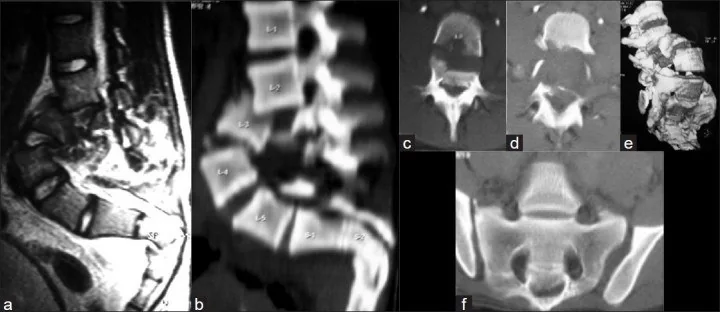
Travma sonrası pedikül kırığı vertebra gövdesi patlama kırığına eşlik edebilir. İnce kesit kemik algoritmalı BT, kırık hattını, fragman yönünü ve posterior arkın kanal ile fasetlere uzanımını göstermede temel incelemedir. İki taraflı posterior ark kırığında aynı düzeyde vertebra gövdesi kırığı, faset eklem dizilim bozukluğu veya translasyon ayrıca aranır; bu eşlik eden bulgular gerilim bandı ya da translasyon yaralanması şüphesini artırabilir. Fragmanı tek başına tanımlayıp kanal, faset hizası ve vertebral yer değiştirmeyi değerlendirmemek eşlik eden kanal içi uzanımı veya translasyonlu yaralanmayı gözden kaçırabilir.
Faz ve pencere
- Kontrastsız BT tanısal
- İnce kesit kontrastsız travma BT’sinin kemik algoritmasında pedikül ve lamina korteksindeki kesinti ile kemik fragmanlarının yer değiştirmesi değerlendirilir; kırık hattı aksiyel görüntüler ve sagittal/koronal rekonstrüksiyonlarda izlenir. İki pedikül, laminalar ve faset hizası uygun düzlemlerde karşılaştırılır. Kanal içine uzanan retropulse fragmanlar ve eşlik eden patlama morfolojisi BT'de değerlendirilir.
Önerilen pencereler G genişlik, M merkez; değerler Hounsfield birimi (HU)
- KemikG 1800 / M +400
BT bulguları
- Pedikül kortikal kesintisi — travma BT’sinde kırık hattının pedikülde bulunması ve tarafı tanımlanır.
- Lamina kırık hattı — posterior ark korteksindeki kesinti ve fragmanlar arası açıklık aksiyel görüntüyle birlikte uygun sagittal/koronal rekonstrüksiyonlarda doğrulanır.
- İki taraflı posterior ark kırığı — bilateral pedikül veya lamina kırığında posterior ark bütünlüğü ve kanal sınırına yönelen fragman araştırılır; iki taraflılık tek başına kanal basısını kanıtlamaz.
- Faset eklem uyum kaybı — kırık düzeyindeki üst ve alt artiküler fasetlerin örtüşmesi karşı taraf ve komşu seviyelerle kıyaslanır.
- Kanal fragmanı — lamina veya pedikül parçasının kemik spinal kanal içine uzanımı ve eşlik eden kanal daralması aksiyel ve rekonstrükte görüntülerde değerlendirilir.
- Eşlik eden vertebra gövdesi yaralanması — posterior duvar kırığı, son plak çökmesi ve patlama morfolojisi aynı seviyede ayrıca aranır.
- Posterior gerilim bandı yaralanma göstergeleri — interspinöz genişleme, faset eklem dizilim bozukluğu, vertebral translasyon, spinöz proses kırığı veya horizontal laminar kırık BT'de PLC yaralanmasını düşündürebilir; bu dolaylı bulgular tek başına bağ yırtığını kesinleştirmez.
Ölçütler ve sınıflamalar
- AO Spine torakolomber morfoloji
- A0, spinal kolon stabilitesini anlamlı bozmayan izole, minör spinöz çıkıntı, transvers çıkıntı veya lamina kırığını kapsar. B tipi yaralanmalar anterior veya posterior gerilim bandı bozulmasını, C tipi yaralanmalar vertebralar arasında translasyon ya da deplasmanı tanımlar. İzole posterior eleman kırığı tek başına bağsal PLC yırtığını kanıtlamaz; kırığın yönü ve eşlik eden bulgular birlikte değerlendirilir.
- TLICS
- Morfoloji, posterior ligamentöz kompleks bütünlüğü ve nörolojik durum TLICS’in ayrı bileşenleridir. BT kırık morfolojisini ve PLC yaralanması için bazı dolaylı işaretleri gösterir; PLC bütünlüğü belirsizse bağlar yalnız BT’ye dayanarak sağlam kabul edilmez ve TLICS’in nörolojik bileşeni klinik değerlendirme gerektirir.
Normalde
Pediküller vertebra korpusunu arka elemanlara bağlar; laminalar orta hatta birleşerek spinal kanalın arka sınırını oluşturur. Kırık şüphesinde karşı pedikül ve komşu lamina ile korteks sürekliliğini, kanal sınırını ve aynı seviyedeki faset eklem uyumunu karşılaştırın.
Normal BT ile kıyasla
Aynı bölgenin, kaynak veri setinde patoloji içermediği belirtilen bir BT incelemesini kesit kesit kaydırın; organ sınırlarını açarak anatomiyi hasta görüntüsüyle karşılaştırın. Küçük rastlantısal bulgular tümüyle dışlanmamıştır.
Kaynak: TotalSegmentator v2.01 veri seti (Wasserthal ve ark., Radiology: Artificial Intelligence 2023), CC BY 4.0, vaka s1338; organ sınırları veri setinin otomatik segmentasyonundan, birleştirilerek sadeleştirildi. Görüntüler 2,5 mm kesit aralığına yeniden örneklendi.
Ayırıcı tanı
- Pars interartikülaris defekti
- pedikül kırığından ayrı bir posterior eleman hattı olarak değerlendirilir; hattın anatomik lokalizasyonu ince kesit BT'de aksiyel ve uygun çok düzlemli görüntülerde doğrulanır.
- İzole transvers çıkıntı kırığı
- kırık lateral çıkıntıda tanımlanır; aynı seviyede eşlik eden vertebra gövdesi kırığı veya posterior ark kırığı ayrıca kontrol edilir.
Tuzaklar
- Kırık hattının pedikül, pars veya fasetle ilişkisini tek aksiyel kesite dayandırmayın; uygun sagittal ve koronal rekonstrüksiyonlarda lokalize edin.
- Lamina kırığı tek başına kanal içine uzanan fragmanı göstermez; kemik parçasının konumu ve kanal genişliği doğrudan kesitlerde doğrulanır.
- Pedikül kırığı ile pars interartikülaris kırığı komşu posterior elemanlardan geçer; kırık hattını çok düzlemli görüntülerde anatomik olarak lokalize edin.
Kendini dene
Travma BT'sinde sağ pedikül korteksi kesintili; sol pedikül ve lamina korteksleri sağlam, faset hizası korunmuş ve kemik spinal kanal açık. En uygun tanımlama hangisi?
Cevabı göster
Tek taraflı pedikül kırığı. Kortikal kesintinin sağ pedikülde olması, karşı pedikül ile laminaların sağlam ve faset hizasının korunmuş olması tek taraflı pedikül kırığını destekler. Diğer seçenekler kökte belirtilen korunmuş veya kırık yapılarla çelişir.
Bilateral lamina kırığı olan torakolomber travma hastasında BT'de PLC yaralanmasını düşündüren ek bulgu hangisidir?
Cevabı göster
Vertebral translasyon. Vertebral translasyon bağımsız PLC öngördürücülerinden biridir; diğer seçeneklerdeki dejeneratif bulgular bu listede yer almaz.
İlgili konular
- Travmatik spinal kanal retropulsiyonu
- Torakolomber subluksasyon
- AO Spine torakolomber sınıflaması
- TLICS (Torakolomber Yaralanma Sınıflama ve Şiddet Skoru)
Kaynaklar
Bu sayfadaki 40 cümle ve 2 quiz sorusu aşağıdaki kaynaklardan alıntılarla otomatik olarak karşılaştırıldı; 26 cümle bu karşılaştırmada düzeltildi (2026-10-12).
- Imaging evaluation of traumatic thoracolumbar spine injuries: Radiological reviewpmc.ncbi.nlm.nih.gov
- Accuracy of CT Scan for Detecting Posterior Ligamentous Complex Injury in Traumatic Thoracolumbar Fractures: A Systematic Review and Meta-Analysispubmed.ncbi.nlm.nih.gov
- AO Spine thoracolumbar injury classification systemsurgeryreference.aofoundation.org
- Classifications in Brief: AO Thoracolumbar Classification Systempmc.ncbi.nlm.nih.gov
- A Proposal for a Standardized Imaging Algorithm to Improve the Accuracy and Reliability for the Diagnosis of Thoracolumbar Posterior Ligamentous Complex Injury in Computed Tomography and Magnetic Resonance Imagingpubmed.ncbi.nlm.nih.gov
- Understanding a mass in the paraspinal region: an anatomical approachlink.springer.com
- CT of Unusual Iliopsoas Compartment Lesionspubs.rsna.org
- 7.3 The Vertebral Columnopenstax.org
- A Review of Treatment for Acute and Chronic Pars Fractures in the Lumbar Spinelink.springer.com
- Classification and Radiological Diagnosis of Thoracolumbar Spine Fractures: WFNS Spine Committee Recommendationspubmed.ncbi.nlm.nih.gov
- AO Spine Classification Systems—the complete guidesaofoundation.org
- The Radiology Assistant: AO Spine Classification of Thoracolumbar Fracturesradiologyassistant.nl
- Application of AUSS-TLIF for the treatment of a lumbar burst fracture: A case reportpmc.ncbi.nlm.nih.gov
- Case Report: Diagnostic and therapeutic challenges of secondary spinal tuberculosis following percutaneous vertebroplasty: a case of staged surgery with bone cement retention reportpmc.ncbi.nlm.nih.gov
- Minimally Invasive Lumbopelvic and Transiliac-Transsacral Fixation for a Pathological Sacral Fracture Due to Metastatic Breast Cancer: A Case Reportpmc.ncbi.nlm.nih.gov
- C7 Vertebral Pathological Compressive Fracture after Radiotherapy for Esophageal Cancer: A Case Reportpmc.ncbi.nlm.nih.gov
- Compression fracture of the T12 vertebra combined with diaphragmatic hernia after low-energy trauma: a case report and literature reviewpmc.ncbi.nlm.nih.gov
- Artery of Adamkiewicz.pubmed.ncbi.nlm.nih.gov
- Isolated Traumatic Bitemporal Hemianopia.pubmed.ncbi.nlm.nih.gov
- Rare spondylodiscitis due to Mycobacterium mucogenicum .pubmed.ncbi.nlm.nih.gov
- Pedicle screw loosening: a clinically relevant complication?pubmed.ncbi.nlm.nih.gov
- Template guided cervical pedicle screw instrumentation.pubmed.ncbi.nlm.nih.gov
- Floating Lateral Mass Fractures of the Cervical Spine.pubmed.ncbi.nlm.nih.gov
- Robotic-Assisted Pedicle Screw Placement During Spine Surgery.pubmed.ncbi.nlm.nih.gov
- Mono-segment fixation of thoracolumbar burst fractures.pubmed.ncbi.nlm.nih.gov
- Techniques and accuracy of thoracolumbar pedicle screw placement.pubmed.ncbi.nlm.nih.gov
- Fractures of C2 (Axis) Vertebra: Clinical Presentation and Management.pubmed.ncbi.nlm.nih.gov
- Usefulness of navigated O-arm(®) in a teaching center for spinal trauma.pubmed.ncbi.nlm.nih.gov
- Unskilled unawareness and the learning curve in robotic spine surgery.pubmed.ncbi.nlm.nih.gov
- Surgical Outcome in Thoracolumbar Fractures Managed by Short-segment Pedicle Instrumentation.pubmed.ncbi.nlm.nih.gov
- Indications and Limitations of Standalone Percutaneous Vertebroplasty for Reverse Chance Fractures Associated With Ankylosing Spinal Disorders.pubmed.ncbi.nlm.nih.gov
- Microscopic far lateral transforaminal lumbar/thoracolumbar interbody fusion for patients with kyphotic Kummell's disease - a retrospective comparison study with bone cement enhanced screws plus vertebroplasty.pubmed.ncbi.nlm.nih.gov
- The evolution of cervical spine trauma classification: a paradigm shift from morphological description to clinical decision-making.pubmed.ncbi.nlm.nih.gov
- Anatomical and biological reconstruction of traumatic complete burst fractures of the thoracolumbar vertebrae using pedicle fixation combined with stent-armed kyphoplasty and intracorporeal bone grafting: technique rationale, 7-year experience and clinical, imaging, and histological outcomes.pubmed.ncbi.nlm.nih.gov
- Efficacy and Safety of Percutaneous Pedicle Screw Fixation for Neurologically Intact Thoracolumbar Burst Fractures: A Prospective Interventional Study.pubmed.ncbi.nlm.nih.gov
- Construction and validation of a U-type finite element model of an osteoporotic vertebral compression fracture.pubmed.ncbi.nlm.nih.gov
- Case Report: Use of veterinary cuttable plates to maintain reduction and reinforce polymethylmethacrylate (PMMA) fixation in two canine C2 vertebral fractures.pubmed.ncbi.nlm.nih.gov
- Traumatic Unilateral Pedicle Fracture Treated With a Partially Threaded Screw: A Case Report.pubmed.ncbi.nlm.nih.gov
- Application of AUSS-TLIF for the treatment of a lumbar burst fracture: A case report.pubmed.ncbi.nlm.nih.gov
- Spontaneous multilevel lumbar pediculolysis associated with spondylolysis: a rare case and review of the literature.pubmed.ncbi.nlm.nih.gov
- Osteotomies: Indications, Imaging Appearance, Surgical Techniques, and Complications.pubmed.ncbi.nlm.nih.gov
- Beyond Cement: A Case Report of Cadaveric Allograft and Vertebral Body Stenting for a Traumatic Thoracolumbar Burst Fracture.pubmed.ncbi.nlm.nih.gov
- The clinical and radiological outcomes of a transfacet pedicle-sparing approach for directly addressing the compression of unstable thoracolumbar burst fractures with retropulsion.pubmed.ncbi.nlm.nih.gov
- Consensus practice guidelines on sacroiliac joint complex pain from a multispecialty, international working group.pubmed.ncbi.nlm.nih.gov
- Single-Stage Posterior Unilateral Transpedicular Corpectomy With Circumferential Reconstructive Stabilization for the Treatment of Severe Thoracic and Lumbar Complete Burst Fractures.pubmed.ncbi.nlm.nih.gov
- Towards a standardized reporting of the impact of magnetic resonance imaging on the decision-making of thoracolumbar fractures without neurological deficit: Conceptual framework and proposed methodology.pubmed.ncbi.nlm.nih.gov
- Dural tears from traumatic spinal fractures: an illustrative case and systematic review of its incidence, diagnosis, risk factors, and management.pubmed.ncbi.nlm.nih.gov
- Extrapedicular approach for basivertebral nerve radiofrequency ablation: a conceptual review.pubmed.ncbi.nlm.nih.gov
- Development and Validation of an AI-Integrated System for Automated Fracture Detection and Pedicle Puncture Planning in Lumbar Osteoporotic Vertebral Compression Fractures Based on the Nine-Grid Area Division Method.pubmed.ncbi.nlm.nih.gov
- Traumatic lumbosacral instability: part 1 - proposing a definition and identifying underlying injury patterns.pubmed.ncbi.nlm.nih.gov
- Management of C2 fractures following multiple classifications, a narrative review.pubmed.ncbi.nlm.nih.gov
- Air Crash Investigation: Pattern of Spinal Injuries, Management During the COVID-19 Pandemic, and Outcomes.pubmed.ncbi.nlm.nih.gov
- Minimally invasive percutaneous cannulated polyaxial screw and rod fixation thoracolumbar and lumbosacral vertebrae: cadaveric evaluation of accuracy and safety of a fluoroscopic-guided technique, in large breed dogs.pubmed.ncbi.nlm.nih.gov
- Koala Kyphoscoliosis: Radiographic and CT Features of Abnormal Vertebral Column Curvature in Koalas (<i>Phascolarctos cinereus</i>) of the Mount Lofty Ranges, South Australia.pubmed.ncbi.nlm.nih.gov
- Totally endoscopic trans‑superior articular process lumbar interbody fusion: A case series on the development and preliminary evaluation of an innovative minimally invasive lumbar spine surgical technique.pubmed.ncbi.nlm.nih.gov
- Reliability of thoracolumbar burst fracture classification in the Swedish Fracture Register.pubmed.ncbi.nlm.nih.gov
- Radiomics in spinal research: a narrative review.pubmed.ncbi.nlm.nih.gov
- Spinal lesions: a comprehensive radiologic overview.pubmed.ncbi.nlm.nih.gov
- Spinal hydatid cyst initially diagnosed as spinal tumor: A case report and review of the literature.pubmed.ncbi.nlm.nih.gov
- Agreement and discordance between the modified thoracolumbar injury classification and severity score and the thoracolumbar AOSpine injury score in guiding surgical decision-making for thoracolumbar fractures: a comparative study.pubmed.ncbi.nlm.nih.gov
- Impact of preoperative lumbar paraspinal muscle quality on the prognosis of open pedicle screw fixation for thoracolumbar fractures.pubmed.ncbi.nlm.nih.gov
- Reliability and reproducibility of the modified thoracolumbar injury classification and severity score and the thoracolumbar AO spine injury score for guiding surgical decision-making in thoracolumbar fractures.pubmed.ncbi.nlm.nih.gov
- Imaging Evaluation of Bone Tumors in the Cervical Spine: A Comprehensive Review.pubmed.ncbi.nlm.nih.gov
- Left Acetabular Osteoarticular Cryptococcosis in an Immunosuppressed Renal Transplant Recipient: A Case Report and Literature Review.pubmed.ncbi.nlm.nih.gov
- A4 Thoracolumbar Fracture Class Is Associated With a Greater Degree of Vertebral Height Loss in Conservatively Managed Patients.pubmed.ncbi.nlm.nih.gov
- Does Magnetic Resonance Imaging Predict Neurological Deficit in Patients with Traumatic Lower Lumbar Fractures?pubmed.ncbi.nlm.nih.gov
- Predictors of adverse events after percutaneous pedicle screws fixation in patients with single-segment thoracolumbar burst fractures.pubmed.ncbi.nlm.nih.gov
- Diagnostic imaging confusion in infectious spondylitis.pubmed.ncbi.nlm.nih.gov
- Single-position robot-assisted lateral lumbar corpectomy with minimally invasive posterior spinal fusion for traumatic burst fracture showing MRI-demonstrated indirect decompression: illustrative case.pubmed.ncbi.nlm.nih.gov
- The Prone-Transpsoas Approach for Single-Position Lateral Corpectomy: A Case Series.pubmed.ncbi.nlm.nih.gov
- Machine Learning Algorithm to Predict Change in the Decision-Making for Thoracolumbar Fractures Without Neurological Deficit After MRI: A Multicenter Study.pubmed.ncbi.nlm.nih.gov
- The Integrated Nerve, Discoligamentous Complex, and Vertebra Scoring System for Thoracolumbar Junction (TLJ) Injury.pubmed.ncbi.nlm.nih.gov
- Reconstruction Procedures for Osteoporotic Thoracolumbar Vertebral Fractures With Neurological Deficits: A Retrospective Comparison of the Lateral-Posterior Combined Approach and the Posterior-Only Approach With Three-Column Osteotomy.pubmed.ncbi.nlm.nih.gov
- Direct pedicle screw fixation in infected vertebrae for acute pyogenic spondylitis: short-term outcomes from a single-arm retrospective study.pubmed.ncbi.nlm.nih.gov
- Paper template-based intraoperative rod bending for percutaneous stabilization of thoracic extension-distraction fracture: illustrative case.pubmed.ncbi.nlm.nih.gov
- Posterior thoracic discectomy and interbody fusion for the correction of severe hyperkyphotic deformity: technical note and case report.pubmed.ncbi.nlm.nih.gov
- Traumatic Durotomy with Entrapment of Nerve Roots in a Lumbar Burst Fracture Diagnosed Intraoperatively: A Case Report.pubmed.ncbi.nlm.nih.gov
- Global trends in lumbar spondylolysis research: A comprehensive bibliometric analysis.pubmed.ncbi.nlm.nih.gov
- Comparative outcomes of motion-preserving techniques for lumbar spondylolysis in young athletes.pubmed.ncbi.nlm.nih.gov
- Lowest Instrumented Vertebra Selection in Adolescent Idiopathic Scoliosis With Concomitant Spondylolysis.pubmed.ncbi.nlm.nih.gov
- Spinal granulocytic sarcoma with both extradural and intradural involvement: a case report.pubmed.ncbi.nlm.nih.gov
- SPECT/CT bone scintigraphy to evaluate low back pain in young athletes: common and uncommon etiologies.pubmed.ncbi.nlm.nih.gov
- Multilevel spinal fractures in ankylosing spondylitis: illustrative case.pubmed.ncbi.nlm.nih.gov
- Minimally invasive robotic-assisted lumbar laminectomy.pubmed.ncbi.nlm.nih.gov
- Cortical screw placement with a spinous process clamp guide: a cadaver study accessing accuracy.pubmed.ncbi.nlm.nih.gov
- Plough Fracture (Anterior Arch Fracture Type Traumatic Posterior Atlantoaxial Dislocation, TPAD-AOT Type III): A Retrospective Study of Nine Clinical Cases With Complete Imaging Data.pubmed.ncbi.nlm.nih.gov
- Pedicle paradox: Duplicate vertebral pedicles creating a rare "pseudo foramen" with symptomatic foraminal stenosis.pubmed.ncbi.nlm.nih.gov
- Congenital and Breed-Associated Vertebral Anomalies in Dogs and Cats: Developmental Anatomy, Genetic Determinants, and Biological Significance.pubmed.ncbi.nlm.nih.gov
Eğitim amaçlıdır; hasta başında tanı ve tedavi kararının yerine geçmez, tıbbi tavsiye değildir. Metinler yapay zekâ desteğiyle yazıldı ve otomatik bir adımda kaynak alıntılarıyla karşılaştırıldı; bu bir tıbbi doğrulama değildir ve içerik uzman radyolog incelemesinden geçmedi. Klinik kararlarda güncel kılavuzları, kurum protokollerini ve radyoloji raporunu esas alın.