Özet
TLICS, torakolomber travmayı yaralanma morfolojisi, posterior ligamentöz kompleks (PLC) bütünlüğü ve nörolojik durum olmak üzere üç bağımsız başlıkla tanımlar. BT özellikle kompresyon, burst, translasyon ve distraksiyon morfolojisini ortaya koyar; PLC'yi faset diastazı veya interspinöz açılma gibi dolaylı kemik işaretlerinden değerlendirir. Nörolojik puan klinik muayeneye dayanır, PLC şüphesi ise belirsiz olgularda MR ve uzman değerlendirmesi gerektirebilir. BT bulgusunu tek başına tüm skora dönüştürmek, muayene veya bağ bütünlüğü verisini varsaymak anlamına gelir ve sınıflamanın üç bileşenli yapısını bozar.
Faz ve pencere
- Kontrastsız tanısal
- Kontrastsız ince kesit travma BT'sinde korpus kompresyonu, burst arka duvarı, translasyon, faset uyumu ve kemiksel distraksiyon morfoloji puanını destekler; kontrast fazı TLICS morfolojisi için gerekli değildir.
- Kemik algoritması tanısal
- Aksiyel ve çok düzlemli kemik rekonstrüksiyonlarda vertebra arka duvarı, posterior eleman kırıkları, faset aralıkları ve interspinöz açılma incelenir; PLC bütünlüğü BT'de dolaylı değerlendirilir ve klinik nörolojik durum görüntüden okunamaz.
Önerilen pencereler: Kemik (G 1800 / M 400).
BT bulguları
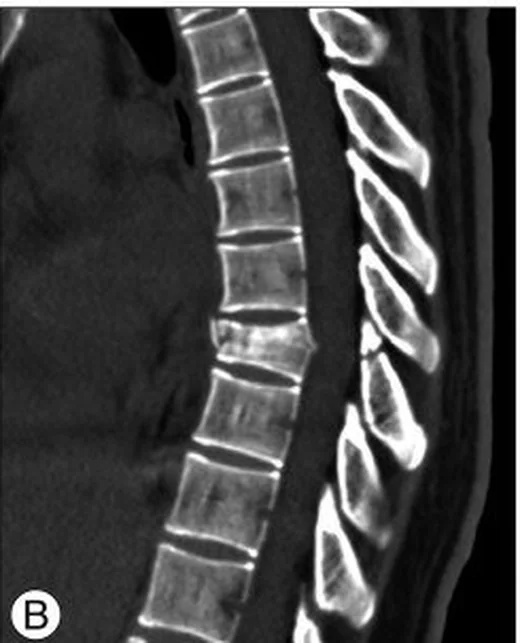
- Morfoloji — kompresyon ve burst örüntüsü, translasyon/rotasyon ve distraksiyon birbirinden ayrılır; vertebra gövdesinin posterior duvarı burst tanımını belirler.
- PLC için faset bulgusu — faset eklem yüzlerinde diastaz veya malalignment, posterior stabilizasyon yapılarının zedelenmesine dolaylı işaret olabilir.
- PLC için interspinöz bulgu — komşu spinöz çıkıntılar arasında beklenmeyen açılma posterior gerilim bandı hasarı şüphesini artırır.
- PLC için posterior kemik avulsiyonu — spinöz çıkıntı, lamina veya pedikül kırığı, bağların yapışma bölgelerindeki kopma örüntüsüyle birlikte incelenir.
- Translasyon göstergesi — korpus posterior çizgisinde basamak veya faset dislokasyonu translasyon/rotasyon morfolojisini destekler.
- Nörolojik bileşen — kord, konus, sinir kökü veya kauda ekuina işlevi görüntüye bakarak puanlanmaz; muayene verisi gerekir.
- Belirsiz PLC — BT'de açılma, faset uyumsuzluğu veya kırık paterni güven vermiyorsa bağ bütünlüğü kesin sağlam olarak varsayılmaz.
Ölçütler ve sınıflamalar
- TLICS morfoloji puanı
- Kompresyon: 1 puan; burst: 2 puan; translasyon/rotasyon: 3 puan; distraksiyon: 4 puan. Birden fazla morfolojik bileşen içeren kompleks kırıklar, bileşenleri birlikte tanımlayan bir ifadeyle (ör. distraksiyon-translasyon-kompresyon) betimlenebilir. Posterior duvar tutulumu burst morfolojisini destekler.
- TLICS posterior ligamentöz kompleks puanı
- PLC sağlam: 0 puan; yaralanma şüpheli veya belirsiz: 2 puan; PLC yaralı: 3 puan. BT dolaylı işaretleri gösterir, ligament yapısının kendisi için MR gerekebilir.
- TLICS nörolojik durum puanı
- Nörolojik olarak sağlam: 0 puan; sinir kökü yaralanması: 1 puan; komplet kord yaralanması: 2 puan; inkomplet kord yaralanması: 3 puan; kauda ekuina sendromu: 3 puan. Puanlama klinik nörolojik değerlendirmeye dayanır.
Normalde
TLICS bileşenlerini okurken görüntüden yalnız morfoloji ile PLC'ye ait radyolojik ipuçlarını kaydedin; nörolojik muayene alanını ayrıca klinik kaynaktan tamamlayın.
Normal BT ile kıyasla
Aynı bölgenin, kaynak veri setinde patoloji içermediği belirtilen bir BT incelemesini kesit kesit kaydırın; organ sınırlarını açarak anatomiyi hasta görüntüsüyle karşılaştırın. Küçük rastlantısal bulgular tümüyle dışlanmamıştır.
Kaynak: TotalSegmentator v2.01 veri seti (Wasserthal ve ark., Radiology: Artificial Intelligence 2023), CC BY 4.0, vaka s1338; organ sınırları veri setinin otomatik segmentasyonundan, birleştirilerek sadeleştirildi. Görüntüler 2,5 mm kesit aralığına yeniden örneklendi.
Ayırıcı tanı
- Kompresyon morfolojisi
- korpus kama biçiminde çöker, arka duvar korunur; burst puanlaması için posterior korteks tutulumu aranır.
- Burst morfolojisi
- posterior duvar ve bir veya iki son plak kırığına parçalanma/retropulsiyon eşlik edebilir.
- Distraksiyon morfolojisi
- disk aralığı, posterior elemanlar veya kemik boyunca açılma ve tension-band ayrışması görülür.
- Translasyon/rotasyon morfolojisi
- komşu vertebralar arasında yönlü kayma veya faset dislokasyonu vardır.
Tuzaklar
- Posterior ligamentöz kompleksin BT'de normal görünmesi onun kesin sağlam olduğunu kanıtlamaz; indirekt işaret yokluğu ile yumuşak doku hasarı sınırını açıkça ayırın.
- Kanal retropulsiyonu nörolojik defisitin kendisi değildir; TLICS nörolojik başlığını radyolojik kanal alanından türetmeyin.
- Kompresyon ve burst puanlarını karıştırmayın; posterior vertebra duvarının sağlamlığı morfoloji tanımını değiştirir.
- BT raporunda toplam puanı eksik klinik veriyle tamamlamayın; PLC veya nörolojik bileşen belirsizse o bileşeni belirsiz olarak bırakın.
Kendini dene
BT’de tek son plak ve posterior duvar kırığı var. PLC bütünlüğü ayrı MR değerlendirmesinde sağlam ve nörolojik muayene normal. Morfoloji ve toplam puan nedir?
Cevabı göster
Burst 2; toplam 2. Posterior duvar tutulumu burst morfolojisidir ve 2 puandır; PLC sağlam ve nörolojik muayene normalse bu iki başlık 0 puan ekler. Diğer seçenekler görüntüdeki morfolojiye uymaz.
BT'de belirgin faset diastazı var, ligament bütünlüğü görüntüden kesin değil. PLC başlığı nasıl kaydedilir?
Cevabı göster
Şüpheli, 2 puan. Şüpheli/belirsiz PLC TLICS'te 2 puandır. BT'deki diastaz dolaylı bulgudur; kesin sağlamlık veya yaralanma kararı görüntüde bağın doğrudan görülmesine dayandırılmaz. Nörolojik puan ayrı klinik bileşendir.
İlgili konular
- AO Spine torakolomber sınıflaması
- Travmatik spinal kanal retropulsiyonu
- Torakolomber pedikül/lamina kırığı
- Torakolomber subluksasyon
Kaynaklar
Bu sayfadaki 47 cümle ve 2 quiz sorusu aşağıdaki kaynaklardan alıntılarla tek tek karşılaştırıldı; 2 cümle bu karşılaştırmada düzeltildi (2026-10-09).
- Spine Trauma Classifications: Historical, Current, and Emerging Perspectives for Radiologistspmc.ncbi.nlm.nih.gov
- The Effect of Thoracolumbar Injury Classification in the Clinical Outcome of Operative and Non-Operative Treatmentspmc.ncbi.nlm.nih.gov
- Thoracolumbar Injury Classification and Injury Severity Score System: A Literature Review of Its Safetypmc.ncbi.nlm.nih.gov
- Reliability and reproducibility of the modified thoracolumbar injury classification and severity score and the thoracolumbar AO spine injury score for guiding surgical decision-making in thoracolumbar fracturespmc.ncbi.nlm.nih.gov
- Agreement and discordance between the modified thoracolumbar injury classification and severity score and the thoracolumbar AOSpine injury score in guiding surgical decision-making for thoracolumbar fractures: a comparative studypmc.ncbi.nlm.nih.gov
- Management of thoracolumbar spine fractures.pubmed.ncbi.nlm.nih.gov
- Classifying thoracolumbar fractures: role of quantitative imaging.pubmed.ncbi.nlm.nih.gov
- Essentials of Spine Trauma Imaging: Radiographs, CT, and MRI.pubmed.ncbi.nlm.nih.gov
- [Radiological imaging of spinal trauma in special situations].pubmed.ncbi.nlm.nih.gov
- Spine Trauma Classifications: Historical, Current, and Emerging Perspectives for Radiologists.pubmed.ncbi.nlm.nih.gov
- Imaging evaluation of traumatic thoracolumbar spine injuries: Radiological review.pubmed.ncbi.nlm.nih.gov
- Thoracolumbar spine trauma classification.pubmed.ncbi.nlm.nih.gov
- Kyphoplasty Solves Stabilization and Pain Control Inadequately Treated via Prior Hartshill Rectangle for Thoracolumbar Burst Fracture.pubmed.ncbi.nlm.nih.gov
- Thoracolumbar Injury Classification and Severity Score in Children: A Validity Study.pubmed.ncbi.nlm.nih.gov
- Nonoperative Management in Neurologically Intact Thoracolumbar Burst Fractures: Clinical and Radiographic Outcomes.pubmed.ncbi.nlm.nih.gov
- Evaluation of TLICS for thoracolumbar fractures.pubmed.ncbi.nlm.nih.gov
- Traumatic thoracolumbar spine injuries: what the spine surgeon wants to know.pubmed.ncbi.nlm.nih.gov
- Modified thoracolumbar injury classification and severity score (TLICS) and its clinical usefulness.pubmed.ncbi.nlm.nih.gov
- Thoracolumbar Injury Classification and Severity Score in children: a reliability study.pubmed.ncbi.nlm.nih.gov
- Risk Factors for the Failure of Spinal Burst Fractures Treated Conservatively According to the Thoracolumbar Injury Classification and Severity Score (TLICS): A Retrospective Cohort Trial.pubmed.ncbi.nlm.nih.gov
- Comparative analysis of two modified TLICS systems in guiding surgical decision-making for thoracolumbar fractures.pubmed.ncbi.nlm.nih.gov
- Predicting neurological recovery after thoracolumbar spine trauma: The role of injury morphology and admission American Spinal Injury Association Impairment Scale grade.pubmed.ncbi.nlm.nih.gov
- Agreement and discordance between the modified thoracolumbar injury classification and severity score and the thoracolumbar AOSpine injury score in guiding surgical decision-making for thoracolumbar fractures: a comparative study.pubmed.ncbi.nlm.nih.gov
- A pictorial essay of thoracic wall diseases: multiple pathologies in the same anatomical site.pubmed.ncbi.nlm.nih.gov
- Congenital and Breed-Associated Vertebral Anomalies in Dogs and Cats: Developmental Anatomy, Genetic Determinants, and Biological Significance.pubmed.ncbi.nlm.nih.gov
- Is there a way to diagnose spinal instability in acute burst fractures by performing ultrasound?pubmed.ncbi.nlm.nih.gov
- Cervical spine trauma.pubmed.ncbi.nlm.nih.gov
- Towards a standardized reporting of the impact of magnetic resonance imaging on the decision-making of thoracolumbar fractures without neurological deficit: Conceptual framework and proposed methodology.pubmed.ncbi.nlm.nih.gov
- A Proposal for a Standardized Imaging Algorithm to Improve the Accuracy and Reliability for the Diagnosis of Thoracolumbar Posterior Ligamentous Complex Injury in Computed Tomography and Magnetic Resonance Imaging.pubmed.ncbi.nlm.nih.gov
- The development and evaluation of the subaxial injury classification scoring system for cervical spine trauma.pubmed.ncbi.nlm.nih.gov
- Determining the need for stabilising therapy of cervical spine injuries on CT: towards standardising decision-making in the emergency department.pubmed.ncbi.nlm.nih.gov
- Atlantoaxial Subluxation Related to Axial Spondylarthritis: A Case-Based Systematic Review.pubmed.ncbi.nlm.nih.gov
- Rugby Injury Imaging.pubmed.ncbi.nlm.nih.gov
- The Integrated Nerve, Discoligamentous Complex, and Vertebra Scoring System for Thoracolumbar Junction (TLJ) Injury.pubmed.ncbi.nlm.nih.gov
- A narrative review of AI monitoring in postoperative pain management and functional rehabilitation for spinal cord injury.pubmed.ncbi.nlm.nih.gov
- Differentiating Tuberculous and Pyogenic Spondylodiscitis: Part II: MRI/CT Features, Prediction Models, and the Role of PET/CT-A Narrative Review.pubmed.ncbi.nlm.nih.gov
- Cranial anatomy, palaeoneurology, palaeobiology and stratigraphic age of the large-bodied ornithopod, <i>Muttaburrasaurus langdoni</i> Bartholomai and Molnar, 1981, from the mid-Cretaceous of Australia.pubmed.ncbi.nlm.nih.gov
- Blunt Thoracolumbar-Spine Trauma Evaluation in the Emergency Department: A Meta-Analysis of Diagnostic Accuracy for History, Physical Examination, and Imaging.pubmed.ncbi.nlm.nih.gov
- Reliability and reproducibility of the modified thoracolumbar injury classification and severity score and the thoracolumbar AO spine injury score for guiding surgical decision-making in thoracolumbar fractures.pubmed.ncbi.nlm.nih.gov
- Early Management of Spinal Cord Injury: WFNS Spine Committee Recommendations.pubmed.ncbi.nlm.nih.gov
- Anatomical and biological reconstruction of traumatic complete burst fractures of the thoracolumbar vertebrae using pedicle fixation combined with stent-armed kyphoplasty and intracorporeal bone grafting: technique rationale, 7-year experience and clinical, imaging, and histological outcomes.pubmed.ncbi.nlm.nih.gov
- The AO Spine Thoracolumbar Injury Classification System and Treatment Algorithm in Decision Making for Thoracolumbar Burst Fractures Without Neurologic Deficit.pubmed.ncbi.nlm.nih.gov
- Analysis of the Classification Systems for Thoracolumbar Fractures in Adults and Their Evolution and Impact on Clinical Management.pubmed.ncbi.nlm.nih.gov
- A Primer on Anatomy, Biophysics, Pathology, Imaging and Treatment of the Intervertebral Disc and the Anterior Spinal Column: The Discogenic, Intervertebral, Spinal Column (DISC) ASPN Workgroup.pubmed.ncbi.nlm.nih.gov
- Magnetic Resonance Imaging for Spine Emergencies.pubmed.ncbi.nlm.nih.gov
- Rate and Predictors of Failure in the Conservative Management of Stable Thoracolumbar Burst Fractures: A Systematic Review and Meta-Analysis.pubmed.ncbi.nlm.nih.gov
- Combined anterior-posterior surgery versus posterior surgery for thoracolumbar burst fractures: a systematic review of the literature.pubmed.ncbi.nlm.nih.gov
- Diagnostic imaging for spinal disorders in the elderly: a narrative review.pubmed.ncbi.nlm.nih.gov
- Surgical management and outcomes analysis of lower lumbar (L3-L5) burst fractures: A single-center experience and meta-analysis.pubmed.ncbi.nlm.nih.gov
- A rare case of lumbar facet fracture-dislocation and review of the literature.pubmed.ncbi.nlm.nih.gov
- Regional variability in use of a novel assessment of thoracolumbar spine fractures: United States versus international surgeons.pubmed.ncbi.nlm.nih.gov
- Traumatic Bilateral Lumbosacral Jumped Facet Without Fracture in Childhood: Case Report and Systematic Review.pubmed.ncbi.nlm.nih.gov
- Radiological Diagnosis and Advances in Imaging of Vertebral Compression Fractures.pubmed.ncbi.nlm.nih.gov
- Magnetic resonance imaging of the spine.pubmed.ncbi.nlm.nih.gov
- ABCs of the degenerative spine.pubmed.ncbi.nlm.nih.gov
- Degenerative Cervical Myelopathy: A Practical Approach to Diagnosis.pubmed.ncbi.nlm.nih.gov
- The value of magnetic resonance imaging and computed tomography in the study of spinal disorders.pubmed.ncbi.nlm.nih.gov
- Application of the pivot forward combined leveraging technique in the treatment of thoracolumbar fractures: a finite element analysis and clinical study.pubmed.ncbi.nlm.nih.gov
- Association of supine apical vertebral rotation with three-dimensional deformity and global spinal alignment in adult degenerative scoliosis: a retrospective study.pubmed.ncbi.nlm.nih.gov
- Comparative Radiologic and Morphologic Analysis of Posterolateral Fusion and Percutaneous Pedicle Screw Fixation for Thoracolumbar Junction Burst Fractures.pubmed.ncbi.nlm.nih.gov
- Radiographic and Clinical Adjacent Segment Disease After Posterior Instrumented Fusion for Traumatic Thoracolumbar and Lumbar Vertebral Fractures.pubmed.ncbi.nlm.nih.gov
Eğitim amaçlıdır; hasta başında tanı ve tedavi kararının yerine geçmez. İçerik yapay zekâ destekli bir süreçle güncel literatüre göre cümle cümle kaynaklarla karşılaştırıldı, ancak uzman radyolog incelemesinden geçmedi. Klinik kararlarda güncel kılavuzları, kurum protokollerini ve radyoloji raporunu esas alın.