Özet
Yüksek enerjili aksiyel yüklenmede vertebra korpusunun arka duvarı parçalanarak kemik fragmanlarını spinal kanala itebilir; bu görünüm çoğunlukla burst kırığının parçasıdır. Kontrastsız ince kesit BT, fragmanın kemik kaynaklı olduğunu, hangi seviyede bulunduğunu ve kanalın kemik konturunun ne ölçüde daraldığını gösterir. Sagittal ve aksiyel rekonstrüksiyonları birlikte okumak, yalnız ön korpus çökmesini kanal içine taşmış arka duvar parçasından ayırır. BT'de kanalın açık görünmesi kord, konus veya kauda ekuina hasarını dışlamaz; bası ya da nöral yaralanma gözden kaçarsa kritik klinik bulgu rapora yansımayabilir.
Faz ve pencere
- Kontrastsız tanısal
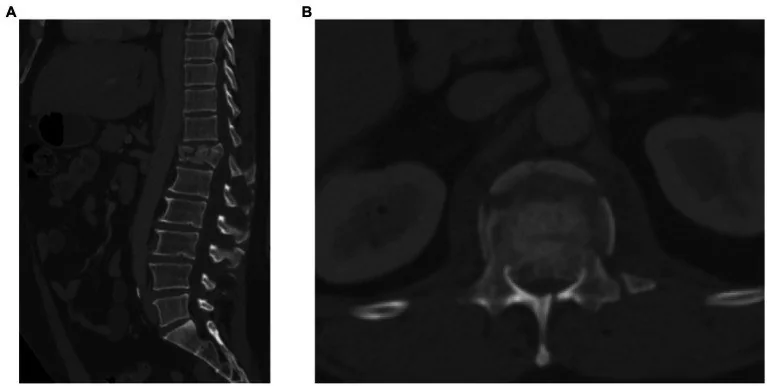
- Kemik algoritmalı ince kesit aksiyel BT’de vertebra arka duvarından kopup kanalın ön konturuna taşan kemik fragmanı görülür. Sagittal ve aksiyel rekonstrüksiyonlar fragmanın kraniokaudal uzanımını, son plak kırığını ve spinal kanalın kemik konturundaki daralmasını gösterir; BT nöral dokudaki hasarı dışlamaz.
Önerilen pencereler: Kemik (G 1800 / M 400).
BT bulguları
- Arka duvar fragmanı — kortikal parça vertebra korpusunun posterior sınırından kanala doğru yer değiştirir; kaynağı ve yönü sagittal planda izlenir.
- Korpus burst morfolojisi — üst veya alt son plakta kırıkla birlikte arka duvarın da tutulması, basit anterior kama kompresyonundan ayrılır.
- Spinal kanalın kemik lümeninde daralma — retropulse fragman ile karşı kanal duvarı arasındaki açıklık ve kanal konturu aksiyel kesitte, aynı seviyenin komşu seviyeleriyle karşılaştırılarak değerlendirilir.
- Fragman lateralizasyonu — parçanın orta hatta mı, sağ ya da sol lateral reseste mi uzandığı belirtilir; pedikül/lamina ile devamlılığı aranır.
- Retropulsiyonun segmentel kapsamı — sagittal rekonstrüksiyonda arka duvar kırığının kraniyal ve kaudal sonlanımı ile komşu seviyelerin ilişkisi not edilir.
- Eşlik eden posterior eleman hasarı — pedikül, lamina, spinöz çıkıntı veya faset kırığı tension-band yaralanma olasılığını değiştirir.
- Nöral değerlendirme sınırı — kemik penceresindeki BT kanal basısını tanımlar ancak kord, konus veya kauda ekina düzeyindeki ödem, kontüzyon veya epidural hematomu tek başına dışlamaz.
Ölçütler ve sınıflamalar
- AO Spine torakolomber A alt tipleri
- A1 tek son plak kompresyonunda arka duvar sağlamdır; A3 tek son plak ve arka duvarı içeren inkomplet burst, A4 iki son plak ve arka duvarı içeren komplet burst kırığıdır. Arka duvar tutulumu burst morfolojisini (A tipi) destekler; gerilim bandı bütünlüğünün bozulması (B tipi) veya translasyon (C tipi) varlığında bu bileşenler ayrı ayrı değerlendirilir ve sınıflandırılır.
- TLICS
- Morfoloji, PLC bütünlüğü ve nörolojik durum birbirinden ayrı bileşenlerdir; burst morfolojisi, arka bağ kompleksinin durumu ve klinik nörolojik muayene birlikte kaydedilir. Kemik pencere BT, retropulse parça ile spinal kanalın daralmasını tanımlar ancak nörolojik durumun derecelendirilmesi klinik muayene ve nöral yumuşak doku değerlendirmesi için MR gerektirir.
Normalde
Normal aynı seviyede vertebra korpusunun arka korteksi düzgün ve komşu korpusların posterior çizgisiyle uyumludur; spinal kanal ön duvarında kanala doğru çıkıntı yapan kortikal parça bulunmaz. Yaralı düzeyi bir üst ve alt vertebrayla sagittal planda karşılaştırın, ardından aksiyel kesitte pediküller arasındaki kanal konturunun daralıp daralmadığına bakın.
Normal BT ile kıyasla
Aynı bölgenin, kaynak veri setinde patoloji içermediği belirtilen bir BT incelemesini kesit kesit kaydırın; organ sınırlarını açarak anatomiyi hasta görüntüsüyle karşılaştırın. Küçük rastlantısal bulgular tümüyle dışlanmamıştır.
Kaynak: TotalSegmentator v2.01 veri seti (Wasserthal ve ark., Radiology: Artificial Intelligence 2023), CC BY 4.0, vaka s1338; organ sınırları veri setinin otomatik segmentasyonundan, birleştirilerek sadeleştirildi. Görüntüler 2,5 mm kesit aralığına yeniden örneklendi.
Ayırıcı tanı
- Kama kompresyon kırığı
- ön korpus yüksekliği azalmıştır ancak arka duvar korteksi ve kanal ön konturu korunur.
- Schmorl nodülü
- son plakta sınırlı çökme ve çevresel skleroz görülür; posterior korteksten kanala uzanan akut parça yoktur.
- Epidural hematom
- kanal içinde yumuşak doku dansitesi kemik fragmanı gibi görünebilir; kemik penceresinde kortikal devamlılık ve yumuşak doku penceresinde dansite değerlendirilir.
- Kronik retropulse parça
- kenarları kortikeleşmiş, vertebra deformitesi yeniden şekillenmiş ve çevresinde akut kırık bulgusu sınırlı olabilir.
- Artefakt veya kısmi hacim
- tek kesitte görülen yalancı kanal kenarı kesintisi ardışık aksiyel ve sagittal görüntülerde doğrulanmaz.
Tuzaklar
- Sagittal orta hat kesiti fragmanı kaçırabilir; parça lateral reseste kalıyorsa aksiyel görüntüde kanalın iki yanını ayrı ayrı tarayın.
- Kanalda kemik fragmanı görülmesi kord yaralanmasının derecesini göstermez; nörolojik muayene ve gerektiğinde MR bulguları ayrı raporlanır.
- Korpus yüksekliği kaybı tek başına burst tanısı koydurmaz; posterior duvarın kesintili olup olmadığını ve fragmanın kanala yer değiştirip değiştirmediğini doğrulayın.
Kendini dene
L1'de üst son plak kırığına posterior korteksin kanala doğru yer değiştiren parçası eşlik ediyor. Morfoloji hangisidir?
Cevabı göster
A3 inkomplet burst. Tek son plak ve posterior duvar tutulumu A3 inkomplet burst morfolojisine uyar. A1'de posterior duvar korunur; spinöz çıkıntı ve faset yaralanmaları farklı anatomik yapılardadır.
BT'de retropulse kemik fragmanı ve kanal daralması görülüyor; nörolojik işlev hakkında hangi çıkarım doğrudur?
Cevabı göster
BT kord hasarını dışlamaz. BT kemik parçasını ve kemik kanal konturunu gösterir; kord, konus veya kauda ekuina hasarını tek başına dışlayamaz. Diğer seçenekler BT'nin nöral yumuşak doku sınırını aşan sonuçlar çıkarır.
Kaynaklar
Bu sayfadaki 42 cümle ve 2 quiz sorusu aşağıdaki kaynaklardan alıntılarla tek tek karşılaştırıldı; 8 cümle bu karşılaştırmada düzeltildi (2026-10-08).
- Emergency radiology of severe acute injury in extreme alpine summer sports: a pictorial essaypmc.ncbi.nlm.nih.gov
- Traumatic Durotomy with Entrapment of Nerve Roots in a Lumbar Burst Fracture Diagnosed Intraoperatively: A Case Reportpmc.ncbi.nlm.nih.gov
- Dural tears from traumatic spinal fractures: an illustrative case and systematic review of its incidence, diagnosis, risk factors, and managementpmc.ncbi.nlm.nih.gov
- Anatomical and biological reconstruction of traumatic complete burst fractures of the thoracolumbar vertebrae using pedicle fixation combined with stent-armed kyphoplasty and intracorporeal bone grafting: technique rationale, 7-year experience and clinical, imaging, and histological outcomespmc.ncbi.nlm.nih.gov
- Diagnostic decision-making, vertebral augmentation, and osteoporosis therapy in vertebral compression fractures: a narrative reviewpmc.ncbi.nlm.nih.gov
- Traumatic Fracture: Dislocation of Cervicothoracic Junction-Grand Round Presentation of C7-T1 Instabilities and Different Instrumentation Techniques.pubmed.ncbi.nlm.nih.gov
- Armed Kyphoplasty: An Indirect Central Canal Decompression Technique in Burst Fractures.pubmed.ncbi.nlm.nih.gov
- Does Magnetic Resonance Imaging Predict Neurological Deficit in Patients with Traumatic Lower Lumbar Fractures?pubmed.ncbi.nlm.nih.gov
- Morphological features of thoracolumbar burst fractures associated with neurological outcome in thoracolumbar traumatic spinal cord injury.pubmed.ncbi.nlm.nih.gov
- Diagnostic Reliability of Computed Tomography in Predicting Posterior Ligamentous Complex Injury in Traumatic Lower Lumbar Fracture.pubmed.ncbi.nlm.nih.gov
- Case report: Continuous spinal cord physiologic monitoring following traumatic spinal cord injury-A report from the Winnipeg Intraspinal Pressure Study (WISP).pubmed.ncbi.nlm.nih.gov
- Minimally Invasive Percutaneous Pedicle Screw Fixation in Thoracolumbar Spine Fractures: A Clinical Evaluation Study and Computed Tomography Scan Analysis of Screw Tracts.pubmed.ncbi.nlm.nih.gov
- Timing of surgery and predictors of canal reduction after short-segment fixation for thoracolumbar burst fractures.pubmed.ncbi.nlm.nih.gov
- Single-position robot-assisted lateral lumbar corpectomy with minimally invasive posterior spinal fusion for traumatic burst fracture showing MRI-demonstrated indirect decompression: illustrative case.pubmed.ncbi.nlm.nih.gov
- Anatomical and biological reconstruction of traumatic complete burst fractures of the thoracolumbar vertebrae using pedicle fixation combined with stent-armed kyphoplasty and intracorporeal bone grafting: technique rationale, 7-year experience and clinical, imaging, and histological outcomes.pubmed.ncbi.nlm.nih.gov
- Emergency radiology of severe acute injury in extreme alpine summer sports: a pictorial essay.pubmed.ncbi.nlm.nih.gov
- Application of AUSS-TLIF for the treatment of a lumbar burst fracture: A case report.pubmed.ncbi.nlm.nih.gov
- Surgical Management of Progressive Scoliosis in Crisponi Syndrome: Multidisciplinary Perioperative Strategy and Technical Considerations.pubmed.ncbi.nlm.nih.gov
- Beyond Chordoma: A Comprehensive Review of Sacral Lesions.pubmed.ncbi.nlm.nih.gov
- Bone cement displacement after percutaneous vertebroplasty for a three-column fracture: a case report.pubmed.ncbi.nlm.nih.gov
- Fatal Injuries Caused by Falling Trees: Correlation Between Postmortem Computed Tomography and Forensic Autopsy Findings in Eight Cases.pubmed.ncbi.nlm.nih.gov
- The Double Blow Phenomenon: Back-To-Back C5 Palsy in Compressive Cervical Myelopathy Surgery: A Case Series.pubmed.ncbi.nlm.nih.gov
- Anatomical Variants of the Cervical Spine and Sports-Related Injury in Athletes: A Narrative Review.pubmed.ncbi.nlm.nih.gov
- Arthroscopic-assisted uniportal spinal surgery for the treatment of rare T10/T11 thoracic disc herniation: a case report.pubmed.ncbi.nlm.nih.gov
- Unilateral biportal endoscopic technique combined with percutaneous transpedicular screw fixation for thoracolumbar burst fractures with neurological symptoms: technical note and preliminary report.pubmed.ncbi.nlm.nih.gov
- Trauma of the spine and spinal cord: imaging strategies.pubmed.ncbi.nlm.nih.gov
- Long-term results of thoracolumbar and lumbar burst fractures after short-segment pedicle instrumentation, with special reference to implant failure and correction loss.pubmed.ncbi.nlm.nih.gov
- Post-Traumatic Bronchial Artery Pseudoaneurysm: A Case Report.pubmed.ncbi.nlm.nih.gov
- Association of preoperative vertebral kyphosis and other factors with cement leakage after percutaneous kyphoplasty: a retrospective cohort study.pubmed.ncbi.nlm.nih.gov
- Treatment strategies for incomplete burst fractures (AO Spine A3) at the thoracolumbar junction -results of a nationwide German survey.pubmed.ncbi.nlm.nih.gov
- Partial C2 corpectomy with iliac/fibula bone graft and posterior instrumented fusion for C2 vertebral body lesions: An innovative approach.pubmed.ncbi.nlm.nih.gov
- Salvage Full-Endoscopic Resection of Residual Giant Thoracic Disc Herniation After Transpedicular Decompression and Instrumented Fusion: Technical Note, Literature Review, and Supplemental Video.pubmed.ncbi.nlm.nih.gov
- Full-Endoscopic Transforaminal Approach With Partial Pediculectomy for a Central Thoracic Disc Herniation: Technical Note and Literature Review.pubmed.ncbi.nlm.nih.gov
- Risk factors for refracture by different cement leakage after percutaneous vertebroplasty in patients with thoracolumbar compression fractures.pubmed.ncbi.nlm.nih.gov
- The value of magnetic resonance imaging and computed tomography in the study of spinal disorders.pubmed.ncbi.nlm.nih.gov
- Comparative efficacy of unilateral biportal endoscopy versus endoscopic foraminoplasty decompression for single-level lumbar spinal stenosis: a retrospective cohort study.pubmed.ncbi.nlm.nih.gov
- Assessment of paediatric vertebral body and canal dimension in the cervical spine considering the influence of ethnicity in a New Zealand cohort.pubmed.ncbi.nlm.nih.gov
- Diagnostic Performance of CT-like Images for Lumbar Pedicle Screw Planning and Spinal Canal Area Measurement: A Comparative Study with Conventional CT and MRI.pubmed.ncbi.nlm.nih.gov
- Treatment of Extraosseous Giant Cell Tumor of Bone and Calcitriol-Mediated Hypercalcemia With Denosumab in Paget Disease.pubmed.ncbi.nlm.nih.gov
- Efficacy and Safety of Simultaneous Integrated Boost Followed by Selective Sequential Boost Radiotherapy for Spinal Metastases: A Single-Arm Retrospective Study.pubmed.ncbi.nlm.nih.gov
- Imaging of sacroiliitis: Current status, limitations and pitfalls.pubmed.ncbi.nlm.nih.gov
- Modified Stabilization Technique Following Resection of a Massive Cervical Infiltrative Lipoma with Spinal Compression in a Dog.pubmed.ncbi.nlm.nih.gov
- Direct pars repair techniques for lumbar spondylolysis: a comparative literature review.pubmed.ncbi.nlm.nih.gov
- Modified spinopelvic crab-shaped fixation using offset connectors for a H-shaped sacral fracture with a floating Roy-Camille type 3 transverse component: a case report.pubmed.ncbi.nlm.nih.gov
- Ankylosing spondylitis complicated by cervical spine fracture and cervicothoracic epidural hematoma: A case report.pubmed.ncbi.nlm.nih.gov
- The Role of MRI in Evaluating Spinal Cord Injuries: Diagnostic Accuracy, Prognostic Value, and Clinical Decision-Making.pubmed.ncbi.nlm.nih.gov
- Spinal cord ischemia following pediatric cardiac arrest: An unexplored complication of hypoxic ischemic injury.pubmed.ncbi.nlm.nih.gov
- Impact of lamina preservation height during posterior decompression on lumbar biomechanical stress distribution: a finite element study.pubmed.ncbi.nlm.nih.gov
- Spinal lesions: a comprehensive radiologic overview.pubmed.ncbi.nlm.nih.gov
- Biomechanical evaluation of In-Out-In pedicle screws for atlantoaxial posterior fixation in the presence of high-riding vertebral artery and narrow C2 pedicles: a finite element analysis.pubmed.ncbi.nlm.nih.gov
- Agreement and discordance between the modified thoracolumbar injury classification and severity score and the thoracolumbar AOSpine injury score in guiding surgical decision-making for thoracolumbar fractures: a comparative study.pubmed.ncbi.nlm.nih.gov
- The AO Spine TL Injury Classification System Drives Clinical Decision Making in Acute Thoracolumbar Fractures: A Retrospective Evaluation of Clinical Implementation.pubmed.ncbi.nlm.nih.gov
- Machine Learning Algorithm to Predict Change in the Decision-Making for Thoracolumbar Fractures Without Neurological Deficit After MRI: A Multicenter Study.pubmed.ncbi.nlm.nih.gov
- One-Stage Posterior Open Fixation with SpineJack Expansion Kyphoplasty for Unstable A4 Complete Thoracolumbar Burst Fracture with Neurological Deficit: A Proof-of-Concept Case Series.pubmed.ncbi.nlm.nih.gov
- Predicting neurological recovery after thoracolumbar spine trauma: The role of injury morphology and admission American Spinal Injury Association Impairment Scale grade.pubmed.ncbi.nlm.nih.gov
- Reliability and reproducibility of the modified thoracolumbar injury classification and severity score and the thoracolumbar AO spine injury score for guiding surgical decision-making in thoracolumbar fractures.pubmed.ncbi.nlm.nih.gov
- Comparative analysis of two modified TLICS systems in guiding surgical decision-making for thoracolumbar fractures.pubmed.ncbi.nlm.nih.gov
- Radiographic Predictors of Spinal Column Instability After Gunshot Wounds: A Pragmatic Score.pubmed.ncbi.nlm.nih.gov
- The Integrated Nerve, Discoligamentous Complex, and Vertebra Scoring System for Thoracolumbar Junction (TLJ) Injury.pubmed.ncbi.nlm.nih.gov
- The neurologically intact patient with TLICS 4 or 5 burst fracture should be given a trial of nonoperative management.pubmed.ncbi.nlm.nih.gov
- Posterior unilateral small fenestration of lamina combined with a custom-made Y-shaped fracture reduction device for the treatment of severe thoracolumbar burst fracture: a prospective comparative study.pubmed.ncbi.nlm.nih.gov
- A Proposal for a Standardized Imaging Algorithm to Improve the Accuracy and Reliability for the Diagnosis of Thoracolumbar Posterior Ligamentous Complex Injury in Computed Tomography and Magnetic Resonance Imaging.pubmed.ncbi.nlm.nih.gov
- Indications and Limitations of Standalone Percutaneous Vertebroplasty for Reverse Chance Fractures Associated With Ankylosing Spinal Disorders.pubmed.ncbi.nlm.nih.gov
- Robot-assisted modified unilateral percutaneous vertebroplasty for lumbar Kümmell's disease: a randomized controlled trial.pubmed.ncbi.nlm.nih.gov
- Chronic nonbacterial osteomyelitis in neuroradiology - behavior and evolution of vertebral and mandibular lesions on imaging.pubmed.ncbi.nlm.nih.gov
- m2ABQ-a proposed refinement of the modified algorithm-based qualitative classification of osteoporotic vertebral fractures.pubmed.ncbi.nlm.nih.gov
- Axial Spondyloarthritis: Mimics and Pitfalls of Imaging Assessment.pubmed.ncbi.nlm.nih.gov
- Progressive Spastic Paraparesis Caused by Thoracic Spinal Epidural Lipomatosis: A Case Report and Systematic Review.pubmed.ncbi.nlm.nih.gov
- Neuroimaging for neurovascular complications of traumatic brain injury.pubmed.ncbi.nlm.nih.gov
- A Focal Traumatic Injury to the Neonatal Rodent Spinal Cord Causes an Immediate and Massive Spreading Depolarization Sustained by Chloride Ions, with Transient Network Dysfunction.pubmed.ncbi.nlm.nih.gov
- Brazilian Society of Otology task force - Vestibular Schwannoma ‒ evaluation and treatment.pubmed.ncbi.nlm.nih.gov
- Total laparoscopic radical hysterectomy for cervical cancer in prolapsed uterus.pubmed.ncbi.nlm.nih.gov
- Dural tears from traumatic spinal fractures: an illustrative case and systematic review of its incidence, diagnosis, risk factors, and management.pubmed.ncbi.nlm.nih.gov
- Metal hypersensitivity in spinal surgery: mechanisms, diagnosis, and management - a narrative review.pubmed.ncbi.nlm.nih.gov
- Revision Lumbar Spine Surgery for Failed Back Surgery Syndrome: A Retrospective Study of Causes, Complications, and Outcomes.pubmed.ncbi.nlm.nih.gov
- Diagnostic decision-making, vertebral augmentation, and osteoporosis therapy in vertebral compression fractures: a narrative review.pubmed.ncbi.nlm.nih.gov
- Biomaterials for vertebral body repair: interior augmentation and total replacement-a literature review of bone fusion outcomes in clinical studies.pubmed.ncbi.nlm.nih.gov
- Compression fracture of the T12 vertebra combined with diaphragmatic hernia after low-energy trauma: a case report and literature review.pubmed.ncbi.nlm.nih.gov
- Robot-Assisted "Postage-Stamp" Vertebrotomy for Spinal Tumor Resection: Case Report.pubmed.ncbi.nlm.nih.gov
- The evolution of cervical spine trauma classification: a paradigm shift from morphological description to clinical decision-making.pubmed.ncbi.nlm.nih.gov
- Exploring motor unit and neuromuscular junction dysfunction in aging and sarcopenia: insights from electromyography in systematic review.pubmed.ncbi.nlm.nih.gov
- Case Report: Giant L1 dumbbell-shaped spinal schwannoma with osteolytic destruction and intense [<sup>18</sup>F]FDG uptake on PET/CT mimicking a malignant tumor.pubmed.ncbi.nlm.nih.gov
- Surgery of the tumors of the spine.pubmed.ncbi.nlm.nih.gov
- Accessory Articulation of Elongated Anterior Tubercles of the Transverse Processes at C5-C6 in a Young Adult Female Patient: A Case Report.pubmed.ncbi.nlm.nih.gov
- Occipital plate-assisted posterior reduction for tumor-related severe atlantoaxial dislocation: a single-case surgical technique.pubmed.ncbi.nlm.nih.gov
- Morphological and Epidemiological Analysis of the Sphenoid Sinus Based on Computed Tomography and Magnetic Resonance Imaging: A Narrative Review.pubmed.ncbi.nlm.nih.gov
- Clinical and radiological predictors of adverse outcomes after unilateral biportal endoscopic surgery for short-segment degenerative lumbar spinal stenosis.pubmed.ncbi.nlm.nih.gov
- Surgical Reduction Techniques and Outcomes for Cervical Spondyloptosis: A Technical Report and Case Series.pubmed.ncbi.nlm.nih.gov
- Safety and Stability of a Combined C2 Screw Placement Strategy With Vertebral Artery Mobilization.pubmed.ncbi.nlm.nih.gov
- Towards Automated Spine Fracture Detection on Whole-Body CT of Polytraumatized Patients.pubmed.ncbi.nlm.nih.gov
- Stress-driven design of intervertebral disc implants and optimization of mechanical and biological performance.pubmed.ncbi.nlm.nih.gov
- Combine Short-Segment Fixation and Leverage Reduction Technique to Correct Kyphotic Angle in Kümmell's Disease.pubmed.ncbi.nlm.nih.gov
- Predictors of failure of non-operative management in neurologically intact thoracolumbar burst fractures: a systematic review and meta-analysis.pubmed.ncbi.nlm.nih.gov
- Automatic Classification of Hydrogen-Induced Acoustic Emission Signals in High-Strength Offshore Bolts Using Time-Frequency Feature Engineering.pubmed.ncbi.nlm.nih.gov
- Spine Trauma Classifications: Historical, Current, and Emerging Perspectives for Radiologists.pubmed.ncbi.nlm.nih.gov
- Towards a standardized reporting of the impact of magnetic resonance imaging on the decision-making of thoracolumbar fractures without neurological deficit: Conceptual framework and proposed methodology.pubmed.ncbi.nlm.nih.gov
- Current Evidence and Clinical Implications of Full-Endoscopic Spine Surgery for Post-Vertebroplasty Lumbar Radiculopathy: A Comprehensive Review.pubmed.ncbi.nlm.nih.gov
- Radiological findings of February 2023 twin earthquakes-related spine injuries.pubmed.ncbi.nlm.nih.gov
- Prevalence, Implications, and Risk Factors of Traumatic Dural Tears in Thoracic and Lumbar Fractures: A Retrospective Study.pubmed.ncbi.nlm.nih.gov
- The Role of CT in Cervical Spine Imaging for Suspected Cervical Myelopathy.pubmed.ncbi.nlm.nih.gov
- Structural changes occurring at the surgical site long after hemilaminectomy in small-breed dogs with type I thoracolumbar intervertebral disk herniation.pubmed.ncbi.nlm.nih.gov
- Unilateral biportal endoscopic decompression for acute spontaneous spinal epidural hematoma at the cervicothoracic junction: a case report and literature review.pubmed.ncbi.nlm.nih.gov
- Spontaneous Triceps Haematoma Presenting With Ulnar Neuropathy: A Report of a Rare Case.pubmed.ncbi.nlm.nih.gov
- Migration of an ingested orthodontic retainer into the psoas muscle presenting with radiculopathy-like symptoms: A case report.pubmed.ncbi.nlm.nih.gov
- Contrast-Enhanced CT of the Coelom in a Female Bald Eagle (<i>Haliaeetus leucocephalus</i>): Development of a Preliminary CT-Based Anatomical Segmentation Workflow.pubmed.ncbi.nlm.nih.gov
- Traumatic Durotomy with Entrapment of Nerve Roots in a Lumbar Burst Fracture Diagnosed Intraoperatively: A Case Report.pubmed.ncbi.nlm.nih.gov
- Inducing thoracolumbar burst fractures in human cadaveric specimens using a combined axial-flexion loading: a fracture simulation.pubmed.ncbi.nlm.nih.gov
- Surgical management and outcomes analysis of lower lumbar (L3-L5) burst fractures: A single-center experience and meta-analysis.pubmed.ncbi.nlm.nih.gov
- Determinants of lateral fusion in single-level oblique lateral lumbar interbody fusion: a retrospective analysis of fusion patterns and clinical outcomes.pubmed.ncbi.nlm.nih.gov
- Clinical and Radiographic Comparison of Oblique Lateral Lumbar Interbody Fusion and Minimally Invasive Transforaminal Lumbar Interbody Fusion in Patients with L4/5 grade-1 Degenerative Spondylolisthesis.pubmed.ncbi.nlm.nih.gov
- Magnetic resonance imaging of the spine.pubmed.ncbi.nlm.nih.gov
- Minimally Invasive Lateral Thoracic and Lumbar Interbody Fusion with Expandable Interbody Spacers for Spine Trauma-Indications, Complications and Outcomes.pubmed.ncbi.nlm.nih.gov
- Magnetic Resonance Imaging for Spine Emergencies.pubmed.ncbi.nlm.nih.gov
- Percutaneous spinal endoscopic surgery for thoracic ossification of the posterior longitudinal ligament: a noval bilateral crossover decompression technique.pubmed.ncbi.nlm.nih.gov
- Regression of Lumbar Ossification of the Ligamentum Flavum after Indirect Decompression via Full-endoscopic Trans-Kambin's Triangle Lumbar Interbody Fusion: A 3-year Case Report.pubmed.ncbi.nlm.nih.gov
Eğitim amaçlıdır; hasta başında tanı ve tedavi kararının yerine geçmez. İçerik yapay zekâ destekli bir süreçle güncel literatüre göre cümle cümle kaynaklarla karşılaştırıldı, ancak uzman radyolog incelemesinden geçmedi. Klinik kararlarda güncel kılavuzları, kurum protokollerini ve radyoloji raporunu esas alın.