Özet
Travma sonrası saptanan bir vertebra kırığı, özellikle ankilozan spondilit veya DISH nedeniyle rijit omurgası olan hastada, ikinci ve birbirinden uzak kırık olasılığını gündeme getirir. Tüm omurganın BT'si kemik ayrıntısını ve kırık seviyeleri arasındaki mesafeyi gösterir; sagittal ve koronal MPR hizalanmayı ve atlanan kırık çizgilerini taramayı kolaylaştırır. Ağrı yeri ek kırık seviyesini güvenilir biçimde göstermeyebilir ve ankilozlu segment uzun kaldıraç kolu gibi davranır. İkinci instabil kırığın atlanması deplasman ve nörolojik kötüleşmeye yol açabilir.
Faz ve pencere
- Kontrastsız tanısal
- Görüntülenen tüm omurga boyunca vertebra korpusları, disk aralıkları ve posterior elemanlarda akut kortikal kırık, transdiscal hat, deplasman ve ankilozlu segmentte kesinti araştırılır. Sagittal ve koronal ince kesit MPR hizalanmayı ve kırık uzanımını gösterir; aksiyel kesitler pedikül, faset ve posterior eleman tutulumunu tamamlar.
Önerilen pencereler: Kemik (G 1800 / M 400).
BT bulguları
- Ayrık kırık odakları — aynı omurga içinde arada sağlam vertebralar bulunan birden çok kırık alanı olabilir.
- Ankilozlu segmentte transvers hat — füze olmuş disk, faset veya uzun kemiksi köprü boyunca geçen kesinti, küçük travmada bile önemli bir yaralanma olabilir.
- Üç kolon boyunca devamlılık — kırık hattının ön korpus/osteofitlerden posterior elemanlara uzanması instabil yaralanma morfolojisini gösterir.
- Ağrı düzeyiyle uyumsuz kırık — semptomatik bölgeden uzakta ek kırık bulunabileceği için yalnız ağrı noktasına yönelik kesitler yeterli tarama sayılmaz.
- Korpus basamağı veya açılanma — sagittal profilde posterior duvar retropulsiyonu, kifotik deformite ya da translasyon eşlik edebilir.
- Gövde ve/veya posterior elemanlarda kırık — Ankilozlu omurgada yaralanma hatları disk, gövde ve posterior elemanları tek başına veya birlikte tutabilir.
- Sakrum ve servikotorasik bileşke — taranan tüm omurga boyunca torakolomber odaktan uzak bölgelerde de ikinci yaralanma aranır.
Normalde
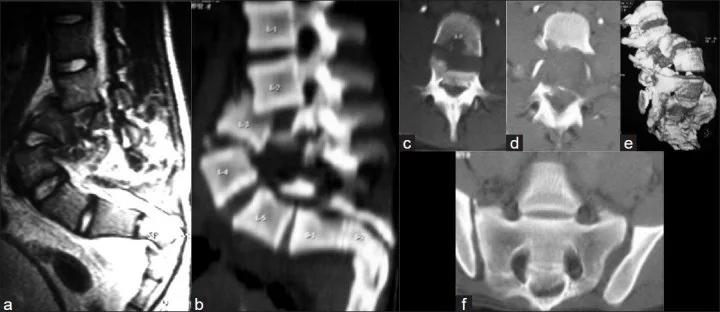
Normal omurga ve ankiloz karşılaştırması — Normal omurgada vertebra korpusları ve disk aralıkları belirgindir; DISH'li hastalarda ise komşu vertebra gövdeleri arasında neredeyse normal disk yüksekliğinde kemik köprüleri izlenir. Şüpheli seviyeyi komşu sağlam diskler, korpuslar ve fasetlerle kıyaslayıp kortikal çizgi kesintisi, yeni basamaklanma ve ayrı ikinci odak arayın.
Normal BT ile kıyasla
Aynı bölgenin, kaynak veri setinde patoloji içermediği belirtilen bir BT incelemesini kesit kesit kaydırın; organ sınırlarını açarak anatomiyi hasta görüntüsüyle karşılaştırın. Küçük rastlantısal bulgular tümüyle dışlanmamıştır.
Kaynak: TotalSegmentator v2.01 veri seti (Wasserthal ve ark., Radiology: Artificial Intelligence 2023), CC BY 4.0, vaka s1338; organ sınırları veri setinin otomatik segmentasyonundan, birleştirilerek sadeleştirildi. Görüntüler 2,5 mm kesit aralığına yeniden örneklendi.
Ayırıcı tanı
- Dejeneratif osteofit kırığı
- ön osteofitte ince kopma çizgisi olabilir; vertebra korpusu ve posterior elemanlarda devam eden instabil hat bulunmayabilir.
- Ankilozan spondilit spondilodiskiti
- disk aralığı ve endplate erozyonu kronik inflamatuvar değişikliklerle ilişkili olabilir; akut travmatik kortikal basamaklanmayla aynı değildir.
- Eski kompresyon deformitesi
- MR, akut kırıkları kronik deformitelerden ayırmada temel görüntüleme yöntemlerinden biridir.
- Schmorl nodu
- endplate içine sınırlı fokal çökme yapar; vertebra boyunca uzanan transvers kırık hattı değildir.
- Kemik adacığı veya benign sklerotik odak
- medüller yerleşimli, düzgün sınırlı yoğunluk artışıdır; kortikal süreksizlik ve hizalanma bozukluğu yaratmaz.
Tuzaklar
- Ağrının olduğu tek seviyeye odaklanmak ikinci kırığı kaçırabilir; doğrulanmış bir spinal kolon kırığından sonra geri kalan omurgayı da inceleyin.
- Ankilozlu omurgadaki ince transdiscal çizgiyi dejeneratif değişiklik sanmayın; kemik köprü ve posterior eleman boyunca devamlılığını çok düzlemli izleyin.
- Kısmi tarama alanı tüm omurga değerlendirmesi yerine geçmez; travma BT'sindeki görüntülenen bölümlerle birlikte eksik kalan segmentleri saptayın.
- BT'de kırık görünmemesi omurilik veya bağ yaralanmasını bütünüyle dışlamaz; nörolojik bulgu ya da klinik-görüntüleme uyumsuzluğu varsa MR'ın rolü vardır.
Kendini dene
Minör travma sonrası DISH'li hastada T12 kırığı saptanıyor; bel ağrısı var. Görüntüleme taraması nasıl tamamlanmalı?
Cevabı göster
Omurganın geri kalanını görüntüle. Ankilozan omurga kırıklarında çok seviyeli ve ağrıdan uzak yaralanma olasılığı artar. Kırık doğrulanınca geri kalan spinal kolon da değerlendirilmelidir; odaklı tekrar, yalnız MR veya grafi tüm omurgadaki kemik kırık taramasının yerini tutmaz.
Sagittal BT'de T8'de transdiscal çizgi ve L1'de ayrı posterior eleman kırığı görülüyor. Bu iki odağı nasıl adlandırırsınız?
Cevabı göster
Çok seviyeli ayrık yaralanma. Birbirinden uzak seviyelerde iki ayrı kırık çok seviyeli ve nonkontigu yaralanmadır. Ankilozan omurgada izole basit kompresyon yaralanması olasılığı düşüktür; verilen kaynaklar vakum fenomeni veya blok vertebranın tanımını doğrulamıyor.
Kaynaklar
Bu sayfadaki 37 cümle ve 2 quiz sorusu aşağıdaki kaynaklardan alıntılarla tek tek karşılaştırıldı; 4 cümle bu karşılaştırmada düzeltildi (2026-10-08).
- Spine Fractures in Ankylosing Diseases: Recommendations of the Spine Section of the German Society for Orthopaedics and Trauma (DGOU)pmc.ncbi.nlm.nih.gov
- Traumatic cervical spine fracture patterns on CT: a retrospective analysis at a level 1 trauma center.pubmed.ncbi.nlm.nih.gov
- Multilevel Noncontiguous Spinal Fractures: Surgical Approach towards Clinical Characteristics.pubmed.ncbi.nlm.nih.gov
- A system of predictive scores to evaluate the risk of multilevel noncontiguous spinal fractures in patients with traumatic cervical spine injury.pubmed.ncbi.nlm.nih.gov
- Hemothorax from a Thoracic Chalk-Stick Fracture in Ankylosing Spondylitis: A Case Report.pubmed.ncbi.nlm.nih.gov
- High-flow nasal oxygen with flexible channel oxygen insufflation for ankylosing spondylitis and cervical fracture-dislocation: a case report and literature review.pubmed.ncbi.nlm.nih.gov
- Life-threatening spinal cord injury and occult intercostal artery rupture following low-energy trauma in a patient with ankylosing spondylitis: a case report.pubmed.ncbi.nlm.nih.gov
- Relationship of posterior superior iliac spine morphology and ideal S1 pedicle screw trajectory: A cross-sectional study of closed versus open posterior superior iliac spine morphology.pubmed.ncbi.nlm.nih.gov
- Accuracy and Safety of a Triad-Dependent Technique for Subaxial Cervical Pedicle Screw Placement: A Prospective Cohort Study.pubmed.ncbi.nlm.nih.gov
- An Extended Follow-up of Spinal Instrumentation Rescue with Cement Augmentation.pubmed.ncbi.nlm.nih.gov
- Role of 3D Printing in Preoperative Planning for Spine Surgery: A Scoping Review.pubmed.ncbi.nlm.nih.gov
- Esophageal Injury in Patients with Ankylosing Spondylitis After Cervical Spine Trauma: Our Case Series and Narrative Review.pubmed.ncbi.nlm.nih.gov
- Utility of repeat MRI in assessing treatment non-response in axial spondyloarthritis: data from two large tertiary rheumatology centres.pubmed.ncbi.nlm.nih.gov
- Rehabilitation modalities in ankylosing spondylitis: orthopaedic perspectives on function, bone health, and surgical safety.pubmed.ncbi.nlm.nih.gov
- Risk-stratified management of ankylosing spondylitis-related spinal fractures-a meta-synthesis of contemporary surgical and nonsurgical strategies: a narrative review.pubmed.ncbi.nlm.nih.gov
- Clinical characteristics and management of spinal fractures in patients with ankylosing spondylitis: a retrospective cohort study.pubmed.ncbi.nlm.nih.gov
- Acute thoracolumbar fractures in patients with a rigid spine: a computed tomography study.pubmed.ncbi.nlm.nih.gov
- Diagnostic accuracy of plain films in detection of thoracolumbar fractures in minor trauma patients: comparison with CT.pubmed.ncbi.nlm.nih.gov
- Spinal disorders mimicking infection.pubmed.ncbi.nlm.nih.gov
- Accessory Articulation of Elongated Anterior Tubercles of the Transverse Processes at C5-C6 in a Young Adult Female Patient: A Case Report.pubmed.ncbi.nlm.nih.gov
- CT evaluation of pediatric craniocervical distraction injuries: a comprehensive review of morphometric parameters and practical applications.pubmed.ncbi.nlm.nih.gov
- Chronic Noninfectious Osteomyelitis: A Review of Imaging Findings.pubmed.ncbi.nlm.nih.gov
- Clinicopathologic and Molecular Analysis of Primary Angiosarcoma of Bone-A Single Institution Experience.pubmed.ncbi.nlm.nih.gov
- Diagnosis and Treatment of Skipped Multifocal Spinal Tuberculosis Lesions.pubmed.ncbi.nlm.nih.gov
- Intact Posterior Tension Band in Spinal Fractures in Patients With Spinal Ankylosing Disorders - Is it a Myth or a Reality? A Systematic Review.pubmed.ncbi.nlm.nih.gov
- Clinical Outcomes of Transdiscal Screws for Thoracolumbar Spinal Fractures with Marked Anterior Distraction Gap Accompanied by Diffuse Idiopathic Skeletal Hyperostosis.pubmed.ncbi.nlm.nih.gov
- A Rigid Spine at Risk: Chalk-Stick Fracture With Dural Sac Entrapment After Ground-Level Fall.pubmed.ncbi.nlm.nih.gov
- Application of the pivot forward combined leveraging technique in the treatment of thoracolumbar fractures: a finite element analysis and clinical study.pubmed.ncbi.nlm.nih.gov
- Acetabular superior wall fractures: a distinct acetabular fracture entity.pubmed.ncbi.nlm.nih.gov
- Multicentre prospective randomised controlled non-inferiority trial on the efficacy and safety of minimally invasive SAIF vertebral reconstruction technique versus spinal fixation in unstable osteoporotic vertebral compression fractures: a protocol.pubmed.ncbi.nlm.nih.gov
- Radiomics in spinal research: a narrative review.pubmed.ncbi.nlm.nih.gov
- Time-critical care gaps and systemic delays linked to higher mortality in severe trauma patients in Tanzania.pubmed.ncbi.nlm.nih.gov
- The Prone-Transpsoas Approach for Single-Position Lateral Corpectomy: A Case Series.pubmed.ncbi.nlm.nih.gov
- Diagnostic decision-making, vertebral augmentation, and osteoporosis therapy in vertebral compression fractures: a narrative review.pubmed.ncbi.nlm.nih.gov
- Anatomical and biological reconstruction of traumatic complete burst fractures of the thoracolumbar vertebrae using pedicle fixation combined with stent-armed kyphoplasty and intracorporeal bone grafting: technique rationale, 7-year experience and clinical, imaging, and histological outcomes.pubmed.ncbi.nlm.nih.gov
- Revision surgical technique for laterally placed MinuteMan<sup>®</sup> interspinous devices using a novel VertiFix<sup>®</sup> removal system through a spinous process-preserving midline approach with InSpan fusion.pubmed.ncbi.nlm.nih.gov
- Navigation-Assisted Bilateral Troughing Technique for Lumbar Laminectomy: A Stepwise Approach to Safe, Teachable, and Efficient Decompression.pubmed.ncbi.nlm.nih.gov
- A Modified Technique of Minimally Invasive Cortical Bone Trajectory Screws With U-Rod for Treatment of Lumbar Spondylolysis.pubmed.ncbi.nlm.nih.gov
- Congenital and Breed-Associated Vertebral Anomalies in Dogs and Cats: Developmental Anatomy, Genetic Determinants, and Biological Significance.pubmed.ncbi.nlm.nih.gov
- Traumatic spinal fractures: epidemiological and clinical evaluation in a forensic medicine clinic sample.pubmed.ncbi.nlm.nih.gov
- Acute management of spinal fractures: What you need to know.pubmed.ncbi.nlm.nih.gov
- Biomechanical analysis of ponte osteotomy and PSO osteotomy in the treatment of ankylosing spondylitis with thoracolumbar kyphotic deformity.pubmed.ncbi.nlm.nih.gov
- Surgical algorithms for ankylosing spondylitis-related pseudarthrosis : adapting to radiological and clinical variations.pubmed.ncbi.nlm.nih.gov
- Development and Validation of a Computer-Assisted Screw Trajectory Planning Model Based on Iterative Closest Point Registration and Weighted K-Nearest Neighbors Algorithms for Cortical Bone and Pedicle Screw Techniques.pubmed.ncbi.nlm.nih.gov
- Multilevel Lumbar CT Attenuation Beyond L1: Comparison with QCT-Derived Volumetric Bone Mineral Density and Prevalent Fragility Fracture Status in a Diagnostic Referral Cohort.pubmed.ncbi.nlm.nih.gov
- SpineMAE: A bone-window self-supervised and structure-aware framework for 3D cervical vertebra segmentation and fracture classification.pubmed.ncbi.nlm.nih.gov
- Artifact-Controlled Multi-Vertebral Transfer Learning Ensemble for Patient-Level Three-Class Osteoporosis Screening Using Thoracoabdominal CT-Derived Lumbar Images.pubmed.ncbi.nlm.nih.gov
- A rare and complex case report of superimposed clostridial spondylodiscitis and epidural abscess associated with spinal lymphoma of the thoracic spine.pubmed.ncbi.nlm.nih.gov
- Infectious Spondylodiscitis of Bacterial Causes in Adults: Epidemiology, Pathophysiology, Diagnostic and Treatment Challenges.pubmed.ncbi.nlm.nih.gov
- From misdiagnosis to definitive diagnosis of SAPHO syndrome during a routine health check-up: a case report and literature review.pubmed.ncbi.nlm.nih.gov
- Vertebral Artery Dissection and PICA-Territory Stroke Associated with Chronic Atlantoaxial Structural Abnormality: A Case Report.pubmed.ncbi.nlm.nih.gov
- Atlantoaxial rotatory subluxation in a pediatric patient with osteopetrosis following minor trauma: illustrative case.pubmed.ncbi.nlm.nih.gov
- Surgical Strategies and Challenges in Scheuermann's Kyphosis: A Comprehensive Review.pubmed.ncbi.nlm.nih.gov
- Effects of endplate healing morphology on intervertebral disc degeneration after pedicle screw fixation for thoracolumbar fractures.pubmed.ncbi.nlm.nih.gov
- 3D shape analyses of extant primate and fossil hominin vertebrae support the ancestral shape hypothesis for intervertebral disc herniation.pubmed.ncbi.nlm.nih.gov
- Unveiling Primary Bone Tumors of the Spine: A Review of Essential Imaging Clues.pubmed.ncbi.nlm.nih.gov
- ESR Essentials: bone marrow MRI in oncology-practice recommendations by the European Society of Musculoskeletal Radiology.pubmed.ncbi.nlm.nih.gov
- Spinal lesions: a comprehensive radiologic overview.pubmed.ncbi.nlm.nih.gov
- Teaching common cognitive biases and associated errors in veterinary neurologic diagnosis using clinical vignettes: a narrative review.pubmed.ncbi.nlm.nih.gov
- Navigating Acceptability: A Think-Aloud Study of Subjective and Contextual Factors in Radiographic Image Rejection.pubmed.ncbi.nlm.nih.gov
- Ultrasound-Guided Pericapsular Nerve Group Block vs Suprainguinal Fascia Iliaca Block for Analgesia in Hip Fracture Surgery: A Prospective Comparative Observational Study.pubmed.ncbi.nlm.nih.gov
- Cervical Collar in Adult Trauma: Evidence, Controversies, and Clinical Decision-Making.pubmed.ncbi.nlm.nih.gov
- Case Report: Revision surgery for a missed posterior dislocation of the humeral head in a shoulder fracture-dislocation and literature review.pubmed.ncbi.nlm.nih.gov
- Feasibility of AI-Denoised Ultra-Low-Dose CT for Detection of Acute Pelvic and Hip Fractures: A Pilot Multi-Reader Study.pubmed.ncbi.nlm.nih.gov
- C3 spinal cord infarction associated with cervical ossification of the posterior longitudinal ligament presenting as a stroke mimic: illustrative case.pubmed.ncbi.nlm.nih.gov
- Cervical Spinal Cord Injury Without Radiographic Evidence of Trauma (SCIWORET) in an Adult: A Rare Diagnosis in the Intensive Care Unit.pubmed.ncbi.nlm.nih.gov
- MDCT Morphometry of the Thoracolumbar Junction in a Turkish Cohort: Surgical, Radiological, and Forensic Implications.pubmed.ncbi.nlm.nih.gov
- CT-Based Quantitative Analysis of Ossification Centres in the C7 Vertebra of Human Fetuses.pubmed.ncbi.nlm.nih.gov
- Leptomeninges: Anatomy, Mechanisms of Disease and Neuroimaging.pubmed.ncbi.nlm.nih.gov
- Trabecular bone score beyond bone mineral density for identifying osteoporotic vertebral compression fractures: a matched case-control study.pubmed.ncbi.nlm.nih.gov
- Long-term effects of denosumab: a 10-year single-center retrospective study.pubmed.ncbi.nlm.nih.gov
- Disease-specific definitions of new bone formation on spine radiographs: a systematic literature review.pubmed.ncbi.nlm.nih.gov
- Posterior osteotomy techniques for rigid cervical deformity correction.pubmed.ncbi.nlm.nih.gov
- Spine Fractures in Ankylosing Diseases: Recommendations of the Spine Section of the German Society for Orthopaedics and Trauma (DGOU).pubmed.ncbi.nlm.nih.gov
- Polyostotic fibrous dysplasia: Unveiling the complexity of a rare bone disorder through a case report.pubmed.ncbi.nlm.nih.gov
- Radiological Diagnosis and Advances in Imaging of Vertebral Compression Fractures.pubmed.ncbi.nlm.nih.gov
- Bechterew's Disease and the Risk of Spinal Fractures: Clinical Patterns, Imaging Correlation, and Outcomes.pubmed.ncbi.nlm.nih.gov
- Long-Term Prognosis and Risk Factors for Low Back Pain-Related Disorders in the General Population: A 7-Year Follow-Up of the Wakayama Spine Study.pubmed.ncbi.nlm.nih.gov
- Updated practice guideline for dual-energy X-ray absorptiometry (DXA).pubmed.ncbi.nlm.nih.gov
- National Trends and Risk Factors for Dysphagia After Anterior Cervical Discectomy and Fusion.pubmed.ncbi.nlm.nih.gov
- Geriatric spine fractures - Demography, changing trends, challenges and special considerations: A narrative review.pubmed.ncbi.nlm.nih.gov
- Spine Stereotactic Body Radiotherapy: Indications, Outcomes, and Points of Caution.pubmed.ncbi.nlm.nih.gov
- The era of stereotactic body radiotherapy for spinal metastases and the multidisciplinary management of complex cases.pubmed.ncbi.nlm.nih.gov
- Multilevel spinal fractures in ankylosing spondylitis: illustrative case.pubmed.ncbi.nlm.nih.gov
- Anatomy of the intraosseous arterial microvasculature of the adult lumbar vertebral body and its role in fracture healing: a literature review and historical perspective.pubmed.ncbi.nlm.nih.gov
- Imaging clues for the diagnosis of various pathogenic causes of infectious spondylitis.pubmed.ncbi.nlm.nih.gov
- High-energy traumatic spondyloptosis at T8-T9 with complete spinal cord injury: a case report.pubmed.ncbi.nlm.nih.gov
- Occipital plate-assisted posterior reduction for tumor-related severe atlantoaxial dislocation: a single-case surgical technique.pubmed.ncbi.nlm.nih.gov
- Analysis of the characteristics of spino-pelvic sagittal parameters in Degenerative Thoracolumbar Kyphosis deformity and the mechanism of sagittal imbalance.pubmed.ncbi.nlm.nih.gov
- Staged dorsolateral decompression and posterior stabilization for severe ventral odontoid compression in basilar invagination: illustrative case.pubmed.ncbi.nlm.nih.gov
- Single-Position Minimally Invasive Retropleural Asymmetric Vertebral Column Resection and Percutaneous Pedicle Screw Fixation in the Lateral Position for Congenital Kyphoscoliosis.pubmed.ncbi.nlm.nih.gov
- Hajdu-Cheney Syndrome as a Rare Cause of Acroosteolysis: A Case Report.pubmed.ncbi.nlm.nih.gov
- Management of a Severe L4/5 Andersson Lesion with Three-Column Instability in Ankylosing Spondylitis Using Single-Stage Circumferential Reconstruction: A Case Report.pubmed.ncbi.nlm.nih.gov
- Schmorl's nodes are associated with prevalent osteoporotic vertebral fracture and low bone mineral density: a population-based thoracic spine MRI study in older men and women.pubmed.ncbi.nlm.nih.gov
- Magnetic resonance imaging of the spine.pubmed.ncbi.nlm.nih.gov
- Incidental findings on MRI for the evaluation of endometriosis: prevalence and clinical significance.pubmed.ncbi.nlm.nih.gov
- Anatomical variability, morphofunctional characteristics, and clinical relevance of accessory ossicles of the back: implications for spinal pathophysiology and differential diagnosis.pubmed.ncbi.nlm.nih.gov
- Limbus Vertebrae as Incidental Finding in a Patient With Acute Lower Back Pain.pubmed.ncbi.nlm.nih.gov
- Imaging for Plasma Cell Dyscrasias: What, When, and How?pubmed.ncbi.nlm.nih.gov
- Lumbar Vertebral Fracture Through a Pre-Existing Schmorl's Node Mimicking Histopathologically a Low-Grade Chondrosarcoma.pubmed.ncbi.nlm.nih.gov
- Why Are Some Intervertebral Discs More Prone to Degeneration?: Insights Into Isolated Thoracic "Dysgeneration".pubmed.ncbi.nlm.nih.gov
- Efficacy of Percutaneous Kyphoplasty in the Treatment of Kümmell's Disease and Osteoporotic Vertebral Compression Fractures: A Clinical Comparative Study.pubmed.ncbi.nlm.nih.gov
- Skeletal Involvement in Systemic Mastocytosis: Pathophysiology, Clinical Management, Standards of Care, and Novel Therapeutic Strategies.pubmed.ncbi.nlm.nih.gov
- Biomechanics in the onset and severity of spondyloarthritis: a force to be reckoned with.pubmed.ncbi.nlm.nih.gov
- Spinal manifestations of Paget's disease: Case presentation and systematic review.pubmed.ncbi.nlm.nih.gov
- Prevalence of os odontoideum: a systematic review, meta-analysis and meta-regression with implications for vertebral artery and osseous anomalies.pubmed.ncbi.nlm.nih.gov
- Pediatric Spinal Cord Injury: A Review.pubmed.ncbi.nlm.nih.gov
Eğitim amaçlıdır; hasta başında tanı ve tedavi kararının yerine geçmez. İçerik yapay zekâ destekli bir süreçle güncel literatüre göre cümle cümle kaynaklarla karşılaştırıldı, ancak uzman radyolog incelemesinden geçmedi. Klinik kararlarda güncel kılavuzları, kurum protokollerini ve radyoloji raporunu esas alın.