Özet
Son plak kırığı, vertebra yüksekliğinde ölçülebilir değişiklik olmadan da görülebilir; tek bir atravmatik vertebra kırığı osteoporoz tanısına yol açabilir. BT, vertebra kompresyon kırığının çizgisini, korpus çökmesini, kortikal bütünlüğünü, retropulsiyonu ve posterior eleman tutulumunu göstererek kırık örüntüsünü değerlendirmeye yardımcı olur. Korpus arka duvarı tutulumu burst kırıklarında görülebilir ve kemik fragmanları spinal kanala retropulsiyonla kanal darlığına yol açabilir; posterior eleman kırıkları instabiliteye veya nörolojik etkilenmeye katkıda bulunabilir. Son plak kırığı, belirgin vertebra korpus yüksekliği kaybı olmadan görülebilir; osteoporotik kırığı taklit edebilen diğer değişiklikler ayırıcı tanıda sistematik olarak dışlanmalıdır.
Faz ve pencere
- Kontrastsız tanısal
- Kontrastsız BT rekonstrüksiyonlarında üst veya alt son plakta kortikal bütünlük kaybı ve korpus içinde kırık hattı izlenir; posterior korpus duvarı tutulumu ve retropulsiyon ayrıca değerlendirilir. İntravenöz kontrast son plak kırığını saptamak için gerekli değildir.
Önerilen pencereler G genişlik, M merkez; değerler Hounsfield birimi (HU)
- KemikG 1800 / M +400
- Yumuşak dokuG 400 / M +40
BT bulguları
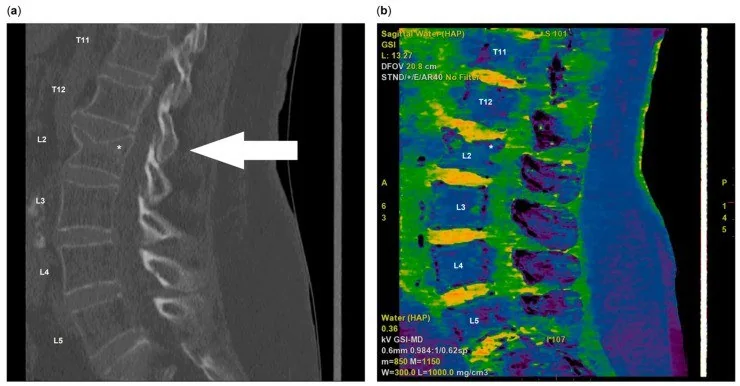
- Son plakta kortikal bütünlük kaybı ve vertebra korpusu içine uzanan kırık hattı izlenir.
- BT'de kırık hattı vertebra korpusu içinde normal kemik yapıda kesinti yapan çizgi olarak izlenir.
- Ön korpus yüksekliğindeki kama biçimli azalmayı ölçüp tarif edin; vertebra şekil değişikliği tek başına son plak kırığı kanıtı değildir.
- Posterior korpus duvarı kortikal bütünlüğünün korunmuş olması ve spinal kanala retropulsiyon gösteren kemik fragmanı bulunmaması değerlendirilir.
- Karşı son plak ve disk aralığında spondilodiskit düşündürebilecek erozyon, disk aralığı değişikliği veya paravertebral yumuşak doku bulgularını değerlendir.
- Akut kırıkta komşu yumuşak dokuda paraspinal hematom veya ödem eşlik edebilir.
- Posterior duvar kesintisi veya posterior eleman kırıkları, daha geniş bir yaralanma örüntüsüne eşlik edebilir.
Ölçütler ve sınıflamalar
- AO Spine torakolomber sınıflaması
- AO Spine sınıflamasında kırık morfolojisi değerlendirilirken üst son plak, alt son plak ve posterior duvar tutulumu incelenen temel anatomik bölgelerdir. AO sınıflamasında tip A yaralanmaları kompresyon kırıklarını kapsar; izole kama kırıklarına kıyasla burst kırıkları korpusun hem anterior hem de posterior bölümlerini içerir.
Normalde
Normal vertebra son plakları ince, düzgün ve kesintisiz kortikal sınırla korpusun süngerimsi kemiğini diskten ayırır; korpus yüksekliği ve arka duvar çizgisi korunur. Şüpheli son plağı karşı son plakla, komşu vertebralarla ve aynı korpusun arka duvarıyla kıyaslayarak fokal basamak, çökme ve posterior duvar uzanımı ara.
Normal BT ile kıyasla
Aynı bölgenin, kaynak veri setinde patoloji içermediği belirtilen bir BT incelemesini kesit kesit kaydırın; organ sınırlarını açarak anatomiyi hasta görüntüsüyle karşılaştırın. Küçük rastlantısal bulgular tümüyle dışlanmamıştır.
Kaynak: TotalSegmentator v2.01 veri seti (Wasserthal ve ark., Radiology: Artificial Intelligence 2023), CC BY 4.0, vaka s1338; organ sınırları veri setinin otomatik segmentasyonundan, birleştirilerek sadeleştirildi. Görüntüler 2,5 mm kesit aralığına yeniden örneklendi.
Ayırıcı tanı
- Schmorl nodülü
- genellikle görüntülemede tesadüfen saptanan asemptomatik bir lezyondur; ancak akut veya rüptüre nodüldeki keskin son plak defekti vertebra kırığı ayırıcı tanısına girer.
- Dejeneratif değişiklikler benzer klinikle ortaya çıkabildiğinden son plak kırığının ayırıcı tanısında yer alır.
- Burst kırığı
- vertebra korpusunun hem anterior hem de posterior bölümlerini içerir ve kemik fragmanlarının spinal kanala retropulsiyonu ile kanal daralması görülebilir.
- Osteoporotik vertebra kompresyon kırıkları tek veya çok seviyeli olabilir. Radyografide görülen kama deformitesi tek başına olası kırık etiyolojilerini ayırt ettirmeyebilir.
- Enfeksiyöz spondilodiskit
- iki komşu son plağın karşılıklı erozyonu, disk aralığında daralma ve paravertebral inflamasyon öne çıkar.
Tuzaklar
- Tek bir görüntü düzlemiyle yetinme; sagittal, aksiyel ve koronal rekonstrüksiyonlarda son plakları ve korpus konturunu birlikte değerlendir.
- Schmorl nodülleri görüntülemede sıklıkla tesadüfen saptanır; ancak akut olgularda son plak kırığı ve çevre kemik iliği ödemi eşlik edebileceğinden ayırıcı tanıda dikkatle değerlendirilmelidir.
- Kırığı kompresyon morfolojisi olarak adlandırmadan önce posterior korpus duvarını değerlendir; arka duvar tutulumu burst morfolojisine işaret eder ve spinal kanalda retropulsiyonu kontrol etmeyi gerektirir.
- AO Spine torakolomber sınıflaması kırık morfolojisini dikkate alır; burst kırıkları vertebra korpusunun anterior ve posterior bölümlerini içerir.
- Son plak kırığı osteoporotik vertebra kırığını tanımlamada önemli bir morfolojik bulgudur; kırığın akut ya da kronik olduğunu değerlendirmede MRI'daki kemik iliği ödemi yardımcı olur.
Kendini dene
Osteoporotik vertebra kırığı değerlendirmesinde kullanılan ABQ yaklaşımında kırığı yalnız şekil değişikliğinden ayıran temel morfolojik bulgu hangisidir?
Cevabı göster
Son plak kırığı kanıtı. ABQ kriterlerine göre osteoporotik kırığın birincil göstergesi vertebra şekil değişikliğinden ziyade son plak kırığı kanıtıdır.
Schmorl nodülleri için belirtilen tipik özellik hangisidir?
Cevabı göster
Genellikle asemptomatik olup görüntülemede tesadüfen saptanırlar. Schmorl nodülleri genellikle asemptomatiktir ve görüntülemede tesadüfen saptanır.
İlgili konular
Kaynaklar
Bu sayfadaki 38 cümle ve 2 quiz sorusu aşağıdaki kaynaklardan alıntılarla otomatik olarak karşılaştırıldı; 15 cümle bu karşılaştırmada düzeltildi (2026-10-12).
- AO Surgery Reference: Thoracic and lumbar traumasurgeryreference.aofoundation.org
- AO Spine A1: Definitionsurgeryreference.aofoundation.org
- AO Spine A2: Definitionsurgeryreference.aofoundation.org
- AO Spine A3: Definitionsurgeryreference.aofoundation.org
- AO Spine A4: Definitionsurgeryreference.aofoundation.org
- Classifications in Brief: AO Thoracolumbar Classification Systempmc.ncbi.nlm.nih.gov
- Radiological Diagnosis and Advances in Imaging of Vertebral Compression Fracturespmc.ncbi.nlm.nih.gov
- Spinal Neuroarthropathy: Pathophysiology, Clinical and Imaging Features, and Differential Diagnosispubs.rsna.org
- Imaging of Spondylodiscitis: A Comprehensive Updated Reviewpmc.ncbi.nlm.nih.gov
- Differentiation between spinal subchondral bone metastasis with focal pathologic endplate fracture and oedematous Schmorl’s nodepubmed.ncbi.nlm.nih.gov
- Appropriateness criteria: Suspected Spine Trauma (ACR/RSNA)radiologyinfo.org
- Imaging evaluation of traumatic thoracolumbar spine injuries: Radiological reviewpmc.ncbi.nlm.nih.gov
- Radiological diagnosis of prevalent osteoporotic vertebral fracture on radiographs: ESSR interim consensuslink.springer.com
- AO Spine Thoracolumbar Injury Classification System postermedia.aofoundation.org
- Schmorl’s nodespmc.ncbi.nlm.nih.gov
- AO Spine C: Displacement or dislocationsurgeryreference.aofoundation.org
- AO Spine B1: Definitionsurgeryreference.aofoundation.org
- Silent Vertebral Fractures in Elderly Patients: A High Incidence Regardless of Gender and Widespread Vitamin D Deficiency—A Pilot Study in Patients Who Have Suffered a Fracture Elsewhere in the Bodypmc.ncbi.nlm.nih.gov
- Posterior Lumbar Arthrodesis Using a Stand-Alone Hydrophilic Synthetic Bone Graft in the Setting of Postoperative Osteomyelitis/Discitis: A Case Reportpmc.ncbi.nlm.nih.gov
- Per-Vertebra Prediction of Future Osteoporotic Fractures from Routine Computed Tomography Using a Two-Stage Machine Learning Frameworkpmc.ncbi.nlm.nih.gov
- Anterior column reconstruction in thoracolumbar injuries utilizing a computer-assisted navigation system.pubmed.ncbi.nlm.nih.gov
- Spinal decompression and stabilisation in a cat with lumbar vertebral pathological fracture and subluxation, following discospondylitis and spinal epidural empyema.pubmed.ncbi.nlm.nih.gov
- Per-Vertebra Prediction of Future Osteoporotic Fractures from Routine Computed Tomography Using a Two-Stage Machine Learning Framework.pubmed.ncbi.nlm.nih.gov
- Traumatic common iliac artery occlusion mimicking acute sciatica: a case report.pubmed.ncbi.nlm.nih.gov
- Helcococcus kunzii as a rare etiological agent of spondylodiscitis partially managed with oral antibiotic therapy in a patient with diabetes mellitus: a case report.pubmed.ncbi.nlm.nih.gov
- Osteoporosis: The Renascent Impact of Vertebral Fractures-A Narrative Review of Diagnosis, Risk Stratification, and Integrated Management.pubmed.ncbi.nlm.nih.gov
- Single-position robot-assisted lateral lumbar corpectomy with minimally invasive posterior spinal fusion for traumatic burst fracture showing MRI-demonstrated indirect decompression: illustrative case.pubmed.ncbi.nlm.nih.gov
- Treatment strategies for incomplete burst fractures (AO Spine A3) at the thoracolumbar junction -results of a nationwide German survey.pubmed.ncbi.nlm.nih.gov
- The role of intracorporeal cancellous bone grafting in the biological augmentation of vertebral body fractures: a literature review, historical perspective, and update on imaging and bone healing outcomes.pubmed.ncbi.nlm.nih.gov
- Treatment Concept and Technical Considerations of Biportal Endoscopic Spine Surgery for Lumbar Spinal Stenosis.pubmed.ncbi.nlm.nih.gov
- Reoperation Strategy for Failure of Cervical Disc Arthroplasty at Index and Adjacent Levels.pubmed.ncbi.nlm.nih.gov
- The value of magnetic resonance imaging and computed tomography in the study of spinal disorders.pubmed.ncbi.nlm.nih.gov
- Artificial Intelligence for Clinical Decision Support in Rural Spine Care: A Narrative Review.pubmed.ncbi.nlm.nih.gov
- Axial Spondyloarthritis: Mimics and Pitfalls of Imaging Assessment.pubmed.ncbi.nlm.nih.gov
- Identifying osteoporotic vertebral endplate and cortex fractures.pubmed.ncbi.nlm.nih.gov
- Orthopedic Mechanophenotype: A Structured Narrative Review of Multiscale Biomechanics, Mechanotransduction, and Clinical Decision-Making.pubmed.ncbi.nlm.nih.gov
- Radiographic and Clinical Adjacent Segment Disease After Posterior Instrumented Fusion for Traumatic Thoracolumbar and Lumbar Vertebral Fractures.pubmed.ncbi.nlm.nih.gov
- Pathophysiology, diagnosis, and management of discogenic low back pain: a phenotype-driven precision framework for surgical and interventional decision-making.pubmed.ncbi.nlm.nih.gov
- The evolution of cervical spine trauma classification: a paradigm shift from morphological description to clinical decision-making.pubmed.ncbi.nlm.nih.gov
- Unilateral biportal endoscopic lumbar hemivertebra resection with bilateral percutaneous fixation in a pediatric patient: a case report.pubmed.ncbi.nlm.nih.gov
- L1 vertebral body replacement using 3D-printed polylactic acid bioimplants: <i>in vitro</i> cellular evaluation, <i>in vivo</i> rat model assessment, and histological analysis of implant osseointegration.pubmed.ncbi.nlm.nih.gov
- Agreement and discordance between the modified thoracolumbar injury classification and severity score and the thoracolumbar AOSpine injury score in guiding surgical decision-making for thoracolumbar fractures: a comparative study.pubmed.ncbi.nlm.nih.gov
- A novel technique for posterior internal fixation of acetabular fractures.pubmed.ncbi.nlm.nih.gov
- Machine Learning Algorithm to Predict Change in the Decision-Making for Thoracolumbar Fractures Without Neurological Deficit After MRI: A Multicenter Study.pubmed.ncbi.nlm.nih.gov
- Thoracolumbar Fractures: Historical Systems and Advancements With the AO Spine Classification.pubmed.ncbi.nlm.nih.gov
- Indications, complications and outcomes of minimally-invasive lateral lumbar interbody fusion with anterior column realignment vs. standard LLIF using expandable interbody spacers.pubmed.ncbi.nlm.nih.gov
- Geriatric spine fractures - Demography, changing trends, challenges and special considerations: A narrative review.pubmed.ncbi.nlm.nih.gov
- Multilevel Contiguous Osteoporotic Lumbar Compression Fractures: The Relationship of Scoliosis to the Development of Cascading Fractures.pubmed.ncbi.nlm.nih.gov
- Traumatic Cervical Myelopathy Masked by Alcohol Intoxication and Diagnostic Anchoring.pubmed.ncbi.nlm.nih.gov
- Fused Spinopelvic Angle in Adult Spinal Deformity with Pure Sagittal Malalignment: A Postoperative Threshold Associated with Proximal Junctional Kyphosis.pubmed.ncbi.nlm.nih.gov
- Proximal junctional kyphosis in distraction-based growth-friendly treatment: Definition, risk factors, and timeline.pubmed.ncbi.nlm.nih.gov
- Paper template-based intraoperative rod bending for percutaneous stabilization of thoracic extension-distraction fracture: illustrative case.pubmed.ncbi.nlm.nih.gov
- A Primer on Anatomy, Biophysics, Pathology, Imaging and Treatment of the Intervertebral Disc and the Anterior Spinal Column: The Discogenic, Intervertebral, Spinal Column (DISC) ASPN Workgroup.pubmed.ncbi.nlm.nih.gov
- Post-traumatic lumbar discal fracture: A case report.pubmed.ncbi.nlm.nih.gov
- Biomechanical, Structural, and Composition Characterization of the Vertebra-Disc Interface.pubmed.ncbi.nlm.nih.gov
- Posterior Lumbar Arthrodesis Using a Stand-Alone Hydrophilic Synthetic Bone Graft in the Setting of Postoperative Osteomyelitis/Discitis: A Case Report.pubmed.ncbi.nlm.nih.gov
- Spinal disorders mimicking infection.pubmed.ncbi.nlm.nih.gov
- Lumbar Intervertebral Disc and Discovertebral Segment. Part 2: An Imaging Review of Pathologic Conditions With Anatomic Correlation.pubmed.ncbi.nlm.nih.gov
- Thoracolumbar spine trauma: a guide for the FRCS examination.pubmed.ncbi.nlm.nih.gov
- Magnetic Resonance Imaging for Spine Emergencies.pubmed.ncbi.nlm.nih.gov
- Mechanical augmentation for vertebral compression fractures: A scoping review.pubmed.ncbi.nlm.nih.gov
- Automated detection and classification of acute vertebral body fractures using a convolutional neural network on computed tomography.pubmed.ncbi.nlm.nih.gov
- Mechanical Instability After Civilian Thoracolumbar Gunshot Injuries: A Systematic Review to Support Classification Development.pubmed.ncbi.nlm.nih.gov
- Magnetic resonance imaging of the spine.pubmed.ncbi.nlm.nih.gov
- Establishing the Injury Severity of Subaxial Cervical Spine Trauma: Validating the Hierarchical Nature of the AO Spine Subaxial Cervical Spine Injury Classification System.pubmed.ncbi.nlm.nih.gov
- Anatomical and biological reconstruction of traumatic complete burst fractures of the thoracolumbar vertebrae using pedicle fixation combined with stent-armed kyphoplasty and intracorporeal bone grafting: technique rationale, 7-year experience and clinical, imaging, and histological outcomes.pubmed.ncbi.nlm.nih.gov
- One-Stage Posterior Open Fixation with SpineJack Expansion Kyphoplasty for Unstable A4 Complete Thoracolumbar Burst Fracture with Neurological Deficit: A Proof-of-Concept Case Series.pubmed.ncbi.nlm.nih.gov
- Acute Schmorl's Node during Strenuous Monofin Swimming: A Case Report and Review of the Literature.pubmed.ncbi.nlm.nih.gov
- Pott's disease as the initial presentation of tuberculosis: diagnostic challenges and radiological findings in district-level care-a case report.pubmed.ncbi.nlm.nih.gov
- Post-vertebroplasty lumbar spondylodiscitis due to <i>Cutibacterium modestum</i>.pubmed.ncbi.nlm.nih.gov
- Osteotomies: Indications, Imaging Appearance, Surgical Techniques, and Complications.pubmed.ncbi.nlm.nih.gov
- Reliability and reproducibility of the modified thoracolumbar injury classification and severity score and the thoracolumbar AO spine injury score for guiding surgical decision-making in thoracolumbar fractures.pubmed.ncbi.nlm.nih.gov
- Management of Fractures of the Thoracolumbar Spine-A Narrative Review.pubmed.ncbi.nlm.nih.gov
- Multilevel Lumbar CT Attenuation Beyond L1: Comparison with QCT-Derived Volumetric Bone Mineral Density and Prevalent Fragility Fracture Status in a Diagnostic Referral Cohort.pubmed.ncbi.nlm.nih.gov
- Bone-Targeted Therapies and Spinal Morphometry in Postmenopausal Osteoporosis: A Real-World Longitudinal Retrospective Study.pubmed.ncbi.nlm.nih.gov
- Pathogenic mechanisms of adult degenerative scoliosis.pubmed.ncbi.nlm.nih.gov
- Analysis of risk factors and development of a predictive model for new vertebral fractures subsequent to percutaneous kyphoplasty in patients with single-segment osteoporotic vertebral compression fractures.pubmed.ncbi.nlm.nih.gov
- Unique presentation of immune thrombocytopenic purpura in adult osteopetrosis: A case report.pubmed.ncbi.nlm.nih.gov
- Practical approach to the diagnosis, management, and treatment of pediatric patients with bone fragility: an expert opinion.pubmed.ncbi.nlm.nih.gov
- Comparison between Short-Segment versus Long-Segment Screw Fixation in Osteoporotic Vertebral Compression Fractures in Thoracolumbar Junction with Myelopathy.pubmed.ncbi.nlm.nih.gov
- Schmorl's nodes and vertebral fractures: A diagnostic dilemma.pubmed.ncbi.nlm.nih.gov
- m2ABQ-a proposed refinement of the modified algorithm-based qualitative classification of osteoporotic vertebral fractures.pubmed.ncbi.nlm.nih.gov
- Updated practice guideline for dual-energy X-ray absorptiometry (DXA).pubmed.ncbi.nlm.nih.gov
- The prevention of osteoporotic vertebral fractures in eastern and in western countries.pubmed.ncbi.nlm.nih.gov
- Towards the diagnosis of osteoporosis - contributions from coincidental diagnostic imaging findings in chiropractors' practice.pubmed.ncbi.nlm.nih.gov
- Evaluation and management of lower back pain in young athletes.pubmed.ncbi.nlm.nih.gov
- Musculoskeletal disorders in the elderly.pubmed.ncbi.nlm.nih.gov
- Advancements in biomaterials and bioactive solutions for lumbar spine fusion cages: Current trends and future perspectives.pubmed.ncbi.nlm.nih.gov
- Advances in Bone Marrow Imaging: Strengths and Limitations from a Clinical Perspective.pubmed.ncbi.nlm.nih.gov
- Three-material decomposition with dual-layer spectral CT compared to MRI for the detection of bone marrow edema in patients with acute vertebral fractures.pubmed.ncbi.nlm.nih.gov
- Photon-counting detector CT virtual monoenergetic imaging for bone mineral density quantification: Validation with Micro-CT.pubmed.ncbi.nlm.nih.gov
- Updates on the Applications of Spectral Computed Tomography for Musculoskeletal Imaging.pubmed.ncbi.nlm.nih.gov
- Comparison of volumetric and areal bone mineral density in CT and scout scans using spectral detector technology.pubmed.ncbi.nlm.nih.gov
- Combine Short-Segment Fixation and Leverage Reduction Technique to Correct Kyphotic Angle in Kümmell's Disease.pubmed.ncbi.nlm.nih.gov
- Evaluation of corticosteroid treatment in patients with post-traumatic ascending myelopathy and spinal cord injury: three case reports and review of the literature.pubmed.ncbi.nlm.nih.gov
- Kyphoplasty as a Treatment Option for Traumatic Burst Fractures: A Case Series Evaluating Patient Outcomes and Functional Benefits.pubmed.ncbi.nlm.nih.gov
- Application of the pivot forward combined leveraging technique in the treatment of thoracolumbar fractures: a finite element analysis and clinical study.pubmed.ncbi.nlm.nih.gov
- Intrabody Cage Augmentation in Kümmell Disease and Osteoporotic Burst Fractures: Technical Insights and Narrative Review of Current Evidence.pubmed.ncbi.nlm.nih.gov
- Anatomy of the intraosseous arterial microvasculature of the adult lumbar vertebral body and its role in fracture healing: a literature review and historical perspective.pubmed.ncbi.nlm.nih.gov
- 3D-printed tantalum artificial vertebral body or titanium mesh in anterior column reconstruction post-spondylectomy for thoracic vertebral tumors: a retrospective comparative cohort study and finite element analysis.pubmed.ncbi.nlm.nih.gov
- Percutaneous vertebroplasty and percutaneous kyphoplasty for osteoporotic vertebral compression fractures: medium- and long-term evaluation of clinical outcomes and affecting factors.pubmed.ncbi.nlm.nih.gov
- Multidisciplinary expert consensus on clinical diagnosis and therapies for low back pain.pubmed.ncbi.nlm.nih.gov
- Personalized Approaches to Spine Surgery.pubmed.ncbi.nlm.nih.gov
- Novel artificial transverse atlantal ligament reconstruction for atlantoaxial instability: a finite element analysis.pubmed.ncbi.nlm.nih.gov
- Multivariate Risk Factor Analysis and Clinical Prediction Model Construction of Intercostal Neuralgia Following Single-Segment Osteoporotic Thoracic Vertebral Compression Fractures.pubmed.ncbi.nlm.nih.gov
- Concomitant osteoporotic vertebral compression fracture and infectious spondylitis in a patient with herpes zoster: A case report.pubmed.ncbi.nlm.nih.gov
- Transverse Process Fractures in Athletes: Mechanisms, Management and Return-to-Play Considerations.pubmed.ncbi.nlm.nih.gov
- The Integrated Nerve, Discoligamentous Complex, and Vertebra Scoring System for Thoracolumbar Junction (TLJ) Injury.pubmed.ncbi.nlm.nih.gov
- Efficacy and Safety of Percutaneous Pedicle Screw Fixation for Neurologically Intact Thoracolumbar Burst Fractures: A Prospective Interventional Study.pubmed.ncbi.nlm.nih.gov
- Benign Spine Lesions: Advances in Techniques for Minimally Invasive Percutaneous Treatment.pubmed.ncbi.nlm.nih.gov
- Conservative Treatment of Pediatric Fractures-Narrative Review of Acceptable Deformity and Remodeling Potential.pubmed.ncbi.nlm.nih.gov
- Spine Trauma Classifications: Historical, Current, and Emerging Perspectives for Radiologists.pubmed.ncbi.nlm.nih.gov
- Intact Posterior Tension Band in Spinal Fractures in Patients With Spinal Ankylosing Disorders - Is it a Myth or a Reality? A Systematic Review.pubmed.ncbi.nlm.nih.gov
- Use of O-arm navigation in percutaneous pedicle screw fixation for thoracolumbar fractures in patients with ankylosing spinal disorders: reducing intraoperative radiation exposure-a retrospective cohort study.pubmed.ncbi.nlm.nih.gov
- PMMA-Cement-PLIF Is Safe and Effective as a Single-Stage Posterior Procedure in Treating Pyogenic Erosive Lumbar Spondylodiscitis-A Single-Center Retrospective Study of 73 Cases.pubmed.ncbi.nlm.nih.gov
- The American Society of Pain and Neuroscience (ASPN) Evidence-Based Clinical Guideline of Interventional Treatments for Low Back Pain.pubmed.ncbi.nlm.nih.gov
- Diagnostic accuracy of plain films in detection of thoracolumbar fractures in minor trauma patients: comparison with CT.pubmed.ncbi.nlm.nih.gov
- Anatomical reconstruction of complete burst vertebral fracture case report-combined reduction methods and armed kyphoplasty with stents filled with bone graft.pubmed.ncbi.nlm.nih.gov
- Risk factors for immediate severe pain in patients with thoracolumbar junction fracture treated with percutaneous pedicle screw fixation: a retrospective study of 598 patients.pubmed.ncbi.nlm.nih.gov
- SPECT/CT bone scintigraphy to evaluate low back pain in young athletes: common and uncommon etiologies.pubmed.ncbi.nlm.nih.gov
- Case Report: Ochronotic arthropathy mimicking spondyloarthritis: a case-based review of diagnostic pitfalls and a novel likely pathogenic HGD variant.pubmed.ncbi.nlm.nih.gov
- Assessing the effects of immune checkpoint inhibitors on bone utilizing machine learning-assisted opportunistic quantitative computed tomography.pubmed.ncbi.nlm.nih.gov
- Single-incision four-level oblique lateral interbody fusion and cement-augmented fixation in a severely osteoporotic lumbar spine: a case report.pubmed.ncbi.nlm.nih.gov
- Redefining the applications of navigation in spine surgery.pubmed.ncbi.nlm.nih.gov
- Biportal Endoscopic Foraminotomy with Unilateral Screw Fixation Using a Dynamic Rod for Radiculopathy Due to Osteoporotic Compression Fracture.pubmed.ncbi.nlm.nih.gov
- Clinical Outcomes of Percutaneous Vertebroplasty and Conservative Management in Patients With Osteoporotic Vertebral Compression Fractures.pubmed.ncbi.nlm.nih.gov
- Effect of screw insertion depth into fractured vertebrae in the treatment of thoracolumbar fractures.pubmed.ncbi.nlm.nih.gov
- Preoperative Surgical Planning and Intraoperative Considerations for the Treatment of Adult Spinal Deformity Surgery.pubmed.ncbi.nlm.nih.gov
- Retrospective Review of 181 Patients with Pathologic Vertebral Compression Fractures.pubmed.ncbi.nlm.nih.gov
- Non-Infectious Spinal Diseases Mimicking Infection: A Pictorial Essay.pubmed.ncbi.nlm.nih.gov
Eğitim amaçlıdır; hasta başında tanı ve tedavi kararının yerine geçmez, tıbbi tavsiye değildir. Metinler yapay zekâ desteğiyle yazıldı ve otomatik bir adımda kaynak alıntılarıyla karşılaştırıldı; bu bir tıbbi doğrulama değildir ve içerik uzman radyolog incelemesinden geçmedi. Klinik kararlarda güncel kılavuzları, kurum protokollerini ve radyoloji raporunu esas alın.