Özet
Yüksek enerjili künt travma sonrası vertebral kolonun bir bölümünün komşu bölüme göre yer değiştirmesi, çoğu kez stabilizan ligamentlerin ve faset eklem kapsüllerinin tam kopuşuyla ilişkilidir. BT, translasyonun düzlemini ve eşlik eden kemik yaralanmalarını değerlendirmeye, spinal kanal morfolojisini göstermeye yardımcı olur. Bu örüntü belirgin mekanik instabilite ve nörolojik yaralanma riski taşır; nörolojik muayenenin korunmuş olması translasyonel yapısal yaralanmayı dışlamaz. Torakolomber kırık-çıkıklarda BT, kemik yaralanmasını ve eşlik eden travmaları değerlendirmede kullanılır; bazı AO tip C olgularında ölçülen preoperatif vertebral kolon translasyon miktarı nörolojik prognozla ilişkili bulunmuştur.
Faz ve pencere
- Kontrastsız tanısal
- Kontrastsız kemik algoritmalı kesitlerde vertebra korpuslarının kortikal konturunda basamaklanma, bir düzlemde translasyon ve aksiyel kesitte rotasyon; faset uyumsuzluğu, kırık fragmanlar ve kanal içine retropulsiyon aranır. Paraspinal hematom dansite artışı gösterebilir; damar yaralanması bu fazda güvenle dışlanamaz.
Önerilen pencereler: Kemik (G 1800 / M 400), Yumuşak doku (G 400 / M 40).
BT bulguları
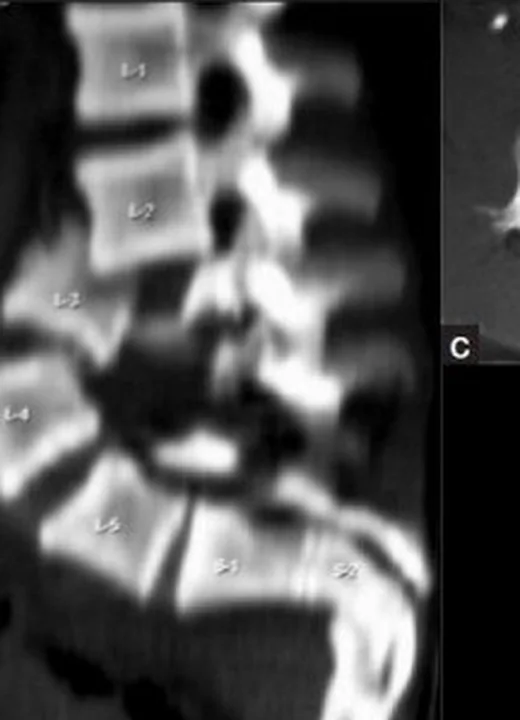
- Komşu vertebra korpuslarının arka veya yan kortekslerinde süreksiz hizalanma ve segmental basamaklanma
- Aksiyel görüntülerde bir vertebranın diğerine göre rotasyonu; spinöz çıkıntıların orta hattan sapması
- Tek ya da iki taraflı faset ekleminde örtüşme kaybı, subluksasyon veya kilitlenme
- Pedikül, lamina, faset veya spinöz çıkıntılarda çevresel kopuşu açıklayan kırık hatları
- Translasyon disk aralığından geçebilir; posterior ligamentöz kompleks ve diğer diskoligamentöz yapılar eşlik eden hasar gösterebilir.
- Kanal çapında translasyon, retropulse korpus parçası veya posterior eleman fragmanları nedeniyle daralma
- Paravertebral yumuşak dokuda hematom; komşu kaburga, pelvis veya abdominal organ yaralanması
Ölçütler ve sınıflamalar
- AO Spine torakolomber sınıflaması
- Tip C, kraniyal vertebral kolonun kaudal kolona göre herhangi bir düzlemde yer değiştirmesini veya dislokasyonunu tanımlar. Güncel AO Spine sınıflamasında C1–C3 alt tipleri yoktur; eşlik eden korpus kırığı A alt tipiyle ayrıca kodlanır. Distraksiyon ve gerilme bandı hasarı B tipi olarak tanımlanır; hiperekstansiyon kaynaklı kopuşlar da bu kategori içinde değerlendirilir.
Normalde
Normal torakolomber BT'de korpusların ön ve arka korteksleri ardışık düzgün çizgiler oluşturur; pediküller, laminalar ve spinöz çıkıntılar orta hatta simetrik dizilir. Yaralanma seviyesinde aynı kortikal hatların basamaklanmasını, fasetlerin karşılıklı eklem yüzü temasını ve kanal konturunun komşu seviyeye göre değişimini karşılaştır.
Normal BT ile kıyasla
Aynı bölgenin, kaynak veri setinde patoloji içermediği belirtilen bir BT incelemesini kesit kesit kaydırın; organ sınırlarını açarak anatomiyi hasta görüntüsüyle karşılaştırın. Küçük rastlantısal bulgular tümüyle dışlanmamıştır.
Kaynak: TotalSegmentator v2.01 veri seti (Wasserthal ve ark., Radiology: Artificial Intelligence 2023), CC BY 4.0, vaka s1338; organ sınırları veri setinin otomatik segmentasyonundan, birleştirilerek sadeleştirildi. Görüntüler 2,5 mm kesit aralığına yeniden örneklendi.
Ayırıcı tanı
- Fleksiyon-distraksiyon yaralanması
- posterior gerilme bandı hasarıyla karakterizedir; belirgin kolon yer değiştirmesi varsa AO sınıflamasında translasyonel tip C örüntüsü düşünülür.
- Rotasyonel faset subluksasyonu
- faset asimetrisi ve rotasyon ön plandadır; korpus korteksleri arasında belirgin translasyon bulunmayabilir.
- Burst kırığı
- posterior duvar fragmanı kanala ilerler, ancak üst ve alt vertebra kolonları arasında yer değiştirme eşlik etmez.
- Kronik spondilolistezis
- düzgün kortike pars defekti ve dejeneratif fasetler akut yumuşak doku şişliği olmadan izlenir.
Tuzaklar
- Tek sagittal rekonstrüksiyonda görülen hizalanma kusuru rotasyon düzleminde gizlenebilir; korpus kortekslerini aksiyel ve koronal düzlemlerde de izleyerek gerçek translasyonu doğrula.
- Kırık sonrası spontan kısmi redüksiyon, ilk yaralanmadaki yer değiştirmeyi olduğundan küçük gösterebilir; faset kilitlenmesi, disk aralığı ve çoklu posterior eleman kopuşlarını birlikte ara.
- Omurilik bulgusu olmayan hastada ağır translasyonel yaralanmayı dışlama; BT'de mekanik kopuş, nörolojik muayeneden bağımsız bir yapısal bulgudur.
Kendini dene
Yüksek enerjili travmada T12-L1 düzeyinde korpus korteksleri basamaklı, bir faset kilitli ve posterior elemanlar kopuk. En uygun morfolojik sınıf hangisi?
Cevabı göster
AO Spine tip C. Korpuslar arası translasyonla faset ve posterior eleman kopuşunun birlikteliği AO tip C yer değiştirme yaralanmasını destekler. A1 tek son plak kompresyonudur; B1 transosseöz posterior gerilme bandı hasarıdır ve dejeneratif kayma kronik kortike değişiklik gösterir.
Korpus arka duvarından kanala fragman uzanıyor; üst ve alt vertebraların kortikal hizası korunmuş. Hangi örüntü daha olası?
Cevabı göster
Burst kırığı. Posterior duvarın kanala retropulsiyonu ve kolonlar arası hizanın korunması burst kırığına uyar. Translasyonel yaralanmada komşu kolonlar yer değiştirir; izole faset çıkığı ve kronik pars defekti bu korpus fragmanını açıklamaz.
İlgili konular
Kaynaklar
Bu sayfadaki 39 cümle ve 2 quiz sorusu aşağıdaki kaynaklardan alıntılarla otomatik olarak karşılaştırıldı; 7 cümle bu karşılaştırmada düzeltildi (2026-10-09).
- Thoracolumbar Fracture Dislocations Without Spinal Cord Injury: Classification and Principles of Managementpmc.ncbi.nlm.nih.gov
- Classifying thoracolumbar fractures: role of quantitative imaging.pubmed.ncbi.nlm.nih.gov
- Does displacement of cervical and thoracolumbar dislocation-translation injuries predict spinal cord injury or recovery?pubmed.ncbi.nlm.nih.gov
- Intraoperative finding and management of complete spinal cord transection after thoracolumbar traumatic fracture-dislocation: A case report.pubmed.ncbi.nlm.nih.gov
- Acute management of spinal fractures: What you need to know.pubmed.ncbi.nlm.nih.gov
- Mechanical Instability After Civilian Thoracolumbar Gunshot Injuries: A Systematic Review to Support Classification Development.pubmed.ncbi.nlm.nih.gov
- Computed Tomography Findings and Classification of Traumatic Lumbosacral Spine Injuries: Insights from the AOSpine Classification System.pubmed.ncbi.nlm.nih.gov
- Compression fracture of the T12 vertebra combined with diaphragmatic hernia after low-energy trauma: a case report and literature review.pubmed.ncbi.nlm.nih.gov
- Emergency radiology of severe acute injury in extreme alpine summer sports: a pictorial essay.pubmed.ncbi.nlm.nih.gov
- High-energy traumatic spondyloptosis at T8-T9 with complete spinal cord injury: a case report.pubmed.ncbi.nlm.nih.gov
- Predicting neurological recovery after thoracolumbar spine trauma: The role of injury morphology and admission American Spinal Injury Association Impairment Scale grade.pubmed.ncbi.nlm.nih.gov
- Posterior-Only Vertebral Column Resection for Neglected Post-traumatic Thoracolumbar Fracture-Dislocation With Neurological Recovery: A Case Report.pubmed.ncbi.nlm.nih.gov
- The evolution of cervical spine trauma classification: a paradigm shift from morphological description to clinical decision-making.pubmed.ncbi.nlm.nih.gov
- Conservative Treatment of Pediatric Fractures-Narrative Review of Acceptable Deformity and Remodeling Potential.pubmed.ncbi.nlm.nih.gov
- Cervical Spine Pathology in the Context of Intimate Partner and Interpersonal Violence: A Case Series and Focused Narrative Review.pubmed.ncbi.nlm.nih.gov
- A Proposal for a Standardized Imaging Algorithm to Improve the Accuracy and Reliability for the Diagnosis of Thoracolumbar Posterior Ligamentous Complex Injury in Computed Tomography and Magnetic Resonance Imaging.pubmed.ncbi.nlm.nih.gov
- Imaging evaluation of traumatic thoracolumbar spine injuries: Radiological review.pubmed.ncbi.nlm.nih.gov
- Subaxial cervical spine trauma.pubmed.ncbi.nlm.nih.gov
- Post-traumatic lumbar discal fracture: A case report.pubmed.ncbi.nlm.nih.gov
- Adverse events among older adults receiving chiropractic spinal manipulation and related treatments: an updated systematic review.pubmed.ncbi.nlm.nih.gov
- Minimally Invasive Lateral Thoracic and Lumbar Interbody Fusion with Expandable Interbody Spacers for Spine Trauma-Indications, Complications and Outcomes.pubmed.ncbi.nlm.nih.gov
- Subaxial cervical spine fractures with facet joint dislocation: Surgical management, technique, and results in a retrospective series of 36 patients.pubmed.ncbi.nlm.nih.gov
- Dural tears from traumatic spinal fractures: an illustrative case and systematic review of its incidence, diagnosis, risk factors, and management.pubmed.ncbi.nlm.nih.gov
- Clinical efficacy comparison of Mazor X robot-assisted and traditional freehand techniques in the treatment of atlantoaxial fracture and dislocation.pubmed.ncbi.nlm.nih.gov
- Traumatic Bilateral Lumbosacral Jumped Facet Without Fracture in Childhood: Case Report and Systematic Review.pubmed.ncbi.nlm.nih.gov
- Complex Charcot Spine Reconstruction in a Young Paraplegic Patient: A Case Report.pubmed.ncbi.nlm.nih.gov
- Spine Trauma Classifications: Historical, Current, and Emerging Perspectives for Radiologists.pubmed.ncbi.nlm.nih.gov
- The Prone-Transpsoas Approach for Single-Position Lateral Corpectomy: A Case Series.pubmed.ncbi.nlm.nih.gov
- An Investigation of the Etiology and Pattern of Spinal Injuries Among Patients Presenting to the Emergency Department in a Tertiary Care Hospital.pubmed.ncbi.nlm.nih.gov
- Clinical Outcomes and Safety of a Triple-Modality Approach Combining Decompression, Vertebral Augmentation, and Radiotherapy for Thoracolumbar Metastatic Tumors With Neurological Involvement.pubmed.ncbi.nlm.nih.gov
- Surgical stabilization of rib fractures (SSRF): the WSES and CWIS position paper.pubmed.ncbi.nlm.nih.gov
- The 2023 WSES guidelines on the management of trauma in elderly and frail patients.pubmed.ncbi.nlm.nih.gov
- Paper template-based intraoperative rod bending for percutaneous stabilization of thoracic extension-distraction fracture: illustrative case.pubmed.ncbi.nlm.nih.gov
- MDCT Morphometry of the Thoracolumbar Junction in a Turkish Cohort: Surgical, Radiological, and Forensic Implications.pubmed.ncbi.nlm.nih.gov
- Operative Efficiency, Technical Workflow, and Perioperative Outcomes in Minimally Invasive Trans-Kambin Oblique Thoracic Interbody Fusion (MIS-OTIF): A Retrospective Clinical Analysis.pubmed.ncbi.nlm.nih.gov
- Biomaterials for vertebral body repair: interior augmentation and total replacement-a literature review of bone fusion outcomes in clinical studies.pubmed.ncbi.nlm.nih.gov
- Minimally invasive surgical techniques for the treatment of thoracolumbar burst fractures.pubmed.ncbi.nlm.nih.gov
- The AO Spine TL Injury Classification System Drives Clinical Decision Making in Acute Thoracolumbar Fractures: A Retrospective Evaluation of Clinical Implementation.pubmed.ncbi.nlm.nih.gov
- Traumatic Spine Injury in Southern Ethiopia: Falls, Delayed Presentation, and High Early Mortality at a Tertiary Referral Center.pubmed.ncbi.nlm.nih.gov
- Role of 3D Printing in Preoperative Planning for Spine Surgery: A Scoping Review.pubmed.ncbi.nlm.nih.gov
- Determining the need for stabilising therapy of cervical spine injuries on CT: towards standardising decision-making in the emergency department.pubmed.ncbi.nlm.nih.gov
- Sacral and Pelvic Fractures: Historical Systems and Advancements with the AO Spine Classification.pubmed.ncbi.nlm.nih.gov
- Agreement and discordance between the modified thoracolumbar injury classification and severity score and the thoracolumbar AOSpine injury score in guiding surgical decision-making for thoracolumbar fractures: a comparative study.pubmed.ncbi.nlm.nih.gov
- Intact Posterior Tension Band in Spinal Fractures in Patients With Spinal Ankylosing Disorders - Is it a Myth or a Reality? A Systematic Review.pubmed.ncbi.nlm.nih.gov
- Thoracolumbar Fractures: Historical Systems and Advancements With the AO Spine Classification.pubmed.ncbi.nlm.nih.gov
- Machine Learning Algorithm to Predict Change in the Decision-Making for Thoracolumbar Fractures Without Neurological Deficit After MRI: A Multicenter Study.pubmed.ncbi.nlm.nih.gov
- Association of supine apical vertebral rotation with three-dimensional deformity and global spinal alignment in adult degenerative scoliosis: a retrospective study.pubmed.ncbi.nlm.nih.gov
- Traumatic Bilateral Perched Facet of the Thoracic Spine With Associated Vertebral Fracture: A Case Report.pubmed.ncbi.nlm.nih.gov
- The AO Spine Thoracolumbar Injury Classification System and Treatment Algorithm in Decision Making for Thoracolumbar Burst Fractures Without Neurologic Deficit.pubmed.ncbi.nlm.nih.gov
- AO spine injury classification system: a revision proposal for the thoracic and lumbar spine.pubmed.ncbi.nlm.nih.gov
- Artificial intelligence in lumbar radiography: bridging deep learning and clinical practice in low-resource environments.pubmed.ncbi.nlm.nih.gov
- What's New in Osteogenesis Imperfecta.pubmed.ncbi.nlm.nih.gov
- International Society of Paediatric Surgical Oncology (IPSO) Surgical Practice Guidelines.pubmed.ncbi.nlm.nih.gov
- Anatomical and biological reconstruction of traumatic complete burst fractures of the thoracolumbar vertebrae using pedicle fixation combined with stent-armed kyphoplasty and intracorporeal bone grafting: technique rationale, 7-year experience and clinical, imaging, and histological outcomes.pubmed.ncbi.nlm.nih.gov
- Application of AUSS-TLIF for the treatment of a lumbar burst fracture: A case report.pubmed.ncbi.nlm.nih.gov
- Preoperative CT-Based Planning for Unilateral Pedicle Approach PVP Reduces Cement Leakage and Improves Radiological Outcomes in Osteoporotic Vertebral Compression Fractures: A Retrospective Cohort Study.pubmed.ncbi.nlm.nih.gov
- Abusive spinal injury: imaging and updates.pubmed.ncbi.nlm.nih.gov
- Complication rates in thoracolumbar fracture-dislocations with and without neurological injury.pubmed.ncbi.nlm.nih.gov
- Application of the pivot forward combined leveraging technique in the treatment of thoracolumbar fractures: a finite element analysis and clinical study.pubmed.ncbi.nlm.nih.gov
- Reliability and reproducibility of the modified thoracolumbar injury classification and severity score and the thoracolumbar AO spine injury score for guiding surgical decision-making in thoracolumbar fractures.pubmed.ncbi.nlm.nih.gov
- Diagnostic decision-making, vertebral augmentation, and osteoporosis therapy in vertebral compression fractures: a narrative review.pubmed.ncbi.nlm.nih.gov
- Intrabody Cage Augmentation in Kümmell Disease and Osteoporotic Burst Fractures: Technical Insights and Narrative Review of Current Evidence.pubmed.ncbi.nlm.nih.gov
- Treatment of unilateral cervical facet fractures without evidence of dislocation or subluxation: a narrative review and proposed treatment algorithm.pubmed.ncbi.nlm.nih.gov
- Clinical and Radiological Outcome of Posterior Cervical Fusion Using Philips AlluraXper FD20 Angiography Suite.pubmed.ncbi.nlm.nih.gov
- The role of radiography in the study of spinal disorders.pubmed.ncbi.nlm.nih.gov
- Magnetic Resonance Imaging for Spine Emergencies.pubmed.ncbi.nlm.nih.gov
- Subaxial cervical spine trauma: evaluation and surgical decision-making.pubmed.ncbi.nlm.nih.gov
- The development and evaluation of the subaxial injury classification scoring system for cervical spine trauma.pubmed.ncbi.nlm.nih.gov
- Mid- to long-term outcome of instrumented anterior cervical fusion for subaxial injuries.pubmed.ncbi.nlm.nih.gov
- Lower Urinary Tract Symptoms as an Indicator of Occult Neurologic Disease: A System-first Framework for Urologic Practice.pubmed.ncbi.nlm.nih.gov
- Traumatic spinal cord injury: a review of the current state of art and future directions - what do we know and where are we going?pubmed.ncbi.nlm.nih.gov
- Management of thoracolumbar spine trauma: An overview.pubmed.ncbi.nlm.nih.gov
- Defining mechanical instability in tuberculosis of the spine: a systematic review.pubmed.ncbi.nlm.nih.gov
- Classification and Radiological Diagnosis of Thoracolumbar Spine Fractures: WFNS Spine Committee Recommendations.pubmed.ncbi.nlm.nih.gov
Eğitim amaçlıdır; hasta başında tanı ve tedavi kararının yerine geçmez, tıbbi tavsiye değildir. Metinler yapay zekâ desteğiyle yazıldı ve otomatik bir adımda kaynak alıntılarıyla karşılaştırıldı; bu bir tıbbi doğrulama değildir ve içerik uzman radyolog incelemesinden geçmedi. Klinik kararlarda güncel kılavuzları, kurum protokollerini ve radyoloji raporunu esas alın.