Özet
Yüksek enerjili pelvik travmada sakral kırık çizgileri zayıflık çizgileri boyunca yayılabilir ve ortaya çıkan kırık örüntüleri nöral yapılar üzerinde baskı yaparak kauda ekuina sendromu dahil nörolojik yaralanma riski taşıyabilir. Politravma sırasında uygulanan BT, sakral kırıkların tanı ve karakterizasyonunda standarttır; kırık morfolojisini ve eşlik eden yumuşak doku yaralanmalarının uzanımını değerlendirmek için kullanılır. BT, muayenesi güvenilir olmayan hastada olası sinir basısını düşündüren yapısal daralmayı da gösterebilir, ancak sinir hasarını tek başına kanıtlamaz. Kanal ya da foramene uzanan fragmanın atlanması, nörolojik riskin ve kırık örüntüsünün eksik raporlanmasına yol açabilir.
Faz ve pencere
- Kontrastsız BT tanısal
- Kontrastsız ince kesit BT'de korteksi kesen kırık hattının sakral foramen içine girip girmediği, iç kortikal kenarda kemik parçası bulunup bulunmadığı ve fragmanın sakral kanala doğru yer değiştirip değiştirmediği aksiyel, koronal ve sagittal rekonstrüksiyonlarda izlenir. Kontrastsız BT sakral kırıkların tanı ve karakterizasyonunda standarttır ve eşlik eden yumuşak doku yaralanmalarının tip ve uzanımını da gösterir.
Önerilen pencereler G genişlik, M merkez; değerler Hounsfield birimi (HU)
- KemikG 1800 / M +400
- Yumuşak dokuG 400 / M +40
BT bulguları
- Sakral kırıkların yeri, Denis gibi sınıflandırma sistemlerinde nöral foramen ve kanal ile olan anatomik ilişkisine göre tanımlanır.
- Foramen lümenine taşan kortikal parça sinir kökü çıkış alanını daraltabilir; bu daralma BT'de değerlendirilmelidir.
- Sakral kanal içindeki kemik fragmanı ve kanal konturuna etkisi BT kemik penceresinde değerlendirilir.
- Fragmanın yönü ve yer değiştirmesi sagittal ve koronal MPR'de izlenerek yalnız aksiyel kesitte görülen parçalı görünümün gerçek uzanımı belirlenir.
- Vertikal ve transvers bileşen içeren kırık örüntüleri U veya H biçimli olabilir ve spinopelvik ayrışma ile ilişkili olabilir.
- Denis zonu kırık hattının foramen ve kanal ile ilişkisine göre verilir; zon tanımı fragmanın sinir köküne etkisini tek başına ölçmez.
- Sakroiliak eklem, iliak kanat ve anterior pelvik halka eşlik eden kırıklar bakımından taranır; sakral kırıklar pelvik halka bozulumu ile yaklaşık %40-50 oranında birliktelik gösterebilir.
- Sakral kırıkta BT'de eşlik eden pelvik halka ve yumuşak doku yaralanmalarının varlığını ve uzanımını değerlendirin.
Ölçütler ve sınıflamalar
- Denis sakral zonları
- Denis zonlaması kırık hattının yerleşim örüntüsünü tanımlar; nörolojik durum ayrıca kaydedilir.
- AO Spine sakral tip B alt tipleri
- AOSpine sakral kırık sınıflaması, kırık örüntülerini standart biçimde tanımlamak için kullanılan bir sistemdir. Denis ve AOSpine sakral kırık sınıflamaları ayrı sınıflama sistemleridir.
Normalde
BT kemik pencerede keskin kortikal kesinti kırık lehine değerlendirilir ve düzgün kortikalli varyant görünümü kırık fragmanından ayrılmalıdır.
Normal BT ile kıyasla
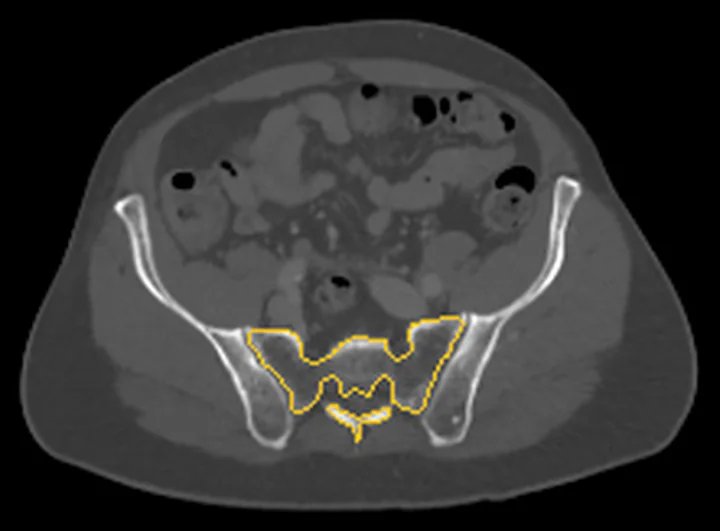
Aynı bölgenin, kaynak veri setinde patoloji içermediği belirtilen bir BT incelemesini kesit kesit kaydırın; organ sınırlarını açarak anatomiyi hasta görüntüsüyle karşılaştırın. Küçük rastlantısal bulgular tümüyle dışlanmamıştır.
Kaynak: TotalSegmentator v2.01 veri seti (Wasserthal ve ark., Radiology: Artificial Intelligence 2023), CC BY 4.0, vaka s1256; organ sınırları veri setinin otomatik segmentasyonundan, birleştirilerek sadeleştirildi. Görüntüler 2,5 mm kesit aralığına yeniden örneklendi.
Ayırıcı tanı
- Normal varyant görünüm düzgün kortikalli kenar gösterir ve keskin kırık fragmanından ayrılmalıdır.
- Sakral ala yetmezlik kırıkları, özellikle yaşlılarda zayıflamış kemik yapısı ve düşük enerjili travmayla ilişkili olabilir.
- Sakral metastazlar litik odaklar oluşturabilir ve patolojik sakral kırıkla birlikte görülebilir.
Tuzaklar
- Aksiyel kesitte küçük görünen fragmanın kraniokaudal devamını atlama; koronal ve sagittal MPR'de kanal ya da komşu foramen içine ilerleyip ilerlemediğini izle.
- Foramen içinden geçen çizgiyi otomatik olarak kanal tutulumu sayma; Denis zon II foramen düzeyidir, zon III ise kanal tarafındaki yaralanmayı tanımlar.
- İki taraflı dikey kırıkta yatay sakral bileşeni gözden kaçırmak U tipi ayrışmayı gizleyebilir; sagittal rekonstrüksiyonda S1-S2 hizasını ve deplasmanı kontrol et.
- BT'de fragmanın görülmesi klinik nörolojik defisiti kanıtlamaz; raporda anatomik basıyı ve klinikte değerlendirilecek sinir kökü/kauda ekuina durumunu ayrı ifade et.
Kendini dene
Travma BT'sinde sakral kırık hattı foramen içinden geçiyor. Hastada sedasyon nedeniyle klinik nörolojik muayene yapılamıyor. BT'nin bu durumda en değerli rolü nedir?
Cevabı göster
Sinir sıkışması veya traksiyon yaralanmasının dolaylı belirleyicisi olmak. Sedasyon/obtundasyon varken BT sinir sıkışmasının dolaylı belirleyicisidir; defisiti kesin kanıtlamaz, iletim ölçmez.
S1 forameni içinde keskin kemik parça ve kanal yönünde uzanım görülüyor. En doğru raporlama yaklaşımı hangisi?
Cevabı göster
Fragman ve kanal uzanımını tarif etmek. Zon kırık hattının yerini kodlar; fragmanın foramene/kanala uzanımı ve kanal daralması ayrıca tarif edilmelidir. BT anatomik basıyı gösterir ancak nörolojik işlev kaybının klinik muayenesinin yerini tutmaz.
İlgili konular
Kaynaklar
Bu sayfadaki 40 cümle ve 2 quiz sorusu aşağıdaki kaynaklardan alıntılarla otomatik olarak karşılaştırıldı; 11 cümle bu karşılaştırmada düzeltildi (2026-10-12).
- Medial-caudal first access strategy for safe disc-side corridor creation in unilateral biportal endoscopic surgery for lateral lumbar disc herniationpmc.ncbi.nlm.nih.gov
- Sacral Insufficiency Fracture Following L4–S1 Circumferential Fusion in Corticosteroid-associated Bone Fragility: A Case Report and Biomechanical Considerationspmc.ncbi.nlm.nih.gov
- Microendoscopic Posterior Decompression for L5–S1 Foraminal and Extraforaminal Lesions: A Comparative Study of Herniation Versus Stenosispmc.ncbi.nlm.nih.gov
- Is extension of multi-level lumbar fusion to S1 necessary in the absence of L5–S1 instability? A comparative study of selective decompression versus TLIF with S1 pedicle screw fixationpmc.ncbi.nlm.nih.gov
- Acute sacral osteomyelitis mimicking hip pathology in a child: A diagnostic challengepmc.ncbi.nlm.nih.gov
- Dental Injuries and Management.pubmed.ncbi.nlm.nih.gov
- Adipose Tissue-derived Microvascular Fragments as Vascularization Units for Dental Pulp Regeneration.pubmed.ncbi.nlm.nih.gov
- Evaluation of Torsional Resistance and Bending Stiffness of Coronal Flaring Nickel-Titanium Instruments.pubmed.ncbi.nlm.nih.gov
- Scattering and phase-contrast X-ray methods reveal damage to glass fibers in endodontic posts following dental bur trimming.pubmed.ncbi.nlm.nih.gov
- A novel translaminar crossover approach for pathologies in the lumbar hidden zone.pubmed.ncbi.nlm.nih.gov
- Isthmic spondylolisthesis treated with circumferential arthrodesis (ALIF and posterior fixation): correction, fusion and indirect decompression.pubmed.ncbi.nlm.nih.gov
- Internal carotid artery dissection following blunt head trauma: a pediatric case report and review of the literature.pubmed.ncbi.nlm.nih.gov
- Shaping and Centering Ability, Cyclic Fatigue Resistance and Fractographic Analysis of Three Thermally Treated NiTi Endodontic Instrument Systems.pubmed.ncbi.nlm.nih.gov
- The first virtual cranial endocast of a lungfish (sarcopterygii: dipnoi).pubmed.ncbi.nlm.nih.gov
- Management of a posterior gunshot injury with a floating pedicle and cerebrospinal fluid leak.pubmed.ncbi.nlm.nih.gov
- Classification of micro-CT images using 3D characterization of bone canal patterns in human osteogenesis imperfecta.pubmed.ncbi.nlm.nih.gov
- Postoperative Pain Relief With Ultrasound-Guided Dorsal Sacral Foramen Block for Foot and Ankle Surgeries.pubmed.ncbi.nlm.nih.gov
- Ultrasound-guided lumbar transforaminal injections: feasibility and validation study.pubmed.ncbi.nlm.nih.gov
- Biocompatibility and bioactivity of calcium silicate-based endodontic sealers in human dental pulp cells.pubmed.ncbi.nlm.nih.gov
- Open and Percutaneous Fixation of Traumatic Sacral Fracture-Dislocation with Spinopelvic Dissociation: Two Adolescent Cases and a Systematic Literature Review.pubmed.ncbi.nlm.nih.gov
- Sacral and Pelvic Fractures: Historical Systems and Advancements with the AO Spine Classification.pubmed.ncbi.nlm.nih.gov
- Traumatic lumbosacral instability: part 2-indications and techniques for surgical management.pubmed.ncbi.nlm.nih.gov
- Multidisciplinary management of spinal metastases: what the radiologist needs to know.pubmed.ncbi.nlm.nih.gov
- Intervertebral Disc Diseases PART 2: A Review of the Current Diagnostic and Treatment Strategies for Intervertebral Disc Disease.pubmed.ncbi.nlm.nih.gov
- Dural tears from traumatic spinal fractures: an illustrative case and systematic review of its incidence, diagnosis, risk factors, and management.pubmed.ncbi.nlm.nih.gov
- L4-sparing versus L4-L5 spinopelvic fixation in traumatic spinopelvic dissociation: A randomized controlled trial.pubmed.ncbi.nlm.nih.gov
- The evolution of cervical spine trauma classification: a paradigm shift from morphological description to clinical decision-making.pubmed.ncbi.nlm.nih.gov
- Minimally Invasive Lateral Thoracic and Lumbar Interbody Fusion with Expandable Interbody Spacers for Spine Trauma-Indications, Complications and Outcomes.pubmed.ncbi.nlm.nih.gov
- Protocol of the randomised placebo controlled pilot trial of the management of acute sciatica (SCIATICA): a feasibility study.pubmed.ncbi.nlm.nih.gov
- Long-term safety and effectiveness of the "OptEase" vena cava filter.pubmed.ncbi.nlm.nih.gov
- Staged management of a Tile C3 pelvic ring injury with bilateral sacroiliac disruption and T-shaped sacral fracture.pubmed.ncbi.nlm.nih.gov
- Neuronavigated placement of iliosacral screws in sacral fractures: an additional tool in the spine surgeon's arsenal.pubmed.ncbi.nlm.nih.gov
- A Case of U-shaped Sacral Fracture After Longstanding Spinopelvic Fixation Treated With Percutaneous Sacroiliac Joint Fusion and Iliosacral Osteosynthesis.pubmed.ncbi.nlm.nih.gov
- Minimally Invasive Surgery for the Treatment of Lumbar Spinal Stenosis: A Comprehensive Review.pubmed.ncbi.nlm.nih.gov
- Correlation of Clinical and MRI Findings With Intraoperative Findings in Lumbar Intervertebral Disc Prolapse: A Prospective Observational Study.pubmed.ncbi.nlm.nih.gov
- Far lateral lumbar disc herniation part 1: Imaging, neurophysiology and clinical features.pubmed.ncbi.nlm.nih.gov
- Imaging in spinal posterior epidural space lesions: A pictorial essay.pubmed.ncbi.nlm.nih.gov
- Preferential sacral fracture sites in fragility fractures of the pelvis type IVb and comparison of internal fixation methods: CT-based morphological mapping and finite element analysis.pubmed.ncbi.nlm.nih.gov
- Chronic pelvic insufficiency fractures and their treatment.pubmed.ncbi.nlm.nih.gov
- Surgical management strategies for unstable sacral fractures: Case series and surgical guideline.pubmed.ncbi.nlm.nih.gov
- Perfecting the pour: A novel co-axial technique with sequential injections for optimising cement delivery during sacroplasty.pubmed.ncbi.nlm.nih.gov
- Beyond Chordoma: A Comprehensive Review of Sacral Lesions.pubmed.ncbi.nlm.nih.gov
- Unveiling Primary Bone Tumors of the Spine: A Review of Essential Imaging Clues.pubmed.ncbi.nlm.nih.gov
- Giant Cell Tumor of the Sacrum: A Narrative Review of Management Challenges and Modalities.pubmed.ncbi.nlm.nih.gov
- Minimally Invasive Lumbopelvic and Transiliac-Transsacral Fixation for a Pathological Sacral Fracture Due to Metastatic Breast Cancer: A Case Report.pubmed.ncbi.nlm.nih.gov
- Imaging of Sacroiliac Pain: The Current State-of-the-Art.pubmed.ncbi.nlm.nih.gov
- Multimodality imaging features of primary mammary angiosarcoma: a case report with delayed osseous metastases.pubmed.ncbi.nlm.nih.gov
- Giant Cell Tumor of the Sacrum With Secondary Changes of an Aneurysmal Bone Cyst: A Case Report.pubmed.ncbi.nlm.nih.gov
- CT of Sacral Fractures: Classification Systems and Management.pubmed.ncbi.nlm.nih.gov
- AO spine injury classification system: a revision proposal for the thoracic and lumbar spine.pubmed.ncbi.nlm.nih.gov
- Explainable Multimodal Machine Learning Predicts 90-Day Treatment Failure in Older Patients with Fragility Fractures of the Pelvis.pubmed.ncbi.nlm.nih.gov
- Accessory Articulation of Elongated Anterior Tubercles of the Transverse Processes at C5-C6 in a Young Adult Female Patient: A Case Report.pubmed.ncbi.nlm.nih.gov
- PediLoc<sup>®</sup> blade plate yields faster consolidation rates than LCP pediatric condylar plate in distal femoral osteotomies: a retrospective comparison and description of surgical technique.pubmed.ncbi.nlm.nih.gov
- Current Evidence and Clinical Implications of Full-Endoscopic Spine Surgery for Post-Vertebroplasty Lumbar Radiculopathy: A Comprehensive Review.pubmed.ncbi.nlm.nih.gov
- Sacral dysmorphism and gender-specific variations: A CT-Based approach to safe percutaneous sacral screw placement - An ambispective study.pubmed.ncbi.nlm.nih.gov
- Minimally Invasive and Navigation-Assisted Fracture Stabilization Following Traumatic Spinopelvic Dissociation.pubmed.ncbi.nlm.nih.gov
- International Society of Paediatric Surgical Oncology (IPSO) Surgical Practice Guidelines.pubmed.ncbi.nlm.nih.gov
- Anatomy of the intraosseous arterial microvasculature of the adult lumbar vertebral body and its role in fracture healing: a literature review and historical perspective.pubmed.ncbi.nlm.nih.gov
- Medial-caudal first access strategy for safe disc-side corridor creation in unilateral biportal endoscopic surgery for lateral lumbar disc herniation.pubmed.ncbi.nlm.nih.gov
- Acute sacral osteomyelitis mimicking hip pathology in a child: A diagnostic challenge.pubmed.ncbi.nlm.nih.gov
- Is extension of multi-level lumbar fusion to S1 necessary in the absence of L5-S1 instability? A comparative study of selective decompression versus TLIF with S1 pedicle screw fixation.pubmed.ncbi.nlm.nih.gov
- Knowledge gaps in high-energy sacral fracture treatment and management.pubmed.ncbi.nlm.nih.gov
- Consensus practice guidelines on sacroiliac joint complex pain from a multispecialty, international working group.pubmed.ncbi.nlm.nih.gov
- Accuracy, complications, and outcomes of dual-pin reference frame placement in navigated minimally invasive transforaminal lumbar interbody fusion.pubmed.ncbi.nlm.nih.gov
- FRAGILITY FRACTURES OF THE SACRUM: A SILENT EPIDEMIC.pubmed.ncbi.nlm.nih.gov
- Sacral fractures: issues, challenges, solutions.pubmed.ncbi.nlm.nih.gov
- Axial Spondyloarthritis: Mimics and Pitfalls of Imaging Assessment.pubmed.ncbi.nlm.nih.gov
- Fifty Shades of PSMA-Avid Rib Lesions: A Comprehensive Review.pubmed.ncbi.nlm.nih.gov
- Spinal lesions: a comprehensive radiologic overview.pubmed.ncbi.nlm.nih.gov
- Diagnosis and Treatment of Lumbar Giant Cell Tumor of the Spine: Update on Current Management Strategies.pubmed.ncbi.nlm.nih.gov
- Radiomics in spinal research: a narrative review.pubmed.ncbi.nlm.nih.gov
- Surgically Treated Benign Bone Tumors and Tumor-like Conditions in the Pediatric Population-A 10-Year Institutional Experience.pubmed.ncbi.nlm.nih.gov
- Neurolymphomatosis: A Comprehensive Review of Clinical and Imaging Features.pubmed.ncbi.nlm.nih.gov
- Neuroimaging features of genetic syndromes associated with CNS overgrowth.pubmed.ncbi.nlm.nih.gov
- Facet Joint Syndrome: Pathophysiology, Diagnosis, and Treatment.pubmed.ncbi.nlm.nih.gov
- Delayed reduction of tile C pelvic ring injuries and evidence-based management strategies.pubmed.ncbi.nlm.nih.gov
- Biomechanical optimization of iliolumbar fixation strategies for unilateral vertical sacral fractures: Prioritizing stability-mobility balance via finite element analysis.pubmed.ncbi.nlm.nih.gov
- Pictorial Review of Paediatric Limp.pubmed.ncbi.nlm.nih.gov
- Patterns of injury and violence in Yaoundé Cameroon: an analysis of hospital data.pubmed.ncbi.nlm.nih.gov
- A positioning method for the transiliac-transsacral screw bone channel based on a manual tracing of a transparent overlay of preoperative computed tomography images in patients with pelvic fracture and a unilateral trans-sacroiliac corridor.pubmed.ncbi.nlm.nih.gov
- Fragility Fractures of the Pelvis-Current Understanding and Open Questions.pubmed.ncbi.nlm.nih.gov
- Glossary of terms for musculoskeletal radiology.pubmed.ncbi.nlm.nih.gov
- Clinical Guidelines for the Diagnosis and Treatment of Fragility Fractures of the Pelvis.pubmed.ncbi.nlm.nih.gov
- A Primer on Anatomy, Biophysics, Pathology, Imaging and Treatment of the Intervertebral Disc and the Anterior Spinal Column: The Discogenic, Intervertebral, Spinal Column (DISC) ASPN Workgroup.pubmed.ncbi.nlm.nih.gov
- Comprehensive Management of Different Types of Pelvic Fractures Through Multiple Disciplines: A Case Series.pubmed.ncbi.nlm.nih.gov
- Clinical efficacy and psychological influence of lateral rectus approach for treating pelvic fracture with lumbosacral plexus injury.pubmed.ncbi.nlm.nih.gov
- Comprehensive Orthopedic Management of an Open-Book Pelvic Fracture: A Multidisciplinary Approach in Trauma Care.pubmed.ncbi.nlm.nih.gov
- Surgical management of lumbosacral and sacral fractures: roles of the pelvic and spinal surgeons.pubmed.ncbi.nlm.nih.gov
- High-affinity alphavbeta3 integrin targeted optical probe as a new imaging biomarker for early atherosclerosis: initial studies in Watanabe rabbits.pubmed.ncbi.nlm.nih.gov
- Description and Reliability of the AOSpine Sacral Classification System.pubmed.ncbi.nlm.nih.gov
- Denis pattern-dependent biomechanical behavior of posterior trans-iliac plate fixation compared with bilateral triangular osteosynthesis in unilateral sacral fractures: a finite element study.pubmed.ncbi.nlm.nih.gov
- Intact Posterior Tension Band in Spinal Fractures in Patients With Spinal Ankylosing Disorders - Is it a Myth or a Reality? A Systematic Review.pubmed.ncbi.nlm.nih.gov
- Iatrogenic nerve injury following pelvic ring injury: a network meta-analysis.pubmed.ncbi.nlm.nih.gov
- Fracture lines and comminution zones of traumatic sacral fractures.pubmed.ncbi.nlm.nih.gov
- What Are the Key Factors of Functional Outcomes in Patients with Spinopelvic Dissociation Treated with Triangular Osteosynthesis?pubmed.ncbi.nlm.nih.gov
- Traumatic lumbosacral instability: part 1 - proposing a definition and identifying underlying injury patterns.pubmed.ncbi.nlm.nih.gov
- The Transiliac Approach: A Forgotten Alternative for Transforaminal Endoscopic Decompression at the L5-S1 Level in Patients With High Iliac Crests.pubmed.ncbi.nlm.nih.gov
- The value of magnetic resonance imaging and computed tomography in the study of spinal disorders.pubmed.ncbi.nlm.nih.gov
- Case review of 3 patients with musculoskeletal manifestation of human immunodeficiency virus and highly active antiretroviral therapy in the form of osteopenia and insufficiency fractures.pubmed.ncbi.nlm.nih.gov
- Modified spinopelvic crab-shaped fixation using offset connectors for a H-shaped sacral fracture with a floating Roy-Camille type 3 transverse component: a case report.pubmed.ncbi.nlm.nih.gov
- S1-pedicle-based triangle fixation for U-type sacral fracture: a technical note.pubmed.ncbi.nlm.nih.gov
- Biomechanical stability evaluation of isolated straddle fracture using finite element analysis.pubmed.ncbi.nlm.nih.gov
- Surgical Management of a Lateral Compression (LC)III Pelvic Ring Fracture With Type I Crescent Fracture-Dislocation: A Case Report.pubmed.ncbi.nlm.nih.gov
- Risser growth plate injury in unstable paediatric pelvic fractures: a multicentre retrospective study.pubmed.ncbi.nlm.nih.gov
- Sacral Insufficiency Fracture Following L4-S1 Circumferential Fusion in Corticosteroid-associated Bone Fragility: A Case Report and Biomechanical Considerations.pubmed.ncbi.nlm.nih.gov
- Magnetic resonance imaging of the spine.pubmed.ncbi.nlm.nih.gov
- Radiological and histological findings in ancient salt mummies from the salt mine of Douzlākh, Iran.pubmed.ncbi.nlm.nih.gov
- An International Continence Society (ICS)/ International Urogynecological Association (IUGA) joint report on the terminology for the assessment and management of obstetric pelvic floor disorders.pubmed.ncbi.nlm.nih.gov
- Robot-assisted closed reduction and navigated fixation for pelvic ring injuries: a focused narrative review of a reduction-fixation-audit framework.pubmed.ncbi.nlm.nih.gov
- Anatomy-driven automated subsegmentation of pelvic and proximal femoral CT into clinically relevant subregions and landmarks.pubmed.ncbi.nlm.nih.gov
- Recognizing Sacral Insufficiency Fractures Hidden in Plain Sight: An Illustrative Case Report.pubmed.ncbi.nlm.nih.gov
- Sacral U-Type Fractures: A Comparative Study of Treatment Approaches.pubmed.ncbi.nlm.nih.gov
- Management of a Severe L4/5 Andersson Lesion with Three-Column Instability in Ankylosing Spondylitis Using Single-Stage Circumferential Reconstruction: A Case Report.pubmed.ncbi.nlm.nih.gov
- Traumatic Spinal Cord Injury: A Contemporary Review of Classification, Evaluation, and Acute Management.pubmed.ncbi.nlm.nih.gov
- Dual-Energy Computed Tomography Virtual Noncalcium Technique in Diagnosing Osteoporosis: Correlation With Quantitative Computed Tomography.pubmed.ncbi.nlm.nih.gov
Eğitim amaçlıdır; hasta başında tanı ve tedavi kararının yerine geçmez, tıbbi tavsiye değildir. Metinler yapay zekâ desteğiyle yazıldı ve otomatik bir adımda kaynak alıntılarıyla karşılaştırıldı; bu bir tıbbi doğrulama değildir ve içerik uzman radyolog incelemesinden geçmedi. Klinik kararlarda güncel kılavuzları, kurum protokollerini ve radyoloji raporunu esas alın.