Özet
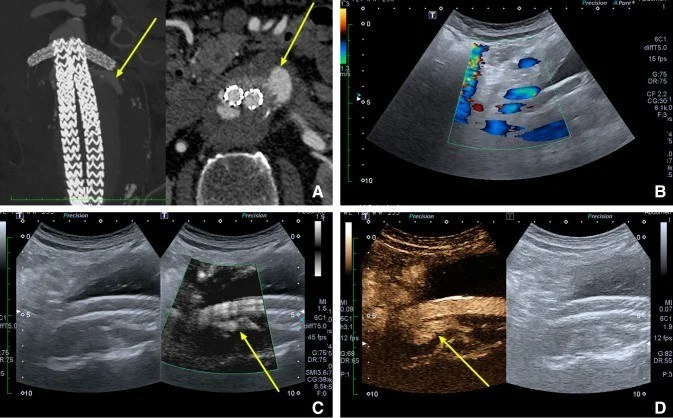
Tip I endoleak, EVAR greftinin proksimal (Ia) veya distal (Ib) tutunma zonundaki yetersiz sızdırmazlıktan kaynaklanır ve Tip Ic alt tipi ortak iliak arter/iliak oklüder düzeyindeki sızdırmazlık kaybıyla ilişkilidir. Arteriyel faz BT anjiyografi, tip I kaçağı greftin proksimal veya distal tutunma bölgesinde fokal kontrast ekstravazasyonu olarak gösterir. Tip I kaçak, dışlanan keseyi sistemik basınca doğrudan açık bırakan yüksek basınçlı bir kaçaktır ve rüptür riski yüksektir. Proksimal sızdırmazlık zonunda greft ile aort duvarı arasındaki kontrast şeridi, tip I endoleak açısından ayırıcı tanı ölçütü olarak değerlendirilmelidir.
Faz ve pencere
- Kontrastsız
- Kontrastsız BT'de endoleak kontrastı gösterilemediğinden kaçak kaynağı doğrulanamaz; endoleak saptanması ve tip ayrımı için arteriyel faz kontrastlı BT anjiyografisi gerekir.
- BTA tanısal
- Arteriyel fazda, greftin proksimal veya distal tutunma zonundan anevrizma kesesine fokal kontrast ekstravazasyonu izlenir ve kaçak bağlantı noktasında odaklanır.
- Gecikmiş
- Tip I kaçak arteriyel fazda en iyi değerlendirildiğinden, gecikmiş fazda kesede izlenen kontrastlanmanın kaynağı arteriyel faz görüntüleriyle birlikte değerlendirilir.
Önerilen pencereler G genişlik, M merkez; değerler Hounsfield birimi (HU)
- AnjiyoG 600 / M +150
- BatınG 400 / M +50
BT bulguları
- Proksimal tutunma zonu yakınındaki Ia kaçakta kontrast, greftin üst ucu ile aort duvarı arasından anevrizma kesesine geçer.
- Distal tutunma zonu yakınındaki Ib kaçakta kese opaklanması greft bacağı ile iliak arter arasındaki sızdırmazlık aralığına komşudur.
- Tip Ic, ortak iliak arter düzeyindeki yetersiz sızdırmazlıkla ilişkilidir; fenestreli veya dallı greftte bağlantı stenti ile hedef damar bağlantısı arasındaki ayrışma Tip IIIc olarak sınıflandırılır.
- Kaçak kontrastı arteriyel fazda greftin proksimal veya distal tutunma bölgesinde fokal kontrast ekstravazasyonu olarak görülür.
- Sakküler kese kontrastlanması greft bileşenlerinden uzakta yan dal komşuluğunda başlıyorsa tip II kaçağı da araştır.
- Eşlik eden morfolojik değişiklikler arasında kese çapı artışı, proksimal boyunda genişleme veya kısalma ve greft göçü değerlendirilebilir.
- Tip I endoleak eşliğinde greft çevresinde retroperitoneal hematom izlenirse rüptür olasılığı değerlendirilmelidir.
Ölçütler ve sınıflamalar
- Tip I alt grupları
- Ia: proksimal tutunma zonu; Ib: distal greft ucu; Ic: aorto-uni-iliak greftte karşı ortak iliak arter oklüderi çevresinde yetersiz tıkanma.
Normalde
Endoleaksiz EVAR'da greft lümeni arteriyel fazda opaklaşırken dışlanan anevrizma kesesi kontrast almaz ve bu durum proksimal ile distal tutunma bölgelerinde yeterli çevresel sızdırmazlığın sağlandığını gösterir. Endoleaksiz EVAR'da greft lümeni arteriyel fazda opaklaşırken dışlanan anevrizma kesesi kontrast almaz.
Normal BT ile kıyasla
Aynı bölgenin, kaynak veri setinde patoloji içermediği belirtilen bir BT incelemesini kesit kesit kaydırın; organ sınırlarını açarak anatomiyi hasta görüntüsüyle karşılaştırın. Küçük rastlantısal bulgular tümüyle dışlanmamıştır.
Kaynak: TotalSegmentator v2.01 veri seti (Wasserthal ve ark., Radiology: Artificial Intelligence 2023), CC BY 4.0, vaka s0115; organ sınırları veri setinin otomatik segmentasyonundan, birleştirilerek sadeleştirildi. Görüntüler 2,5 mm kesit aralığına yeniden örneklendi.
Ayırıcı tanı
- Tip II endoleak
- kese kontrastı lomber arter veya inferior mezenterik arterle bağlantılıdır ve çoğu kez gecikmiş fazda daha belirgindir.
- Tip III endoleak
- bileşen ayrışması veya greft kumaş kusuru yakınında doğrudan kaçak görülür; tutunma zonu sağlam olabilir.
- Greft içi normal lümen opaklanması
- kontrast greft lümeni içinde kalır ve dışlanan anevrizma kesesi arteriyel dolaşımdan çıkarılmış olarak değerlendirilir.
- Endotansiyon
- kese çapı artabilir ancak Tip I–IV endoleak'a ait kontrast geçişi gösterilemez.
- Greft artefaktı
- metal kaynaklı artefaktlar BT'de endoleak değerlendirmesini zorlaştırabilir.
Tuzaklar
- Kesedeki kontrast hemen tip II olarak etiketlenmeden önce greft tutunma bölgelerindeki doğrudan bağlantı değerlendirilmeli, tip I ile tip II ayrımı belirsizse tanısal anjiyografi veya zamansal çözünürlüğü yüksek (dinamik) BT anjiyografi ile değerlendirme yapılmalıdır.
- Proksimal greft göçü tek başına tip Ia ile eş değer değildir ve greft ucu ile aort duvarı arasındaki yeni sızdırmazlık kaybı kontrast şeridi olarak gösterilmelidir.
- Tip I endoleak açısından proksimal tutunma zonunun yeterliliğini dikkatle değerlendir.
- Kese büyümesi izlenmese bile Tip I kaçağın yüksek basınçlı bir endoleak olduğu unutulmamalıdır.
- Greft ile aort arasında proksimal sızdırmazlık zonunda kontrast şeridi görülmesi veya boyun genişlemesi ya da kısalması Tip I endoleak lehine morfolojik ölçütlerdir.
Kendini dene
EVAR sonrası arteriyel BTA'da kese, proksimal greft ucu ile aort duvarı arasından hemen opaklaşıyor. Bu kaçak tipi?
Cevabı göster
Tip I endoleak. Proksimal tutunma zonundaki kaçak tip Ia'dır ve sistemik akımı keseye doğrudan iletir. Tip II yan dallardan retrograd dolum yapar; tip III greft kusuru veya bileşen ayrışmasıyla ilişkilidir; endotansiyonda görünür kaçak saptanmaz.
Kontrastlı kese odağı distal greft bacaginin iliak duvara temas ettiği seviyede basliyor. Alt tip hangisi?
Cevabı göster
Tip Ib. Distal greft bacağı tutunma kaçağı Tip Ib'dir; Ia proksimal tutunma zonundadır, Ic ortak iliak arter düzeyiyle ilişkilidir, Tip III ise bileşen ayrışması veya kumaş kusuruna bağlıdır.
İlgili konular
Kaynaklar
Bu sayfadaki 41 cümle ve 2 quiz sorusu aşağıdaki kaynaklardan alıntılarla otomatik olarak karşılaştırıldı; 22 cümle bu karşılaştırmada düzeltildi (2026-10-12).
- Advances in endovascular repair for type A aortic dissectionpmc.ncbi.nlm.nih.gov
- Endovaskuläre Aortenreparatur bei Endoleakspmc.ncbi.nlm.nih.gov
- The Nellix endovascular aneurysm sealing system: current perspectivespmc.ncbi.nlm.nih.gov
- Evaluation of Type I endoleak after endovascular aneurysm repair for abdominal aortic aneurysm using component quantification of energy loss: a preliminary feasibility studypmc.ncbi.nlm.nih.gov
- Dual complications of type I endoleak and aorto-enteric fistula post-EVAR: A case report and review of literaturepmc.ncbi.nlm.nih.gov
- Hybrid repair of symptomatic aberrant right subclavian artery and Kommerell's diverticulum.pubmed.ncbi.nlm.nih.gov
- Comparison of outcomes with open, fenestrated, and chimney graft repair of juxtarenal aneurysms: are we ready for a paradigm shift?pubmed.ncbi.nlm.nih.gov
- Chimney Grafts in Aortic Stent Grafting: Hazardous or Useful Technique? Systematic Review of Current Data.pubmed.ncbi.nlm.nih.gov
- Extended use of endovascular aneurysm sealing: Chimneys for juxtarenal aneurysms.pubmed.ncbi.nlm.nih.gov
- Imaging After Nellix Endovascular Aneurysm Sealing: A Consensus Document.pubmed.ncbi.nlm.nih.gov
- Aorfix™ device for abdominal aortic aneurysm with challenging anatomy.pubmed.ncbi.nlm.nih.gov
- Studying the interaction of stent-grafts and treated abdominal aortic aneurysms: time to move caudally!pubmed.ncbi.nlm.nih.gov
- Complicated acute type B thoracic aortic dissections: endovascular treatment for visceral malperfusion and pseudoaneurysms.pubmed.ncbi.nlm.nih.gov
- Endostaples: are they the solution to graft migration and Type I endoleaks?pubmed.ncbi.nlm.nih.gov
- [Endovascular aortic repair of endoleaks : Diagnosis, treatment, and outcomes].pubmed.ncbi.nlm.nih.gov
- Endovascular aortic repair of infrarenal abdominal aortic dissection.pubmed.ncbi.nlm.nih.gov
- Late type IIIb endoleak after endovascular aneurysm repair: case report and review of the literature.pubmed.ncbi.nlm.nih.gov
- Systematic review with pooled data analysis reveals the need for a standardized reporting protocol including the visceral vessels during fenestrated endovascular aortic repair (FEVAR).pubmed.ncbi.nlm.nih.gov
- Mid-Term Outcomes of Late Open Conversion with Endograft Preservation for Sac Enlargement after Endovascular Abdominal Aortic Aneurysm Repair.pubmed.ncbi.nlm.nih.gov
- Case Report: Hidden danger of stiff guidewire retention: masking effect on distal sealing during EVAR.pubmed.ncbi.nlm.nih.gov
- Physician-modified endografts using an endoskeleton ePTFE platform for complex aortic aneurysms requiring a single fenestration: a proof-of-concept study.pubmed.ncbi.nlm.nih.gov
- Feasibility of Aorto-uni-iliac Endovascular Aortic Repair Using the Gore Excluder for Abdominal Aortic Aneurysm.pubmed.ncbi.nlm.nih.gov
- Dual complications of type I endoleak and aorto-enteric fistula post-EVAR: A case report and review of literature.pubmed.ncbi.nlm.nih.gov
- Acute Traumatic Aortic Injury: What the Radiologist Needs to Know.pubmed.ncbi.nlm.nih.gov
- A Pictorial Review of Current Approaches in Endoleak Imaging.pubmed.ncbi.nlm.nih.gov
- Targeting the sac or the feeders? An anatomy-driven review of contemporary embolization strategies of type II endoleaks.pubmed.ncbi.nlm.nih.gov
- Type III endoleaks following endovascular aortic repair: a case series.pubmed.ncbi.nlm.nih.gov
- Evaluation of Type I endoleak after endovascular aneurysm repair for abdominal aortic aneurysm using component quantification of energy loss: a preliminary feasibility study.pubmed.ncbi.nlm.nih.gov
- Impact of Preoperative Image Sharing and Anatomical Suitability on EVAR Outcomes for Ruptured Abdominal Aortic Aneurysm.pubmed.ncbi.nlm.nih.gov
- Clinical and Imaging Features of Aortic Penetrating Atherosclerotic Ulcers: A Systematic Review and Meta-Analysis.pubmed.ncbi.nlm.nih.gov
- Spectral Computed Tomography Angiography in Visceral Artery Aneurysms: Technical Principles and Clinical Applications.pubmed.ncbi.nlm.nih.gov
- Review of Clinical Applications of Dual-Energy CT in Patients after Endovascular Aortic Repair.pubmed.ncbi.nlm.nih.gov
- Automatic Segmentation of Intraluminal Thrombus in Abdominal Aortic Aneurysms Based on CT Images: A Comprehensive Review of Deep Learning-Based Methods.pubmed.ncbi.nlm.nih.gov
- Photon-Counting Computed Tomography (PCCT): Technical Background and Cardio-Vascular Applications.pubmed.ncbi.nlm.nih.gov
- Multimodal imaging of acquired aortic diseases: clinical efficacy, comparative analysis, and future perspectives.pubmed.ncbi.nlm.nih.gov
- Proximal infolding of an Endurant II endograft for barrel-shaped neck: A rare but treatable complication with proximal cuff and coil embolization.pubmed.ncbi.nlm.nih.gov
- Patient-specific static and dynamic 3D-printed models for planning endovascular repair of complex aortic disease with physician-modified stent grafts.pubmed.ncbi.nlm.nih.gov
- Endovascular management of a spontaneous aorto-caval fistula resulting from abdominal aortic aneurysm: case report and literature review.pubmed.ncbi.nlm.nih.gov
- CIRSE Standards of Practice on Management of Endoleaks Following Endovascular Aneurysm Repair.pubmed.ncbi.nlm.nih.gov
- CT angiography for the assessment of EVAR complications: a pictorial review.pubmed.ncbi.nlm.nih.gov
- Prognostic value of a non-contrast CT-based radiomics model in patients with Type-B aortic dissection after thoracic endovascular aortic repair.pubmed.ncbi.nlm.nih.gov
- Cinematic rendering in CT angiography: a pictorial review of clinical applications.pubmed.ncbi.nlm.nih.gov
- Artificial Intelligence CT Texture Radiomics for Outcome Prediction After EVAR: A Narrative Review.pubmed.ncbi.nlm.nih.gov
- Identification and endovascular treatment of a rare deep circumflex iliac artery-L3 lumbar artery anastomosis causing type II aortic aneurysm endoleak.pubmed.ncbi.nlm.nih.gov
- Laparoscopic Clipping of the Inferior Mesenteric Artery for the Treatment of Type II Endoleak Using Intra-operative Indocyanine Green Fluorescence Angiography.pubmed.ncbi.nlm.nih.gov
- Pathogenesis, Diagnosis, and Clinical Management of Aortic Aneurysms: Current Status and Future Perspectives.pubmed.ncbi.nlm.nih.gov
- Long-Term Outcomes of Stent Relining for the Management of High-Pressure Endoleaks With Progressive Sac Expansion After Endovascular Aneurysm Repair (EVAR).pubmed.ncbi.nlm.nih.gov
- Dual-Source Photon-Counting Computed Tomography-Part III: Clinical Overview of Vascular Applications beyond Cardiac and Neuro Imaging.pubmed.ncbi.nlm.nih.gov
- Mechanisms of aortic dissection: From pathological changes to experimental and <i>in silico</i> models.pubmed.ncbi.nlm.nih.gov
- Long-term safety and effectiveness of the "OptEase" vena cava filter.pubmed.ncbi.nlm.nih.gov
- Aortoileal fistula following endovascular repair of an abdominal aortic aneurysm: a case report.pubmed.ncbi.nlm.nih.gov
- Vasa Vasorum-A Silent Enemy After EVAR: A Case Report and Review of the Literature.pubmed.ncbi.nlm.nih.gov
- Endovascular repair for complicated Azzizadeh Grade III blunt traumatic aortic injury: a single-center cohort study of thoracic injuries with a separate abdominal subgroup.pubmed.ncbi.nlm.nih.gov
- Outcomes of Physician-Modified Endografts for Juxtarenal and Pararenal Abdominal Aortic Aneurysms: A Systematic Review and Single-Arm Meta-Analysis.pubmed.ncbi.nlm.nih.gov
- Clinical Imaging and Innovations in Aortic Aneurysm and Dissection.pubmed.ncbi.nlm.nih.gov
- Contrast-enhanced ultrasound versus CT angiography for endoleak detection after EVAR: a reference-standard-aware systematic review and meta-analysis.pubmed.ncbi.nlm.nih.gov
- An Overview of the Diagnostic and Treatment Strategies for Aortic Disease.pubmed.ncbi.nlm.nih.gov
- Brazilian Society for Angiology and Vascular Surgery guidelines on abdominal aortic aneurysm.pubmed.ncbi.nlm.nih.gov
- Radiation Dose Reduction Opportunities in Vascular Imaging.pubmed.ncbi.nlm.nih.gov
- Ultrasonography for endoleak detection after endoluminal abdominal aortic aneurysm repair.pubmed.ncbi.nlm.nih.gov
- Patterns of injury and violence in Yaoundé Cameroon: an analysis of hospital data.pubmed.ncbi.nlm.nih.gov
- Adjunctive embolization of target vessel dissections to improve suitability for fenestrated-branched endovascular aortic repair.pubmed.ncbi.nlm.nih.gov
- Early Outcomes of a Curvature-Guided Strategy for Dual-Branch Revascularization in Zone 1 TEVAR.pubmed.ncbi.nlm.nih.gov
- Visceral segment interrupted constraining suture in physician-modified endografts for dissecting thoracoabdominal aortic aneurysms.pubmed.ncbi.nlm.nih.gov
- When Endovascular Interventions for Endoleaks Fail.pubmed.ncbi.nlm.nih.gov
- A Scoping Review on the Incidence, Risk Factors, and Outcomes of Proximal Neck Dilatation after Standard and Complex Endovascular Repair for Abdominal Aortic Aneurysms.pubmed.ncbi.nlm.nih.gov
- Endograft position and endoleak detection after endovascular abdominal aortic repair with low-field tiltable MRI: a feasibility study.pubmed.ncbi.nlm.nih.gov
- Multimodality imaging and 3D-printing of a thoraco-abdominal aortic aneurysm eroding into the spine.pubmed.ncbi.nlm.nih.gov
- Pseudoendoleak: A post-endovascular aortic repair ultrasound surveillance pitfall - Single institution case series.pubmed.ncbi.nlm.nih.gov
- Post-EVAR Endoleaks: A Morphovolumetric Approach to Prediction, Surveillance, and Management.pubmed.ncbi.nlm.nih.gov
- The Role of Dynamic Computed Tomography Angiography in Endoleak Detection and Classification After Endovascular Aneurysm Repair: A Comprehensive Review.pubmed.ncbi.nlm.nih.gov
- Management of Non-A Non-B Aortic Dissection: A Narrative Review.pubmed.ncbi.nlm.nih.gov
- Medical Radiology: Current Progress.pubmed.ncbi.nlm.nih.gov
- Procedural Software Toolkit in the Armamentarium of Interventional Therapies: A Review of Additive Usefulness and Current Evidence.pubmed.ncbi.nlm.nih.gov
- Post-TEVAR type IA endoleak caused hemoptysis in a case of mid-thoracic aortic saccular aneurysm.pubmed.ncbi.nlm.nih.gov
- Safety and Feasibility of In Situ Fenestration in the Aortic Arch: A Prospective Single-Center Observational Cohort Study.pubmed.ncbi.nlm.nih.gov
- Management of Late TEVAR Migration Using a Novel Branched Endograft: First Western Experience.pubmed.ncbi.nlm.nih.gov
- Re-Do Endovascular Endoleak Embolization by Transprosthetic Puncture After Endovascular Aneurysm Repair.pubmed.ncbi.nlm.nih.gov
- Atherosclerotic Abdominal Aortic Aneurysms on Computed Tomography Angiography: A Narrative Review on Spectrum of Findings, Structured Reporting, Treatment, Secondary Complications and Differential Diagnosis.pubmed.ncbi.nlm.nih.gov
- Long-Term Outcomes in Patients Managed with the Endurant TM Endograft under Elective Setting.pubmed.ncbi.nlm.nih.gov
- Chronic Periaortitis After Endovascular Aneurysm Repair Revealing Graft-Associated <i>Listeria monocytogenes</i> Infection Diagnosed by Multimodal Imaging and Invasive Sampling: A Case Report.pubmed.ncbi.nlm.nih.gov
- Thoracic Trauma: Aortic Injuries.pubmed.ncbi.nlm.nih.gov
- Pictorial review on the endovascular management of paediatric aortic injuries.pubmed.ncbi.nlm.nih.gov
- SCMR Position Paper (2020) on clinical indications for cardiovascular magnetic resonance.pubmed.ncbi.nlm.nih.gov
- Surveillance Imaging following Endovascular Aneurysm Repair: State of the Art.pubmed.ncbi.nlm.nih.gov
- Surveillance Imaging Following Endovascular Aneurysm Repair.pubmed.ncbi.nlm.nih.gov
- Early single-centre experience with physician-modified and Najuta fenestrated endografts for aortic arch disease: technical considerations and bailout strategies.pubmed.ncbi.nlm.nih.gov
- Prevalence, causes, management strategies, and outcomes of secondary interventions during long-term follow-up after endovascular aneurysm repair: a retrospective cohort study.pubmed.ncbi.nlm.nih.gov
- Emergency endovascular repair of blunt thoracic aortic injury-related pseudoaneurysm using a castor single-branched stent graft: a case report and literature review.pubmed.ncbi.nlm.nih.gov
- Comparative Evaluation of Clinical Outcomes Following Endovascular and Hybrid Repair of Aortic Arch Aneurysms.pubmed.ncbi.nlm.nih.gov
- Patient-specific digital twins in aortic disease: integrating computational hemodynamics, immune profiling, and precision endovascular strategy.pubmed.ncbi.nlm.nih.gov
- AI-driven decision making for intravascular device selection in aortic disease. Current insights and prospects.pubmed.ncbi.nlm.nih.gov
- Long-Term Outcomes of the Aorfix™ Stent Graft in Japanese Patients with Severely Angulated Aortic Necks: A Single-Center Retrospective Study.pubmed.ncbi.nlm.nih.gov
- Diagnostic accuracy of contrast-enhanced ultrasound versus duplex ultrasound and computed tomography angiography for endoleak detection after EVAR: a prospective comparative study.pubmed.ncbi.nlm.nih.gov
- Early Outcome of Elective and Emergent Endovascular Aortic Repair with the Minos<sup>TM</sup> Abdominal Aortic Stent-Graft.pubmed.ncbi.nlm.nih.gov
- Imaging in Interventional Radiology: Applications of Contrast-Enhanced Ultrasound.pubmed.ncbi.nlm.nih.gov
- Minimum Core Data Elements for Evaluation of Thoracic Aortic Disease.pubmed.ncbi.nlm.nih.gov
- Physician-modified fenestrated/inner-branched endovascular aortic repair for distal aortic arch aneurysm after stent graft migration: a case report.pubmed.ncbi.nlm.nih.gov
- Clinically silent early proximal seal failure with suspected interval distal endograft displacement after hybrid zone 2 thoracic endovascular aortic repair in severe arch tortuosity: a case report with 1-year follow-up.pubmed.ncbi.nlm.nih.gov
- Limited culprit-vessel reperfusion before endovascular aneurysm repair for ruptured abdominal aortic aneurysm with concurrent inferior ST-segment elevation myocardial infarction.pubmed.ncbi.nlm.nih.gov
- Infected aortic aneurysm with rupture due to <i>Streptococcus equi</i> infection: A case report and review of literature.pubmed.ncbi.nlm.nih.gov
- Physician modification of a thoracoabdominal branch endoprosthesis into a shortened unibody branched device.pubmed.ncbi.nlm.nih.gov
- Computed Tomography Imaging of Thoracic Aortic Surgery: Distinguishing Life-Saving Repairs from Life-Threatening Complications.pubmed.ncbi.nlm.nih.gov
- Cross-sectional imaging of aortic infections.pubmed.ncbi.nlm.nih.gov
- Preoperative Abdominal Aortic Aneurysm Diameter Is Associated with Long-Term Durability After Endovascular Aortic Aneurysm Repair: A Multicenter Real-World Italian Cohort Study.pubmed.ncbi.nlm.nih.gov
- Application of radiomics in abdominal aortic aneurysm and endovascular aneurysm repair-related adverse events imaging: a systematic review.pubmed.ncbi.nlm.nih.gov
- Controversies in contrast-enhanced ultrasound (CEUS): pregnancy, paediatric, abdominal trauma, complex renal cysts, and endovascular aortic repair follow-up.pubmed.ncbi.nlm.nih.gov
- Three-year outcomes of endovascular repair of descending thoracic aortic lesions with a single-branched endograft for left subclavian artery preservation.pubmed.ncbi.nlm.nih.gov
- Early Outcomes of Zone 2 Thoracic Endovascular Aortic Repair with an Integrated Branch Stent Graft for the Left Subclavian Artery: Evidence from a Western Centre.pubmed.ncbi.nlm.nih.gov
- Evolution of Sac Filling Techniques and Concepts in Endovascular Treatment of Abdominal Aortic Aneurysm: A Narrative Review.pubmed.ncbi.nlm.nih.gov
- Procedural Complexity and Clinical Outcomes of Contemporary Iliac Branch Device Implantation Versus Internal Iliac Artery Embolization During Endovascular Repair of Aotoiliac Artery Aneurysms.pubmed.ncbi.nlm.nih.gov
- Dedicated Single-Branch Platforms for Totally Endovascular Zone 2 TEVAR with LSA Revascularization: A Comparison of Castor/Cratos and Gore TAG Thoracic Branch Endoprosthesis.pubmed.ncbi.nlm.nih.gov
- Enhancing image quality in computed tomography angiography follow-ups after endovascular aneurysm repair: a comparative study of reconstruction techniques.pubmed.ncbi.nlm.nih.gov
- Ensuring Reproducibility in Endovascular Aneurysm Repair: Clinical Impact of Prophylactic Branch Embolization in a Low-Volume Setting.pubmed.ncbi.nlm.nih.gov
- Clinical outcomes of external fenestration TEVAR in Stanford type B aortic dissection involving the left subclavian artery: a retrospective study.pubmed.ncbi.nlm.nih.gov
Eğitim amaçlıdır; hasta başında tanı ve tedavi kararının yerine geçmez, tıbbi tavsiye değildir. Metinler yapay zekâ desteğiyle yazıldı ve otomatik bir adımda kaynak alıntılarıyla karşılaştırıldı; bu bir tıbbi doğrulama değildir ve içerik uzman radyolog incelemesinden geçmedi. Klinik kararlarda güncel kılavuzları, kurum protokollerini ve radyoloji raporunu esas alın.