Özet
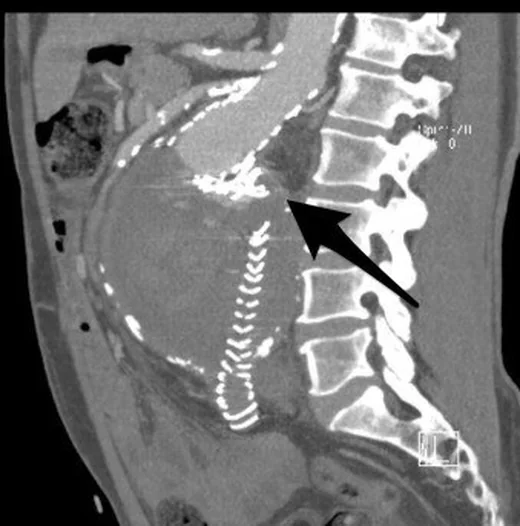
Tip III endoleak, greft bileşenlerinin ayrışması, yetersiz örtüşmesi veya greft materyalindeki kusur nedeniyle anevrizma kesesi ile arteriyel sistem arasında doğrudan bağlantı oluşmasıdır; keseyi sistemik basınca maruz bıraktığı için yüksek riskli kabul edilir. Tip IIIb bazı olgularda Tip II'yi taklit edebilir; kuşkulu kaynaklarda zaman çözünürlüklü BTA kaçak odağını belirlemeye yardımcı olabilir.
Faz ve pencere
- Kontrastsız
- Greft modüllerinin konumu, örtüşmesi, metal halkalar, anevrizma kesesi çapı ve olası hematom başlangıç kıyası için görülür; aktif kese dolumunu göstermez.
- BTA tanısal
- Arteriyel fazda greft bileşen birleşimi, gövde-bacak ayrımı veya kumaş kusuru yakınında keseye doğrudan kontrast kaçağı görülür; kaçak kontrastı erken ve greft lümenine yakın yoğunlukta olabilir.
- Gecikmiş
- Tip IIIb endoleak kontrastlı BT'de Tip II olarak yanlış sınıflandırılabilir; zaman çözünürlüklü BTA, kaçak odağını göstermeye yardımcı olabilir.
Önerilen pencereler: Anjiyo (G 600 / M 150), Batın (G 400 / M 50).
BT bulguları
- Tip IIIa kaçakta modüler greft parçaları arasındaki bağlantı ayrışır; bileşen uçları arasında anormal aralık veya örtüşme kaybı görülebilir.
- Tip IIIb, greft kumaşındaki yırtık veya defektten anevrizma kesesine doğrudan kaçak gelişmesidir; eşlik eden stent kırığı greft bütünlüğü bozulmasını destekleyebilir.
- Fenestralı veya dallı greftte hedef damar stenti ile ana gövde arasındaki birleşim ayrışması Tip IIIc kaçağa yol açabilir.
- Kese kontrastı arteriyel fazda erken belirir ve greft lümeniyle benzer atenüasyonda olabilir.
- Kaçak odağı çoğu kez greft bifurkasyonu veya modüler birleşime yakın yerleşir; ince aksiyel kesitler kadar koronal ve sagittal rekonstrüksiyonlar da gereklidir.
- Önceki BTA ile gövde-bacak bileşenlerinin örtüşme uzunluğu, konumu ve greft bütünlüğündeki değişim kıyaslanır.
- Anevrizma kesesi çapında artış ve greft konum değişikliği eşlik edebilir; çap değişmemiş olsa bile görünür tip III kaçak ayrıca tanımlanır.
- Perigraft yüksek dansiteli kan, retroperitoneal hematom veya kese konturunda ani değişiklik eşlik ederse rüptür bulguları araştırılır.
- Alt tiplerde Tip IIIa bileşen ayrışmasını, Tip IIIb greft kumaşı yırtığı veya stent kırığını ifade eder; fenestralı ya da dallı greftlerde hedef damar köprü stentlerinin ayrışması, kırılması veya kumaş yırtığıyla ilişkili Tip IIIB/IIIC kaçaklar bildirilmiştir.
Ölçütler ve sınıflamalar
- Tip III alt grupları
- IIIa: modüler bileşenlerin ayrışması; IIIb: greft kumaşında yırtık veya greft materyalinde stent kırığı; IIIc: fenestralı ya da dallı greftlerde hedef damar köprü stentlerinin ayrışması, kırılması veya kumaş kusuruyla ilişkili kaçak.
Normalde
Normal EVAR incelemesinde modüler parçalar tasarlanan biçimde örtüşür, greft kumaşı çevresinde keseye kontrast geçişi olmaz ve dışlanan kese opaklaşmaz. Aksiyel görüntülerde bileşen aralığını bulduktan sonra koronal ve sagittal planda örtüşme sürekliliğini, greft bütünlüğünü ve kese ile doğrudan kontrast bağlantısını karşılaştır.
Normal BT ile kıyasla
Aynı bölgenin, kaynak veri setinde patoloji içermediği belirtilen bir BT incelemesini kesit kesit kaydırın; organ sınırlarını açarak anatomiyi hasta görüntüsüyle karşılaştırın. Küçük rastlantısal bulgular tümüyle dışlanmamıştır.
Kaynak: TotalSegmentator v2.01 veri seti (Wasserthal ve ark., Radiology: Artificial Intelligence 2023), CC BY 4.0, vaka s0115; organ sınırları veri setinin otomatik segmentasyonundan, birleştirilerek sadeleştirildi. Görüntüler 2,5 mm kesit aralığına yeniden örneklendi.
Ayırıcı tanı
- Tip I endoleak da Tip III gibi yüksek basınçlı kabul edilir ve rüptür riski taşır.
- Tip II endoleak lomber arterlerden kaynaklanabilir; bir olguda bilateral L4 lomber arterler kaçağın giriş ve çıkış damarları olarak gösterilmiştir.
- Tip IV endoleak, endoleak sınıflamasında ayrı özellikleri tanımlanan beş tipten biridir.
- Endotansiyon
- kese genişler fakat mevcut görüntüleme kontrastlı endoleak kaynağı göstermez; tip III'te greft içinden keseye akım odağı bulunur.
- Greft metal artefaktı
- çizgisel yalancı defektler yapabilir; gerçek kontrast kaçağı damar lümeniyle devam eder ve komşu kesitlerde sürer.
Tuzaklar
- Gövde-bacak örtüşmesini tek aksiyel kesitten değerlendirip ayrışmayı kaçırma; bileşen ilişkisini koronal ve sagittal rekonstrüksiyonlarda izle.
- Greft gövdesindeki bir Tip III kaçak, kontrastlı BT'de Tip II endoleak olarak yanlış sınıflandırılabilir; şüpheli durumda zaman çözünürlüklü BT anjiyografiyle kaçak kaynağını araştır.
- Metal kaynaklı çizgilenmeyi kumaş yırtığı olarak adlandırma; kontrast odağının greft dışına taşan ve keseye ulaşan devamlılığını farklı düzlemlerde doğrula.
- Kese çapı stabil diye tip III kaçağı göz ardı etme; görünür kaçak ve greft bütünlüğü, seri çap ölçümünden ayrı bulgulardır.
- Tip IIIb endoleakler, greft kumaşı defektleri çok küçük olduğunda veya aralıklı kaçak yaptığında başka endoleak tiplerini taklit edebilir.
Kendini dene
BTA'da greft bileşenleri arasındaki örtüşme bölgesinde ayrışma ve kesede kontrast dolumu görülüyor. Tanı?
Cevabı göster
Tip IIIa endoleak. Modüler bileşenlerin ayrışması tip IIIa kaçağı tanımlar; tip III kaçaklar arteriyel sistem ile anevrizma kesesi arasında doğrudan bağlantı oluşturabilir. Tip I ve III yüksek basınçlı kaçaklardır; Tip II ise lomber gibi yan dallardan retrograd akışla gelişir.
Tip IIIb endoleak hangi greft kusuruyla tanımlanır?
Cevabı göster
Greft kumaşında yırtık veya greft materyalinde stent kırığı. Tip IIIb, greft kumaşındaki yırtık veya greft materyalindeki stent kırığı olarak sınıflandırılır.
İlgili konular
Kaynaklar
Bu sayfadaki 39 cümle ve 2 quiz sorusu aşağıdaki kaynaklardan alıntılarla otomatik olarak karşılaştırıldı; 11 cümle bu karşılaştırmada düzeltildi (2026-10-09).
- Endovascular repair of a common hepatic artery aneurysm using overlapping self-expanding covered stent graftspmc.ncbi.nlm.nih.gov
- Re-intervention for type III endoleak after endovascular aneurysm repair with an ALTO stent graft: a case descriptionpmc.ncbi.nlm.nih.gov
- Type III endoleaks following endovascular aortic repair: a case seriespmc.ncbi.nlm.nih.gov
- AFX catheter retention with type III endoleakpmc.ncbi.nlm.nih.gov
- Endovascular salvage of a dislodged renal bridging stent using balloon-induced foreshortening following thoracoabdominal multibranch endograftpmc.ncbi.nlm.nih.gov
- Mid-Term Outcomes of Late Open Conversion with Endograft Preservation for Sac Enlargement after Endovascular Abdominal Aortic Aneurysm Repair.pubmed.ncbi.nlm.nih.gov
- Urgent Relining of a Fenestrated Stent-Graft for Symptomatic Type V TAAA due to Late Type IIIB and IIIC Endoleaks in a Patient With Marfan Syndrome Case Report and Literature Review.pubmed.ncbi.nlm.nih.gov
- Short-term outcomes of endovascular aortic aneurysm repair with the new Braile Biomédica® total custom-made abdominal endograft: Experience from three Italian centers.pubmed.ncbi.nlm.nih.gov
- Geometry and respiratory-induced deformation of abdominal branch vessels and stents after complex endovascular aneurysm repair.pubmed.ncbi.nlm.nih.gov
- Fenestrated or branched endovascular aortic repair for postdissection thoracoabdominal aortic aneurysm.pubmed.ncbi.nlm.nih.gov
- Endovascular Treatment of Aorto-Iliac-Femoral Anastomotic Pseudoaneurysms: A Multicentric Study.pubmed.ncbi.nlm.nih.gov
- Computational analysis of stresses acting on intermodular junctions in thoracic aortic endografts.pubmed.ncbi.nlm.nih.gov
- Outcomes of thoracic endovascular aortic repair using aortic arch chimney stents in high-risk patients.pubmed.ncbi.nlm.nih.gov
- Endovascular repair of thoracoabdominal aortic aneurysms.pubmed.ncbi.nlm.nih.gov
- Endovascular treatment options for complex abdominal aortic aneurysms.pubmed.ncbi.nlm.nih.gov
- Geometric and hemodynamic analysis of fenestrated and multibranched aortic endografts.pubmed.ncbi.nlm.nih.gov
- Evaluation of the Zenith low-profile abdominal aortic aneurysm stent graft.pubmed.ncbi.nlm.nih.gov
- AnacondaTM: the Italian Registry. Study protocol and preliminary perioperative results.pubmed.ncbi.nlm.nih.gov
- [Endovascular aneurysm repair in high-surgical-risk abdominal aortic aneurysm patients: initial and long-term results].pubmed.ncbi.nlm.nih.gov
- Type III endoleaks following endovascular aortic repair: a case series.pubmed.ncbi.nlm.nih.gov
- Clinical Imaging and Innovations in Aortic Aneurysm and Dissection.pubmed.ncbi.nlm.nih.gov
- CIRSE Standards of Practice on Management of Endoleaks Following Endovascular Aneurysm Repair.pubmed.ncbi.nlm.nih.gov
- Impact of Preoperative Image Sharing and Anatomical Suitability on EVAR Outcomes for Ruptured Abdominal Aortic Aneurysm.pubmed.ncbi.nlm.nih.gov
- Visceral artery aneurysms: a literature review of etiology, natural history, diagnosis and treatment paradigms.pubmed.ncbi.nlm.nih.gov
- Ferumoxytol-enhanced magnetic resonance angiography for endovascular aortic repair surveillance in a patient after renal transplant.pubmed.ncbi.nlm.nih.gov
- Non-pulmonary postoperative complications of cardiothoracic surgery.pubmed.ncbi.nlm.nih.gov
- CT angiography for the assessment of EVAR complications: a pictorial review.pubmed.ncbi.nlm.nih.gov
- MDCT Imaging of Non-Traumatic Thoracic Aortic Emergencies and Its Impact on Diagnosis and Management-A Reappraisal.pubmed.ncbi.nlm.nih.gov
- Unveiling the next generation of MRI contrast agents: current insights and perspectives on ferumoxytol-enhanced MRI.pubmed.ncbi.nlm.nih.gov
- Case report: Type IIIa endoleak due to disconnection of AFX2 and the Endurant aortic extension cuff after endovascular aneurysm repair.pubmed.ncbi.nlm.nih.gov
- Exploring Type IIIb Endoleaks: A Literature Review to Identify Possible Physical Mechanisms and Implications.pubmed.ncbi.nlm.nih.gov
- Rupture of Abdominal Aortic Aneurysm Caused by Combined Type IIIb and Type Ia Endoleak with the Endurant II Endograft: A Case Report.pubmed.ncbi.nlm.nih.gov
- Gastrointestinal complications and visceral circulation changes after intentional celiac artery embolization during complex endovascular aortic repair.pubmed.ncbi.nlm.nih.gov
- Long-term safety and effectiveness of the "OptEase" vena cava filter.pubmed.ncbi.nlm.nih.gov
- Artificial Intelligence for Computer-Aided Detection in Endovascular Interventions: Clinical Applications, Validation, and Translational Perspectives.pubmed.ncbi.nlm.nih.gov
- Aorta unveiled: the crucial role of imaging in diagnosing and managing aortic disease-a review.pubmed.ncbi.nlm.nih.gov
- The Role of Dynamic Computed Tomography Angiography in Endoleak Detection and Classification After Endovascular Aneurysm Repair: A Comprehensive Review.pubmed.ncbi.nlm.nih.gov
- Hybrid Open and Endovascular Repair in Pararenal Abdominal Aortic Pseudoaneurysm-Literature Review and Case Presentation.pubmed.ncbi.nlm.nih.gov
- Non-A Non-B Acute Aortic Dissection: Is There Some Confusion in the Radiologist's Mind?pubmed.ncbi.nlm.nih.gov
- Image fusion guidance for left subclavian artery in situ fenestration during thoracic endovascular repair.pubmed.ncbi.nlm.nih.gov
- Physician-modified endografts using an endoskeleton ePTFE platform for complex aortic aneurysms requiring a single fenestration: a proof-of-concept study.pubmed.ncbi.nlm.nih.gov
- Clinically silent early proximal seal failure with suspected interval distal endograft displacement after hybrid zone 2 thoracic endovascular aortic repair in severe arch tortuosity: a case report with 1-year follow-up.pubmed.ncbi.nlm.nih.gov
- Dedicated Single-Branch Platforms for Totally Endovascular Zone 2 TEVAR with LSA Revascularization: A Comparison of Castor/Cratos and Gore TAG Thoracic Branch Endoprosthesis.pubmed.ncbi.nlm.nih.gov
- Prevalence, causes, management strategies, and outcomes of secondary interventions during long-term follow-up after endovascular aneurysm repair: a retrospective cohort study.pubmed.ncbi.nlm.nih.gov
- Post-EVAR Endoleaks: A Morphovolumetric Approach to Prediction, Surveillance, and Management.pubmed.ncbi.nlm.nih.gov
- Duodenal imaging on the spotlight: from A to Z.pubmed.ncbi.nlm.nih.gov
- 2022 ACC/AHA guideline for the diagnosis and management of aortic disease: A report of the American Heart Association/American College of Cardiology Joint Committee on Clinical Practice Guidelines.pubmed.ncbi.nlm.nih.gov
- 2022 ACC/AHA Guideline for the Diagnosis and Management of Aortic Disease: A Report of the American Heart Association/American College of Cardiology Joint Committee on Clinical Practice Guidelines.pubmed.ncbi.nlm.nih.gov
- Pathogenesis, Diagnosis, and Clinical Management of Aortic Aneurysms: Current Status and Future Perspectives.pubmed.ncbi.nlm.nih.gov
- Automatic Segmentation of Intraluminal Thrombus in Abdominal Aortic Aneurysms Based on CT Images: A Comprehensive Review of Deep Learning-Based Methods.pubmed.ncbi.nlm.nih.gov
- Emphysematous conditions of the abdomen and pelvis: pearls and pitfalls.pubmed.ncbi.nlm.nih.gov
- A multidisciplinary approach: Case report of an abdominal aortic aneurysm with type IIIA endoleak in the setting of cholangitis.pubmed.ncbi.nlm.nih.gov
- Surveillance Imaging following Endovascular Aneurysm Repair: State of the Art.pubmed.ncbi.nlm.nih.gov
- Case Report: Hidden danger of stiff guidewire retention: masking effect on distal sealing during EVAR.pubmed.ncbi.nlm.nih.gov
- Computed Tomography Imaging of Thoracic Aortic Surgery: Distinguishing Life-Saving Repairs from Life-Threatening Complications.pubmed.ncbi.nlm.nih.gov
- Atherosclerotic Abdominal Aortic Aneurysms on Computed Tomography Angiography: A Narrative Review on Spectrum of Findings, Structured Reporting, Treatment, Secondary Complications and Differential Diagnosis.pubmed.ncbi.nlm.nih.gov
- Targeting the sac or the feeders? An anatomy-driven review of contemporary embolization strategies of type II endoleaks.pubmed.ncbi.nlm.nih.gov
- Identification and endovascular treatment of a rare deep circumflex iliac artery-L3 lumbar artery anastomosis causing type II aortic aneurysm endoleak.pubmed.ncbi.nlm.nih.gov
- Laparoscopic Clipping of the Inferior Mesenteric Artery for the Treatment of Type II Endoleak Using Intra-operative Indocyanine Green Fluorescence Angiography.pubmed.ncbi.nlm.nih.gov
- Early Outcome of Elective and Emergent Endovascular Aortic Repair with the Minos<sup>TM</sup> Abdominal Aortic Stent-Graft.pubmed.ncbi.nlm.nih.gov
- Vasa Vasorum-A Silent Enemy After EVAR: A Case Report and Review of the Literature.pubmed.ncbi.nlm.nih.gov
- Evolution of Sac Filling Techniques and Concepts in Endovascular Treatment of Abdominal Aortic Aneurysm: A Narrative Review.pubmed.ncbi.nlm.nih.gov
- Management of Acute Diverticulitis and Incidental Abdominal Aortic Aneurysm in a 67-Year-Old Male: A Case Report of Balancing Priorities in a High-Risk Patient.pubmed.ncbi.nlm.nih.gov
- Acute Traumatic Aortic Injury: What the Radiologist Needs to Know.pubmed.ncbi.nlm.nih.gov
- Body MR Imaging: Artifacts, k-Space, and Solutions.pubmed.ncbi.nlm.nih.gov
- 2.5-mm articulated endoluminal forceps using a compliant mechanism.pubmed.ncbi.nlm.nih.gov
- The Technological Advancement to Engineer Next-Generation Stent-Grafts: Design, Material, and Fabrication Techniques.pubmed.ncbi.nlm.nih.gov
- Mechanisms of aortic dissection: From pathological changes to experimental and <i>in silico</i> models.pubmed.ncbi.nlm.nih.gov
- Theragenerative Nanomaterials: Integrating Therapy, Regeneration, and Diagnosis-Navigating the Shared Pathways Between Tissue Repair and Malignancy.pubmed.ncbi.nlm.nih.gov
- Cytokine-Engineered Chimeric Antigen Receptor-T Cell Therapy: How to Balance the Efficacy and Toxicity.pubmed.ncbi.nlm.nih.gov
- Hyaluronan: An Architect and Integrator for Cancer and Neural Diseases.pubmed.ncbi.nlm.nih.gov
- Mid-Term Clinical Outcomes of the Low-Profile Ankura™ Stent Graft System for Endovascular Aneurysm Repair.pubmed.ncbi.nlm.nih.gov
- The Role of Interventional Radiology in the Diagnosis and Treatment of Gynecological Conditions.pubmed.ncbi.nlm.nih.gov
- Periaortic inflammation after endoleak repair: a risk to watch.pubmed.ncbi.nlm.nih.gov
- When Endovascular Interventions for Endoleaks Fail.pubmed.ncbi.nlm.nih.gov
- Thoracic endovascular aortic repair with unibody single-branched stent-graft for type B aortic dissection: a real-world multicenter study.pubmed.ncbi.nlm.nih.gov
- A Pictorial Review of Current Approaches in Endoleak Imaging.pubmed.ncbi.nlm.nih.gov
- Medium-term clinical and imaging outcomes of SilverFlow covered bridging stent implantation using <i>in situ</i> fenestration for aortic arch lesions: a single-centre retrospective cohort study.pubmed.ncbi.nlm.nih.gov
- CIRSE Standards of Practice on the Endovascular Management of Descending Thoracic Aortic Disease.pubmed.ncbi.nlm.nih.gov
- Long-term Outcomes of Fenestrated and Branched Endovascular Aortic Repair for Complex Aortic Aneurysms in a High-volume Aortic Center.pubmed.ncbi.nlm.nih.gov
- Three-year outcomes of endovascular repair of descending thoracic aortic lesions with a single-branched endograft for left subclavian artery preservation.pubmed.ncbi.nlm.nih.gov
- Early Outcomes of Zone 2 Thoracic Endovascular Aortic Repair with an Integrated Branch Stent Graft for the Left Subclavian Artery: Evidence from a Western Centre.pubmed.ncbi.nlm.nih.gov
- Left Subclavian Artery Revascularization With In Situ Laser Fenestration During Thoracic Endovascular Aortic Repair for Acute Complicated or High-Risk Type B Aortic Dissection: Results of the LLTEVAR Trial.pubmed.ncbi.nlm.nih.gov
- Cuff-first technique is associated with a lower 6-month type II endoleak rate after endovascular aneurysm repair for infrarenal abdominal aortic aneurysm.pubmed.ncbi.nlm.nih.gov
- Wall Derived Atypical Type II Endoleak 10 Years After Endovascular Aneurysm Repair: Intra-operative and Histopathological Evidence of Vasa Vasorum Mediated Haemorrhage.pubmed.ncbi.nlm.nih.gov
- Clinical outcomes of external fenestration TEVAR in Stanford type B aortic dissection involving the left subclavian artery: a retrospective study.pubmed.ncbi.nlm.nih.gov
- Safety and Feasibility of In Situ Fenestration in the Aortic Arch: A Prospective Single-Center Observational Cohort Study.pubmed.ncbi.nlm.nih.gov
- Management of type II endoleak after EVAR: Risk assessment and surveillance.pubmed.ncbi.nlm.nih.gov
- Anatomical features of aneurysm sac, thrombus volume and localization and their impact on post-EVAR outcomes.pubmed.ncbi.nlm.nih.gov
- Proximal infolding of an Endurant II endograft for barrel-shaped neck: A rare but treatable complication with proximal cuff and coil embolization.pubmed.ncbi.nlm.nih.gov
- Evaluation of Type I endoleak after endovascular aneurysm repair for abdominal aortic aneurysm using component quantification of energy loss: a preliminary feasibility study.pubmed.ncbi.nlm.nih.gov
- Endovascular Repair of Abdominal Aortic and Iliac Aneurysms Complicated by Multiple Endoleaks, Renal Dysfunction, and Urological Interventions.pubmed.ncbi.nlm.nih.gov
- Diagnostic accuracy of contrast-enhanced ultrasound versus duplex ultrasound and computed tomography angiography for endoleak detection after EVAR: a prospective comparative study.pubmed.ncbi.nlm.nih.gov
- Early Outcomes of a Curvature-Guided Strategy for Dual-Branch Revascularization in Zone 1 TEVAR.pubmed.ncbi.nlm.nih.gov
- Endovascular repair of a complicated acute type B aortic dissection in a pediatric patient with visceral and lower-extremity malperfusion.pubmed.ncbi.nlm.nih.gov
- General principles and overview of vascular contrast-enhanced ultrasonography.pubmed.ncbi.nlm.nih.gov
- Giant Sac Growth: A Hybrid Approach to Treat a Misdiagnosed Late Type IIIb Endoleak.pubmed.ncbi.nlm.nih.gov
- Massive pseudoaneurysm caused by fabric tear of a thoracic endovascular aortic repair stent graft 15 years after the initial procedure.pubmed.ncbi.nlm.nih.gov
- Geometric Aortic Remodeling and Stent-Graft Migration After TEVAR: Insights from Longitudinal 3D Analysis and Literature Review.pubmed.ncbi.nlm.nih.gov
- Successful hybrid management of a ruptured abdominal aortic aneurysm induced by type II and IIIB endoleaks after endovascular aortic repair.pubmed.ncbi.nlm.nih.gov
Eğitim amaçlıdır; hasta başında tanı ve tedavi kararının yerine geçmez, tıbbi tavsiye değildir. Metinler yapay zekâ desteğiyle yazıldı ve otomatik bir adımda kaynak alıntılarıyla karşılaştırıldı; bu bir tıbbi doğrulama değildir ve içerik uzman radyolog incelemesinden geçmedi. Klinik kararlarda güncel kılavuzları, kurum protokollerini ve radyoloji raporunu esas alın.