Özet
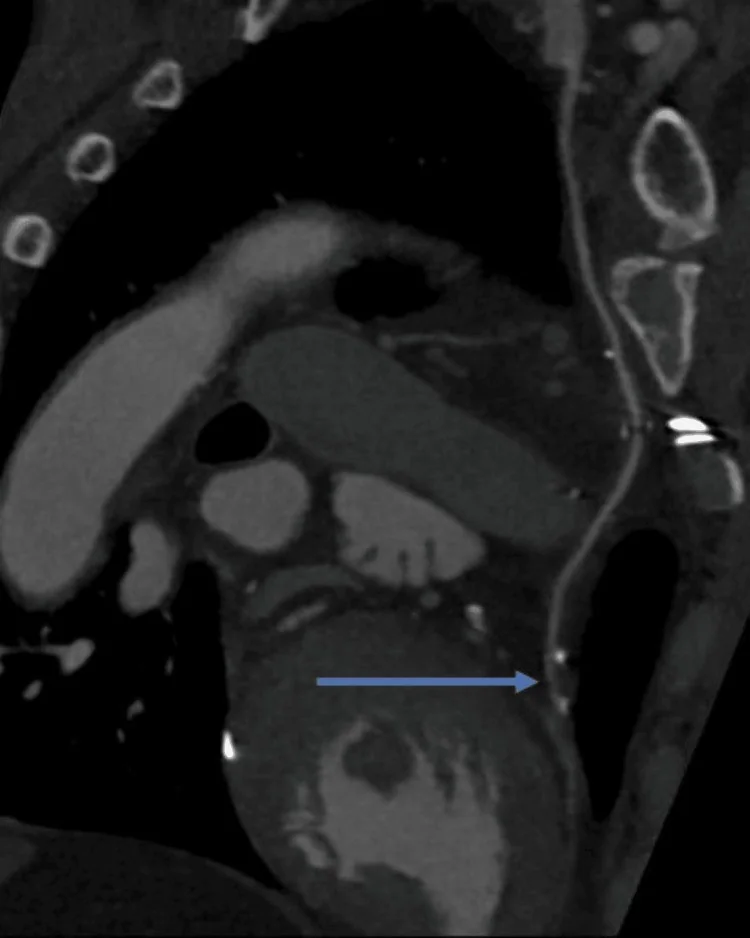
Koroner bypass sonrası göğüs ağrısı veya iskemi kuşkusunda greft gövdesi, çıkan aorta veya internal torasik arter kökeni, distal anastomoz ve beslenen doğal koroner arter izlenir. Koroner BT anjiyografi bypass greft açıklığını değerlendirmede yüksek doğruluğa sahip noninvaziv bir yöntemdir; doğal koroner arterlerin değerlendirilmesi yaygın ve ileri ateroskleroz nedeniyle daha güç olabilir, ayrıca cerrahi klips ve hareket artefaktı distal anastomozu sınırlayabilir. Greftte fokal daralma veya kontrast devamlılığının kaybı ile distal hedef damardaki hastalık ayrı ayrı değerlendirilmelidir. Greft veya distal doğal damar lezyonunun atlanması koroner dolaşımın yeniden yapılandırılmış anatomisini eksik bırakır.
Faz ve pencere
- BTA tanısal
- Greft başlangıcından gövde boyunca distal anastomoza kadar kontrastla dolan lümen izlenir; fokal daralma, ani kesilme/oklüzyon, anastomoz darlığı ve distal hedef koroner arter opasifikasyonu değerlendirilir. Konvansiyonel safen ven grefti genellikle çıkan aortaya bağlanır; in situ internal torasik arter greftinin kökeni subklavyen arterdedir, serbest/kompozit greftlerde proksimal bağlantı değişebilir ve cerrahi klipsler ile kardiyak hareket artefaktı küçük distal/anastomotik lümenin değerlendirilmesini zorlaştırabilir.
Önerilen pencereler G genişlik, M merkez; değerler Hounsfield birimi (HU)
- AnjiyoG 600 / M +150
- MediastenG 350 / M +50
BT bulguları
- Greft ostiumu ve başlangıcı — çıkan aort kökenli greftin çıkışı veya internal torasik arter greftinin subklavyen kaynağı ve proksimal seyri aranır.
- Greft gövdesinde kontrast devamlılığı — kontrast sütununun greft boyunca kesintisiz ilerlemesi açıklığı destekler.
- Fokal greft stenozu — greft lümeninde yerel daralma ve öncesi/sonrası kalibre farkı izlenir.
- Greft oklüzyonu — lümenin ani sonlanması veya greft boyunca kontrastlanmama görünür; proksimal ostiumun tam opaklaşması kontrol edilir.
- Distal anastomoz — greft ile hedef doğal koroner arter arasındaki bağlantı ve bağlantı sonrası damar açıklığı değerlendirilir.
- Hedef doğal koroner arter — distal anastomoz sonrasındaki damarda ileri ateroskleroz, darlık veya opasifikasyon kaybı aranır.
- Greft çevresi cerrahi klipsler — metal artefaktı greft kenarını veya komşu anastomoz lümenini kısmen örtebilir.
- 64 kesitli koroner BT anjiyografide >%50 greft stenozu veya greft oklüzyonu yüksek duyarlılık ve özgüllükle değerlendirilebilir.
Normalde
Açık bypass greftinde kontrastlı lümen greft kökeninden gövde boyunca distal anastomoza ve hedef koroner artere kesintisiz uzanır; belirgin fokal kalibre daralması görülmez. Şüpheli inceleme boyunca greftin her iki anastomozunu, greft gövdesini ve anastomoz distalindeki doğal damarı ayrı ayrı kıyaslayın; yalnız greft gövdesinin açık olması hedef damar hastalığını dışlamaz.
Normal BT ile kıyasla
Aynı bölgenin, kaynak veri setinde patoloji içermediği belirtilen bir BT incelemesini kesit kesit kaydırın; organ sınırlarını açarak anatomiyi hasta görüntüsüyle karşılaştırın. Küçük rastlantısal bulgular tümüyle dışlanmamıştır.
Kaynak: TotalSegmentator v2.01 veri seti (Wasserthal ve ark., Radiology: Artificial Intelligence 2023), CC BY 4.0, vaka s0977; organ sınırları veri setinin otomatik segmentasyonundan, birleştirilerek sadeleştirildi. Görüntüler 2,5 mm kesit aralığına yeniden örneklendi.
Ayırıcı tanı
- Greft oklüzyonu
- greft lümeninde ani kontrast sonlanması görülür; doğal hedef damar veya kollateraller distal alanı yine opaklaştırabilir.
- Greft stenozu
- greft gövdesi ya da anastomoz içinde kalıcı fokal lümen daralması vardır, tam kesilme şart değildir.
- Hedef doğal koroner arter stenozu
- greft açık olsa da distal anastomoz sonrası doğal damar segmentinde ayrı plak ve daralma izlenir.
- Cerrahi klips artefaktı
- greft komşuluğundaki metal çizgilenme lümen sınırını örter; farklı düzlemde damar devamı görülebilir.
- LIMA greftinde rekabetçi doğal akıma bağlı difüz incelme (string sign) açıklık olarak değerlendirilmez, işlevsel greft oklüzyonu olarak kaydedilir.
Tuzaklar
- Aortik greft ostiumunu atlayıp yalnız görünür greft gövdesine bakma; başlangıç, gövde ve distal bağlantıyı tek bir seyir olarak takip et.
- Açık greft distalinde kontrast görülmesini greft açıklığı kanıtı sayma; hedef damar kollaterallerden retrograd dolabilir.
- Cerrahi klips yanında kontrast kesilmesini otomatik oklüzyon kabul etme; klips artefaktını ortogonal rekonstrüksiyonlarda ve komşu kesitlerde kontrol et.
- Açık greft sonucuyla tüm miyokard yatağının normal olduğunu varsayma; anastomoz sonrası doğal koroner ve greftlenmemiş segmentlerdeki hastalığı ayrıca değerlendir.
Kendini dene
LIMA-LAD grefti kontrastla açık, ancak distal anastomoz sonrası LAD'de fokal plak ve daralma var. Lezyonun yeri nedir?
Cevabı göster
Hedef doğal koroner arter. Greft açık olduğu halde anastomoz sonrası LAD'deki plak hedef doğal koroner arter stenozudur. Greft gövdesi ve ostium ayrı anatomik segmentlerdir; miyokardiyal köprü kas içi seyirdir.
Greftin distalindeki damar kontrastlı, fakat greft boyunca kontrast sütunu görülmüyor. Hangi yorum uygundur?
Cevabı göster
Greft oklüzyonu olası. Distal damar kollateral dolaşımla opaklaşabilir; greft boyunca kontrast yokluğu oklüzyonu düşündürür ve ostium/artefakt kontrolü gerekir. Distal kontrast greft açıklığını kanıtlamaz.
Kaynaklar
Bu sayfadaki 39 cümle ve 2 quiz sorusu aşağıdaki kaynaklardan alıntılarla otomatik olarak karşılaştırıldı; 7 cümle bu karşılaştırmada düzeltildi (2026-10-12).
- CT angio for the evaluation of graft patencyjtd.amegroups.org
- Use of CT angiography among patients with prior coronary artery bypass grafting surgerypmc.ncbi.nlm.nih.gov
- Coronary computed tomography angiography following robotic coronary artery bypass grafting surgery: Systematic approach to image analysis and practical considerationspmc.ncbi.nlm.nih.gov
- Multidector CT Imaging of Coronary Artery Stent and Coronary Artery Bypass Graftintechopen.com
- Myocardial Bridging: Review on the Role of Coronary Computed Tomography Angiographypubmed.ncbi.nlm.nih.gov
- Coronary Artery Bypass Grafting for Myocardial Bridging 21 Years After the Senning Procedurepmc.ncbi.nlm.nih.gov
- Photon-counting computed tomography in coronary artery bypass grafting planning and follow-up: a narrative review of a high-resolution adjunct to invasive angiographypmc.ncbi.nlm.nih.gov
- Covered Stent Treatment of a Saphenous Vein Graft Pseudoaneurysmpmc.ncbi.nlm.nih.gov
- Patency of Arterial Versus Venous Grafts in Multisegmental Coronary Artery Diseasepmc.ncbi.nlm.nih.gov
- Correlates of haemodynamic flow characteristics of sequential saphenous vein grafts in coronary artery bypass grafting.pubmed.ncbi.nlm.nih.gov
- Stenting an aortopulmonary conduit with peripheral cardiopulmonary bypass support.pubmed.ncbi.nlm.nih.gov
- Postmortem imaging as a complementary tool for the investigation of cardiac death.pubmed.ncbi.nlm.nih.gov
- Pedicled versus skeletonized internal thoracic artery grafts: a randomized trial.pubmed.ncbi.nlm.nih.gov
- Short-term assessment of radial artery grafts with multidetector computed tomography.pubmed.ncbi.nlm.nih.gov
- [On-pump total arterial revascularization in coronary artery disease patients with left ventricular dysfunction: a multi-center retrospective study].pubmed.ncbi.nlm.nih.gov
- The Potential Impact of Functional Imaging on Decision Making and Outcome in Patients Undergoing Surgical Revascularization.pubmed.ncbi.nlm.nih.gov
- Beating heart totally endoscopic coronary artery bypass.pubmed.ncbi.nlm.nih.gov
- Impact of contralateral carotid or vertebral artery occlusion in patients undergoing carotid endarterectomy or carotid artery stenting.pubmed.ncbi.nlm.nih.gov
- Anatomic Repair of a Left Coronary Artery Main Stem Atresia.pubmed.ncbi.nlm.nih.gov
- 64 slice-coronary computed tomography sensitivity and specificity in the evaluation of coronary artery bypass graft stenosis: A meta-analysis.pubmed.ncbi.nlm.nih.gov
- Early angiographic evaluation after off-pump coronary artery bypass grafting.pubmed.ncbi.nlm.nih.gov
- Risk of New Native-Vessel Occlusion After Coronary Artery Bypass Grafting.pubmed.ncbi.nlm.nih.gov
- Study Design of the Graft Patency After FFR-Guided Versus Angiography-Guided CABG Trial (GRAFFITI).pubmed.ncbi.nlm.nih.gov
- Below the Aortic Annulus: Multiphase CT Features of an Interventricular Membranous Septal Aneurysm.pubmed.ncbi.nlm.nih.gov
- Effect of Evolocumab on Grafts Post-Coronary Artery Bypass Surgery: Post-Hoc Analysis of Newton-CABG CardioLink-5.pubmed.ncbi.nlm.nih.gov
- Determinants of graft patency after coronary artery bypass grafting.pubmed.ncbi.nlm.nih.gov
- The internal mammary artery - use as a free graft in coronary artery bypass grafting - evidence, technical considerations and controversies.pubmed.ncbi.nlm.nih.gov
- The No-Touch Saphenous Vein Harvesting Improves Graft Patency After Off-Pump Coronary Artery Bypass Surgery: A Propensity-Matched Analysis.pubmed.ncbi.nlm.nih.gov
- Physiology of in-situ arterial revascularization in coronary artery bypass grafting: Preoperative, intraoperative and postoperative factors and influences.pubmed.ncbi.nlm.nih.gov
- Intrapleural left axillary artery bypass grafting compromising subsequent left internal thoracic artery harvesting: a case report.pubmed.ncbi.nlm.nih.gov
- What represents complete surgical myocardial revascularization in 2026?pubmed.ncbi.nlm.nih.gov
- Coronary Artery Bypass Grafting for Myocardial Bridging 21 Years After the Senning Procedure.pubmed.ncbi.nlm.nih.gov
- Patency of conduits in patients who received internal mammary artery, radial artery and saphenous vein grafts.pubmed.ncbi.nlm.nih.gov
- On the relationship between competitive flow and FFT analysis of the flow waves in the left internal mammary artery graft in the process of CABG.pubmed.ncbi.nlm.nih.gov
- Proceedings of the 15th International Congress on Circumpolar Health.pubmed.ncbi.nlm.nih.gov
- Multiomics Analysis-Based Biomarkers in Diagnosis of Polycystic Ovary Syndrome.pubmed.ncbi.nlm.nih.gov
- Invited review: Recommendations for reporting intervention studies on reproductive performance in dairy cattle: Improving design, analysis, and interpretation of research on reproduction.pubmed.ncbi.nlm.nih.gov
- Photon-counting computed tomography in coronary artery bypass grafting planning and follow-up: a narrative review of a high-resolution adjunct to invasive angiography.pubmed.ncbi.nlm.nih.gov
- Computed Tomography-Derived Fractional Flow Reserve Versus Transit-Time Flow Measurement for Predicting Early Competitive Graft Flow After Coronary Artery Bypass Grafting.pubmed.ncbi.nlm.nih.gov
- Patency of Arterial Versus Venous Grafts in Multisegmental Coronary Artery Disease.pubmed.ncbi.nlm.nih.gov
- Evaluation and Treatment of Myocardial Bridging by Clinical Phenotype.pubmed.ncbi.nlm.nih.gov
- Clinical features of Q fever vertebral osteomyelitis: case reports and literature review.pubmed.ncbi.nlm.nih.gov
- Influence of moderate left subclavian artery stenosis on outcomes after coronary bypass surgery in patients requiring hemodialysis.pubmed.ncbi.nlm.nih.gov
- Impact of Fascial Orientation of the Radial Artery Graft on Mid-Term Patency and Clinical Outcome.pubmed.ncbi.nlm.nih.gov
- Robotic Coronary Artery Bypass Grafting: A Narrative Review of Techniques, Evidence, and Future Directions.pubmed.ncbi.nlm.nih.gov
- The Shifting Boundary Between Invasive and Non-Invasive Angiographic Investigation in Contemporary Cardiology and Cardiac Surgery: An Up-to-Date Narrative Review.pubmed.ncbi.nlm.nih.gov
- Computed Tomography Coronary Angiography as a Gatekeeper for Invasive Coronary Assessment Before Transcatheter Aortic Valve Implantation.pubmed.ncbi.nlm.nih.gov
- Multilevel Surgical Repair of Iatrogenic Aortocoronary Dissection: A Lifesaving Strategy.pubmed.ncbi.nlm.nih.gov
- Surgical and Histopathologic Insights Into Mid-Aortic Syndrome: A Case Report.pubmed.ncbi.nlm.nih.gov
- Acute Myocardial Infarction Secondary to Idiopathic Ascending Aortic Thrombus.pubmed.ncbi.nlm.nih.gov
- Reoperative repair of recurrent anastomotic pseudoaneurysm following aorto-aortic bypass for middle aortic syndrome.pubmed.ncbi.nlm.nih.gov
- Left ventricular outflow tract stenosis following Bentall procedure using the graft insertion technique: a case report.pubmed.ncbi.nlm.nih.gov
- Case Report: Navigating the flow-dependent interaction between the left internal mammary artery graft and the left anterior descending artery: when deliberate graft occlusion comes into play.pubmed.ncbi.nlm.nih.gov
- Coronary-Subclavian Steal Syndrome in a Post-Coronary Artery Bypass Grafting Patient: A Reversible Cause of Myocardial Ischemia.pubmed.ncbi.nlm.nih.gov
- Venous But Not Arterial Graft Failure Associated with Ischaemic Sequelae After Coronary Bypass Surgery.pubmed.ncbi.nlm.nih.gov
- Right internal mammary artery steal syndrome: successful percutaneous coil embolization of a collateral branch-case report.pubmed.ncbi.nlm.nih.gov
- Presumed Primary Cardiac Angiosarcoma With Atrioventricular Groove Rupture and Right Coronary Artery Compromise: A Case Report and Literature Review.pubmed.ncbi.nlm.nih.gov
- Advancements in 3D Transoesophageal Echocardiography (TOE) and Computed Tomography (CT) for Stroke Prevention in Left Atrial Appendage Occlusion Interventions.pubmed.ncbi.nlm.nih.gov
- Multimodality imaging in the diagnosis and management of prosthetic valve endocarditis: A contemporary narrative review.pubmed.ncbi.nlm.nih.gov
- Predictors of a prolonged puncture-wire time in patients with ST-Elevation Myocardial Infarction (STEMI).pubmed.ncbi.nlm.nih.gov
- Traumatic brachial artery reconstruction using an in-wound no-touch superficial vein graft with 20-month imaging follow-up: a case report.pubmed.ncbi.nlm.nih.gov
- Should we ligate coronary conduits when flow measurements indicate competitive flow? a case report.pubmed.ncbi.nlm.nih.gov
- Radial artery graft in coronary artery bypass surgery 1 week to 1 year postoperation.pubmed.ncbi.nlm.nih.gov
- Anomalies of coronary artery origin at invasive angiography: a prospective study of prevalence, catheter utilisation, access strategy and procedural implications.pubmed.ncbi.nlm.nih.gov
- Comparison of coronary computed tomography angiography to invasive coronary angiography for coronary allograft vasculopathy surveillance in patients with orthotopic heart transplant.pubmed.ncbi.nlm.nih.gov
- Right Internal Mammary Artery Perforation and Large Mediastinal Hematoma Formation as a Complication of Radial Access Coronary Angiography: A Case Report.pubmed.ncbi.nlm.nih.gov
- Second or subsequent microvascular free flaps in head and neck reconstructive surgery: a narrative review.pubmed.ncbi.nlm.nih.gov
- Radiologic Interventions for Gastrointestinal Bleeding.pubmed.ncbi.nlm.nih.gov
- Iatrogenic vascular trauma of the extremities in pediatric patients: A case series report and review of literature.pubmed.ncbi.nlm.nih.gov
- High-flow bypass and trapping for ruptured intracranial internal carotid artery dissection in fibromuscular dysplasia: illustrative case.pubmed.ncbi.nlm.nih.gov
- Two Cases of Kounis Syndrome Caused by Contrast Medium: Early Extracorporeal Membrane Oxygenation.pubmed.ncbi.nlm.nih.gov
- Clinical outcomes of external fenestration TEVAR in Stanford type B aortic dissection involving the left subclavian artery: a retrospective study.pubmed.ncbi.nlm.nih.gov
- Multimodality Cardiovascular Imaging in Patients After Coronary Artery Bypass Grafting: Diagnosis and Risk Stratification.pubmed.ncbi.nlm.nih.gov
- A bibliometric analysis of the top 100 most-cited articles in interventional cardiology: trends, authors, journals, origins, and gender representation.pubmed.ncbi.nlm.nih.gov
Eğitim amaçlıdır; hasta başında tanı ve tedavi kararının yerine geçmez, tıbbi tavsiye değildir. Metinler yapay zekâ desteğiyle yazıldı ve otomatik bir adımda kaynak alıntılarıyla karşılaştırıldı; bu bir tıbbi doğrulama değildir ve içerik uzman radyolog incelemesinden geçmedi. Klinik kararlarda güncel kılavuzları, kurum protokollerini ve radyoloji raporunu esas alın.