Özet
Akut göğüs ağrısında koroner arterin tamamen tıkanması, beslediği miyokardda akut iskemi ve infarkt riski oluşturan kritik bir bulgudur. Koroner BT anjiyografi, opak lümen sütununun kesildiği yeri, varsa oklüzyona yol açan plağı ve distal damar yatağını gösterebilir. Distal damar kollaterallerle yeniden opaklaşabilir; bu görünüm oklüzyonu dışlamaz. Oklüzyonun gözden kaçması akut koroner olayın tanınmasını ve uygun acil değerlendirmeyi geciktirebilir.
Faz ve pencere
- BTA tanısal
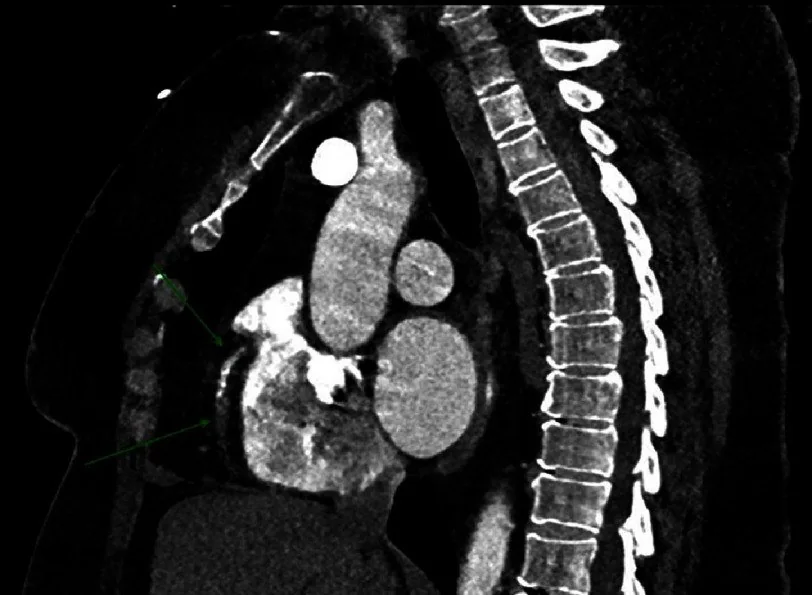
- Kontrastlı koroner çekimde damar lümenindeki opak sütunun bir segmentte tamamen sonlanması ve segment boyunca lümen kontrastının görülmemesi aranır; distal damar opaklaşmıyorsa kesinti belirginleşir, kollateral dolum varsa daha geç veya daha az yoğun distal opasifikasyon görülebilir; aterosklerotik olguda plağın özellikleri ayrıca değerlendirilir.
- BT perfüzyon
- Kronik total oklüzyonda seçilmiş incelemelerde koroner BT anjiyografiye BT perfüzyon eklenerek koroner anatomiye ek olarak miyokard perfüzyonu da değerlendirilebilir.
Önerilen pencereler: Anjiyo (G 600 / M 150), Mediasten (G 350 / M 50).
BT bulguları
- Kontrast sütununun bir koroner segmentte tam kesilmesi; darlıkla karıştırmamak için lümenin devamlılığını çok düzlemli izlemde doğrula.
- Oklüzyonun proksimal ve distal sınırları, damar adı ve yan dal çıkışlarıyla ilişkisi.
- Distal damar opasifikasyonunun yokluğu veya kollaterallerden gelen daha zayıf distal kontrastlanma.
- Koroner BT anjiyografi kronik total oklüzyonda oklüzyon uzunluğunu, güdük özelliklerini, damar seyrini ve kollateral anatomiyi gösterebilir.
- Oklüzyonun distalindeki miyokardda hipoenhansman veya incelme eşlik edebilir; bu bulgular evrensel olarak bulunmaz.
- Yoğun kalsiyum, hareket veya düşük kontrast nedeniyle lümen izlenemiyorsa kesin oklüzyon yerine tanısal sınırlılığı belirt.
Ölçütler ve sınıflamalar
- CAD-RADS 5
- CAD-RADS 5: total oklüzyon
- CAD-RADS 2.0 stenoz kategorisi 5
- CAD-RADS 5, koroner arterde tam oklüzyon bulunduğunu ifade eder.
Normalde
Koroner BT anjiyografi koroner ağacın üç boyutlu anatomik görünümünü sağlayabilir. Şüpheli segmentte aynı damarın proksimal opasifikasyonunu, kesinti uzunluğunu ve distal yatağın opaklaşıp opaklaşmadığını; ayrıca karşı taraftan gelen kollateral damarları kıyaslayın.
Normal BT ile kıyasla
Aynı bölgenin, kaynak veri setinde patoloji içermediği belirtilen bir BT incelemesini kesit kesit kaydırın; organ sınırlarını açarak anatomiyi hasta görüntüsüyle karşılaştırın. Küçük rastlantısal bulgular tümüyle dışlanmamıştır.
Kaynak: TotalSegmentator v2.01 veri seti (Wasserthal ve ark., Radiology: Artificial Intelligence 2023), CC BY 4.0, vaka s0977; organ sınırları veri setinin otomatik segmentasyonundan, birleştirilerek sadeleştirildi. Görüntüler 2,5 mm kesit aralığına yeniden örneklendi.
Ayırıcı tanı
- Ciddi subtotal stenoz
- çok ince kontrast kanalı damar boyunca devam eder; gerçek total oklüzyonda lümen sütunu kesilmiştir.
- Hareket artefaktı
- kontur atlaması komşu kesitlerde veya farklı rekonstrüksiyon fazında kaybolabilir.
- Kalsiyum blooming
- kalsifiye plağın parlak kenarları opak lümeni örter; daha ince kernel ve damar eksenine dik kesitler değerlendirilir.
- Koroner opasifikasyon yetersizliğinde kontrast zamanlaması teknik etkenlerden biri olabilir; hasta-özgü zamanlama, tepe koroner kontrastlanmayı sabit 5 saniyelik gecikmeden daha doğru öngörmüştür.
- Koroner arter anomalisi veya doğuştan hipoplazi
- beklenmedik damar seyri ve küçük çap tüm güzergâh boyunca izlenir; ani fokal lümen kesilmesi beklenmez.
Tuzaklar
- Distal segmentin kontrastlanması total tıkanmayı dışlamaz; proksimal oklüzyondan sonra kollateral dolum olasılığını koroner ağ boyunca izle.
- Bir iki kesitte görülen opasite kaybını oklüzyon sayma; eğrisel MPR ve ardışık ince kesitlerde kontrast sütununun gerçekten sonlandığını doğrula.
- Kronik oklüzyon segmentindeki yoğun kalsifikasyon ve daralan lümen, proksimal başlangıcın (stump) değerlendirmesini zorlaştırabilir; bu nedenle damarın tek bir kesitte değil, eğrisel MPR ile seyrinde izlenmesi gerekir.
- Akut miyokard infarktüsü tanısı konmuş bazı hastalarda geç gadolinyum tutulumlu kardiyak MR görüntülemesinde görünür miyokard hasarı saptanmayabilir; bu nedenle tutulumun yokluğu infarktüsü tek başına dışlamaz.
- Kronik total oklüzyon, koroner arterde tam oklüzyonun 3 aydan uzun sürmesi olarak tanımlanır.
Kendini dene
Koroner BT anjiyografide CAD-RADS 5 hangi bulguyu ifade eder?
Cevabı göster
Koroner arterde tam oklüzyon. CAD-RADS 5, koroner arterde tam oklüzyon bulunduğunu ifade eder.
Kronik total oklüzyonda koroner BT anjiyografi hangi anatomik özelliği gösterebilir?
Cevabı göster
Oklüzyon uzunluğu ve güdük özellikleri. Koroner BT anjiyografi, kronik total oklüzyonda oklüzyon uzunluğu ve güdük özellikleri gibi anatomik ayrıntıları gösterebilir.
Kaynaklar
Bu sayfadaki 36 cümle ve 2 quiz sorusu aşağıdaki kaynaklardan alıntılarla otomatik olarak karşılaştırıldı; 14 cümle bu karşılaştırmada düzeltildi (2026-10-09).
- 25-Year Comparison of Coronary Lesions Anatomy in Two Cohorts of French Canadians with Familial Hypercholesterolemiapmc.ncbi.nlm.nih.gov
- H-type hypertension is a risk factor for chronic total coronary artery occlusion: a cross-sectional study from southwest Chinapmc.ncbi.nlm.nih.gov
- More Than Just an Ulcer: A Case of HIV-Associated Iliac Aneurysms Presenting With a Leg Ulcerpmc.ncbi.nlm.nih.gov
- Non-ST elevation myocardial infarction related to total coronary artery occlusion – prevalence and patient characteristicspmc.ncbi.nlm.nih.gov
- Very Late Chronic Total Occlusion After Drug-Coated Balloon Treatment for a Diffuse Long Coronary Lesion in Unstable Angina: A Case Reportpmc.ncbi.nlm.nih.gov
- [Is FFR CT a game changer in coronary CT angiography?].pubmed.ncbi.nlm.nih.gov
- A method for coronary artery calcium scoring using contrast-enhanced computed tomography.pubmed.ncbi.nlm.nih.gov
- Outcomes and computed tomography scan follow-up of bioresorbable vascular scaffold for the percutaneous treatment of chronic total coronary artery occlusion.pubmed.ncbi.nlm.nih.gov
- [Prediction of severe cardiac complications with the help of myocardial perfusion scintigraphy in patients with residual chronic total occlusion after percutaneous coronary interventions].pubmed.ncbi.nlm.nih.gov
- Factors determining success in percutaneous revascularization of chronic total coronary occlusion: multidetector computed tomography analysis.pubmed.ncbi.nlm.nih.gov
- Absence of visible infarction on cardiac magnetic resonance imaging despite the established diagnosis of myocardial infarction by 4th Universal Definition of Myocardial Infarction.pubmed.ncbi.nlm.nih.gov
- Chronic Total Occlusion Percutaneous Coronary Intervention: Present and Future.pubmed.ncbi.nlm.nih.gov
- Chronic total occlusion percutaneous coronary intervention: 2026 update.pubmed.ncbi.nlm.nih.gov
- Chronic Total Occlusions: Current Approaches, Evidence and Outcomes.pubmed.ncbi.nlm.nih.gov
- 3D printing in adult cardiovascular surgery and interventions: a systematic review.pubmed.ncbi.nlm.nih.gov
- Experimental model of transthoracic, vascular-targeted, photodynamically induced myocardial infarction.pubmed.ncbi.nlm.nih.gov
- Management of Nonocclusive Mesenteric Ischemia in Patients with Cardiac Failure.pubmed.ncbi.nlm.nih.gov
- The Impact of Calcium on Chronic Total Occlusion Management.pubmed.ncbi.nlm.nih.gov
- Total Left Main Occlusion ST-Elevation Myocardial Infarction Complicated by Cardiogenic Shock and Delayed Sinus Node Dysfunction.pubmed.ncbi.nlm.nih.gov
- Anterior ST-Segment Elevation From Nondominant Right Coronary Artery Occlusion: Lessons From Two Cases.pubmed.ncbi.nlm.nih.gov
- Acute Myocardial Infarction Secondary to Idiopathic Ascending Aortic Thrombus.pubmed.ncbi.nlm.nih.gov
- Comparative analysis of bypass vs. stent for coronary revascularization using an ex-vivo organ care system in an animal model.pubmed.ncbi.nlm.nih.gov
- ST-elevation myocardial infarction following road traffic accident in a young patient: a case report.pubmed.ncbi.nlm.nih.gov
- Association of metabolic dysfunction-associated steatotic liver disease with coronary plaque vulnerability and prognosis in patients with acute coronary syndrome.pubmed.ncbi.nlm.nih.gov
- Simultaneous Acute Multiple Ischemic Strokes of the Left Cerebral Hemisphere and Signs of Acute Anterior STEMI: A Case Report.pubmed.ncbi.nlm.nih.gov
- Clinical characteristics and diagnostic challenges of non-ST-segment elevation acute coronary syndrome patients with normal electrocardiograms: a review.pubmed.ncbi.nlm.nih.gov
- Incidental Electrocardiographic Recognition of Left Anterior Fascicular Block With Delayed Troponin Elevation: A Case Report With Clinical Correlation.pubmed.ncbi.nlm.nih.gov
- Superficial femoral artery thrombosis after PFNA in an intertrochanteric fracture patient with sarcopenia and copd: a rare case report.pubmed.ncbi.nlm.nih.gov
- Spontaneous conus medullaris infarction in a 79 year-old female with cardiovascular risk factors: a case report.pubmed.ncbi.nlm.nih.gov
- Long-term safety and effectiveness of the "OptEase" vena cava filter.pubmed.ncbi.nlm.nih.gov
- Photon-counting CT iodine maps for late iodine enhancement: a retrospective feasibility study of image quality and reader confidence.pubmed.ncbi.nlm.nih.gov
- The Diagnostic and Prognostic Impact of Cardiovascular Magnetic Resonance in Ischemic Heart Disease: A Systematic Review.pubmed.ncbi.nlm.nih.gov
- Clinical Applications of Artificial Intelligence in Cardiac CT: From Coronary CT Angiography to CT-Derived Fractional Flow Reserve and Myocardial Perfusion Imaging.pubmed.ncbi.nlm.nih.gov
- Association of serum fibroblast growth factor 21 levels with coronary artery calcification and coronary intervention in patients with chronic total occlusion.pubmed.ncbi.nlm.nih.gov
- Serum Alpha-Klotho and Coronary Atherosclerosis: Associations with Coronary CT Angiography Findings and Atherogenic Indices.pubmed.ncbi.nlm.nih.gov
- Role of T1-weighted MRI in Identifying Coronary Intraplaque Hemorrhage: CATCH the Truly High-Risk Plaque.pubmed.ncbi.nlm.nih.gov
- Case Report: Iatrogenic left main coronary artery dissection during premature ventricular contraction ablation managed with emergent coronary artery bypass grafting.pubmed.ncbi.nlm.nih.gov
- Delayed Anterior Interventricular Vein Opacification Guides True-Lumen Wiring in Stump-Less LAD Occlusion.pubmed.ncbi.nlm.nih.gov
- An interpretable machine learning model for predicting prognosis in acute ischemic stroke with large vessel occlusion.pubmed.ncbi.nlm.nih.gov
- Retrograde endovascular recanalization via the ascending cervical artery for non-conical stump vertebral artery occlusion: a case report.pubmed.ncbi.nlm.nih.gov
- Sharp recanalization of extensive multilevel central venous occlusions in a young patient with familial Mediterranean fever: A case report.pubmed.ncbi.nlm.nih.gov
- Coronary CT Angiography in PCI Planning: Advances, Clinical Applications, and Challenges.pubmed.ncbi.nlm.nih.gov
- Chronic Total Occlusion Recanalization in a 14-Year-Old Girl With Pseudoxanthoma Elasticum: IVUS-Guided Stentless Strategy.pubmed.ncbi.nlm.nih.gov
- Coronary CT Angiography for PCI Planning and Guidance: A Comprehensive Narrative Review.pubmed.ncbi.nlm.nih.gov
- The complex role of cardiovascular imaging in viability testing.pubmed.ncbi.nlm.nih.gov
- Ischemic Heart Disease: Noninvasive Imaging Techniques and Findings.pubmed.ncbi.nlm.nih.gov
- Many faces of acute bowel ischemia: overview of radiologic staging.pubmed.ncbi.nlm.nih.gov
- Pictorial review: a step-by-step guide to coronary CT angiography with photon-counting detector CT.pubmed.ncbi.nlm.nih.gov
- Advanced quantitative CT for coronary artery disease: integrating stenosis quantification, plaque quantification, and fractional flow reserve-CT.pubmed.ncbi.nlm.nih.gov
- Spectral computed tomography characterization of coronary atherosclerotic plaque: principles, imaging biomarkers, and clinical significance.pubmed.ncbi.nlm.nih.gov
- CAD-RADS: A Standardized Reporting System for Coronary CT Angiography.pubmed.ncbi.nlm.nih.gov
- Evaluation of Coronary Artery Disease Plaques Using Coronary CT Angiography in a High-Risk Population.pubmed.ncbi.nlm.nih.gov
- Case Report: Zero-contrast multivessel PCI with left main bifurcation guided by dual IVUS strategies using a coronary CTA roadmap.pubmed.ncbi.nlm.nih.gov
- Real-Time Intravascular Ultrasound-Guided Percutaneous Coronary Intervention for Spontaneous Coronary Artery Dissection.pubmed.ncbi.nlm.nih.gov
- Arterial Supply to the Atrioventricular Node: Anatomical Variability and Clinical Implications.pubmed.ncbi.nlm.nih.gov
- Coronary Artery Anomalies Revisited: Description of the Types, Pathophysiology and Treatment Options Based on Latest Guidelines.pubmed.ncbi.nlm.nih.gov
- Single Coronary Artery in the Context of Vascular Disease: Anatomy, Development, Multimodality Imaging, and Clinical Interpretation.pubmed.ncbi.nlm.nih.gov
- Comparative evaluation of large language models for generating CAD-RADS 2.0-compliant diagnostic conclusions in cardiac CT reports.pubmed.ncbi.nlm.nih.gov
- CAD-RADS 2.0: Comparison of methods for assessment of plaque burden.pubmed.ncbi.nlm.nih.gov
- Kounis Syndrome in the Modern Era: A Comprehensive Review of Allergic Acute Coronary Syndromes.pubmed.ncbi.nlm.nih.gov
- Coronary chronic total occlusion on coronary CT angiography: what radiologists should know?pubmed.ncbi.nlm.nih.gov
- CT-FFR by expanding coronary tree with Newton-Krylov-Schwarz method to solve the governing equations of CFD.pubmed.ncbi.nlm.nih.gov
- MDCT Imaging of Non-Traumatic Thoracic Aortic Emergencies and Its Impact on Diagnosis and Management-A Reappraisal.pubmed.ncbi.nlm.nih.gov
- Diagnostic performance of deep learning and computational fluid dynamics-based instantaneous wave-free ratio derived from computed tomography angiography.pubmed.ncbi.nlm.nih.gov
- Society for Cardiovascular Magnetic Resonance/European Society of Cardiovascular Imaging/American Society of Echocardiography/Society for Pediatric Radiology/North American Society for Cardiovascular Imaging Guidelines for the use of cardiovascular magnetic resonance in pediatric congenital and acquired heart disease : Endorsed by The American Heart Association.pubmed.ncbi.nlm.nih.gov
- Technical advances and clinical impact of photon-counting computed tomography angiography for peripheral artery disease.pubmed.ncbi.nlm.nih.gov
- Artificial intelligence in cardiology in the current era: a narrative review.pubmed.ncbi.nlm.nih.gov
- Noninvasive Cardiac Imaging in Older Adults: Diagnostic Challenges and Prognostic Implications Across Modalities.pubmed.ncbi.nlm.nih.gov
- Patient-specific timing acquisition for coronary CT angiography: A retrospective patient validation study.pubmed.ncbi.nlm.nih.gov
- Radiation dose optimization in coronary CT angiography clinical application of absolute phase gating in patients with atrial fibrillation.pubmed.ncbi.nlm.nih.gov
- The Contemporary Role of Intracoronary Physiological Assessment: Fractional Flow Reserve, Non-Hyperemic Pressure Ratios, Wireless Technologies, and Microcirculation.pubmed.ncbi.nlm.nih.gov
- Acute inferior STEMI in a unique setting: case report on anomalous circumflex and multivessel coronary artery disease.pubmed.ncbi.nlm.nih.gov
- Chest Discomfort: Could Coronary Pathology Extend Beyond Atherosclerosis?pubmed.ncbi.nlm.nih.gov
- Cardiovascular Computed Tomography Angiographic Assessment of Simple Cardiac Shunts in Adults.pubmed.ncbi.nlm.nih.gov
- 2.5-mm articulated endoluminal forceps using a compliant mechanism.pubmed.ncbi.nlm.nih.gov
- Guidelines on multidisciplinary approaches for the prevention and management of diabetic foot disease (2020 edition).pubmed.ncbi.nlm.nih.gov
- MRI perfusion in patients with stable chest-pain.pubmed.ncbi.nlm.nih.gov
- Very Late Chronic Total Occlusion After Drug-Coated Balloon Treatment for a Diffuse Long Coronary Lesion in Unstable Angina: A Case Report.pubmed.ncbi.nlm.nih.gov
- Sleep Phenotype, Shift-Related Occupation, and Coronary Plaque Complexity in Young Adults: Association with CT-Derived Functional Ischemia.pubmed.ncbi.nlm.nih.gov
- Ultra-low 70-kV cardiac CT angiography in neonates: a comparative dose-optimized approach with preserved image quality.pubmed.ncbi.nlm.nih.gov
- Navigation of the Clinical Implications, Interventional Challenges, and Complexities of the Circumflex Coronary Artery: A Comprehensive Review.pubmed.ncbi.nlm.nih.gov
- Society for Cardiovascular Magnetic Resonance 2024 Cases of SCMR case series.pubmed.ncbi.nlm.nih.gov
- Pathogenesis and Surgical Treatment of Dextro-Transposition of the Great Arteries (D-TGA): Part II.pubmed.ncbi.nlm.nih.gov
- Cardiac substructure delineation in radiation therapy - A state-of-the-art review.pubmed.ncbi.nlm.nih.gov
- Prevalence of coronary artery-pulmonary artery collaterals in patients with chronic thromboembolic pulmonary hypertension.pubmed.ncbi.nlm.nih.gov
- Current status of percutaneous coronary intervention of chronic total occlusion.pubmed.ncbi.nlm.nih.gov
- Association between stress hyperglycemia ratio and acute total occlusion in patients with non-ST-segment elevation myocardial infarction.pubmed.ncbi.nlm.nih.gov
- Association of Coronary Collaterals and Myocardial Salvage Measured by Serial Cardiac Magnetic Resonance Imaging after Acute Myocardial Infarction.pubmed.ncbi.nlm.nih.gov
- Balloon Pulmonary Angioplasty for Chronic Thromboembolic Pulmonary Hypertension: Identifying and Managing Complications for the Operator.pubmed.ncbi.nlm.nih.gov
- Applications of Artificial Intelligence in Chronic Total Occlusion Revascularization: From Present to Future-A Narrative Review.pubmed.ncbi.nlm.nih.gov
- Velocimetry based on multiphase CCTA images for reliable coronary flow velocity quantification across stenosis severities and ischemia detection.pubmed.ncbi.nlm.nih.gov
- Optimizing Coronary CT Image Reconstruction With Deep Learning for Improved Quality: A Retrospective Study.pubmed.ncbi.nlm.nih.gov
- Enhancing diagnostic performance and image quality in coronary CT angiography: Impact of SnapShot Freeze 2 algorithm across varied heart rates in stent patients.pubmed.ncbi.nlm.nih.gov
- Artificial Intelligence Across the Radiology Workflow: A Nine-Stage Narrative Review.pubmed.ncbi.nlm.nih.gov
- Dynamic myocardial CT perfusion imaging-state of the art.pubmed.ncbi.nlm.nih.gov
- Dual energy imaging in cardiothoracic pathologies: A primer for radiologists and clinicians.pubmed.ncbi.nlm.nih.gov
- Chaotic Dynamics Analysis of Magnetocardiography Signals for Early Detection of Myocardial Ischemia.pubmed.ncbi.nlm.nih.gov
- Review of image segmentation techniques for biomedical micro-CT: from laboratory absorption imaging to synchrotron phase-contrast.pubmed.ncbi.nlm.nih.gov
- Next-Generation Cardiovascular Imaging in Precision Medicine: Integrating Functional Imaging, Artificial Intelligence, Biomarkers, and Personalized Risk Stratification.pubmed.ncbi.nlm.nih.gov
- Obesity and Cardiovascular Disease: An Obesity Medicine Association (OMA) Clinical Practice Statement (CPS) 2026.pubmed.ncbi.nlm.nih.gov
- Coronary Arterial Anomalies in Adults with Congenital Heart Disease: From Detection to Management Strategies.pubmed.ncbi.nlm.nih.gov
- Coronary Computed Tomography Angiography to Guide Percutaneous Coronary Intervention: Expert Opinion from a SCAI/SCCT Roundtable.pubmed.ncbi.nlm.nih.gov
- Comparison of transaxial source images and 3-plane, thin-slab maximal intensity projection images for the diagnosis of coronary artery stenosis with using ECG-gated cardiac CT.pubmed.ncbi.nlm.nih.gov
- Intravascular Plaque Modification With Rotational Atherectomy Technique for Recanalization of Heavily Calcified Chronic Total Occlusion.pubmed.ncbi.nlm.nih.gov
- Beyond Angiography: Cardiac CT for Planning Complex PCI in Calcified Coronary Lesions.pubmed.ncbi.nlm.nih.gov
- Coronary Intramural Hematoma in a Young Athlete After Direct Ball Impact to the Chest.pubmed.ncbi.nlm.nih.gov
- Recurrent Syncope and Sudden Cardiac Death due to Anomalous Origin of the Right Coronary Artery From the Pulmonary Artery (ARCAPA): A Case Report.pubmed.ncbi.nlm.nih.gov
- Multimodality imaging in the detection and management of coronary and peripheral arterial disease in patients with cancer receiving cardiotoxic antineoplastic treatments: A clinical consensus statement of the ESC Council of Cardio-Oncology and the European Association of Cardiovascular Imaging (EACVI) of the ESC.pubmed.ncbi.nlm.nih.gov
- Successful recanalization of a calcified, collateral-poor LAD-CTO via repeat antegrade dissection and re-entry guided by intravascular ultrasound after prior subintimal plaque modification: a case report.pubmed.ncbi.nlm.nih.gov
- A Novel Classification for Predicting Chronic Total Occlusion Percutaneous Coronary Intervention.pubmed.ncbi.nlm.nih.gov
- Defusing a ticking time bomb: percutaneous intervention for a giant coronary pseudoaneurysm - a case report.pubmed.ncbi.nlm.nih.gov
- Quantitative multi-slice spiral CT perfusion parameters as predictors of collateral status and 90-day functional outcome in acute ischemic stroke.pubmed.ncbi.nlm.nih.gov
- CT Angiography of the Upper Extremities: Review of Acute Arterial Entities.pubmed.ncbi.nlm.nih.gov
- Guidelines for Cardiovascular Magnetic Resonance Imaging from the Korean Society of Cardiovascular Imaging-Part 3: Perfusion, Delayed Enhancement, and T1- and T2 Mapping.pubmed.ncbi.nlm.nih.gov
- Preliminary exploration of the value of pericoronary adipose tissue radiomics in identifying high-risk patients with chronic coronary syndrome: a retrospective Chinese cohort study.pubmed.ncbi.nlm.nih.gov
Eğitim amaçlıdır; hasta başında tanı ve tedavi kararının yerine geçmez, tıbbi tavsiye değildir. Metinler yapay zekâ desteğiyle yazıldı ve otomatik bir adımda kaynak alıntılarıyla karşılaştırıldı; bu bir tıbbi doğrulama değildir ve içerik uzman radyolog incelemesinden geçmedi. Klinik kararlarda güncel kılavuzları, kurum protokollerini ve radyoloji raporunu esas alın.