Özet
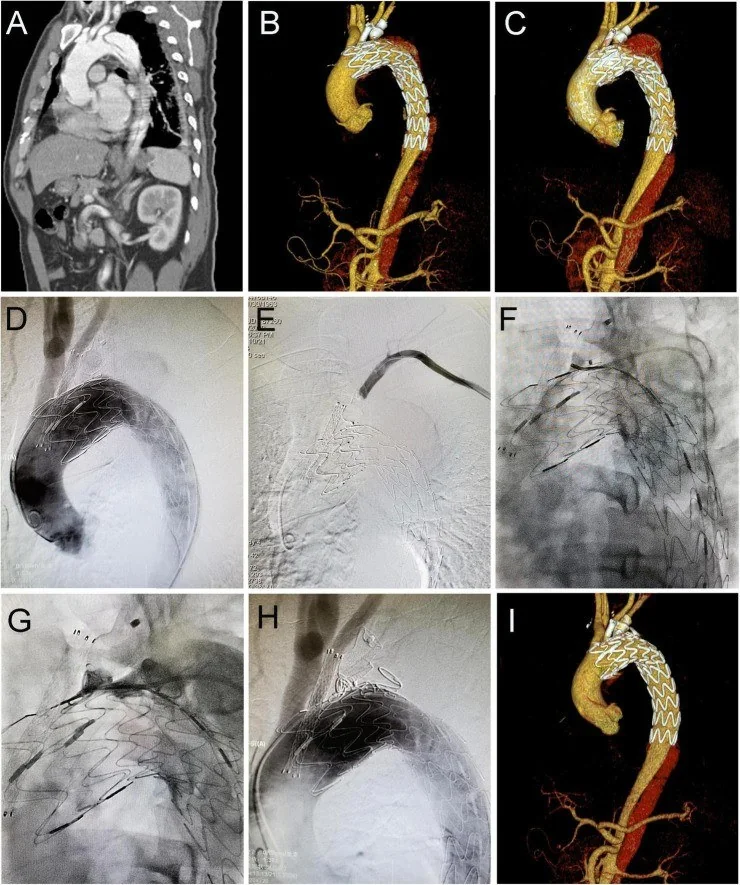
TEVAR sonrasında endoleak, endogreft dışında ve dışlanmış anevrizma kesesi içinde süren kan akımıdır. Çift fazlı BTA serisinde bazı endoleakler yalnız gecikmiş fazda görülmüştür, bu nedenle arteriyel ve gecikmiş faz birlikte değerlendirilir. Proksimal tutunma bölgesi kaçağı ve greft bileşenlerinin ayrışması, anevrizma kesesinde sistemik basıncın sürmesine yol açabilir. Endoleak tipi ve kese çapındaki değişim takip değerlendirmesinde kaydedilmelidir.
Faz ve pencere
- Kontrastsız tanısal
- Kontrastsız BT, kese içindeki yüksek dansiteli trombüsün kontrastlanmadan ayrımına yardımcı olabilir; fazlar arası karşılaştırma yapılmalıdır.
- BTA tanısal
- Çalışmada endoleaklerin çoğu arteriyel fazda görülmüş, bir kısmı yalnız gecikmiş fazda saptanmıştır.
- Gecikmiş tanısal
- Gecikmiş seride erken fazda görünmeyen yavaş kese dolumu araştırılır; bazı endoleakler yalnız gecikmiş fazda görülebilir.
Önerilen pencereler G genişlik, M merkez; değerler Hounsfield birimi (HU)
- AnjiyoG 600 / M +150
- MediastenG 350 / M +50
BT bulguları
- Greft dışındaki dışlanmış kese içinde kontrastlanma, uygun faz ve görüntü karşılaştırmasıyla endoleak lehine değerlendirilir.
- Proksimal tutunma kaçağı — kontrast, greftin proksimal kenarı ile aort duvarı arasından kese içine uzanır.
- Distal tutunma kaçağı, distal greft tutunma bölgesindeki yetersiz sızdırmazlıktan dışlanmış kese içine süren kan akımıdır.
- Bileşen ayrışması veya kumaş defekti — modüler bağlantıda ya da greft gövdesinde kese ile doğrudan kontrast iletişimi görülür.
- Gecikmiş fazda tip II endoleak görülebilir; yan dal kaynaklı dolum saptanırsa besleyici damar ayrıca gösterilmelidir.
- Kese genişlemesi — aynı düzleme dik, dış duvardan dış duvara ölçümle önceki BTA'ya göre ≥5 mm çap artışı kaydedilir.
- Endoleak olmadan kese büyümesi — standart fazlarda kese opasifikasyonu görülmese de dış çap artışı sürüyorsa gizli kaçak veya endotansiyon olasılığı gündeme gelir.
Ölçütler ve sınıflamalar
- Endoleak tipleri I-V
- Tip Ia endoleak, greftin proksimalindeki yetersiz sızdırmazlıktan; tip III endoleak ise modüler bileşen ayrışması (IIIa) veya greft kumaş defektinden (IIIb) kaynaklanır.
Normalde
Komplikasyonsuz TEVAR'da greft lümeni arteriyel fazda homojen kontrastlanır; endogreft ile aort duvarı arasındaki dışlanmış kese içinde yeni kontrast birikimi olmaz. Aynı merkez çizgisine dik kesitte kese dış çapını ve greft kenarları çevresindeki kontrastı önceki BTA ile karşılaştırın; normal greft içi kontrastı kese içi opasifikasyonla karıştırmayın.
Normal BT ile kıyasla
Aynı bölgenin, kaynak veri setinde patoloji içermediği belirtilen bir BT incelemesini kesit kesit kaydırın; organ sınırlarını açarak anatomiyi hasta görüntüsüyle karşılaştırın. Küçük rastlantısal bulgular tümüyle dışlanmamıştır.
Kaynak: TotalSegmentator v2.01 veri seti (Wasserthal ve ark., Radiology: Artificial Intelligence 2023), CC BY 4.0, vaka s0115; organ sınırları veri setinin otomatik segmentasyonundan, birleştirilerek sadeleştirildi. Görüntüler 2,5 mm kesit aralığına yeniden örneklendi.
Ayırıcı tanı
- Yüksek dansiteli trombüs yalancı endoleak görünümü verebilir
- kontrastsız seri, trombüsün kontrastlanmadan ayrımına yardımcı olabilir; fazlar arası karşılaştırma yapılmalıdır.
- Cerrahi tampon (pledget) veya hemostatik materyal
- patolojik süreci taklit eden beklenen postoperatif bulgu olabilir; kontrastsız görüntü ve ameliyat notuyla doğrulanır.
- Tromboze intramural hematom, aort duvarı boyunca dairesel veya hilal biçimli kalınlaşma gösterir ve gerçek lumen ile duvar arasında kan akımı izlenmez.
- Tip II endoleak yerine tutunma kaçağı
- kontrast kese sınırında greft kenarına doğrudan temas eder; dal ile kese arasında retrograd kanal izlenmez.
- Endotansiyon
- kese genişler ancak rutin incelemede belirgin endoleak gösterilemeyebilir; gecikmiş fazda mural kontrastlanma görülebilir.
Tuzaklar
- Yalnız arteriyel seri bazı endoleakleri kaçırabilir; kese büyümesi varsa gecikmiş seriyi inceleyin.
- Greft içindeki kontrastın dış duvar dışına taştığını göstermeden endoleak demeyin; kesenin greft dışındaki sınırını çok düzlemli rekonstrüksiyonda izleyin.
- Diseksiyon nedeniyle TEVAR yapılmış hastada yalancı lümen dolumunu endoleak tipine ek olarak giriş yırtığının yeri ve uzanımını belirten diseksiyon sınıflamasıyla tanımlayın.
- Metal artefaktı greft kenarındaki küçük kontrast odağını örtebilir; ince kesit, çok düzlemli görüntü ve kontrastsız seriyle teyit edin.
Kendini dene
TEVAR sonrası arteriyel seride kese sakin; gecikmiş seride interkostal daldan kese içine ince kanal doluyor. En olası tip?
Cevabı göster
Tip II endoleak. Yan dal üzerinden retrograd kese dolumu tip II endoleak ile uyumludur ve gecikmiş seride daha belirgin olabilir. Tip I tutunma kenarında, tip III bileşen ayrışması veya kumaş defektinde görülür; endotansiyonda rutin görüntülemede belirgin endoleak gösterilemeyebilir.
Greftin proksimal kenarı ile aort duvarı arasında kontrastlı yarık keseye açılıyor. Hangi mekanizma?
Cevabı göster
Proksimal tutunma kaçağı. Greftin proksimal tutunma alanındaki yetersiz sızdırmazlık tip Ia endoleak ile uyumludur. Dal kaynaklı kaçakta besleyici arter izlenebilir; kumaş defekti greft içinden sızıntıyı, endotansiyon ise belirgin kaçak gösterilemeden kese genişlemesini tanımlar.
İlgili konular
Kaynaklar
Bu sayfadaki 40 cümle ve 2 quiz sorusu aşağıdaki kaynaklardan alıntılarla otomatik olarak karşılaştırıldı; 17 cümle bu karşılaştırmada düzeltildi (2026-10-12).
- Can Low-Iodine, Low-Radiation-Dose CT Aortogram Reliably Detect Endoleak after Endovascular Aneurysm Repair of the Aorta?pmc.ncbi.nlm.nih.gov
- Type 1A Endoleak after TEVAR in the Aortic Arch: A Review of the Literaturepmc.ncbi.nlm.nih.gov
- Thoracic Endovascular Aortic Repair for Aberrant Subclavian Artery and Stanford Type B Aortic Intramural Hematomapmc.ncbi.nlm.nih.gov
- Hemoptysis as a first symptom of endoleak after thoracic endovascular aortic repair, which caused aortic rupture and required complex managementpmc.ncbi.nlm.nih.gov
- The chimney technique for preserving the left subclavian artery in thoracic endovascular aortic repairpmc.ncbi.nlm.nih.gov
- Type II endoleaks.pubmed.ncbi.nlm.nih.gov
- Aortic stent-grafts: Endoleak surveillance.pubmed.ncbi.nlm.nih.gov
- Secondary interventions following endovascular repair of abdominal aortic aneurysm.pubmed.ncbi.nlm.nih.gov
- Is it time to eliminate CT after EVAR as routine follow-up?pubmed.ncbi.nlm.nih.gov
- Outcomes of target vessel endoleaks after fenestrated-branched endovascular aortic repair.pubmed.ncbi.nlm.nih.gov
- In Situ Antegrade Laser Fenestrations During Endovascular Aortic Repair.pubmed.ncbi.nlm.nih.gov
- Impact of suprarenal neck angulation on endovascular aneurysm repair outcomes.pubmed.ncbi.nlm.nih.gov
- Geometric and hemodynamic analysis of fenestrated and multibranched aortic endografts.pubmed.ncbi.nlm.nih.gov
- Angio PLanewave UltraSensitive Imaging (Angio PL.U.S.) as an Innovative Doppler Ultrasound Technique with a Potential to follow up Endoleaks after Endovascular Aneurysm Repair (EVAR).pubmed.ncbi.nlm.nih.gov
- Endoleaks after endovascular aortic aneurysm repair: Improved detection with noise-optimized virtual monoenergetic dual-energy CT.pubmed.ncbi.nlm.nih.gov
- Society for Vascular Surgery clinical practice guidelines of thoracic endovascular aortic repair for descending thoracic aortic aneurysms.pubmed.ncbi.nlm.nih.gov
- Dual-energy CT for detection of endoleaks after endovascular abdominal aneurysm repair: usefulness of colored iodine overlay.pubmed.ncbi.nlm.nih.gov
- Prevention of type II endoleak using the AMPLATZER vascular plug before endovascular aneurysm repair.pubmed.ncbi.nlm.nih.gov
- Thoracic Endovascular Aortic Repair With Single/Double Chimney Technique for Aortic Arch Pathologies.pubmed.ncbi.nlm.nih.gov
- Safety and Feasibility of In Situ Fenestration in the Aortic Arch: A Prospective Single-Center Observational Cohort Study.pubmed.ncbi.nlm.nih.gov
- Impact of Prior Thoracic Endovascular Aortic Repair on Outcomes After Open Thoracoabdominal Aortic Replacement for Type B Aortic Dissection.pubmed.ncbi.nlm.nih.gov
- Three-year outcomes of endovascular repair of descending thoracic aortic lesions with a single-branched endograft for left subclavian artery preservation.pubmed.ncbi.nlm.nih.gov
- Spectral Computed Tomography Angiography in Visceral Artery Aneurysms: Technical Principles and Clinical Applications.pubmed.ncbi.nlm.nih.gov
- Multimodal imaging of acquired aortic diseases: clinical efficacy, comparative analysis, and future perspectives.pubmed.ncbi.nlm.nih.gov
- 4D Flow Cardiovascular Magnetic Resonance Uncovers the Hemodynamic Clue in Aortic Dissection.pubmed.ncbi.nlm.nih.gov
- Targeting the sac or the feeders? An anatomy-driven review of contemporary embolization strategies of type II endoleaks.pubmed.ncbi.nlm.nih.gov
- Physician-modified endografts using an endoskeleton ePTFE platform for complex aortic aneurysms requiring a single fenestration: a proof-of-concept study.pubmed.ncbi.nlm.nih.gov
- Clinically silent early proximal seal failure with suspected interval distal endograft displacement after hybrid zone 2 thoracic endovascular aortic repair in severe arch tortuosity: a case report with 1-year follow-up.pubmed.ncbi.nlm.nih.gov
- Clinical Imaging and Innovations in Aortic Aneurysm and Dissection.pubmed.ncbi.nlm.nih.gov
- MDCT Imaging of Non-Traumatic Thoracic Aortic Emergencies and Its Impact on Diagnosis and Management-A Reappraisal.pubmed.ncbi.nlm.nih.gov
- Four-Dimensional (4D) Volume-Based Bolus-Tracking Monitoring for Post-endovascular Aneurysm Repair CT: Feasibility of Combined Hemodynamic and Morphological Imaging.pubmed.ncbi.nlm.nih.gov
- Contrast-enhanced ultrasound versus CT angiography for endoleak detection after EVAR: a reference-standard-aware systematic review and meta-analysis.pubmed.ncbi.nlm.nih.gov
- A Pictorial Review of Current Approaches in Endoleak Imaging.pubmed.ncbi.nlm.nih.gov
- Identification and endovascular treatment of a rare deep circumflex iliac artery-L3 lumbar artery anastomosis causing type II aortic aneurysm endoleak.pubmed.ncbi.nlm.nih.gov
- Artificial Intelligence for Computer-Aided Detection in Endovascular Interventions: Clinical Applications, Validation, and Translational Perspectives.pubmed.ncbi.nlm.nih.gov
- Early single-centre experience with physician-modified and Najuta fenestrated endografts for aortic arch disease: technical considerations and bailout strategies.pubmed.ncbi.nlm.nih.gov
- Endovascular Repair of Type IA Endoleak With Zone 0 TBE and Carotid-Carotid-Subclavian Bypass.pubmed.ncbi.nlm.nih.gov
- The Role of Dynamic Computed Tomography Angiography in Endoleak Detection and Classification After Endovascular Aneurysm Repair: A Comprehensive Review.pubmed.ncbi.nlm.nih.gov
- Computed Tomography Imaging of Thoracic Aortic Surgery: Distinguishing Life-Saving Repairs from Life-Threatening Complications.pubmed.ncbi.nlm.nih.gov
- Anesthetic management of endovascular embolization in a patient of neurofibromatosis with associated aortic and multisystemic vasculopathy: A case report.pubmed.ncbi.nlm.nih.gov
- Type III endoleaks following endovascular aortic repair: a case series.pubmed.ncbi.nlm.nih.gov
- Ensuring Reproducibility in Endovascular Aneurysm Repair: Clinical Impact of Prophylactic Branch Embolization in a Low-Volume Setting.pubmed.ncbi.nlm.nih.gov
- Cuff-first technique is associated with a lower 6-month type II endoleak rate after endovascular aneurysm repair for infrarenal abdominal aortic aneurysm.pubmed.ncbi.nlm.nih.gov
- Simple Renal Cysts and Aortic Aneurysms: From Imaging Markers to Prognostic Indicators of Postoperative Outcomes.pubmed.ncbi.nlm.nih.gov
- Post-EVAR Endoleaks: A Morphovolumetric Approach to Prediction, Surveillance, and Management.pubmed.ncbi.nlm.nih.gov
- A case of TEVAR for aneurysmal re-expansion and hemoptysis post-FET.pubmed.ncbi.nlm.nih.gov
- Total endovascular repair of a post-TEVAR Crawford extent II thoracoabdominal aortic aneurysm with concomitant renal artery aneurysm: a case report.pubmed.ncbi.nlm.nih.gov
- Evaluation of endovascular procedures for abdominal false lumen repair in patients with post-dissection aortic aneurysm.pubmed.ncbi.nlm.nih.gov
- Acute Traumatic Aortic Injury: What the Radiologist Needs to Know.pubmed.ncbi.nlm.nih.gov
- Geometric Aortic Remodeling and Stent-Graft Migration After TEVAR: Insights from Longitudinal 3D Analysis and Literature Review.pubmed.ncbi.nlm.nih.gov
- Six Years' Experience With a Novel Dissection-Specific Stent-Graft to Prevent Distal Stent-Graft-Induced New Entry.pubmed.ncbi.nlm.nih.gov
- Mechanisms of aortic dissection: From pathological changes to experimental and <i>in silico</i> models.pubmed.ncbi.nlm.nih.gov
- Displacement Forces in Different Proximal Landing Zones for Thoracic Endovascular Aortic Repair: Towards Patient-Specific Assessment.pubmed.ncbi.nlm.nih.gov
- Thoracic Endovascular Aortic Repair for Blunt Thoracic Aortic Injury: Impact of Arch Type on the Rate of Type 1 Endoleak.pubmed.ncbi.nlm.nih.gov
- Debranching with thoracic endovascular aortic repair for treating aortic arch lesions: a retrospective single-center experience.pubmed.ncbi.nlm.nih.gov
- Signal Detection Using Change Point Analysis to Identify Safety Signals from Spontaneous Reports in Aortic Stent Grafts in Japan.pubmed.ncbi.nlm.nih.gov
- Long-Term Outcomes of Stent Relining for the Management of High-Pressure Endoleaks With Progressive Sac Expansion After Endovascular Aneurysm Repair (EVAR).pubmed.ncbi.nlm.nih.gov
- Three-dimensional simulations for planning fenestrated/branched endografts in endovascular aneurysm repair for complex abdominal aortic aneurysm: a retrospective cohort study.pubmed.ncbi.nlm.nih.gov
- CT Angiography of the Upper Extremities: Review of Acute Arterial Entities.pubmed.ncbi.nlm.nih.gov
- Multimodality 3-dimensional image integration for congenital cardiac catheterization.pubmed.ncbi.nlm.nih.gov
- CIRSE Standards of Practice on the Endovascular Management of Descending Thoracic Aortic Disease.pubmed.ncbi.nlm.nih.gov
- Patient-specific computational simulation for thoracic endovascular aortic repair in patients with Stanford type B aortic dissection.pubmed.ncbi.nlm.nih.gov
- Recurrent Type A Aortic Dissection and New Entry after Endovascular Repair.pubmed.ncbi.nlm.nih.gov
- Type II endoleaks: challenges and solutions.pubmed.ncbi.nlm.nih.gov
- SCMR Position Paper (2020) on clinical indications for cardiovascular magnetic resonance.pubmed.ncbi.nlm.nih.gov
- Vasa Vasorum-A Silent Enemy After EVAR: A Case Report and Review of the Literature.pubmed.ncbi.nlm.nih.gov
- Aortoileal fistula following endovascular repair of an abdominal aortic aneurysm: a case report.pubmed.ncbi.nlm.nih.gov
- Wall Derived Atypical Type II Endoleak 10 Years After Endovascular Aneurysm Repair: Intra-operative and Histopathological Evidence of Vasa Vasorum Mediated Haemorrhage.pubmed.ncbi.nlm.nih.gov
- Long-term safety and effectiveness of the "OptEase" vena cava filter.pubmed.ncbi.nlm.nih.gov
- Modernizing Aortic Dissection Classification in the Era of Endovascular and Hybrid Repair: Implications for Radiology Reporting.pubmed.ncbi.nlm.nih.gov
- Frozen Elephant Trunk for Retrograde Type A Aortic Dissection Within 1 Year Following Heart Transplant.pubmed.ncbi.nlm.nih.gov
- Endovascular technology for aortic arch repair: from innovation to integration.pubmed.ncbi.nlm.nih.gov
- Photon-counting detector computed tomography for temporal bone: does higher resolution matter?pubmed.ncbi.nlm.nih.gov
- Understanding Photon-Counting CT: Physics, Detector Technology, and Image Reconstructions.pubmed.ncbi.nlm.nih.gov
- CT Evaluation of Lumbar Interbody Fusion: A Comprehensive Review with an Integrated Framework for Principle-Based Interpretation.pubmed.ncbi.nlm.nih.gov
- Long-term outcome of endovascular repair of thoracic and abdominal aortic diseases: a retrospective cohort study of 101 patients from a tertiary care centre.pubmed.ncbi.nlm.nih.gov
- 2022 ACC/AHA guideline for the diagnosis and management of aortic disease: A report of the American Heart Association/American College of Cardiology Joint Committee on Clinical Practice Guidelines.pubmed.ncbi.nlm.nih.gov
- Delayed hepatic artery pseudoaneurysm with arterioportal fistula after penetrating liver trauma successfully treated with coil embolization: a case report and focused literature review.pubmed.ncbi.nlm.nih.gov
- CT-Centered Multimodality Imaging of Arterial Wall Fragility in Acute Aortic Syndromes: A Narrative Review of Imaging Markers and Clinical Implications.pubmed.ncbi.nlm.nih.gov
- Endovascular treatment of retrograde type A aortic dissection: a decade of experience in a single-center.pubmed.ncbi.nlm.nih.gov
- Ultrasonography for endoleak detection after endoluminal abdominal aortic aneurysm repair.pubmed.ncbi.nlm.nih.gov
- The Role of Interventional Radiology in the Diagnosis and Treatment of Gynecological Conditions.pubmed.ncbi.nlm.nih.gov
- Feasibility and Effectiveness of 3D Coil Framing in the Embolization of Pulmonary Arteriovenous Malformations and Visceral Artery Aneurysms and Pseudoaneurysms.pubmed.ncbi.nlm.nih.gov
- Four-Year Experience With the ALTO Stent Graft in Abdominal Aortic Aneurysms With Hostile Features.pubmed.ncbi.nlm.nih.gov
- A wireless, implantable sensor for continuous monitoring of blood leakage after endovascular aneurysm repair.pubmed.ncbi.nlm.nih.gov
- Physician-modified fenestrated/inner-branched endovascular aortic repair for distal aortic arch aneurysm after stent graft migration: a case report.pubmed.ncbi.nlm.nih.gov
- Outcomes of Intentional Celiac Artery Coverage During Thoracic Endovascular Aortic Repair for Infective Native Aortic Aneurysms: A Case Series.pubmed.ncbi.nlm.nih.gov
- Dedicated Single-Branch Platforms for Totally Endovascular Zone 2 TEVAR with LSA Revascularization: A Comparison of Castor/Cratos and Gore TAG Thoracic Branch Endoprosthesis.pubmed.ncbi.nlm.nih.gov
- Review of Clinical Applications of Dual-Energy CT in Patients after Endovascular Aortic Repair.pubmed.ncbi.nlm.nih.gov
- Mimics of Complications in the Postsurgical Aorta at CT.pubmed.ncbi.nlm.nih.gov
- Pre- and Postoperative Imaging of the Aortic Root.pubmed.ncbi.nlm.nih.gov
- Acute aortic dissection masquerading as large bowel obstruction: a case report.pubmed.ncbi.nlm.nih.gov
- Photon-counting detector CT vs energy-integrating detector CT for the diagnosis of arterial dissection in the cervicocerebral region: A single-center case series.pubmed.ncbi.nlm.nih.gov
- Rapid Diagnosis and Surgical Management of Catastrophic Stanford Type A Acute Aortic Dissection Resulting in Successful Lung Donation: A Case Report.pubmed.ncbi.nlm.nih.gov
- Aortic remodeling after thoracic endovascular aortic repair and Provisional ExTension To Induce COmplete ATtachment to treat complicated type B aortic dissection.pubmed.ncbi.nlm.nih.gov
- Isolated Brachiocephalic Artery Dissection after Two-Debranching Thoracic Endovascular Aortic Repair: A Case Report.pubmed.ncbi.nlm.nih.gov
- Neurological complications post aortic arch surgery: a state of art review.pubmed.ncbi.nlm.nih.gov
- Demystifying penetrating atherosclerotic ulcer of aorta: unrealised tyrant of senile aortic changes.pubmed.ncbi.nlm.nih.gov
- Management of type 2 endoleaks following endovascular thoracic aortic dissection repair associated with patent ductus arteriosus: A report of two cases in patients with Marfan syndrome.pubmed.ncbi.nlm.nih.gov
- Right thoracotomy approach for the management of uncommon type II endoleak after thoracic endovascular aortic repair.pubmed.ncbi.nlm.nih.gov
- Clinical outcomes of external fenestration TEVAR in Stanford type B aortic dissection involving the left subclavian artery: a retrospective study.pubmed.ncbi.nlm.nih.gov
- Technical and anatomical considerations in aortic stent graft infolding following thoracic endovascular aortic repair.pubmed.ncbi.nlm.nih.gov
- Custom Endovascular Repair of an Aortic Arch Aneurysm After Coronary Artery Bypass Grafting.pubmed.ncbi.nlm.nih.gov
- Single-institution experience with Shape medical polymer sponge embolization as adjunct therapy for rapid aortic remodeling in the multi-modal management of complex persistent large false lumens following aortic dissection.pubmed.ncbi.nlm.nih.gov
- Treatment of a Type II Endoleak from an Atypical Mediastinal Collateral Branch Following Total Arch Replacement with Frozen Elephant Trunk.pubmed.ncbi.nlm.nih.gov
- Super-Selective Embolization Using Flow-Directed Microcatheter and 0.010-inch Microwire for Type II Endoleak Following Thoracic Endovascular Aortic Repair: A Three-Case Report.pubmed.ncbi.nlm.nih.gov
- Secondary Aortopulmonary Fistula After Thoracic Endovascular Aortic Repair: Case Report.pubmed.ncbi.nlm.nih.gov
- Aortic Pseudoaneurysm Mimicking a Pulmonary Neoplasm in an 87-Year-Old Patient: The Challenge of the "Great Mimicker" in Emergency Medicine.pubmed.ncbi.nlm.nih.gov
- Intraoperative quantitative angiography predicts midterm left subclavian artery patency after thoracic endovascular aortic repair.pubmed.ncbi.nlm.nih.gov
- An Overview of the Diagnostic and Treatment Strategies for Aortic Disease.pubmed.ncbi.nlm.nih.gov
- Long-term outcomes and prognostic factors of hybrid aortic arch repair: a 15-year cohort study.pubmed.ncbi.nlm.nih.gov
- Emergency endovascular repair of blunt thoracic aortic injury-related pseudoaneurysm using a castor single-branched stent graft: a case report and literature review.pubmed.ncbi.nlm.nih.gov
- Management of Complex Endoleak From Endovascular Graft Component Separation in the Thoracoabdominal Aorta.pubmed.ncbi.nlm.nih.gov
- Case report: Diffuse large B-cell lymphoma associated with chronic inflammation presenting as a rapidly enlarging perigraft hematoma after TEVAR.pubmed.ncbi.nlm.nih.gov
- 3D printing-assisted triple-vessel <i>in situ</i> fenestration combined with a diameter-restricting technique for a complex giant aortic arch aneurysm in an octogenarian: a case report and technical innovation.pubmed.ncbi.nlm.nih.gov
Eğitim amaçlıdır; hasta başında tanı ve tedavi kararının yerine geçmez, tıbbi tavsiye değildir. Metinler yapay zekâ desteğiyle yazıldı ve otomatik bir adımda kaynak alıntılarıyla karşılaştırıldı; bu bir tıbbi doğrulama değildir ve içerik uzman radyolog incelemesinden geçmedi. Klinik kararlarda güncel kılavuzları, kurum protokollerini ve radyoloji raporunu esas alın.