Özet
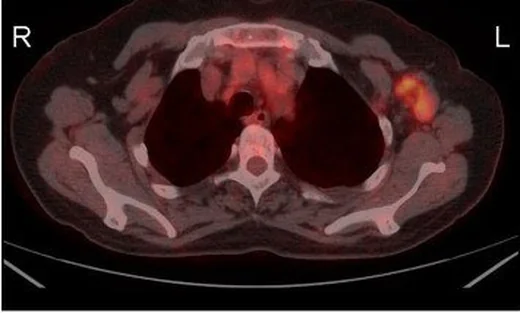
Meme kanseri, başta aynı taraf aksiller nodlar olmak üzere internal mammary ve supraklaviküler bölgesel lenfatik istasyonlara yayılabilir. Kontrastlı toraks BT bu zincirleri ve eşlik eden göğüs içi hastalığı birlikte gösterir, ancak küçük hacimli nodal metastazı dışlayamaz ve nodal evreyi tek başına doğrulamaz. Morfoloji, taraf, nodların dağılımı ve primer meme bulgusuyla uyum birlikte değerlendirilmelidir. Şüpheli bölgesel nodların gözden kaçması hastalık yaygınlığının eksik bildirilmesine yol açabilir.
Faz ve pencere
- Portal tanısal
- Kontrastlı toraks BT'de aksiller seviyeler, infraklaviküler alan, internal mammary zincir ve supraklaviküler fossadaki nodların kısa ekseni, oval/yuvarlak biçimi, yağlı hilus seçilebilirliği ve çevre yağ planı incelenir. Heterojen kontrastlanan, yuvarlaklaşmış veya perinodal sınırlanması bozulmuş nodlar şüphe uyandırır; normal boyuttaki nodda mikrometastaz dışlanamaz.
Önerilen pencereler: Yumuşak doku (G 400 / M 40), Mediasten (G 350 / M 50).
BT bulguları
- Yuvarlak nod morfolojisi — uzun ekseni baskın oval nod yerine kısa ve yuvarlak konturlu nod şüphe uyandırır; boyut tek başına yeterli değildir.
- Yağlı hilus kaybı — normal nod içindeki yağlı merkez seçilemez veya tüm nod homojen yumuşak doku atenüasyonuna dönüşür.
- Kortikal asimetri — kalın ve eksantrik yumuşak doku komponenti, düzgün ince korteksli oval noddan ayrılır.
- BT’nin primer nodal evrelemedeki sınırlı rolü ve orta duyarlılık, düşük özgüllüğü nedeniyle nod içi düşük atenüasyon veya heterojen kontrastlanma tek başına metastazı doğrulamaz.
- Perinodal yayılım — BT’de aksiller nod metastazının değerlendirilmesinde duyarlılık orta, özgüllük düşüktür; bu nedenle çevre yağ planındaki değişiklik tek başına kapsül dışı hastalığı doğrulamaz.
- İpsilateral çoklu nod dağılımı — meme bulgusuyla aynı tarafta birden fazla şüpheli aksiller nod bölgesel yayılım paternini destekler.
- Ek bölgesel istasyonlar — internal mammary zincir, infraklaviküler ve supraklaviküler nodları aksilla dışında ayrıca tarayın.
Normalde
Normal aksiller nodlar çoğunlukla oval, düzgün sınırlı, ince korteksli ve korunmuş yağlı hilusludur; iki taraf arasında hafif boyut farkı tek başına hastalık anlamına gelmez. Meme kanserinin bölgesel lenfatik havzaları aksilla, internal mammary ve supraklaviküler bölgeleri içerir. Aksiller nodlarda şekil, korteks, sınırlar ve yağlı hilusu değerlendirin.
Normal BT ile kıyasla
Aynı bölgenin, kaynak veri setinde patoloji içermediği belirtilen bir BT incelemesini kesit kesit kaydırın; organ sınırlarını açarak anatomiyi hasta görüntüsüyle karşılaştırın. Küçük rastlantısal bulgular tümüyle dışlanmamıştır.
Kaynak: TotalSegmentator v2.01 veri seti (Wasserthal ve ark., Radiology: Artificial Intelligence 2023), CC BY 4.0, vaka s0975; organ sınırları veri setinin otomatik segmentasyonundan, birleştirilerek sadeleştirildi. Görüntüler 2,5 mm kesit aralığına yeniden örneklendi.
Ayırıcı tanı
- Reaktif lenf nodu
- enfeksiyon veya aşı sonrası genellikle korunmuş yağlı hiluslu oval nodlar görülebilir; dağılım klinik bağlam ve önceki incelemeyle karşılaştırılır.
- Lenfoma
- birden fazla nodal istasyonda homojen büyümüş nodlar ve eşlik eden mediastinal zincir tutulumu olabilir; bilinen meme primeri ve nodal morfoloji ayrımda önemlidir.
- Tüberküloz lenfadeniti meme kanseriyle eşzamanlı nodal hastalığı taklit edebilir; ayrımda klinik değerlendirme ve gerektiğinde histopatolojik doğrulama önemlidir.
- Aşı ilişkili aksiller adenopati
- çoğu kez yakın dönem aşı yapılan tarafta ve reaktif morfolojide görülür; zaman ilişkisi ve karşı meme/aksilla bulguları sorgulanır.
- Silikon lenfadenopatisi, implant rüptürü veya silikon göçüyle ilişkili olup meme kanseri metastazını taklit edebilir; US'deki “snowstorm” bulgusu ve MRG silikon göçünü göstermeye yardımcı olur, histopatoloji tanıyı doğrulayabilir.
Tuzaklar
- Kısa eksen boyutunu tek başına metastaz ölçütü saymayın; küçük metastatik nodlar olabilir, büyük reaktif nodlar da görülebilir.
- Tek taraf aksiller nodu aşı öyküsünü ve kol/meme enfeksiyonunu sormadan metastaz diye etiketlemeyin; fakat bilinen primerde morfolojik şüpheyi de boyut normal diye yok saymayın.
- Internal mammary zinciri aksilladan ayrı bir drenaj yolu olarak değerlendirin; internal mammary arter ve ven boyunca, sternum kenarına yakın seyreder.
- BT'nin yağlı hilusu sınırlı uzaysal çözünürlük veya kısmi hacim etkisiyle seçemeyebileceğini hesaba katın; şüpheyi tanı doğrulaması olarak sunmayın.
Kendini dene
Bilinen sağ meme tümörüyle aynı tarafta hilusu silinmiş, yuvarlak aksiller nod ve internal mammary nod var. En olası açıklama nedir?
Cevabı göster
Bölgesel nodal metastaz. Primerle aynı tarafta iki bölgesel istasyonda şüpheli morfoloji yayılım olasılığını yükseltir. Aşı ve enfeksiyon çoğunlukla reaktif bağlamla, silikon lenfadenopatisi implant ilişkili bulgularla desteklenir; görüntüleme bulguları histolojik doğrulamanın yerine geçmez.
Aksiller nod büyümüş ancak oval, düzgün sınırlı ve yağlı hilusu korunmuş; yakın zamanda aynı koldan aşı yapılmış. En olası seçenek nedir?
Cevabı göster
Reaktif lenf nodu. Korunmuş hilus ve oval biçim, aşı sonrası uygun taraf-zaman ilişkisiyle reaktif nodu destekler. Metastaz ve lenfomada morfoloji veya diğer nodal istasyonlar şüphe uyandırabilir; silikon nodu için implant/silikon göçü bağlamı gerekir.
İlgili konular
Kaynaklar
Bu sayfadaki 38 cümle ve 2 quiz sorusu aşağıdaki kaynaklardan alıntılarla otomatik olarak karşılaştırıldı; 7 cümle bu karşılaştırmada düzeltildi (2026-10-09).
- Lymph Node Imaging in Patients with Primary Breast Cancer: Concurrent Diagnostic Toolspmc.ncbi.nlm.nih.gov
- Internal mammary lymphadenopathy in breast cancer: a narrative review and updatepmc.ncbi.nlm.nih.gov
- Internal mammary lymph node metastasis in breast cancer patients based on anatomical imaging and functional imagingpmc.ncbi.nlm.nih.gov
- Management of thyroid cancer: United Kingdom National Multidisciplinary Guidelines.pubmed.ncbi.nlm.nih.gov
- A Case of Male Breast Cancer with a BRCA Gene Mutation.pubmed.ncbi.nlm.nih.gov
- Breast Cancer Skip Metastases: Frequency, Associated Tumor Characteristics, and Role of Staging Nodal Ultrasound in Detection.pubmed.ncbi.nlm.nih.gov
- PET Probe-Guided Surgery in Patients with Breast Cancer: Proposal for a Methodological Approach.pubmed.ncbi.nlm.nih.gov
- Elevated sHLA-G plasma levels post chemotherapy combined with ILT-2 rs10416697C allele status of the sHLA-G-related receptor predict poorest disease outcome in early triple-negative breast cancer patients.pubmed.ncbi.nlm.nih.gov
- Creation of RTOG compliant patient CT-atlases for automated atlas based contouring of local regional breast and high-risk prostate cancers.pubmed.ncbi.nlm.nih.gov
- Whole-body 18 F-fluorodeoxyglucose positron emission tomography-computed tomography ( 18 F-FDG PET/CT) for staging locally advanced breast cancer: A prospective study from a tertiary cancer centre in south India.pubmed.ncbi.nlm.nih.gov
- Unusual Metastatic Lymph Node to Retro-Scapular Area in Occult Breast Cancer: A Case Report.pubmed.ncbi.nlm.nih.gov
- Predictors and prevalence of lateral supraclavicular lymph node metastases on [ 18 F]FDG PET/CT in patients with locally advanced, or multifocal invasive ductal carcinoma of breast: potential impact on adjuvant radiotherapy targets.pubmed.ncbi.nlm.nih.gov
- Case Report: FAPI PET/CT detected occult contralateral DCIS and supraclavicular metastasis, guiding neoadjuvant therapy in synchronous bilateral breast cancer.pubmed.ncbi.nlm.nih.gov
- Primary Surgery in Metastatic Breast Cancer.pubmed.ncbi.nlm.nih.gov
- Axillary De-Escalation After Neoadjuvant Therapy in cN2/N3 HER2-Positive and Triple-Negative Breast Cancer: Navigating Biological Promise and Clinical Uncertainty.pubmed.ncbi.nlm.nih.gov
- Diagnostic Concordance Between Contrast-Enhanced CT and Bone Scintigraphy for Detecting Bone Metastases in Clinical T3/N1 Breast Cancer.pubmed.ncbi.nlm.nih.gov
- Extensive Axillary Nodal Metastasis Despite a Clinically Negative Axilla in Invasive Lobular Carcinoma: A Case Report.pubmed.ncbi.nlm.nih.gov
- PET Imaging in Vulvar Cancer: A Literature Review of the Current Evidence and Clinical Applications.pubmed.ncbi.nlm.nih.gov
- Multimodal Assessment of Breast Cancer-Related Lymphedema Using Bioimpedance Analysis, Ultrasound Tissue Thickness, and Shear Wave Elastography.pubmed.ncbi.nlm.nih.gov
- BI-RADS v2025 for breast ultrasound: key updates and Asian perspectives.pubmed.ncbi.nlm.nih.gov
- Development and validation of a logistic regression model based on multiparametric MRI for differentiating triple-negative from non-triple-negative breast cancer.pubmed.ncbi.nlm.nih.gov
- The effect of the number of negative lymph nodes removed during surgery on the survival and recurrence rates of patients with breast cancer after surgery.pubmed.ncbi.nlm.nih.gov
- Socio-demographic factors, tumor characteristics, treatments administered, and survival in cancer patients in a prison hospitalization unit: a retrospective cohort comparison with matched community controls.pubmed.ncbi.nlm.nih.gov
- Effective Predictor Factors for Lymph Node Metastasis and Survival in Patients with Betel Nut-Related Oral Squamous Cell Carcinoma.pubmed.ncbi.nlm.nih.gov
- Diagnostic Potential of Apparent Diffusion Coefficient-Based Lymph Node Classification in Breast Cancer Patients Undergoing [<sup>18</sup>F]FDG-PET/MRI.pubmed.ncbi.nlm.nih.gov
- Dual-Energy CT Material Decomposition: The Value in the Detection of Lymph Node Metastasis from Breast Cancer.pubmed.ncbi.nlm.nih.gov
- Abbreviated MRI for Comprehensive Regional Lymph Node Staging during Pre-Operative Breast MRI.pubmed.ncbi.nlm.nih.gov
- Subtype-specific sonographic signatures and clinicopathological features of metaplastic breast cancer: a 50-case cohort study.pubmed.ncbi.nlm.nih.gov
- Differentiating Pure and Mixed Mucinous Breast Carcinoma Using Multimodality Imaging: A Retrospective Single-Center Study.pubmed.ncbi.nlm.nih.gov
- Case Report: Spindle cell metaplastic breast carcinoma.pubmed.ncbi.nlm.nih.gov
- Ectopic β-hCG-Expressing Hepatic Neoplasm with Cutaneous Metastasis in a Young Postpartum Woman: A Case Report and Literature Review.pubmed.ncbi.nlm.nih.gov
- International Harmonization of Nomenclature and Diagnostic Criteria (INHAND): Non-proliferative and Proliferative Lesions of the Non-human Primate ( M. fascicularis ).pubmed.ncbi.nlm.nih.gov
- Patterns of injury and violence in Yaoundé Cameroon: an analysis of hospital data.pubmed.ncbi.nlm.nih.gov
- Prospective Evaluation of CEUS-URM in Axillary Lymph Nodes with Diffuse Cortical Thickening in Breast Cancer Patients.pubmed.ncbi.nlm.nih.gov
- Breast Imaging Reporting and Data System v2025: Key Updates in US.pubmed.ncbi.nlm.nih.gov
- Small intestinal metastasis of triple-negative breast cancer mimicking lymphoma: imaging findings and case report.pubmed.ncbi.nlm.nih.gov
- Adenoid cystic carcinoma of the breast: report of the diagnosis and management of two cases.pubmed.ncbi.nlm.nih.gov
- Diagnostic challenges and prognostic implications of extranodal extension in head and neck cancer: a state of the art review and gap analysis.pubmed.ncbi.nlm.nih.gov
- Beyond N Staging in Breast Cancer: Importance of MRI and Ultrasound-based Imaging.pubmed.ncbi.nlm.nih.gov
- S1 guideline sweat gland carcinoma.pubmed.ncbi.nlm.nih.gov
- Comprehensive management of submandibular salivary duct carcinoma with unilateral axillary lymph node metastasis: a case report.pubmed.ncbi.nlm.nih.gov
- Nonproliferative and Proliferative Lesions of the Rat and Mouse Hematolymphoid System.pubmed.ncbi.nlm.nih.gov
- Total laparoscopic radical hysterectomy for cervical cancer in prolapsed uterus.pubmed.ncbi.nlm.nih.gov
- Implantable venous access port placement in the upper arm of breast cancer patients with persistent left superior vena cava: a case series and literature review.pubmed.ncbi.nlm.nih.gov
- Regional Nodal Irradiation in Early-Stage Breast Cancer.pubmed.ncbi.nlm.nih.gov
- Invited review: Recommendations for reporting intervention studies on reproductive performance in dairy cattle: Improving design, analysis, and interpretation of research on reproduction.pubmed.ncbi.nlm.nih.gov
- State-of-the-Art Review: Contemporary Ambulatory Approach to Adult Fever of Unknown Origin.pubmed.ncbi.nlm.nih.gov
- Special Issue: EACR 2026 Congress: Innovative Cancer Science, 8-11 June 2026.pubmed.ncbi.nlm.nih.gov
- Extranodal involvement in lymphoma - A Pictorial Essay and Retrospective Analysis of 281 PET/CT studies.pubmed.ncbi.nlm.nih.gov
- Case Report: Concurrent thyroid tuberculosis and tuberculous lymphadenitis initially misdiagnosed as malignancy by <sup>18</sup>F-FDG PET/CT.pubmed.ncbi.nlm.nih.gov
- Systemic Sarcoidosis Presenting With Hypercalcemia, Acute Kidney Injury, and Diffuse Lymphadenopathy: Unlocking Pandora's Box.pubmed.ncbi.nlm.nih.gov
- Head and Neck Manifestation of Tuberculosis.pubmed.ncbi.nlm.nih.gov
- Axillary Lymphadenopathy in the COVID-19 Era: What the Radiologist Needs to Know.pubmed.ncbi.nlm.nih.gov
- Silicone Axillary Lymphadenopathy Associated With Rupture of Fourth-Generation Cohesive Silicone Breast Implants Following Breast Augmentation.pubmed.ncbi.nlm.nih.gov
- Diagnostic dilemma of silicone-induced ipsilateral internal mammary lymphadenopathy mimicking breast cancer recurrence after mastectomy: a case report.pubmed.ncbi.nlm.nih.gov
- Granuloma-Related Hypercalcemia Secondary to Silicone-Induced Granulomatous Lymphadenopathy: A Case Report.pubmed.ncbi.nlm.nih.gov
- Radiomics-based prediction model for lymph node metastasis in thyroid microcarcinoma.pubmed.ncbi.nlm.nih.gov
- Intraoperative Ex Vivo Shear-Wave Elastography of Sentinel Lymph Nodes in Endometrial Cancer and Other Gynaecological Malignancies.pubmed.ncbi.nlm.nih.gov
- Lymph Node Metastasis in Head and Neck Squamous Cell Carcinoma: Evolving Prognostic Markers, Molecular Insights, and Implications for Precision Staging.pubmed.ncbi.nlm.nih.gov
- COVID-19 Vaccination and Pulmonary Nodules: A Narrative Review of Causality, Detection Bias and Thoracic Imaging Pitfalls.pubmed.ncbi.nlm.nih.gov
- Tattoos causing local and even generalized lymphadenopathies including sarcoidosis.pubmed.ncbi.nlm.nih.gov
- Lymph Node Assessment with Multiparametric Ultrasound: Normal Values, Morphologic Patterns, and Diagnostic Algorithms.pubmed.ncbi.nlm.nih.gov
- Diagnostic Performance of ⁶⁸Ga-FAPI PET/CT, ¹⁸F-FDG PET/CT, and Breast MRI for Assessing Tumor Extent and Axillary Metastasis in Breast Cancer: A Histopathology-Referenced Retrospective Study.pubmed.ncbi.nlm.nih.gov
- Automatic metabolic breast cancer staging using [¹⁸F]FDG PET/CT: comparison with nuclear medicine physician-based and clinical staging.pubmed.ncbi.nlm.nih.gov
- Costal synostosis mimicking supraclavicular lymphadenopathy in a breast cancer patient: A diagnostic pitfall.pubmed.ncbi.nlm.nih.gov
- Computed tomographic Characteristics of Presumed Normal Canine Iliosacral Lymph Nodes.pubmed.ncbi.nlm.nih.gov
- Cross-sectional imaging in cancers of the head and neck: how we review and report.pubmed.ncbi.nlm.nih.gov
- Best Practice Recommendations for Infertility Management.pubmed.ncbi.nlm.nih.gov
- Post-mastectomy radiation therapy in Poland syndrome with left breast cancer: A case report.pubmed.ncbi.nlm.nih.gov
- The PRINCE-BC trial: precision regional irradiation of nodal stations for clinical evaluation of high-risk pN0 breast cancer - a phase III, open-label, randomized controlled trial.pubmed.ncbi.nlm.nih.gov
- A Case of Invasive Ductal Carcinoma with Axillary Skip Metastasis Confined to the Interpectoral (Rotter's) Lymph Node.pubmed.ncbi.nlm.nih.gov
- Male accessory breast mucinous carcinoma: a case report and literature review.pubmed.ncbi.nlm.nih.gov
- Twenty-year results of the randomized European Organization for Research and Treatment of Cancer trial 22922/10925 evaluating internal mammary chain and medial supraclavicular lymph node irradiation in stage I-III breast cancer.pubmed.ncbi.nlm.nih.gov
- A multimodal imaging-based decision tree for preoperative axillary risk stratification in breast cancer: a retrospective clinical utility analysis.pubmed.ncbi.nlm.nih.gov
- Ultrasound for Early Detection of Melanoma Lymph Node Metastasis and Wire Localization of Nonpalpable Findings: A Case Report.pubmed.ncbi.nlm.nih.gov
- Development and validation of a nomogram for predicting axillary reverse mapping lymph node metastasis in breast cancer patients.pubmed.ncbi.nlm.nih.gov
- Quantitative parameters of dual-layer spectral CT for differentiating metastatic and non-metastatic lymph nodes in colorectal cancer.pubmed.ncbi.nlm.nih.gov
- Prognostic value of pretherapy CT-based Node-RADS for overall survival in extensive-stage small cell lung cancer treated with chemoimmunotherapy: a comparison with clinical N staging.pubmed.ncbi.nlm.nih.gov
- Clipped Node Pathology as a Guide for Limited Axillary Surgery in Occult Breast Cancer.pubmed.ncbi.nlm.nih.gov
- Movement Disorders Associated With Breast Cancer: A Systematic Review.pubmed.ncbi.nlm.nih.gov
- Case Report: Primed dendritic cell immunotherapy for multiple solid tumors.pubmed.ncbi.nlm.nih.gov
- Thymus and aging: morphological, radiological, and functional overview.pubmed.ncbi.nlm.nih.gov
- The Spectrum of Human Herpesvirus 8/Epstein-Barr Virus-Co-Positive Lymphoproliferations and Lymphomas.pubmed.ncbi.nlm.nih.gov
- Isolated Regional Nodal Recurrence After Primary Breast Cancer: Risk Factors and Survival by Mode of Detection.pubmed.ncbi.nlm.nih.gov
- Clinical Implications of the Langer's Axillary Arch Muscle in Breast Cancer Patients.pubmed.ncbi.nlm.nih.gov
- Navigating lymphatic drainage uncertainty in abdominal ectopic breast cancer: a novel application of indocyanine green fluorescence-a case report and literature review.pubmed.ncbi.nlm.nih.gov
- Predictors of sentinel lymph node metastasis in cT1-2 cN0 breast cancer: A retrospective cohort study.pubmed.ncbi.nlm.nih.gov
- Less is more: the role of preoperative ultrasound as a risk stratifying tool in identifying low volume axillary disease in breast cancer.pubmed.ncbi.nlm.nih.gov
- The role of <sup>68</sup>Ga-FAPi PET/CT in Staging and Restaging of Breast Cancer Subtypes with Limited <sup>18</sup>F-FDG Uptake.pubmed.ncbi.nlm.nih.gov
- Ex Vivo Shear-Wave Elastography for Intraoperative Prediction of Axillary Lymph Node Metastasis in Breast Cancer.pubmed.ncbi.nlm.nih.gov
- Breast cancer after polyacrylamide hydrogel augmentation: A clinicopathological analysis of 5 cases and literature review.pubmed.ncbi.nlm.nih.gov
- Prostate Cancer Recurrence Mimicking a Primary Paranasal Sinus Tumor on <sup>18</sup>F-FDG PET/CT During Treatment for Metastases After 10 Years of Remission.pubmed.ncbi.nlm.nih.gov
- Effect of capsule invasion on recurrence and survival in axillary lymph node metastases of breast cancer.pubmed.ncbi.nlm.nih.gov
- Prognostic significance of extracapsular extension in patients with non-small cell lung cancer following neoadjuvant chemoimmunotherapy: a retrospective cohort study.pubmed.ncbi.nlm.nih.gov
- YAP-activated lymph node fibroblasts contribute to extracellular matrix remodeling associated with extranodal extension of oral squamous cell carcinoma.pubmed.ncbi.nlm.nih.gov
- Clinical Predictors of Dosimetric Precedence for Deep Inspiratory Breath Hold Radiation Therapy for Breast Cancer.pubmed.ncbi.nlm.nih.gov
- Evaluation of Patterns of Recurrences in Patients With Breast Carcinoma: Are We Treating the Right Volumes, or Does the Tumor Biology Play the Role?pubmed.ncbi.nlm.nih.gov
- Co-existent breast malignancy and contralateral primary axillary tuberculosis.pubmed.ncbi.nlm.nih.gov
- Extrapulmonary tuberculosıs: an old but resurgent problem.pubmed.ncbi.nlm.nih.gov
- Late breast cancer recurrence concurrent with silicone breast implant rupture 17 years after mastectomy and immediate implant-based reconstruction in a 53-year-old woman: a case report.pubmed.ncbi.nlm.nih.gov
- Beyond the lung: recognizing incidental breast lesions on chest computed tomography.pubmed.ncbi.nlm.nih.gov
- From Dyspnea to Suspected Breast Cancer: A Post-traumatic Hematoma as a Diagnostic Pitfall.pubmed.ncbi.nlm.nih.gov
- Targeted axillary dissection in breast cancer patients: a systematic review and meta-analysis.pubmed.ncbi.nlm.nih.gov
- Rethinking lymphadenectomy in the immunotherapy era of colorectal cancer: A hypothesis-generating perspective.pubmed.ncbi.nlm.nih.gov
- Axillary surgical de-escalation after neoadjuvant therapy in breast cancer: current evidence, clinical controversies, and future directions.pubmed.ncbi.nlm.nih.gov
- Case Report: Metachronous bilateral primary and secondary angiosarcoma of the breast.pubmed.ncbi.nlm.nih.gov
- Omission of axillary surgery in cN0, postmenopausal ER-positive/HER2-negative breast cancer patients undergoing breast-conserving treatment.pubmed.ncbi.nlm.nih.gov
- Superomedial Versus Inferior Pedicle Therapeutic Reduction Mammoplasty for Breast Cancer Patients with 35-40 cm Sternal Notch-to-Nipple Distance.pubmed.ncbi.nlm.nih.gov
- A comparative study between central quadrantectomy and nipple resection with areola preservation Versus Grisotti flap mammoplasty in central breast lesions extending to nipple: a randomized clinical trial.pubmed.ncbi.nlm.nih.gov
- Radiologic Axillary Response After Neoadjuvant Chemotherapy in cN2 Breast Cancer: Decision Support for Selective Axillary De-Escalation.pubmed.ncbi.nlm.nih.gov
- Role of Whole-Body Magnetic Resonance Imaging in Detecting Metastasis in Patients With Known Cancer.pubmed.ncbi.nlm.nih.gov
- Diagnostic Accuracy of PET Imaging for Lymph Node Detection in Breast cancer patients undergoing Upfront Surgery: A Single-Institution Analysis of Breast Cancer Patients.pubmed.ncbi.nlm.nih.gov
- Assessment of breast cancer and feasibility of subtyping of breast cancer using thoracoabdominal staging photon-counting detector computed tomography.pubmed.ncbi.nlm.nih.gov
Eğitim amaçlıdır; hasta başında tanı ve tedavi kararının yerine geçmez, tıbbi tavsiye değildir. Metinler yapay zekâ desteğiyle yazıldı ve otomatik bir adımda kaynak alıntılarıyla karşılaştırıldı; bu bir tıbbi doğrulama değildir ve içerik uzman radyolog incelemesinden geçmedi. Klinik kararlarda güncel kılavuzları, kurum protokollerini ve radyoloji raporunu esas alın.