Özet
Posterior reversible ensefalopati sendromu (PRES), hipertansiyon, eklampsi, böbrek yetmezliği, sepsis veya immünosupresif tedavilerle ilişkili akut nörolojik belirtiler ve çoğunlukla vazojenik ödem örüntüsüdür. Kontrastsız BT parieto-oksipital bölgede hipodensite gösterebilse de pres tanısı için manyetik rezonans görüntüleme kadar duyarlı değildir ve incelemeler normal çıkabilir. Tipik dağılım iki taraflı posterior kortikal-subkortikal alanları tutar, ancak frontal loblar, serebellum, beyin sapı veya derin gri çekirdekler de etkilenebilir. BT'de görünürlüğün sınırlı olması PRES'i dışlamaz; eşlik eden kanama, infarkt veya hidrosefaliyi kaçırmak ciddi sonuç doğurabilir.
Faz ve pencere
- Kontrastsız
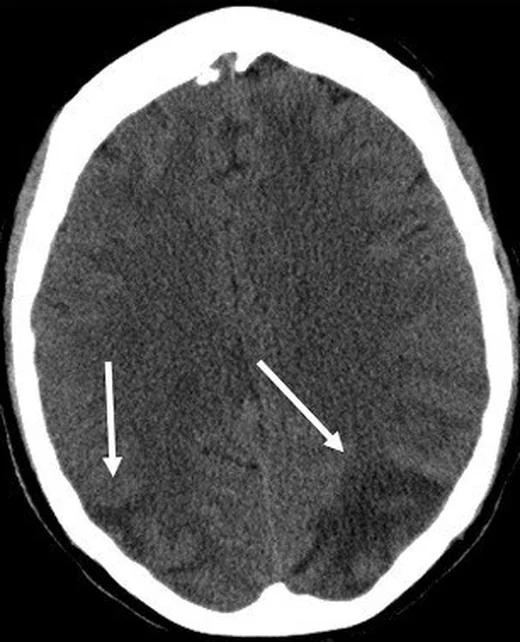
- Kontrastsız BT'de parieto-oksipital loblarda, sıklıkla iki taraflı kortikal-subkortikal düşük atenüasyon ve giral şişkinlik görülebilir; hafif ödemde inceleme normal kalabilir. Aynı inceleme intraparenkimal, subaraknoid veya intraventriküler kanama ile belirgin kitle etkisini gösterir.
Önerilen pencereler: Beyin (G 80 / M 40), Subdural (G 200 / M 75).
BT bulguları
- Posterior ağırlıklı bilateral hipodensite — parietal ve oksipital loblarda genellikle simetrik, bazen asimetrik düşük atenüasyon vazojenik ödemi düşündürür.
- Kortikal-subkortikal tutulum — hipodensite subkortikal beyaz cevherde belirgin olabilir ve komşu kortekse uzanabilir; yalnızca tek bir arter sahasına uymaz.
- Ödemle ilişkili kitle etkisi sulkus silinmesine ve ventrikül basısına yol açabilir.
- Atipik anterior veya merkezi dağılım — frontal loblar, inferior temporal loblar, serebellum, beyin sapı ve bazal ganglionlar posterior örüntüye eşlik edebilir ya da baskın olabilir.
- İntraparenkimal kanama — ödem alanı içinde veya komşuluğunda parankimal hematom görülebilir; kanama varlığı PRES olasılığını tek başına dışlamaz.
- Subaraknoid veya sulkal kan — kortikal sulkuslarda hiperdens kan çizgileri seçilebilir; ödemli bölge ve bazal sisternlerle ilişkisi dikkatle incelenmelidir.
- Kitle etkisi ve hidrosefali — ventrikül sıkışması, orta hat kayması ya da akut hidrosefali ağır ödem veya kanama eşliğini gösterir.
- Normal BT — belirgin parankim hipodensitesi saptanmasa bile klinik şüphe sürüyorsa PRES dışlanmış sayılmaz; MR FLAIR/DWI daha duyarlıdır.
Normalde
Normal parieto-oksipital korteks ve subkortikal beyaz cevher iki hemisferde benzer atenüasyonda, giral konturlar ve konveksite sulkusları açık olarak izlenir. Aynı aksiyel düzeyde sağ-sol parietal ve oksipital lobları; sulkus açıklığı, kortikal kalınlık ve lateral ventrikül atriumlarına bası açısından kıyaslayın, ardından frontal lob ve serebellumda benzer ödem olup olmadığını kontrol edin.
Normal BT ile kıyasla
Aynı bölgenin, kaynak veri setinde patoloji içermediği belirtilen bir BT incelemesini kesit kesit kaydırın; organ sınırlarını açarak anatomiyi hasta görüntüsüyle karşılaştırın. Küçük rastlantısal bulgular tümüyle dışlanmamıştır.
Kaynak: TotalSegmentator v2.01 veri seti (Wasserthal ve ark., Radiology: Artificial Intelligence 2023), CC BY 4.0, vaka s0103; organ sınırları veri setinin otomatik segmentasyonundan, birleştirilerek sadeleştirildi. Görüntüler 2,5 mm kesit aralığına yeniden örneklendi.
Ayırıcı tanı
- Posterior serebral arter infarktı
- oksipital kortekste PCA sulama alanına uyan daha keskin sınırlı değişiklik ve eşlik eden talamik/medial temporal bulgular görülebilir; PRES genellikle vasküler sınırları aşan bilateral ödem yapar.
- Serebral venöz sinüs trombozu
- venöz drenaj alanına uymayan ödem ve hemorajik venöz infarkt oluşturabilir; şüphede BT venografi veya MR venografi gerekir.
- Hipoksik-iskemik hasar
- yaygın korteks ve derin gri cevher gri-beyaz ayrım kaybı oluşturur; posterior watershed ödeminden çok global dağılım ve hipoksi öyküsü ayırıcıdır.
- Ensefalit
- temporal ya da limbik ağırlıklı asimetrik şişme ve ödem gösterebilir; klinik enfeksiyon bulguları ve MR dağılımı yardımcıdır.
- İskemik sitotoksik ödem
- arter sahasına uyan gri-beyaz cevher hipodensitesi ve sulkus silinmesi beklenir; BT tek başına vazojenik-sitotoksik ayrımı güvenilir biçimde yapamaz, DWI/ADC gerekir.
Tuzaklar
- PRES adındaki 'reversible' sözcüğünü görüntüleme güvencesi kabul etmeyin; infarkt, hematom ve kalıcı hasar gelişebilir.
- Kontrastsız BT'nin normal olmasını PRES dışlama ölçütü saymayın; devam eden klinik şüphede MR FLAIR ve difüzyon incelemesi daha duyarlıdır.
- Posterior hipodensiteyi otomatik olarak PRES diye adlandırmayın; PCA infarktı ve venöz tromboz damar alanı, kanama ve klinik bağlamla ayrılmalıdır.
- Kanama saptandığında PRES olasılığını silmeyin; hematom veya sulkal kan ödemle aynı incelemede bulunabilir.
Kendini dene
Nöbet ve akut hipertansiyonla başvuran hastanın BT'sinde bilateral parieto-oksipital kortikal-subkortikal hipodensite ve sulkus silinmesi görülüyor. En olası tanı nedir?
Cevabı göster
PRES. Bilateral posterior kortikal-subkortikal ödemin tek bir arter alanına uymaması ve akut hipertansiyon bağlamı PRES'i destekler. Tek bir arteriyel oklüzyona bağlı iskemik lezyon belirli bir arter sahasına uyabilir; PRES ile ayırıcı değerlendirmede bu dağılım dikkate alınmalıdır.
Posterior ödem benzeri alanın içinde küçük hiperdens parankimal kan odağı izleniyor. Bu durum PRES tanısını nasıl etkiler?
Cevabı göster
PRES ile uyumludur, sık görülen bir komplikasyondur. PRES olgularının yaklaşık %17'sinde kanamalı bulgular bildirilmiştir; bunlar intraparankimal, subaraknoid veya mikrokanama biçiminde olabilir. Kanama PRES ile birlikte görülebildiğinden tanıyı tek başına dışlamaz.
İlgili konular
Kaynaklar
Bu sayfadaki 39 cümle ve 2 quiz sorusu aşağıdaki kaynaklardan alıntılarla otomatik olarak karşılaştırıldı; 5 cümle bu karşılaştırmada düzeltildi (2026-10-09).
- Posterior Reversible Encephalopathy Syndrome in a Postpartum Patient With Eclampsiapmc.ncbi.nlm.nih.gov
- Malignant Posterior Reversible Encephalopathy Syndrome (PRES) After Allogeneic Hematopoietic Stem Cell Transplantation Requiring Emergency Decompressive Craniectomy: A Case Reportpmc.ncbi.nlm.nih.gov
- Idiopathic Posterior Reversible Encephalopathy Syndrome (PRES) in a 4-month-old infant: a case reportpmc.ncbi.nlm.nih.gov
- Beware the Ides of Chemotherapy: A Report on Hyperammonemic Encephalopathy Induced by FOLFOX-6 (5-Fluorouracil, Leucovorin, and Oxaliplatin)pmc.ncbi.nlm.nih.gov
- Atypical Posterior Reversible Encephalopathy Syndrome with Intraventricular Hemorrhage in a Patient with Eclampsia : A Case Reportpmc.ncbi.nlm.nih.gov
- Oxaliplatin-Induced Tonic-Clonic Seizures.pubmed.ncbi.nlm.nih.gov
- Thunderclap headache.pubmed.ncbi.nlm.nih.gov
- A Pictorial Review of Postpartum Complications.pubmed.ncbi.nlm.nih.gov
- [Septic encephalopathy].pubmed.ncbi.nlm.nih.gov
- Imaging of neurovascular emergencies in pregnancy and puerperium.pubmed.ncbi.nlm.nih.gov
- Early postmortem brain MRI findings in COVID-19 non-survivors.pubmed.ncbi.nlm.nih.gov
- Idiopathic pulmonary hemosiderosis - A rare cause of chronic anemia.pubmed.ncbi.nlm.nih.gov
- Radiological findings of multisystem inflammatory syndrome in children associated with COVID-19.pubmed.ncbi.nlm.nih.gov
- How to monitor the brain in septic patients?pubmed.ncbi.nlm.nih.gov
- Posterior Reversible Encephalopathy Syndrome (PRES): Evolving the Mystery of Eclampsia!pubmed.ncbi.nlm.nih.gov
- Posterior fossa mass in immunosuppressed patient.pubmed.ncbi.nlm.nih.gov
- PP120. Hydatidiform mole as a cause of eclampsia in the first trimester: A case report.pubmed.ncbi.nlm.nih.gov
- Posterior Reversible Encephalopathy Syndrome: A Narrative Review for Emergency Clinicians.pubmed.ncbi.nlm.nih.gov
- Posterior reversible encephalopathy syndrome (PRES): presentation, diagnosis and treatment.pubmed.ncbi.nlm.nih.gov
- Case 346.pubmed.ncbi.nlm.nih.gov
- Posterior Reversible Encephalopathy Syndrome (PRES) Associated With Eclampsia in a Pregnant Adolescent: A Case Report.pubmed.ncbi.nlm.nih.gov
- Posterior Reversible Encephalopathy Syndrome Associated With Severe Proton Pump Inhibitor-Induced Hypomagnesemia: A Rare Case.pubmed.ncbi.nlm.nih.gov
- Acute Bilateral Vision Loss in Pregnancy: A Case of Posterior Reversible Encephalopathy Syndrome.pubmed.ncbi.nlm.nih.gov
- Multiterritory Acute Ischemic Stroke with Bilateral Middle Cerebellar Peduncle T2/FLAIR Hyperintensities in the Setting of a Fatal Systemic Arterial Thrombotic Process: A Case Report.pubmed.ncbi.nlm.nih.gov
- Hypertensive crisis in the critically ill.pubmed.ncbi.nlm.nih.gov
- Systemic Immune-Inflammation Index and Clinical Predictors of Atypical PRES in Eclampsia: Higher Blood Pressure and Inflammatory Burden Drive Multi-Regional Involvement.pubmed.ncbi.nlm.nih.gov
- Hemorrhagic posterior reversible encephalopathy syndrome with pontine infarction in early-onset eclampsia: An atypical MRI spectrum.pubmed.ncbi.nlm.nih.gov
- Posterior Reversible Encephalopathy Syndrome in a Postpartum Patient With Eclampsia.pubmed.ncbi.nlm.nih.gov
- Neurological manifestations and neuroimaging findings in patients with SARS-CoV2-a systematic review.pubmed.ncbi.nlm.nih.gov
- Ischemic posterior circulation stroke: a review of anatomy, clinical presentations, diagnosis, and current management.pubmed.ncbi.nlm.nih.gov
- The human frontal lobes and frontal network systems: an evolutionary, clinical, and treatment perspective.pubmed.ncbi.nlm.nih.gov
- Contrast-induced encephalopathy presenting with refractory status epilepticus following endovascular coiling of an intracranial aneurysm: A case report and literature review.pubmed.ncbi.nlm.nih.gov
- Clinical Characteristics of COVID-19-Related Reversible Cerebral Vasoconstriction Syndrome: A Systematic Review of Case Series.pubmed.ncbi.nlm.nih.gov
- Non-contrast CT findings suggestive of secondary intracerebral haemorrhage.pubmed.ncbi.nlm.nih.gov
- Posterior reversible encephalopathy syndrome in Colombia a case series.pubmed.ncbi.nlm.nih.gov
- Obstacles and Trials in Treating Primary Brain Tumors.pubmed.ncbi.nlm.nih.gov
- Consecutive PRES and diffuse alveolar hemorrhage in a patient with active lupus nephritis and antiphospholipid antibodies: a case report and systematic literature review.pubmed.ncbi.nlm.nih.gov
- Posterior Reversible Encephalopathy Syndrome Following Recreational Nitrous Oxide Use: A Case Report.pubmed.ncbi.nlm.nih.gov
- Acute Psychosis as the Initial Presentation of Systemic Lupus Erythematosus Complicated by Posterior Reversible Encephalopathy Syndrome With Hemorrhage: A Case Report.pubmed.ncbi.nlm.nih.gov
- Monoclonal Antibody Therapies in Alzheimer's Disease: A Guide for Emergency Physicians.pubmed.ncbi.nlm.nih.gov
- Amyloid-Related Imaging Abnormalities in the Era of Anti-Amyloid Beta Monoclonal Antibodies for Alzheimer's Disease: Recent Updates on Clinical and Imaging Features and MRI Monitoring.pubmed.ncbi.nlm.nih.gov
- MRI characteristics of chemotherapy-related central neurotoxicity: a pictorial review.pubmed.ncbi.nlm.nih.gov
- Late-Onset Contrast-Induced Encephalopathy After Stent-Assisted Coiling: A Case Report and Review of the Literature.pubmed.ncbi.nlm.nih.gov
- Reversible cerebral vasoconstriction syndrome: A narrative review.pubmed.ncbi.nlm.nih.gov
- Posterior Reversible Encephalopathy Syndrome Following Massive Blood Transfusion in a Case of Pelvic Schwannoma.pubmed.ncbi.nlm.nih.gov
- Malignant Posterior Reversible Encephalopathy Syndrome (PRES) After Allogeneic Hematopoietic Stem Cell Transplantation Requiring Emergency Decompressive Craniectomy: A Case Report.pubmed.ncbi.nlm.nih.gov
- Multimodal Monitoring in Eclamptic Intracerebral Hemorrhage Complicated by Reversible Cerebral Vasoconstriction Syndrome (RCVS): A Case Report.pubmed.ncbi.nlm.nih.gov
- Recurrent PRES in a Patient With Cyclic Vomiting Syndrome.pubmed.ncbi.nlm.nih.gov
- Posterior reversible encephalopathy syndrome (PRES) in children - a summary of 20 years of tertiary neurology centre experience.pubmed.ncbi.nlm.nih.gov
- When Cancer Clots: An Extensive Radiologic Analysis of Cancer-Associated Thromboembolism.pubmed.ncbi.nlm.nih.gov
- Proceedings of the 46<sup>th</sup> Annual Upper Midwest Neuro-Ophthalmology Group Meeting.pubmed.ncbi.nlm.nih.gov
- Cerebrovascular disease in patients with COVID-19: neuroimaging, histological and clinical description.pubmed.ncbi.nlm.nih.gov
- Regional dynamic cerebral autoregulation across anterior and posterior circulatory territories: A detailed exploration and its clinical implications.pubmed.ncbi.nlm.nih.gov
- Spontaneous Non-Aneurysmal Convexity Subarachnoid Hemorrhage: A Scoping Review of Different Etiologies beyond Cerebral Amyloid Angiopathy.pubmed.ncbi.nlm.nih.gov
- Anton syndrome with bilateral occipital infarct: A case report.pubmed.ncbi.nlm.nih.gov
- A Review of the Role of Neuroimaging in Neurotoxicity Monitoring in Children with Acute Lymphoblastic Leukemia.pubmed.ncbi.nlm.nih.gov
- Pathophysiology-driven neuroimaging: decoding brain injury in sepsis.pubmed.ncbi.nlm.nih.gov
- When Metabolism Recovers but the Brain Does Not: A Case Report of Posterior Reversible Encephalopathy Syndrome (PRES)-Like Encephalopathy After Extreme Metformin-Associated Lactic Acidosis.pubmed.ncbi.nlm.nih.gov
- Case Report: Uremic encephalopathy in acute kidney injury caused by abdominal sepsis.pubmed.ncbi.nlm.nih.gov
- A Rare Presentation of Posterior Reversible Encephalopathy Syndrome in a Previously Healthy Young Male: A Case Report.pubmed.ncbi.nlm.nih.gov
- Pediatric Meningeal Diseases: What Radiologists Need to Know.pubmed.ncbi.nlm.nih.gov
- Safety and Diagnostic Utility of Brain Biopsy and Metagenomics in Decision-Making for Patients with Inborn Errors of Immunity (IEI) and Unexplained Neurological Manifestations.pubmed.ncbi.nlm.nih.gov
- A hypothesis-driven pulmonary-cerebral mechanistic framework of neurological decompression illness in repetitive breath-hold diving.pubmed.ncbi.nlm.nih.gov
- Posterior reversible encephalopathy syndrome (PRES): A narrative review of pathophysiology, clinical insights, and advances in management.pubmed.ncbi.nlm.nih.gov
- Tacrolimus-Induced Atypical Posterior Reversible Encephalopathy Syndrome (PRES) in a Kidney Transplant Recipient: A Case Report.pubmed.ncbi.nlm.nih.gov
- Posterior Reversible Encephalopathy Syndrome Associated With Post-Streptococcal Glomerulonephritis in a Young Adult: A Case Report and Literature Review.pubmed.ncbi.nlm.nih.gov
- Posterior Reversible Encephalopathy Syndrome Caused by Renovascular Hypertension in a Solitary Functioning Kidney: Successful Treatment With Renal Artery Stenting.pubmed.ncbi.nlm.nih.gov
- When headache meets visual disturbance: An evidence-based review of common and critical entities.pubmed.ncbi.nlm.nih.gov
- SARS-CoV-2 and Acute Cerebrovascular Events: An Overview.pubmed.ncbi.nlm.nih.gov
- Idiopathic Posterior Reversible Encephalopathy Syndrome (PRES) in a 4-month-old infant: a case report.pubmed.ncbi.nlm.nih.gov
- Central-variant posterior reversible encephalopathy syndrome mimicking tumor progression in a glioblastoma patient on bevacizumab: illustrative case.pubmed.ncbi.nlm.nih.gov
- Posterior reversible encephalopathy syndrome in the setting of severe systemic lupus erythematosus activity with a rapidly fatal outcome: a case report.pubmed.ncbi.nlm.nih.gov
- 'Carotid spells' - transient focal neurological episodes associated with convexity subarachnoid haemorrhage in severe ipsilateral extracranial internal carotid artery stenosis: a case report and concise literature review.pubmed.ncbi.nlm.nih.gov
- Clinical and Neuroradiological Manifestations of Cerebral Amyloid Angiopathy: A Closer Look into the Natural History of a Frequent Disease.pubmed.ncbi.nlm.nih.gov
- Cerebral microbleeds: Causes, clinical relevance, and imaging approach - A narrative review.pubmed.ncbi.nlm.nih.gov
- Posterior reversible encephalopathy syndrome in the puerperium: a case report.pubmed.ncbi.nlm.nih.gov
- Posterior reversible encephalopathy syndrome following eclampsia in a primigravida at 35 weeks of gestation: A case report.pubmed.ncbi.nlm.nih.gov
- The association of posterior reversible encephalopathy syndrome with COVID-19: A systematic review.pubmed.ncbi.nlm.nih.gov
- Hemorrhagic Posterior Reversible Encephalopathy Syndrome as a Manifestation of COVID-19 Infection.pubmed.ncbi.nlm.nih.gov
- Posterior reversible encephalopathy syndrome: A case report.pubmed.ncbi.nlm.nih.gov
- Central-variant posterior reversible encephalopathy syndrome in an infant with mid-aortic syndrome: A rare case of symmetric basal ganglia lesions.pubmed.ncbi.nlm.nih.gov
- Posterior Reversible Encephalopathy Syndrome (PRES) and intraventricular hemorrhage in a patient with untreated hypertension: a case report.pubmed.ncbi.nlm.nih.gov
- Beyond the embolus: "do not miss" diffusion abnormalities of ischaemic and non-ischaemic neurological disease.pubmed.ncbi.nlm.nih.gov
- Diagnostic imaging and emerging image-guided neurointervention in brain tumors: a narrative review.pubmed.ncbi.nlm.nih.gov
- Peritumoral Cystic Meningioma With Diagnostic Challenges: Two Case Reports and a Literature Review.pubmed.ncbi.nlm.nih.gov
- Splenial Lesions of the Corpus Callosum: Disease Spectrum and MRI Findings.pubmed.ncbi.nlm.nih.gov
- A Case Report on Cerebral Autoregulation in Posterior Reversible Encephalopathy Syndrome After Aneurysmal Subarachnoid Hemorrhage.pubmed.ncbi.nlm.nih.gov
- Posterior reversible encephalopathy syndrome as a rare presentation of systemic lupus erythematosus: a case report.pubmed.ncbi.nlm.nih.gov
- Herpes zoster ophthalmicus with atypical occipital lobe and splenial lesions: A case report.pubmed.ncbi.nlm.nih.gov
- Stepwise clinical and diagnostic strategy for coma of unknown origin.pubmed.ncbi.nlm.nih.gov
- Atypical Posterior Reversible Encephalopathy Syndrome with Intraventricular Hemorrhage in a Patient with Eclampsia : A Case Report.pubmed.ncbi.nlm.nih.gov
- Venous-significant intracranial hemorrhage in neonatal HIE treated with therapeutic hypothermia: imaging phenotypes, diagnostic pitfalls, and prognostic implications.pubmed.ncbi.nlm.nih.gov
- Primary Angiitis of the Central Nervous System Mimicking a Cardioembolism: Posterior Circulation Infarction With Subarachnoid Hemorrhage and Obstructive Hydrocephalus.pubmed.ncbi.nlm.nih.gov
- Posterior Reversible Encephalopathy Syndrome: A Case Report With Contemporary Literature Review and Neuropathological Evidence From Autopsy.pubmed.ncbi.nlm.nih.gov
- The Central Variant of Posterior Reversible Encephalopathy Syndrome: A Systematic Review and Meta-Analysis.pubmed.ncbi.nlm.nih.gov
- Intracranial hemorrhage in posterior reversible encephalopathy syndrome: a systematic review and meta-analysis.pubmed.ncbi.nlm.nih.gov
- Posterior reversible encephalopathy syndrome following severe postpartum hemorrhage: An atypical diffuse MRI pattern of brain involvement.pubmed.ncbi.nlm.nih.gov
- Cognition in Cardiovascular Disease.pubmed.ncbi.nlm.nih.gov
- Clinical and radiographic intersection of cerebral amyloid angiopathy with euglycemic diabetic ketoacidosis in the development of transient focal neurologic deficits: case report.pubmed.ncbi.nlm.nih.gov
Eğitim amaçlıdır; hasta başında tanı ve tedavi kararının yerine geçmez, tıbbi tavsiye değildir. Metinler yapay zekâ desteğiyle yazıldı ve otomatik bir adımda kaynak alıntılarıyla karşılaştırıldı; bu bir tıbbi doğrulama değildir ve içerik uzman radyolog incelemesinden geçmedi. Klinik kararlarda güncel kılavuzları, kurum protokollerini ve radyoloji raporunu esas alın.