Özet
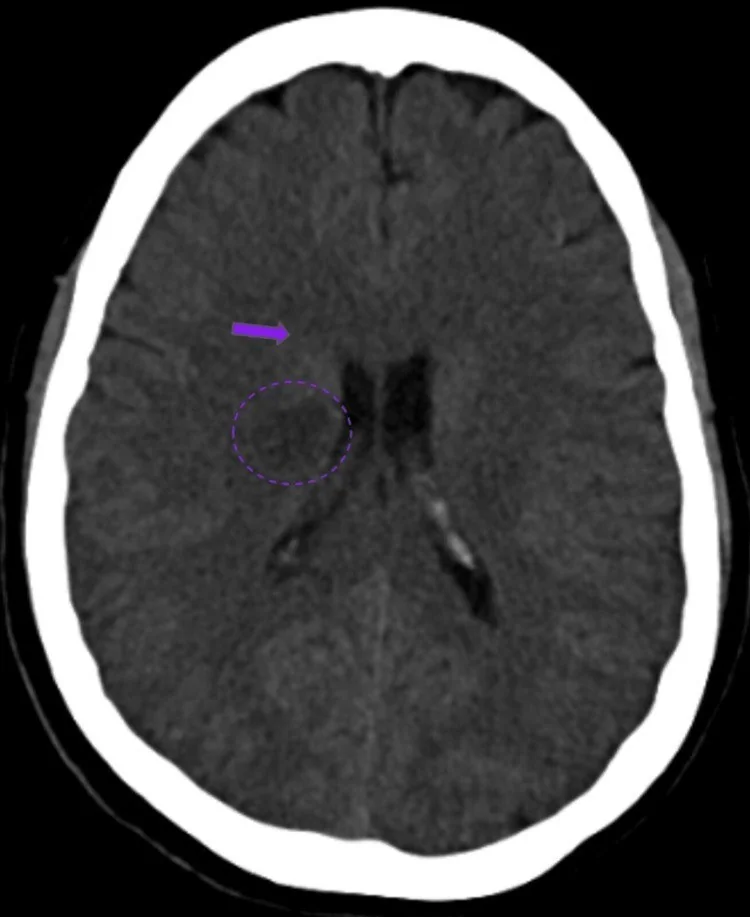
Kronik infarkt alanında parankim kaybı ile ensefalomalazi ve gliyozis gelişebilir. Kontrastsız BT eski infarkt alanını hipodens doku kaybı olarak gösterebilir; lezyon bir damar alanına uyabilir ve komşu sulkus ya da ventrikülde hacim kaybına bağlı genişleme eşlik edebilir. Eski hipodens infarkt alanı kronik subdural hematom gibi başka hipodens patolojilerle karışabilir ve kavite içinde gelişen yeni lezyon kuşku yaratabilir; akut iskemi şüphesinde negatif başlangıç BT tek başına dışlayıcı değildir. Ensefalomalazi kavitesi içinde gelişen kronik subdural hematom gibi yeni bir lezyon kitle etkisi yapabilir ve nörolojik bulguları kötüleştirebilir; bu nadir durum serebrovasküler inme öyküsü olan hastalarda ayırıcı tanıda düşünülmelidir.
Faz ve pencere
- Kontrastsız tanısal
- Eski infarkt alanı BT'de hipodens parankim kaybı ve ensefalomalazi kavitesi olarak görülebilir. Kronik hacim kaybı varsa komşu sulkuslarda ve lezyon tarafındaki ventrikülde ex vacuo genişleme görülebilir.
Önerilen pencereler G genişlik, M merkez; değerler Hounsfield birimi (HU)
- BeyinG 80 / M +40
BT bulguları
- Eski geniş hemisferik infarkt BT'de hipodens alan olarak görülebilir.
- Ensefalomalazi kavitesi çevresinde BT'de silik sınırlı hipoatenüasyon görülebilir; gliyozisi BT'de ayrıca ayırt etmek güvenilir değildir.
- Kronik infarkt sonrası aynı bölgede BT'de ensefalomalazi kavitesi ve çevresinde silik hipoatenüasyon görülebilir.
- Hacim kaybı varsa komşu kortikal sulkuslarda genişleme görülebilir.
- Lezyon tarafındaki lateral ventrikül boynuzu veya gövdesinde ex vacuo genişleme.
- Lezyon, eski MCA infarktı örneğindeki gibi bir arter alanına uyabilir.
Normalde
Şüpheli bölgedeki parankim kaybını ve ventrikül genişliğini karşı hemisferle kıyaslayın; yaşa bağlı atrofi ve doğal asimetriyi göz önünde bulundurun. Şüpheli bölgede parankim kaybını, sulkusların açılmasını ve ventrikülün lezyona doğru genişlemesini karşı taraftaki aynı lob ve ventrikül düzeyiyle kıyaslayın.
Normal BT ile kıyasla
Aynı bölgenin, kaynak veri setinde patoloji içermediği belirtilen bir BT incelemesini kesit kesit kaydırın; organ sınırlarını açarak anatomiyi hasta görüntüsüyle karşılaştırın. Küçük rastlantısal bulgular tümüyle dışlanmamıştır.
Kaynak: TotalSegmentator v2.01 veri seti (Wasserthal ve ark., Radiology: Artificial Intelligence 2023), CC BY 4.0, vaka s0103; organ sınırları veri setinin otomatik segmentasyonundan, birleştirilerek sadeleştirildi. Görüntüler 2,5 mm kesit aralığına yeniden örneklendi.
Ayırıcı tanı
- Akut/subakut infarkt tipik olarak damar alanına uyan bulgularla düşündürülür; kronik lezyonda ise gliyozis ve ensefalomalazi ile ipsilateral ventrikül genişlemesi görülebilir.
- Serebral venöz infarkt ayırıcı tanıda yer alır; patofizyolojisi arteriyel iskemik inmeden farklıdır ve değişken görüntüleme özellikleri gösterir.
Tuzaklar
- Önceden var olan hipodens lezyon yeni BT değişikliklerinin yorumunu güçleştirebilir; akut iskemi şüphesinde negatif başlangıç BT dışlayıcı değildir.
- Kronik hacim kaybına bağlı sulkus ve ventrikül genişlemesini kitle etkisiyle karıştırmayın; kitle etkisi komşu boşluklarda daralmaya yol açabilir.
- BOS dansitesindeki her parankim kavitesini arter infarktı olarak adlandırmayın; travma sonrası ensefalomalazi de kavite bırakabilir, öykü ve dağılımı değerlendirin.
- Eski infarkt kavitesi içinde gelişen yeni lezyon kuşku yaratabilir; ensefalomalazi ve çevresel hipodansiteyi yeni infarktla karıştırmayın, kuşkuda eski görüntüyle karşılaştırın ve doğru tanı için MR isteyin.
Kendini dene
Eski MCA infarktı öyküsü olan hastada BT'de damar alanına uyan hipodens parankim kaybı görülüyor. En uygun yorum nedir?
Cevabı göster
Kronik infarkt. Eski geniş hemisferik infarkt BT'de hipodens alan olarak görülebilir; damar alanına uyan hipodens parankim kaybı kronik infarktı düşündürür ve ensefalomalazi kavitesi içinde gelişen kronik subdural hematomla karışabilir.
Frontal kavitede hacim kaybı var ancak dağılım damar alanını izlemiyor ve eski kafa travması öyküsü mevcut. Hangi tanı düşünülür?
Cevabı göster
Travmatik ensefalomalazi. Damar alanına uymayan kavite ve travma öyküsü travma sonrası ensefalomalaziyi düşündürür; travma sonrası ensefalomalazi bilinen bir sekel biçimidir.
İlgili konular
Kaynaklar
Bu sayfadaki 31 cümle ve 2 quiz sorusu aşağıdaki kaynaklardan alıntılarla otomatik olarak karşılaştırıldı; 15 cümle bu karşılaştırmada düzeltildi (2026-10-12).
- Huge chronic subdural haematoma formation in an encephalomalacia stroke cavity.pubmed.ncbi.nlm.nih.gov
- VEXAS syndrome-associated tumefactive demyelination.pubmed.ncbi.nlm.nih.gov
- Parenchymal Insults in Abuse-A Potential Key to Diagnosis.pubmed.ncbi.nlm.nih.gov
- The reverse question mark and L.G. Kempe incisions for decompressive craniectomy: A case series and narrative review of the literature.pubmed.ncbi.nlm.nih.gov
- Moyamoya disease masquerading as CNS vasculitis: Diagnostic challenges and imaging insights.pubmed.ncbi.nlm.nih.gov
- Clinical Utility of Circulating Biomarkers for Diagnosis and Prognosis of Acute Stroke in the Emergency Department: A Narrative Review from Current Evidence to Clinical Implementation.pubmed.ncbi.nlm.nih.gov
- Stroke or Seizure? Diagnostic Role of Neuroimaging in Acute Neurologic Mimics.pubmed.ncbi.nlm.nih.gov
- The alien limb phenomenon.pubmed.ncbi.nlm.nih.gov
- Fetal intracranial hemorrhage and infarct: Main sonographic and MRI characteristics: A review article.pubmed.ncbi.nlm.nih.gov
- Neonatal cranial sonography: ultrasound findings in neonatal meningitis-a pictorial review.pubmed.ncbi.nlm.nih.gov
- An ABC for decision making.pubmed.ncbi.nlm.nih.gov
- Neuroimaging standards for research into small vessel disease and its contribution to ageing and neurodegeneration.pubmed.ncbi.nlm.nih.gov
- COVID-19 Cerebral Vasculitis With Extensive Involvement of Anterior Circulation and Sparing of Posterior Circulation.pubmed.ncbi.nlm.nih.gov
- Genetic determinants of insufficiency of the collateral circulation.pubmed.ncbi.nlm.nih.gov
- A Quantitative Electroencephalographic Index for Stroke Detection in Adults.pubmed.ncbi.nlm.nih.gov
- Compensating cortical thickness for cortical folding-related variation.pubmed.ncbi.nlm.nih.gov
- Sulcal depth-position profile is a genetically mediated neuroscientific trait: description and characterization in the central sulcus.pubmed.ncbi.nlm.nih.gov
- The XY gene hypothesis of psychosis: origins and current status.pubmed.ncbi.nlm.nih.gov
- A Case-Based Review of Cerebral Venous Infarcts With Perfusion Imaging and Comparison to Arterial Ischemic Stroke.pubmed.ncbi.nlm.nih.gov
- The pathogenesis of cerebral small vessel disease and vascular cognitive impairment.pubmed.ncbi.nlm.nih.gov
- Neonatal neurosonography: A pictorial essay.pubmed.ncbi.nlm.nih.gov
- Social Functioning and Autistic Behaviors in Youth Following Acquired Brain Injury.pubmed.ncbi.nlm.nih.gov
- Response to hypothetical social scenarios in individuals with traumatic brain injury who present inappropriate social behavior: a preliminary report.pubmed.ncbi.nlm.nih.gov
- Perforator-Sparing Microsurgical Clipping of Tandem Dominant-Hemisphere Middle Cerebral Artery Aneurysms: Geometry-Guided Reconstruction of a Wide-Neck Bifurcation and Dorsal M1 Fusiform Lesion.pubmed.ncbi.nlm.nih.gov
- Individualized autoregulation-guided arterial blood pressure management in neurocritical care.pubmed.ncbi.nlm.nih.gov
- Blood Biomarkers for Detection of Brain Injury in COVID-19 Patients.pubmed.ncbi.nlm.nih.gov
- International consensus statement on allergy and rhinology: Olfaction.pubmed.ncbi.nlm.nih.gov
- Transnasal Transsphenoidal Endoscopic Repair of CSF Leakage Using Multilayer Acellular Dermis.pubmed.ncbi.nlm.nih.gov
- A systematic approach to MR spectroscopy of the brain: Indications, protocol, metabolites, and spectral analysis in neurologic diseases.pubmed.ncbi.nlm.nih.gov
- Serum Biomarkers in Acute Ischemic Stroke: Clinical Applications and Emerging Insights.pubmed.ncbi.nlm.nih.gov
- Pediatric Meningeal Diseases: What Radiologists Need to Know.pubmed.ncbi.nlm.nih.gov
- International Harmonization of Nomenclature and Diagnostic Criteria (INHAND): Non-proliferative and Proliferative Lesions of the Non-human Primate ( M. fascicularis ).pubmed.ncbi.nlm.nih.gov
- An unusual presentation of Moyamoya disease managed conservatively in a resource limited region: A case report.pubmed.ncbi.nlm.nih.gov
- Ischemic Stroke as a Possible Initial Manifestation of Primary Sjögren's Syndrome: A Case Report.pubmed.ncbi.nlm.nih.gov
- Transient Cortical Blindness and Hemi-Spatial Neglect Following Watchman Device Implantation.pubmed.ncbi.nlm.nih.gov
- Advances in human intracranial electroencephalography research, guidelines and good practices.pubmed.ncbi.nlm.nih.gov
- Pathophysiology-driven neuroimaging: decoding brain injury in sepsis.pubmed.ncbi.nlm.nih.gov
- Disproportionate bulbar dysfunction following small corona radiata infarction in vascular parkinsonism: A case report.pubmed.ncbi.nlm.nih.gov
- Foreign body-type giant cell reaction post intracranial endovascular clot retrieval: a postmortem case.pubmed.ncbi.nlm.nih.gov
- Persistence of higher visual function deficits in adults with early-onset cerebral visual impairment: A comparative study.pubmed.ncbi.nlm.nih.gov
- Characteristics of head injuries in children at King Abdullah Specialized Children's Hospital, Jeddah: a cross-sectional study.pubmed.ncbi.nlm.nih.gov
- Neonatal herpes simplex virus encephalitis: a single-center retrospective study of 14 cases.pubmed.ncbi.nlm.nih.gov
- Forensic Autopsy in a Long-Term Survivor of Abusive Head Trauma: An Unusual Case Report.pubmed.ncbi.nlm.nih.gov
- Post-Traumatic Middle Cerebral Artery Pseudoaneurysm Following Depressed Skull Fracture: Case Report and PRISMA-Guided Literature Review.pubmed.ncbi.nlm.nih.gov
- Delayed diagnosis and surgical repair of a chronic post-traumatic cerebrospinal fluid fistula with encephalocele in a child.pubmed.ncbi.nlm.nih.gov
- Diagnostic challenge of GAD65-associated autoimmune encephalitis mimicking post-traumatic complications in an older adult: a case report.pubmed.ncbi.nlm.nih.gov
- Congenital central nervous system malformations in piedmontese calves-part 1. structural brain disorders.pubmed.ncbi.nlm.nih.gov
- In search of subcortical and cortical morphologic alterations of a normal brain through aging: an investigation by computed tomography scan.pubmed.ncbi.nlm.nih.gov
- Fetal malformations of cortical development: review and clinical guidance.pubmed.ncbi.nlm.nih.gov
- Exploring the Link Between Traumatic Brain Injury and Benign Paroxysmal Positional Vertigo.pubmed.ncbi.nlm.nih.gov
- Context-Aware Filtering of Unstructured Radiology Reports by Anatomical Region.pubmed.ncbi.nlm.nih.gov
- Epilepsia Partialis Continua in a Post-stroke Patient: A Case Report.pubmed.ncbi.nlm.nih.gov
- Persistent Delirium in the Elderly: A Case Report and Review of Multifactorial Contributors and Management Challenges.pubmed.ncbi.nlm.nih.gov
- Advances in cerebrovascular reserve function assessment for moyamoya disease.pubmed.ncbi.nlm.nih.gov
- Middle cerebral artery dissection: pathophysiology, diagnosis, and therapeutic options.pubmed.ncbi.nlm.nih.gov
- Safety and Efficacy in the Transcortical and Transsylvian Approach in Insular High-Grade Gliomas: A Comparative Series of 58 Patients.pubmed.ncbi.nlm.nih.gov
- Scientific and technical assistance on welfare aspects related to housing and health of cats and dogs in commercial breeding establishments.pubmed.ncbi.nlm.nih.gov
- Differential diagnoses of cerebral hemiatrophy in childhood: a review of literature with illustrative report of two cases.pubmed.ncbi.nlm.nih.gov
- Magnetic resonance imaging findings in children with intractable epilepsy compared to children with medical responsive epilepsy.pubmed.ncbi.nlm.nih.gov
- Clinical Applications of Fetal MRI in the Brain.pubmed.ncbi.nlm.nih.gov
- Giant Cell Tumor of the Cranial Vault: A Rare Frontotemporal Case With Complete Neurological Recovery and Narrative Review.pubmed.ncbi.nlm.nih.gov
- Recurrent parietal lobe supratentorial ependymoma, ZFTA fusion-positive, CNS WHO grade 3, with new dural and calvarial reactive changes in a child: illustrative case.pubmed.ncbi.nlm.nih.gov
- Review of imaging modalities and radiological findings of calvarial lesions.pubmed.ncbi.nlm.nih.gov
- Case Report: Structured MRI assessment of posterior thalamic infarction in a distribution compatible with posterior choroidal artery territory presenting as Déjerine-Roussy syndrome in an adolescent: differentiating arterial ischemia from venous thrombosis and thalamic neoplasm.pubmed.ncbi.nlm.nih.gov
- Tissue clock-guided prediction and intervention of futile recanalization: towards precision therapy in mechanical thrombectomy.pubmed.ncbi.nlm.nih.gov
- Prognostic predictors in HIV-negative neurosyphilis: a retrospective cohort study with prospective follow-up.pubmed.ncbi.nlm.nih.gov
- The genetic basis of hydrocephalus: genes, pathways, mechanisms, and global impact.pubmed.ncbi.nlm.nih.gov
- Fetal intracerebral hemorrhage: review of the literature and practice considerations.pubmed.ncbi.nlm.nih.gov
- Neonatal subpial hemorrhage: Padua experience and systematic review.pubmed.ncbi.nlm.nih.gov
- Childhood Cerebral Vasculitis : A Multidisciplinary Approach.pubmed.ncbi.nlm.nih.gov
- Diagnosis and Classification of Pediatric Epilepsy in Sub-Saharan Africa: A Comprehensive Review.pubmed.ncbi.nlm.nih.gov
- CT Radiomic Features of the Crystalline Lens and Association with Age, Hypertension and Cerebral White Matter Lesions.pubmed.ncbi.nlm.nih.gov
- Society for Cardiovascular Magnetic Resonance 2024 Cases of SCMR case series.pubmed.ncbi.nlm.nih.gov
- Pantothenic Acid Protects Neurons After Ischemic Stroke by Targeting ID3 to Restore Action Potential Amplitude.pubmed.ncbi.nlm.nih.gov
- Role of Low-Field MRI in Acute Stroke.pubmed.ncbi.nlm.nih.gov
- The Role of Brain Frailty in Stroke Outcomes: A Systematic Review.pubmed.ncbi.nlm.nih.gov
- Systems Biology, Neuroimaging, Neuropsychology, Neuroconnectivity and Traumatic Brain Injury.pubmed.ncbi.nlm.nih.gov
- The Relation of Focal Lesions to Cortical Thickness in Pediatric Traumatic Brain Injury.pubmed.ncbi.nlm.nih.gov
- Clinical and literature insights into the frontotemporal dementia and motor neuron disease spectrum.pubmed.ncbi.nlm.nih.gov
- When Stroke Leads to Hydrocephalus: A Case of Unilateral Ventricular Enlargement.pubmed.ncbi.nlm.nih.gov
- Sequential rTMS for MDD and OCD in a patient with left parietal perinatal ischemic infarct: a case report.pubmed.ncbi.nlm.nih.gov
- Fulminant emphysematous hepatitis with pneumoperitoneum: A case report.pubmed.ncbi.nlm.nih.gov
- Ictal laughter induced by repetitive transcranial magnetic stimulation in stroke patients: a case series.pubmed.ncbi.nlm.nih.gov
- Neurite orientation dispersion and density imaging in stroke: current applications, limitations, and future directions.pubmed.ncbi.nlm.nih.gov
- Vertebral Artery Dissection and PICA-Territory Stroke Associated with Chronic Atlantoaxial Structural Abnormality: A Case Report.pubmed.ncbi.nlm.nih.gov
- Enterococcus faecalis Aortic Valve Endocarditis Masquerading As Urinary Tract Infection: Diagnostic Delay, Septic Embolic Strokes, and a Fatal Therapeutic Impasse.pubmed.ncbi.nlm.nih.gov
- Deep learning image reconstruction technique for improving image quality and radiation dose reduction compared to iterative reconstruction technique in non-contrast CT head imaging.pubmed.ncbi.nlm.nih.gov
- Idiopathic steno-occlusive disease with bilateral internal carotid artery occlusion: A Case Report.pubmed.ncbi.nlm.nih.gov
- Association of venous malformation of the head and neck with meningoencephalocele: report of 3 cases.pubmed.ncbi.nlm.nih.gov
- A Case Report of Dyke-Davidoff-Masson Syndrome in the Philippines: Review of the Literature and a Discussion on Neuroplasticity and Brain Network Connectivity.pubmed.ncbi.nlm.nih.gov
- Bacterial Meningoencephalitis in Newborns.pubmed.ncbi.nlm.nih.gov
- Widening the Neuroimaging Features of Adenosine Deaminase 2 Deficiency.pubmed.ncbi.nlm.nih.gov
- An integrated investigation of systemic and localized pathophysiological mechanisms of stroke and multimodal therapeutic strategies.pubmed.ncbi.nlm.nih.gov
- Curing the brain: in search for new astrocyte-specific therapies.pubmed.ncbi.nlm.nih.gov
- Rare Presentation of Homozygous S<i>LC20A2</i> Mutations Causing Intra-Arterial Cerebral Vasculopathy and Stroke in Infancy: Case Report and Review of the Literature.pubmed.ncbi.nlm.nih.gov
- The Hemispheric Imbalance: A Double Encounter with Dyke-Davidoff-Masson Syndrome.pubmed.ncbi.nlm.nih.gov
- Heart-Brain Axis: Subclinical Cardiovascular Changes and Brain Health.pubmed.ncbi.nlm.nih.gov
- Brain fluid physiology in ischaemic stroke; more than just oedema.pubmed.ncbi.nlm.nih.gov
- Stroke risk factors and outcomes in Trinidad and Tobago: the START study.pubmed.ncbi.nlm.nih.gov
- Bypass-assisted trapping and excision of a thrombosed giant M1 aneurysm with unpreservable lenticulostriate arteries: A case report.pubmed.ncbi.nlm.nih.gov
- Parent Artery Disease-Related Stroke: What Is the Impact on Endovascular Treatment? A Narrative Review.pubmed.ncbi.nlm.nih.gov
- Giant Right Sphenoid Wing Meningioma as a Reversible Frontal Network Lesion: A Pseudo-bvFTD Case with Venous-Sparing Skull-Base Resection.pubmed.ncbi.nlm.nih.gov
- Clinical and genetic spectrum of pediatric mitochondrial disorders in China: insights from a 47-case genetically confirmed cohort.pubmed.ncbi.nlm.nih.gov
- The role of nuclear medicine in central nervous system evaluation.pubmed.ncbi.nlm.nih.gov
- Fulminant cerebral edema in the setting of acute dengue fever after mechanical thrombectomy in a patient with massive stroke and severe hypoalbuminemia: a case report.pubmed.ncbi.nlm.nih.gov
- Stroke-Like Migraine Attacks After Radiation Therapy (SMART) Syndrome: A Case Report and Review of a Rare Delayed Complication of Cranial Irradiation.pubmed.ncbi.nlm.nih.gov
- An Anterior Midline Skull Base Epidermoid Cyst Presenting With Spontaneous Intraparenchymal Rupture: A Case Report.pubmed.ncbi.nlm.nih.gov
- Acute Ischemic Stroke Presentation Masked by Falsely Localizing Motor Seizure: A Clinical Case Series.pubmed.ncbi.nlm.nih.gov
- Sinus of Valsalva Aneurysm: A Rare Mechanical Cause of Right Ventricular Outflow Tract Obstruction.pubmed.ncbi.nlm.nih.gov
- Diagnostic Approach to Left Ventricular Hypertrophy: A Review.pubmed.ncbi.nlm.nih.gov
Eğitim amaçlıdır; hasta başında tanı ve tedavi kararının yerine geçmez, tıbbi tavsiye değildir. Metinler yapay zekâ desteğiyle yazıldı ve otomatik bir adımda kaynak alıntılarıyla karşılaştırıldı; bu bir tıbbi doğrulama değildir ve içerik uzman radyolog incelemesinden geçmedi. Klinik kararlarda güncel kılavuzları, kurum protokollerini ve radyoloji raporunu esas alın.