Özet
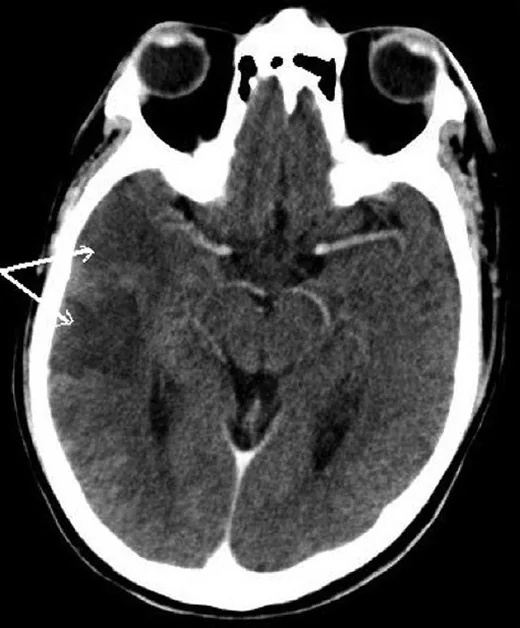
MCA alanı infarktı, kortikal ve subkortikal dokuda erken dönemde gri-beyaz sınır silinmesi ve sulkus effasmanı olarak görünür. Kontrastsız BT kanamayı dışlar ve erken infarkt bulgularını gösterir; damar görüntüleme ise sorumlu büyük damar oklüzyonunu veya stenozunu ortaya koyar. İlk BT'de değişiklikler silik veya görünmez olabilir, bu nedenle damar alanına uyan gri-beyaz ayrım kaybı önem taşır. Alt akım evresinde kitle etkisi ve herniasyon riski artar; geniş hemisferik ödem ipsilateral ventrikülü sıkıştırıp karşı ventrikülde hidrosefale neden olabilir.
Faz ve pencere
- Kontrastsız tanısal
- MCA dağılımında kortikal ve subkortikal hipodensite, insular şerit veya lentiform çekirdek silinmesi, sulkus effasmanı ve ilerlemiş olguda lateral ventrikül basısı aranır. Hemorajik dönüşüm varsa infarkt içindeki yeni hiperdens kan odakları görülebilir; kontrast gerekmez.
- BTA tanısal
- İntrakraniyal ICA, M1 ve M2 dallarında eşlik eden oklüzyon ya da stenoz ile distal dalların opasifikasyonu değerlendirilir; CTA infarkt parankimini değil ilişkili damar lezyonunu gösterir.
Önerilen pencereler: İnme (G 40 / M 40), Beyin (G 80 / M 40), Anjiyo (G 600 / M 150).
BT bulguları
- Kortikal MCA hipodensitesi — etkilenen kortekste gri madde atenüasyonu azalır ve kortikomedüller ayrım silinir.
- Gri-beyaz ayrım kaybı — etkilenen kortekste gri madde atenüasyonu azalır ve kortikomedüller sınır silinir.
- Derin perforan alan tutulumu — kaudat, lentiform çekirdek ve internal kapsülde hipodensite lentikülostriat dalların etkilenmesini gösterir.
- Sulkus effasmanı — etkilenen girusların şişmesi komşu kortikal BOS aralıklarını daraltır.
- Lateral ventrikül basısı — geniş hemisferik ödem ipsilateral frontal boynuz veya gövdeyi sıkıştırabilir.
- Kitle etkisi — genişlemiş hemisfer komşu ventrikülleri sıkıştırır ve subfalcin herniasyona yol açabilir.
- Hemorajik dönüşüm — infarkt içindeki yeni noktasal veya daha birleşik hiperdens odaklar kan ürününü düşündürür ve kontrastsız kesitlerde doğrulanır.
- Damar alanı dağılımı — lezyon çoğunlukla MCA’nın kortikal yüzey ve/veya derin perforan beslenmesine uyar; geniş infarkt veya sınır-bölge uzanımı komşu ACA/PCA kuşaklarına taşabilir.
Normalde
Karşılaştırma — hastalık yoksa veya başka bir patoloji varsa, kontrastsız BT genellikle intrakraniyal kanamanın varlığını veya yokluğunu net şekilde ayırt eder. Ayırıcı tanı — enfarktüs benzeri hipodensiteler, tümör gibi kitle lezyonları veya primer kanamalarla karışmamalı; kontrastsız BT bu farklı patolojileri birbirinden ayırır.
Normal BT ile kıyasla
Aynı bölgenin, kaynak veri setinde patoloji içermediği belirtilen bir BT incelemesini kesit kesit kaydırın; organ sınırlarını açarak anatomiyi hasta görüntüsüyle karşılaştırın. Küçük rastlantısal bulgular tümüyle dışlanmamıştır.
Kaynak: TotalSegmentator v2.01 veri seti (Wasserthal ve ark., Radiology: Artificial Intelligence 2023), CC BY 4.0, vaka s0103; organ sınırları veri setinin otomatik segmentasyonundan, birleştirilerek sadeleştirildi. Görüntüler 2,5 mm kesit aralığına yeniden örneklendi.
Ayırıcı tanı
- Postiktal kortikal ödem
- tek arter alanına uymayan kortikal şişme ve damar oklüzyonu olmaması infarkttan ayrılabilir.
- Hipoglisemi
- ani glukoz düşüşü bilinç bozukluğu, nöbet veya komaya yol açabilir ve enfarktüsle kliniği benzeyebilir; düzeltme ile semptomlar geri dönebilir.
- Ensefalit
- temporal veya limbik ağırlıklı ödem ve bilateral/asimetrik dağılım damar beslenme alanından farklı olabilir.
- Beyin tümörü
- progresif nörolojik bozukluklara ve tedaviye bağlı komplikasyonlara yol açabilir; enfarktüsün akut vasküler başlangıcından farklı seyir izler.
- Eski infarkt
- kronik ensefalomalazi ve doku kaybı, akut infarktın şişme ve sulkus silinmesinden farklıdır.
Tuzaklar
- Erken kontrastsız BT normal olabilir; klinik şüphe yüksekken negatif parankim bulgusunu infarkt yokluğu olarak yazma.
- Doz aşımı riski — yanlış kurulumlu CT perfüzyon yazılımları veya gereksiz tekrarlı kesitler ciddi radyasyon dozlarına yol açabilir.
- Kontrastlı CTA'da damar içi kontrastı subaraknoid kanama veya hemorajik dönüşüm sanma; aynı bölgeyi kontrastsız seriyle eşleştir.
- Eski hipodensiteyi yeni ödemle karıştırma; kronik hacim kaybı ve ventriküler çekilme akut kitle etkisinin tersine işaret eder.
Kendini dene
Sol lateral frontal-temporal kortekste hipodensite, insular silinme ve sağa orta hat itimi görülüyor. Hangi dağılım en iyi açıklar?
Cevabı göster
Sol MCA infarktı. Lateral hemisfer korteksi ve insula MCA alanıdır; sola ait kitle etkisi orta hattı sağa iter. PCA oksipital/medial temporal, ACA medial frontal-parietal, baziler arter ise posterior dolaşım yapılarını besler.
Yakın zamanda kontrastlı damar işlemi geçirmemiş hastanın takip kontrastsız BT’sinde, MCA infarktı içinde yeni hiperdens odaklar ortaya çıkmış. En olası eşlik eden durum nedir?
Cevabı göster
Hemorajik dönüşüm. İnfarktlı dokunun içinde yeni kan dansitesi hemorajik dönüşümle uyumludur. Ensefalomalazi hacim kaybı ve kronik hipodensite yapar; kist ve koroid kalsifikasyonu bu damar alanı içi akut kan görünümünü açıklamaz.
Kaynaklar
Bu sayfadaki 40 cümle ve 2 quiz sorusu aşağıdaki kaynaklardan alıntılarla tek tek karşılaştırıldı; 11 cümle bu karşılaştırmada düzeltildi (2026-10-08).
- Imaging in Acute Strokepmc.ncbi.nlm.nih.gov
- Technical aspects of decompressive craniectomy for malignant middle cerebral artery infarction.pubmed.ncbi.nlm.nih.gov
- Internal carotid artery dissection after a roller coaster ride in a 4-year-old: case report and review of the literature.pubmed.ncbi.nlm.nih.gov
- Early Progressive Changes in White Matter Integrity Are Associated with Stroke Recovery.pubmed.ncbi.nlm.nih.gov
- Feasibility and safety of pipeline embolization device in patients with ruptured carotid blister aneurysms.pubmed.ncbi.nlm.nih.gov
- The Effect of Transoesophageal Echocardiography on Treatment Change in a High-Volume Stroke Unit.pubmed.ncbi.nlm.nih.gov
- Hemicraniectomy and durotomy upon deterioration from infarction-related swelling trial: randomized pilot clinical trial.pubmed.ncbi.nlm.nih.gov
- Predictive Value of the Alberta Stroke Program Early CT Score (ASPECTS) in the Outcome of the Acute Ischemic Stroke and Its Correlation with Stroke Subtypes, NIHSS, and Cognitive Impairment.pubmed.ncbi.nlm.nih.gov
- Stroke in Association with Thyroid Goitre: A Case Report.pubmed.ncbi.nlm.nih.gov
- Femoral artery pseudoaneurysm after carotid artery stenting: Two case reports.pubmed.ncbi.nlm.nih.gov
- Solving the conundrum. A migrainous infarction or an infarct-induced migrainous attack?pubmed.ncbi.nlm.nih.gov
- Common Carotid Artery Occlusion in a Young Patient: Can Large-Vessel Stroke Be the Initial Clinical Manifestation of Coronavirus Disease 2019?pubmed.ncbi.nlm.nih.gov
- Early Prediction of Malignant Edema After Successful Recanalization in Patients with Acute Ischemic Stroke.pubmed.ncbi.nlm.nih.gov
- Perinatal atypical teratoid/rhabdoid tumor involving the deep ear structures and complicated by arterial infarction.pubmed.ncbi.nlm.nih.gov
- Decompressive Craniotomy for Malignant Middle Cerebral Artery Infarction: Optimal Timing and Literature Review.pubmed.ncbi.nlm.nih.gov
- Orbitozygomatic-transsylvian approach to the insula: microsurgical anatomy and endoscopic correlation using the fiber-separation technique.pubmed.ncbi.nlm.nih.gov
- Mechanical Thrombectomy for Internal Carotid Artery Occlusion with Accessory Middle Cerebral Artery: A Case Report.pubmed.ncbi.nlm.nih.gov
- Hemichorea as a Manifestation of Isolated Insular Infarction Successfully Treated with Mechanical Thrombectomy.pubmed.ncbi.nlm.nih.gov
- Malignant middle cerebral artery infarction revealing atrial fibrillation: A Multimodal imaging case of M1 occlusion treated with decompressive craniectomy.pubmed.ncbi.nlm.nih.gov
- Contrast-Induced Neurotoxicity Following Mechanical Thrombectomy for Acute Left MCA Occlusion: A Reversible Radiological Mimic of Intracranial Haemorrhage.pubmed.ncbi.nlm.nih.gov
- Moyamoya disease masquerading as CNS vasculitis: Diagnostic challenges and imaging insights.pubmed.ncbi.nlm.nih.gov
- Multimodal imaging in neuro-ophthalmology.pubmed.ncbi.nlm.nih.gov
- Imaging research, diagnosis, and treatment advances of post-stroke cognitive impairment.pubmed.ncbi.nlm.nih.gov
- Current state and advancements of imaging in acute ischemic stroke: a practical review.pubmed.ncbi.nlm.nih.gov
- Fulminant cerebral edema in the setting of acute dengue fever after mechanical thrombectomy in a patient with massive stroke and severe hypoalbuminemia: a case report.pubmed.ncbi.nlm.nih.gov
- Prognostic Value of Systemic Immune-Inflammation Index for Early Mortality After Decompressive Craniectomy in Malignant Middle Cerebral Artery Infarction.pubmed.ncbi.nlm.nih.gov
- Acute large vessel occlusion stroke as a neurovascular complication of immune thrombotic thrombocytopenic purpura: Mechanical thrombectomy and neurocritical care challenges.pubmed.ncbi.nlm.nih.gov
- Regional perfusion parameters as potential indicators of parenchymal hematoma risk following reperfusion therapy for acute ischemic stroke in the extended time window.pubmed.ncbi.nlm.nih.gov
- Neuroimaging Modalities Used for Ischemic Stroke Diagnosis and Monitoring.pubmed.ncbi.nlm.nih.gov
- Noncontrast CT-based habitat analysis for differentiating hemorrhagic transformation from contrast extravasation after endovascular therapy of acute ischemic stroke.pubmed.ncbi.nlm.nih.gov
- Predictors of Mortality in Posterior Circulation Ischemic Stroke.pubmed.ncbi.nlm.nih.gov
- Ruptured Intracranial Mycotic Aneurysm in Infective Endocarditis: Multidisciplinary Management to Determine Timing of Cardiac Surgery.pubmed.ncbi.nlm.nih.gov
- Occlusion site and outcomes in intra-arterial tenecteplase after successful endovascular therapy: a secondary analysis of the ANGEL-TNK trial.pubmed.ncbi.nlm.nih.gov
- Sequential Contralateral Large-Vessel Occlusion Following Intravenous Thrombolysis: A Case Report of Dynamic Bilateral Cerebral Arterial Thrombosis.pubmed.ncbi.nlm.nih.gov
- Retrieval of an atherosclerotic plaque-vessel wall complex during mechanical thrombectomy: illustrative case.pubmed.ncbi.nlm.nih.gov
- An interpretable machine learning model for predicting prognosis in acute ischemic stroke with large vessel occlusion.pubmed.ncbi.nlm.nih.gov
- Insights into the pathophysiology of stroke-heart syndrome: a review of recent literature and clinical trials to illuminate promising therapeutic strategies.pubmed.ncbi.nlm.nih.gov
- Influence of deep learning image reconstruction and adaptive statistical iterative reconstruction-V on automated Alberta stroke program early CT score- evaluation.pubmed.ncbi.nlm.nih.gov
- Multimodality Imaging of Moyamoya Disease: A Practical Guide for Neuroradiologists Based on a Case Report.pubmed.ncbi.nlm.nih.gov
- Perforator-Sparing Microsurgical Clipping of Tandem Dominant-Hemisphere Middle Cerebral Artery Aneurysms: Geometry-Guided Reconstruction of a Wide-Neck Bifurcation and Dorsal M1 Fusiform Lesion.pubmed.ncbi.nlm.nih.gov
- Fusiform lenticulostriate artery aneurysm with subarachnoid hemorrhage: the role for superselective angiography in treatment planning.pubmed.ncbi.nlm.nih.gov
- Sensitivity of Non-contrast Computed Tomography Net Water Uptake Versus FLAIR-MRI, with MR-DWI Reference Standard, for Early Detection and Physiological Characterization of Ischemic Edema in Hyperacute Stroke.pubmed.ncbi.nlm.nih.gov
- Before the bolus: why anti-amyloid therapy must become part of every stroke code.pubmed.ncbi.nlm.nih.gov
- High-Grade Proteus mirabilis Bacteremia of Unclear Source Complicated by Infective Endocarditis and Embolic Stroke.pubmed.ncbi.nlm.nih.gov
- Development of the SIMPLE scoring system for predicting malignant brain edema in patients with large hemispheric infarction following acute ischemic stroke.pubmed.ncbi.nlm.nih.gov
- Identifying central positional vertigo to prevent diagnostic pitfalls: A case series and review of literature.pubmed.ncbi.nlm.nih.gov
- Hemorrhagic transformation following a malignant middle cerebral artery infarction.pubmed.ncbi.nlm.nih.gov
- AI-Based Approaches for the Identification and Quantification of Traumatic Brain Injury in Computed Tomography Imaging: Systematic Review.pubmed.ncbi.nlm.nih.gov
- Magnetic resonance imaging of primary central nervous system neoplasms of dogs and cats: Basic concepts for diagnostic pathologists.pubmed.ncbi.nlm.nih.gov
- Peri-procedural recognition of a calcified cerebral embolus following mechanical thrombectomy: A case report.pubmed.ncbi.nlm.nih.gov
- StrokeCT-2C5K: A Two-Center Cranial CT Dataset for Four-Class Stroke Classification Using SE-Attention-Enhanced Deep Learning Models.pubmed.ncbi.nlm.nih.gov
- Association of the C-reactive protein-albumin-lymphocyte index with clinical outcomes after mechanical thrombectomy for acute ischemic stroke.pubmed.ncbi.nlm.nih.gov
- High-Resolution MRI Revealed Different Etiology-Specific Associations With Cerebral Infarction in Adult Moyamoya Vasculopathy.pubmed.ncbi.nlm.nih.gov
- Territorial CT Perfusion Burden and Outcome After Aneurysmal Subarachnoid Haemorrhage: A Retrospective Single-Centre Cohort Study.pubmed.ncbi.nlm.nih.gov
- Role of diffusion weighted imaging, apparent diffusion coefficient and magnetic resonence perfusion among acute ischemic stroke patient.pubmed.ncbi.nlm.nih.gov
- Bilateral lesions of the basal ganglia and thalami (central grey matter)-pictorial review.pubmed.ncbi.nlm.nih.gov
- Intracranial venous thrombosis imaging by anatomical location: an educational review with mimics and diagnostic pitfalls.pubmed.ncbi.nlm.nih.gov
- Neuroimaging characteristics associated with early neurological deterioration in single subcortical infarction patients.pubmed.ncbi.nlm.nih.gov
- Deep medullary vein drainage and unfavorable outcomes in stroke patients after endovascular therapy: a retrospective study.pubmed.ncbi.nlm.nih.gov
- Todd's Paralysis Simulating Acute Ischemic Stroke: A Case Report.pubmed.ncbi.nlm.nih.gov
- Postictal Todd's Paralysis Mimicking Acute Ischemic Stroke in Medullary Melanocytoma: A Multimodal Diagnostic Challenge.pubmed.ncbi.nlm.nih.gov
- Brain perfusion imaging in patients with status epilepticus, seizures, and IIC patterns.pubmed.ncbi.nlm.nih.gov
- Hypoglycemic Encephalopathy in a Patient With Diabetes Mellitus: A Case Report.pubmed.ncbi.nlm.nih.gov
- Severe hypoglycemic coma with radiological evidence of hypoglycemic encephalopathy due to impaired awareness to hypoglycemia: a case report.pubmed.ncbi.nlm.nih.gov
- Long-Term Follow-Up of Patients With Mitochondrial Carbonic Anhydrase VA Deficiency. A Case Report and Literature Review.pubmed.ncbi.nlm.nih.gov
- A Fatal Herpes Simplex Encephalitis with a Normocellular Cerebrospinal Fluid: A Case Report.pubmed.ncbi.nlm.nih.gov
- Treatment and Diagnostic Challenges in a Patient with Atypical SARS-CoV-2-Associated Encephalitis Mimicking a Neoplasm: A Case Report.pubmed.ncbi.nlm.nih.gov
- When a Transient Ischemic Attack Is Not a Transient Ischemic Attack: Super-refractory Status Epilepticus in GAD65 Antibody-Associated Autoimmune Encephalitis.pubmed.ncbi.nlm.nih.gov
- Spectrum of Neuroimaging Findings in CNS Lymphoproliferative Disorders.pubmed.ncbi.nlm.nih.gov
- Obstacles and Trials in Treating Primary Brain Tumors.pubmed.ncbi.nlm.nih.gov
- From Lesion to Decision: AI for ARIA Detection and Predictive Imaging in Alzheimer's Disease.pubmed.ncbi.nlm.nih.gov
- Ischemic Stroke as a Possible Initial Manifestation of Primary Sjögren's Syndrome: A Case Report.pubmed.ncbi.nlm.nih.gov
- Persistent Delirium in the Elderly: A Case Report and Review of Multifactorial Contributors and Management Challenges.pubmed.ncbi.nlm.nih.gov
- Role of Low-Field MRI in Acute Stroke.pubmed.ncbi.nlm.nih.gov
- Emergency MRI in acute dizziness and headache: current insights and future directions.pubmed.ncbi.nlm.nih.gov
- Diagnostic Performance of Mobile Low-Field MRI and CT for Acute Headache as the Isolated Clinical Manifestation in the Neurology Emergency Department.pubmed.ncbi.nlm.nih.gov
- Concurrent Occurrence of Ischemic and Hemorrhagic Stroke in a Patient in a Low Resource Setting Hospital, Western Uganda: A Case Report.pubmed.ncbi.nlm.nih.gov
- Verifying the concordance between motion corrected and conventional MPRAGE for pediatric morphometric analysis.pubmed.ncbi.nlm.nih.gov
- Toward reliable computer-aided brain tumor diagnosis: a contrast-enhanced deep learning approach with hybrid KNN classification.pubmed.ncbi.nlm.nih.gov
- Clinical utility and prospective of TMS-EEG: Updated review from an international expert group.pubmed.ncbi.nlm.nih.gov
- Pseudo-Subarachnoid Hemorrhage After Spinal Myelography Mimicking Acute Subarachnoid Hemorrhage.pubmed.ncbi.nlm.nih.gov
- The Role of Interventional Radiology in the Diagnosis and Treatment of Gynecological Conditions.pubmed.ncbi.nlm.nih.gov
- Diabetic striatopathy presenting as stroke-mimicking hemiparesis without involuntary movements: A case report.pubmed.ncbi.nlm.nih.gov
- The spectrum of neurological derangement due to fat embolism: a case series.pubmed.ncbi.nlm.nih.gov
- Keeping An Eye Out for Stroke-Herpes Zoster Ophthalmicus Leading to Acute Ischemic Stroke.pubmed.ncbi.nlm.nih.gov
- Rapid spontaneous regression of a massive post-thrombolysis intracerebral hemorrhage: A case report.pubmed.ncbi.nlm.nih.gov
- Multiterritory Bihemispheric Ischemic Stroke in the Setting of Unilateral Internal Carotid Artery Disease.pubmed.ncbi.nlm.nih.gov
- Aortic Thrombus: A Rare Cause of Ischemic Stroke.pubmed.ncbi.nlm.nih.gov
- The anatomical and radiologic relationship of the superior longitudinal system with the middle cerebral artery branches.pubmed.ncbi.nlm.nih.gov
- Glioblastoma Masquerading as a Presumed Ischemic Stroke: A Case of Delusional Jealousy and Fluctuating Psychosis.pubmed.ncbi.nlm.nih.gov
- Vertebral Artery Dissection and PICA-Territory Stroke Associated with Chronic Atlantoaxial Structural Abnormality: A Case Report.pubmed.ncbi.nlm.nih.gov
- Association of 24-Hour Computed Tomography Infarct Density on Functional Outcomes in Stroke: Secondary Analysis From the AcT Trial.pubmed.ncbi.nlm.nih.gov
- Machine learning in neuroradiology: Recent developments and applications.pubmed.ncbi.nlm.nih.gov
- Bilateral internal carotid artery fibromuscular dysplasia identified during acute ischemic stroke evaluation: A case report.pubmed.ncbi.nlm.nih.gov
- Deep-learning reconstruction for noncontrast head computed tomography: Improved image quality and potential diagnostic impact in acute ischemic stroke.pubmed.ncbi.nlm.nih.gov
- Diagnostic Accuracy of Ischemia and Hemorrhage on Cone-Beam CT Immediately After Endovascular Thrombectomy.pubmed.ncbi.nlm.nih.gov
- A Diagnostic Challenge: From Suspected Ischemic Stroke to Confirmed Herpetic Encephalitis.pubmed.ncbi.nlm.nih.gov
- Primary Ischemic Core Resection (Corectomy) with Immediate Bone Flap Replacement in Malignant Middle Cerebral Artery Infarction: A Case Series and Systematic Comparison with Decompressive Craniectomy Outcomes.pubmed.ncbi.nlm.nih.gov
- Biot's respiratory pattern under mechanical ventilation: Two case reports and literature review.pubmed.ncbi.nlm.nih.gov
- Stroke or Seizure? Diagnostic Role of Neuroimaging in Acute Neurologic Mimics.pubmed.ncbi.nlm.nih.gov
- Middle meningeal artery embolization of meningioma en plaque misdiagnosed as subdural hematoma: illustrative cases.pubmed.ncbi.nlm.nih.gov
- Plasma volume fraction in drug-resistant epilepsy: A DCE-MRI marker of microvascular pathology.pubmed.ncbi.nlm.nih.gov
- Anatomy-Guided Microsurgical Resection of a Dominant Frontal Lobe Tumor Without Intraoperative Adjuncts: A Case Report from a Resource-Limited Context.pubmed.ncbi.nlm.nih.gov
- Lesion-specific EEG signatures in stroke: a multi-scale framework integrating oscillations, connectivity, and asymmetry for machine learning decoding.pubmed.ncbi.nlm.nih.gov
- Where Does the Signal Go? Technical Challenges of CT Perfusion in Lacunar and Infratentorial Stroke.pubmed.ncbi.nlm.nih.gov
- Posterior Communicating Artery Configuration and Laterality of Thalamic and Lenticulostriate Infarction.pubmed.ncbi.nlm.nih.gov
- Alternating Hemispheric Episodes in Bilateral Rasmussen Encephalitis: The Crucial Role of Sequential Multimodal Neuroimaging.pubmed.ncbi.nlm.nih.gov
- Potentially Reversible and Recognizable Acute Encephalopathic Syndromes: Disease Categorization and MRI Appearances.pubmed.ncbi.nlm.nih.gov
- Newly emerged T2 high-signal intensity area mimicking oligodendroglioma expansion on intraoperative magnetic resonance imaging: A case report.pubmed.ncbi.nlm.nih.gov
- Peritumoral Edema in Gliomas: A Review of Mechanisms and Management.pubmed.ncbi.nlm.nih.gov
- Anesthetic Management for Encephaloduroarteriosynangiosis in Moyamoya Disease: A Hemodynamic and Neuromonitoring-Integrated Framework.pubmed.ncbi.nlm.nih.gov
Eğitim amaçlıdır; hasta başında tanı ve tedavi kararının yerine geçmez. İçerik yapay zekâ destekli bir süreçle güncel literatüre göre cümle cümle kaynaklarla karşılaştırıldı, ancak uzman radyolog incelemesinden geçmedi. Klinik kararlarda güncel kılavuzları, kurum protokollerini ve radyoloji raporunu esas alın.