
Özet
Ön dolaşım büyük damar oklüzyonu, akut fokal defisitin intrakraniyal ICA veya MCA ana dallarındaki tıkanıklıkla ilişkili olduğu acil bir damar bulgusudur. BT anjiyografi oklüzyon seviyesini ve kollateral dolumu değerlendirmeyi sağlar; kontrastsız BT ise erken iskemi değişikliklerini ve hemorrhagic risk açısından ASPECTS skorlamasıyla iskemi yükünü belirlemeye yardımcı olur. CTA'da tıkanıklığın kaçırılması damar görüntülemesine dayalı klinik triyajın yanlış kurulmasına neden olabilir. Damarın kesilme noktası ile distal kollaterallerin tarif edilmesi incelemeyi uygulanabilir kılar.
Faz ve pencere
- BTA tanısal
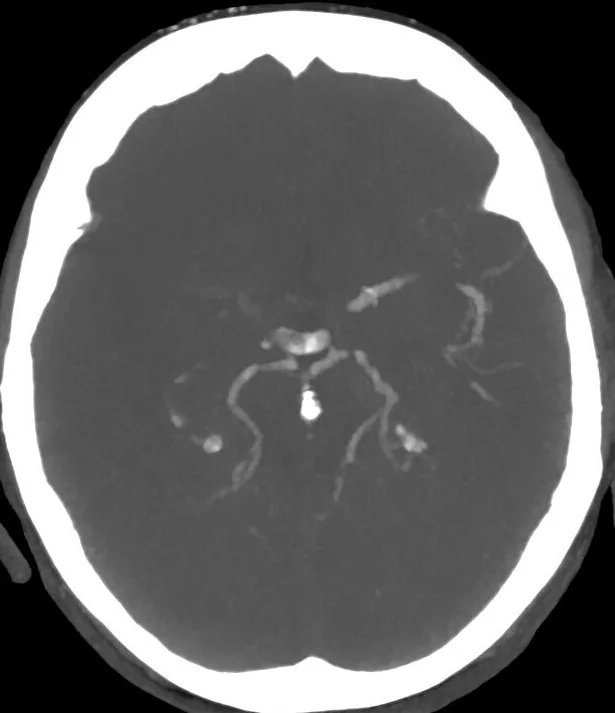
- İntrakraniyal ICA terminusunda, M1'de veya M2 dallarında kontrast kolonunun ani sonlanması, intraluminal dolum defekti ve distal arterlerin azalmış ya da gecikmiş opasifikasyonu aranır. İnce kesit kaynak görüntüler, multiplanar reformasyonlar ve MIP birlikte incelenir.
- Kontrastsız
- Kanama dışlanır; hiperdens arter ve erken parankimal değişiklikler oklüzyon tarafını destekleyebilir ancak lümen açıklığını doğrudan göstermez. Bu konu için kontrastlı BTA'nın yerini tutmaz.
Önerilen pencereler: Anjiyo (G 600 / M 150), İnme (G 40 / M 40).
BT bulguları
- ICA terminus oklüzyonunda tıkanıklık intrakraniyal ICA terminalini tutabilir ve M1 segmentinin başlangıcına uzanabilir.
- M1 dolum kesilmesi — MCA ana gövdesinde ani kontrast sonlanması izlenir; distal dallar az dolar veya kollateral yoldan geç dolar.
- M2 dal oklüzyonu — Sylvian fissür içindeki bir veya daha fazla dalın kontrast kolonu kesilir; segment ve dal sayısı tarif edilir.
- İntraluminal dolum defekti — kontrastla çevrelenen veya lümeni daraltan pıhtı, kaynak görüntülerde seçilebilir.
- Distal yeniden dolum — oklüzyonun ötesindeki dalların leptomeningeal kollateraller üzerinden geç opasifikasyonu görülebilir.
- Etkilenen hemisferdeki Sylvian dallarının sayısı ve opasifikasyonu karşı tarafa kıyaslanarak damar ağacı durumu ve kollateral dolum değerlendirilebilir.
- Tandem lezyon — servikal ICA hastalığı ile intrakraniyal ICA/MCA oklüzyonu aynı incelemede birlikte görülebilir.
Normalde
Normal CTA'da kavernöz ve supraklinoid ICA'dan terminal dallara kadar kontrast kolonu kesintisizdir; M1'den çıkan Sylvian dalları iki hemisferde benzer biçimde dolar. Aynı anatomik seviyede karşı tarafı izleyerek lümen sonlanmasını, distal dal opasifikasyonunu ve damar kalibresini kıyaslayın.
Normal BT ile kıyasla
Aynı bölgenin, kaynak veri setinde patoloji içermediği belirtilen bir BT incelemesini kesit kesit kaydırın; organ sınırlarını açarak anatomiyi hasta görüntüsüyle karşılaştırın. Küçük rastlantısal bulgular tümüyle dışlanmamıştır.
Kaynak: TotalSegmentator v2.01 veri seti (Wasserthal ve ark., Radiology: Artificial Intelligence 2023), CC BY 4.0, vaka s0849; organ sınırları veri setinin otomatik segmentasyonundan, birleştirilerek sadeleştirildi. Görüntüler 2,5 mm kesit aralığına yeniden örneklendi.
Ayırıcı tanı
- Zamanlama farklılıkları nedeniyle damar geç fazda dolabilir; tek bir erken görüntüdeki opasifikasyon azlığı gerçek kesilmeden ziyade bolus dinamiği farkı olabilir.
- Kronik intrakraniyal stenoz
- dar segmentten sonra damar devamlılığı ve kollateral yeniden yapılanma olabilir; ani embolik kesilme görünümünden ayrılır.
- Konjenital hipoplazi
- damar baştan itibaren ince kalibrelidir ve distal seyri boyunca küçüktür; fokal uçta ani kesilme beklenmez.
- Hareket veya kemik artefaktı
- kafa tabanı komşuluğunda yalancı lümen kesintisi oluşturabilir; kaynak görüntülerde diğer düzlemlerde kontrol edilir.
- Damar diseksiyonu
- eksantrik daralma, duvar düzensizliği veya uzun segment incelme görülebilir; tromboembolik ani kesilmeden farklı morfoloji taşır.
Tuzaklar
- MIP görüntüsünde küçük dalın örtüşme nedeniyle kaybolması oklüzyon gibi görünebilir; kesitsel kaynak görüntülere geri dönün.
- Bolus takip ayarları yetersiz olduğunda intrakraniyal damar opasifikasyonu zayıf olabilir; proksimal damar ve aort arkı doluluk düzeyini kontrol edin.
- CTA'da distal yeniden dolum ana damarın açık olduğu anlamına gelmez; kesilme düzeyini ve kollateral ile dolan segmentleri ayrı tarif edin.
- Yüksek dereceli intrakraniyal daralma veya hareket/kemik artefaktları oklüzyon taklit edebilir; karşı taraf anatomisi ve teknik kalite ile birlikte değerlendirilmelidir.
Kendini dene
CTA tabanlı otomatik LVO tespit araçlarında yanlış pozitif (yanlış oklüzyon alarmı) bulgunun en yaygın nedeni nedir?
Cevabı göster
Yüksek dereceli intrakraniyal arter daralmasının oklüzyonu taklit etmesi. S28 çalışmasına göre, RAPID CTA ve JLK LVO gibi yapay zeka araçlarında yanlış pozitif sonuçların en sık nedeni, yüksek dereceli intrakraniyal darlamanın oklüzyonu taklit etmesidir.
CTA tabanlı otomatik LVO tespit araçlarında yanlış pozitif (yanlış oklüzyon alarmı) bulgunun en yaygın nedeni nedir?
Cevabı göster
Yüksek dereceli intrakraniyal arter darılması. S28 çalışmasına göre, RAPID CTA ve JLK LVO gibi yapay zeka araçlarında yanlış pozitif sonuçların en sık nedeni, yüksek dereceli intrakraniyal darlamanın oklüzyonu taklit etmesidir.
Bu konunun yer aldığı turlar
İlgili konular
Kaynaklar
Bu sayfadaki 35 cümle ve 2 quiz sorusu aşağıdaki kaynaklardan alıntılarla tek tek karşılaştırıldı; 8 cümle bu karşılaştırmada düzeltildi (2026-10-08).
- Risk prediction models for malignant cerebral edema after endovascular therapy in patients with acute anterior circulation large vessel occlusion stroke: a systematic review and meta-analysispmc.ncbi.nlm.nih.gov
- Endovascular thrombectomy for acute ischemic stroke: evolving patient selection, procedural strategies, and adjunctive therapiespmc.ncbi.nlm.nih.gov
- Endovascular Therapy in Patients With Acute Ischemic Stroke With Large Infarct: A Guideline From the Society of Vascular and Interventional Neurologypmc.ncbi.nlm.nih.gov
- Long-term outcomes of endovascular thrombectomy vs. medical care in patients with large ischemic stroke: a systematic review and meta-analysis of randomized controlled trialspmc.ncbi.nlm.nih.gov
- Endovascular thrombectomy after anterior circulation large vessel ischemic stroke: an updated meta-analysispmc.ncbi.nlm.nih.gov
- Indications for Mechanical Thrombectomy for Acute Ischemic Stroke: Current Guidelines and Beyond.pubmed.ncbi.nlm.nih.gov
- Automated Brain Perfusion Imaging in Acute Ischemic Stroke: Interpretation Pearls and Pitfalls.pubmed.ncbi.nlm.nih.gov
- Safety and Efficacy of Solitaire Stent Thrombectomy: Individual Patient Data Meta-Analysis of Randomized Trials.pubmed.ncbi.nlm.nih.gov
- The Large Core Paradox.pubmed.ncbi.nlm.nih.gov
- Endovascular thrombectomy with or without intravenous alteplase in large-core ischemic stroke: a systematic review and meta-analysis.pubmed.ncbi.nlm.nih.gov
- Software with artificial intelligence-derived algorithms for analysing CT brain scans in people with a suspected acute stroke: a systematic review and cost-effectiveness analysis.pubmed.ncbi.nlm.nih.gov
- Mechanical thrombectomy in low Alberta stroke program early CT score (ASPECTS) in hyperacute stroke-a systematic review and meta-analysis.pubmed.ncbi.nlm.nih.gov
- Stroke imaging modality for endovascular therapy in the extended window: systematic review and meta-analysis.pubmed.ncbi.nlm.nih.gov
- AI Decision Support for Emergency Triage of Large Vessel Occlusion Using Noncontrast Computed Tomography: Systematic Review and Bayesian Diagnostic Test Accuracy Network Meta-Analysis.pubmed.ncbi.nlm.nih.gov
- Risk prediction models for malignant cerebral edema after endovascular therapy in patients with acute anterior circulation large vessel occlusion stroke: a systematic review and meta-analysis.pubmed.ncbi.nlm.nih.gov
- Long-term outcomes of endovascular thrombectomy vs. medical care in patients with large ischemic stroke: a systematic review and meta-analysis of randomized controlled trials.pubmed.ncbi.nlm.nih.gov
- Endovascular thrombectomy for acute ischemic stroke: evolving patient selection, procedural strategies, and adjunctive therapies.pubmed.ncbi.nlm.nih.gov
- Infarct growth despite full reperfusion in endovascular therapy for acute ischemic stroke.pubmed.ncbi.nlm.nih.gov
- Thrombectomy for Stroke With Large Infarct on Noncontrast CT: The TESLA Randomized Clinical Trial.pubmed.ncbi.nlm.nih.gov
- Multiterritory Bihemispheric Ischemic Stroke in the Setting of Unilateral Internal Carotid Artery Disease.pubmed.ncbi.nlm.nih.gov
- Endovascular thrombectomy for subterminal internal carotid artery occlusions: clinical and radiological heterogeneity in a nationwide registry.pubmed.ncbi.nlm.nih.gov
- Beyond Venous Inflammation: Vessel Wall Imaging of Intracranial Arteries in Neuro-Behçet's Syndrome.pubmed.ncbi.nlm.nih.gov
- Automated CTA-Derived Collateral Grading and Morphologic Metrics for Enhanced Prediction of Poststroke Outcomes.pubmed.ncbi.nlm.nih.gov
- Beyond plaque morphology: a multimodal imaging model combining structural vulnerability and functional reserve predicts stroke recurrence in symptomatic intracranial atherosclerosis.pubmed.ncbi.nlm.nih.gov
- Advances in cerebrovascular reserve function assessment for moyamoya disease.pubmed.ncbi.nlm.nih.gov
- Initial Experience With a Deep Learning Algorithm for Detecting Posterior Circulation Large Vessel Occlusion on Noncontrast Computed Tomography.pubmed.ncbi.nlm.nih.gov
- Stroke or Seizure? Diagnostic Role of Neuroimaging in Acute Neurologic Mimics.pubmed.ncbi.nlm.nih.gov
- RAPID CTA versus JLK LVO for large vessel occlusion detection: a pragmatic comparison of performance and common pitfalls.pubmed.ncbi.nlm.nih.gov
- Radiologic Interventions for Gastrointestinal Bleeding.pubmed.ncbi.nlm.nih.gov
- Rectal artery embolization: recent advances and research progress.pubmed.ncbi.nlm.nih.gov
- Diagnosis and embolization of a non-iatrogenic and non-traumatic thyrocervical pseudoaneurysm.pubmed.ncbi.nlm.nih.gov
- Middle cerebral artery dissection: pathophysiology, diagnosis, and therapeutic options.pubmed.ncbi.nlm.nih.gov
- Prediction of collateral circulation grading and functional outcomes in acute ischemic stroke using FLAIR vascular hyperintensity combined with multimodal CT parameters.pubmed.ncbi.nlm.nih.gov
- Imaging, Intervention, and Workflow in Acute Ischemic Stroke: The Calgary Approach.pubmed.ncbi.nlm.nih.gov
- Evaluation of Atherosclerotic Changes in the Superior Mesenteric Artery Using MDCT.pubmed.ncbi.nlm.nih.gov
- Cardiovascular Computed Tomography Angiographic Assessment of Simple Cardiac Shunts in Adults.pubmed.ncbi.nlm.nih.gov
- Thrombus enhancement sign predicts distal embolization in anterior circulation stroke treated with endovascular thrombectomy.pubmed.ncbi.nlm.nih.gov
- Understanding Photon-Counting CT: Physics, Detector Technology, and Image Reconstructions.pubmed.ncbi.nlm.nih.gov
- AI-driven decision making for intravascular device selection in aortic disease. Current insights and prospects.pubmed.ncbi.nlm.nih.gov
- Emerging multimodality imaging techniques for the pulmonary circulation.pubmed.ncbi.nlm.nih.gov
- Internal carotid artery-middle cerebral artery junction small arterial ring: A report of two cases diagnosed by magnetic resonance angiography.pubmed.ncbi.nlm.nih.gov
- Human cerebral arterial morphogenesis explored by 3D microscopic imaging of cleared embryos: Bridging the gap between embryonic and adult anatomy.pubmed.ncbi.nlm.nih.gov
- Graves' disease-related reversible intracranial arteriopathy presenting with ischemic stroke: A case report and literature review.pubmed.ncbi.nlm.nih.gov
- Impact of Intraprocedural Pulse Pressure During Mechanical Thrombectomy on Functional and Radiological Outcomes in Patients with Acute Ischemic Stroke.pubmed.ncbi.nlm.nih.gov
- Case Report: A Cluster of Complications During Carotid Artery Stenting Managed With Peripheral, Coronary, and Imaging Techniques.pubmed.ncbi.nlm.nih.gov
- Balancing Time and Risk: Temporary Arterial Occlusion in Middle Cerebral Artery Aneurysm Surgery.pubmed.ncbi.nlm.nih.gov
- Unilateral Pulmonary Artery Lesion in an Immunocompromised Patient.pubmed.ncbi.nlm.nih.gov
- Pulmonary artery intimal sarcoma with pleural effusion: a case report.pubmed.ncbi.nlm.nih.gov
- Aortic Injury and Hemopericardium: Key Findings and Evaluation.pubmed.ncbi.nlm.nih.gov
- Moyamoya Vasculopathy and Atypical Moyamoya-like Patterns: Insights into Diagnosis and Therapeutic Implications.pubmed.ncbi.nlm.nih.gov
- Cerebral venous collaterals: A new fort for fighting ischemic stroke?pubmed.ncbi.nlm.nih.gov
- Case Report: Intravascular lithotripsy combined with a new-generation 3-in-1 carotid stent for calcified carotid artery stenosis.pubmed.ncbi.nlm.nih.gov
- Tandem Lesion Strokes: To Stent or Not to Stent, Insights From a Decade of Experience at a Comprehensive Stroke Center in Argentina.pubmed.ncbi.nlm.nih.gov
- Emergency carotid artery stenting during endovascular treatment of tandem lesions in acute ischemic stroke: a single-center retrospective study.pubmed.ncbi.nlm.nih.gov
- High-affinity alphavbeta3 integrin targeted optical probe as a new imaging biomarker for early atherosclerosis: initial studies in Watanabe rabbits.pubmed.ncbi.nlm.nih.gov
- Incidental Detection of a Posterior Inferior Cerebellar Artery (PICA)-Terminating Vertebral Artery Variant During CT Evaluation of Venous Sinus Thrombosis: A Case Report.pubmed.ncbi.nlm.nih.gov
- The role of contrast-enhanced transcranial color-coded real-time sonography combined with the common carotid artery compression test in preoperative evaluation of anterior communicating artery patency in patients with insufficient temporal bone windows.pubmed.ncbi.nlm.nih.gov
- Multimodal imaging in neuro-ophthalmology.pubmed.ncbi.nlm.nih.gov
- Endovascular Embolization in Neurovascular Disease: Material Science, Multimodal Management, and Future Horizons.pubmed.ncbi.nlm.nih.gov
- Diagnostic value of the perfusion mismatch ratio in identifying intracranial atherosclerotic disease related occlusion.pubmed.ncbi.nlm.nih.gov
- Absent internal carotid artery during neck exploration for penetrating trauma.pubmed.ncbi.nlm.nih.gov
- The persistent proatlantal artery: types and subtypes.pubmed.ncbi.nlm.nih.gov
- Operative Procedures for Ultrasound Assessment of Extracranial Artery Disease: A Narrative Review by the Italian Society for Vascular Investigation (SIDV).pubmed.ncbi.nlm.nih.gov
- Imaging and Management of Blunt Cerebrovascular Injury.pubmed.ncbi.nlm.nih.gov
- Neuroimaging with photon-counting computed tomography: A review of clinical applications.pubmed.ncbi.nlm.nih.gov
- Insights into unique anatomical structures of the ascidian Halocynthia papillosa obtained by multimodal imaging.pubmed.ncbi.nlm.nih.gov
- Simultaneous Visualization of the Carotid and Subclavian Arteries Using Non-Contrast-Enhanced MR Angiography With a 3D Fast Field Echo Sequence and Time-Spatial Labeling Inversion Pulse: A Comparison With 3D Time-of-Flight MR Angiography.pubmed.ncbi.nlm.nih.gov
- Optimization of Bolus-Tracking Thresholds levels in Cerebral CT Angiography: Influence of Patient Characteristics on contrast enhancement dynamics and radiation dose metrics.pubmed.ncbi.nlm.nih.gov
- Quantitative multi-slice spiral CT perfusion parameters as predictors of collateral status and 90-day functional outcome in acute ischemic stroke.pubmed.ncbi.nlm.nih.gov
- The Role of Imaging in Portal Vein Thrombosis: From the Diagnosis to the Interventional Radiological Management.pubmed.ncbi.nlm.nih.gov
- Ultrasound Technologies and the Diagnosis of Giant Cell Arteritis.pubmed.ncbi.nlm.nih.gov
- Anatomic variations in basilar artery termination: a systematic review and meta-analysis with presentation of an illustrative case.pubmed.ncbi.nlm.nih.gov
- Endovascular management of tandem embolic stroke due to cardioembolic free-floating thrombus: a case report.pubmed.ncbi.nlm.nih.gov
- Mechanisms of aortic dissection: From pathological changes to experimental and <i>in silico</i> models.pubmed.ncbi.nlm.nih.gov
- Sixty-four-section multidetector CT angiography of carotid arteries: a systematic analysis of image quality and artifacts.pubmed.ncbi.nlm.nih.gov
- Pulmonary artery aneurysms: diagnosis & endovascular therapy.pubmed.ncbi.nlm.nih.gov
- Long-term safety and effectiveness of the "OptEase" vena cava filter.pubmed.ncbi.nlm.nih.gov
- Beyond vascular recanalization: precision medicine in cervical artery dissection guided by multiple mechanisms and multimodal imaging for brain functional recovery.pubmed.ncbi.nlm.nih.gov
- Potentials of ChatGPT in Anatomy Research: A Conversation With ChatGPT.pubmed.ncbi.nlm.nih.gov
- Perforator-Sparing Microsurgical Clipping of Tandem Dominant-Hemisphere Middle Cerebral Artery Aneurysms: Geometry-Guided Reconstruction of a Wide-Neck Bifurcation and Dorsal M1 Fusiform Lesion.pubmed.ncbi.nlm.nih.gov
- The pathogenesis of cerebral small vessel disease and vascular cognitive impairment.pubmed.ncbi.nlm.nih.gov
- Prevalence, diagnosis and management of intracranial atherosclerosis in White populations: a narrative review.pubmed.ncbi.nlm.nih.gov
- An Integrated Approach on the Diagnosis of Cerebral Veins and Dural Sinuses Thrombosis (a Narrative Review).pubmed.ncbi.nlm.nih.gov
- The predictive value of cerebral blood flow perfusion for cSAH following flow-restricting head and neck artery angioplasty.pubmed.ncbi.nlm.nih.gov
- Endovascular revascularization of symptomatic chronic total occlusions of the internal carotid artery using a proximal balloon protection device.pubmed.ncbi.nlm.nih.gov
- Regional Blood Flow in the Normal and Ischemic Brain Is Controlled by Arteriolar Smooth Muscle Cell Contractility and Not by Capillary Pericytes.pubmed.ncbi.nlm.nih.gov
- Non-Contrast MRI Sequences for Ischemic Stroke: A Concise Overview for Clinical Radiologists.pubmed.ncbi.nlm.nih.gov
- Exploring Vascular Contributions to Cognitive Impairment with Focus on Small-Vessel Disease of White Matter and Micro/nanoplastics.pubmed.ncbi.nlm.nih.gov
- Neurovascular Issues in Antiphospholipid Syndrome: Arterial Vasculopathy from Small to Large Vessels in a Neuroradiological Perspective.pubmed.ncbi.nlm.nih.gov
- Identifying the Sylvian Triangle on CT angiography: A technique for detecting distal middle cerebral artery occlusions.pubmed.ncbi.nlm.nih.gov
- Interobserver reliability of computed tomography angiography in the assessment of ruptured intracranial aneurysm and impact on patient management.pubmed.ncbi.nlm.nih.gov
- Multiomics Analysis-Based Biomarkers in Diagnosis of Polycystic Ovary Syndrome.pubmed.ncbi.nlm.nih.gov
- Infarcts and ischemia in the abdomen: an imaging perspective with an emphasis on cross-sectional imaging findings.pubmed.ncbi.nlm.nih.gov
- Embolization in Pediatric Patients: A Comprehensive Review of Indications, Procedures, and Clinical Outcomes.pubmed.ncbi.nlm.nih.gov
- Roles of Trauma CT and CTA in Salvaging the Threatened or Mangled Extremity.pubmed.ncbi.nlm.nih.gov
- CT angio for the evaluation of graft patency.pubmed.ncbi.nlm.nih.gov
- General principles and overview of vascular contrast-enhanced ultrasonography.pubmed.ncbi.nlm.nih.gov
- Tissue clock-guided prediction and intervention of futile recanalization: towards precision therapy in mechanical thrombectomy.pubmed.ncbi.nlm.nih.gov
- Does laparoscopic surgery decrease the risk of atrial fibrillation after foregut surgery?pubmed.ncbi.nlm.nih.gov
- Clinical software for unsupervised automated net water uptake analysis predicts futile recanalization in acute ischemic stroke.pubmed.ncbi.nlm.nih.gov
- Outcome Prediction Using Perfusion Parameters and Collateral Scores of Multi-Phase and Single-Phase CT Angiography in Acute Stroke: Need for One, Two, Three, or Thirty Scans?pubmed.ncbi.nlm.nih.gov
- Predictive value of the velocity of collateral filling in patients with acute ischemic stroke.pubmed.ncbi.nlm.nih.gov
- Tenecteplase versus standard medical treatment for minor stroke due to anterior-circulation medium-vessel occlusion: a multicenter observational study.pubmed.ncbi.nlm.nih.gov
- Acute Ischemic Stroke in 2026: From Time to Penumbra-An Updated Narrative Review of Reperfusion Strategies with a Latin American Implementation Perspective.pubmed.ncbi.nlm.nih.gov
- Imaging Evaluation of Acute Traumatic Brain Injury.pubmed.ncbi.nlm.nih.gov
- Idiopathic Renal Infarct in a Healthy Adult With an Accessory Renal Artery: A Case Report.pubmed.ncbi.nlm.nih.gov
- Neuroimaging for neurovascular complications of traumatic brain injury.pubmed.ncbi.nlm.nih.gov
- Transforming stroke care: the promise of feedback-guided thrombolytic nanomedicine.pubmed.ncbi.nlm.nih.gov
- Multiphase CT angiography versus single-phase CT angiography: comparison of image quality and radiation dose.pubmed.ncbi.nlm.nih.gov
- Commentary: an eye on PET quantification.pubmed.ncbi.nlm.nih.gov
- Fluid transport in the brain.pubmed.ncbi.nlm.nih.gov
- Total laparoscopic radical hysterectomy for cervical cancer in prolapsed uterus.pubmed.ncbi.nlm.nih.gov
- Analysis of perceptual errors in skull-base pathology.pubmed.ncbi.nlm.nih.gov
- Rapid Assessment of Acute Ischemic Stroke by Computed Tomography Using Deep Convolutional Neural Networks.pubmed.ncbi.nlm.nih.gov
- Vessel wall magnetic resonance and arterial spin labelling imaging in the management of presumed inflammatory intracranial arterial vasculopathy.pubmed.ncbi.nlm.nih.gov
Eğitim amaçlıdır; hasta başında tanı ve tedavi kararının yerine geçmez. İçerik yapay zekâ destekli bir süreçle güncel literatüre göre cümle cümle kaynaklarla karşılaştırıldı, ancak uzman radyolog incelemesinden geçmedi. Klinik kararlarda güncel kılavuzları, kurum protokollerini ve radyoloji raporunu esas alın.