Özet
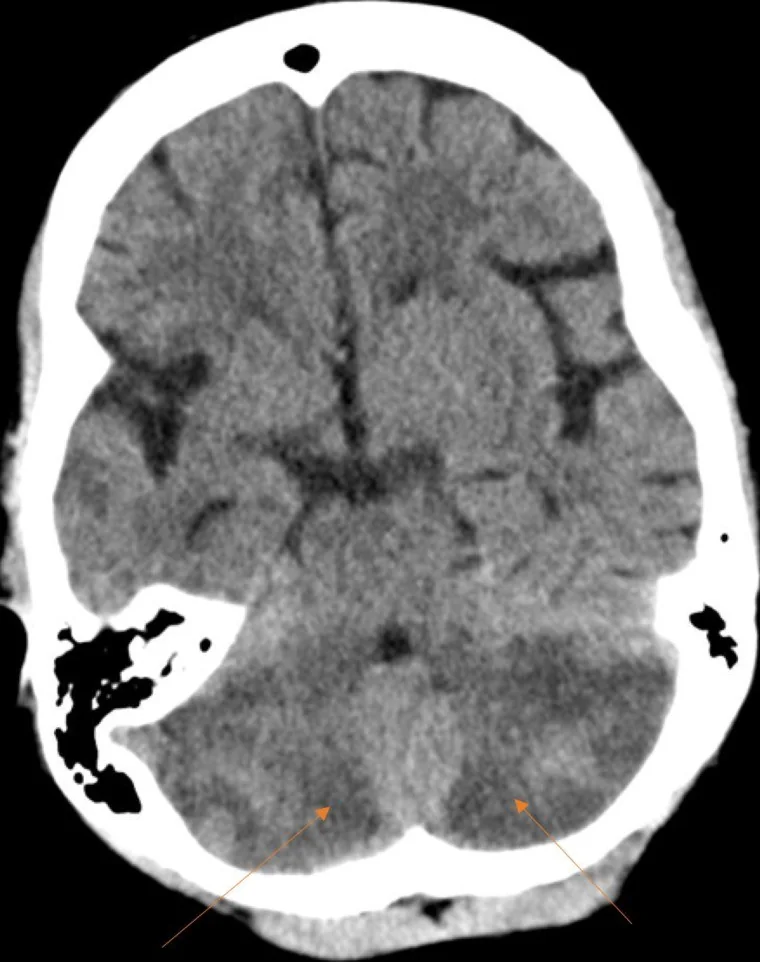
Vertebral-baziler sistem beyin sapı, serebellum, talamus ve oksipital loblarda iskemi oluşturabilir. Baş dönmesi, yürüme ataksisi ve diplopi posterior dolaşım infarktında görülebilen klinik bulgulardır. Kontrastsız BT erken posterior dolaşım iskemisini göstermeyebilir; arka çukurda kemik kaynaklı ışın sertleşmesi erken iskemi bulgularının saptanmasını daha da güçleştirir. BT anjiyografi vertebrobaziler arter lümenindeki tıkanıklığı yüksek duyarlılık ve özgüllükle gösterir. Geniş serebellar infarkt ödemi dördüncü ventrikülü sıkıştırabilir ve obstrüktif hidrosefaliye yol açabilir.
Faz ve pencere
- Kontrastsız tanısal
- Pons, mezensefalon ve serebellar hemisferlerde erken iskemik değişiklikler aranır; kalın kafa tabanına bağlı ışın sertleşmesi artefaktları bu değişikliklerin saptanmasını güçleştirir. Talamus ve oksipital lob posterior dolaşım alanındadır; normal kontrastsız BT posterior dolaşım infarktını güvenilir biçimde dışlamaz.
- BTA tanısal
- BT anjiyografi vertebrobaziler sistemde büyük damar tıkanıklığını ve tıkanıklığın proksimal-distal düzeyini değerlendirmeye yardımcı olur. BT anjiyografi kaynak görüntülerindeki hipoatenüasyon prognostik değerlendirmeye yardımcı olabilir.
Önerilen pencereler G genişlik, M merkez; değerler Hounsfield birimi (HU)
- İnmeG 40 / M +40
- BeyinG 80 / M +40
- AnjiyoG 600 / M +150
BT bulguları
- Pons posterior dolaşım alanındadır ve kalın kafa tabanına bağlı artefaktlar erken iskemik değişikliklerin saptanmasını güçleştirir.
- Mezensefalon posterior dolaşım alanında değerlendirilir; arka çukurda erken iskemik değişikliklerin saptanması artefaktlar nedeniyle güç olabilir.
- Büyük serebellar infarkt ödem ve kitle etkisiyle dördüncü ventriküle bası yapabilir.
- Talamus ve oksipital lob posterior dolaşım alanındadır; normal kontrastsız BT posterior dolaşım infarktını güvenilir biçimde dışlamaz.
- BT anjiyografi vertebrobaziler sistemde büyük damar tıkanıklığını saptamaya yardımcı olur.
- Hiperdens baziler arter işareti — kontrastsız BT'de baziler arter komşu damarlarla kıyaslandığında artmış atenüasyonda görünür ve uygun klinik bağlamda trombüsü düşündürebilir; BT anjiyografi ile doğrulanmalıdır.
- Dördüncü ventrikül basısı ödemin kitle etkisini gösterir ve obstrüktif hidrosefaliye yol açabilir.
- İnfarktın dağılımı PICA, AICA veya SCA gibi serebellar arter alanlarına; baziler perforanlara ya da PCA alanlarına uyabilir; tutulan damar alanı ve eşlik eden beyin sapı bulguları birlikte değerlendirilmelidir.
Ölçütler ve sınıflamalar
- pc-ASPECTS
- Başlangıç puanı 10'dur ve erken iskemi için puan düşülür. Sağ/sol talamus, her bir serebellar hemisfer ve her bir PCA oksipital alanında 1'er; pons veya mezensefalonun her birinde 2 puan düşülür. Bazı baziler arter oklüzyonu kohortlarında daha düşük posterior dolaşım ASPECTS puanları daha kötü klinik sonuçla ilişkili bulunmuştur.
Normalde
Pons, mezensefalon, serebellum ve dördüncü ventrikül posterior dolaşım değerlendirmesinde incelenir; büyük serebellar infarkt kitle etkisiyle görülebilir. Aynı kesit düzeyinde iki serebellar hemisferi, bazal sisternleri ve baziler arterin yoğunluğunu kıyaslayın; ışın sertleşmesi çizgisini anatomik sınırlara uyan gerçek parankim kaybıyla karıştırmayın.
Normal BT ile kıyasla
Aynı bölgenin, kaynak veri setinde patoloji içermediği belirtilen bir BT incelemesini kesit kesit kaydırın; organ sınırlarını açarak anatomiyi hasta görüntüsüyle karşılaştırın. Küçük rastlantısal bulgular tümüyle dışlanmamıştır.
Kaynak: TotalSegmentator v2.01 veri seti (Wasserthal ve ark., Radiology: Artificial Intelligence 2023), CC BY 4.0, vaka s0103; organ sınırları veri setinin otomatik segmentasyonundan, birleştirilerek sadeleştirildi. Görüntüler 2,5 mm kesit aralığına yeniden örneklendi.
Ayırıcı tanı
- PRES
- tipik görüntüleme paterni iki taraflı posterior ağırlıklı vazojenik ödemdir; en sık parieto-oksipital bölgeler etkilenir.
- Akut kanama
- kontrastsız BT akut intrakraniyal kanamayı saptamada temel görüntüleme yöntemidir; arka çukur kemik artefaktı değerlendirmeyi zorlaştırabilir.
Tuzaklar
- Bazis krani kaynaklı çizgisel ışın sertleşme artefaktı ponsu yalancı heterojen gösterebilir; beyin penceresi ve ardışık kesitlerde anatomik süreklilik arayın.
- Normal kontrastsız BT erken beyin sapı iskemisini dışlamaz; klinik şüphe yüksekse BTA'da vertebrobaziler açıklığı ve varsa ileri görüntülemeyi ayrı sorular olarak değerlendirin.
- Küçük serebellar infarkt erken kontrastsız BT'de seçilemeyebilir; arka çukur kemik artefaktı duyarlılığı azaltır. Karşı hemisfer ve dördüncü ventrikül konturunu birlikte değerlendirin.
- Hiperdens baziler görünüm kafa tabanı ışın sertleşmesi veya parsiyel hacim etkisiyle yalancı pozitif olabilir; komşu damarlarla kıyaslayın ve BTA'da lümen açıklığını doğrulayın.
Kendini dene
Akut diplopi ve ataksiye rağmen kontrastsız BT'de pons seçilemiyor; BTA'da baziler gövdede dolum kesintisi var. En doğru yorum hangisidir?
Cevabı göster
Posterior dolaşım büyük damar oklüzyonu. Baziler gövdedeki BTA dolum kesintisi oklüzyon lehinedir; normal kontrastsız BT arka çukur iskemisini dışlamaz. Laküner lezyon küçük ve derin yerleşimlidir; PRES tipik olarak iki taraflı posterior ağırlıklı vazojenik ödem yapar, ACA ise medial frontal-parietal korteksi besler.
Serebellar hemisferde hipodens şişme, daralmış dördüncü ventrikül ve hidrosefali var. En önemli eşlik eden sorun hangisidir?
Cevabı göster
Obstrüktif hidrosefaliye bağlı BOS akım bozulması. Serebellar infarkta bağlı sitotoksik ödem kitle etkisi yapar; dördüncü ventrikülün sıkışması BOS akımını bozarak obstrüktif hidrosefaliye yol açabilir. PRES tipik olarak kitle etkisi yapmayan, iki taraflı parieto-oksipital bölgelerde ağırlıklı vazojenik ödemle görülür.
İlgili konular
- Baziler arter oklüzyonu
- Posterior dolaşım ASPECTS (pc-ASPECTS)
- PRES: posterior ağırlıklı vazojenik ödem
Kaynaklar
Bu sayfadaki 43 cümle ve 2 quiz sorusu aşağıdaki kaynaklardan alıntılarla otomatik olarak karşılaştırıldı; 26 cümle bu karşılaştırmada düzeltildi (2026-10-12).
- Posterior circulation ischaemic stroke diagnosis and managementpmc.ncbi.nlm.nih.gov
- Prevalence of signs and symptoms in posterior circulation ischemic stroke: a systematic review and meta-analysispmc.ncbi.nlm.nih.gov
- Cerebral circulation 1: anatomypmc.ncbi.nlm.nih.gov
- Neuroimaging Predictors of Clinical Outcome in Acute Basilar Artery Occlusionfrontiersin.org
- Diagnostic and prognostic computed tomography imaging markers in basilar artery occlusion (Review)spandidos-publications.com
- CT for Treatment Selection in Acute Ischemic Stroke: A Code Stroke Primerpubs.rsna.org
- The hyperdense vessel sign in cerebral computed tomography: pearls and pitfallspmc.ncbi.nlm.nih.gov
- Posterior Reversible Encephalopathy Syndrome: Clinical Features and Outcomefrontiersin.org
- Imaging Patterns of Toxic and Metabolic Brain Disorderspubs.rsna.org
- Acute cerebellitis in adults: a case report and review of the literaturepubmed.ncbi.nlm.nih.gov
- Imaging of Primary Posterior Fossa Brain Tumors in Childrencdn.ymaws.com
- Computed tomography in acute intracerebral hemorrhage: neuroimaging predictors of hematoma expansion and outcomepubmed.ncbi.nlm.nih.gov
- Neuroimaging standards for research into small vessel disease – advances since 2013 (STRIVE-2)discovery.ucl.ac.uk
- Anatomical Variations and Morphometric Features of the Anterior Cerebral Artery: A Systematic Review and Meta-Analysis of 24,015 Casespubmed.ncbi.nlm.nih.gov
- Posterior circulation ischaemic stroke diagnosis and managementpubmed.ncbi.nlm.nih.gov
- Progress in the Study of Diagnostic Methods for Central Acute Vestibular Syndrome of a Vascular Causepmc.ncbi.nlm.nih.gov
- Cerebral Blood Flow Velocity Modulation and Clinical Efficacy of Acupuncture for Posterior Circulation Infarction Vertigo: A Systematic Review and Meta-Analysispmc.ncbi.nlm.nih.gov
- Hidden Bow Hunter's Syndrome Diagnosed Using Dynamic Cerebral Angiography and Successfully Treated with Spinal Surgery: A Case Report and Review of the Literaturepmc.ncbi.nlm.nih.gov
- Basilar artery hypoplasia associated with changes of brainstem potential, transcranial Doppler and perfusion-weighted imaging.pubmed.ncbi.nlm.nih.gov
- Incidence and clinical features of acute multiple small cerebellar infarction.pubmed.ncbi.nlm.nih.gov
- Morphine overinfusion of intrathecal drug administration system under magnetic resonance evaluation for the diagnosis of stroke: a case report.pubmed.ncbi.nlm.nih.gov
- Less thrombolysis in posterior circulation infarction-a necessary evil?pubmed.ncbi.nlm.nih.gov
- Vertebral artery hypoplasia: an innocent lamb or a disguise?pubmed.ncbi.nlm.nih.gov
- One-year follow-up in patients with brainstem infarction due to large-artery atherothrombosis.pubmed.ncbi.nlm.nih.gov
- Diagnostic ability of 3-dimensional contrast-enhanced MR angiography in identifying vertebral basilar artery stenosis.pubmed.ncbi.nlm.nih.gov
- Extracranial and Intracranial Ultrasonographic Findings in Posterior Circulation Infarction.pubmed.ncbi.nlm.nih.gov
- Artery of Percheron infarction: review of literature with a case report.pubmed.ncbi.nlm.nih.gov
- Prognostic Factors for Long-Term Recovery of Homonymous Visual Field Defects After Posterior Circulation Ischemic Stroke.pubmed.ncbi.nlm.nih.gov
- A retrospective analysis of negative diffusion-weighted image results in patients with acute cerebral infarction.pubmed.ncbi.nlm.nih.gov
- The Spectrum of Vestibular Disorders Presenting With Acute Continuous Vertigo.pubmed.ncbi.nlm.nih.gov
- Carotid Doppler and lipid profile findings in ischemic stroke patients--a hospital based study.pubmed.ncbi.nlm.nih.gov
- A retrospective analysis of a newly proposed imaging-etiologic classification for acute ischemic stroke with large vascular occlusion based on MRI and pathogenesis.pubmed.ncbi.nlm.nih.gov
- Individualized endovascular management of distal posterior circulation aneurysms: a single-center experience and decision framework.pubmed.ncbi.nlm.nih.gov
- The Epidemiology and Clinical Presentation of the Acute Imbalance Syndrome (AIS)-A Systematic Review and Meta-Analysis.pubmed.ncbi.nlm.nih.gov
- Anatomic variations in basilar artery termination: a systematic review and meta-analysis with presentation of an illustrative case.pubmed.ncbi.nlm.nih.gov
- Primary Angiitis of the Central Nervous System Mimicking a Cardioembolism: Posterior Circulation Infarction With Subarachnoid Hemorrhage and Obstructive Hydrocephalus.pubmed.ncbi.nlm.nih.gov
- Transient neuromonitoring changes and delayed vertebrobasilar infarction following anterior cervical discectomy and fusion: illustrative case.pubmed.ncbi.nlm.nih.gov
- Early space-occupying cerebellar oedema requiring decompressive craniectomy following a clinically minor stroke.pubmed.ncbi.nlm.nih.gov
- Recurrent brief positional vertigo as the initial presentation of medial branch of the posterior inferior cerebellar artery territory cerebellar infarction: a case report.pubmed.ncbi.nlm.nih.gov
- Vertebral Artery Dissection and PICA-Territory Stroke Associated with Chronic Atlantoaxial Structural Abnormality: A Case Report.pubmed.ncbi.nlm.nih.gov
- Endovascular Revascularization for Chronic Vertebral Artery Occlusion with Poor Collateral Circulation and a Large Perfusion Abnormality Identified by Automated Perfusion Imaging: A Case Report.pubmed.ncbi.nlm.nih.gov
- Ruptured Brain Arteriovenous Malformation Coexisting With Reversible Cerebral Vasoconstriction Syndrome: A Case Report.pubmed.ncbi.nlm.nih.gov
- Difficulty and prospects of endovascular treatment for spontaneous intracranial artery dissection.pubmed.ncbi.nlm.nih.gov
- Incorporating algorithmic uncertainty into a clinical machine deep learning algorithm for urgent head CTs.pubmed.ncbi.nlm.nih.gov
- Endovascular Treatment for Posterior Circulation Stroke: Ways to Maximize Therapeutic Efficacy.pubmed.ncbi.nlm.nih.gov
- Computed Tomography-Based Imaging Scores in Basilar Artery Occlusions: A Comparison of Predictive Abilities for Functional Outcomes.pubmed.ncbi.nlm.nih.gov
- Where Does the Signal Go? Technical Challenges of CT Perfusion in Lacunar and Infratentorial Stroke.pubmed.ncbi.nlm.nih.gov
- Venous-phase Tan-based collateral assessment on CTP-derived CTA for outcome stratification after reperfusion therapy in acute ischemic stroke.pubmed.ncbi.nlm.nih.gov
- Neurosonology in acute stroke revealing bilateral internal carotid artery occlusion maintained by persistent embryologic collaterals: A case report.pubmed.ncbi.nlm.nih.gov
- Endovascular thrombectomy for acute ischemic stroke: evolving patient selection, procedural strategies, and adjunctive therapies.pubmed.ncbi.nlm.nih.gov
- A novel radiological score on digital subtraction angiography predicts prognosis for acute basilar artery occlusion treated with endovascular thrombectomy: a two-center retrospective study.pubmed.ncbi.nlm.nih.gov
- Postpartum Vertebral Artery Dissection After Neck Massage Resulting in a Right Cerebellar Infarct: A Case Report and Literature Review.pubmed.ncbi.nlm.nih.gov
- Identifying central positional vertigo to prevent diagnostic pitfalls: A case series and review of literature.pubmed.ncbi.nlm.nih.gov
- Preoperative ipsilateral thalamic volume reduction as a prognostic marker in malignant middle cerebral artery infarction undergoing decompressive craniectomy.pubmed.ncbi.nlm.nih.gov
- Consecutive PRES and diffuse alveolar hemorrhage in a patient with active lupus nephritis and antiphospholipid antibodies: a case report and systematic literature review.pubmed.ncbi.nlm.nih.gov
- The Central Variant of Posterior Reversible Encephalopathy Syndrome: A Systematic Review and Meta-Analysis.pubmed.ncbi.nlm.nih.gov
- Isolated brainstem death: case presentation demonstrating preserved supratentorial perfusion on <sup>99m</sup>Tc-bicisate brain scintigraphy.pubmed.ncbi.nlm.nih.gov
- The clinical value of vHIT saccadic parameters in the diagnosis and management of central vestibular disorders: a narrative review.pubmed.ncbi.nlm.nih.gov
- Cerebellum, or Not Cerebellum, That Was the Question.pubmed.ncbi.nlm.nih.gov
- Wall-Eyed Bilateral Internuclear Ophthalmoplegia With Concomitant Facial Diplegia: A Case Report and Review of the Literature.pubmed.ncbi.nlm.nih.gov
- Dual impact of flow diverters on ischemic and hemorrhagic outcomes in vertebral artery dissecting aneurysms presenting with ischemia.pubmed.ncbi.nlm.nih.gov
- Factors influencing functional recovery in posterior circulation stroke following mechanical thrombectomy: a systematic review and meta-analysis.pubmed.ncbi.nlm.nih.gov
- Integrated predictors of outcome in vertebrobasilar artery occlusion treated With endovascular therapy.pubmed.ncbi.nlm.nih.gov
- Parenchymal Insults in Abuse-A Potential Key to Diagnosis.pubmed.ncbi.nlm.nih.gov
- The Big Black Brain: Subdural Hemorrhage with Hemispheric Swelling and Low Attenuation.pubmed.ncbi.nlm.nih.gov
- Imaging Guidance for Therapeutic Delivery: The Dawn of Neuroenergetics.pubmed.ncbi.nlm.nih.gov
- Computed tomography perfusion-defined ischemic core predicts functional outcome after basilar artery thrombectomy.pubmed.ncbi.nlm.nih.gov
- Endovascular Therapy for Acute Basilar Artery Occlusion: Prognosis Prediction Value from Clinical to Imaging Variables.pubmed.ncbi.nlm.nih.gov
- Imaging Evaluation of Acute Traumatic Brain Injury.pubmed.ncbi.nlm.nih.gov
- Simultaneous ST-Elevation Myocardial Infarction Without Obstructive Coronary Disease and Intracranial Hemorrhage Complicated by Recurrent Stroke in a Patient With Diffuse Thrombosis.pubmed.ncbi.nlm.nih.gov
- Stroke risk following bee and wasp stings: a systematic review of ischemic and hemorrhagic events.pubmed.ncbi.nlm.nih.gov
- Non-contrast CT findings suggestive of secondary intracerebral haemorrhage.pubmed.ncbi.nlm.nih.gov
- Age-Related Volumetric Changes of the Posterior Cranial Fossa and its Structures in Stroke Patients.pubmed.ncbi.nlm.nih.gov
- Mega Cisterna Magna: Current Perspectives and Future Directions-A Literature Review.pubmed.ncbi.nlm.nih.gov
- Mesenchymal tumors of the central nervous system: illustrative case.pubmed.ncbi.nlm.nih.gov
- Anatomically Precise Microsurgical Resection of a Posterior Fossa Cerebellar Metastasis in an Elderly Patient with Preservation of Venous Outflow, Dentate Nucleus, and Cerebrospinal Fluid Pathways.pubmed.ncbi.nlm.nih.gov
- Sequential Contralateral Large-Vessel Occlusion Following Intravenous Thrombolysis: A Case Report of Dynamic Bilateral Cerebral Arterial Thrombosis.pubmed.ncbi.nlm.nih.gov
- The Occurrence of Acute Disseminated Encephalomyelitis in SARS-CoV-2 Infection/Vaccination: Our Experience and a Systematic Review of the Literature.pubmed.ncbi.nlm.nih.gov
- Imaging in Chronic Traumatic Encephalopathy and Traumatic Brain Injury.pubmed.ncbi.nlm.nih.gov
- Encephalitis in Patients with COVID-19: A Systematic Evidence-Based Analysis.pubmed.ncbi.nlm.nih.gov
- Computed tomography perfusion stroke mimics on RAPID commercial software: A case-based review.pubmed.ncbi.nlm.nih.gov
- Overview of Imaging Modalities in Stroke.pubmed.ncbi.nlm.nih.gov
- Endovascular treatment of carotid cavernous sinus fistula: A systematic review.pubmed.ncbi.nlm.nih.gov
- Role of Neuroimaging in COVID 19 Infection-A Retrospective Study.pubmed.ncbi.nlm.nih.gov
- Mucormycosis Leading to Cerebral Edema and Cerebellar Tonsillar Herniation after Allogeneic Bone Marrow Transplant: A Case Report.pubmed.ncbi.nlm.nih.gov
- Ascending Transtentorial Herniation: A Rare Complication of Posterior Cranial Fossa Tumors and Review of Literature.pubmed.ncbi.nlm.nih.gov
- Fourth ventricular pilocytic astrocytoma mimicking an arachnoid cyst: A case report and review of literature.pubmed.ncbi.nlm.nih.gov
- Unleashing the Mystery of a Treated Case of Medulloblastoma.pubmed.ncbi.nlm.nih.gov
- Transient Ischemic Attack Progressing to Top-of-the-Basilar Syndrome: A Case Report.pubmed.ncbi.nlm.nih.gov
- Pontine Tegmental Infarction With Cerebellar Involvement Mimicking Lateral Medullary Syndrome: A Clinico-Radiological Paradox.pubmed.ncbi.nlm.nih.gov
- The imaging-quiescent phenotype in thrombolysed acute ischemic stroke: a diffusion-weighted MRI-based deconstruction.pubmed.ncbi.nlm.nih.gov
- Multimodal neuromonitoring during aortic arch surgeries: A prospective study of neurologic outcomes and postoperative recovery.pubmed.ncbi.nlm.nih.gov
- An Atlas of Neonatal Neurovascular Imaging Anatomy as Depicted with Microvascular Imaging: The Intracranial Arteries.pubmed.ncbi.nlm.nih.gov
- Developmental venous anomalies and cerebral cavernous malformations: Partners in crime.pubmed.ncbi.nlm.nih.gov
- Herpes Simplex Virus Encephalitis With Cerebellar Infarction and Cortical Laminar Necrosis.pubmed.ncbi.nlm.nih.gov
- Neuroimaging of the Most Common Meningitis and Encephalitis of Adults: A Narrative Review.pubmed.ncbi.nlm.nih.gov
- An extensive posterior circulation infarction secondary to primary hyperthyroidism accompanied with superior mesenteric artery syndrome: A case report and description of patho-physiological association.pubmed.ncbi.nlm.nih.gov
- Association between fetal-type posterior cerebral artery variants and NIHSS-defined stroke severity in acute posterior circulation infarction.pubmed.ncbi.nlm.nih.gov
- Multiple Posterior Circulation Infarctions in a Patient With Complex Aortic Atheroma and Left Vertebral Artery Stenosis: A Case Report.pubmed.ncbi.nlm.nih.gov
- The first reported case of <i>Balamuthia</i> amoebic encephalitis initially presenting as anti-NMDAR encephalitis.pubmed.ncbi.nlm.nih.gov
- Obstructive hydrocephalus masquerading as impending eclampsia in a 37-week pregnant woman: a case report.pubmed.ncbi.nlm.nih.gov
- Coexistence of anti-GluK2 and anti-LGI1 antibodies in a patient with autoimmune encephalitis: a rare case report and literature review.pubmed.ncbi.nlm.nih.gov
- Acute ataxia in children: etiological spectrum and clinical characteristics.pubmed.ncbi.nlm.nih.gov
- Etiological spectrum, risk factors, and outcomes of pediatric acute encephalitis: a 17-year pediatric intensive care unit retrospective cohort study.pubmed.ncbi.nlm.nih.gov
- Pathophysiology and clinical implications of dengue-associated neurological disorders.pubmed.ncbi.nlm.nih.gov
- Investigating neurological symptoms of infectious diseases like COVID-19 leading to a deeper understanding of neurodegenerative disorders such as Parkinson's disease.pubmed.ncbi.nlm.nih.gov
- Acute fulminant cerebellitis in children: a case series and literature review on diagnostic challenges and management strategies.pubmed.ncbi.nlm.nih.gov
- Solitary fibrous tumor of the posterior fossa: a rare and atypical case report.pubmed.ncbi.nlm.nih.gov
- Optimization of Posterior Fossa Image Quality Using Virtual Monoenergetic Reconstructions from Dual-Layer Spectral CT.pubmed.ncbi.nlm.nih.gov
- The Imaging Compass: Navigating Reperfusion in Acute Ischemic Stroke.pubmed.ncbi.nlm.nih.gov
- HLA-B class I allele associations with neurological complications in pediatric SARS-CoV-2 infection: a retrospective observational study.pubmed.ncbi.nlm.nih.gov
- Remote cerebellar hemorrhage as a complication of lumbar spine surgery.pubmed.ncbi.nlm.nih.gov
- Giant Posterior Fossa Tuberculoma Mimicking Atypical Teratoid/Rhabdoid Tumor in a Child: Illustrative Case.pubmed.ncbi.nlm.nih.gov
- Coexistence of Fahr-Type Intracranial Calcification and a Presumed Cerebellar Pilocytic Astrocytoma With Obstructive Hydrocephalus: A Rare Case Report.pubmed.ncbi.nlm.nih.gov
- Hemorrhagic posterior reversible encephalopathy syndrome with pontine infarction in early-onset eclampsia: An atypical MRI spectrum.pubmed.ncbi.nlm.nih.gov
- Posterior Reversible Encephalopathy Syndrome in a Postpartum Patient With Eclampsia.pubmed.ncbi.nlm.nih.gov
- Posterior reversible encephalopathy syndrome associated with <i>Rickettsia conorii</i> infection: a rare case report.pubmed.ncbi.nlm.nih.gov
- Severe cerebellitis as a manifestation of infliximab-associated overlap of neurosarcoidosis and myelin oligodendrocyte glycoprotein antibody-associated disease - case report.pubmed.ncbi.nlm.nih.gov
- Immunotherapy-Induced Glutamic Acid Decarboxylase 65 Cerebellitis.pubmed.ncbi.nlm.nih.gov
- Expanding Neurological Spectrum of Scrub Typhus: A Single-Center Case Series of Cerebral Venous Sinus Thrombosis, Opsoclonus-Myoclonus Syndrome, and Guillain-Barré Syndrome.pubmed.ncbi.nlm.nih.gov
- Beta-ketothiolase deficiency with progressive basal ganglia and extra basal ganglia involvement: CT-MRI correlation in a pediatric metabolic encephalopathy: A case report.pubmed.ncbi.nlm.nih.gov
- Atypical MRI presentation of symmetrical thalamic and basal ganglia lesions in adult-onset MOG-IgG-associated disease: a case report.pubmed.ncbi.nlm.nih.gov
- Diagnostic Challenges of Methanol Poisoning in Resource-Limited Settings: A Case Series.pubmed.ncbi.nlm.nih.gov
- Intracranial Hemorrhage as a Life-Threatening Complication of Congenital Factor VII Deficiency Associated With Inhibitor Development: A Case Report.pubmed.ncbi.nlm.nih.gov
- Multifocal intracranial hemorrhage on emergency brain CT in a child with end-stage nephrotic syndrome.pubmed.ncbi.nlm.nih.gov
- Posterior Reversible Encephalopathy Syndrome Following Massive Blood Transfusion in a Case of Pelvic Schwannoma.pubmed.ncbi.nlm.nih.gov
- Cerebral venous disorders: clinical presentation, diagnostic strategy, and contemporary management.pubmed.ncbi.nlm.nih.gov
- Successfully treated delayed upward trans-tentorial herniation (UTTH) following ventriculoperitoneal shunt placement for an acute obstructive hydrocephalus secondary to midline posterior fossa mass in a low-resource setting: case report.pubmed.ncbi.nlm.nih.gov
Eğitim amaçlıdır; hasta başında tanı ve tedavi kararının yerine geçmez, tıbbi tavsiye değildir. Metinler yapay zekâ desteğiyle yazıldı ve otomatik bir adımda kaynak alıntılarıyla karşılaştırıldı; bu bir tıbbi doğrulama değildir ve içerik uzman radyolog incelemesinden geçmedi. Klinik kararlarda güncel kılavuzları, kurum protokollerini ve radyoloji raporunu esas alın.