Özet
Baş ağrısı, nöbet, bilinç değişikliği veya görme yakınması gelişen; hipertansiyon, preeklampsi/eklampsi, böbrek yetmezliği ya da sitotoksik ilaç maruziyeti bulunan hastada PRES akla gelmelidir. Kontrastsız beyin BT, akut başvuruda kanamayı dışlamaya ve posterior ağırlıklı ödemi göstermeye yarar; inceleme normal ya da özgül olmayan görünümde olabilir ve MR daha duyarlıdır. BT'de iki taraflı posterior hipodensite klinik bağlamla eşleşirse tanıyı destekler, fakat tek başına vazojenik ödemi arteriyel infarkttan kesin ayıramaz. PRES'in atlanması, nöbet ve görme bulgularının nedeninin gecikmeli tanınmasına; eşlik eden kanama veya infarkt benzeri hasarın gözden kaçmasına yol açabilir.
Faz ve pencere
- Kontrastsız tanısal
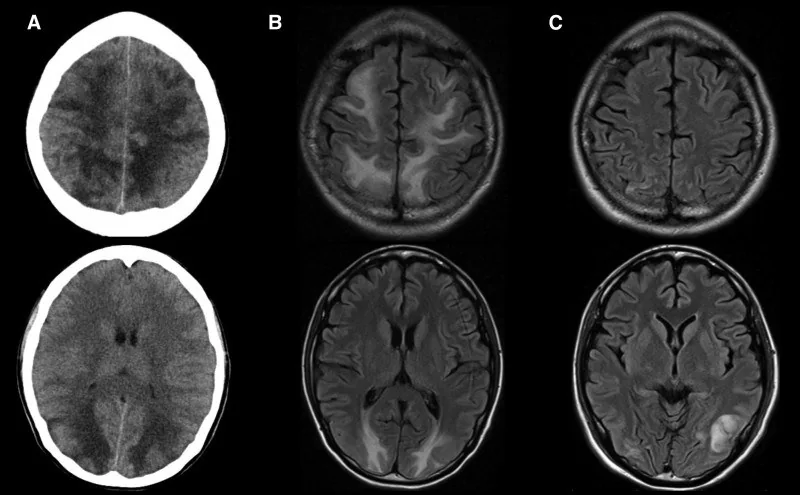
- Parieto-oksipital subkortikal beyaz cevherde, bazen kortekse uzanan, sınırları silik hipodens ödem alanları görülebilir; dağılım çoğunlukla iki taraflı ve yaklaşık simetriktir. Kontrastsız BT normal veya özgül olmayan olabilir; kontrastlı faz klasik PRES ödemini göstermek için gerekli değildir.
Önerilen pencereler: Beyin (G 80 / M 40).
BT bulguları
- İki taraflı parietal ve oksipital subkortikal beyaz cevher hipodensitesi
- Posterior hemisferlerde birbirine yakın dağılımlı, sınırları belirsiz ödem
- Hipodens alanın kortikal giruslara eşlik edebilmesi
- Şiddetli olgularda ödem ile birlikte kitlesel etki, hidrosefali veya intraventriküler kanama görülebilir.
- BT'nin belirgin parankim bulgusu göstermemesi PRES'i dışlamaz
Normalde
Aynı lateral ventrikül atriumu düzeyindeki normal BT'de parietal ve oksipital subkortikal beyaz cevher, karşı hemisferle benzer atenüasyonda ve belirgin sulkus basısı olmadan izlenir. Kıyaslarken iki tarafta posterior beyaz cevher yoğunluğunun simetrisini, korteks-beyaz cevher sınırını ve oksipital sulkusların açıklığını birlikte kontrol et.
Normal BT ile kıyasla
Aynı bölgenin, kaynak veri setinde patoloji içermediği belirtilen bir BT incelemesini kesit kesit kaydırın; organ sınırlarını açarak anatomiyi hasta görüntüsüyle karşılaştırın. Küçük rastlantısal bulgular tümüyle dışlanmamıştır.
Kaynak: TotalSegmentator v2.01 veri seti (Wasserthal ve ark., Radiology: Artificial Intelligence 2023), CC BY 4.0, vaka s0103; organ sınırları veri setinin otomatik segmentasyonundan, birleştirilerek sadeleştirildi. Görüntüler 2,5 mm kesit aralığına yeniden örneklendi.
Ayırıcı tanı
- PRES'te lezyonlar vasküler alan sınırlarını aşabilir; bu dağılım PCA infarktından ayrımda yardımcıdır.
- Hipoksik-iskemik hasar
- korteks ve derin gri çekirdeklerde yaygın gri-beyaz cevher ayrım kaybı görülebilir.
- Toksik-metabolik ensefalopati
- dağılım etkenine göre simetrik olabilir; klinik ve laboratuvar bağlamı ayırıcıdır.
- Ensefalit
- temporal veya limbik ağırlıklı fokal şişme, klasik posterior-subkortikal örüntüden ayrılır.
- Nöbet ilişkili ödem
- nöbetlerle ilişkili görüntülemede akut ödem bulguları görülebilir.
Tuzaklar
- Erken veya hafif PRES'te kontrastsız BT normal olabilir; klinik kuşku sürüyorsa normal BT'yi dışlama testi gibi yorumlama.
- Posterior hipodensiteyi otomatik olarak PCA infarktı sayma; PRES çoğu kez arter sınırlarını aşan ve iki hemisferi benzer biçimde tutan ödem oluşturur.
- Asimetri PRES'i dışlamaz; tek taraflı ya da belirgin asimetrik örüntüde eşlik eden infarkt, kanama ve alternatif tanıları ayrıca ara.
- Atipik PRES formlarında beyinsap veya bazal ganglia tutulumu, hipoksik-iskemik ensefalopati, toksik-metabolik ensefalopati veya derin serebral ven trombozu ile karışabilir.
Kendini dene
Eklampsi sonrası görme bulanıklığı olan hastada BT'de iki oksipital bölgede silik atenüasyon azalması görülüyor. En olası tanı hangisidir?
Cevabı göster
PRES. Peripartum klinik ve iki taraflı posterior parankim değişikliği PRES'i destekler. Glioblastom ve apse genellikle fokal kitle/enfeksiyon örüntüsü verir; subdural hematom ekstraaksiyel kan koleksiyonudur.
Hipertansif hastada nöbet sonrası BT'de parieto-oksipital beyaz cevher yoğunluğu azalmış; lezyonlar arter alanı sınırlarını aşmış. En uygun tanı hangisidir?
Cevabı göster
PRES. Arteriyel dağılıma uymayan posterior ödem, hipertansif nöbet bağlamında PRES lehinedir. Menenjitte BT'deki parankim örüntüsü bu tanıyı koydurmaz; hidrosefali ventrikül genişlemesi yapar; venöz trombozda sinüs/ven bulguları ve drenaj alanına uyan lezyon aranır.
İlgili konular
Kaynaklar
Bu sayfadaki 35 cümle ve 2 quiz sorusu aşağıdaki kaynaklardan alıntılarla otomatik olarak karşılaştırıldı; 3 cümle bu karşılaştırmada düzeltildi (2026-10-09).
- Posterior Reversible Encephalopathy Syndrome (PRES) and intraventricular hemorrhage in a patient with untreated hypertension: a case reportpmc.ncbi.nlm.nih.gov
- Idiopathic Posterior Reversible Encephalopathy Syndrome (PRES) in a 4-month-old infant: a case reportpmc.ncbi.nlm.nih.gov
- Atypical Posterior Reversible Encephalopathy Syndrome with Intraventricular Hemorrhage in a Patient with Eclampsia : A Case Reportpmc.ncbi.nlm.nih.gov
- Posterior Reversible Encephalopathy Syndrome Following Recreational Nitrous Oxide Use: A Case Reportpmc.ncbi.nlm.nih.gov
- Pathophysiology-driven neuroimaging: decoding brain injury in sepsispmc.ncbi.nlm.nih.gov
- Concurrent transfusion-related acute lung injury and posterior reversible encephalopathy: A rare multisystem imaging presentation.pubmed.ncbi.nlm.nih.gov
- The onset of posterior reversible encephalopathy syndrome (PRES) and reversible cerebral vasoconstriction syndrome (RCVS) with the use of decongestant agents: a European pharmacovigilance analysis.pubmed.ncbi.nlm.nih.gov
- Posterior Reversible Encephalopathy Syndrome Associated With Post-Streptococcal Glomerulonephritis in a Young Adult: A Case Report and Literature Review.pubmed.ncbi.nlm.nih.gov
- Recurrent PRES in a Patient With Cyclic Vomiting Syndrome.pubmed.ncbi.nlm.nih.gov
- Stepwise clinical and diagnostic strategy for coma of unknown origin.pubmed.ncbi.nlm.nih.gov
- COVID-19-Associated Reversible Cerebral Vasoconstriction Syndrome: A Rare Case of Secondary Thunderclap Headache.pubmed.ncbi.nlm.nih.gov
- Atypical presentation of posterior reversible encephalopathy syndrome: Clinical and radiological characteristics in eclamptic patients.pubmed.ncbi.nlm.nih.gov
- Suspected Murine Typhus Associated With Neurologic Symptoms and Posterior Reversible Encephalopathy Syndrome (PRES)-Like MRI Abnormalities: A Case Report.pubmed.ncbi.nlm.nih.gov
- Acute Bilateral Visual Loss as an Atypical Manifestation of Wernicke Encephalopathy Secondary to Hyperemesis Gravidarum: A Case Report and Narrative Literature Review.pubmed.ncbi.nlm.nih.gov
- When headache meets visual disturbance: An evidence-based review of common and critical entities.pubmed.ncbi.nlm.nih.gov
- Posterior Reversible Encephalopathy Syndrome Following Recreational Nitrous Oxide Use: A Case Report.pubmed.ncbi.nlm.nih.gov
- Consecutive PRES and diffuse alveolar hemorrhage in a patient with active lupus nephritis and antiphospholipid antibodies: a case report and systematic literature review.pubmed.ncbi.nlm.nih.gov
- Posterior Reversible Encephalopathy Syndrome: A Case Report With Contemporary Literature Review and Neuropathological Evidence From Autopsy.pubmed.ncbi.nlm.nih.gov
- Concurrent Reversible Cerebral Vasoconstriction Syndrome and Bilateral Vertebral Artery Dissection in the Postpartum Period: A Case Report.pubmed.ncbi.nlm.nih.gov
- Case Report: Pediatric ACTH-secreting pituitary adenoma presenting with hypertension and anuria.pubmed.ncbi.nlm.nih.gov
- Tyrosine Kinase Inhibitor Therapy for Brain Metastases in Non-Small-Cell Lung Cancer: A Primer for Radiologists.pubmed.ncbi.nlm.nih.gov
- Relapsing Demyelinating Syndromes in Children: A Practical Review of Neuroradiological Mimics.pubmed.ncbi.nlm.nih.gov
- Neuroimaging of Natalizumab Complications in Multiple Sclerosis: PML and Other Associated Entities.pubmed.ncbi.nlm.nih.gov
- Acute Bilateral Vision Loss in Pregnancy: A Case of Posterior Reversible Encephalopathy Syndrome.pubmed.ncbi.nlm.nih.gov
- Atypical Presentation of a Preeclamptic Patient With Severe Features and Auditory Hallucinations.pubmed.ncbi.nlm.nih.gov
- Hemorrhagic posterior reversible encephalopathy syndrome with pontine infarction in early-onset eclampsia: An atypical MRI spectrum.pubmed.ncbi.nlm.nih.gov
- Clinical and Neuroradiological Manifestations of Cerebral Amyloid Angiopathy: A Closer Look into the Natural History of a Frequent Disease.pubmed.ncbi.nlm.nih.gov
- Pediatric Meningeal Diseases: What Radiologists Need to Know.pubmed.ncbi.nlm.nih.gov
- Malignant Posterior Reversible Encephalopathy Syndrome (PRES) After Allogeneic Hematopoietic Stem Cell Transplantation Requiring Emergency Decompressive Craniectomy: A Case Report.pubmed.ncbi.nlm.nih.gov
- Posterior Reversible Encephalopathy Syndrome (PRES) Following Fruquintinib in a Normotensive Patient With Metastatic Colorectal Cancer: A Case Report.pubmed.ncbi.nlm.nih.gov
- Glucagon-Like Peptide-1 (GLP-1) Receptor Agonist Treatment After Liver Transplantation: A Hypothesis-Generating Case Report.pubmed.ncbi.nlm.nih.gov
- Posterior Reversible Encephalopathy Syndrome in an Elderly Man: A Case Report.pubmed.ncbi.nlm.nih.gov
- Idiopathic Posterior Reversible Encephalopathy Syndrome (PRES) in a 4-month-old infant: a case report.pubmed.ncbi.nlm.nih.gov
- Takayasu Arteritis in a 15-Year-Old Male Presenting with Constitutional Symptoms and Upper Limb Pulse Deficit: A Case Report a Resource-Limited Settings.pubmed.ncbi.nlm.nih.gov
- Exploring Underrecognized Risk Factors and Diagnosis of Postpartum Eclampsia: A Case Report.pubmed.ncbi.nlm.nih.gov
- Multiterritory Acute Ischemic Stroke with Bilateral Middle Cerebellar Peduncle T2/FLAIR Hyperintensities in the Setting of a Fatal Systemic Arterial Thrombotic Process: A Case Report.pubmed.ncbi.nlm.nih.gov
- Linezolid induced acute toxic leukoencephalopathy and severe thrombocytopenia presenting as stroke mimic-a case report.pubmed.ncbi.nlm.nih.gov
- Bilateral lesions of the basal ganglia and thalami (central grey matter)-pictorial review.pubmed.ncbi.nlm.nih.gov
- Machine learning-based prediction of cerebral artery territorial infarcts in acute ischemic stroke using non-contrast CT.pubmed.ncbi.nlm.nih.gov
- Ischemic stroke as an initial manifestation of Loeys-Dietz syndrome type 3 caused by the recurrent p.Arg287Trp variant in <i>SMAD3</i>: a case report with familial context.pubmed.ncbi.nlm.nih.gov
- Five-Year Delayed Rupture of a Suspected Infectious Intracranial Aneurysm: A Case Report.pubmed.ncbi.nlm.nih.gov
- Magnetic Resonance Imaging of the Neonatal Brain: Modalities, Scoring Systems, and Clinical Applications.pubmed.ncbi.nlm.nih.gov
- Pseudo-SAH in a patient with methanol poisoning: a case report.pubmed.ncbi.nlm.nih.gov
- Satralizumab in the management of aquaporin-4 antibody-positive neuromyelitis optica spectrum disorder during pregnancy: a case report.pubmed.ncbi.nlm.nih.gov
- Beta-ketothiolase deficiency with progressive basal ganglia and extra basal ganglia involvement: CT-MRI correlation in a pediatric metabolic encephalopathy: A case report.pubmed.ncbi.nlm.nih.gov
- Influenza B-Associated Acute Necrotizing Encephalopathy in a Previously Healthy Child: A Case Report of Fulminant Neurological Deterioration.pubmed.ncbi.nlm.nih.gov
- Diffuse high-grade glioma with gliomatosis cerebri pattern mimicking symmetric white matter disease.pubmed.ncbi.nlm.nih.gov
- Basal Ganglia Lesion Associated With Faciobrachial Dystonic Seizures (FBDS) in Anti-LGI1 Encephalitis: A Clinicopathological Case Report.pubmed.ncbi.nlm.nih.gov
- Suspected encephalitis in adults.pubmed.ncbi.nlm.nih.gov
- The role of brain MRI in autoimmune encephalitis.pubmed.ncbi.nlm.nih.gov
- Todd's Paralysis Simulating Acute Ischemic Stroke: A Case Report.pubmed.ncbi.nlm.nih.gov
- Neurocysticercosis mimicking eclampsia in a pregnant woman with a history of preeclampsia: a case report.pubmed.ncbi.nlm.nih.gov
- Postictal Todd's Paralysis Mimicking Acute Ischemic Stroke in Medullary Melanocytoma: A Multimodal Diagnostic Challenge.pubmed.ncbi.nlm.nih.gov
- Pathophysiology-driven neuroimaging: decoding brain injury in sepsis.pubmed.ncbi.nlm.nih.gov
- A Review of the Role of Neuroimaging in Neurotoxicity Monitoring in Children with Acute Lymphoblastic Leukemia.pubmed.ncbi.nlm.nih.gov
- Adrenergic Storm with Obstructive Hydrocephalus: Atypical Neurological Presentation of Von Hippel-Lindau Disease with Bilateral Pheochromocytoma in an Adolescent.pubmed.ncbi.nlm.nih.gov
- SARS-CoV-2 and Acute Cerebrovascular Events: An Overview.pubmed.ncbi.nlm.nih.gov
- Posterior Reversible Encephalopathy Syndrome Associated With Severe Proton Pump Inhibitor-Induced Hypomagnesemia: A Rare Case.pubmed.ncbi.nlm.nih.gov
- A presentation of posterior reversible encephalopathy syndrome after heart transplantation: a case report and review of literature.pubmed.ncbi.nlm.nih.gov
- Multimodal imaging in neuro-ophthalmology.pubmed.ncbi.nlm.nih.gov
- Cranial anatomy, palaeoneurology, palaeobiology and stratigraphic age of the large-bodied ornithopod, <i>Muttaburrasaurus langdoni</i> Bartholomai and Molnar, 1981, from the mid-Cretaceous of Australia.pubmed.ncbi.nlm.nih.gov
- Microvascular Ultrasound Imaging in the Neonatal Brain: From Advanced Doppler to Super-Resolution.pubmed.ncbi.nlm.nih.gov
- Posterior Reversible Encephalopathy Syndrome in a Postpartum Patient With Eclampsia.pubmed.ncbi.nlm.nih.gov
- Posterior reversible encephalopathy syndrome in a bilateral lung transplant recipient with subtherapeutic tacrolimus levels: a case report.pubmed.ncbi.nlm.nih.gov
- Obstacles and Trials in Treating Primary Brain Tumors.pubmed.ncbi.nlm.nih.gov
- Arterial Spin Labeling technique and clinical applications of the intracranial compartment in stroke and stroke mimics - A case-based review.pubmed.ncbi.nlm.nih.gov
- Neurovascular disorders in children: an updated practical guide.pubmed.ncbi.nlm.nih.gov
- Posterior Reversible Encephalopathy Syndrome (PRES) and intraventricular hemorrhage in a patient with untreated hypertension: a case report.pubmed.ncbi.nlm.nih.gov
- Lenvatinib-Associated Posterior Reversible Encephalopathy Syndrome in a Patient With Metastatic Clear Cell Renal Cell Carcinoma: A Case Report.pubmed.ncbi.nlm.nih.gov
- Central-variant posterior reversible encephalopathy syndrome mimicking tumor progression in a glioblastoma patient on bevacizumab: illustrative case.pubmed.ncbi.nlm.nih.gov
- Posterior Reversible Encephalopathy Syndrome: A Clinico-Radiological Approach.pubmed.ncbi.nlm.nih.gov
- Atypical posterior reversible encephalopathy syndrome: A lentiform fork sign following transplantation.pubmed.ncbi.nlm.nih.gov
- Reversible cerebral vasoconstriction syndrome: A narrative review.pubmed.ncbi.nlm.nih.gov
- New-Onset Psychotic Episode as the Primary Manifestation One Week After Liver Transplantation: A Case Report and Comprehensive Review About the Risk Factors.pubmed.ncbi.nlm.nih.gov
- Neurological Puzzles After Radiotherapy: Mysterious Clues of Smart Syndrome, Two Case Reports.pubmed.ncbi.nlm.nih.gov
- Transient Cortical Blindness and Hemi-Spatial Neglect Following Watchman Device Implantation.pubmed.ncbi.nlm.nih.gov
- 'Carotid spells' - transient focal neurological episodes associated with convexity subarachnoid haemorrhage in severe ipsilateral extracranial internal carotid artery stenosis: a case report and concise literature review.pubmed.ncbi.nlm.nih.gov
- Posterior Cortical Atrophy Masked by a Pituitary Macroadenoma: Diagnostic Challenges in the Setting of Dual Visual Pathology.pubmed.ncbi.nlm.nih.gov
- Peri-ictal magnetic resonance imaging findings in pediatric seizures: a scoping review on pearls and pitfalls from a heterogeneous population.pubmed.ncbi.nlm.nih.gov
- Seizure-Related Deterioration in Treated Glioma: A Narrative Review of Nonconvulsive Status Epilepticus, Peri-Ictal Pseudoprogression, Treatment-Related Change, and True Progression.pubmed.ncbi.nlm.nih.gov
- Reversible Lesions of the Genu of the Corpus Callosum and White Matter Detected by MRI in a Neonate With Apnea: A Case Report.pubmed.ncbi.nlm.nih.gov
- Distinguishing Neuroimaging Features in Patients Presenting with Visual Hallucinations.pubmed.ncbi.nlm.nih.gov
- Posterior reversible encephalopathy syndrome in a child with autoimmune lymphoproliferative syndrome: Case report and review of literature.pubmed.ncbi.nlm.nih.gov
- Geometric morphometric analysis of the brainstem and cerebellum in Chiari I malformation.pubmed.ncbi.nlm.nih.gov
- Quantitative and clinical impact of MRI-based attenuation correction methods in [ 18 F]FDG evaluation of dementia.pubmed.ncbi.nlm.nih.gov
- Vascular neuro-ophthalmology.pubmed.ncbi.nlm.nih.gov
- Atypical Posterior Reversible Encephalopathy Syndrome with Intraventricular Hemorrhage in a Patient with Eclampsia : A Case Report.pubmed.ncbi.nlm.nih.gov
- Systemic Immune-Inflammation Index and Clinical Predictors of Atypical PRES in Eclampsia: Higher Blood Pressure and Inflammatory Burden Drive Multi-Regional Involvement.pubmed.ncbi.nlm.nih.gov
Eğitim amaçlıdır; hasta başında tanı ve tedavi kararının yerine geçmez, tıbbi tavsiye değildir. Metinler yapay zekâ desteğiyle yazıldı ve otomatik bir adımda kaynak alıntılarıyla karşılaştırıldı; bu bir tıbbi doğrulama değildir ve içerik uzman radyolog incelemesinden geçmedi. Klinik kararlarda güncel kılavuzları, kurum protokollerini ve radyoloji raporunu esas alın.