Özet
Temporal kemik kırığı, künt kafa travmasında dış kulak yolu, orta kulak, mastoid, işitme kemikçikleri, fasiyal sinir kanalı ve iç kulak yapılarını etkileyebilir. Yüksek çözünürlüklü temporal kemik BT'si kırık sınıflaması ve koklear açıklığın değerlendirilmesinde kullanılır. Raporda kırığın yönü, tuttuğu temporal kemik segmenti ve otik kapsülle ilişkisi tanımlanmalıdır. Temporal kemik kırıkları fasiyal sinir yaralanması, beyin omurilik sıvısı kaçağı ve işitme kaybı ile komplike olabilir.
Faz ve pencere
- Kontrastsız tanısal
- Temporal kemik BT'sinde kırık hattının yönü, tuttuğu temporal kemik segmenti ve otik kapsülle ilişkisi tanımlanmalıdır. Pnömolabirent şüphesinde yüksek çözünürlüklü temporal kemik BT'si tercih edilen görüntüleme yöntemidir.
Önerilen pencereler G genişlik, M merkez; değerler Hounsfield birimi (HU)
- KemikG 1800 / M +400
- Yumuşak dokuG 400 / M +40
- BeyinG 80 / M +40
BT bulguları
- Mastoid veya orta kulak opasifikasyonu — travma sonrası mastoid hava hücrelerindeki opasifikasyon kanama veya efüzyonu gösterebilir.
- Ossiküler zincir yaralanması — IS eklem dislokasyonu en sık lezyondur, bunu IM ayrışma ve stapes süperstrüktür kırığı izler.
- Otic kapsül ilişkisi — kırık çizgisinin otik kapsülü ihlal edip etmediği sınıflanır; ihlal eden kırık koklea, vestibül veya bunların birleşimine uzanır.
- Fasiyal kanal uzanımı ayrıca kaydedilir; temporal kemik kırıklarının en sık komplikasyonlarından biri fasiyal sinir yaralanmasıdır.
- Temporal kemik travması damar yaralanmasıyla komplike olabilir, bu nedenle kırığın damar yapılarla ilişkisi değerlendirilir.
- Pnömolabirent — koklea veya vestibülde hava odağı; travma bağlamında otik kapsül ihlalini destekler ve kırık hattıyla birlikte değerlendirilir.
Ölçütler ve sınıflamalar
- Otik kapsül korunmuş (sparing) / ihlal edilmiş (violating) sınıflaması
- Otik kapsül korunmuş kırık, otik kapsülü ihlal etmeyen kırık tipidir ve ihlal eden tipe göre işlevsel komplikasyon riskiyle daha az ilişkilidir. Otik kapsül ihlal eden kırık koklea, vestibül veya bunların birleşimine uzanır ve sensörinöral işitme kaybıyla güçlü biçimde ilişkilidir. Geleneksel uzunlamasına/enine kırık yönü tanımı tek başına bu yapısal ilişkiyi veya prognozu vermez.
Normalde
Normal temporal kemikte mastoid hava hücreleri havalıdır, opasifikasyon kanama veya efüzyonu düşündürür; malleus, inkus ve stapes BT'de değerlendirilir. Temporal kemikte kırıkla karışabilen çok sayıda anatomik varyasyon vardır.
Normal BT ile kıyasla
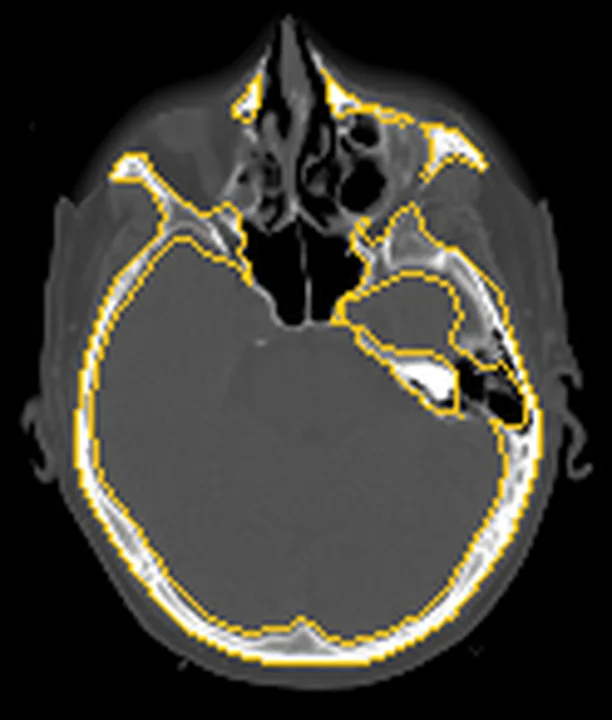
Aynı bölgenin, kaynak veri setinde patoloji içermediği belirtilen bir BT incelemesini kesit kesit kaydırın; organ sınırlarını açarak anatomiyi hasta görüntüsüyle karşılaştırın. Küçük rastlantısal bulgular tümüyle dışlanmamıştır.
Kaynak: TotalSegmentator v2.01 veri seti (Wasserthal ve ark., Radiology: Artificial Intelligence 2023), CC BY 4.0, vaka s0103; organ sınırları veri setinin otomatik segmentasyonundan, birleştirilerek sadeleştirildi. Görüntüler 2,5 mm kesit aralığına yeniden örneklendi.
Ayırıcı tanı
- Mastoid hava hücrelerindeki opasifikasyon kanama veya efüzyonu gösterebilir ve tek başına kırık kanıtı değildir.
- Temporal kemikte kırıkla karışabilen çok sayıda anatomik varyasyon vardır.
- Temporal kemik kırığını taklit edebilen anatomik yapılar ayırıcı tanıda göz önünde bulundurulmalıdır.
- Temporal kemikteki normal fissür ve sütürler kırıkla karışabilir; kuşkulu çizgi kırıktan ayırt edilmelidir.
- Ossiküler zincir kuşkusu yüksek çözünürlüklü temporal kemik BT ile değerlendirilir.
Tuzaklar
- Rutin kafa BT'sindeki kalın kesitlere dayanarak ince temporal kemik kırığını dışlamayın; mevcut ince kesit kemik algoritmalı rekonstrüksiyonları açın.
- Orta kulak veya mastoid opasifikasyonunu kırık kanıtı saymayın; kemik duvarında kortikal kesinti ayrı gösterilmelidir.
- Ossiküler zincir kopukluğu yüksek çözünürlüklü temporal kemik BT ile değerlendirilir.
- Kırık çizgisini taklit edebilen doğal anatomik kanallar ve yarıklar ayırıcı tanıda göz önünde bulundurulmalıdır.
Kendini dene
Travma sonrası çekilen yüksek çözünürlüklü temporal kemik BT'sinde kırık hattı koklea ile vestibülün birleşimine kadar uzanıyor. Güncel sınıflamaya göre bu kırık nasıl tanımlanır?
Cevabı göster
Otik kapsülü ihlal eden kırık. Otik kapsülü ihlal eden kırıklar koklea, vestibül veya bunların birleşimine uzanır ve sensörinöral işitme kaybıyla güçlü ilişkilidir; kırığın otik kapsülle ilişkisi sınıflamanın belirleyicisidir.
Temporal kemik travmasına bağlı ossiküler zincir yaralanmalarında, literatüre göre en sık görülen zedelenme hangisidir?
Cevabı göster
Incudostapedial eklem ayrışması. Travmaya bağlı ossiküler zincir yaralanmalarında en sık lezyon incudostapedial (IS) eklem ayrışmasıdır; bunu inkomalleolar (IM) ayrışma ve stapes süperstrüktür kırığı izler. Bu yaralanma kalıcı iletim tipi işitme kaybı yapabilir ve kuşkulu durumlarda kopukluğun yerini yüksek çözünürlüklü temporal kemik BT ile göstermek gerekir.
İlgili konular
- Otik kapsülü ihlal eden temporal kemik kırığı
- Otik kapsülü koruyan temporal kemik kırığı
- Hemotimpanum ve mastoid kanaması
- Temporal kemik travmasında kemikçik hasarı
- Temporal kemik travmasında karotid kanal yaralanması
Kaynaklar
Bu sayfadaki 38 cümle ve 2 quiz sorusu aşağıdaki kaynaklardan alıntılarla otomatik olarak karşılaştırıldı; 18 cümle bu karşılaştırmada düzeltildi (2026-10-10).
- Cochlear Implantation After Temporal Bone Fracture: A Systematic Review of Preoperative Predictors and Timingpmc.ncbi.nlm.nih.gov
- Outcomes of Cochlear Implantation in Patients with Temporal Bone Trauma: A Systematic Review and Narrative Synthesispmc.ncbi.nlm.nih.gov
- Post-concussive Dizziness: A Review and Clinical Approach to the Patientpmc.ncbi.nlm.nih.gov
- A Case of Parapharyngeal Emphysema due to Temporal Bone Fracture as a Sequel of Traumatic Road Accidentpmc.ncbi.nlm.nih.gov
- Isolated abducens nerve involvement as a revealing sign of temporal bone fracture: A case reportpmc.ncbi.nlm.nih.gov
- Imaging of temporal bone trauma.pubmed.ncbi.nlm.nih.gov
- Imaging of Temporal Bone Trauma: A Clinicoradiologic Perspective.pubmed.ncbi.nlm.nih.gov
- [Petrous bone fractures].pubmed.ncbi.nlm.nih.gov
- Ossiculoplasty for Trauma.pubmed.ncbi.nlm.nih.gov
- Traumatic Injury of the Petrous Part of the Temporal Bone: Keys for Reporting a Complex Diagnosis.pubmed.ncbi.nlm.nih.gov
- Multidetector CT of temporal bone fractures.pubmed.ncbi.nlm.nih.gov
- Facial nerve stimulation associated with cochlear implant use following temporal bone fractures.pubmed.ncbi.nlm.nih.gov
- Systematic review of hearing loss after traumatic brain injury without associated temporal bone fracture.pubmed.ncbi.nlm.nih.gov
- A Systematic Review of Cochlear Implantation in Temporal Bone Fractures and the Significance of Otic Capsule Involvement.pubmed.ncbi.nlm.nih.gov
- Parapharyngeal cerebrospinal fluid collection: an unusual complication of temporal bone fracture.pubmed.ncbi.nlm.nih.gov
- Cochlear Implantation After Temporal Bone Fracture: A Systematic Review of Preoperative Predictors and Timing.pubmed.ncbi.nlm.nih.gov
- Clinical-radiological Correlation in Temporal Bone Fractures.pubmed.ncbi.nlm.nih.gov
- Management and outcome of pediatric skull base fractures.pubmed.ncbi.nlm.nih.gov
- Middle ear and mastoid obliteration for cochlear implant in adults: indications and anatomical results.pubmed.ncbi.nlm.nih.gov
- The ovine temporal bone for otologic surgery training: a systematic review.pubmed.ncbi.nlm.nih.gov
- Multimodal imaging in conductive hearing loss: Optimising CT, MRI and CTA for accurate diagnosis and management.pubmed.ncbi.nlm.nih.gov
- Serous Otitis Media Secondary to a Middle Ear Neuroendocrine Tumor of Five-Year Duration.pubmed.ncbi.nlm.nih.gov
- Understanding Photon-Counting CT: Physics, Detector Technology, and Image Reconstructions.pubmed.ncbi.nlm.nih.gov
- Morphological and Epidemiological Analysis of the Sphenoid Sinus Based on Computed Tomography and Magnetic Resonance Imaging: A Narrative Review.pubmed.ncbi.nlm.nih.gov
- Multimodal imaging in neuro-ophthalmology.pubmed.ncbi.nlm.nih.gov
- Surgical Techniques and Materials Used in the Treatment of Complicated Otomastoiditis: A Systematic Review.pubmed.ncbi.nlm.nih.gov
- A Novel Descriptive Framework for Petroclival and Temporal Bone Meningioma Surgical Outcomes.pubmed.ncbi.nlm.nih.gov
- Microsurgical Reconstruction of the Ear and Temporal Region: Structural and Functional Considerations Including Hearing Rehabilitation-A Narrative Review.pubmed.ncbi.nlm.nih.gov
- Clinical Features and Management of Skull Base Fractures in the Pediatric Population: A Systematic Review.pubmed.ncbi.nlm.nih.gov
- Evaluation and Outcomes of Hearing Loss in Temporal Bone Fractures: A Prospective Study.pubmed.ncbi.nlm.nih.gov
- Managing Complex Chronic Otitis Media: Insights from Subtotal Petrosectomy with Blind Sac Closure.pubmed.ncbi.nlm.nih.gov
- The Stylohyoid Complex: An Update on Its Embryology, Comparative Anatomy and Human Variations.pubmed.ncbi.nlm.nih.gov
- Comprehensive Review of External and Middle Ear Anatomy on Photon-Counting CT.pubmed.ncbi.nlm.nih.gov
- Cranial cerebrospinal fluid leak and intracranial hypotension syndrome - a case report.pubmed.ncbi.nlm.nih.gov
- Pneumolabyrinth secondary to temporal bone fracture: a case report and review of the literature.pubmed.ncbi.nlm.nih.gov
- External and middle ear diseases: radiological diagnosis based on clinical signs and symptoms.pubmed.ncbi.nlm.nih.gov
- Traumatic perilymphatic fistula with stapes luxation into the vestibule and pneumolabyrinth: a case report.pubmed.ncbi.nlm.nih.gov
- Traumatic stapediovestibular luxation: two contrasting cases highlighting the importance of early treatment decision: A case report and literature review.pubmed.ncbi.nlm.nih.gov
- Temporal Bone Fractures on High-Resolution CT: Bridging Radiologic Detail with Otologic Anatomy and Surgical Implications.pubmed.ncbi.nlm.nih.gov
- The potential protective effects of temporal bone pneumatization: A shock absorber in temporal bone fracture.pubmed.ncbi.nlm.nih.gov
- Beyond Tympanomastoidectomy: A Review of Less Common Postoperative Temporal Bone CT Findings.pubmed.ncbi.nlm.nih.gov
- The Facial Nerve in Contemporary Surgery: Anatomical Variability, Pathology-Induced Distortion, and Functional Preservation.pubmed.ncbi.nlm.nih.gov
- Safety and Efficacy of Endoscopic and Microscopic Techniques for Facial Nerve Decompression After Trauma: A Systematic Review and Meta-Analysis.pubmed.ncbi.nlm.nih.gov
- Navigating Post-Traumatic Facial Nerve Palsy: Insights from a Case Series on Management and Recovery Strategies.pubmed.ncbi.nlm.nih.gov
- Atypical Manifestation of Skull Base Osteomyelitis Secondary to Malignant Otitis Externa Following Radiotherapy: A Case Report.pubmed.ncbi.nlm.nih.gov
- Diagnostic and Surgical Challenges in External Auditory Canal Cholesteatoma: Experience from a Tertiary Care Centre.pubmed.ncbi.nlm.nih.gov
- A Peculiar Case of Isolated Bilateral Tympanic Plate Fractures.pubmed.ncbi.nlm.nih.gov
- Imaging of cerebrovascular complications from blunt skull base trauma.pubmed.ncbi.nlm.nih.gov
- Temporal Bone Fractures and Related Complications in Pediatric and Adult Cranio-Facial Trauma: A Comparison of MDCT Findings in the Acute Emergency Setting.pubmed.ncbi.nlm.nih.gov
- The cavernous sinus: An anatomic study with clinical implication.pubmed.ncbi.nlm.nih.gov
- Clinical Characteristics and Management Outcomes of Pediatric Temporal Bone Fractures: A Retrospective Cohort Study.pubmed.ncbi.nlm.nih.gov
- Audiometric and vestibular outcomes following temporal bone fractures: a retrospective analysis of a major trauma center cohort in China.pubmed.ncbi.nlm.nih.gov
- Improved Hearing Impairment of Granulomatosis with Polyangiitis Treated with Rituximab and Avacopan without Glucocorticoids.pubmed.ncbi.nlm.nih.gov
- Successful Treatment of Eosinophilic Chronic Rhinosinusitis and Secretory Otitis Media in Refractory Asthma With Thymic Stromal Lymphopoietin (TSLP) Receptor Monoclonal Antibody.pubmed.ncbi.nlm.nih.gov
- Mastoid emissary vein, mastoid emissary foramen, and mastoid emissary canal: anatomy, variability, imaging, and clinical implications.pubmed.ncbi.nlm.nih.gov
- Degeneration rather than hypoplasia may be the pathologic feature of the endolymphatic sac in patients with ipsilateral delayed endolymphatic hydrops.pubmed.ncbi.nlm.nih.gov
- Cochlear Implantation for Sensorineural Hearing Loss Related to Cochlear Aqueduct Obstruction by a Jugular Foramen Tumor.pubmed.ncbi.nlm.nih.gov
- Comparative Analysis of Middle Ear Prostheses Using Photon-Counting Detector CT versus Conventional CT.pubmed.ncbi.nlm.nih.gov
- Experimental investigation of rotational tomography in reconstructed middle ears with clinical implications.pubmed.ncbi.nlm.nih.gov
- Fatal Injuries Caused by Falling Trees: Correlation Between Postmortem Computed Tomography and Forensic Autopsy Findings in Eight Cases.pubmed.ncbi.nlm.nih.gov
- Beyond Cartilage Regeneration: Targeting the Subchondral Bone with Extracorporeal Shock Wave Therapy and Regenerative Medicine in Knee Osteoarthritis.pubmed.ncbi.nlm.nih.gov
- A review of the oral health of individuals with disabilities in Puerto Rico and among U.S. Hispanics.pubmed.ncbi.nlm.nih.gov
- Isolated abducens nerve involvement as a revealing sign of temporal bone fracture: A case report.pubmed.ncbi.nlm.nih.gov
- Multiple Ossicular Dislocation Including Stapediovestibular Dislocation Presenting with Conductive Hearing Loss.pubmed.ncbi.nlm.nih.gov
- A Prospective Observational Study on the Pattern of Hearing Loss and Its Recovery in Temporal Bone Fractures.pubmed.ncbi.nlm.nih.gov
- Medication-related osteonecrosis of the external auditory canal and treatment with teriparatide.pubmed.ncbi.nlm.nih.gov
- Moth-Eaten Osteolysis of Multiple Foot Bones After a Conservatively Treated "Stable" Ankle Fracture: A Case Report and Literature Review.pubmed.ncbi.nlm.nih.gov
- Experience with PEEK Clamp Fixation of Custom Porous Hydroxyapatite Implants in Cranioplasty: A Preliminary Single-Center Feasibility Case Series.pubmed.ncbi.nlm.nih.gov
- Petrosal morphology and cochlear function in Mesozoic stem therians.pubmed.ncbi.nlm.nih.gov
- Artificial Intelligence Model Trained with Sparse Data to Detect Facial and Cranial Bone Fractures from Head CT.pubmed.ncbi.nlm.nih.gov
- Clinical Approach to Myelopathy Diagnosis.pubmed.ncbi.nlm.nih.gov
- Imaging of Bone in the Head and Neck Region, is There More Than CT?pubmed.ncbi.nlm.nih.gov
- Brazilian Society of Otology Task Force - bone-anchored hearing system - recommendations based on strength of evidence.pubmed.ncbi.nlm.nih.gov
- Rare Diseases of the Middle Ear and Lateral Skull Base.pubmed.ncbi.nlm.nih.gov
- Emerging and re-emerging infectious disease in otorhinolaryngology.pubmed.ncbi.nlm.nih.gov
- Efficacy of endoscopic removal of anterior malleolar ligament calcification combined with tympanic membrane repair for the treatment of conductive hearing loss.pubmed.ncbi.nlm.nih.gov
- Combined analysis of finite element model and audiometry provides insights into the pathogenesis of conductive hearing loss.pubmed.ncbi.nlm.nih.gov
- Brazilian Society of Otology task force - Otosclerosis: evaluation and treatment.pubmed.ncbi.nlm.nih.gov
- "Leave me alone": anatomical structures and variations seen on computed tomography of the temporal bone.pubmed.ncbi.nlm.nih.gov
- Characteristics of the Facial Canal-Lateral Canal Dehiscence: The Under-recognized Third Window.pubmed.ncbi.nlm.nih.gov
- Cochlear-Internal Canal and Cochlear-Facial Dehiscence: A Novel Entity.pubmed.ncbi.nlm.nih.gov
- Radiomics in spinal research: a narrative review.pubmed.ncbi.nlm.nih.gov
- Evidence-informed methodological approaches for coupled neuromusculoskeletal-finite element analysis workflows in orthopaedic biomechanics.pubmed.ncbi.nlm.nih.gov
- Can Artificial Intelligence Really Help? A Practicing Radiologist's Simplified Guide to AI, with a Critical Appraisal of the Use of AI in Cancer-Associated Thromboembolism.pubmed.ncbi.nlm.nih.gov
- Extensive Cervicomediastinal Emphysema from Mastoid Injury.pubmed.ncbi.nlm.nih.gov
- Audiological and Middle Ear Outcomes in Ukrainian Soldiers with Traumatic Tympanic Membrane Perforation.pubmed.ncbi.nlm.nih.gov
- Tophaceous Gout of the Middle Ear.pubmed.ncbi.nlm.nih.gov
- Brazilian Society of Otology task force - cochlear implant ‒ recommendations based on strength of evidence.pubmed.ncbi.nlm.nih.gov
- Rare Disorders of the Vestibular Labyrinth: of Zebras, Chameleons and Wolves in Sheep's Clothing.pubmed.ncbi.nlm.nih.gov
- Prevalence of the endolymphatic sac hypoplasia in a cohort of individuals without Meniere disease.pubmed.ncbi.nlm.nih.gov
- The Macroscopic and Radiographic Skull and Dental Pathology of the Tasmanian Devil ( Sarcophilus harrisii ).pubmed.ncbi.nlm.nih.gov
- Clinical Applications of Photon-counting CT: A Review of Pioneer Studies and a Glimpse into the Future.pubmed.ncbi.nlm.nih.gov
- Orbital Anatomy: Anatomical Relationships of Surrounding Structures.pubmed.ncbi.nlm.nih.gov
- Trauma-Associated Tinnitus and Hearing Loss: A Comprehensive Narrative Review of Prevalence, Risk Factors, and Clinical Outcomes.pubmed.ncbi.nlm.nih.gov
- Diagnostic Quandary of Granulomatosis With Polyangiitis Presenting First in the Petrous Apex.pubmed.ncbi.nlm.nih.gov
- Posterior fossa extradural haematoma with cerebral venous sinus thrombosis precipitates haemophilia a diagnosis: a paediatric case report and literature review.pubmed.ncbi.nlm.nih.gov
- Validity of endoscopic ossiculoplasty immediately after its introduction for ossicular chain disruption.pubmed.ncbi.nlm.nih.gov
- Contemporary Applications of Platelet-Rich Fibrin in Mandibular Surgery With Implications for Mandibular Fracture Management.pubmed.ncbi.nlm.nih.gov
- Characteristics of head injuries in children at King Abdullah Specialized Children's Hospital, Jeddah: a cross-sectional study.pubmed.ncbi.nlm.nih.gov
- Open Fractures Beyond Long Bones: Rethinking Age-Dependent Injury Mechanisms and Anatomical Patterns in Pediatric Trauma.pubmed.ncbi.nlm.nih.gov
- Report of an Otic Capsule Disrupting Fracture of the Temporal Bone: Visualization of Pneumolabyrinth and Functional Assessment.pubmed.ncbi.nlm.nih.gov
- From thunder to silence: Cochlear implantation for bilateral profound sensorineural hearing loss after lightning strike.pubmed.ncbi.nlm.nih.gov
- Advances in 3D Inner Ear Reconstruction Software for Cochlear Implants: A Comprehensive Review.pubmed.ncbi.nlm.nih.gov
- Current Status of Pediatric Hearing Loss Cases in Oita University Hospital From 2016 to 2019.pubmed.ncbi.nlm.nih.gov
- Progressive Conductive Hearing Loss in Osteogenesis Imperfecta (Lobstein Disease): A Case Report.pubmed.ncbi.nlm.nih.gov
- Cochlear isolation in neonatal mice for <i>in vitro</i> and <i>ex vivo</i> models: an anatomical landmark-based protocol.pubmed.ncbi.nlm.nih.gov
- Cerebrospinal fluid leak following traumatic skull base fractures: Predictors and outcomes.pubmed.ncbi.nlm.nih.gov
- Translabyrinthine Resection of Posterior Petrous Face Meningiomas: Surgical, Functional, and Oncological Outcomes and Associations with Anatomical Extension and Tumor Burden.pubmed.ncbi.nlm.nih.gov
- The Unspoken Danger of the Mount Fuji Sign Leading to Sudden Death.pubmed.ncbi.nlm.nih.gov
- Management and Outcomes of Spontaneous Cerebrospinal Fluid Otorrhoea.pubmed.ncbi.nlm.nih.gov
- Post-traumatic bilateral longitudinal temporal bone fracture with bilateral facial nerve palsy: a rare case.pubmed.ncbi.nlm.nih.gov
- Treatment of Temporal Bone Fractures.pubmed.ncbi.nlm.nih.gov
- Left Peripheral Nerve Palsy after Left Anterior Temporal Lobectomy for Mesial Temporal Sclerosis.pubmed.ncbi.nlm.nih.gov
- Trigeminal-Facial Nerve Anatomical Connections and Their Clinical Value: A Narrative Review.pubmed.ncbi.nlm.nih.gov
- Anatomic, Radiographic, and Computed Tomographic Study of the Skull in the Persian Squirrel (Sciurus anomalus).pubmed.ncbi.nlm.nih.gov
Eğitim amaçlıdır; hasta başında tanı ve tedavi kararının yerine geçmez, tıbbi tavsiye değildir. Metinler yapay zekâ desteğiyle yazıldı ve otomatik bir adımda kaynak alıntılarıyla karşılaştırıldı; bu bir tıbbi doğrulama değildir ve içerik uzman radyolog incelemesinden geçmedi. Klinik kararlarda güncel kılavuzları, kurum protokollerini ve radyoloji raporunu esas alın.