
Özet
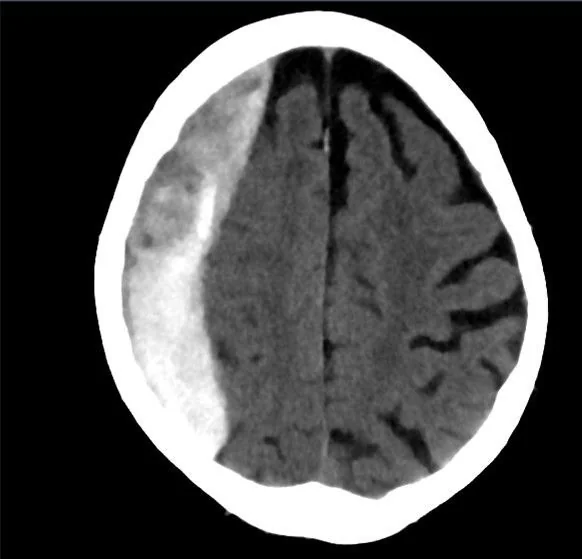
Epidural hematom, travma sonrası kalvaryumun iç tabulası ile dura arasında kan birikmesidir; özellikle temporal/temporopariyetal bölgede kırıkla birlikte görülebilir. Travmatik akut epidural hematomlar genellikle orta meningeal arter veya venöz sinüs yaralanmaları sonucu oluşur ve kitle etkisi yaratmaya eğilimlidir. Kontrastsız beyin BT koleksiyonun biçimini, yayılımını ve beyin üzerindeki basıyı gösterir; kemik penceresi eşlik eden kırığı araştırır. Hematomun erken ya da sınırlı görünmesi genişleyen kanama ve herniasyon bulgularını dışlamaz.
Faz ve pencere
- Kontrastsız tanısal
- Dura ile kalvaryum iç tabulası arasında, travma sonrası intrakraniyal kanamada karakteristik olarak hiperdens ve bikonveks şekilli koleksiyon izlenir; travma sonrası intrakraniyal kanamanın değerlendirilmesinde kontrastsız BT altın standart olup tanı için ek kontrast uygulanması gerekmez. Travma sonrası intrakraniyal kanamanın değerlendirilmesinde kontrastsız BT altın standart olup tanı için ek kontrast uygulanması gerekmez.
Önerilen pencereler: Beyin (G 80 / M 40), Subdural (G 200 / M 75), Kemik (G 1800 / M 400).
BT bulguları
- Epidural hematomlar karakteristik olarak bikonveks şekilli ekstraaksiyel kanamalar olup kafa içi kitle etkisi oluşturabilir.
- Kontrastsız BT, travma sonrası intrakraniyal kanamanın ve eşlik eden kırık hattlarının tanımlanmasında altın standart olup koleksiyonun yayılımı ve kafa içi yapılar üzerindeki baskı etkisi değerlendirilmelidir.
- Bilgisayarlı tomografide kırık hattları ve komşu damar yaralanmalarına işaret eden kemik lezyonları epidural hematom açısından değerlendirilmelidir.
- Hematom içindeki swirl sign (girdap işareti), kanamanın hızlı ilerlediğini ve kötü prognoz riskinin arttığını gösteren bir bulgu olarak değerlendirilir.
- Temporal lobun medial itilmesi, bazal sisternlerin daralması ve orta hat yapılarının karşıya ötelenmesi bası etkisini gösterir.
- Arka çukur epidural hematomları, bu bölgenin kısıtlı hacmi nedeniyle beyin sapı ve solunum merkezleri üzerinde ciddi bası etkisi oluşturabilir.
Normalde
Travma sonrası BT incelemelerinde, intrakraniyal kanama veya kırık gibi patolojik bulguların yokluğu normal anatomik yapıların korunmuş olduğunu gösterir. Travma sonrası BT incelemelerinde, kanamanın genişleme eğilimi ve komşu kafa içi yapılar üzerindeki baskı etkisi seri görüntülemelerle takip edilmelidir.
Normal BT ile kıyasla
Aynı bölgenin, kaynak veri setinde patoloji içermediği belirtilen bir BT incelemesini kesit kesit kaydırın; organ sınırlarını açarak anatomiyi hasta görüntüsüyle karşılaştırın. Küçük rastlantısal bulgular tümüyle dışlanmamıştır.
Kaynak: TotalSegmentator v2.01 veri seti (Wasserthal ve ark., Radiology: Artificial Intelligence 2023), CC BY 4.0, vaka s0103; organ sınırları veri setinin otomatik segmentasyonundan, birleştirilerek sadeleştirildi. Görüntüler 2,5 mm kesit aralığına yeniden örneklendi.
Ayırıcı tanı
- Travmatik ekstraaksiyel kanamaların ayırıcı tanısında bilgisayarlı tomografi, kanamanın yerini, boyutunu ve gelişebilecek kitle etkisi riskini değerlendirmek için gereklidir.
- Hemorajik kontüzyon ve diğer parankimal kanama tipleri arasında ayrım yapılırken, BT intrakraniyal kanamanın çeşitli nedenlerini ve varyant görünümlerini ortaya koymalıdır.
- Kalvaryum altında oluşan ekstraaksiyel koleksiyonların ayırıcı tanısında bilgisayarlı tomografi, eşlik eden kafa kemiği kırıklarını, intrakraniyal kanamayı ve parankimal yaralanmaları değerlendirmek için kullanılır.
- Ekstraaksiyel hiperdens lezyonların ayırıcı tanısında travmatik kanama dışındaki patolojiler de düşünülmeli ve bilgisayarlı tomografi ile kanama yoğunluğu ve kitle etkisi değerlendirilmelidir.
Tuzaklar
- BT görüntülerinde ekstraparenkimal kanama türlerinin ayırt edilmesi kritik olup, 'hemoraji' aktif süreç iken 'hematom' oluşan kan kütlelerini tanımladığından terminoloji dikkatle seçilmelidir.
- Arka çukur ve kranioservikal bölgede travmatik kanamaların değerlendirilmesinde çoklu düzlemli bilgisayarlı tomografi reformasyonları, lezyon saptanmasını ve tedavi edilebilir yaralanmaların erken tanısını kolaylaştırır.
- Swirl sign (girdap işareti), epidural hematomda progresyon ve kötü prognoz göstergesidir; ancak tek başına kesin bir cerrahi endikasyon olarak kabul edilmemelidir.
Kendini dene
Travma sonrası kafatası üstü konkaviteste, kemik kırığı hattının üzerinde yer alan bikonveks ve hiperdens bir koleksiyon saptanıyor. Bu radyolojik görünüm en çok aşağıdakilerden hangisini düşündürür?
Cevabı göster
Epidural hematom. Kemik kırığı hattının üzerinde, dura ile kalvaryum arasında sınırlı kalan bikonveks ve hiperdens koleksiyon epidural hematom ile karakteristiktir. Akut subdural hematom sığırboynuzu şeklinde yayılır, kontüzyon parankim içindedir ve subaraknoid kanama girintilerde izlenir.
Akut epidural hematom görüntüsünde hiperdens kanama içinde hipodens girdap benzeri alan (swirl sign) izleniyor. Bu radyolojik işaret en çok aşağıdakilerden hangisini gösterir?
Cevabı göster
Kanamanın aktif ilerlediğini ve kötü prognoz riskini artırdığını. Swirl sign, epidural hematomda aktif kanama ve hızlı progresyonun radyolojik göstergesidir ve kötü klinik seyir ile ilişkilendirilir.
Bu konunun yer aldığı turlar
İlgili konular
Kaynaklar
Bu sayfadaki 34 cümle ve 2 quiz sorusu aşağıdaki kaynaklardan alıntılarla tek tek karşılaştırıldı; 22 cümle bu karşılaştırmada düzeltildi (2026-10-08).
- Nonsurgical segment “spreading-type” symptomatic epidural hematoma formation after lumbar fusion surgery: A case report and literature reviewpmc.ncbi.nlm.nih.gov
- Suture‐Related Delayed Epidural Hematoma Following Cervical Open‐Door Laminoplasty: A Report of Two Cases and Literature Reviewpmc.ncbi.nlm.nih.gov
- Should venous thromboembolism chemoprophylaxis be utilized following spinal fusions?—a systematic review and literature-based decision analysispmc.ncbi.nlm.nih.gov
- Thoracic Epidural Analgesia in Major Cancer Surgery: An Updatepmc.ncbi.nlm.nih.gov
- Epidural Catheterization in Cardiac Surgery: A Systematic Review and Risk Assessment of Epidural Hematomapmc.ncbi.nlm.nih.gov
- Spinal epidural hematoma.pubmed.ncbi.nlm.nih.gov
- Surgical Management of Trauma-Related Intracranial Hemorrhage-a Review.pubmed.ncbi.nlm.nih.gov
- Imaging of Intracranial Hemorrhage.pubmed.ncbi.nlm.nih.gov
- Spinal Emergencies in Primary Care Practice.pubmed.ncbi.nlm.nih.gov
- Imaging of head trauma.pubmed.ncbi.nlm.nih.gov
- Motion preserving management of unstable traumatic clivus fracture extending through bilateral occipital condyles.pubmed.ncbi.nlm.nih.gov
- Spinal angiolipoma-a rare but reversible cause of paraplegia in a child.pubmed.ncbi.nlm.nih.gov
- Imaging of Acute Low Back Pain.pubmed.ncbi.nlm.nih.gov
- History of head trauma in a 6-year-old boy: maybe more than meets the eye (and head).pubmed.ncbi.nlm.nih.gov
- Magnetic Resonance Imaging of Spinal Emergencies.pubmed.ncbi.nlm.nih.gov
- Race against the clock: overcoming challenges in the management of anticoagulant-associated intracerebral hemorrhage.pubmed.ncbi.nlm.nih.gov
- Injuries to the Rigid Spine: What the Spine Surgeon Wants to Know.pubmed.ncbi.nlm.nih.gov
- [Emergency scenario: epidural hematoma - evaluation and management].pubmed.ncbi.nlm.nih.gov
- [Two cases of spontaneous cervical epidural hematoma mimicking cerebral infarction].pubmed.ncbi.nlm.nih.gov
- Characteristics of head injuries in children at King Abdullah Specialized Children's Hospital, Jeddah: a cross-sectional study.pubmed.ncbi.nlm.nih.gov
- Adjunctive middle meningeal artery embolization with low-viscosity liquid embolic agents for acute epidural hematoma: technical considerations and a case series.pubmed.ncbi.nlm.nih.gov
- Clinical and Radiological Characteristics of Pediatric Skull Fractures and Their Association with Neurosurgical Intervention: A Retrospective Cohort Study.pubmed.ncbi.nlm.nih.gov
- Acute subdural hematoma in spontaneous intracranial hypotension: illustrative case and review of the literature.pubmed.ncbi.nlm.nih.gov
- Intracranial venous thrombosis imaging by anatomical location: an educational review with mimics and diagnostic pitfalls.pubmed.ncbi.nlm.nih.gov
- Intracerebral Hemorrhage in a Middle-Aged Male With Classical Ehlers-Danlos Syndrome in the Absence of Macrovascular Lesions: A Case Report.pubmed.ncbi.nlm.nih.gov
- Intentional Self-Inflicted Transcranial Screwdriver Injury: A Case Report.pubmed.ncbi.nlm.nih.gov
- AI-Based Approaches for the Identification and Quantification of Traumatic Brain Injury in Computed Tomography Imaging: Systematic Review.pubmed.ncbi.nlm.nih.gov
- Bedside transcranial Doppler as a diagnostic bridge for suspected intracranial hypertension after traumatic brain injury surgery: A case report.pubmed.ncbi.nlm.nih.gov
- Rapid spontaneous regression of a massive post-thrombolysis intracerebral hemorrhage: A case report.pubmed.ncbi.nlm.nih.gov
- Role of the "In-Window" Craniectomy in the Management of Serious Head Trauma: 12 Case Series, Technical Note, Literature Review, and Comparison With Other Surgical Managements.pubmed.ncbi.nlm.nih.gov
- Focal epidural hematoma occluding the sigmoid sinus evacuated through a single burr hole in a pediatric patient: Illustrative case and review of the literature.pubmed.ncbi.nlm.nih.gov
- Armored Brain, Giant Calcified Chronic Subdural Hematoma, in 97-Year-Old Patient: Systematic Review.pubmed.ncbi.nlm.nih.gov
- Two case reports of Glanzmann thrombasthenia with intracranial hemorrhage and a review of the literature.pubmed.ncbi.nlm.nih.gov
- Catastrophic spontaneous spinal epidural hematoma following thrombolysis: An intersection of neurosurgical and cardiological challenges - An institutional experience.pubmed.ncbi.nlm.nih.gov
- Case of idiopathic cervical spinal subarachnoid hematoma mimicking an epidural hematoma: A case report.pubmed.ncbi.nlm.nih.gov
- Predictors of Intracranial Hemorrhage on Initial Head Computed Tomography After Mild Traumatic Brain Injury.pubmed.ncbi.nlm.nih.gov
- Computed tomographic detection of a spontaneous cervical spinal epidural hematoma in a patient without overt neurological deficits.pubmed.ncbi.nlm.nih.gov
- Diagnostic and Therapeutic Pitfalls Encountered in a Young Adult Patient with a Symptomatic Chronic Subdural Hematoma Mimicking a Subacute Epidural Hematoma in the Presence of a Galassi Grade III Arachnoid Cyst: Case Report.pubmed.ncbi.nlm.nih.gov
- Seizure and aspiration complicating acute expanding epidural hematoma in a tuberous sclerosis adolescent: a case report of clinical and surgical emergency.pubmed.ncbi.nlm.nih.gov
- Spontaneous Epidural Hematoma in Patients With Sickle Cell Disease: A Series of Two Cases of a Rare Neurological Complication.pubmed.ncbi.nlm.nih.gov
- Clinical efficacy of uniportal and biportal endoscopic ULBD techniques in the treatment of lumbar spinal stenosis.pubmed.ncbi.nlm.nih.gov
- Intrapartum Ultrasound in Vacuum Operative Delivery: A Comprehensive Review and Proposal of the Novel Ultrasound Flexion Point Method.pubmed.ncbi.nlm.nih.gov
- Craniofacial surgery for removing tumors in advanced stages that invade the anterior skull base.pubmed.ncbi.nlm.nih.gov
- Early middle meningeal artery embolization for small acute epidural hematomas: a clinical study from a single center.pubmed.ncbi.nlm.nih.gov
- A Case of Acute Epidural Hematoma Caused by Mandibular Fossa Fracture.pubmed.ncbi.nlm.nih.gov
- Intracerebral Hemorrhage Caused by the Rupture of a Traumatic Pseudoaneurysm in the Middle Meningeal Artery.pubmed.ncbi.nlm.nih.gov
- Acute Computer Tomography Findings in Pediatric Accidental Head Trauma-Review.pubmed.ncbi.nlm.nih.gov
- Minimally Invasive Intracerebral Hemorrhage Evacuation Techniques: A Review.pubmed.ncbi.nlm.nih.gov
- Imaging of Spontaneous Intracerebral Hemorrhage.pubmed.ncbi.nlm.nih.gov
- Post-traumatic hydrocephalus in adults: the mechanisms of development, predictors of progression and management strategies. A narrative review and case series analysis.pubmed.ncbi.nlm.nih.gov
- Clinical, Laboratory, and Radiological Predictors of Three-Month Outcome After Surgical Treatment of Acute Extra-Axial Hematomas.pubmed.ncbi.nlm.nih.gov
- Rapid prediction of cerebral edema on CT scan after traumatic brain injury.pubmed.ncbi.nlm.nih.gov
- Intracranial hypotension headache complicated by retroclival subdural hematoma: clinical insights and literature review.pubmed.ncbi.nlm.nih.gov
- Diagnostic Challenges and Surgical Outcomes of Miyazaki Syndrome: A Report of Two Cases and a Systematic Review.pubmed.ncbi.nlm.nih.gov
- Primary Intracranial Cholesteatoma Presenting as a Cerebellar Mass Without Otologic Symptoms.pubmed.ncbi.nlm.nih.gov
- Pneumocephalus with suspected cerebrospinal fluid leakage after epiduroscopic epidural neuroplasty: a case report.pubmed.ncbi.nlm.nih.gov
- Extra-Flaval Lateralized Transforaminal Lumbar Interbody Fusion Using Unilateral Biportal Endoscopy: A Technical Note on How to Maximize Kambin's Corridor.pubmed.ncbi.nlm.nih.gov
- Presumed cervical subperiosteal vertebral hemorrhage in nine greyhounds.pubmed.ncbi.nlm.nih.gov
- Occult middle meningeal artery to middle cerebral artery anastomosis associated with prior trauma.pubmed.ncbi.nlm.nih.gov
- Combined pterional burr hole and coagulation of middle meningeal artery for chronic subdural hematoma.pubmed.ncbi.nlm.nih.gov
- Rare Lumbar Epidural Lesions: Differentiating Chronic Spontaneous Lumbar Epidural Hematoma from Lumbar Synovial Cyst-A Single-Center Comparative Study.pubmed.ncbi.nlm.nih.gov
- Reliability of Preoperative MRI Findings for Differentiating Spontaneous Spinal Subdural and Epidural Hematomas: A Multi-Institutional Retrospective Study of 27 Surgically Treated Cases.pubmed.ncbi.nlm.nih.gov
- Early (<24 hours) venous thromboembolism prophylaxis in traumatic brain injury: development of the EViTBI algorithm using a national cohort.pubmed.ncbi.nlm.nih.gov
- Neuroendoscopy for acute severe neurological conditions: high hematoma clearance and rapid recovery in 815 patients - cohort study.pubmed.ncbi.nlm.nih.gov
- Traumatic Orbital Compartment Syndrome in Children-Systematic Review and Descriptive Summary.pubmed.ncbi.nlm.nih.gov
- Case 348: Orbital Subperiosteal and Epidural Hematomas Secondary to Sickle Cell Bone Infarcts.pubmed.ncbi.nlm.nih.gov
- Comparative Imaging of Allergic Fungal Sinusitis With Orbital and Intracranial Extension: A Case Report.pubmed.ncbi.nlm.nih.gov
- The "Eagle Ray Sign" of the lumbar epidural space: A case of vascular-dominant spinal angiolipoma mimicking Aetobatus spp. morphology with favorable outcome and literature review.pubmed.ncbi.nlm.nih.gov
- Cervical Osteophyte as a Rare Etiology of Spontaneous Intracranial Hypotension With Bilateral Subdural Hematomas: A Case Report and Literature Review.pubmed.ncbi.nlm.nih.gov
- Middle meningeal artery embolization of meningioma en plaque misdiagnosed as subdural hematoma: illustrative cases.pubmed.ncbi.nlm.nih.gov
- West Nile Virus Lineage 2 Neuroinvasive Infection Presenting as Intraparenchimal Cerebral Hemorrage.pubmed.ncbi.nlm.nih.gov
- Pediatric abusive spine trauma: a review of whole-spine imaging essentials.pubmed.ncbi.nlm.nih.gov
- Neuroimaging for neurovascular complications of traumatic brain injury.pubmed.ncbi.nlm.nih.gov
- Exploring Rare Traumatic Injuries: A Miniseries of 4 Cases Discussing Epidural Hematomas Bridging the Infratentorial and Supratentorial Regions.pubmed.ncbi.nlm.nih.gov
- Risk Factors and Prognostic Value of Swirl Sign in Traumatic Acute Epidural Hematoma.pubmed.ncbi.nlm.nih.gov
- A Spherical Cap Model of Epidural Hematomas.pubmed.ncbi.nlm.nih.gov
- Imaging of cerebrovascular complications from blunt skull base trauma.pubmed.ncbi.nlm.nih.gov
- Surgery around the Orbit: How to Select an Approach.pubmed.ncbi.nlm.nih.gov
- Patterns of injury and violence in Yaoundé Cameroon: an analysis of hospital data.pubmed.ncbi.nlm.nih.gov
- Pediatric acute epidural hematoma caused by contrecoup injury: illustrative case.pubmed.ncbi.nlm.nih.gov
- Evaluation of intraoperative color Doppler ultrasonography in the surgical evacuation of acute intracranial hematoma: a single-center study from Botswana.pubmed.ncbi.nlm.nih.gov
- Correlation of Contusion Morphology and Volume With Functional Recovery and in Hospital Mortality in Traumatic Brain Injury.pubmed.ncbi.nlm.nih.gov
- Congenital Mastoid Cholesteatoma With Giant Intracranial Extension: A Case Report.pubmed.ncbi.nlm.nih.gov
- Do Serum Brain Biomarkers Differentiate the Hemorrhagic Head Injury Lesion Phenotypes? An Interim Analysis of an On-Going Randomized Clinical Trial.pubmed.ncbi.nlm.nih.gov
- Retroclival Epidural Hematoma in Pediatric Head Trauma: A Case Report and Comprehensive Literature Review.pubmed.ncbi.nlm.nih.gov
- Imaging for the diagnosis and management of traumatic brain injury.pubmed.ncbi.nlm.nih.gov
- Challenges in diagnosing malignant lymphoma involving the spine: illustrative cases.pubmed.ncbi.nlm.nih.gov
- The Chinese carpet flap for anterior cranial fossa reconstruction in cases of depressed frontal fractures: 10 years' experience at a tertiary referral center.pubmed.ncbi.nlm.nih.gov
- Pathophysiological hypotheses of the triad in abusive infant shaking: A systematic review and analysis of corroborated cases.pubmed.ncbi.nlm.nih.gov
- Bacterial Meningoencephalitis in Newborns.pubmed.ncbi.nlm.nih.gov
- Retrospective Review of Head Injury: Are Pre-Injury Anticoagulant and Antiplatelet Therapy Associated with Acute Traumatic Intracranial Hemorrhage?pubmed.ncbi.nlm.nih.gov
- A Standardized Anatomical Classification of Intracranial Hemorrhage.pubmed.ncbi.nlm.nih.gov
- Machine learning-based triage model for elderly traumatic brain injury patients in Chinese emergency department.pubmed.ncbi.nlm.nih.gov
- Trauma-induced coagulopathy in pediatric traumatic brain injury: incidence, risk factors, and outcomes in a retrospective cohort study.pubmed.ncbi.nlm.nih.gov
- A calcified cephalohematoma in a 1-month-old infant requiring surgery.pubmed.ncbi.nlm.nih.gov
- Evaluation of Clinical Outcomes of Laminectomy Versus Laminoplasty in Patients With Intradural Spinal Tumors: A Retrospective Observational Study.pubmed.ncbi.nlm.nih.gov
- Point-of-care ultrasound (POCUS) diagnosis of rib fractures.pubmed.ncbi.nlm.nih.gov
- Dural Follicular Non-Hodgkin Lymphoma Mimicking a Chronic Subdural Hematoma: A Case Report and Literature Review.pubmed.ncbi.nlm.nih.gov
- Grade III en-plaque meningioma mimicking subacute subdural hematoma: A case report.pubmed.ncbi.nlm.nih.gov
- Perforator-Sparing Microsurgical Clipping of Tandem Dominant-Hemisphere Middle Cerebral Artery Aneurysms: Geometry-Guided Reconstruction of a Wide-Neck Bifurcation and Dorsal M1 Fusiform Lesion.pubmed.ncbi.nlm.nih.gov
- Repurposing of Chemokine Antagonists for Combined Phase-Resolved Spinal Cord Injury Treatment.pubmed.ncbi.nlm.nih.gov
- The Anticoagulation Dilemma: Concurrent Traumatic Brain Hemorrhage and Cerebral Venous Thrombosis in a Blast Injury Patient.pubmed.ncbi.nlm.nih.gov
- Lung Parenchymal and Airway Injuries: Differential Diagnosis and Severity Grading.pubmed.ncbi.nlm.nih.gov
- Giant intraosseous (ectopic) meningioma of the temporoparietal calvarium with rapid expansion over 5 years: A case report.pubmed.ncbi.nlm.nih.gov
- Operative diagnosis of a meningioma-like intraosseous skull lesion revealing multiple myeloma: Case report and literature review.pubmed.ncbi.nlm.nih.gov
- Solitary Fibrous Tumours in the Central Nervous System and Their Clinical Mimickers: A Case Series.pubmed.ncbi.nlm.nih.gov
- Imaging in Chronic Traumatic Encephalopathy and Traumatic Brain Injury.pubmed.ncbi.nlm.nih.gov
- A Comprehensive Review of the Role of the Latest Minimally Invasive Neurosurgery Techniques and Outcomes for Brain and Spinal Surgeries.pubmed.ncbi.nlm.nih.gov
- Osteotomies: Indications, Imaging Appearance, Surgical Techniques, and Complications.pubmed.ncbi.nlm.nih.gov
- Combined Endoscopic and Open Cranial Approach for Treatment of Skull Base Lesions: A Case Series and Lessons Learned.pubmed.ncbi.nlm.nih.gov
- Spontaneous bacteremia and spontaneous bacterial peritonitis share similar prognosis in patients with cirrhosis: a cohort study.pubmed.ncbi.nlm.nih.gov
- Recurrent Strictly Unilateral Extra-Axial Intracranial Hemorrhage in Severe Hemophilia A Without Inhibitors Revealing a Suspected Dural Arteriovenous Fistula: A Case Report.pubmed.ncbi.nlm.nih.gov
- Nontraumatic subdural hemorrhage due to arachnoid cyst rupture.pubmed.ncbi.nlm.nih.gov
- Carotid Cavernous Fistula: A Case Report of a Rare Diagnosis and Presentation.pubmed.ncbi.nlm.nih.gov
- Posterior Reversible Encephalopathy Syndrome Following Massive Blood Transfusion in a Case of Pelvic Schwannoma.pubmed.ncbi.nlm.nih.gov
Eğitim amaçlıdır; hasta başında tanı ve tedavi kararının yerine geçmez. İçerik yapay zekâ destekli bir süreçle güncel literatüre göre cümle cümle kaynaklarla karşılaştırıldı, ancak uzman radyolog incelemesinden geçmedi. Klinik kararlarda güncel kılavuzları, kurum protokollerini ve radyoloji raporunu esas alın.