Özet
Kronik subdural hematom, sıklıkla hafif travmayı izleyen süreçte subdural boşlukta organize olan ve yaşlılarda sinsi nörolojik yakınmalarla ortaya çıkabilen koleksiyondur. Kontrastsız BT koleksiyonun dağılımını, kan ürünlerinin göreli yoğunluğunu, membran-septasyon görünümünü ve beyin üzerindeki basıyı gösterir. Düşük yoğunluklu görünüm higromayla karışabilir; septalı veya bölmeli yapı tek bir homojen sıvı tabakası gibi değerlendirilmemelidir. Yaşlılarda serebral atrofi eşliğinde subdural boşluğun genişlemesi, intrakranial basınçta belirgin artış olmadan koleksiyonun kademeli büyümesine ve nörolojik belirtilerin yavaş gelişmesine yol açabilir.
Faz ve pencere
- Kontrastsız tanısal
- Kronik koleksiyon sıklıkla BOS'a yakın hipodens veya kortekse izodens hilal görünümündedir; heterojen pıhtı artıkları, laminer kenar, membran ya da septalar seçilebilir. Tanısal başlangıç incelemesi kontrastsızdır; rutin kontrastlı faz gerekmez.
Önerilen pencereler: Beyin (G 80 / M 40), Subdural (G 200 / M 75).
BT bulguları
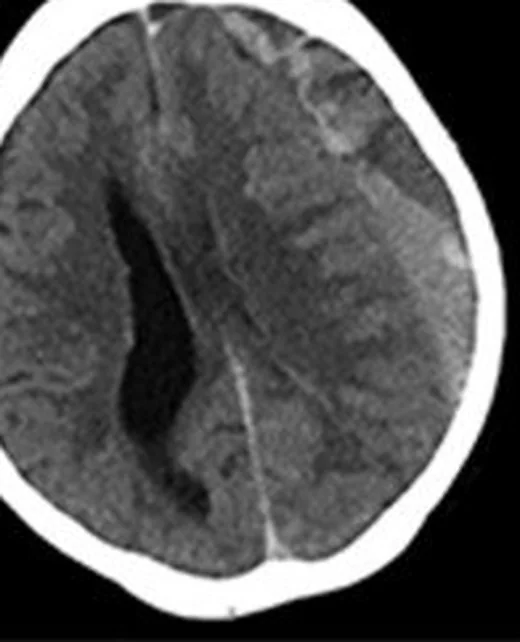
- Konveksite boyunca uzanan hipodens yarımay, komşu frontal veya parietal korteksin konturunu izler.
- Koleksiyonun korteksle izodens olduğu kesimlerde sulkus daralması veya gri-beyaz sınırın içe taşınması yerini belli edebilir.
- İç kenardaki ince hiperdens lamina, organize hematom ile korteks arasındaki membran yüzeyini işaret edebilir.
- İnce bölmeler veya lokülasyonlar tek boşluklu sıvı görünümünü bozar; kompartımanlar farklı dansitede olabilir.
- Karma yoğunluk, yeniden kanama olasılığı dahil farklı bileşimde kan ürünlerini düşündürür; yalnız BT yoğunluğu kesin yaş tayini sağlamaz.
- Beyaz cevherin içe itilmesi, ipsilateral ventrikül basısı ve orta hat yapılarının ötelenmesi koleksiyonun kitle etkisini gösterir.
Ölçütler ve sınıflamalar
- Nakaguchi iç mimari (BT örüntüsü) sınıflaması
- Kronik subdural hematom BT’de homojen veya ayrışmış iç mimari örüntüler gösterebilir. Bu örüntüler kanamanın kesin yaşını tek başına belirlemez.
Normalde
Normal frontoparietal konveksitede beyin yüzeyiyle kafatası arasında BOS yoğunluğunda geniş bir hilal ve iç membran çizgisi izlenmez; kortikal sulkuslar açık kalır. Aynı seviyedeki iki hemisferde sulkus genişliğini, gri-beyaz sınırın kalvaryuma uzaklığını ve lateral ventrikül biçimini karşılaştırarak kronik koleksiyonun oluşturduğu asimetrik basıyı bul.
Normal BT ile kıyasla
Aynı bölgenin, kaynak veri setinde patoloji içermediği belirtilen bir BT incelemesini kesit kesit kaydırın; organ sınırlarını açarak anatomiyi hasta görüntüsüyle karşılaştırın. Küçük rastlantısal bulgular tümüyle dışlanmamıştır.
Kaynak: TotalSegmentator v2.01 veri seti (Wasserthal ve ark., Radiology: Artificial Intelligence 2023), CC BY 4.0, vaka s0103; organ sınırları veri setinin otomatik segmentasyonundan, birleştirilerek sadeleştirildi. Görüntüler 2,5 mm kesit aralığına yeniden örneklendi.
Ayırıcı tanı
- Subdural higroma
- bazı araştırmacılar kronik subdural hematomun subdural higromayı izleyebileceğini öne sürmüştür.
- İzodens subakut subdural hematom
- bilateral izodens kronik subdural hematomun tanısında MRI, BT’den daha duyarlı olabilir.
- Epidural hematom
- interdural hematomlar epidural hematom olarak yanlış sınıflandırılabilir.
- Subdural ampiyem
- dura ile araknoid arasında pürülan materyal birikimiyle seyreden intrakraniyal bir enfeksiyondur.
Tuzaklar
- Kronik subdural hematom BT’de çoğunlukla hilal biçimli hipodens koleksiyon olarak görülür; zamanla yeniden kanama veya membran aktivitesine bağlı heterojenleşebilir ve septasyonlar ya da neovasküler membranlar izlenebilir.
- Kronik subdural hematomda iç septasyonlar ve lokülasyonlar görülebilir; koleksiyonun iç mimarisini değerlendir.
- Karışık yoğunluk mutlaka yeni kanamanın zamanını kanıtlamaz; yoğunluk örüntüsünü klinik zaman çizelgesi olmadan kesin tarihleme için kullanma.
Kendini dene
Yavaş ilerleyen yürüme bozukluğu olan hastada BT’de hilal biçimli, heterojen bir subdural koleksiyon görülüyor; koleksiyonda membran ve septalar da mevcut. En olası tanı nedir?
Cevabı göster
Kronik subdural hematom. Kronik subdural hematom BT’de hilal biçimli hipodens koleksiyon olarak görülebilir; septasyonlar ve neovasküler membranlar da izlenebilir.
Kronik subdural hematom BT’de en sık nasıl görünür?
Cevabı göster
Hilal biçimli, hipoatenüe koleksiyon. Kaynak, kronik subdural hematomun BT’de en sık hilal biçimli ve hipoatenüe koleksiyon olarak görüldüğünü; zamanla heterojenleşebileceğini bildiriyor.
İlgili konular
Kaynaklar
Bu sayfadaki 35 cümle ve 2 quiz sorusu aşağıdaki kaynaklardan alıntılarla otomatik olarak karşılaştırıldı; 8 cümle bu karşılaştırmada düzeltildi (2026-10-09).
- Middle meningeal artery embolization in chronic subdural hematoma: a paradigm shift?pmc.ncbi.nlm.nih.gov
- Can Low-Dose Radiation Therapy Aid in Chronic Subdural Hematoma Management? A Historical Reviewpmc.ncbi.nlm.nih.gov
- Chronic Subdural Hematoma: Pathophysiology, Diagnosis, and the Emerging Role of Middle Meningeal Artery Embolizationpmc.ncbi.nlm.nih.gov
- Clinical and Radiographic Course Following Middle Meningeal Artery Embolization for Chronic Subdural Hematomapmc.ncbi.nlm.nih.gov
- Pathophysiology of chronic subdural hematoma—new insightspmc.ncbi.nlm.nih.gov
- Neuroendovascular surgery.pubmed.ncbi.nlm.nih.gov
- Chronic subdural hematoma.pubmed.ncbi.nlm.nih.gov
- Chronic Subdural Hematoma (cSDH): A review of the current state of the art.pubmed.ncbi.nlm.nih.gov
- Natural History of Acute Subdural Hematoma.pubmed.ncbi.nlm.nih.gov
- Subdural hygromas in abusive head trauma: pathogenesis, diagnosis, and forensic implications.pubmed.ncbi.nlm.nih.gov
- A Radiological Assessment of Chronic Subdural Hematomas.pubmed.ncbi.nlm.nih.gov
- Surgical Management of Trauma-Related Intracranial Hemorrhage-a Review.pubmed.ncbi.nlm.nih.gov
- [Chronic subdural hematoma in the elderly].pubmed.ncbi.nlm.nih.gov
- [Chronic subdural hematoma - assessment and management].pubmed.ncbi.nlm.nih.gov
- [Chorea due to chronic subdural hematoma].pubmed.ncbi.nlm.nih.gov
- Spontaneous subdural hematoma associated with microcystic meningioma: first case report in the literature.pubmed.ncbi.nlm.nih.gov
- Advances in chronic subdural hematoma and membrane imaging.pubmed.ncbi.nlm.nih.gov
- Expert consensus on drug treatment of chronic subdural hematoma.pubmed.ncbi.nlm.nih.gov
- Diagnostic challenge of GAD65-associated autoimmune encephalitis mimicking post-traumatic complications in an older adult: a case report.pubmed.ncbi.nlm.nih.gov
- Acute fatal delayed subdural hemorrhage diagnosed with head computed tomography scan 19 days after hospital admission: A case report.pubmed.ncbi.nlm.nih.gov
- Chronic Subdural Hematoma: Pathophysiology, Diagnosis, and the Emerging Role of Middle Meningeal Artery Embolization.pubmed.ncbi.nlm.nih.gov
- Diagnostic Performance of Ultrafast Brain MRI for Evaluation of Abusive Head Trauma.pubmed.ncbi.nlm.nih.gov
- Severe Late-Onset Vitamin K Deficiency Bleeding Presenting With Subdural Hematoma and Seizures in a 4-Month-Old Infant: A Case Report From a Resource-Limited Setting.pubmed.ncbi.nlm.nih.gov
- Predictors of Neurological Outcome and Recurrence after Standardized Double Burr-hole Evacuation for Chronic Subdural Hematoma.pubmed.ncbi.nlm.nih.gov
- Embolization of the Middle Meningeal Artery As Primary Treatment for Chronic Subdural Hematoma in Older Filipino Adults.pubmed.ncbi.nlm.nih.gov
- Analysis of risk factors for recurrence in septated chronic subdural hematoma.pubmed.ncbi.nlm.nih.gov
- Recurrence prediction in chronic subdural hematomas: a risk stratification score based on 118 consecutive patients.pubmed.ncbi.nlm.nih.gov
- Aphasia and Chronic Subdural Hematoma Evacuation: A Retrospective Cohort Study.pubmed.ncbi.nlm.nih.gov
- Preliminary efficacy analysis of middle meningeal artery embolization using Glubran 2 for chronic subdural hematoma.pubmed.ncbi.nlm.nih.gov
- Global prevalence and incidence of chronic subdural hematoma: A systematic review.pubmed.ncbi.nlm.nih.gov
- A review of sub acute subdural hematoma (SASDH) with our institutional experience and its management by double barrel technique (DbT): A novel technique.pubmed.ncbi.nlm.nih.gov
- Using non-invasive neuroimaging to enhance the care, well-being and experimental outcomes of laboratory non-human primates (monkeys).pubmed.ncbi.nlm.nih.gov
- The role of endoscope-assisted septectomy and membranectomy for complex chronic subdural hematomas: safety, efficacy, technical feasibility. Patient series.pubmed.ncbi.nlm.nih.gov
- ABO Blood Types Are Not Associated with Recurrence After the Surgical Treatment of Chronic Subdural Hematoma-A Retrospective Cohort Study.pubmed.ncbi.nlm.nih.gov
- Triple-modality management of complex septated chronic subdural hematoma: a preliminary technical note on feasibility and safety.pubmed.ncbi.nlm.nih.gov
- Mini-Craniotomy for Chronic Subdural Hematoma: A Reliable Surgical Option.pubmed.ncbi.nlm.nih.gov
- Primary enlarged craniotomy in organized chronic subdural hematomas.pubmed.ncbi.nlm.nih.gov
- Endoscopic-Assisted evacuation vs. burr-hole drainage for chronic subdural hematoma: a retrospective comparative study.pubmed.ncbi.nlm.nih.gov
- Spontaneous Intracranial Hemorrhage in Liver Failure: A Case-Based Approach to Transplant Candidacy and Care.pubmed.ncbi.nlm.nih.gov
- Chronic subdural hematoma management with MMA embolization ± surgery: Pre-existing statin therapy did not reduce recurrence.pubmed.ncbi.nlm.nih.gov
- Post-traumatic hydrocephalus in adults: the mechanisms of development, predictors of progression and management strategies. A narrative review and case series analysis.pubmed.ncbi.nlm.nih.gov
- Case Report: Endoscopic evacuation of acute subdural hematoma in selected young patients: a report of two cases.pubmed.ncbi.nlm.nih.gov
- Bilateral subdural hematomas complicating intracranial hypotension following lumbar spine procedures: two case reports.pubmed.ncbi.nlm.nih.gov
- Intracranial venous thrombosis imaging by anatomical location: an educational review with mimics and diagnostic pitfalls.pubmed.ncbi.nlm.nih.gov
- Bilateral frontal arachnoid cyst rupture associated with chronic subdural hematoma following traumatic brain injury: a case report and literature review.pubmed.ncbi.nlm.nih.gov
- Revision rate and postoperative volume development of chronic subdural hematomas after burr hole craniotomy in combination with tranexamic acid vs. surgery alone - a single-center propensity score-matched analysis.pubmed.ncbi.nlm.nih.gov
- Chronic Subdural Hematoma Is Not Subdural: Anatomical, Biological, and Therapeutic Implications of a Misleading Definition.pubmed.ncbi.nlm.nih.gov
- Pre-existing statin use and recurrence in relation to hematoma architecture of chronic subdural hematomas - A propensity score-matched analysis.pubmed.ncbi.nlm.nih.gov
- Pathophysiology of chronic subdural hematoma-new insights.pubmed.ncbi.nlm.nih.gov
- A deep learning approach to predict temporal changes of subdural hemorrhage on computed tomography.pubmed.ncbi.nlm.nih.gov
- Review of imaging modalities and radiological findings of calvarial lesions.pubmed.ncbi.nlm.nih.gov
- Streptococcus anginosus group brain abscesses and subdural empyemas: exploratory compartment-specific phenotypes and discharge outcomes in a single-center retrospective cohort study.pubmed.ncbi.nlm.nih.gov
- Subdural Empyema and Pneumocephalus From Chronic Polypoid Sinusitis in an Elderly Woman With Rapid Neurological Recovery: A Report of a Rare Case.pubmed.ncbi.nlm.nih.gov
- Postoperative brain abscesses and infections after neurosurgery: Clinical characteristics, risk profiles, microbiological findings, and longitudinal DWI and ADC MRI analysis.pubmed.ncbi.nlm.nih.gov
- Pain in the back after a brain trauma-The revelation of a spinal subdural hematoma: A case report with a literature review.pubmed.ncbi.nlm.nih.gov
- An Integrated Approach on the Diagnosis of Cerebral Veins and Dural Sinuses Thrombosis (a Narrative Review).pubmed.ncbi.nlm.nih.gov
- Imaging Evaluation of Acute Traumatic Brain Injury.pubmed.ncbi.nlm.nih.gov
- Long-term safety and effectiveness of the "OptEase" vena cava filter.pubmed.ncbi.nlm.nih.gov
- AI-Based Approaches for the Identification and Quantification of Traumatic Brain Injury in Computed Tomography Imaging: Systematic Review.pubmed.ncbi.nlm.nih.gov
- Computed tomography in acute intracerebral hemorrhage: neuroimaging predictors of hematoma expansion and outcome.pubmed.ncbi.nlm.nih.gov
- CT perfusion imaging in aneurysmal subarachnoid hemorrhage. State of the art.pubmed.ncbi.nlm.nih.gov
- Sentiment Analysis of Radiological Narratives and Intracranial MRI Hemorrhage Images for the Prediction of Dementia and Alzheimer's Disease.pubmed.ncbi.nlm.nih.gov
- Middle meningeal artery embolisation: The review of a new treatment for chronic subdural hematomas.pubmed.ncbi.nlm.nih.gov
- Neuroimaging Patterns of Intracranial Infections: Meningitis, Cerebritis, and Their Complications.pubmed.ncbi.nlm.nih.gov
- Bacterial Meningoencephalitis in Newborns.pubmed.ncbi.nlm.nih.gov
- Danger points, complications and medico-legal aspects in endoscopic sinus surgery.pubmed.ncbi.nlm.nih.gov
- Individualized treatment for pediatric intracranial aneurysms in China: case series and literature review.pubmed.ncbi.nlm.nih.gov
- Giant Right Sphenoid Wing Meningioma as a Reversible Frontal Network Lesion: A Pseudo-bvFTD Case with Venous-Sparing Skull-Base Resection.pubmed.ncbi.nlm.nih.gov
- Development of a delayed chronic subdural haematoma 3 years after traumatic brain injury with urinary incontinence: a case report.pubmed.ncbi.nlm.nih.gov
- A novel CT-based edema grading system combined with machine learning for precise prognostic prediction in traumatic brain injury.pubmed.ncbi.nlm.nih.gov
- Posterior Fossa Stereotactic Biopsy with Leksell Vantage Frame-Case Series and Review of Literature.pubmed.ncbi.nlm.nih.gov
- Acute Computer Tomography Findings in Pediatric Accidental Head Trauma-Review.pubmed.ncbi.nlm.nih.gov
- Endoscope-assisted Manipulation of Chronic Subdural Hematomas Provides a Novel Solution for Eliminating the Septum and Inner Membrane Leading to Reduced Recurrence.pubmed.ncbi.nlm.nih.gov
- Determination of cystathionine beta-synthase activity in human plasma by LC-MS/MS: potential use in diagnosis of CBS deficiency.pubmed.ncbi.nlm.nih.gov
- Optimal timing of cranioplasty post-decompressive craniectomy in traumatic brain injury: a systematic review, meta-analysis, and overview of ongoing trials.pubmed.ncbi.nlm.nih.gov
- Spontaneous Intracranial Hypotension: Atypical Radiologic Appearances, Imaging Mimickers, and Clinical Look-Alikes.pubmed.ncbi.nlm.nih.gov
- The splenium of the corpus callosum: embryology, anatomy, function and imaging with pathophysiological hypothesis.pubmed.ncbi.nlm.nih.gov
- Chronic Subdural Hematomas-A Retrospective Analysis of the Internal Architecture and Evaluation of Risk Factors for Recurrences After Surgical Therapy.pubmed.ncbi.nlm.nih.gov
- Natural course of chronic subdural hematoma following surgical clipping of unruptured intracranial aneurysm by pterional approach.pubmed.ncbi.nlm.nih.gov
- Brain Midline Shift Measurement and Its Automation: A Review of Techniques and Algorithms.pubmed.ncbi.nlm.nih.gov
- Acute subdural hematoma in spontaneous intracranial hypotension: illustrative case and review of the literature.pubmed.ncbi.nlm.nih.gov
- Dural Follicular Non-Hodgkin Lymphoma Mimicking a Chronic Subdural Hematoma: A Case Report and Literature Review.pubmed.ncbi.nlm.nih.gov
- Predictors of Intracranial Hemorrhage on Initial Head Computed Tomography After Mild Traumatic Brain Injury.pubmed.ncbi.nlm.nih.gov
- Factors Affecting Chronic Subdural Hematoma Recurrence after Middle Meningeal Artery Embolization.pubmed.ncbi.nlm.nih.gov
- Intraindividual histopathological comparison of embolized and nonembolized territories in recurrent chronic subdural hematoma after middle meningeal artery embolization: illustrative case.pubmed.ncbi.nlm.nih.gov
- Revisiting the Surgical Outcomes of Non-Acute Subdural Hematomas among Retired Military Personnel : A Single Tertiary Hospital Retrospective Analysis in the Philippines.pubmed.ncbi.nlm.nih.gov
- Paget's disease with tumefactive soft tissue extension mimicking a chronic subdural hematoma.pubmed.ncbi.nlm.nih.gov
- Recurrence of the Chronic Subdural Hematoma After Burr-Hole Trephination With or Without Intra-Operative Saline Irrigation.pubmed.ncbi.nlm.nih.gov
- Chronic Subdural Hematoma Segmentation: A Dedicated Model to Overcome the Limitations of Acute Hemorrhage Segmentation Across Chronic Subdural Hematoma Subtypes and Density Variations.pubmed.ncbi.nlm.nih.gov
- Neomembrane Formation Suggestive of an Organized Chronic Subdural Hematoma: An Incidental Cadaveric Finding.pubmed.ncbi.nlm.nih.gov
- Intracranial hypotension headache complicated by retroclival subdural hematoma: clinical insights and literature review.pubmed.ncbi.nlm.nih.gov
- Is There Still a Role for Twist Drill Craniostomy in Contemporary Management of Chronic Subdural Hematoma?pubmed.ncbi.nlm.nih.gov
- Classification of recurrence status after surgical treatment of chronic subdural hemorrhage - A machine learning approach.pubmed.ncbi.nlm.nih.gov
- The interdural hematoma: A subtype of convexity subdural/dural hematoma with specific radioanatomical characteristics.pubmed.ncbi.nlm.nih.gov
- Sectional Anatomy Quiz - VIII.pubmed.ncbi.nlm.nih.gov
- Imaging in Chronic Traumatic Encephalopathy and Traumatic Brain Injury.pubmed.ncbi.nlm.nih.gov
- Fulminant <i>Fusobacterium necrophorum</i> Meningoencephalitis Secondary to Frontal Sinusitis in a Previously Healthy Young Adult: A Case Report.pubmed.ncbi.nlm.nih.gov
- Successful surgical management of a cerebellar subdural empyema in a domestic cat.pubmed.ncbi.nlm.nih.gov
- A Man Living in the Wilderness Presents With a Unique Case of <i>Erysipelothrix rhusiopathiae</i> Causing Primary CNS Infection.pubmed.ncbi.nlm.nih.gov
- Arachnoid cyst in the pediatric patient: What the radiologist needs to know.pubmed.ncbi.nlm.nih.gov
- Do Serum Brain Biomarkers Differentiate the Hemorrhagic Head Injury Lesion Phenotypes? An Interim Analysis of an On-Going Randomized Clinical Trial.pubmed.ncbi.nlm.nih.gov
- Subperiosteal Hematoma of the Orbit: A Variety of Presentations.pubmed.ncbi.nlm.nih.gov
- Migratory Preseptal Cellulitis Secondary to Rhinosinusitis Complicated by Left Frontal Subdural Empyema in a Child: A Case Report.pubmed.ncbi.nlm.nih.gov
- Imaging for Pediatric Head and Neck Emergencies: Critical Insights.pubmed.ncbi.nlm.nih.gov
- Decompressive craniectomy surgery in a dog with intracranial extradural hematoma following blunt force trauma.pubmed.ncbi.nlm.nih.gov
- The Mini-Craniotomy for cSDH Revisited: New Perspectives.pubmed.ncbi.nlm.nih.gov
- Consensus Statement on Middle Meningeal Artery Embolization in Chronic Subdural Hematoma Treatment: A Guideline from the Society of Vascular and Interventional Neurology Guidelines and Practice Standards Committee.pubmed.ncbi.nlm.nih.gov
- <i>Actinomyces urogenitalis</i> and <i>Peptoniphilus asaccharolyticus</i> brain abscess in an immunocompetent patient: A case report.pubmed.ncbi.nlm.nih.gov
Eğitim amaçlıdır; hasta başında tanı ve tedavi kararının yerine geçmez, tıbbi tavsiye değildir. Metinler yapay zekâ desteğiyle yazıldı ve otomatik bir adımda kaynak alıntılarıyla karşılaştırıldı; bu bir tıbbi doğrulama değildir ve içerik uzman radyolog incelemesinden geçmedi. Klinik kararlarda güncel kılavuzları, kurum protokollerini ve radyoloji raporunu esas alın.