Özet
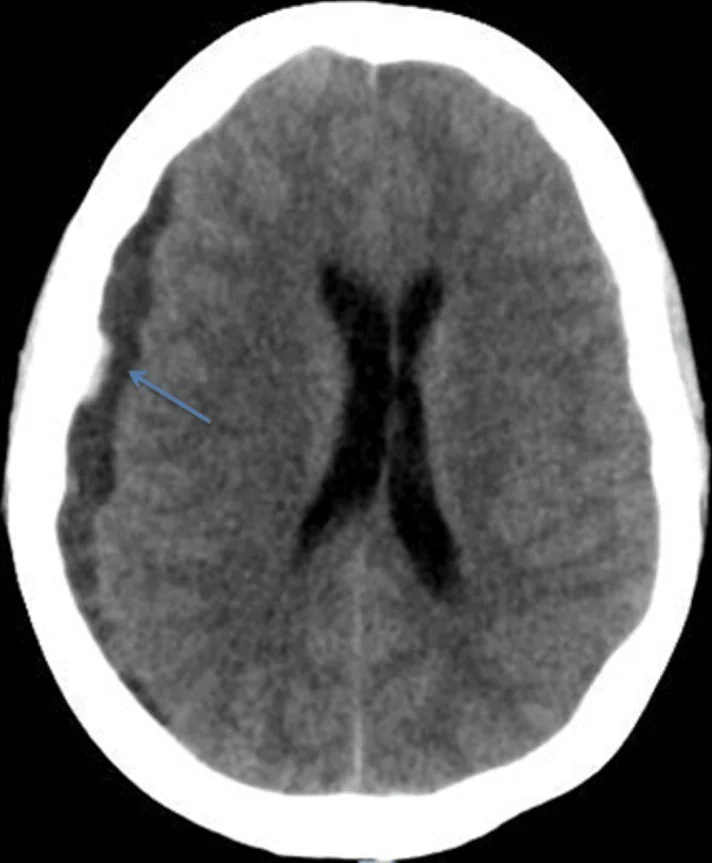
Akut-kronik subdural hematom, önceden var olan kronik subdural koleksiyon içinde daha yeni kan ürünlerinin birikmesiyle oluşan karma yaşlı kanama görünümüdür. Kontrastsız BT, hipodens veya izodens arka plan içinde yeni hiperdens bileşeni, seviyelenmeyi ve toplam kitle etkisini gösterir. Akut-kronik subdural hematomda düşük yoğunluklu koleksiyonun altında yüksek yoğunluklu bir tabaka ve sıvı-kan seviyesi görülebilir. Yeni bileşeni ve iki taraflı basıyı atlamak, hastadaki ani klinik değişimi açıklayan önemli görüntüleme bulgusunu gözden kaçırabilir.
Faz ve pencere
- Kontrastsız tanısal
- BOS'a yakın hipodens ya da kortekse izodens subdural koleksiyon içinde hiperdens yeni kan alanı, tabakalanma veya farklı yoğunluklu odacıklar görülebilir. Tanısal değerlendirme kontrastsız BT'de yapılır; sabit HU eşiğiyle yaş tayini yapılamaz ve kontrastlı faz rutin tanı için gerekli değildir.
Önerilen pencereler: Beyin (G 80 / M 40), Subdural (G 200 / M 75).
BT bulguları
- Kronik görünümlü hilal koleksiyonun içinde, kenarında veya bağımlı bölümünde belirgin hiperdens yeni kan bileşeni bulunabilir.
- Sıvı-kan seviyesi veya düşük yoğunluklu koleksiyonun altındaki hiperdens tabaka, akut-kronik subdural hematomda yakın dönem kanamayı düşündürebilir.
- Aynı koleksiyonun farklı kompartımanları hipodens, izodens ve hiperdens görünebilir.
- Akut-kronik subdural hematom koleksiyonunda hacim artışı ve kitle etkisiyle orta hat kayması ve lateral ventriküllere bası görülebilir.
- Bilateral hematomlarda toplam kitle etkisi subfalsin herniasyona yol açabilir; singulat girus falksın altına yer değiştirir ve ön serebral arter basısı gelişebilir.
- Eşlik eden kontüzyon, subaraknoid kan veya kalvaryal kırık, yeni travmanın başka intrakraniyal izlerini gösterebilir.
- BT'de hematomun maksimum genişliği ve orta hat kayması ayrı ayrı ölçülüp kaydedilmelidir.
Normalde
Normal lateral ventrikül gövdesi düzeyinde konveksite boyunca ekstraaksiyel hilal, yoğunluk tabakaları veya kortikal yüzeye bası bulunmaz; ventriküller ve sulkuslar iki tarafta dengelidir. Karşılaştırmada düşük yoğunluklu koleksiyonun yayılımını ve altındaki yüksek yoğunluklu bileşeni ayrı değerlendir; ardından koleksiyonun oluşturduğu kitle etkisini, örneğin orta hat kaymasını, incele.
Normal BT ile kıyasla
Aynı bölgenin, kaynak veri setinde patoloji içermediği belirtilen bir BT incelemesini kesit kesit kaydırın; organ sınırlarını açarak anatomiyi hasta görüntüsüyle karşılaştırın. Küçük rastlantısal bulgular tümüyle dışlanmamıştır.
Kaynak: TotalSegmentator v2.01 veri seti (Wasserthal ve ark., Radiology: Artificial Intelligence 2023), CC BY 4.0, vaka s0103; organ sınırları veri setinin otomatik segmentasyonundan, birleştirilerek sadeleştirildi. Görüntüler 2,5 mm kesit aralığına yeniden örneklendi.
Ayırıcı tanı
- Tek başına kronik subdural hematom
- hipodens/izodens koleksiyon ve membranlar bulunur, yeni odak hiperdens olmayabilir.
- Tek akut subdural hematom
- koleksiyon genel olarak hiperdensdir; kronik sıvı arka planı veya belirgin membranlaşma yoktur.
- Subdural higroma içinde akut kan
- BOS yoğunluklu sıvı içine kan karışabilir; önceki görüntü ve membran görünümü kronik hematomdan ayırmaya yardım eder.
- Düşük yoğunluklu bileşenin altında keskin sınırlı yüksek yoğunluklu tabaka, ayrılmış tip akut-kronik subdural hematomda yakın dönem kanamayı düşündürür.
Tuzaklar
- Karışık yoğunluklu subdural koleksiyonların görünümü tekrarlayan kanama epizotlarını yansıtabilir.
- Yeni hiperdens bileşen, sıvılaşmış hematom içinde tabaka, düzensiz sınırlı pıhtı veya nodüler odaklar şeklinde görülebilir; koleksiyonun tamamını tek yoğunlukta değerlendirme.
- Bilateral hematomlarda her iki hemisferdeki kitle etkisi ve ventriküler bası ayrı ayrı değerlendirilmelidir.
- Akut travma sonrası karışık yoğunluklu subdural koleksiyon akut-kronik hematomla uyumlu olabilir; yoğunluk görünümü tekrarlayan kanama epizotlarını yansıtabileceğinden kanın yaşı tek başına BT görünümünden kesin belirlenemez.
Kendini dene
Daha önce var olan kronik subdural hematom içinde kontrastsız BT'de hipodens ve hiperdens bileşenler ile orta hat kayması görülmüş. En olası tanı nedir?
Cevabı göster
Akut-kronik subdural hematom. Akut-kronik subdural hematom, önceden var olan hematom üzerine yeni kanama eklenmesidir. Kontrastsız BT'de akut ve kronik subdural hematom bileşenleri birlikte görülebilir.
Akut-kronik subdural hematomun ayrılmış tipinde kontrastsız BT'de hangi görünüm beklenir?
Cevabı göster
Düşük yoğunluklu koleksiyonun altında keskin sınırlı yüksek yoğunluklu tabaka. Ayrılmış tipte yoğunluğu yüksek bölümün altta ve düşük yoğunluklu bölümden belirgin bir sınırla ayrılmış görünmesi, yeni kanamayı düşündürür.
İlgili konular
Kaynaklar
Bu sayfadaki 35 cümle ve 2 quiz sorusu aşağıdaki kaynaklardan alıntılarla otomatik olarak karşılaştırıldı; 19 cümle bu karşılaştırmada düzeltildi (2026-10-09).
- Delayed Recognition, Surgical Dilemmas, and Complications: A Case Report of Acute-on-Chronic Subdural Hematoma With Ischemic Strokepmc.ncbi.nlm.nih.gov
- A Rare Case of Systemic Cystic Angiomatosis in an Elderly Female Initially Misdiagnosed as Vascular Neoplasm: A Case Report and Literature Reviewpmc.ncbi.nlm.nih.gov
- Coexistence of ipsilateral acute‐on‐chronic subdural hematoma and acute extradural hematoma: A case reportpmc.ncbi.nlm.nih.gov
- Simultaneous intracranial acute and chronic subdural hematoma on one side: A rare case reportpmc.ncbi.nlm.nih.gov
- Acute-to-chronic subdural hematoma: radiographic and clinical progression from acute subdural hematomapmc.ncbi.nlm.nih.gov
- Pure Acute-on-Chronic Subdural Hematoma Due to Ruptured Posterior Communicating Artery Aneurysm: Unsuspecting Entity.pubmed.ncbi.nlm.nih.gov
- Outcome in Chronic Subdural Hematoma After Subdural vs. Subgaleal Drain.pubmed.ncbi.nlm.nih.gov
- Acute-on-Chronic Subdural Hematoma: Not Uncommon Events.pubmed.ncbi.nlm.nih.gov
- Acute-on-Chronic Subdural Hematoma Secondary to Falls Due to Alcoholism.pubmed.ncbi.nlm.nih.gov
- Metastatic Subdural Hematoma with Dural Metastasis Secondary to Poorly Differentiated Adenocarcinoma of Unknown Origin.pubmed.ncbi.nlm.nih.gov
- Spontaneous Intracranial Hypotension With Site of Leak Detected Only After 111In-DTPA Cisternogram.pubmed.ncbi.nlm.nih.gov
- Acute-on-chronic subdural hematoma by spinal anesthesia in a patient with undiagnosed chronic subdural hematoma -A case report-.pubmed.ncbi.nlm.nih.gov
- Case report: treatment of subdural hematoma in the emergency department utilizing the subdural evacuating port system.pubmed.ncbi.nlm.nih.gov
- Acute on chronic bilateral subdural hematoma presenting with acute complete flaccid paraplegia and urinary retention mimicking an acute spinal cord injury: a case report.pubmed.ncbi.nlm.nih.gov
- Evacuation of a multi-loculated acute-on-chronic subdural hematoma using tandem bedside subdural evacuation port systems.pubmed.ncbi.nlm.nih.gov
- An autopsy case of encapsulated acute subdural hematoma presenting as an acute-on-chronic spontaneous subdural hematoma.pubmed.ncbi.nlm.nih.gov
- Delayed Recognition, Surgical Dilemmas, and Complications: A Case Report of Acute-on-Chronic Subdural Hematoma With Ischemic Stroke.pubmed.ncbi.nlm.nih.gov
- Successful Management of Acute Promyelocytic Leukemia in a Patient Who Presented With Acute Ischemic Stroke on Top of Subdural Hematoma.pubmed.ncbi.nlm.nih.gov
- Acute-on-chronic versus isolated acute subdural hematoma in complicated mild traumatic brain injury: association with radiological mass effect markers in a multicenter cohort.pubmed.ncbi.nlm.nih.gov
- Surgical management of warfarin-associated spontaneous bilateral subdural hematoma in a mechanical heart valve patient: a rare case report.pubmed.ncbi.nlm.nih.gov
- Subdural Hematomapubmed.ncbi.nlm.nih.gov
- Traumatic intracranial pseudoaneurysms of cortical middle cerebral artery and posterior cerebral artery branches presenting as subdural hematomas in elderly patients: A two-case report.pubmed.ncbi.nlm.nih.gov
- Consensus Statement on Middle Meningeal Artery Embolization in Chronic Subdural Hematoma Treatment: A Guideline from the Society of Vascular and Interventional Neurology Guidelines and Practice Standards Committee.pubmed.ncbi.nlm.nih.gov
- Paraparesis caused by intradural thoracic spinal granuloma secondary to organizing hematoma: illustrative case.pubmed.ncbi.nlm.nih.gov
- Rapidly Developing Subdural Empyema in an Adult with Sinusitis: A Neurosurgical Threat Alert.pubmed.ncbi.nlm.nih.gov
- Pathophysiology of chronic subdural hematoma-new insights.pubmed.ncbi.nlm.nih.gov
- Hematoma Capsule Spanning the Sylvian Fissure and Non-Blocking the Middle Meningeal Artery During Surgery Are Associated With Postoperative Recurrence of Chronic Subdural Hematoma.pubmed.ncbi.nlm.nih.gov
- Chronic Subdural Hematoma: Pathophysiology, Diagnosis, and the Emerging Role of Middle Meningeal Artery Embolization.pubmed.ncbi.nlm.nih.gov
- Initial data from the prospectively randomized G-MEMBRANE trial and systematic review on the embolization of the middle meningeal artery in the treatment of chronic subdural hematomas.pubmed.ncbi.nlm.nih.gov
- Subdural versus subgaleal drains: Impact on postoperative complications and length of stay following subdural hematoma evacuation.pubmed.ncbi.nlm.nih.gov
- The role of endoscope-assisted septectomy and membranectomy for complex chronic subdural hematomas: safety, efficacy, technical feasibility. Patient series.pubmed.ncbi.nlm.nih.gov
- Imaging in Chronic Traumatic Encephalopathy and Traumatic Brain Injury.pubmed.ncbi.nlm.nih.gov
- Imaging Evaluation of Acute Traumatic Brain Injury.pubmed.ncbi.nlm.nih.gov
- Postoperative Density of Residual Hematoma Is a Predictor of Chronic Subdural Hematoma Recurrence-A Single-Center Retrospective Study.pubmed.ncbi.nlm.nih.gov
- Balancing Bleeding and Clot: Type 2 Heparin-Induced Thrombocytopenia With Extensive Thromboses in a Patient With Subdural Hematoma.pubmed.ncbi.nlm.nih.gov
- Chronic Subdural Hematoma Is Not Subdural: Anatomical, Biological, and Therapeutic Implications of a Misleading Definition.pubmed.ncbi.nlm.nih.gov
- Intracranial venous thrombosis imaging by anatomical location: an educational review with mimics and diagnostic pitfalls.pubmed.ncbi.nlm.nih.gov
- Minimally invasive evacuation of chronic subdural hematoma: Repurposing a spinal rigid endoscope.pubmed.ncbi.nlm.nih.gov
- Classification of recurrence status after surgical treatment of chronic subdural hemorrhage - A machine learning approach.pubmed.ncbi.nlm.nih.gov
- Pre-existing statin use and recurrence in relation to hematoma architecture of chronic subdural hematomas - A propensity score-matched analysis.pubmed.ncbi.nlm.nih.gov
- Non-traumatic bilateral subdural hematoma in a 1-year-old child with optic glioma: a rare case report and literature review.pubmed.ncbi.nlm.nih.gov
- Bilateral subdural hematomas complicating intracranial hypotension following lumbar spine procedures: two case reports.pubmed.ncbi.nlm.nih.gov
- Emergency burr-hole evacuation for subacute SDH with uncal herniation: a case report of near-complete neurological recovery despite bilateral occipital infarction.pubmed.ncbi.nlm.nih.gov
- Predictors of Intracranial Hemorrhage on Initial Head Computed Tomography After Mild Traumatic Brain Injury.pubmed.ncbi.nlm.nih.gov
- Clinical and Radiological Characteristics of Pediatric Skull Fractures and Their Association with Neurosurgical Intervention: A Retrospective Cohort Study.pubmed.ncbi.nlm.nih.gov
- Serial Magnetic Resonance Imaging Leading to the Diagnosis of a Growing Skull Fracture in an Infant Without an Apparent Fracture Widening on Follow-Up Computed Tomography.pubmed.ncbi.nlm.nih.gov
- Surgical evacuation of an isolated interhemispheric subdural hematoma presenting with falx syndrome in the subacute period: A case report.pubmed.ncbi.nlm.nih.gov
- Factors Affecting Chronic Subdural Hematoma Recurrence after Middle Meningeal Artery Embolization.pubmed.ncbi.nlm.nih.gov
- Armored Brain, Giant Calcified Chronic Subdural Hematoma, in 97-Year-Old Patient: Systematic Review.pubmed.ncbi.nlm.nih.gov
- Chronic subdural hematoma: Clinical experience and recurrence risk factors in a Mexican neurosurgery residency training program.pubmed.ncbi.nlm.nih.gov
- Diagnostic Accuracy and Time Efficiency of Artificial Intelligence for Intracranial Hemorrhage Detection on Emergency Brain CT.pubmed.ncbi.nlm.nih.gov
- Non-contrast CT findings suggestive of secondary intracerebral haemorrhage.pubmed.ncbi.nlm.nih.gov
- Cervical Osteophyte as a Rare Etiology of Spontaneous Intracranial Hypotension With Bilateral Subdural Hematomas: A Case Report and Literature Review.pubmed.ncbi.nlm.nih.gov
- Global prevalence and incidence of chronic subdural hematoma: A systematic review.pubmed.ncbi.nlm.nih.gov
- Patterns of injury and violence in Yaoundé Cameroon: an analysis of hospital data.pubmed.ncbi.nlm.nih.gov
- Long-term safety and effectiveness of the "OptEase" vena cava filter.pubmed.ncbi.nlm.nih.gov
- AI-Based Approaches for the Identification and Quantification of Traumatic Brain Injury in Computed Tomography Imaging: Systematic Review.pubmed.ncbi.nlm.nih.gov
- Individualized treatment for pediatric intracranial aneurysms in China: case series and literature review.pubmed.ncbi.nlm.nih.gov
- Deep learning segmentation-based bone removal from computed tomography of the brain improves subdural hematoma detection.pubmed.ncbi.nlm.nih.gov
- Preserving Continuity of Cancer Therapy in Patients with Hematologic Malignancies and Chronic Subdural Hematomas: Comparative Outcomes of Middle Meningeal Artery Embolization and Surgery.pubmed.ncbi.nlm.nih.gov
- Order and Timing of Middle Meningeal Artery Embolization as a Perioperative Adjunct to Surgical Evacuation for Chronic Subdural Hematomas: A Multicenter Study.pubmed.ncbi.nlm.nih.gov
- A novel CT-based edema grading system combined with machine learning for precise prognostic prediction in traumatic brain injury.pubmed.ncbi.nlm.nih.gov
- Intentional Self-Inflicted Transcranial Screwdriver Injury: A Case Report.pubmed.ncbi.nlm.nih.gov
- Dual Impact: Coup-Contrecoup Brain Injury in a Young Cyclist-A Case Report.pubmed.ncbi.nlm.nih.gov
- Acute subdural hematoma in spontaneous intracranial hypotension: illustrative case and review of the literature.pubmed.ncbi.nlm.nih.gov
- Bilateral subdural empyema diagnosed after middle meningeal artery embolization: illustrative case.pubmed.ncbi.nlm.nih.gov
- Recurrent nontraumatic acute subdural hematoma secondary to ruptured accessory meningeal artery aneurysm: A case report and literature review.pubmed.ncbi.nlm.nih.gov
- Fatal Spontaneous Rebleeding of Subdural Haematoma Following COVID-19 Infection: A Case Report.pubmed.ncbi.nlm.nih.gov
- Case Report: Life-threatening acute subdural hematoma associated with human parvovirus B19 infection in a young adult.pubmed.ncbi.nlm.nih.gov
- Advances in neuroproteomics for neurotrauma: unraveling insights for personalized medicine and future prospects.pubmed.ncbi.nlm.nih.gov
- New developments in the antiviral treatment of hepatitis C.pubmed.ncbi.nlm.nih.gov
- Vascular endothelial growth factor concentration in chronic subdural hematoma fluid is related to computed tomography appearance and exudation rate.pubmed.ncbi.nlm.nih.gov
- Validation of intensive care unit predictive scoring systems in West Africans.pubmed.ncbi.nlm.nih.gov
- Assessing the appropriateness of helicopter emergency medical services for non-traumatic emergencies in a medically underserved rural area, Japan.pubmed.ncbi.nlm.nih.gov
- Preoperative identification of low-risk patients for major complications after acute hip fracture surgery in geriatric patients: an observational cohort study.pubmed.ncbi.nlm.nih.gov
- Management of intracranial hypertension.pubmed.ncbi.nlm.nih.gov
- Seizure following epidural blood patch in spontaneous intracranial hypotension complicated by subdural hematoma: Illustrated case and literature review.pubmed.ncbi.nlm.nih.gov
- Simultaneous Burr hole drainage and middle meningeal artery occlusion through a single incision for chronic subdural hematoma guided by 3D reconstruction.pubmed.ncbi.nlm.nih.gov
- Over-hydration as a key modifiable predictor of obstructive sleep apnea severity in dialysis patients with daytime sleepiness.pubmed.ncbi.nlm.nih.gov
- Risk Stratification for Early Seizures after Traumatic Brain Injury: A Clinical Scoring Model for Prediction and Management.pubmed.ncbi.nlm.nih.gov
- Early detection of intracranial hemorrhage in Yellow Fever utilizing multimodal neuromonitoring: A case report.pubmed.ncbi.nlm.nih.gov
- Acute soft head syndrome in sickle cell disease: A rare and under-recognized complication with diagnostic challenges.pubmed.ncbi.nlm.nih.gov
- Acute Computer Tomography Findings in Pediatric Accidental Head Trauma-Review.pubmed.ncbi.nlm.nih.gov
- Triphasic Response of Pituitary Stalk Injury Secondary to Traumatic Brain Injury.pubmed.ncbi.nlm.nih.gov
- A Sneeze Away From Paralysis: A Unique Case of Spontaneous Spinal Intradural Hematoma.pubmed.ncbi.nlm.nih.gov
- Guidelines for Essential Trauma Care: Second Edition (2026).pubmed.ncbi.nlm.nih.gov
- Reversible hemi-parkinsonism syndrome secondary to bilateral subdural hematomas: case report and literature review.pubmed.ncbi.nlm.nih.gov
- Preoperative CT markers and poor discharge functional status after burr-hole drainage for chronic subdural hematoma: a retrospective cohort study.pubmed.ncbi.nlm.nih.gov
- Unusual case: Late diagnosis of tuberous sclerosis complex in a 59-year-old woman associated with extended fibrous dysplasia in craniofacial bones and spine.pubmed.ncbi.nlm.nih.gov
- Intracranial intricacies: Comprehensive analysis of rare skull base meningiomas-A single-center case series.pubmed.ncbi.nlm.nih.gov
- Middle Meningeal Artery Embolization With n-Butyl Cyanoacrylate in Patients With Chronic Subdural Hematoma: A Randomized Clinical Trial.pubmed.ncbi.nlm.nih.gov
- Middle Meningeal Artery Embolization in the Treatment of Chronic Subdural Hematoma: A Two-Center Retrospective Study.pubmed.ncbi.nlm.nih.gov
- Embosphere microsphere embolization of the middle meningeal artery for the treatment of chronic subdural hematoma: a single-center experience.pubmed.ncbi.nlm.nih.gov
- Management of LVAD in Cerebral Salt-Wasting Syndrome.pubmed.ncbi.nlm.nih.gov
- Facial nerve palsy after middle meningeal artery embolization for chronic subdural hematoma: illustrative case.pubmed.ncbi.nlm.nih.gov
- Interventional Pain Procedures: A Narrative Review Focusing on Safety and Complications. Part 3 - Sympathetic and Ganglion-Targeted Techniques.pubmed.ncbi.nlm.nih.gov
- Perioperative Matrix Metalloproteinase-2 and Matrix Metalloproteinase-9 Profiles in Acute and Chronic Subdural Hematomas.pubmed.ncbi.nlm.nih.gov
- Intracranial hemorrhagic risk after cortical brain biopsy during shunt surgery for idiopathic normal pressure hydrocephalus: a prospective comparative study.pubmed.ncbi.nlm.nih.gov
- Bioethics and medical oversight in multi-site observational neuroimaging studies with children and adolescents: 10 years of ABCD experience.pubmed.ncbi.nlm.nih.gov
- Explainable AI in medicine: challenges of integrating XAI into the future clinical routine.pubmed.ncbi.nlm.nih.gov
- Anatomy education potential of the first digital twin of a Korean cadaver.pubmed.ncbi.nlm.nih.gov
- Dural Follicular Non-Hodgkin Lymphoma Mimicking a Chronic Subdural Hematoma: A Case Report and Literature Review.pubmed.ncbi.nlm.nih.gov
- A deep learning approach to predict temporal changes of subdural hemorrhage on computed tomography.pubmed.ncbi.nlm.nih.gov
- Value of transcranial color-coded duplex sonography-derived middle cerebral artery pulsatility index in intracranial pressure assessment at moderate to high altitudes.pubmed.ncbi.nlm.nih.gov
- Evaluating the Machine Learning Models in Predicting Intensive Care Unit Discharge for Neurosurgical Patients Undergoing Craniotomy: A Big Data Analysis.pubmed.ncbi.nlm.nih.gov
- Italian guidelines on the assessment and management of pediatric head injury in the emergency department.pubmed.ncbi.nlm.nih.gov
- The Empirical Foundations of Teleradiology and Related Applications: A Review of the Evidence.pubmed.ncbi.nlm.nih.gov
- Epidural analgesia for adults undergoing cardiac surgery with or without cardiopulmonary bypass.pubmed.ncbi.nlm.nih.gov
- Beyond Ischemia: The Rare Occurrence of Hemorrhagic Strokes in Pediatric Sickle Cell Anemia.pubmed.ncbi.nlm.nih.gov
- Continuum topological derivative - A novel application tool for segmentation of CT and MRI images.pubmed.ncbi.nlm.nih.gov
- Diagnostic Approach to Macrocephaly in Children.pubmed.ncbi.nlm.nih.gov
- IE-Vnet: Deep Learning-Based Segmentation of the Inner Ear's Total Fluid Space.pubmed.ncbi.nlm.nih.gov
- Imaging for the diagnosis and management of traumatic brain injury.pubmed.ncbi.nlm.nih.gov
- Clinical manifestations, progression and treatment of post-traumatic hydrocephalus accompanied by contralateral subdural effusion after decompressive craniectomy: a single-center retrospective study.pubmed.ncbi.nlm.nih.gov
- Osmotic Demyelination Syndrome Complicating Moderate Hyponatremia Correction in the Emergency Department: A Case Report.pubmed.ncbi.nlm.nih.gov
Eğitim amaçlıdır; hasta başında tanı ve tedavi kararının yerine geçmez, tıbbi tavsiye değildir. Metinler yapay zekâ desteğiyle yazıldı ve otomatik bir adımda kaynak alıntılarıyla karşılaştırıldı; bu bir tıbbi doğrulama değildir ve içerik uzman radyolog incelemesinden geçmedi. Klinik kararlarda güncel kılavuzları, kurum protokollerini ve radyoloji raporunu esas alın.