
Özet
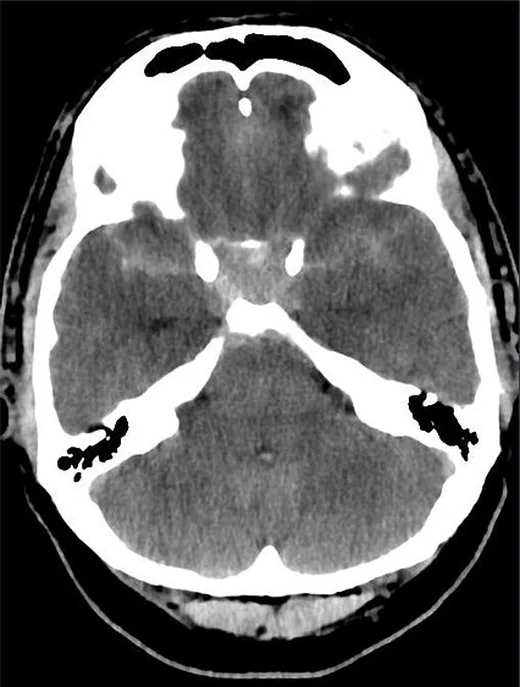
İntrakraniyal anevrizma rüptürü subaraknoid kanamaya yol açabilir; tipik anevrizmal örüntü bazal sisternler ve komşu fissürlerde belirgin kan içerir. Klinik tablo ani şiddetli baş ağrısı ve bilinç değişikliğini içerebilir. İlk inceleme kontrastsız BT'dir; kan dağılımı, ventrikül içine kan geçişi ve hidrosefali bu seride değerlendirilir. BTA hızlı vasküler değerlendirmeye olanak sağlar ancak kanamayı tek başına doğrulamaz; küçük anevrizmalarda duyarlılık düşüktür ve ilk BTA ile DSA negatif olsa da kanama kaynağı bulunamayabilir. Kanama yükü modifiye Fisher derecesiyle kodlanır ve gecikmiş serebral iskemi riskiyle ilişkilidir; ventrikül içi kan ile hidrosefali BT’de ayrıca değerlendirilir.
Faz ve pencere
- Kontrastsız tanısal
- Akut kan kontrastsız BT’de hiperdens subaraknoid materyal olarak görülür; tipik anevrizmal dağılım bazal sisternler, Sylvian ve anterior interhemisferik fissürleri içerir. Aynı seride lateral ventrikül genişlemesini ve çevresindeki interstisyel ödemi değerlendirin.
- BTA tanısal
- BTA’daki çok düzlemli ve üç boyutlu rekonstrüksiyonlar anevrizmanın yeri, boyutu ve morfolojisini değerlendirmeye elverir; kanın en yoğun olduğu sistern veya fissür olası kaynak damara ipucu verir. BTA küçük anevrizmaları uzaysal çözünürlük sınırlılığı nedeniyle ilk incelemede göstermeyebilir; tromboze anevrizmalar ise kontrastlanan lümen bulunmaması nedeniyle okült kalabilir.
Önerilen pencereler G genişlik, M merkez; değerler Hounsfield birimi (HU)
- BeyinG 80 / M +40
- AnjiyoG 600 / M +150
BT bulguları
- Suprasellar sistern kanı — optik kiazma ve hipofiz sapı komşuluğundaki sisternal aralıkta hiperdens kan.
- İnterhemisferik fissür uzanımı — falx komşuluğunda hiperdens kan görülebilir.
- Sylvian fissür baskınlığı — bir tarafta fissür boyunca yayılan kan, orta serebral arter kaynaklı rüptür olasılığına yöneltir.
- Perimezensefalik kan dağılımı — orta beyin sisternlerinde lokalize kan ile seyreden, genellikle benign seyirli nonanevrizmal perimezensefalik örüntüyle uyumlu olabilir.
- İntraventriküler hematom — ventriküllerdeki kan BOS dolaşım yolunu etkileyerek akut obstrüktif hidrosefaliye yol açabilir.
- Akut hidrosefali — ventriküllerde genişleme ve çevresinde interstisyel ödem görülebilir.
- Sistern basısı/obliterasyonu — suprasellar, prepontin ve ambient bazal sisternlerin normal konfigürasyonunun daralması veya seçilememesi görülebilir.
Ölçütler ve sınıflamalar
- Fisher derece 3: bazal sisternlerde fokal pıhtı veya vertikal kan tabakası
- Vertikal kan tabakası ≥1 mm
- Fisher BT sınıflaması
- 4: Subaraknoid kanama yaygın olsun ya da hiç olmasın, intraventriküler ya da intraparenkimal pıhtı bulunması.
- Modifiye Fisher sınıflaması
- Dereceler ince (<1 mm) veya kalın (≥1 mm) SAH tabakası ile intraventriküler kanı birlikte kodlar; 0: SAH ve IVH yok, 1: ince SAH-IVH yok, 2: ince SAH-IVH var, 3: kalın SAH-IVH yok, 4: kalın SAH-IVH var ve en yüksek risklidir.
Normalde
Normal düzeyde suprasellar, interpedinküler ve ambient sisternler BOS yoğunluklu, açık aralıklardır; Sylvian ve interhemisferik fissürlerde hiperdens içerik bulunmaz. Kıyaslamada kanın hangi arter komşuluğunda yoğunlaştığını ve ventrikül içine yayılımını gözden geçirin; ventrikül boyutları hidrosefali değerlendirmesini tamamlar.
Normal BT ile kıyasla
Aynı bölgenin, kaynak veri setinde patoloji içermediği belirtilen bir BT incelemesini kesit kesit kaydırın; organ sınırlarını açarak anatomiyi hasta görüntüsüyle karşılaştırın. Küçük rastlantısal bulgular tümüyle dışlanmamıştır.
Kaynak: TotalSegmentator v2.01 veri seti (Wasserthal ve ark., Radiology: Artificial Intelligence 2023), CC BY 4.0, vaka s0103; organ sınırları veri setinin otomatik segmentasyonundan, birleştirilerek sadeleştirildi. Görüntüler 2,5 mm kesit aralığına yeniden örneklendi.
Ayırıcı tanı
- Perimezensefalik nonanevrizmal kanama, anjiyografi-negatif SAK örüntülerinden biridir ve genellikle benign seyirlidir.
- Konveksite subaraknoid kanaması
- kan kortikal sulkuslarda ağırlıklıdır; düşük hacimli kortikal sulkal örüntü anevrizma dışı nedenlerle ilişkili olabilir.
- Psödo-subaraknoid görünüm
- subaraknoid aralıktaki kan dışı artmış dansite gerçek subaraknoid kanamayı taklit edebilir.
Tuzaklar
- Kan dağılımını yalnızca 'SAH var' diye özetlemeyin; bazal sistern, fissür ve ventrikül uzanımı kaynak damarı ve ağırlığı yorumlamaya yardım eder.
- İlk BTA negatif olsa da küçük anevrizmalar dışlanamayabilir; şüphe sürdüğünde dijital substraksiyon anjiyografi dahil ileri damar görüntülemesi değerlendirilir.
- Akut hidrosefaliyi değerlendirirken lateral ventrikül genişlemesini, çevresindeki interstisyel ödemi ve üçüncü ventrikülün yuvarlaklaşmış, künt konturunu inceleyin.
Kendini dene
Anevrizma rüptürüne bağlı akut hidrosefalinin en sık tipi hangisidir?
Cevabı göster
Obstrüktif hidrosefali. Anevrizmal SAK sonrası akut hidrosefali yaklaşık %15-87 sıklıkta görülür ve çoğunlukla obstrüktif tiptedir; az sayıda hasta komünikan tipte kalır.
Subaraknoid kanamalı hastanın BT’sinde ventrikül içi kan ve ventrikül genişlemesi görülüyor. En olası eşlikçi sorun hangisidir?
Cevabı göster
Akut hidrosefali. Ventrikül içi kan BOS dolaşım yolunu etkileyerek akut obstrüktif hidrosefaliye yol açabilir.
İlgili konular
- Travmatik subaraknoid kanama
- Perimezensefalik subaraknoid kanama örüntüsü
- Konveksite subaraknoid kanaması
Kaynaklar
Bu sayfadaki 39 cümle ve 2 quiz sorusu aşağıdaki kaynaklardan alıntılarla otomatik olarak karşılaştırıldı; 21 cümle bu karşılaştırmada düzeltildi (2026-10-12).
- 2023 Guideline for the Management of Patients With Aneurysmal Subarachnoid Hemorrhage: A Guideline From the American Heart Association/American Stroke Associationpubmed.ncbi.nlm.nih.gov
- Imaging Strategy for Patients With Aneurysmal Subarachnoid Hemorrhage and Negative Initial Imaging: Evidence, Pitfalls, and Emerging Techniquesjournals.sagepub.com
- Imaging in Neurocritical Care Practicethieme-connect.com
- Aneurysmal subarachnoid haemorrhage from a neuroimaging perspectivelink.springer.com
- Current status of perimesencephalic non-aneurysmal subarachnoid hemorrhagefrontiersin.org
- Imaging of cerebral aneurysms: a clinical perspectivelink.springer.com
- Prediction of symptomatic vasospasm after subarachnoid hemorrhage: the modified fisher scalepubmed.ncbi.nlm.nih.gov
- Delineation of Subarachnoid Cisterns Using CT Cisternography, CT Brain Positive and Negative Contrast, and a Three Dimensional MRI Sequence: A Pictorial Reviewassets.cureus.com
- Chinese expert consensus on the management of aneurysmal subarachnoid hemorrhage-related hydrocephaluspmc.ncbi.nlm.nih.gov
- Interpretation of Emergency Head CT: A Practical Handbook, Second Editioneprints.poltekkesadisutjipto.ac.id
- Subarachnoid haemorrhagepmc.ncbi.nlm.nih.gov
- Nontraumatic Subarachnoid Hemorrhage and Ruptured Intracranial Aneurysm: Recognition and Evaluationaafp.org
- Quantification of blood and CSF volume to predict outcome after aneurysmal subarachnoid hemorrhagelink.springer.com
- Imaging Findings in Acute Traumatic Brain Injury: a National Institute of Neurological Disorders and Stroke Common Data Element-Based Pictorial Review and Analysis of Over 4000 Admission Brain Computed Tomography Scans from the CENTER-TBI Studyjournals.sagepub.com
- Modified Fisher scale grade — NIH Common Data Elements Repositorycde.nlm.nih.gov
- Efficacy and Safety of Lumbar Drainage before Endovascular Treatment for Ruptured Intracranial Aneurysmspmc.ncbi.nlm.nih.gov
- Diagnostic evaluation of suspected aneurysmal subarachnoid hemorrhage after negative CT: risk-stratified use of lumbar puncture and CT angiographypmc.ncbi.nlm.nih.gov
- Cerebral Vasospasm Detection and Delayed Cerebral Ischemia Prediction after Aneurysmal Subarachnoid Hemorrhage: A Scoping Reviewpmc.ncbi.nlm.nih.gov
- Noninvasive neurophysiological diagnostics of delayed cerebral ischemia in aneurysmal subarachnoid hemorrhage: a scoping reviewpmc.ncbi.nlm.nih.gov
- Subarachnoid Hemorrhage.pubmed.ncbi.nlm.nih.gov
- Subarachnoid Hemorrhage.pubmed.ncbi.nlm.nih.gov
- Aneurysmal Subarachnoid Hemorrhage.pubmed.ncbi.nlm.nih.gov
- Diagnosis of Delayed Cerebral Ischemia in Patients with Aneurysmal Subarachnoid Hemorrhage and Triggers for Intervention.pubmed.ncbi.nlm.nih.gov
- Subarachnoid hemorrhage in the emergency department.pubmed.ncbi.nlm.nih.gov
- [Aneurysmal subarachnoid hemorrhage].pubmed.ncbi.nlm.nih.gov
- Aneurysmal Subarachnoid Hemorrhage: the Last Decade.pubmed.ncbi.nlm.nih.gov
- Advanced MRI Measures of Cerebral Perfusion and Their Clinical Applications.pubmed.ncbi.nlm.nih.gov
- Aneurysmal subarachnoid hemorrhage: current concepts and updates.pubmed.ncbi.nlm.nih.gov
- Clinical application of perfusion computed tomography in neurosurgery.pubmed.ncbi.nlm.nih.gov
- Aneurysmal Subarachnoid Hemorrhage: Unanswered Questions.pubmed.ncbi.nlm.nih.gov
- Continuous EEG detection of DCI and seizures following aSAH: a systematic review.pubmed.ncbi.nlm.nih.gov
- Vasospasm: Role of Imaging in Detection and Monitoring Treatment.pubmed.ncbi.nlm.nih.gov
- Recognizing the signs and symptoms of aneurysmal subarachnoid hemorrhage.pubmed.ncbi.nlm.nih.gov
- Comparative anatomical and clinical evaluation of three surgical spaces for contralateral internal carotid artery C7-segment aneurysm clipping: the role of the subchiasmatic-preinfundibular space.pubmed.ncbi.nlm.nih.gov
- Subarachnoid cisterns as surgical corridors: Integrating microsurgical anatomy and neuroimaging for intracranial navigation.pubmed.ncbi.nlm.nih.gov
- How I do it? Microsurgical treatment of traumatic anterior cerebral artery pseudoaneurysm with cerebrospinal fluid rhinorrhea.pubmed.ncbi.nlm.nih.gov
- Callosomarginal artery: an in-depth of anatomical characteristics, clinical significance, neurosurgical considerations, and surgical applications.pubmed.ncbi.nlm.nih.gov
- Exploratory study to assess feasibility of intracerebral hemorrhage detection by point of care cranial ultrasound.pubmed.ncbi.nlm.nih.gov
- Neuroimaging Patterns of Intracranial Infections: Meningitis, Cerebritis, and Their Complications.pubmed.ncbi.nlm.nih.gov
- Brain abnormalities in COVID-19 acute/subacute phase: A rapid systematic review.pubmed.ncbi.nlm.nih.gov
- Trans-sylvian hematoma evacuation combined with lamina terminalis ventriculostomy for hypertensive basal ganglia hemorrhage: a retrospective cohort study.pubmed.ncbi.nlm.nih.gov
- Lumbar drainage in intracerebral haemorrhage with intraventricular haemorrhage (DRAIN IVH): protocol for a multi-centre, randomised-controlled, two-arm, assessor-blinded trial.pubmed.ncbi.nlm.nih.gov
- Impact of Hemorrhage Extent on External Ventricular Drain-Associated Infections in Aneurysmal Subarachnoid Hemorrhage.pubmed.ncbi.nlm.nih.gov
- Persistent Hypersomnolence Following Aneurysmal Subarachnoid Hemorrhage: A Case Report.pubmed.ncbi.nlm.nih.gov
- Cold-Induced Reversible Cerebral Vasoconstriction Syndrome Presenting With Intraventricular Hemorrhage in a Normotensive Patient.pubmed.ncbi.nlm.nih.gov
- Awake prone positioning in a patient with respiratory impairment due to subarachnoid hemorrhage: a case report.pubmed.ncbi.nlm.nih.gov
- Non-contrast computed tomography at the end of the acute care phase as an additional prognostic tool after aneurysmal subarachnoid hemorrhage.pubmed.ncbi.nlm.nih.gov
- Diagnostic Accuracy and Time Efficiency of Artificial Intelligence for Intracranial Hemorrhage Detection on Emergency Brain CT.pubmed.ncbi.nlm.nih.gov
- Craniospinal cerebrospinal fluid volume changes after extreme bilateral frontotemporoparietal craniectomy and cranioplasty: a volumetric magnetic resonance imaging case report.pubmed.ncbi.nlm.nih.gov
- Automated Evans index measurement using deep learning in acute subarachnoid hemorrhage: reliability, agreement with experts, and association with external ventricular drainage.pubmed.ncbi.nlm.nih.gov
- Post-traumatic hydrocephalus in adults: the mechanisms of development, predictors of progression and management strategies. A narrative review and case series analysis.pubmed.ncbi.nlm.nih.gov
- Comparative CT Ventricular Morphometrics in Hydrocephalus, Stroke, and Traumatic Brain Injury: A Distortion-Controlled Analysis.pubmed.ncbi.nlm.nih.gov
- Imaging features of a frontal neuroglial cyst in an adult patient: A rare case report.pubmed.ncbi.nlm.nih.gov
- Inter-Rater Reliability of Subarachnoid Hemorrhage Radiological Grading Scales: A Systematic Review and Meta-Analysis.pubmed.ncbi.nlm.nih.gov
- Aneurysmal subarachnoid hemorrhage: predictive score for angiographic vasospasm.pubmed.ncbi.nlm.nih.gov
- "Small ghost aneurysm": delayed visualization of a ruptured thrombosed nonbranching M2 aneurysm with pathological and hemodynamic correlation. Illustrative case.pubmed.ncbi.nlm.nih.gov
- Delayed thrombosis of a ruptured anterior spinal artery aneurysm after prolonged morphological stability: illustrative case.pubmed.ncbi.nlm.nih.gov
- Traumatic intracranial pseudoaneurysms of cortical middle cerebral artery and posterior cerebral artery branches presenting as subdural hematomas in elderly patients: A two-case report.pubmed.ncbi.nlm.nih.gov
- Baseline radiological parameters associated with good neurological outcome following ventriculoperitoneal shunt in normal pressure hydrocephalus: A single-center study on 82 patients.pubmed.ncbi.nlm.nih.gov
- Case Report: Endoscopic-assisted cistern ostomy with Ommaya reservoir insertion for trapped temporal horn: surgical technique and case illustration.pubmed.ncbi.nlm.nih.gov
- From Benign Symptoms to Subarachnoid Hemorrhage: A Pediatric Case.pubmed.ncbi.nlm.nih.gov
- Flexible endoscopy for removal of a migrated fractured ventricular catheter in an adult: A case report and technical note.pubmed.ncbi.nlm.nih.gov
- Clinical and epidemiological comparison between perimesencephalic and non-perimesencephalic, non-aneurysmal subarachnoid hemorrhage: a single-center cohort study from a referral center in a developing country.pubmed.ncbi.nlm.nih.gov
- Perimesencephalic Hemorrhagic-Pontine Infarction Syndrome: Miler Fisher's Hint to Subarachnoid Paramedian Artery Rupture-A Case Report.pubmed.ncbi.nlm.nih.gov
- Perimesencephalic non-aneurysmal subarachnoid hemorrhage: is there a need for repeat digital subtraction angiography?pubmed.ncbi.nlm.nih.gov
- Neuroimaging in inborn errors of immunity: More than infections.pubmed.ncbi.nlm.nih.gov
- Benign versus sinister aetiologies underlying basal cistern subarachnoid haemorrhage: a case series.pubmed.ncbi.nlm.nih.gov
- Fetal mri of obstructive hydrocephalus: a review proposing a surgical etiology-based approach.pubmed.ncbi.nlm.nih.gov
- PHACE syndrome: a systematic literature review and illustrative case report of a patient with severe cerebrovascular and neurodevelopmental sequelae.pubmed.ncbi.nlm.nih.gov
- Low-Pressure Hydrocephalus in Spontaneous Angiogram-Negative Subarachnoid Hemorrhage Following COVID-19 Infection.pubmed.ncbi.nlm.nih.gov
- Perimesencephalic Subarachnoid Hemorrhage After Thunderclap Headache in a Clinically Stable Patient: A Case Report.pubmed.ncbi.nlm.nih.gov
- Neurological Disorders Associated With COVID-19 Hospital Admissions: Experience of a Single Tertiary Healthcare Center.pubmed.ncbi.nlm.nih.gov
- Intracranial Migration of Silicone Delaying Life Saving Surgical Management: A Mimicker of Hemorrhage.pubmed.ncbi.nlm.nih.gov
- Mechanical birth-related trauma to the neonate: An imaging perspective.pubmed.ncbi.nlm.nih.gov
- Clinical condition of 120 patients alive at 3 years after poor-grade aneurysmal subarachnoid hemorrhage.pubmed.ncbi.nlm.nih.gov
- Coronavirus disease 2019 (COVID-19)-associated brain abscesses caused by Pseudomonas aeruginosa and Aspergillus fumigatus: two case and a review of the literature.pubmed.ncbi.nlm.nih.gov
- Tuberous sclerosis complex: a case report and literature review.pubmed.ncbi.nlm.nih.gov
- Impact of surgery within 6 hours on preoperative rerupture and prognosis of poor-grade aneurysmal subarachnoid hemorrhage.pubmed.ncbi.nlm.nih.gov
- Subarachnoid Hemorrhage Causing Hydrocephalus: Narrative Review of a Neurosurgical Emergency.pubmed.ncbi.nlm.nih.gov
- Angiography-Negative Subarachnoid Hemorrhage Detected After Emergent Percutaneous Coronary Intervention for Non-ST-Segment Elevation Myocardial Infarction: A Case Report.pubmed.ncbi.nlm.nih.gov
- Individualized endovascular management of distal posterior circulation aneurysms: a single-center experience and decision framework.pubmed.ncbi.nlm.nih.gov
- Jugular Venous Compression via Soft Cervical Collar in Shunt-Refractory Low-Pressure Hydrocephalus: A Report of Two Cases.pubmed.ncbi.nlm.nih.gov
- Multiple Abdominal abscesses following ventriculoperitoneal shunt placement in an immunosuppressed patient: An illustrative case.pubmed.ncbi.nlm.nih.gov
- Co-administration of Four-Factor Prothrombin Complex Concentrate With Andexanet alfa for Reversal of Nontraumatic Intracranial Hemorrhage.pubmed.ncbi.nlm.nih.gov
- Prolonged delayed vasospasm in the setting of nonaneurysmal intraventricular hemorrhage.pubmed.ncbi.nlm.nih.gov
- Inflammation Meets Ventricular Dynamics: Combined Hematologic and Radiologic Predictors of Shunt-Dependent Hydrocephalus in Endovascularly Treated Patients with Aneurysmal Subarachnoid Hemorrhage.pubmed.ncbi.nlm.nih.gov
- Stretching the Limits: A Rare Case Report of Perimesencephalic Subarachnoid Hemorrhage During Yoga.pubmed.ncbi.nlm.nih.gov
- From shunt dependency to shunt freedom: Endoscopic third ventriculostomy in ventriculoperitoneal shunt-dependent communicating tetraventricular hydrocephalus: A case report.pubmed.ncbi.nlm.nih.gov
- Meningococcal Meningitis Complicated by Cerebral Venous Sinus Thrombosis Presenting as Pseudo-Subarachnoid Hemorrhage in a Toddler: A Case Report.pubmed.ncbi.nlm.nih.gov
- Aggressive biological behavior of benign central nervous system neoplasms: The case of hemorrhagic subependymomas - An illustrated review.pubmed.ncbi.nlm.nih.gov
- Case Report: Giant acute hemorrhagic colloid cyst in the septum pellucidum-foramen of Monro region with obstructive hydrocephalus in an 8-month-old infant.pubmed.ncbi.nlm.nih.gov
- Paediatric cranial ultrasound: assessment of the preterm brain.pubmed.ncbi.nlm.nih.gov
- Diagnostic evaluation of suspected aneurysmal subarachnoid hemorrhage after negative CT: risk-stratified use of lumbar puncture and CT angiography.pubmed.ncbi.nlm.nih.gov
- Vessel wall MRI detection of an angiographically occult A3 blister aneurysm presenting with subarachnoid hemorrhage: illustrative case.pubmed.ncbi.nlm.nih.gov
- Artificial Intelligence for Intracranial Aneurysm Detection, Rupture-Risk Prediction, and Prognosis Evaluation: Recent Advances and Clinical Integration.pubmed.ncbi.nlm.nih.gov
- Peri-ictal Hyperperfusion Revealed by Arterial Spin Labeling Perfusion Images in 2 Patients with Post-aneurysmal Subarachnoid Hemorrhage Epilepsy and Associated Old Infarction in the Middle Cerebral Artery Territory.pubmed.ncbi.nlm.nih.gov
- Delayed identification and treatment of a cervicomedullary spinal vascular lesion following angiogram-negative, high-grade subarachnoid hemorrhage: illustrative case.pubmed.ncbi.nlm.nih.gov
- Imaging of Skull Base Tumors.pubmed.ncbi.nlm.nih.gov
- Intraventricular Hemorrhage Burden and Treatment-Specific Symptomatic Vasospasm After Aneurysmal Subarachnoid Hemorrhage.pubmed.ncbi.nlm.nih.gov
- Development and internal validation of a macrophage migration inhibitory factor-based risk assessment model for delayed cerebral ischemia in patients with aneurysmal subarachnoid hemorrhage.pubmed.ncbi.nlm.nih.gov
- Peritruncal hematoma volume: is it a neglected prognostic marker in aneurysmal subarachnoid hemorrhage?pubmed.ncbi.nlm.nih.gov
- Bilateral Vein of Trolard Thrombosis Presenting with Seizure and Minimal Deficits: A Rare Case Report.pubmed.ncbi.nlm.nih.gov
- Reversible cerebral vasoconstriction syndrome: A narrative review.pubmed.ncbi.nlm.nih.gov
- Hypothalamic adipsia presenting as persistent hypernatremia after aneurysmal subarachnoid hemorrhage.pubmed.ncbi.nlm.nih.gov
- De novo ruptured intracranial aneurysm associated with cerebral proliferative angiopathy: illustrative case.pubmed.ncbi.nlm.nih.gov
- Managing Dual Intracranial Pathologies of a Ruptured ACA Aneurysm Presenting Concomitantly with a Large Anterior Fossa Meningioma: Illustrative Case with Operative Video and Literature Review.pubmed.ncbi.nlm.nih.gov
- Ruptured distal anterior cerebral artery (A2) aneurysm presenting with simultaneous bilateral intraparenchymal hemorrhage and acute subdural hematoma: A case report and literature review.pubmed.ncbi.nlm.nih.gov
- Neuroradiology in women of childbearing age.pubmed.ncbi.nlm.nih.gov
- Beyond Vasospasm: Dual Milrinone and Balloon Angioplasty in Refractory Delayed Cerebral Ischemia Post-Subarachnoid Hemorrhage.pubmed.ncbi.nlm.nih.gov
- Thoracic root-related intradural extramedullary cavernoma presenting with subarachnoid hemorrhage: illustrative case.pubmed.ncbi.nlm.nih.gov
- Are the Post-COVID-19 Posttraumatic Stress Disorder (PTSD) Symptoms Justified by the Effects of COVID-19 on Brain Structure? A Systematic Review.pubmed.ncbi.nlm.nih.gov
- Isolated acute nontraumatic cortical subarachnoid hemorrhage.pubmed.ncbi.nlm.nih.gov
- Reversible cerebral vasoconstriction syndrome with concomitant recurrent subarachnoid hemorrhage and coronary vasospastic angina: A manifestation of systemic vasoconstriction syndrome.pubmed.ncbi.nlm.nih.gov
- Prediction of functional outcomes in aneurysmal subarachnoid hemorrhage using pre-/postoperative noncontrast CT within 3 days of admission.pubmed.ncbi.nlm.nih.gov
- A Longitudinal Imaging and Clinical Data Workflow Identifies Potential Time-Dependent Risk Factors for Post-Subarachnoid Hemorrhage Epilepsy.pubmed.ncbi.nlm.nih.gov
- The Discriminative Ability of ROTEM for Delayed Cerebral Ischemia and Poor Outcome Following Aneurysmal Subarachnoid Hemorrhage.pubmed.ncbi.nlm.nih.gov
- When Guidelines Fail: A Case Report of Rule-Negative Traumatic Subarachnoid Hemorrhage From a Contrecoup Mechanism.pubmed.ncbi.nlm.nih.gov
- Clinical Outcomes of Primary Subarachnoid Hemorrhage: An Exploratory Cohort Study from Sudan.pubmed.ncbi.nlm.nih.gov
- Magnesium and Hemorrhage Volume in Patients With Aneurysmal Subarachnoid Hemorrhage.pubmed.ncbi.nlm.nih.gov
- Commentary: an eye on PET quantification.pubmed.ncbi.nlm.nih.gov
- Intra-arterial nimodipine and outcomes in delayed cerebral ischemia after aneurysmal subarachnoid hemorrhage.pubmed.ncbi.nlm.nih.gov
- Clinical outcomes before and after the introduction of clazosentan in aneurysmal subarachnoid hemorrhage: a multicenter retrospective study of clipping and endovascular treatment.pubmed.ncbi.nlm.nih.gov
- Current Management of Aneurysmal Subarachnoid Hemorrhage.pubmed.ncbi.nlm.nih.gov
- Comparison of Clazosentan and Nimodipine on Vasospasm and Vasospasm-Related Outcomes after Aneurysmal Subarachnoid Hemorrhage : A Post-hoc Propensity Score-Matched Analysis of Six Randomized Clinical Trials.pubmed.ncbi.nlm.nih.gov
- Ghost Aneurysms in Acute Subdural Hematomas: A Report of Two Cases.pubmed.ncbi.nlm.nih.gov
- A systematic review of causes of sudden and severe headache (Thunderclap Headache): should lists be evidence based?pubmed.ncbi.nlm.nih.gov
- Inflammation, coagulation, and nutritional reserves refine 90-day prognostic stratification after ruptured intracranial aneurysm repair.pubmed.ncbi.nlm.nih.gov
- Clearance of Early Complement Protein From CSF After Aneurysmal Subarachnoid Hemorrhage and Influence on Neurologic Outcome.pubmed.ncbi.nlm.nih.gov
- Epidemiology of Patients Coming With Subarachnoid Hemorrhage to a Tertiary Care Facility in the State of Qatar.pubmed.ncbi.nlm.nih.gov
Eğitim amaçlıdır; hasta başında tanı ve tedavi kararının yerine geçmez, tıbbi tavsiye değildir. Metinler yapay zekâ desteğiyle yazıldı ve otomatik bir adımda kaynak alıntılarıyla karşılaştırıldı; bu bir tıbbi doğrulama değildir ve içerik uzman radyolog incelemesinden geçmedi. Klinik kararlarda güncel kılavuzları, kurum protokollerini ve radyoloji raporunu esas alın.