Özet
Kronik hipertansiyonla ilişkili küçük damar hastalığında lentikülostriat, talamoperforan ve benzeri perforan arterlerin beslediği derin gri cevherde spontan hematom gelişebilir. Kontrastsız BT akut kanı hızlı gösterir; kanın putamen, kaudat başı, talamus ya da derin beyaz cevherdeki merkezini ve ventriküllere yayılımını ortaya koyar. Derin yerleşim hipertansif kanamayla uyumlu bir örüntüdür. AVM, intraparenkimal kanamanın makrovasküler ikincil nedenlerinden biridir. AVM ve MMD, intraparenkimal kanamayla ilişkili olabilen makrovasküler nedenler arasındadır. Ventriküler açılım, kitle etkisi ve hidrosefali gözden kaçarsa bilinç bozulmasının görüntüleme nedeni eksik kalır.
Faz ve pencere
- Kontrastsız tanısal
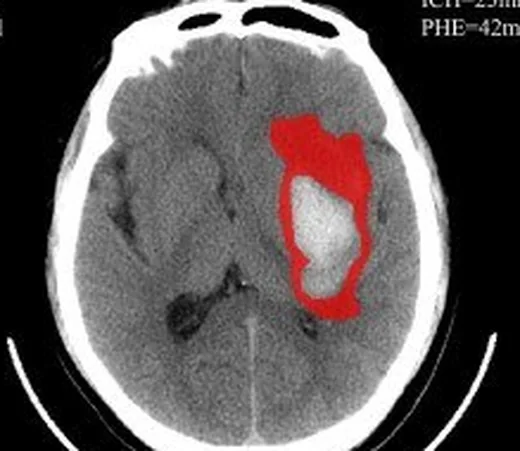
- Akut hematom, derin gri cevher içinde beyin parankimine göre belirgin hiperdens, yuvarlak ya da düzensiz sınırlı odak olarak izlenir; çevresindeki düşük atenüasyonlu ödem, sulkus silinmesi ve ventrikül basısı aynı incelemede değerlendirilir. Akut parankim kanamasının temel tanısal fazıdır.
- BTA
- Seçilmiş olguda damar yumağı, anevrizma, arteriyel düzensizlik veya hematom içinde damar havuzuyla eşzamanlı kontrastlanan odak aranır; bu inceleme kanamayı saptamak için değil, olası makrovasküler nedeni ve aktif kanama göstergesini araştırmak için eklenir.
Önerilen pencereler: Beyin (G 80 / M 40), Anjiyo (G 600 / M 150).
BT bulguları
- Putaminal merkez — hematomun lentikülostriat arter alanındaki putamen ve komşu dış kapsülde yoğunlaşması hipertansif derin yerleşimi destekler.
- Kaudat başı tutulumu — hematomun frontal boynuz komşuluğunda kaudat başına oturması ve ventrikül duvarıyla ilişkisi gösterilmelidir.
- Talamik merkez — üçüncü ventrikülün yan duvarına komşu hematom talamoperforan damar alanındadır; yalnız bu bulgu etiyolojiyi kesinleştirmez.
- İç kapsül etkilenmesi — putaminal hematom medialinde veya talamik hematom lateralinde kapsüler liflerin basısı, itilmesi ya da hematomla örtülmesi aranır.
- İntraventriküler açılım — pıhtının lateral ventrikül, üçüncü ventrikül veya devamında dördüncü ventriküle uzanması ayrı ayrı izlenir.
- Perihematomal ödem — hematom sınırındaki hipodens kuşak komşu gri-beyaz cevher ayrımını siler; kanın kendisiyle karıştırılmamalıdır.
- Hematoma bağlı kitle etkisi — ipsilateral ventrikül daralması, orta hat yapılarında itilme ve bazal sisternlerde daralma kaydedilir.
Normalde
Normal bazal ganglion düzeyinde kaudat başı, lentiform çekirdek ve iç-dış kapsüller iki tarafta simetrik gri-beyaz cevher sınırlarıyla seçilir; talamik kesitlerde üçüncü ventrikül orta hatta ince yarık biçimindedir. Karşı hemisferdeki çekirdek yoğunluğunu referans alarak asimetriye, ventrikül duvarındaki kan materyaline ve iç kapsülün yer değiştirmesine bakın.
Normal BT ile kıyasla
Aynı bölgenin, kaynak veri setinde patoloji içermediği belirtilen bir BT incelemesini kesit kesit kaydırın; organ sınırlarını açarak anatomiyi hasta görüntüsüyle karşılaştırın. Küçük rastlantısal bulgular tümüyle dışlanmamıştır.
Kaynak: TotalSegmentator v2.01 veri seti (Wasserthal ve ark., Radiology: Artificial Intelligence 2023), CC BY 4.0, vaka s0103; organ sınırları veri setinin otomatik segmentasyonundan, birleştirilerek sadeleştirildi. Görüntüler 2,5 mm kesit aralığına yeniden örneklendi.
Ayırıcı tanı
- Hemorajik infarkt
- damar alanına uyan kortiko-subkortikal kama biçimli ödem ve birden çok peteşiyal kan odağı parankim hematomundan ayrılır.
- Kavernom kanaması
- akut pıhtı küçük, iyi sınırlı olabilir; BT altta yatan retiküler lezyonu göstermeyebilir ve MRI duyarlılık sekansları gerekir.
- Kanamalı tümör
- hematom çevresinde nodüler doku, beklenmeyen ödem veya takipte kalıcı kitle şüphesi doğurur; akut BT ile dışlanamayabilir.
- Arteriyovenöz malformasyon
- hematom komşuluğunda kıvrımlı damar yapıları veya BTA'da anormal damar yumağı görülmesi primer hipertansif kanamaya karşı uyarır.
- Travmatik kontüzyon
- eşlik eden kafa derisi şişliği, kırık, ekstraaksiyel kan ve korteks yüzeyine yakın odak travmayı destekler.
Tuzaklar
- Kaudat başı kaynaklı kan frontal boynuza erken açılabilir; ventrikül içindeki pıhtıyı parankim hematomunun tamamı sanmamak için komşu kesitlerde kaudat konturunu izleyin.
- Akut pıhtının çevresindeki ödem daha düşük yoğunluktadır; pencereyi genişletip hematom sınırını kontrol etmeden ödemi ikinci bir kan odağı olarak işaretlemeyin.
- Derin yerleşim hipertansif mekanizmayı düşündürür ancak AVM, tümör veya koagülopatiyi dışlamaz; yaş, klinik ve seçilmiş olgudaki damar görüntülemesiyle birlikte yorumlayın.
Kendini dene
Hipertansiyon öyküsü olan hastada putamen merkezli pıhtı iç kapsülü itiyor ve lateral ventriküle açılıyor. En uygun tanımlama hangisidir?
Cevabı göster
Derin perforan damar hematomu. Putamen merkezli parankim içi kanama, hipertansif kanamanın tipik olarak yerleştiği derin yapılar ve bazal ganglionlar bölgesindedir. Hipertansif kanama travmatik olmayan intraserebral kanamaların en yaygın tipi olup karakteristik olarak derin yapıları, özellikle bazal ganglionları tutar.
Derin hematom komşuluğunda BTA'da AVM ve besleyici damarlar görülebilir. Hangi neden özellikle düşünülmelidir?
Cevabı göster
Arteriyovenöz malformasyon. Hematom komşuluğunda BTA veya anjiyografide anormal damar yumağı ya da fistül görülmesi, eşlik eden makrovasküler lezyon olasılığını düşündürür. Arteriyovenöz malformasyonlar intraserebral kanama ile prezente olabilir ve BT anjiyografide anormal damar yapısı olarak izlenebilir.
İlgili konular
Kaynaklar
Bu sayfadaki 39 cümle ve 2 quiz sorusu aşağıdaki kaynaklardan alıntılarla tek tek karşılaştırıldı; 6 cümle bu karşılaştırmada düzeltildi (2026-10-09).
- ’Carotid spells’ - transient focal neurological episodes associated with convexity subarachnoid haemorrhage in severe ipsilateral extracranial internal carotid artery stenosis: a case report and concise literature reviewpmc.ncbi.nlm.nih.gov
- Perforator-Sparing Microsurgical Clipping of Tandem Dominant-Hemisphere Middle Cerebral Artery Aneurysms: Geometry-Guided Reconstruction of a Wide-Neck Bifurcation and Dorsal M1 Fusiform Lesionpmc.ncbi.nlm.nih.gov
- Lacunar stroke with and without chronic imaging biomarkers of small vessel disease: clinical profiles and stroke etiologypmc.ncbi.nlm.nih.gov
- Parent Artery Disease-Related Stroke: What Is the Impact on Endovascular Treatment? A Narrative Reviewpmc.ncbi.nlm.nih.gov
- An Anatomy-Guided, Stepwise Microsurgical Reconstruction of a Posteriorly Projecting ICA–PCoA Aneurysm Beneath the Optic Apparatus: A Detailed Operative Sequencepmc.ncbi.nlm.nih.gov
- Simultaneous subarachnoid hemorrhage and cerebral infarction due to aneurysm rupture and occlusion of the parent terminal artery: A cause of angiogram-negative non-perimesencephalic subarachnoid hemorrhage.pubmed.ncbi.nlm.nih.gov
- The Potential Impact of Neuroimaging and Translational Research on the Clinical Management of Lacunar Stroke.pubmed.ncbi.nlm.nih.gov
- Integrative Approaches in Acute Ischemic Stroke: From Symptom Recognition to Future Innovations.pubmed.ncbi.nlm.nih.gov
- Yield of MRI in patients with spontaneous deep intracerebral hemorrhage.pubmed.ncbi.nlm.nih.gov
- The Cerebellum in Poststroke Movement Disorders: A Case of Head Tremor Indicating a Cerebrovascular Emergency.pubmed.ncbi.nlm.nih.gov
- Stroke as a rare complication of scorpion stings: A systematic review and analysis.pubmed.ncbi.nlm.nih.gov
- Acute care of spontaneous intracerebral hemorrhage.pubmed.ncbi.nlm.nih.gov
- Impact of migalastat on cerebral outcomes in fabry disease - results from the prospective observational FAMOUS trial.pubmed.ncbi.nlm.nih.gov
- Genetic and epigenetic architectures of stroke: Insights from GWAS to precision medicine.pubmed.ncbi.nlm.nih.gov
- Trans-sylvian hematoma evacuation combined with lamina terminalis ventriculostomy for hypertensive basal ganglia hemorrhage: a retrospective cohort study.pubmed.ncbi.nlm.nih.gov
- Predictive value of the admission IBIL/TBIL ratio for poor prognosis after surgical treatment of intracerebral hemorrhage.pubmed.ncbi.nlm.nih.gov
- Catastrophic consequences of prolonged immobilization after intracerebral hemorrhage: a case report of crush syndrome combined with capillary leak syndrome.pubmed.ncbi.nlm.nih.gov
- Machine learning in neuroradiology: Recent developments and applications.pubmed.ncbi.nlm.nih.gov
- Diagnostic Accuracy of Ischemia and Hemorrhage on Cone-Beam CT Immediately After Endovascular Thrombectomy.pubmed.ncbi.nlm.nih.gov
- Island Sign on Computed Tomography Is Associated With Cerebral Amyloid Angiopathy in Patients With Intracerebral Hemorrhage.pubmed.ncbi.nlm.nih.gov
- Concurrent Computed Tomography Angiography Spot Signs in Cerebral Contusion and Subdural Hematoma Following Severe Traumatic Brain Injury: A Case Report.pubmed.ncbi.nlm.nih.gov
- Value of the spot sign combined with the blend sign for predicting the outcome of patients with intracerebral hemorrhage who have undergone stereotactic minimally invasive surgery.pubmed.ncbi.nlm.nih.gov
- Intracerebral Hemorrhage: Advances, Knowledge Gaps, and Future Directions.pubmed.ncbi.nlm.nih.gov
- Spontaneous intracerebral hemorrhage during computed tomography scanning-assessment of hyperacute hematoma growth.pubmed.ncbi.nlm.nih.gov
- Identification of the Bleeding Point in Hemorrhagic Moyamoya Disease Using Fusion Images of Susceptibility-Weighted Imaging and Time-of-Flight MRA.pubmed.ncbi.nlm.nih.gov
- Not a String, not a Tangle, not an Aneurysm : Emerging Pattern of Large Parenchymal Bleeding in Younger Patients Associated with Abnormal Vessels on Imaging.pubmed.ncbi.nlm.nih.gov
- Rapid spontaneous regression of a massive post-thrombolysis intracerebral hemorrhage: A case report.pubmed.ncbi.nlm.nih.gov
- Acupuncture at "Baihui" and "Xuanli" attenuates intracerebral hemorrhage-induced brain injury by modulating autophagy and the PI3K/AKT signaling pathway in rats.pubmed.ncbi.nlm.nih.gov
- Usefulness and pitfalls of neuroendoscopic tumor biopsy for intracranial malignant lymphoma.pubmed.ncbi.nlm.nih.gov
- Bilateral simultaneous thalamic hematomas - Unusual presentation of intracerebral hemorrhage: A case report.pubmed.ncbi.nlm.nih.gov
- Large-scale network topography of stroke predicts functional outcome after mechanical thrombectomy.pubmed.ncbi.nlm.nih.gov
- Does Severe Early Motor Deficit Define Recovery Ceiling after Basal Ganglia or Thalamic Hemorrhage? A Systematic Review of Time-Dependent Motor Outcomes and Corticospinal Tract-Related Predictors.pubmed.ncbi.nlm.nih.gov
- Computed Tomography Angiography Recognition of a Hemorrhagic Moyamoya Pattern May Alter Acute Blood Pressure Management.pubmed.ncbi.nlm.nih.gov
- Chainsaw culture: Cladophialophora bantiana cerebral abscess after chainsaw activity in an immunocompetent host. Illustrative case.pubmed.ncbi.nlm.nih.gov
- Sex differences in imaging features including cerebral amyloid angiopathy markers in intracerebral hemorrhage.pubmed.ncbi.nlm.nih.gov
- In-hospital intracerebral hemorrhage: A comprehensive characterization of a provincial cohort.pubmed.ncbi.nlm.nih.gov
- Radiomic hemorrhage roundness predicts outcome beyond the ICH score in deep intracerebral hemorrhage with IVH.pubmed.ncbi.nlm.nih.gov
- The Effect of Intensive Blood Pressure Reduction on Perihematomal Edema After Intracerebral Hemorrhage: A Systematic Review and Meta-Analysis.pubmed.ncbi.nlm.nih.gov
- Early secondary brain abscess formation caused by <i>Bacteroides fragilis</i> at the intracerebral hemorrhage site: A case report.pubmed.ncbi.nlm.nih.gov
- Ruptured Cerebral Arteriovenous Malformation Initially Managed As Presumed Eclampsia: A Diagnostic Challenge Following Initial Management in a Resource-Limited Setting.pubmed.ncbi.nlm.nih.gov
- Proton Density MR Imaging: A Simple and Powerful Sequence to Visualise Anatomical Structures in Functional Neurosurgery.pubmed.ncbi.nlm.nih.gov
- Acute arterial ischemic stroke in children: single-center experience.pubmed.ncbi.nlm.nih.gov
- Stroke-related restless leg syndrome in hemorrhagic and ischemic stroke patients.pubmed.ncbi.nlm.nih.gov
- Bilateral Gustatory Disturbance Associated With Unilateral Putaminal Hemorrhage: A Case Report and Literature Review.pubmed.ncbi.nlm.nih.gov
- Territorial CT Perfusion Burden and Outcome After Aneurysmal Subarachnoid Haemorrhage: A Retrospective Single-Centre Cohort Study.pubmed.ncbi.nlm.nih.gov
- Investigation of the hyperperfusion phenomenon following carotid artery stenting using preoperative computed tomography perfusion imaging.pubmed.ncbi.nlm.nih.gov
- Role of Low-Field MRI in Acute Stroke.pubmed.ncbi.nlm.nih.gov
- Clinical utility of consecutive volume scanning dual-energy CT in differentiating hemorrhage from contrast staining in ischemic stroke patients.pubmed.ncbi.nlm.nih.gov
- Endovascular Embolization in Neurovascular Disease: Material Science, Multimodal Management, and Future Horizons.pubmed.ncbi.nlm.nih.gov
- Radiation-induced cavernous malformation arising within vestibular schwannoma manifesting as subarachnoid hemorrhage: Case report and literature review.pubmed.ncbi.nlm.nih.gov
- Partial Oculomotor Nerve Palsy Revealing PDCD10-Related Familial Cerebral Cavernous Malformation in a Child.pubmed.ncbi.nlm.nih.gov
- Diagnostic challenges of a giant cerebral cavernous malformation mimicking a glioma in a 16-year-old male.pubmed.ncbi.nlm.nih.gov
- Intraventricular giant cavernous malformation mimicking central neurocytoma characterized by digital subtraction angiography: illustrative case.pubmed.ncbi.nlm.nih.gov
- Von Hippel-Lindau syndrome presenting as a lateral ventricular space-occupying lesion: a case report.pubmed.ncbi.nlm.nih.gov
- Distal Anterior Inferior Cerebellar Artery Aneurysm Associated with Arteriovenous Malformation: A Case Report.pubmed.ncbi.nlm.nih.gov
- Clinical and epidemiological comparison between perimesencephalic and non-perimesencephalic, non-aneurysmal subarachnoid hemorrhage: a single-center cohort study from a referral center in a developing country.pubmed.ncbi.nlm.nih.gov
- Jugular foramen dural arteriovenous fistula: A case report and literature review.pubmed.ncbi.nlm.nih.gov
- Pathway-level proteomics identifies subcellular trafficking dysregulation as a molecular signature in severe traumatic brain injury.pubmed.ncbi.nlm.nih.gov
- Intraparenchymal B cell therapy protects neurological function and modulates local neuroinflammation in experimental hemorrhagic stroke.pubmed.ncbi.nlm.nih.gov
- Multifunctional nanozyme platforms in central nervous system therapies: from rational design to translational medicine.pubmed.ncbi.nlm.nih.gov
- Minimal-access exoscopic approach for caudate hemorrhage with intraventricular extension using the ViewSite Brain Access System.pubmed.ncbi.nlm.nih.gov
- Paediatric cranial ultrasound: assessment of the preterm brain.pubmed.ncbi.nlm.nih.gov
- Minimally Invasive Evacuation for Spontaneous Supratentorial Intracerebral Hemorrhage After Contemporary Randomized Trials: Patient Selection, Timing, and Platform Choice.pubmed.ncbi.nlm.nih.gov
- Clinical Utility of Circulating Biomarkers for Diagnosis and Prognosis of Acute Stroke in the Emergency Department: A Narrative Review from Current Evidence to Clinical Implementation.pubmed.ncbi.nlm.nih.gov
- A novel inflammatory score predicts hematoma expansion and 90‑day functional outcomes after spontaneous intracerebral hemorrhage.pubmed.ncbi.nlm.nih.gov
- Computed tomography in acute intracerebral hemorrhage: neuroimaging predictors of hematoma expansion and outcome.pubmed.ncbi.nlm.nih.gov
- A Causal Classification System for Intracerebral Hemorrhage Subtypes.pubmed.ncbi.nlm.nih.gov
- Radiological assessment of dementia: the Italian inter-society consensus for a practical and clinically oriented guide to image acquisition, evaluation, and reporting.pubmed.ncbi.nlm.nih.gov
- Perforator-Sparing Microsurgical Clipping of Tandem Dominant-Hemisphere Middle Cerebral Artery Aneurysms: Geometry-Guided Reconstruction of a Wide-Neck Bifurcation and Dorsal M1 Fusiform Lesion.pubmed.ncbi.nlm.nih.gov
- An Anatomy-Guided, Stepwise Microsurgical Reconstruction of a Posteriorly Projecting ICA-PCoA Aneurysm Beneath the Optic Apparatus: A Detailed Operative Sequence.pubmed.ncbi.nlm.nih.gov
- 'Carotid spells' - transient focal neurological episodes associated with convexity subarachnoid haemorrhage in severe ipsilateral extracranial internal carotid artery stenosis: a case report and concise literature review.pubmed.ncbi.nlm.nih.gov
- Non-contrast CT findings suggestive of secondary intracerebral haemorrhage.pubmed.ncbi.nlm.nih.gov
- Spontaneous Non-Aneurysmal Convexity Subarachnoid Hemorrhage: A Scoping Review of Different Etiologies beyond Cerebral Amyloid Angiopathy.pubmed.ncbi.nlm.nih.gov
- Adult intracranial pial arteriovenous fistulas: a case report and literature review.pubmed.ncbi.nlm.nih.gov
- Onyx embolization of a cerebellar arteriovenous malformation fed by the posterior inferior cerebellar artery originating from a vertebral artery fenestration: illustrative case.pubmed.ncbi.nlm.nih.gov
- Ultrasound guided microsurgical resection of cerebral arteriovenous malformations.pubmed.ncbi.nlm.nih.gov
- From rupture to recovery: A case report on a multidisciplinary approach to arteriovenous malformation (AVM)-associated intracerebral hemorrhage.pubmed.ncbi.nlm.nih.gov
- Risk factors for cerebral vasospasm following arteriovenous malformation-related hemorrhage: a systematic review and meta-analysis.pubmed.ncbi.nlm.nih.gov
- ZAP-X Stereotactic Radiosurgery for Arteriovenous Malformations: Initial Experience of Three Patients.pubmed.ncbi.nlm.nih.gov
- Recent research progress and future directions of intracerebral hemorrhage.pubmed.ncbi.nlm.nih.gov
- Development of Diagnostic Support Software for Phase Estimation of Intracerebral Hemorrhage Using Multi-sequence Magnetic Resonance Imaging.pubmed.ncbi.nlm.nih.gov
- Beyond Resection: Determinants of Outcome After Pediatric Brain Arteriovenous Malformation Surgery.pubmed.ncbi.nlm.nih.gov
- Effect of tranexamic acid for acute spontaneous intracerebral haemorrhage: a systematic review and individual patient data meta-analysis.pubmed.ncbi.nlm.nih.gov
- Epidemiology and Outcome of Early Acute Kidney Injuries in Patients with Acute Intracerebral Hemorrhage Admitted to the Apex Neurosciences Center in Dubai.pubmed.ncbi.nlm.nih.gov
Eğitim amaçlıdır; hasta başında tanı ve tedavi kararının yerine geçmez. İçerik yapay zekâ destekli bir süreçle güncel literatüre göre cümle cümle kaynaklarla karşılaştırıldı, ancak uzman radyolog incelemesinden geçmedi. Klinik kararlarda güncel kılavuzları, kurum protokollerini ve radyoloji raporunu esas alın.