Özet
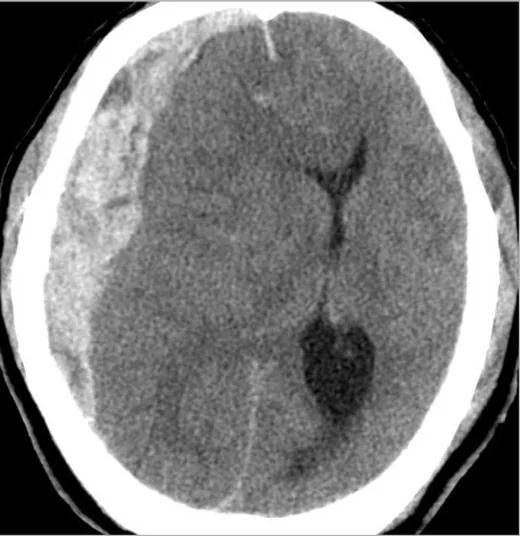
Akut subdural hematom, çoğunlukla travmada köprü venlerinin gerilmesi veya kortikal damar yaralanmasıyla dura ile araknoid arasındaki potansiyel aralıkta kan birikmesidir. Kontrastsız BT'de kanın hiperdens hilal biçimi, komşu korteks üzerindeki etkisi ve eşlik eden parankim yaralanması birlikte incelenir. BT'de akut subdural kanama geniş bir hemisfer yüzeyine yayılabilir; bu nedenle çoklu kesitlerin ve koronal planların incelenmesi yayılımı değerlendirmede önemlidir. Tanının gecikmesi, progresif beyin ödeminin ve kitle etkisinin zamanında fark edilmemesine yol açabilir.
Faz ve pencere
- Kontrastsız tanısal
- Akut dönemde kan, komşu beyin dokusuna kıyasla hiperdens görünümlü, konveksiteye doğru çıkıntı yapan konkav iç sınırlı hilal şeklinde bir koleksiyon oluşturur; eşlik eden pıhtılaşma bozuklukları ise kanamanın hacmini ve klinik seyri belirleyici faktörlerdir. Akut travmada tanı ve ilk değerlendirme için kontrastsız BT yeterlidir; kitle efekti, orta hat kayması ve parankim yaralanmaları bu yöntemle saptanır.
Önerilen pencereler: Beyin (G 80 / M 40), Subdural (G 200 / M 75), Kemik (G 1800 / M 400).
BT bulguları
- Akut subdural hematom dura ile beyin arasında yer alır ve örneğin frontoparietal bölgeyi kapsayacak şekilde genişleyebilir.
- Subdural kanamalar interhemisferik fissürde ve tentoryumda lokalize olabilir; BT incelemelerinde koronal planlarda koleksiyonun uzanımı ve sınırları değerlendirilebilir.
- Hematomun yarattığı kitle etkisi, komşu sulkusların basıya bağlı silikleşmesi, bazal sisternlerin daralması veya kaybolması ve beyin dokusunun komşu boşluklara doğru yer değiştirmesi ile ortaya çıkar.
- Orta hat kayması, hemisferler arası yapıların (septum pellucidum gibi) yer değiştirmesidir ve şiddeti milimetre cinsinden ölçülerek değerlendirilir.
- Hemisferik kitle etkisi, orta hat kaymasına ve bazal sisternlere bası yapmaya yol açarak artan intrakraniyal basınca neden olabilir.
- Hematom komşuluğundaki kortikal kontüzyon, travmatik subaraknoid kan veya kemik kırığı eşlik eden diğer yaralanma örüntülerini belirler.
Normalde
Kontrastsız BT, ekstraaksiyel kanamaların varlığını, intraparenkimal veya subaraknoid kanamanın eşlik edip etmediğini ve diğer patolojik bulguları değerlendirmek için acil travma değerlendirmesinde ilk başvurulacak görüntüleme yöntemidir. Aynı seviyede iki hemisferin sulkus genişliğini, lateral ventrikül gövdelerinin biçimini ve septum pellucidumun orta hatta olup olmadığını kıyasla.
Normal BT ile kıyasla
Aynı bölgenin, kaynak veri setinde patoloji içermediği belirtilen bir BT incelemesini kesit kesit kaydırın; organ sınırlarını açarak anatomiyi hasta görüntüsüyle karşılaştırın. Küçük rastlantısal bulgular tümüyle dışlanmamıştır.
Kaynak: TotalSegmentator v2.01 veri seti (Wasserthal ve ark., Radiology: Artificial Intelligence 2023), CC BY 4.0, vaka s0103; organ sınırları veri setinin otomatik segmentasyonundan, birleştirilerek sadeleştirildi. Görüntüler 2,5 mm kesit aralığına yeniden örneklendi.
Ayırıcı tanı
- Epidural hematom, akut travmada subdural hematomdan farklı olarak sıklıkla kemik kırıkları ve orta meningeal arter yaralanması ile ilişkili olarak lokalize kanamalar şeklinde ortaya çıkar.
- Subaraknoid kanama, beyin yüzeyindeki sulkuslar ve fissürlerde kan birikimi ile karakterizedir ve akut subdural hematom ile birlikte görülebilir.
- Hemorajik kontüzyon
- gri-beyaz bileşke çevresinde parankim içi düzensiz kanama ve ödem vardır.
- Subdural higroma
- BOS'a yakın yoğunluklu, çoğu kez korteksin iç kenarını izleyen sıvı koleksiyonudur.
Tuzaklar
- Subdural hematom, özellikle kafa tabanı yakınında diğer kanama türleri veya kemik kırıkları ile karışabilir; tanı için çoklu kesitlerin ve ilgili klinik bulguların birlikte değerlendirilmesi önemlidir.
- Pıhtılaşma bozuklukları ve antikoagülan kullanım, akut subdural hematomun büyümesini ve cerrahi yönetimini etkileyerek kötü prognoz ile ilişkilendirilebilir.
- Bilateral subdural hematomlar, özellikle spontane intrakraniyal hipotansiyon veya travma sonrası gelişebilir; her iki tarafta da kitle etkisi yaratarak nörolojik bozulmaya yol açabilir ve takibi zorlaşabilir.
Kendini dene
Olgu sunumunda 86 yaşındaki erkekte akut subdural hematom hangi bölgelerde bildirilmiştir?
Cevabı göster
İnterhemisferik ve tentorial bölgelerde. Kaynak, bu olguda interhemisferik ve tentorial subdural hematomlar bildirildiğini belirtiyor.
Kaynağa göre travmatik akut subdural hematom hızlı nörolojik kötüleşmeyle hangi bulgular nedeniyle ilişkili olabilir?
Cevabı göster
Kitle etkisi ve artmış intrakraniyal basınç. Kaynak, travmatik akut subdural hematomun kitle etkisi ve artmış intrakraniyal basınç nedeniyle hızlı nörolojik kötüleşmeyle ilişkili olabileceğini bildiriyor.
Bu konunun yer aldığı turlar
İlgili konular
Kaynaklar
Bu sayfadaki 31 cümle ve 2 quiz sorusu aşağıdaki kaynaklardan alıntılarla tek tek karşılaştırıldı; 14 cümle bu karşılaştırmada düzeltildi (2026-10-09).
- Surgical decision-making in traumatic acute subdural hematoma: A scoping review of current evidence, knowledge gaps, and future directionspmc.ncbi.nlm.nih.gov
- Beyond the bone flap: integrating biomarkers, imaging, and emerging technologies in the surgical continuum of acute subdural hematoma (ASDH)pmc.ncbi.nlm.nih.gov
- The Impact of Time-to-Intervention on Mortality and Functional Outcome in Acute Subdural Hematoma: A Systematic Review and Meta-Analysispmc.ncbi.nlm.nih.gov
- Prognostic Factors of Mortality and Functional Outcome for Acute Subdural Hematoma: A Review Articlepmc.ncbi.nlm.nih.gov
- Post-traumatic epilepsy: bridging pathogenesis, diagnosis, and pharmacotherapeutic strategiespmc.ncbi.nlm.nih.gov
- A Review of Sport-Related Head Injuries.pubmed.ncbi.nlm.nih.gov
- Neurocritical Care of Acute Subdural Hemorrhage.pubmed.ncbi.nlm.nih.gov
- Natural History of Acute Subdural Hematoma.pubmed.ncbi.nlm.nih.gov
- Surgical Management of Trauma-Related Intracranial Hemorrhage-a Review.pubmed.ncbi.nlm.nih.gov
- Sphenoid and subdural hemorrhage as a presenting sign of ruptured clinoid aneurysm.pubmed.ncbi.nlm.nih.gov
- Spontaneous rapid resolution of acute subdural hematoma in children.pubmed.ncbi.nlm.nih.gov
- [Surgical techniques for severe brain injury : With special emphasis on polytrauma].pubmed.ncbi.nlm.nih.gov
- Intracranial hemorrhage following surgery for occult spinal dysraphism: a case-based update.pubmed.ncbi.nlm.nih.gov
- [Subdural hematoma at the cranio-vertebral junction following head trauma: a case report].pubmed.ncbi.nlm.nih.gov
- Case Report and Review of Literature of Delayed Acute Subdural Hematoma.pubmed.ncbi.nlm.nih.gov
- Contralateral acute subdural hematoma following traumatic acute subdural hematoma evacuation.pubmed.ncbi.nlm.nih.gov
- Acute Subdural Hematoma and Subarachnoid Hemorrhage Caused by Ruptured Cortical Artery Aneurysm: Case Report and Review of Literature.pubmed.ncbi.nlm.nih.gov
- Very High Blood Alcohol Concentration and Fatal Hemorrhage in Acute Subdural Hematoma.pubmed.ncbi.nlm.nih.gov
- Primary Decompressive Craniectomy After Traumatic Brain Injury: A Literature Review.pubmed.ncbi.nlm.nih.gov
- Intracranial venous thrombosis imaging by anatomical location: an educational review with mimics and diagnostic pitfalls.pubmed.ncbi.nlm.nih.gov
- Endovascular Embolization in Neurovascular Disease: Material Science, Multimodal Management, and Future Horizons.pubmed.ncbi.nlm.nih.gov
- Excessive subgaleal suction from a variable vacuum drainage system used for managing chronic subdural hematomas: a cautionary note. Illustrative case.pubmed.ncbi.nlm.nih.gov
- Giant chronic subgaleal hematoma secondary to repetitive self-injurious head-banging in severe autism: A case report.pubmed.ncbi.nlm.nih.gov
- Non-contrast CT findings suggestive of secondary intracerebral haemorrhage.pubmed.ncbi.nlm.nih.gov
- Systematic review of commercial artificial intelligence tools for the detection and volume quantification in intracerebral hemorrhage.pubmed.ncbi.nlm.nih.gov
- AI-Based Approaches for the Identification and Quantification of Traumatic Brain Injury in Computed Tomography Imaging: Systematic Review.pubmed.ncbi.nlm.nih.gov
- Penetrating Cranio-Cerebral Gunshot Injury with Retained Intracranial Bullet Adjacent to the Superior Sagittal Sinus.pubmed.ncbi.nlm.nih.gov
- Diagnostic Accuracy and Time Efficiency of Artificial Intelligence for Intracranial Hemorrhage Detection on Emergency Brain CT.pubmed.ncbi.nlm.nih.gov
- Intentional Self-Inflicted Transcranial Screwdriver Injury: A Case Report.pubmed.ncbi.nlm.nih.gov
- Chronic Subdural Hematoma: Pathophysiology, Diagnosis, and the Emerging Role of Middle Meningeal Artery Embolization.pubmed.ncbi.nlm.nih.gov
- Middle meningeal artery aneurysms: Etiology, presentation, management, and outcomes - A systematic review.pubmed.ncbi.nlm.nih.gov
- Spontaneous Bilateral Subdural Hematomas Associated With Resolving Hypertensive Intraparenchymal Hemorrhage: A Case Report.pubmed.ncbi.nlm.nih.gov
- A deep learning approach to predict temporal changes of subdural hemorrhage on computed tomography.pubmed.ncbi.nlm.nih.gov
- Metformin-Associated Vitamin B12 Deficiency: An Underrecognized Complication.pubmed.ncbi.nlm.nih.gov
- Metastatic gestational trophoblastic neoplasia presenting initially as intraparenchymal and subdural hematoma: a case report.pubmed.ncbi.nlm.nih.gov
- Late surgical site hemorrhage is a possible radiologic indicator of early tumor recurrence in grossly totally resected high-grade meningioma: A case report.pubmed.ncbi.nlm.nih.gov
- Imaging of Non-atherosclerotic Vasculopathies.pubmed.ncbi.nlm.nih.gov
- Can Low-Dose Radiation Therapy Aid in Chronic Subdural Hematoma Management? A Historical Review.pubmed.ncbi.nlm.nih.gov
- Continuum of Irreversible and Potentially Reversible Traumatic Brain Injury Sequelae: Axonal Injury and Hydrocephalus.pubmed.ncbi.nlm.nih.gov
- Risk factors for post-traumatic hydrocephalus after decompressive craniectomy in patients with traumatic brain injury.pubmed.ncbi.nlm.nih.gov
- Giant Right Sphenoid Wing Meningioma as a Reversible Frontal Network Lesion: A Pseudo-bvFTD Case with Venous-Sparing Skull-Base Resection.pubmed.ncbi.nlm.nih.gov
- Rapid spontaneous regression of a massive post-thrombolysis intracerebral hemorrhage: A case report.pubmed.ncbi.nlm.nih.gov
- Post-traumatic hydrocephalus in adults: the mechanisms of development, predictors of progression and management strategies. A narrative review and case series analysis.pubmed.ncbi.nlm.nih.gov
- Occipital Bone Angiomatosis and Chronic Subdural Hematoma Causing Severe Cerebellar and Brainstem Compression and Obstructive Hydrocephalus in a Young Adult Cat.pubmed.ncbi.nlm.nih.gov
- Survival status, mortality predictors, and scores in patients with severe traumatic brain injury in the intensive care unit.pubmed.ncbi.nlm.nih.gov
- Clinical and Radiological Characteristics of Pediatric Skull Fractures and Their Association with Neurosurgical Intervention: A Retrospective Cohort Study.pubmed.ncbi.nlm.nih.gov
- Successful endoscopic evacuation of traumatic intracerebral hemorrhage: A report of two cases.pubmed.ncbi.nlm.nih.gov
- Calcified intracranial lipoma in the temporal lobe convexity - A report of unusual manifestations of a rare disease with a brief review of literature.pubmed.ncbi.nlm.nih.gov
- Unusual case: Late diagnosis of tuberous sclerosis complex in a 59-year-old woman associated with extended fibrous dysplasia in craniofacial bones and spine.pubmed.ncbi.nlm.nih.gov
- Paediatric cranial ultrasound: abnormalities of the brain in term neonates and young infants.pubmed.ncbi.nlm.nih.gov
- Comprehensive Morphometric MRI Assessment in Children with Breath-Holding Spells: Integration of Automated (Vol2Brain) and Semi-Automated (3D Slicer) Segmentation Methods.pubmed.ncbi.nlm.nih.gov
- Asymmetry in Atypical Parkinsonian Syndromes-A Review.pubmed.ncbi.nlm.nih.gov
- Accuracy and Outcomes of KYMERO Robot-Guided Deep Brain Stimulation for Dystonia : Retrospective Cohort Analysis.pubmed.ncbi.nlm.nih.gov
- Variability in the circulation of cerebrospinal fluid: causes and clinical implications for intraventricular drug delivery.pubmed.ncbi.nlm.nih.gov
- Impaired cerebrospinal fluid transport due to idiopathic subdural hematoma in pig: an unusual case.pubmed.ncbi.nlm.nih.gov
- Radiological assessment of dementia: the Italian inter-society consensus for a practical and clinically oriented guide to image acquisition, evaluation, and reporting.pubmed.ncbi.nlm.nih.gov
- Consensus Statement on Middle Meningeal Artery Embolization in Chronic Subdural Hematoma Treatment: A Guideline from the Society of Vascular and Interventional Neurology Guidelines and Practice Standards Committee.pubmed.ncbi.nlm.nih.gov
- Clinical applications of portable CT scanners.pubmed.ncbi.nlm.nih.gov
- The Role of Computed Tomography in Imaging Non-neurologic Disorders of the Head in Equine Patients.pubmed.ncbi.nlm.nih.gov
- Systemic Mastocytosis: Multidisciplinary Approach.pubmed.ncbi.nlm.nih.gov
- Long-term safety and effectiveness of the "OptEase" vena cava filter.pubmed.ncbi.nlm.nih.gov
- Bilateral subdural hematomas complicating intracranial hypotension following lumbar spine procedures: two case reports.pubmed.ncbi.nlm.nih.gov
- Emergency burr-hole evacuation for subacute SDH with uncal herniation: a case report of near-complete neurological recovery despite bilateral occipital infarction.pubmed.ncbi.nlm.nih.gov
- Explainable Artificial Intelligence in Non-Contrast Brain Computed Tomography Scan for Intracerebral Hemorrhage: A Scoping Review.pubmed.ncbi.nlm.nih.gov
- Decision-making for emergency craniotomy in traumatic intracranial hemorrhage with severe thrombocytopenia and coagulopathy in a patient with suspected acute leukemia: A case-based review.pubmed.ncbi.nlm.nih.gov
- Systemic endothelial glycocalyx shedding mediates vascular hyperpermeability after traumatic brain injury.pubmed.ncbi.nlm.nih.gov
- Parasagittal subdural space: a novel quantitative marker of spontaneous intracranial hypotension syndrome-induced chronic subdural hematoma.pubmed.ncbi.nlm.nih.gov
- Comparison of midline shift and ventricular size measured by transcranial ultrasound and non-contrast computed tomography in patients with acute subdural hemorrhage undergoing decompressive craniectomy: A prospective observational study.pubmed.ncbi.nlm.nih.gov
- A novel CT-based edema grading system combined with machine learning for precise prognostic prediction in traumatic brain injury.pubmed.ncbi.nlm.nih.gov
- The paradox of relief: how decompression sets the stage for hydrocephalus-a retrospective inquiry into its clinical determinants.pubmed.ncbi.nlm.nih.gov
- Risk stratification for significant acute traumatic intracranial hemorrhage in older adults after a ground-level fall: A prospective multicentre cohort study.pubmed.ncbi.nlm.nih.gov
- Second edition of the recommendations from the Colombian consensus committee for the management of traumatic brain injury in the prehospital setting, emergency department, surgery, and intensive care (Beyond one option for treatment of traumatic brain injury: A stratified protocol [BOOTStraP]).pubmed.ncbi.nlm.nih.gov
- Profile and Management of Traumatic Orbital Hematoma in a Child With Hemophilia C: A Case Report.pubmed.ncbi.nlm.nih.gov
- The use of machine learning models for subdural hematoma detection: a single-arm meta-analysis.pubmed.ncbi.nlm.nih.gov
- Acute subdural hematoma in Anaplasma phagocytophilum infection: illustrative case.pubmed.ncbi.nlm.nih.gov
- Case Report: Endoscopic evacuation of acute subdural hematoma in selected young patients: a report of two cases.pubmed.ncbi.nlm.nih.gov
- Effects of Angiotensin-Converting Enzyme Inhibition on the Recurrence and Internal Structure of Chronic Subdural Hematomas.pubmed.ncbi.nlm.nih.gov
- Case of idiopathic cervical spinal subarachnoid hematoma mimicking an epidural hematoma: A case report.pubmed.ncbi.nlm.nih.gov
- Acute subdural hematoma in spontaneous intracranial hypotension: illustrative case and review of the literature.pubmed.ncbi.nlm.nih.gov
- Surgical decision-making in traumatic acute subdural hematoma: A scoping review of current evidence, knowledge gaps, and future directions.pubmed.ncbi.nlm.nih.gov
- Acute subdural hematoma during sexual intercourse due to an aneurysm rupture on posterior communicating artery: a case report.pubmed.ncbi.nlm.nih.gov
- Imaging in Chronic Traumatic Encephalopathy and Traumatic Brain Injury.pubmed.ncbi.nlm.nih.gov
- Cerebral Hemodynamics in Pediatric Abusive Head Trauma: 3 Severe Cases with Preserved Motor Cortex, Hyperperfusion, and Recovery of Mild Paralysis.pubmed.ncbi.nlm.nih.gov
- Cranioplasty with a 3D-printed titanium implant for post-decompressive craniectomy syndrome: A case report.pubmed.ncbi.nlm.nih.gov
- Neonatal herpes simplex virus encephalitis: a single-center retrospective study of 14 cases.pubmed.ncbi.nlm.nih.gov
- Review of imaging modalities and radiological findings of calvarial lesions.pubmed.ncbi.nlm.nih.gov
- Spinal cord protection in open and endovascular aortic surgery: current strategies, controversies and future directions.pubmed.ncbi.nlm.nih.gov
- The 2023 WSES guidelines on the management of trauma in elderly and frail patients.pubmed.ncbi.nlm.nih.gov
- A Case of Convexity Meningioma Presenting With Acute Subdural Hematoma: A Case Report With a Pooled Analysis of 63 Reported Cases.pubmed.ncbi.nlm.nih.gov
- Traumatic intracranial pseudoaneurysms of cortical middle cerebral artery and posterior cerebral artery branches presenting as subdural hematomas in elderly patients: A two-case report.pubmed.ncbi.nlm.nih.gov
- Combined interventional and craniotomy surgery for meningioma apoplexy complicated by acute subdural hematoma: a case report and literature review.pubmed.ncbi.nlm.nih.gov
- Inner table skull fracture with intact outer cortex: a rare case report and literature review.pubmed.ncbi.nlm.nih.gov
- Imaging Evaluation of Acute Traumatic Brain Injury.pubmed.ncbi.nlm.nih.gov
- Comprehensive review on rhino-neurosurgery.pubmed.ncbi.nlm.nih.gov
- Reversible hemi-parkinsonism syndrome secondary to bilateral subdural hematomas: case report and literature review.pubmed.ncbi.nlm.nih.gov
- Bilateral subdural hematomas in spontaneous intracranial hypotension: A systematic review with case illustration.pubmed.ncbi.nlm.nih.gov
- Moving on in hydrocephalus imaging: from 2D to 3D biomarkers.pubmed.ncbi.nlm.nih.gov
- Magnetic resonance imaging of primary central nervous system neoplasms of dogs and cats: Basic concepts for diagnostic pathologists.pubmed.ncbi.nlm.nih.gov
- Anatomy-Guided Microsurgical Resection of a Dominant Frontal Lobe Tumor Without Intraoperative Adjuncts: A Case Report from a Resource-Limited Context.pubmed.ncbi.nlm.nih.gov
- Fetal intracranial hemorrhage and infarct: Main sonographic and MRI characteristics: A review article.pubmed.ncbi.nlm.nih.gov
- The interdural hematoma: A subtype of convexity subdural/dural hematoma with specific radioanatomical characteristics.pubmed.ncbi.nlm.nih.gov
- Using non-invasive neuroimaging to enhance the care, well-being and experimental outcomes of laboratory non-human primates (monkeys).pubmed.ncbi.nlm.nih.gov
- Radiogenomics of congenital brain malformations: Linking embryology, genetics, and imaging.pubmed.ncbi.nlm.nih.gov
- Cerebrospinal Fluid Biomarkers in iNPH: A Narrative Review.pubmed.ncbi.nlm.nih.gov
- Ruptured Berry Aneurysm as the initial presentation of Polycystic Kidney Disease: A case report and review of literature.pubmed.ncbi.nlm.nih.gov
- Traumatic basal ganglia hemorrhage: illustrative cases.pubmed.ncbi.nlm.nih.gov
- The Dynamics of Neuroinflammation in Traumatic Brain Injury: Molecular Markers Useful for Establishing the Post-Traumatic Interval in Forensic Practice.pubmed.ncbi.nlm.nih.gov
- Clinical Practice Recommendations of the Swiss Society for Neuroradiology: Neuroimaging Standards for Enrollment and Disease Monitoring in Anti-Amyloid Immunotherapies.pubmed.ncbi.nlm.nih.gov
- Armored Brain, Giant Calcified Chronic Subdural Hematoma, in 97-Year-Old Patient: Systematic Review.pubmed.ncbi.nlm.nih.gov
- Subdural Lesions Linking Additional Intracranial Spaces and Chronic Subdural Hematomas: A Narrative Review with Mutual Correlation and Possible Mechanisms behind High Recurrence.pubmed.ncbi.nlm.nih.gov
- Health system learning enables generalist neuroimaging models.pubmed.ncbi.nlm.nih.gov
- Advanced multi-label brain hemorrhage segmentation using an attention-based residual U-Net model.pubmed.ncbi.nlm.nih.gov
- Role of the Ear in Meningitis: A Narrative Review of Neuroimaging.pubmed.ncbi.nlm.nih.gov
- Case report: a patient with spontaneous spinal epidural hematoma recovered after conservative treatment.pubmed.ncbi.nlm.nih.gov
- Beyond Ischemia: The Rare Occurrence of Hemorrhagic Strokes in Pediatric Sickle Cell Anemia.pubmed.ncbi.nlm.nih.gov
Eğitim amaçlıdır; hasta başında tanı ve tedavi kararının yerine geçmez. İçerik yapay zekâ destekli bir süreçle güncel literatüre göre cümle cümle kaynaklarla karşılaştırıldı, ancak uzman radyolog incelemesinden geçmedi. Klinik kararlarda güncel kılavuzları, kurum protokollerini ve radyoloji raporunu esas alın.