Özet
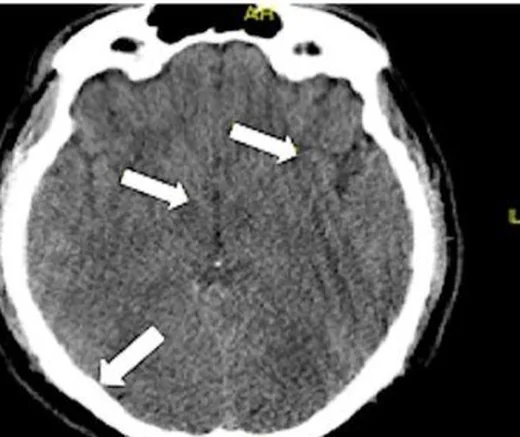
Kafa travması sonrası gelişen fokal veya yaygın parankim şişmesi, erken BT’de yalnız kitle etkisiyle başlayabilir ve ilerleyen ödemle yoğunluk değişikliği belirginleşebilir. Kontrastsız BT, eşlik eden kanamayı ve beyin dokusunun sulkus, ventrikül ve sisternlere yaptığı basıyı hızlıca gösterir. Sulkusların ve bazal sisternlerin kaybı, ventrikül basısı veya gri-beyaz cevher ayrımının silinmesi kafa içi basınç artışını düşündürür. Bu değişiklikler gözden kaçarsa hızla ilerleyen herniasyon ve beyin sapı basısı fark edilmeyebilir.
Faz ve pencere
- Kontrastsız tanısal
- Şişmiş parankimde sulkuslar daralır, ventriküller basılanır ve bazal sisternler silinebilir; erken şişmede gri-beyaz ayrım korunabilir, sitotoksik ödemde ayrım azalır ve ödemli alan hipodensleşebilir.
Önerilen pencereler: Beyin (G 80 / M 40), Subdural (G 200 / M 75), Kemik (G 1800 / M 400).
BT bulguları
- Konveksite sulkuslarında iki taraflı yaygın daralma veya silinme
- Suprasellar, ambient veya prepontin sisternlerde kitle etkisine bağlı daralma
- Lateral ventrikül gövdeleri ve temporal hornlarda basılanma
- Korteks ile komşu beyaz cevher arasındaki dansite farkının silinmesi
- Fokal kontüzyon çevresinde bölgesel ödem ve lokal sulkal effasman
- Tek taraflı kitle etkisi varsa septum pellucidumun karşı tarafa itilmesi
- İleri olguda tentoryal veya foramen magnum düzeyine uzanan doku yer değiştirmesi
Normalde
Her anatomik düzeyde normal BT ile karşı tarafı kıyaslayın: konveksitede kortikal sulkuslar seçilir, lateral ventriküller benzer genişliktedir ve gri-beyaz sınır nettir. Daha alt kesitlerde bazal sisternler BOS dansitesindeki açıklığını korur.
Normal BT ile kıyasla
Aynı bölgenin, kaynak veri setinde patoloji içermediği belirtilen bir BT incelemesini kesit kesit kaydırın; organ sınırlarını açarak anatomiyi hasta görüntüsüyle karşılaştırın. Küçük rastlantısal bulgular tümüyle dışlanmamıştır.
Kaynak: TotalSegmentator v2.01 veri seti (Wasserthal ve ark., Radiology: Artificial Intelligence 2023), CC BY 4.0, vaka s0103; organ sınırları veri setinin otomatik segmentasyonundan, birleştirilerek sadeleştirildi. Görüntüler 2,5 mm kesit aralığına yeniden örneklendi.
Ayırıcı tanı
- Yaygın hipoksik-iskemik hasar
- global hipoperfüzyona bağlı olarak korteks ve derin gri çekirdeklerde gri-beyaz dansite oranında azalma ile gri-beyaz ayrım kaybı belirgin olabilir.
- Beyin hiperemisi
- travmatik beyin hasarında etkilenen bölgelerde artmış perfüzyon görülebilir.
- Fokal kontüzyon
- yüzeyel, çoğu kez hemorajik odak ve çevresinde sınırlı ödem oluşturur
- Obstrüktif hidrosefali
- ventriküller basılanmak yerine genişler; temporal hornlar ve periventriküler hipodensite eşlik edebilir
Tuzaklar
- Erken travmatik şişmede gri-beyaz ayrımın korunması ödemi dışlamaz; sulkus, ventrikül ve sistern basısını birlikte ara.
- Orta hat kaymasının belirgin olmaması yaygın beyin şişmesini tek başına dışlamaz; sulkal effasman, ventrikül basısı ve gri-beyaz cevher ayrımının kaybı da ödemle ilişkili BT bulgularıdır.
Kendini dene
Travma sonrası iki hemisferde sulkuslar silik ve ventriküller basılı; gri-beyaz sınır hâlâ seçiliyor. En uygun yorum nedir?
Cevabı göster
Erken yaygın beyin şişmesi. Yaygın sulkal ve ventriküler bası şişmeyi gösterir; erken evrede gri-beyaz ayrım korunabilir. Hidrosefalide ventriküller genişler; kanama tanıları için ekstraaksiyel veya sulkal hiperdens kan beklenir.
Yaygın sulkal silinmeye ek olarak korteks ile beyaz cevher sınırları seçilemiyor. Hangi değişiklik belirginleşmiştir?
Cevabı göster
Sitotoksik ödem. Gri-beyaz ayrımın silinmesi sitotoksik ödem/iskemik hücresel şişmeyle uyumludur. Atrofide sulkuslar ve ventriküller genişler; subdural koleksiyon ekstraaksiyel yerleşimlidir.
Bu konunun yer aldığı turlar
İlgili konular
Kaynaklar
Bu sayfadaki 33 cümle ve 2 quiz sorusu aşağıdaki kaynaklardan alıntılarla tek tek karşılaştırıldı; 4 cümle bu karşılaştırmada düzeltildi (2026-10-08).
- Computed tomography signs of intracranial hypertension: what intensivists should knowpmc.ncbi.nlm.nih.gov
- Case Report: Debridement with vacuum sealing drainage for conservative management of post-cranioplasty surgical site infectionpmc.ncbi.nlm.nih.gov
- Possible delayed neuronal death after seemingly successful evacuation of traumatic acute subdural hematoma: Image reportpmc.ncbi.nlm.nih.gov
- Serial Changes in CSF Volume Proportion on Brain CT and 6-Month Neurologic Outcomes After Cardiac Arrest: A 72–96-h Landmark Cohort Studypmc.ncbi.nlm.nih.gov
- Successful endoscopic evacuation of traumatic intracerebral hemorrhage: A report of two casespmc.ncbi.nlm.nih.gov
- Intraparenchymal Meningioma.pubmed.ncbi.nlm.nih.gov
- Nonaccidental head injury.pubmed.ncbi.nlm.nih.gov
- Imaging in Neurocritical Care Practice.pubmed.ncbi.nlm.nih.gov
- Pathophysiology and treatment of cerebral edema in traumatic brain injury.pubmed.ncbi.nlm.nih.gov
- Cytotoxic Edema Associated with Hemorrhage Predicts Poor Outcome after Traumatic Brain Injury.pubmed.ncbi.nlm.nih.gov
- Cerebral Venous Sinus Thrombosis in an Immunocompetent HIV Patient.pubmed.ncbi.nlm.nih.gov
- Essential Topics About the Imaging Diagnosis and Treatment of Hemorrhagic Stroke: A Comprehensive Review of the 2022 AHA Guidelines.pubmed.ncbi.nlm.nih.gov
- Structural Neuroimaging Findings in Mild Traumatic Brain Injury.pubmed.ncbi.nlm.nih.gov
- Intensive management and prognosis of 127 cases with traumatic bilateral frontal contusions.pubmed.ncbi.nlm.nih.gov
- Decompressive craniectomy in the treatment of post-traumatic intracranial hypertension in children: our philosophy and indications.pubmed.ncbi.nlm.nih.gov
- Traumatic brain injury in infants and toddlers, 0-3 years old.pubmed.ncbi.nlm.nih.gov
- Establishment and validation of prognosis model for patients with cerebral contusion.pubmed.ncbi.nlm.nih.gov
- Risk factors predicting prognosis and outcome of elderly patients with isolated traumatic brain injury.pubmed.ncbi.nlm.nih.gov
- Conservative management of presumed low-grade gliomas in the asymptomatic pediatric population.pubmed.ncbi.nlm.nih.gov
- Post-traumatic hydrocephalus in adults: the mechanisms of development, predictors of progression and management strategies. A narrative review and case series analysis.pubmed.ncbi.nlm.nih.gov
- Intracranial venous thrombosis imaging by anatomical location: an educational review with mimics and diagnostic pitfalls.pubmed.ncbi.nlm.nih.gov
- Cerebral Hemodynamics in Pediatric Abusive Head Trauma: 3 Severe Cases with Preserved Motor Cortex, Hyperperfusion, and Recovery of Mild Paralysis.pubmed.ncbi.nlm.nih.gov
- Imaging for the diagnosis and management of traumatic brain injury.pubmed.ncbi.nlm.nih.gov
- Comparative Study of Antemortem Computed Tomography (CT) Findings With Autopsy Findings in Head Injury Cases.pubmed.ncbi.nlm.nih.gov
- From Cervical Trauma and Head Injury to Malignant Cerebral Edema: Blunt Cerebrovascular Injury Causing Large-Vessel Occlusion Treated With Thrombectomy and Neurocritical Care.pubmed.ncbi.nlm.nih.gov
- In-hospital unexpected cerebral herniation-New neurosurgical quality control standards: A case report.pubmed.ncbi.nlm.nih.gov
- Neonatal herpes simplex virus encephalitis: a single-center retrospective study of 14 cases.pubmed.ncbi.nlm.nih.gov
- Pathophysiology-driven neuroimaging: decoding brain injury in sepsis.pubmed.ncbi.nlm.nih.gov
- Choking leading to cardiac arrest and subsequent atypical radiological features of brain damage: A case report.pubmed.ncbi.nlm.nih.gov
- Bilateral Subdural Hygromas Following Rupture of a Temporal Arachnoid Cyst in a 16-Year-Old Boy: A Case Report.pubmed.ncbi.nlm.nih.gov
- Chronic Subdural Hematoma: Pathophysiology, Diagnosis, and the Emerging Role of Middle Meningeal Artery Embolization.pubmed.ncbi.nlm.nih.gov
- The laminar subarachnoid hemorrhage of infant venous stroke: Evidence of a 4<sup>th</sup> meningeal layer?pubmed.ncbi.nlm.nih.gov
- Endoscopic transclival decompression for ventral brainstem tuberculous abscess: illustrative case.pubmed.ncbi.nlm.nih.gov
- Leptomeninges: Anatomy, Mechanisms of Disease and Neuroimaging.pubmed.ncbi.nlm.nih.gov
- Unilateral Hearing Loss as the Sole Presentation of Extensive Intracranial Epidermoid Cyst: A Case Report.pubmed.ncbi.nlm.nih.gov
- Rapid spontaneous regression of a massive post-thrombolysis intracerebral hemorrhage: A case report.pubmed.ncbi.nlm.nih.gov
- Delayed Expanding Intracerebral Pneumatocele Following Severe Craniofacial Trauma: A Case Report With Serial Imaging Correlation.pubmed.ncbi.nlm.nih.gov
- Navigating the challenges of lateral ventricle epidermoid cysts: Diagnostic insights and surgical strategies. patient series.pubmed.ncbi.nlm.nih.gov
- Posterior Reversible Encephalopathy Syndrome Following Massive Blood Transfusion in a Case of Pelvic Schwannoma.pubmed.ncbi.nlm.nih.gov
- Time-specific comparison of gray-white matter ratio models for predicting outcomes after cardiac arrest: basal ganglia as the leading model.pubmed.ncbi.nlm.nih.gov
- Possible delayed neuronal death after seemingly successful evacuation of traumatic acute subdural hematoma: Image report.pubmed.ncbi.nlm.nih.gov
- Brain Shift Patterns: Upward, Lateral and Downward Herniation, Its Correlation with Clinical Patterns in Acute Intracranial Pathologies and Neurosurgical Management.pubmed.ncbi.nlm.nih.gov
- A dynamic nomogram for predicting primary intraoperative brain bulge in patients with traumatic acute subdural hematoma.pubmed.ncbi.nlm.nih.gov
- Pupillomotor Dysfunction and Outcomes After Decompressive Craniectomy in Pediatric Patients.pubmed.ncbi.nlm.nih.gov
- Brain Herniationpubmed.ncbi.nlm.nih.gov
- Case Report: Imaging and pathological features of compartmentalized subdural empyema and pachymeningitis within pre-existing porencephaly in a dog.pubmed.ncbi.nlm.nih.gov
- Uncal Herniationpubmed.ncbi.nlm.nih.gov
- Parasagittal subdural space: a novel quantitative marker of spontaneous intracranial hypotension syndrome-induced chronic subdural hematoma.pubmed.ncbi.nlm.nih.gov
- Branch-Critical Clipping of a Ruptured Carotid-Posterior Communicating Aneurysm with Fetal PCA Configuration.pubmed.ncbi.nlm.nih.gov
- Anatomically Precise Microsurgical Resection of a Posterior Fossa Cerebellar Metastasis in an Elderly Patient with Preservation of Venous Outflow, Dentate Nucleus, and Cerebrospinal Fluid Pathways.pubmed.ncbi.nlm.nih.gov
- Venous-significant intracranial hemorrhage in neonatal HIE treated with therapeutic hypothermia: imaging phenotypes, diagnostic pitfalls, and prognostic implications.pubmed.ncbi.nlm.nih.gov
- Clinical Reasoning: A 66-Year-Old Female Patient With Rapidly Progressive Memory Changes.pubmed.ncbi.nlm.nih.gov
- Neuroimaging Findings in Children and Young Adults With Neurotoxicity After CAR T-Cell Therapy for B-Cell Malignancies.pubmed.ncbi.nlm.nih.gov
- Neuromonitoring after Pediatric Cardiac Arrest: Cerebral Physiology and Injury Stratification.pubmed.ncbi.nlm.nih.gov
- Imaging Guidance for Therapeutic Delivery: The Dawn of Neuroenergetics.pubmed.ncbi.nlm.nih.gov
- Telemetric intracranial pressure monitoring in patients with hydrocephalus: a systematic literature review.pubmed.ncbi.nlm.nih.gov
- A Sub-acute Cerebral Contusion Presenting with Medication-resistant Psychosis.pubmed.ncbi.nlm.nih.gov
- Neuroimaging in epilepsy.pubmed.ncbi.nlm.nih.gov
- PITCH (pediatric infratentorial tumors - hydrocephalus-related complications) registry study design: observational, prospective, multicenter study evaluating the number of surgeries associated with the treatment of hydrocephalus secondary to infratentorial tumors in childhood and adolescence.pubmed.ncbi.nlm.nih.gov
- Hydrocephalus: Molecular and Neuroimaging Biomarkers in Diagnosis and Management.pubmed.ncbi.nlm.nih.gov
- Portable Bedside Low-Field MRI for Assessment of Ventricular Size.pubmed.ncbi.nlm.nih.gov
- Massive brain swelling after cranioplasty in the setting of severe sunken flap syndrome: illustrative case.pubmed.ncbi.nlm.nih.gov
- Fulminant cerebral edema in the setting of acute dengue fever after mechanical thrombectomy in a patient with massive stroke and severe hypoalbuminemia: a case report.pubmed.ncbi.nlm.nih.gov
- Case Report: Stepwise quantitative assessment of intraoperative intracranial pressure after perforation, craniotomy, dural incision, and hematoma removal in acute subdural hematoma.pubmed.ncbi.nlm.nih.gov
- Ruptured Vertebral-Anterior Spinal Artery Junction Aneurysm Presenting With Diffuse Subarachnoid Hemorrhage: Diagnostic Limitations of CT Angiography (CTA) and the Role of Digital Subtraction Angiography (DSA) in Management-Related Decision-Making.pubmed.ncbi.nlm.nih.gov
- Taking the EEG Back Into the Brain: The Power of Multiple Discrete Sources.pubmed.ncbi.nlm.nih.gov
- Cranial ultrasound for beginners.pubmed.ncbi.nlm.nih.gov
- Bilateral lesions of the basal ganglia and thalami (central grey matter)-pictorial review.pubmed.ncbi.nlm.nih.gov
- An ABC for decision making.pubmed.ncbi.nlm.nih.gov
- Magnetic resonance imaging in central nervous system tuberculosis.pubmed.ncbi.nlm.nih.gov
- Impact of lumbar cerebrospinal fluid drainage to control intracranial hypertension in patients with severe traumatic brain injury: a retrospective monocentric cohort.pubmed.ncbi.nlm.nih.gov
- Traumatic Brain Injury With Concomitant Myocardial Infarction: A Clinical Dilemma.pubmed.ncbi.nlm.nih.gov
- Computational Approaches for Acute Traumatic Brain Injury Image Recognition.pubmed.ncbi.nlm.nih.gov
- Anatomy-Guided Microsurgical Resection of a Dominant Frontal Lobe Tumor Without Intraoperative Adjuncts: A Case Report from a Resource-Limited Context.pubmed.ncbi.nlm.nih.gov
- A Case of Acute Hemorrhagic Necrotizing Encephalitis in the Neonatal Period: Case Report with Autopsy Findings.pubmed.ncbi.nlm.nih.gov
- Alternating Hemispheric Episodes in Bilateral Rasmussen Encephalitis: The Crucial Role of Sequential Multimodal Neuroimaging.pubmed.ncbi.nlm.nih.gov
- Magnetic Resonance Imaging of the Neonatal Brain: Modalities, Scoring Systems, and Clinical Applications.pubmed.ncbi.nlm.nih.gov
- Mechanisms of inflammatory response in secondary brain injury: a review of computational approaches, challenges, and future directions.pubmed.ncbi.nlm.nih.gov
- Role of neuroimaging in multidisciplinary approach towards Non-Alzheimer's dementia.pubmed.ncbi.nlm.nih.gov
- Case Report: Debridement with vacuum sealing drainage for conservative management of post-cranioplasty surgical site infection.pubmed.ncbi.nlm.nih.gov
- Posterior fossa dynamic craniotomy utilizing NuCrani reversibly expandable bone flap fixation plates: patient series.pubmed.ncbi.nlm.nih.gov
- Imaging Evaluation of Acute Traumatic Brain Injury.pubmed.ncbi.nlm.nih.gov
- Posterior Reversible Encephalopathy Syndrome Associated With Post-Streptococcal Glomerulonephritis in a Young Adult: A Case Report and Literature Review.pubmed.ncbi.nlm.nih.gov
- Imaging the efficacy and side effects of CAR T-cell therapy in children and young adults.pubmed.ncbi.nlm.nih.gov
- Bilateral temporal lobe disease: looking beyond herpes encephalitis.pubmed.ncbi.nlm.nih.gov
- Use of perfusion imaging and other imaging techniques to assess risks/benefits of acute stroke interventions.pubmed.ncbi.nlm.nih.gov
- Systematic review of commercial artificial intelligence tools for the detection and volume quantification in intracerebral hemorrhage.pubmed.ncbi.nlm.nih.gov
- Characteristics of brain computed tomography in dementia with cardiovascular disease and psychological and behavioral symptoms.pubmed.ncbi.nlm.nih.gov
- Comparative CT Ventricular Morphometrics in Hydrocephalus, Stroke, and Traumatic Brain Injury: A Distortion-Controlled Analysis.pubmed.ncbi.nlm.nih.gov
- Alzheimer's disease and related dementia: evaluation, diagnosis and acute care management.pubmed.ncbi.nlm.nih.gov
- The spectrum of neurological derangement due to fat embolism: a case series.pubmed.ncbi.nlm.nih.gov
- Malignant Posterior Reversible Encephalopathy Syndrome (PRES) After Allogeneic Hematopoietic Stem Cell Transplantation Requiring Emergency Decompressive Craniectomy: A Case Report.pubmed.ncbi.nlm.nih.gov
- Multifocal intracranial hemorrhage on emergency brain CT in a child with end-stage nephrotic syndrome.pubmed.ncbi.nlm.nih.gov
- European Resuscitation Council and European Society of Intensive Care Medicine guidelines 2021: post-resuscitation care.pubmed.ncbi.nlm.nih.gov
- Lumbar Puncture and Brain Herniation in Acute Bacterial Meningitis: An Updated Narrative Review.pubmed.ncbi.nlm.nih.gov
- AI assisted reader evaluation in acute CT head interpretation (AI-REACT): protocol for a multireader multicase study.pubmed.ncbi.nlm.nih.gov
- Radiological predictors of shunt response in the diagnosis and treatment of idiopathic normal pressure hydrocephalus: a systematic review and meta-analysis.pubmed.ncbi.nlm.nih.gov
- Ophthalmologic assessment and intracranial pressure in children: diagnostic methods, clinical correlations, and future directions.pubmed.ncbi.nlm.nih.gov
- Paediatric cranial ultrasound: abnormalities of the brain in term neonates and young infants.pubmed.ncbi.nlm.nih.gov
- Albuminocytologic Dissociation and Intravenous Immunoglobulin Therapy in Parsonage-Turner Syndrome With Bilateral Involvement: A Case Report.pubmed.ncbi.nlm.nih.gov
- Hyperbaric Oxygen Therapy for Cognitive Impairment Resulting from Neurological Disorders: Mechanisms of Action and Application Advances.pubmed.ncbi.nlm.nih.gov
- From oxidative stress to epigenetic regulation: Molecular mechanisms of preterm brain injury and neuroprotective strategies (Review).pubmed.ncbi.nlm.nih.gov
Eğitim amaçlıdır; hasta başında tanı ve tedavi kararının yerine geçmez. İçerik yapay zekâ destekli bir süreçle güncel literatüre göre cümle cümle kaynaklarla karşılaştırıldı, ancak uzman radyolog incelemesinden geçmedi. Klinik kararlarda güncel kılavuzları, kurum protokollerini ve radyoloji raporunu esas alın.