Özet
Lambdoid sinostoz, parietal ve oksipital kemikler arasındaki sütürün erken füzyonudur ve posterior kafa asimetrisine yol açar. Pozisyonel plagiosefali daha sık görülen bir taklitçi olduğundan BT'de yalnız oksipital düzleşmeye değil, sütür hattındaki kemik köprüleşmesine, mastoid bölgeye ve karşı taraf konturuna bakılır. Üstten ve arkadan 3B kemik rekonstrüksiyonları trapezoid sinostotik biçim ile paralelkenar pozisyonel biçimi karşılaştırmayı kolaylaştırır. Sütür açıkken lambdoid sinostoz demek hatalı tanıdır; gerçek füzyonu atlamak ise posterior deformitenin nedenini yanlış sınıflandırmak demektir.
Faz ve pencere
- Kontrastsız tanısal
- BT'de füzyonlu sütürde kısmi kayıp, lineer sırt ve perisutural skleroz görülebilir; 3B üstten görünüm trapezoid kafa konfigürasyonunu gösterir. Tanı BT ve üç boyutlu rekonstrüksiyonla konur.
Önerilen pencereler G genişlik, M merkez; değerler Hounsfield birimi (HU)
- KemikG 1800 / M +400
BT bulguları
- Lambdoid sütür obliterasyonu — oksipital ve parietal kemiklerin birleşimindeki tırtıklı radyolüsent hat kısmen ya da tamamen kaybolur.
- Perisutural skleroz ve kemik sırtı — füzyonlu sütürde lineer sırt ve perisutural skleroz görülebilir.
- İpsilateral oksipitoparietal düzleşme — arka kafa tutulan tarafta geride ve yassı görünür.
- Kontralateral oksipitoparietal bossing — karşı arka kalvaryum telafi edici biçimde dışa taşar.
- Tek taraflı lambdoid füzyonda üstten görünümde trapezoid, pozisyonel plagiosefalide ise paralelkenar kafa biçimi görülebilir; ayırıcı değerlendirmede lambdoid sütürün açıklığı, oksipital kontur ve mastoid bölge bulguları da dikkate alınır.
- Mastoid çıkıntı — tutulan tarafta mastoid bölge belirginleşebilir ve posterior kafa tabanı asimetrisine katılır.
- Posterior fontanel yön değişikliği — posterior fontanel karşı tarafa kaymış görünebilir.
- Tek taraflı ve bilateral lambdoid füzyonu ayırt etmek için her iki lambdoid sütürün açıklığını ve posterior kafa konturunu birlikte değerlendirin.
- Tek taraflı lambdoid sinostozda arka kafa tabanında eğiklik görülebilir; bu bulgu sütür füzyonu ve kafa konturuyla birlikte değerlendirilir.
Normalde
Normalde sağ ve sol lambdoid sütürler parietal kemikleri oksipital kemikten ayıran, tırtıklı ve radyolüsent iki çizgidir; oksiput ile mastoid bölgeler karşılıklı benzer konturdadır. Üstten 3B görünümde lambdoid sinostoz trapezoid, pozisyonel plagiosefali ise paralelkenar kafa konfigürasyonu gösterir; patent sütür radyolüsent, tırtıklı ve doğrusal olmayan görünür. Pozisyonel plagiosefalide lambdoid sütür açık kalır; lambdoid sinostozda ipsilateral kulak posteriora yer değiştirebilir.
Normal BT ile kıyasla
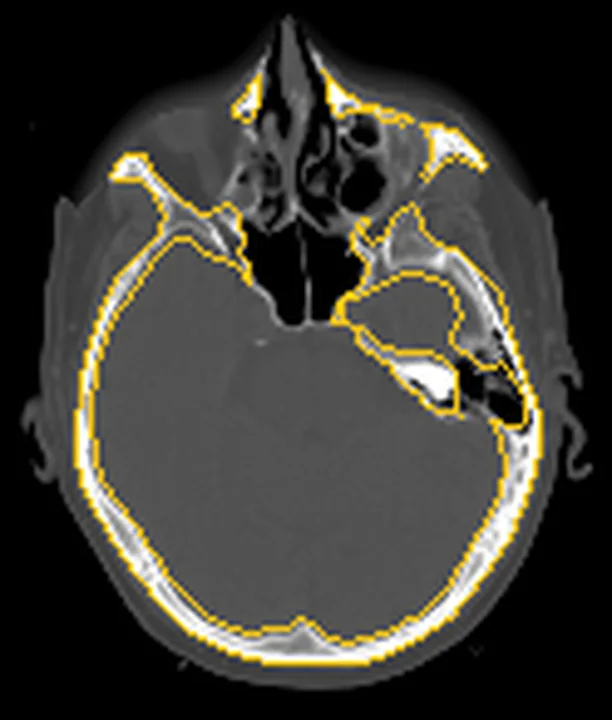
Aynı bölgenin, kaynak veri setinde patoloji içermediği belirtilen bir BT incelemesini kesit kesit kaydırın; organ sınırlarını açarak anatomiyi hasta görüntüsüyle karşılaştırın. Küçük rastlantısal bulgular tümüyle dışlanmamıştır.
Kaynak: TotalSegmentator v2.01 veri seti (Wasserthal ve ark., Radiology: Artificial Intelligence 2023), CC BY 4.0, vaka s0103; organ sınırları veri setinin otomatik segmentasyonundan, birleştirilerek sadeleştirildi. Görüntüler 2,5 mm kesit aralığına yeniden örneklendi.
Ayırıcı tanı
- Pozisyonel plagiosefali
- oksipital düzleşme ve ipsilateral frontal bossing yapabilir; lambdoid sütür patent ve tırtıklı kalır.
- Unikoronal sinostoz
- anterior plagiosefali (ön kafa bölgesinde oblik deformite) ve orbital asimetri baskındır; lambdoid hat yerine koronal sütür füzyonu görülür.
- Bilateral lambdoid sinostoz
- iki posterior sütür kapanır; bilateral oksipitoparietal düzleşme ve küçük posterior kranial fossa ile tek taraflı düzleşmeden ayrılır.
- Aksesuar oksipital (mendosal) sütür
- oksipital kemik içinde tırtıklı ve radyolüsent bir hat olarak izlenebilir; transvers oksipital sütürün orta bölümde füzyonuyla oluşan çift lateral sütürlerdir.
Tuzaklar
- Posterior düzleşmeyi tek başına lambdoid sinostoz saymayın; sütürün tüm görülebilen seyri boyunca açıklık veya kemik köprüsü arayın.
- Mastoid çıkıntının belirginliğini karşı taraf ve kafa tabanı asimetrisi ile birlikte doğrulayın.
- Aksesuar oksipital ya da mendosal sütürü lambdoid füzyon sanmayın; normal sutural çizgiler de tırtıklı, kıvrımlı ve radyolüsenttir.
- Sinostotik trapezoid konturu pozisyonel paralelkenar biçiminden ayırırken kulak yerleşimini de kontrol edin; tek bir kontur işaretine dayanmayın.
Kendini dene
Sol oksipitoparietal düzleşme, sol mastoid çıkıntıda belirginlik ve sol lambdoid hatta kemik köprüsü var. En olası tanı nedir?
Cevabı göster
Sol lambdoid sinostoz. Lambdoid sütürdeki füzyon/kemik köprüsü, ipsilateral oksipitoparietal düzleşme ve mastoid belirginliği gerçek lambdoid sinostozu destekler. Pozisyonel plagiosefalide lambdoid sütür açık kalır ve mastoid belirginliği beklenmez.
Arka kafa düzleşmiş, ancak lambdoid sütür tırtıklı ve açık; ipsilateral frontal bossing mevcut.
Cevabı göster
Pozisyonel plagiosefali. Pozisyonel plagiosefalide lambdoid sütür patent kalır ve ipsilateral frontal bossing eklenir. Lambdoid sinostozda ise sütürde perisutural skleroz, lineerite, azalmış tırtıklanma veya kemik köprüleşme ile üstten görünümde trapezoid kontur aranır; bikoronal sinostoz brachycephaly, metopik sinostoz ise trigonocephaly yapar.
İlgili konular
Kaynaklar
Bu sayfadaki 39 cümle ve 2 quiz sorusu aşağıdaki kaynaklardan alıntılarla otomatik olarak karşılaştırıldı; 9 cümle bu karşılaştırmada düzeltildi (2026-10-12).
- Craniosynostosis : Updates in Radiologic Diagnosispmc.ncbi.nlm.nih.gov
- The Course and Interaction of Ventriculomegaly and Cerebellar Tonsillar Herniation in Crouzon Syndrome over Timepmc.ncbi.nlm.nih.gov
- Non-syndromic craniosynostosis: contemporary concepts in biology, diagnosis, and distraction-based operative strategypmc.ncbi.nlm.nih.gov
- Total Cranial Vault Remodeling Using Multidirectional Cranial Distraction Osteogenesis in Craniosynostosispmc.ncbi.nlm.nih.gov
- Syndromic craniosynostosis: current concepts in intracranial hypertension, cranial base pathology, and surgical managementpmc.ncbi.nlm.nih.gov
- The Course and Interaction of Ventriculomegaly and Cerebellar Tonsillar Herniation in Crouzon Syndrome over Time.pubmed.ncbi.nlm.nih.gov
- Combined unilateral coronal-lambdoid suture synostosis: surgical outcome of suturectomy and postoperative helmet therapy.pubmed.ncbi.nlm.nih.gov
- Computed tomography quantitative analysis of cranial vault dysmorphology and severity of facial complex changes in posterior synostotic plagiocephaly patients.pubmed.ncbi.nlm.nih.gov
- Craniosynostosis and ENT.pubmed.ncbi.nlm.nih.gov
- Imaging in craniosynostosis: when and what?pubmed.ncbi.nlm.nih.gov
- The metopic suture: Natural history.pubmed.ncbi.nlm.nih.gov
- Surgical Treatment of Nonsyndromic Unicoronal Craniosynostosis.pubmed.ncbi.nlm.nih.gov
- Progressive Postnatal Pansynostosis.pubmed.ncbi.nlm.nih.gov
- How ultrasonography can contribute to diagnosis of craniosynostosis.pubmed.ncbi.nlm.nih.gov
- Predicting calvarial morphology in sagittal craniosynostosis.pubmed.ncbi.nlm.nih.gov
- Craniosynostosis.pubmed.ncbi.nlm.nih.gov
- Evaluation and management of nonsyndromic craniosynostosis.pubmed.ncbi.nlm.nih.gov
- The computed cranial focal point.pubmed.ncbi.nlm.nih.gov
- Planning and Osteotomy Designs in the Correction of Single-Suture Craniosynostosis.pubmed.ncbi.nlm.nih.gov
- Non-syndromic craniosynostosis: contemporary concepts in biology, diagnosis, and distraction-based operative strategy.pubmed.ncbi.nlm.nih.gov
- Endoscope-assisted release for pancraniosynostosis with delayed single-suture refusion managed with endoscopic re-release in the same patient: illustrative case.pubmed.ncbi.nlm.nih.gov
- Syndromic craniosynostosis: current concepts in intracranial hypertension, cranial base pathology, and surgical management.pubmed.ncbi.nlm.nih.gov
- Deep learning-based craniosynostosis classification via suture segmentation and mask-weighted classification.pubmed.ncbi.nlm.nih.gov
- Predictive Value of Sonographic Parameters on the Effects of Cranial Molding Helmet Therapy in Infants with Positional Plagiocephaly.pubmed.ncbi.nlm.nih.gov
- Neuroimaging in Nonsyndromic Craniosynostosis: Key Concepts to Unlock Innovation.pubmed.ncbi.nlm.nih.gov
- Diagnosis of infant synostotic and nonsynostotic cranial deformities: a review for pediatricians.pubmed.ncbi.nlm.nih.gov
- Craniosynostosis : Updates in Radiologic Diagnosis.pubmed.ncbi.nlm.nih.gov
- Zero-TE MRI: principles and applications in the head and neck.pubmed.ncbi.nlm.nih.gov
- Diagnostic value of exome and whole genome sequencing in craniosynostosis.pubmed.ncbi.nlm.nih.gov
- Humeroradial Synostosis: An Updated Classification and Differential Diagnosis Based on Genetic Aetiology.pubmed.ncbi.nlm.nih.gov
- Allometry of human calvaria bones during development from birth to 8 years of age shows a nonlinear growth pattern.pubmed.ncbi.nlm.nih.gov
- Novel 1q22-q23.1 duplication in a patient with lambdoid and metopic craniosynostosis, muscular hypotonia, and psychomotor retardation.pubmed.ncbi.nlm.nih.gov
- Radiological Diagnosis of Crouzon Syndrome: A Case Study.pubmed.ncbi.nlm.nih.gov
- Review of imaging modalities and radiological findings of calvarial lesions.pubmed.ncbi.nlm.nih.gov
- Frontofacial Features of Unilateral Lambdoid Craniosynostosis: A Multicenter Assessment.pubmed.ncbi.nlm.nih.gov
- Anterior Craniofacial Changes Following Occipital Switch Cranioplasty in Unilateral Lambdoid Craniosynostosis.pubmed.ncbi.nlm.nih.gov
- A Case of Trigeminal Neuralgia in an Adult Patient With Lambdoid Synostosis.pubmed.ncbi.nlm.nih.gov
- Craniosynostosis-4 with Heterozygous Mutation in the ERF Gene: A Case Report.pubmed.ncbi.nlm.nih.gov
- Spring-Assisted Surgery of Unilambdoid Craniosynostosis.pubmed.ncbi.nlm.nih.gov
- A Unique Case of Pure Bilateral Lambdoid Craniosynostosis and Progression to Mercedes-Benz Syndrome Following Spring Cranioplasty.pubmed.ncbi.nlm.nih.gov
- Evaluation and Management of Nonsyndromic Craniosynostosis.pubmed.ncbi.nlm.nih.gov
- Isolated Sagittal Craniosynostosis: A Comprehensive Review.pubmed.ncbi.nlm.nih.gov
- Predicting and comparing three corrective techniques for sagittal craniosynostosis.pubmed.ncbi.nlm.nih.gov
- Neurocognitive outcomes in children with craniosynostosis after surgical correction: a narrative review.pubmed.ncbi.nlm.nih.gov
- The 27 Facial Sutures: Timing and Clinical Consequences of Closure.pubmed.ncbi.nlm.nih.gov
- Craniofacial and Airway Morphology in Down Syndrome: A Cone Beam Computed Tomography Case Series Evaluation.pubmed.ncbi.nlm.nih.gov
- Clinical and Genetic Studies of the First Monozygotic Twins with Pfeiffer Syndrome.pubmed.ncbi.nlm.nih.gov
- Helmet Therapy in Infants with Positional Skull Deformity: A Retrospective Study of 455 Patients from a German Tertiary Care Center.pubmed.ncbi.nlm.nih.gov
- Case Report: Three-dimensional characteristics of craniofacial morphology in facial asymmetry due to unilateral coronal synostosis.pubmed.ncbi.nlm.nih.gov
- Geometric Morphometric Analysis of Forehead Morphology in Unicoronal Synostosis: Identifying the Pivot Line.pubmed.ncbi.nlm.nih.gov
- Comparison of Cranial Vault Remodeling Versus Spring Cranioplasty for Nonsyndromic Unicoronal Craniosynostosis: Analysis of Outcomes.pubmed.ncbi.nlm.nih.gov
- Mendosal suture patency beyond infancy: a large-scale computed tomography study in an Asian cohort.pubmed.ncbi.nlm.nih.gov
- An Aberrant Line on CT Head: The Mendosal Suture.pubmed.ncbi.nlm.nih.gov
- Ultrasonographic Measurement of Anterior Fontanelle Size in Infants with Deformational Plagiocephaly.pubmed.ncbi.nlm.nih.gov
- Integrated multidisciplinary analysis of mobile digital radiographic acquisitions of the mummies of the Hermits from the Sanctuary of Madonna della Corona (Italy - 17th to 19th Century CE).pubmed.ncbi.nlm.nih.gov
- Mapping Executive Function Performance Based on Resting-State EEG in Healthy Individuals: A Systematic and Mechanistic Review.pubmed.ncbi.nlm.nih.gov
- Evaluation of the Cortical Silent Period of the Laryngeal Motor Cortex in Healthy Individuals.pubmed.ncbi.nlm.nih.gov
- TGF-β/BMP signaling in skeletal biology: molecular mechanisms, regulatory networks, and therapeutic implications in development, regeneration, and disease.pubmed.ncbi.nlm.nih.gov
- Transcriptional analysis of human cranial compartments with different embryonic origins.pubmed.ncbi.nlm.nih.gov
- Cranial neural crest cell contribution to craniofacial formation, pathology, and future directions in tissue engineering.pubmed.ncbi.nlm.nih.gov
- UCSQ Method Applied on 3D Photogrammetry: Non-Invasive Objective Differentiation Between Synostotic and Positional Plagiocephaly.pubmed.ncbi.nlm.nih.gov
- When Virchow's law fails: Crouzon syndrome as a test case for quantitative suture closure-endocranial shape relationships.pubmed.ncbi.nlm.nih.gov
- Visual outcome in 5-year-old children operated for non-syndromic craniosynostosis.pubmed.ncbi.nlm.nih.gov
- A tissue engineering approach to regenerate the cranial suture skeletal stem cell niche with a multicompartment biomaterial scaffold.pubmed.ncbi.nlm.nih.gov
- Initial In Vivo Analyses of Small Pore Polymer Scaffolds for Creation of an Artificial Cranial Stem Cell Niche.pubmed.ncbi.nlm.nih.gov
- Calvarial Bloom Biomechanics: Dural Tension Governing Cranial Form.pubmed.ncbi.nlm.nih.gov
- The Effect of Cranial Sutures Should Be Considered in Transcranial Electrical Stimulation.pubmed.ncbi.nlm.nih.gov
- Neuro-Ophthalmological Manifestations of Craniosynostosis: Current Perspectives.pubmed.ncbi.nlm.nih.gov
- Craniosynostosis - Recognition, clinical characteristics, and treatment.pubmed.ncbi.nlm.nih.gov
- Positional Skull Deformities.pubmed.ncbi.nlm.nih.gov
- Craniosynostosis in the Middle Pleistocene human Cranium 14 from the Sima de los Huesos, Atapuerca, Spain.pubmed.ncbi.nlm.nih.gov
- Rethinking the Origin of the Primary Respiratory Mechanism.pubmed.ncbi.nlm.nih.gov
- Effectiveness of Helmet therapy for infants with moderate to severe positional plagiocephaly.pubmed.ncbi.nlm.nih.gov
- Ophthalmological Care of Patients With Craniofacial Disorders.pubmed.ncbi.nlm.nih.gov
- From FGFR2 mutations to precision management: a review of prenatal diagnosis and multidisciplinary interventions in apert syndrome.pubmed.ncbi.nlm.nih.gov
- Genetic advances in craniosynostosis.pubmed.ncbi.nlm.nih.gov
- Exploring Different Management Modalities of Nonsyndromic Craniosynostosis.pubmed.ncbi.nlm.nih.gov
- Multisuture craniosynostosis and acquired Chiari malformation secondary to vitamin D deficiency rickets: illustrative case.pubmed.ncbi.nlm.nih.gov
- The Key Aspects of Neonatal and Infant Neurological Examination: The Ballard Score, the Infant's Head with Hydrocephalus and Assessment in a Clinical Setting.pubmed.ncbi.nlm.nih.gov
- Functional and morphological changes in hypoplasic posterior fossa.pubmed.ncbi.nlm.nih.gov
- Developments in diagnostic and surgical techniques in children with sagittal suture craniosynostosis: a systematic review spanning the last 30 years.pubmed.ncbi.nlm.nih.gov
- Complications in craniosynostosis surgery in patients with rickets: illustrative case and systematic review of literature.pubmed.ncbi.nlm.nih.gov
- Pfeiffer syndrome in an adult with previous surgical correction: A case report of CT findings.pubmed.ncbi.nlm.nih.gov
- Novel mutation detection of fibroblast growth factor receptor 1 (FGFR1) gene, FGFR2IIIa, FGFR2IIIb, FGFR2IIIc, FGFR3, FGFR4 gene for craniosynostosis: A prospective study in Asian Indian patient.pubmed.ncbi.nlm.nih.gov
- Prevalence and Temporal Trends of Deformational Plagiocephaly and Brachycephaly in Finland: A Population-Based Register Study.pubmed.ncbi.nlm.nih.gov
- Contralateral Coronal-Lambdoid Craniosynostosis Treated with Distraction Osteogenesis and Spring-Mediated Cranioplasty.pubmed.ncbi.nlm.nih.gov
- Cerebral Vein Malformations Result from Loss of Twist1 Expression and BMP Signaling from Skull Progenitor Cells and Dura.pubmed.ncbi.nlm.nih.gov
- Management of Chiari 1 Malformation and Hydrocephalus in Syndromic Craniosynostosis: A Review.pubmed.ncbi.nlm.nih.gov
- Craniosynostosis in Siblings, an Extremely Rare Occurrence: A Case Report.pubmed.ncbi.nlm.nih.gov
- Craniosynostosis of the lambdoid suture.pubmed.ncbi.nlm.nih.gov
Eğitim amaçlıdır; hasta başında tanı ve tedavi kararının yerine geçmez, tıbbi tavsiye değildir. Metinler yapay zekâ desteğiyle yazıldı ve otomatik bir adımda kaynak alıntılarıyla karşılaştırıldı; bu bir tıbbi doğrulama değildir ve içerik uzman radyolog incelemesinden geçmedi. Klinik kararlarda güncel kılavuzları, kurum protokollerini ve radyoloji raporunu esas alın.