Özet
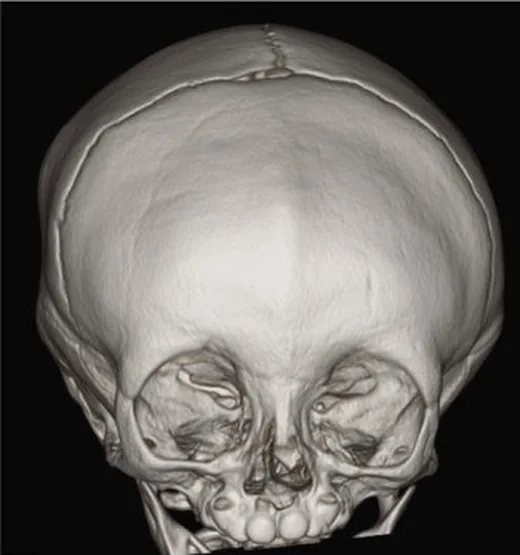
Metopik sinostoz, frontal kemikler arasındaki sütürün erken füzyonuyla frontal büyümeyi sınırlar ve trigonosefali oluşturabilir. BT'de kapanmış orta hat çizgisi ancak frontal kontur, orbitanın yönelimi ve interorbital mesafe ile birlikte yorumlanır; çünkü metopik sütürün fizyolojik kapanması da sık görülebilir. Kemik algoritması ve 3B önden görünüm, basit metopik sırt ile gerçek üçgensi deformiteyi ayırmada öğreticidir. Kapanmayı tek başına hastalık saymak yanlış pozitif tanıya, orbital ve frontal şekil değişikliğini atlamak ise anlamlı sinostozun eksik tanımlanmasına yol açabilir.
Faz ve pencere
- Kontrastsız tanısal
- Frontal kemikler arasındaki metopik hatta kemik köprüsü veya belirgin kemik sırtı, önden üçgensi alın konturu, daralmış interorbital mesafe ve yukarı-mediale eğimli orbital çatılar kemik pencerede değerlendirilir. 3B rekonstrüksiyon frontal daralmayı gösterir; bu patoloji için kontrast fazı gerekmez.
Önerilen pencereler: Kemik (G 1800 / M 400).
BT bulguları
- Metopik sütürün kapanması — frontal kemikler arasındaki normal radyolüsent çizgi silinir veya doğrusal kemik sırtına dönüşür.
- Trigonosefali — önden bakışta alın dar ve üçgensi; frontal kemiklerin lateral büyümesi kısıtlıdır.
- Frontal kemiklerde orta hat kabarıklığı — metopik sırttan sinostozu tek başına ayırmaz, konturla birlikte değerlendirilir.
- Hipotelorizm — daralmış interorbital mesafe trigonosefali tablosuna eşlik edebilir.
- Orbital çatıların yukarı ve mediale eğimi — frontal-orbital kompleksin şekil değişikliğini gösterir.
- Küçük anterior kraniyal fossa ve dar frontal bölge — üç boyutlu rekonstrüksiyonda frontal hacim kısıtlılığını destekler.
Normalde
Normal BT'de metopik sütür frontal kemikler arasında orta hat boyunca ilerler; yaşa bağlı kapanırken kemik sırtı oluşabilse de alın konturu genellikle üçgensi hale gelmez. Frontal kemiklerin dışa açılımını, interorbital aralığı ve orbital çatıların yönünü aynı önden 3B görünümde değerlendirin; yalnızca sütürün görünmemesi tanı koydurmaz.
Normal BT ile kıyasla
Aynı bölgenin, kaynak veri setinde patoloji içermediği belirtilen bir BT incelemesini kesit kesit kaydırın; organ sınırlarını açarak anatomiyi hasta görüntüsüyle karşılaştırın. Küçük rastlantısal bulgular tümüyle dışlanmamıştır.
Kaynak: TotalSegmentator v2.01 veri seti (Wasserthal ve ark., Radiology: Artificial Intelligence 2023), CC BY 4.0, vaka s0103; organ sınırları veri setinin otomatik segmentasyonundan, birleştirilerek sadeleştirildi. Görüntüler 2,5 mm kesit aralığına yeniden örneklendi.
Ayırıcı tanı
- Metopik sırt
- orta hatta belirgin kemik çıkıntısı vardır; ancak alın genişliği ve orbital biçim trigonosefaliyi desteklemez.
- Sagittal sinostoz
- füzyon frontal kemikler arasında değil parietal orta hatta uzanır; kafa uzun-dar olur, alın ön görünümde üçgensi olmayabilir.
- Bikoronal sinostoz
- iki koronal hattın kapanması ön-arka kısalmış, enine geniş kafa ve bilateral orbital yükselme oluşturur.
- İzole metopik sütür kapanması veya orta hat sırtı, trigonosefali ve hipotelorizm gibi diğer karakteristik deformiteleri taşımadığında patolojik sinostoz değil, fizyolojik bir kapanma varyantı olarak yorumlanmalıdır.
Tuzaklar
- Metopik sütür kapanmasını yaş ve kafa biçiminden bağımsız olarak patolojik etiketlemeyin; izole füzyon fizyolojik olabilir.
- Palpabl veya BT'de görülen metopik sırtı trigonosefaliyle eşitlemeyin; frontal genişlik ve orbital geometriyi inceleyin.
- Tek bir aksiyel kesitte interorbital mesafe ya da orbital çatı açısı hakkında hüküm vermeyin; koronal ve önden 3B görüntüyü ekleyin.
- Metopik hattın kapanmasına eşlik eden diğer sütür füzyonlarını gözden kaçırmamak için kalvaryumun tamamını tarayın.
Kendini dene
Metopik çizgi kapalı; önden alın belirgin üçgensi ve orbital çatılar mediale eğimli. En olası tanı hangisidir?
Cevabı göster
Metopik sinostoz. Metopik füzyona eşlik eden üçgensi frontal kontur ve orbital geometri değişikliği sinostoz lehinedir. İzole sırt frontal biçimi bozmayabilir; sagittal tutulum parietal orta hatta, pozisyonel plagiosefali ise arka kafa konturunda belirgindir.
Orta hat frontal kemik sırtı var; alın genişliği korunmuş ve orbital çatılar simetrik. En uygun adlandırma nedir?
Cevabı göster
Metopik sırt. Yalnızca orta hatta kemik sırtı izlenirken, alın genişliğinin korunması ve orbital deformitenin bulunmaması trigonosefaliden ayırır; bu bulgu seti izole metopik sırt ile uyumludur.
İlgili konular
Kaynaklar
Bu sayfadaki 35 cümle ve 2 quiz sorusu aşağıdaki kaynaklardan alıntılarla otomatik olarak karşılaştırıldı; 2 cümle bu karşılaştırmada düzeltildi (2026-10-08).
- Craniosynostosis : Updates in Radiologic Diagnosispmc.ncbi.nlm.nih.gov
- Geometric Morphometric Study on Distinguishing Metopic Craniosynostosis from Metopic Ridgingpmc.ncbi.nlm.nih.gov
- A rare case of short stature: Say Meyer syndromepmc.ncbi.nlm.nih.gov
- Non-syndromic craniosynostosis: contemporary concepts in biology, diagnosis, and distraction-based operative strategypmc.ncbi.nlm.nih.gov
- Syndromic craniosynostosis: current concepts in intracranial hypertension, cranial base pathology, and surgical managementpmc.ncbi.nlm.nih.gov
- Aberrant Morphologic Patterning of Combined Sagittal and Metopic Craniosynostosis.pubmed.ncbi.nlm.nih.gov
- Analysis of pre- and post-operative symptoms of patients with mild trigonocephaly using several developmental and psychological tests.pubmed.ncbi.nlm.nih.gov
- Geometric Morphometric Study on Distinguishing Metopic Craniosynostosis from Metopic Ridging.pubmed.ncbi.nlm.nih.gov
- Surgical treatment of trigonocephaly: technique and long-term results in 48 cases.pubmed.ncbi.nlm.nih.gov
- A rare case of short stature: Say Meyer syndrome.pubmed.ncbi.nlm.nih.gov
- Trigonocephaly: results after surgical correction of nonsyndromatic isolated metopic suture synostosis in 54 cases.pubmed.ncbi.nlm.nih.gov
- Value of preoperative imaging in the diagnostics of isolated metopic suture synostosis: a risk-benefit analysis.pubmed.ncbi.nlm.nih.gov
- The metopic suture: Natural history.pubmed.ncbi.nlm.nih.gov
- Atypical scaphocephaly: a review.pubmed.ncbi.nlm.nih.gov
- Morphologic Severity of Craniosynostosis: Implications for Speech and Neurodevelopment.pubmed.ncbi.nlm.nih.gov
- Comparison of Resorbable Plating Systems: Complications During Degradation.pubmed.ncbi.nlm.nih.gov
- Long-Term Assessment of Suturectomy in Trigonocephaly and Anterior Plagiocephaly.pubmed.ncbi.nlm.nih.gov
- Partial Suture Fusion in Nonsyndromic Single-Suture Craniosynostosis.pubmed.ncbi.nlm.nih.gov
- Endoscopic treatment of combined metopic-sagittal craniosynostosis.pubmed.ncbi.nlm.nih.gov
- Non-syndromic craniosynostosis: contemporary concepts in biology, diagnosis, and distraction-based operative strategy.pubmed.ncbi.nlm.nih.gov
- Syndromic craniosynostosis: current concepts in intracranial hypertension, cranial base pathology, and surgical management.pubmed.ncbi.nlm.nih.gov
- Neurocognitive outcomes in children with craniosynostosis after surgical correction: a narrative review.pubmed.ncbi.nlm.nih.gov
- Can Craniosynostosis be Diagnosed on Physical Examination? A Retrospective Review.pubmed.ncbi.nlm.nih.gov
- Insights into craniosynostosis management in low- and middle-income countries: A narrative review of outcomes, shortcomings and paediatric neurosurgery capacity.pubmed.ncbi.nlm.nih.gov
- DeepSSM: A blueprint for image-to-shape deep learning models.pubmed.ncbi.nlm.nih.gov
- Deep learning-based craniosynostosis classification via suture segmentation and mask-weighted classification.pubmed.ncbi.nlm.nih.gov
- Preoperative Prediction of Intraoperative Transfusion in Pediatric Craniosynostosis Surgery: An Exploratory Prediction Model Study.pubmed.ncbi.nlm.nih.gov
- Association between craniosynostosis and phospholipid metabolism: Insights from single-cell and transcriptomic analysis.pubmed.ncbi.nlm.nih.gov
- Novel mutation detection of fibroblast growth factor receptor 1 (FGFR1) gene, FGFR2IIIa, FGFR2IIIb, FGFR2IIIc, FGFR3, FGFR4 gene for craniosynostosis: A prospective study in Asian Indian patient.pubmed.ncbi.nlm.nih.gov
- Clinical and molecular characterization of TCF12 variants in an Asian pediatric cohort with craniosynostosis.pubmed.ncbi.nlm.nih.gov
- Intrafamilial phenotypic variability in hypophosphatasia: evidence from two families and the literature.pubmed.ncbi.nlm.nih.gov
- Allometry of human calvaria bones during development from birth to 8 years of age shows a nonlinear growth pattern.pubmed.ncbi.nlm.nih.gov
- Novel compound heterozygous FAM20C variants cause Raine syndrome - retrospective prenatal diagnosis and literature review.pubmed.ncbi.nlm.nih.gov
- Forehead Shape Analysis following Surgical and Conservative Treatment in Metopic Synostosis: A 3-Dimensional Photogrammetry Analysis.pubmed.ncbi.nlm.nih.gov
- Craniosynostosis: Experience From a Single Tertiary Center in India.pubmed.ncbi.nlm.nih.gov
- A Unique Case of Pure Bilateral Lambdoid Craniosynostosis and Progression to Mercedes-Benz Syndrome Following Spring Cranioplasty.pubmed.ncbi.nlm.nih.gov
- Hypotelorism in Metopic Craniosynostosis: Persistent Undercorrection Following Open Cranial Vault Remodeling.pubmed.ncbi.nlm.nih.gov
- Eye and Orbital Anatomy in Metopic Synostosis.pubmed.ncbi.nlm.nih.gov
- Pre-Operative Ocular Findings and Long-Term Follow-Up in a Large Cohort of Non-Syndromic Unicoronal Craniosynostosis.pubmed.ncbi.nlm.nih.gov
- Ophthalmological outcomes of unilateral coronal synostosis in young children.pubmed.ncbi.nlm.nih.gov
- Preservation versus Structural Cranioplasty: A New Concept for Craniosynostosis Treatment.pubmed.ncbi.nlm.nih.gov
- Treatment strategies and prognostic outcomes in craniosynostosis with concurrent hydrocephalus: a case series.pubmed.ncbi.nlm.nih.gov
- Divergent Mechanisms of Cranial Suture Ossification in Normal Development and Pathologic Fusion.pubmed.ncbi.nlm.nih.gov
- Comparing effectiveness of conservative policy to craniofacial surgery in children with metopic synostosis: protocol for an observational cohort study on clinical outcomes, psychosocial well-being and costs in a Dutch academic hospital.pubmed.ncbi.nlm.nih.gov
- Exploring Different Management Modalities of Nonsyndromic Craniosynostosis.pubmed.ncbi.nlm.nih.gov
- Multisuture and Syndromic Craniosynostoses: Simplifying the Complex.pubmed.ncbi.nlm.nih.gov
- Clinical and genetic features of syndromic craniosynostosis in 18 Chinese probands: novel candidate genes and phenotypes of known pathogenic genes.pubmed.ncbi.nlm.nih.gov
- When Virchow's law fails: Crouzon syndrome as a test case for quantitative suture closure-endocranial shape relationships.pubmed.ncbi.nlm.nih.gov
- A conceptual clinical reasoning framework for early syndromic recognition in dental practice.pubmed.ncbi.nlm.nih.gov
- Emphasis on Early Prenatal Diagnosis and Perinatal Outcomes Analysis of Apert Syndrome.pubmed.ncbi.nlm.nih.gov
- A unique presentation of Crouzon-like syndrome: Complex craniosynostosis in the absence of genetic mutations or familial predisposition - A case report.pubmed.ncbi.nlm.nih.gov
- Congenital hypothyroidism with preserved fifth digits in SMARCA4-related Coffin-Siris syndrome: a case report.pubmed.ncbi.nlm.nih.gov
- A Case of <i>FAM111A</i>-Associated Kenny-Caffey Syndrome Type 2 with New Clinical Features: Microtia, Lacunar Skull Appearance, and Arnold-Chiari Malformation.pubmed.ncbi.nlm.nih.gov
- Malformation Pattern and Molecular Findings in the <i>FGFR1</i>-Related Hartsfield Syndrome Phenotype.pubmed.ncbi.nlm.nih.gov
- Genetic advances in craniosynostosis.pubmed.ncbi.nlm.nih.gov
- BBS9 gene in nonsyndromic craniosynostosis: Role of the primary cilium in the aberrant ossification of the suture osteogenic niche.pubmed.ncbi.nlm.nih.gov
- A 150-year conundrum: cranial robusticity and its bearing on the origin of aboriginal australians.pubmed.ncbi.nlm.nih.gov
- Expanding the phenotypic spectrum associated with ZIC1 variants: A neurodevelopmental disorder with and without craniosynostosis.pubmed.ncbi.nlm.nih.gov
- Broadening the inherited <i>ASXL3</i> spectrum and unveiling molecular mechanisms through detailed genotypic-phenotypic analyses.pubmed.ncbi.nlm.nih.gov
- From Misdiagnosis to Discovery: Expanding the Spectrum of Spliceosomopathies.pubmed.ncbi.nlm.nih.gov
- Imaging Modalities in Craniosynostosis: A Systematic Review and Proposal of the ARCANA Protocol for Multimodal Radiation-Free Assessment.pubmed.ncbi.nlm.nih.gov
- Continuum topological derivative - A novel application tool for segmentation of CT and MRI images.pubmed.ncbi.nlm.nih.gov
- How does nonsyndromic craniosynostosis affect on bone width of nasal cavity in children? - Computed tomography study.pubmed.ncbi.nlm.nih.gov
- Visual outcome in 5-year-old children operated for non-syndromic craniosynostosis.pubmed.ncbi.nlm.nih.gov
- Systematic Screening of Communication Outcomes at Age 5 in Children Treated for Nonsyndromic Craniosynostosis.pubmed.ncbi.nlm.nih.gov
- Is a standardised severity index needed in unicoronal craniosynostosis? Challenges in developing an objective metric.pubmed.ncbi.nlm.nih.gov
- Developments in diagnostic and surgical techniques in children with sagittal suture craniosynostosis: a systematic review spanning the last 30 years.pubmed.ncbi.nlm.nih.gov
- The biomechanics of chewing and suckling in the infant: A potential mechanism for physiologic metopic suture closure.pubmed.ncbi.nlm.nih.gov
- Practical Computed Tomography Scan Findings for Distinguishing Metopic Craniosynostosis from Metopic Ridging.pubmed.ncbi.nlm.nih.gov
- The clinical manifestations, molecular mechanisms and treatment of craniosynostosis.pubmed.ncbi.nlm.nih.gov
- "Validation of Artificial Intelligence Severity Assessment in Metopic Craniosynostosis".pubmed.ncbi.nlm.nih.gov
- Anthropometric Outcomes following Fronto-Orbital Advancement for Metopic Synostosis.pubmed.ncbi.nlm.nih.gov
- Evaluation and Management of Nonsyndromic Craniosynostosis.pubmed.ncbi.nlm.nih.gov
- Nonsyndromic craniosynostosis.pubmed.ncbi.nlm.nih.gov
- Severe Holoprosencephaly With Arhinencephaly in A Liveborn Neonate: A Case Report.pubmed.ncbi.nlm.nih.gov
- First Case Report of Agnathia-Otocephaly Complex Reported in Niger.pubmed.ncbi.nlm.nih.gov
- Craniosynostosis in Siblings, an Extremely Rare Occurrence: A Case Report.pubmed.ncbi.nlm.nih.gov
- Solitary Median Maxillary Central Incisor due to Nasal Pyriform Aperture Stenosis in Fetus: The First Prenatal Ultrasound Case Report.pubmed.ncbi.nlm.nih.gov
- Yield of Brain MRI in Clinically Diagnosed Epilepsy in the Kingdom of Bhutan: A Prospective Study.pubmed.ncbi.nlm.nih.gov
- Craniofacial abnormalities in Hutchinson-Gilford progeria syndrome.pubmed.ncbi.nlm.nih.gov
- Partial intracranial volumes in metopic synostosis - pre- and postoperative comparisons with healthy controls.pubmed.ncbi.nlm.nih.gov
Eğitim amaçlıdır; hasta başında tanı ve tedavi kararının yerine geçmez, tıbbi tavsiye değildir. Metinler yapay zekâ desteğiyle yazıldı ve otomatik bir adımda kaynak alıntılarıyla karşılaştırıldı; bu bir tıbbi doğrulama değildir ve içerik uzman radyolog incelemesinden geçmedi. Klinik kararlarda güncel kılavuzları, kurum protokollerini ve radyoloji raporunu esas alın.