Özet
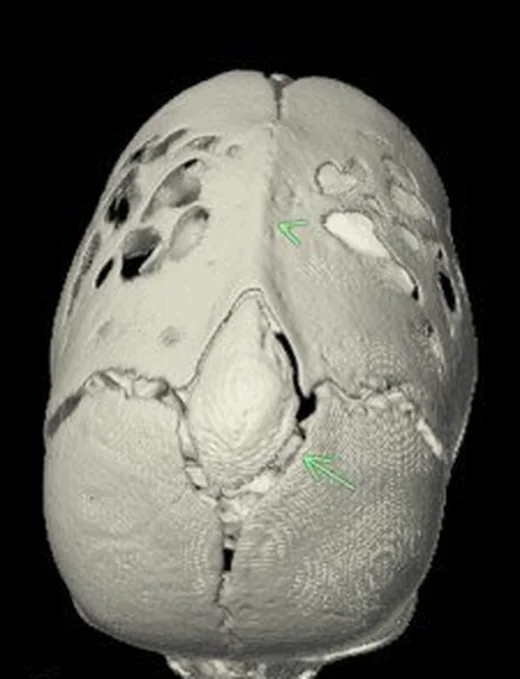
Sagittal sinostoz, iki parietal kemiği ayıran orta hat sütürünün erken füzyonudur ve büyümeyi enine yönde sınırlar. BT'de sütür hattının kemik köprüleşmesiyle kapanması, uzun-dar kalvaryum ve açık komşu sütürlerin telafi edici şekil değişiklikleri birlikte aranır. Üç boyutlu kemik görünümü skafosefaliyi gösterirken aksiyel ve sagittal kesitler füzyon hattını doğrular. Yalnızca uzamış baş biçimine odaklanmak, sütür açıklığını ve çoklu tutulum olasılığını gözden kaçırabilir.
Faz ve pencere
- Kontrastsız tanısal
- İnce kesit kemik algoritması sagittal hatta tırtıklı radyolüsent çizginin kaybını, doğrusal sklerozu veya kemik köprüsünü; 3B rekonstrüksiyon ise uzun-dar kalvaryum, frontal bossing ve oksipital çıkıntıyı gösterir. Tanı için kontrast madde gerekmez; öncelikli görüntüleme yöntemi kemik detayını gösteren kontrastsız BT ve üç boyutlu rekonstrüksiyondur.
Önerilen pencereler: Kemik (G 1800 / M 400).
BT bulguları
- Sagittal sütür obliterasyonu — bregmadan lambdaya uzanan orta hat açıklığı kaybolur veya kesintili kemik köprülerine dönüşür.
- Perisütüral skleroz — sagittal hattın iki kenarında yoğunlaşma ve düzgün doğrusal kontur oluşur.
- Skafosefali — biparietal genişlik kısıtlı, ön-arka kalvaryal uzunluk belirgin görünür.
- Frontal bossing — frontal kemikler öne doğru kompansatuvar bombeleşir.
- Oksipital çıkıntı — posterior kalvaryum uzar ve oksiput belirginleşir.
- Sagittal kemik sırtı — füzyon hattında palpabl olabilen ve 3B yüzeyde seçilen kabarık orta hat konturu.
- Koronal ve lambdoid sütürlerin açıklığı — tırtıklı aralıkların devam etmesi izole sagittal tutulum lehinedir; kapanma varsa kapsam genişletilir.
Normalde
Normal BT'de sagittal sütür bregmadan lambdaya uzanan, parietal kemikler arasında kıvrımlı ve radyolüsent bir çizgi şeklindedir; iki parietal kontur orta hatta birleşmez. 3B üstten görünümde normalde dengeli olan biparietal genişlik ile ön-arka uzunluk, sagittal sinostozda sütür boyunca uzayan dar ve uzun kalvaryum ile değişirken; aksiyal kesitte parietal kemikler arasındaki sütür hattı normalde açıktır, sinostoza bağlı olarak kapalı veya kemik köprüsü şeklinde görünebilir.
Normal BT ile kıyasla
Aynı bölgenin, kaynak veri setinde patoloji içermediği belirtilen bir BT incelemesini kesit kesit kaydırın; organ sınırlarını açarak anatomiyi hasta görüntüsüyle karşılaştırın. Küçük rastlantısal bulgular tümüyle dışlanmamıştır.
Kaynak: TotalSegmentator v2.01 veri seti (Wasserthal ve ark., Radiology: Artificial Intelligence 2023), CC BY 4.0, vaka s0103; organ sınırları veri setinin otomatik segmentasyonundan, birleştirilerek sadeleştirildi. Görüntüler 2,5 mm kesit aralığına yeniden örneklendi.
Ayırıcı tanı
- Dolikosefali veya pozisyonel uzun kafa
- sagittal sütür açık ve tırtıklı kalır; kemik köprüleşmesi olmadan biçim değişikliği tek başına sinostoz değildir.
- Metopik sinostoz
- füzyon orta hatta frontal kemikler arasındadır ve alın önden üçgensi görünür; sagittal parietal hat korunabilir.
- Multisütür sinostoz
- sagittal kapanmaya koronal ya da lambdoid füzyon da eşlik eder ve kafa biçimi tek sütür paternine uymaz.
Tuzaklar
- Kafa uzamasını doğrudan sinostoz kabul etmeyin; sagittal sütürün tüm seyri boyunca kemik devamlılığını gösterin.
- Bregma ve lambda, kraniyal sütürlerin kesişimindeki fontanel bölgeleridir; sagittal sütürü bu birleşim noktalarına göre izleyin.
- 3B yüzeyde belirgin orta hat sırtını tek başına yeterli saymayın; kaynak kesitlerde gerçek açıklık kaybını doğrulayın.
- Sagittal sinostoz saptandığında koronal ve lambdoid sütürleri de baştan sona inceleyin; şekil bozukluğu eşlik eden çoklu füzyonu perdeleyebilir.
Kendini dene
Orta hat parietal sütüründe kemik köprüsü ve öne-arkaya uzamış, enine dar kalvaryum izleniyor. Tanı nedir?
Cevabı göster
Sagittal sinostoz. Sagittal füzyon biparietal genişlemeyi sınırlar ve skafosefalik kafa biçimi oluşturur. Metopik tutulum üçgensi alın, bikoronal tutulum kısa-geniş kafa biçimi yapar; pozisyonel plagiosefalide sütür açıklığı korunur.
Kalvaryum uzun görünüyor; sagittal sütür ise tırtıklı ve tüm uzunluğu boyunca açık. En uygun yorum hangisidir?
Cevabı göster
Dolikosefalik biçim. Pozisyonel kafatası şekil değişikliklerinde sütürler açıktır ve kemik köprüleşmesi gözlenmez; bu nedenle uzun kafa biçimi tek başına sinostoz tanısı koşturmaz. Pansinostoz çoklu sütür kapanması; kemik köprüsü gerçek füzyon; metopik sırt ise frontal orta hat bulgusudur.
İlgili konular
Kaynaklar
Bu sayfadaki 36 cümle ve 2 quiz sorusu aşağıdaki kaynaklardan alıntılarla tek tek karşılaştırıldı; 4 cümle bu karşılaştırmada düzeltildi (2026-10-08).
- Craniosynostosis : Updates in Radiologic Diagnosispmc.ncbi.nlm.nih.gov
- Endoscopic treatment of sagittal suture synostosis — a critical analysis of current management strategiespmc.ncbi.nlm.nih.gov
- Delayed Presentation and Treatment of Sagittal Synostosis: A Case Reportpmc.ncbi.nlm.nih.gov
- The use of OCT to detect signs of intracranial hypertension in patients with sagittal suture synostosis: Reference values and correlationspmc.ncbi.nlm.nih.gov
- Impact of extra-axial cerebrospinal fluid collection in frontal morphology after surgical treatment of scaphocephalypmc.ncbi.nlm.nih.gov
- Management of Sagittal and Lambdoid Craniosynostosis: Open Cranial Vault Expansion and Remodeling.pubmed.ncbi.nlm.nih.gov
- Endoscopic treatment of sagittal suture synostosis - a critical analysis of current management strategies.pubmed.ncbi.nlm.nih.gov
- Prenatal ultrasound parameters in single-suture craniosynostosis.pubmed.ncbi.nlm.nih.gov
- Cerebrospinal fluid collections in sagittal suture synostosis.pubmed.ncbi.nlm.nih.gov
- Altered shapes, same people: Scaphocephaly in the early modern Bucharest.pubmed.ncbi.nlm.nih.gov
- Heterozygous mutations in ERF cause syndromic craniosynostosis with multiple suture involvement.pubmed.ncbi.nlm.nih.gov
- Results of early surgery for sagittal suture synostosis: long-term follow-up and the occurrence of raised intracranial pressure.pubmed.ncbi.nlm.nih.gov
- Benign radiographic coronal synostosis after sagittal synostosis repair.pubmed.ncbi.nlm.nih.gov
- Difficulties in differential diagnosis of sagittal synostosis (scaphocephaly).pubmed.ncbi.nlm.nih.gov
- Impact of extra-axial cerebrospinal fluid collection in frontal morphology after surgical treatment of scaphocephaly.pubmed.ncbi.nlm.nih.gov
- Preliminary experience with a dynamic resorbable fixation device for craniosynostosis surgery.pubmed.ncbi.nlm.nih.gov
- Additional squamosal suture synostosis and segmented intracranial volume in patients with non-syndromic sagittal synostosis.pubmed.ncbi.nlm.nih.gov
- Intraoperative Ultrasound in Endoscopic Sagittal Suture Synostosis to Optimize Incision Planning and Avoid Misdiagnosis.pubmed.ncbi.nlm.nih.gov
- Development of secondary unilateral coronal suture synostosis with a sagittal suture synostosis in a nonsyndromic patient.pubmed.ncbi.nlm.nih.gov
- Neurocognitive outcomes in children with craniosynostosis after surgical correction: a narrative review.pubmed.ncbi.nlm.nih.gov
- The role of Pth1r in posterior cranium cartilage regulation and craniosynostosis.pubmed.ncbi.nlm.nih.gov
- A 3D Tissue-Engineering Model of Craniosynostosis to Study the Microenvironmental Signals Leading to Premature Suture Ossification.pubmed.ncbi.nlm.nih.gov
- Total Cranial Vault Remodeling Using Multidirectional Cranial Distraction Osteogenesis in Craniosynostosis.pubmed.ncbi.nlm.nih.gov
- Phenotypic heterogeneity in Crouzon syndrome: A case of severe intracranial hypertension from isolated temporal squamosal suture synostosis with a de novo FGFR2 p.Cys342Tyr mutation.pubmed.ncbi.nlm.nih.gov
- Clinical and genetic features of syndromic craniosynostosis in 18 Chinese probands: novel candidate genes and phenotypes of known pathogenic genes.pubmed.ncbi.nlm.nih.gov
- When Virchow's law fails: Crouzon syndrome as a test case for quantitative suture closure-endocranial shape relationships.pubmed.ncbi.nlm.nih.gov
- Hominin Variability and Evolutionary Relationships at Guattari Cave During the Middle and Late Pleistocene (San Felice Circeo, Latina, Italy).pubmed.ncbi.nlm.nih.gov
- Neuroimaging in Nonsyndromic Craniosynostosis: Key Concepts to Unlock Innovation.pubmed.ncbi.nlm.nih.gov
- Genetic Disorders Detectable by Fetal MRI: A Review.pubmed.ncbi.nlm.nih.gov
- Genetic advances in craniosynostosis.pubmed.ncbi.nlm.nih.gov
- Genetic Insights Into Craniosynostosis: Identification of Novel IL11RA Variants in Chinese Pediatric Patients.pubmed.ncbi.nlm.nih.gov
- Identification and characterization of short-chain dehydrogenase/reductase 3 (DHRS3) deficiency, a retinoic acid embryopathy of humans.pubmed.ncbi.nlm.nih.gov
- The clinical manifestations, molecular mechanisms and treatment of craniosynostosis.pubmed.ncbi.nlm.nih.gov
- Multisuture craniosynostosis and acquired Chiari malformation secondary to vitamin D deficiency rickets: illustrative case.pubmed.ncbi.nlm.nih.gov
- A conceptual clinical reasoning framework for early syndromic recognition in dental practice.pubmed.ncbi.nlm.nih.gov
- Review of imaging modalities and radiological findings of calvarial lesions.pubmed.ncbi.nlm.nih.gov
- Cephalometric Evaluation of Children with Short Stature of Genetic Etiology: A Review.pubmed.ncbi.nlm.nih.gov
- Non-syndromic craniosynostosis: contemporary concepts in biology, diagnosis, and distraction-based operative strategy.pubmed.ncbi.nlm.nih.gov
- Isolated Sagittal Craniosynostosis: A Comprehensive Review.pubmed.ncbi.nlm.nih.gov
- TGFβ-mediated dural progenitor cell migration into the coronal suture is crucial for preventing craniosynostosis.pubmed.ncbi.nlm.nih.gov
- MicroRNAs Play Key Roles in Progenitor Maintenance, Proliferation, and Osteogenic Differentiation of Osteogenic Progenitor Cells in Syndromic and Nonsyndromic Craniosynostosis.pubmed.ncbi.nlm.nih.gov
- Fetal Brain Development: Regulating Processes and Related Malformations.pubmed.ncbi.nlm.nih.gov
- Exploring Different Management Modalities of Nonsyndromic Craniosynostosis.pubmed.ncbi.nlm.nih.gov
- Association between craniosynostosis and phospholipid metabolism: Insights from single-cell and transcriptomic analysis.pubmed.ncbi.nlm.nih.gov
- Prevalence of motor development delay in children with craniosynostosis: a systematic review and meta-analysis.pubmed.ncbi.nlm.nih.gov
- A specimen-level phylogenetic analysis and taxonomic revision of Diplodocidae (Dinosauria, Sauropoda).pubmed.ncbi.nlm.nih.gov
- Visual outcome in 5-year-old children operated for non-syndromic craniosynostosis.pubmed.ncbi.nlm.nih.gov
- Deep learning-based craniosynostosis classification via suture segmentation and mask-weighted classification.pubmed.ncbi.nlm.nih.gov
- Anatomical Variation of Selected Cranial Emissary Foramina in Adult Greek Skulls: A Mixed Anatomical and Computed Tomography Study.pubmed.ncbi.nlm.nih.gov
- Intrapartum Ultrasound in Vacuum Operative Delivery: A Comprehensive Review and Proposal of the Novel Ultrasound Flexion Point Method.pubmed.ncbi.nlm.nih.gov
- Geographic and sex differences in the 3D configuration of the human parietal bone.pubmed.ncbi.nlm.nih.gov
- Zero-TE MRI: principles and applications in the head and neck.pubmed.ncbi.nlm.nih.gov
- Feminization Surgery of the Upper Face as the Crucial Factor in Gender Confirmation-Pearls and Pitfalls.pubmed.ncbi.nlm.nih.gov
- Treatment strategies and prognostic outcomes in craniosynostosis with concurrent hydrocephalus: a case series.pubmed.ncbi.nlm.nih.gov
- Spring-assisted cranioplasty for sagittal synostosis: long-term clinical and patient-reported outcomes : Ten-year outcomes of spring-assisted cranioplasty for isolated sagittal synostosis: a single-institution cohort study.pubmed.ncbi.nlm.nih.gov
- A Unique Case of Pure Bilateral Lambdoid Craniosynostosis and Progression to Mercedes-Benz Syndrome Following Spring Cranioplasty.pubmed.ncbi.nlm.nih.gov
- Evaluation and Management of Nonsyndromic Craniosynostosis.pubmed.ncbi.nlm.nih.gov
- Bilambdoid and sagittal synostosis: Report of 39 cases.pubmed.ncbi.nlm.nih.gov
- Resolving homology in the face of shifting germ layer origins: Lessons from a major skull vault boundary.pubmed.ncbi.nlm.nih.gov
- Clinical and molecular characterization of TCF12 variants in an Asian pediatric cohort with craniosynostosis.pubmed.ncbi.nlm.nih.gov
- Syndromic craniosynostosis: current concepts in intracranial hypertension, cranial base pathology, and surgical management.pubmed.ncbi.nlm.nih.gov
- Wormian bones: expanded differential diagnosis and implications for abnormal head shape in infancy.pubmed.ncbi.nlm.nih.gov
- Morphometric Outcomes of Late Presentation Nonsyndromic Sagittal Synostosis following Open Cranial Vault Reconstruction.pubmed.ncbi.nlm.nih.gov
- Imaging Modalities in Craniosynostosis: A Systematic Review and Proposal of the ARCANA Protocol for Multimodal Radiation-Free Assessment.pubmed.ncbi.nlm.nih.gov
- Cranial Defect Reconstruction With Custom 3D-Printed Hydroxyapatite Scaffolds Augmented With rhBMP-2 or Dipyridamole in a Nonhuman Primate Model.pubmed.ncbi.nlm.nih.gov
- NELL-1: role and mechanisms in disease pathogenesis and development.pubmed.ncbi.nlm.nih.gov
- Cranial Bone Repair and Regeneration After Trauma: Forensic and Clinical Medico-Legal Consequences.pubmed.ncbi.nlm.nih.gov
- Mobility Assessment Using Multi-Positional MRI in Children with Cranio-Vertebral Junction Anomalies.pubmed.ncbi.nlm.nih.gov
- Rare Diseases of the Orbit.pubmed.ncbi.nlm.nih.gov
- Allometry of human calvaria bones during development from birth to 8 years of age shows a nonlinear growth pattern.pubmed.ncbi.nlm.nih.gov
- Extended experience in parieto-occipital expansion surgery by meander technique-clinical and radiological evaluation.pubmed.ncbi.nlm.nih.gov
- New method for quantification of severity of isolated scaphocephaly linked to intracranial volume.pubmed.ncbi.nlm.nih.gov
- Complications of Insufficient Dura and Blood Loss During Surgical Intervention in Shprintzen-Goldberg Syndrome: A Case Report.pubmed.ncbi.nlm.nih.gov
- Endoscope-assisted release for pancraniosynostosis with delayed single-suture refusion managed with endoscopic re-release in the same patient: illustrative case.pubmed.ncbi.nlm.nih.gov
- Bone in Parathyroid Diseases Revisited: Evidence From Epidemiological, Surgical and New Drug Outcomes.pubmed.ncbi.nlm.nih.gov
- A systematic approach in the diagnosis of paediatric skull lesions: what radiologists need to know.pubmed.ncbi.nlm.nih.gov
Eğitim amaçlıdır; hasta başında tanı ve tedavi kararının yerine geçmez. İçerik yapay zekâ destekli bir süreçle güncel literatüre göre cümle cümle kaynaklarla karşılaştırıldı, ancak uzman radyolog incelemesinden geçmedi. Klinik kararlarda güncel kılavuzları, kurum protokollerini ve radyoloji raporunu esas alın.