Özet
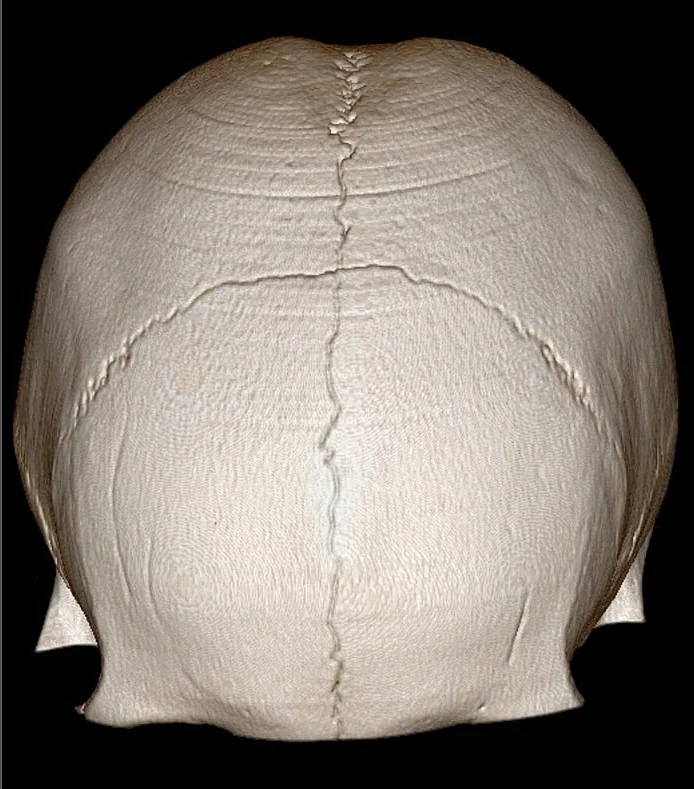
Çocuklarda aksesuar sütürler kraniyal kırıklarla karışabilir; wormian kemikler kraniyal sütürler içinde gelişen aksesuar kemikçiklerdir. Aksesuar sütür ile kırık ayrımında yüksek çözünürlüklü görüntüleme ve üç boyutlu BT değerlendirmesi kullanılır. Kraniyal sütür varyantının kırık sanılması istismar kuşkusu ve hukuki sonuçlara yol açabilir. Karşı taraf ve önceki inceleme yararlıdır, fakat varyantlar asimetrik de olabildiğinden tek başına simetri kararı verdirmez.
Faz ve pencere
- Kontrastsız tanısal
- Kontrastsız kraniyal BT'de wormian kemikler kraniyal sütürler içinde aksesuar kemikçikler olarak görülebilir; travma varlığında aynı incelemede intrakraniyal ve diğer eşlik eden yaralanmalar da değerlendirilir.
- Kemik algoritması tanısal
- Şüpheli hat çok düzlemli ve üç boyutlu BT kemik görüntüleriyle değerlendirilir.
Önerilen pencereler G genişlik, M merkez; değerler Hounsfield birimi (HU)
- KemikG 1800 / M +400
- BeyinG 80 / M +40
- Yumuşak dokuG 400 / M +40
BT bulguları
- Parietal kemiklerde sagittal sütüre dik uzanan bilateral simetrik radyolüsent çizgiler, normal gelişim varyantı olarak görülebilir.
- Wormian kemikler, kraniyal sütürler içinde yer alan küçük ek kemiklerdir; en sık lambdoid sütürde, daha seyrek olarak posterior fontanelde görülür.
- Aksesuar kraniyal sütürler, çocuklarda kırıkla karışabilen sütür varyantlarıdır.
- Aksesuar sütür ile kırık ayrımında yüksek çözünürlüklü görüntüleme kullanılır; 3B BT değerlendirmede tercih edilen yöntem olarak bildirilmiştir.
- Aksesuar sütür ile kırık ayrımında üç boyutlu BT, sütür ve kemikçik yapıları hakkında ek anatomik ayrıntı sağlar.
- Kırık hattı sütür hattını geçebilir.
- Oksipital bölgedeki aksesuar sütürler kraniyal kırık çizgisi gibi görünebilir ve kırık taklitçisidir.
- Wormian kemikler kraniyosinostoz veya osteogenezis imperfekta gibi iskelet durumlarıyla birlikte görülebilir.
Normalde
Wormian kemikler en sık lambdoid sütürde görülür; tek veya çok sayıda kemikçik bu hat içinde yer alabilir. Aksesuar sütürler asimetrik görünebilir; asimetri tek başına kırık kanıtı değildir.
Normal BT ile kıyasla
Aynı bölgenin, kaynak veri setinde patoloji içermediği belirtilen bir BT incelemesini kesit kesit kaydırın; organ sınırlarını açarak anatomiyi hasta görüntüsüyle karşılaştırın. Küçük rastlantısal bulgular tümüyle dışlanmamıştır.
Kaynak: TotalSegmentator v2.01 veri seti (Wasserthal ve ark., Radiology: Artificial Intelligence 2023), CC BY 4.0, vaka s0103; organ sınırları veri setinin otomatik segmentasyonundan, birleştirilerek sadeleştirildi. Görüntüler 2,5 mm kesit aralığına yeniden örneklendi.
Ayırıcı tanı
- Akut kalvaryal kırık
- aksesuar sütürle ayrımda yüksek çözünürlüklü görüntüleme kullanılır; 3B BT değerlendirmede tercih edilen yöntem olarak bildirilmiştir.
- Normal kraniyal sütür varyantları kasıtlı yaralanma ile karışabilir ve istismar sanılabilir.
- Osteogenezis imperfekta veya başka kemik kırılganlığı
- çok sayıda wormian kemikle birlikte yaygın kemik bulguları ve klinik öykü olabilir; kemikçiklerin varlığı tek başına tanı değildir.
- Vasküler oluklar kafatası görüntülerinde kırıkla karışabilir.
Tuzaklar
- Şüpheli kraniyal çizgiyi üç boyutlu BT kemik görüntüleriyle değerlendirin.
- Aksesuar sütürler asimetrik izlenebilir; hattın kemik sınırını aşıp aşmadığını ayrıca değerlendirin.
- Wormian kemikler tek bir sendroma özgü değildir; kraniyosinostoz veya başka iskelet durumlarıyla birlikte görülebilir.
- Yüksek çözünürlüklü görüntüleme aksesuar sütür ile kırık ayrımında en iyi yoldur ve üç boyutlu BT değerlendirmesi tercih edilmektedir.
Kendini dene
Çocukta kraniyal BT'de sütür hattı boyunca, kortike kemikle sınırlı birden çok ayrı kemikçik izleniyor. En uygun adlandırma hangisidir?
Cevabı göster
Wormian kemikler. Kraniyal sütürler içinde yer alan küçük aksesuar kemikçikler wormian kemiklerdir; kırıkla ayrımında klinik bağlam ve görüntüleme değerlendirmesi gerekir.
Arka kalvaryumda lambdoid sütür boyunca birden çok ayrı, kortike kemik adacığı izleniyor. En uygun adlandırma?
Cevabı göster
Wormian kemikler. Sütür içinde kortike sınırlarla ayrılan kemikçikler wormian kemiklerdir ve özellikle lambdoid hatta görülebilir. Wormian kemikler özellikle lambdoid sütürlerde görülebilen küçük ek kemiklerdir.
Bu konunun yer aldığı turlar
İlgili konular
Kaynaklar
Bu sayfadaki 36 cümle ve 2 quiz sorusu aşağıdaki kaynaklardan alıntılarla otomatik olarak karşılaştırıldı; 23 cümle bu karşılaştırmada düzeltildi (2026-10-10).
- Review of imaging modalities and radiological findings of calvarial lesionspmc.ncbi.nlm.nih.gov
- World Congress on Osteoporosis, Osteoarthritis and Musculoskeletal Diseases (WCO-IOF-ESCEO 2025)pmc.ncbi.nlm.nih.gov
- The Radiographic Approach to Child Abusepmc.ncbi.nlm.nih.gov
- Review of imaging modalities and radiological findings of calvarial lesions.pubmed.ncbi.nlm.nih.gov
- Anterior Fontanelle Wormian Bone/ Fontanellar Bone: A Review of this Rare Anomaly with Case Illustration.pubmed.ncbi.nlm.nih.gov
- The radiographic approach to child abuse.pubmed.ncbi.nlm.nih.gov
- A Multispecialty Approach to the Identification and Diagnosis of Nonaccidental Trauma in Children.pubmed.ncbi.nlm.nih.gov
- A Recurrent Mosaic Mutation in SMO, Encoding the Hedgehog Signal Transducer Smoothened, Is the Major Cause of Curry-Jones Syndrome.pubmed.ncbi.nlm.nih.gov
- Imaging of Skull Base Tumors.pubmed.ncbi.nlm.nih.gov
- Imaging Evaluation of Acute Traumatic Brain Injury.pubmed.ncbi.nlm.nih.gov
- Inner table skull fracture with intact outer cortex: a rare case report and literature review.pubmed.ncbi.nlm.nih.gov
- Diagnostic performance of point-of-care ultrasound for pediatric skull fractures: A systematic review and meta-analysis.pubmed.ncbi.nlm.nih.gov
- Evaluation of ChatGPT-5 for CT Imaging in Canadian CT Head Rule-Positive Mild Traumatic Brain Injury: A Pilot Study.pubmed.ncbi.nlm.nih.gov
- Assessment of Bone Regeneration in Rabbit Calvarial Defects Treated With Mineralized Collagen-Based Scaffolds Using In Vivo MicroCT and Three-Dimensional Rendering.pubmed.ncbi.nlm.nih.gov
- Cranial Defect Reconstruction With Custom 3D-Printed Hydroxyapatite Scaffolds Augmented With rhBMP-2 or Dipyridamole in a Nonhuman Primate Model.pubmed.ncbi.nlm.nih.gov
- Brain tumors induce widespread disruption of calvarial bone and alteration of skull marrow immune landscape.pubmed.ncbi.nlm.nih.gov
- Synchrotron microtomography of a Nothosaurus marchicus skull informs on nothosaurian physiology and neurosensory adaptations in early Sauropterygia.pubmed.ncbi.nlm.nih.gov
- Concurrent Sagittal Craniosynostosis and Anterior Fontanelle Wormian Bone: Radiological Findings and Surgical Management in an Infant With Epispadias.pubmed.ncbi.nlm.nih.gov
- Incidence and Medicolegal Significance of Wormian Bones in Human Skulls in North India Region.pubmed.ncbi.nlm.nih.gov
- Long-term Stable Unilateral Mandibular Deformity Associated With Ipsilateral Skull-base Soft-tissue Lesion and Degenerated Pterygoid Muscles in Neurofibromatosis Type 1.pubmed.ncbi.nlm.nih.gov
- Hominin Variability and Evolutionary Relationships at Guattari Cave During the Middle and Late Pleistocene (San Felice Circeo, Latina, Italy).pubmed.ncbi.nlm.nih.gov
- Two Prediction Error Systems in the Nonlemniscal Inferior Colliculus: "Spectral" and "Nonspectral".pubmed.ncbi.nlm.nih.gov
- Automatically Diagnosing Skull Fractures Using an Object Detection Method and Deep Learning Algorithm in Plain Radiography Images.pubmed.ncbi.nlm.nih.gov
- Nonproliferative and Proliferative Lesions of the Rat and Mouse Skeletal Tissues (Bones, Joints, and Teeth).pubmed.ncbi.nlm.nih.gov
- International Society of Paediatric Surgical Oncology (IPSO) Surgical Practice Guidelines.pubmed.ncbi.nlm.nih.gov
- New insights on Ötzi's injuries from a clinical perspective.pubmed.ncbi.nlm.nih.gov
- Patterns of injury and violence in Yaoundé Cameroon: an analysis of hospital data.pubmed.ncbi.nlm.nih.gov
- Commentary: an eye on PET quantification.pubmed.ncbi.nlm.nih.gov
- The genetic basis of hydrocephalus: genes, pathways, mechanisms, and global impact.pubmed.ncbi.nlm.nih.gov
- Radiological review of skull lesions.pubmed.ncbi.nlm.nih.gov
- The clinical and mutational spectrum of B3GAT3 linkeropathy: two case reports and literature review.pubmed.ncbi.nlm.nih.gov
- Computed Tomography Analysis of Craniofacial Features in Japanese Patients With Cleidocranial Dysplasia.pubmed.ncbi.nlm.nih.gov
- Pycnodysostosis With Papilledema and Isolated Low Parathyroid Hormone Levels in an Eight-Year-Old Girl: A Genetically Confirmed Case Report.pubmed.ncbi.nlm.nih.gov
- A Child With Cleidocranial Dysplasia Presenting With Seizure Disorder.pubmed.ncbi.nlm.nih.gov
- Best practice management guidelines for fibrous dysplasia/McCune-Albright syndrome: a consensus statement from the FD/MAS international consortium.pubmed.ncbi.nlm.nih.gov
- Coexistence of Autoantibodies against the Golgi Complex and Ro52 Antigen in a Patient with Nonspecific Interstitial Pneumonia.pubmed.ncbi.nlm.nih.gov
- Imaging Findings in Pediatric Accessory Cranial Sutures using 3D CT Reconstruction: Fracture or Rudimentary Suture.pubmed.ncbi.nlm.nih.gov
- Earliest cranio-encephalic trauma from the Levantine Middle Palaeolithic: 3D reappraisal of the Qafzeh 11 skull, consequences of pediatric brain damage on individual life condition and social care.pubmed.ncbi.nlm.nih.gov
- Cranial Suture Joints in Sheep <i>Ovis aries</i> (<i>Najdi breed</i>): Anatomical and Radiographic Findings.pubmed.ncbi.nlm.nih.gov
- Specimen-level phylogenetic analysis and taxonomic revision of North American metoposaurids: a case for monospecific genera in vertebrate paleontology.pubmed.ncbi.nlm.nih.gov
- Expanding the phenotypic and genotypic spectrum of <i>KCNT1</i>-related epilepsies.pubmed.ncbi.nlm.nih.gov
- Extending the global landscape of Bruck syndrome: Case series of Indonesian and Ukrainian patients with PLOD2 pathogenic variants and literature review.pubmed.ncbi.nlm.nih.gov
- Genotype and Phenotype of 198 Korean Patients With Nonlethal Osteogenesis Imperfecta: A Retrospective Cohort Study.pubmed.ncbi.nlm.nih.gov
- A radiological case series of three siblings with osteogenesis imperfecta and shared paternal inheritance.pubmed.ncbi.nlm.nih.gov
- Review of image segmentation techniques for biomedical micro-CT: from laboratory absorption imaging to synchrotron phase-contrast.pubmed.ncbi.nlm.nih.gov
- Comparative Analysis of Orbital Morphology Accuracy in 3D Models Based on Cone-Beam and Fan-Beam Computed Tomography Scans for Reconstructive Planning.pubmed.ncbi.nlm.nih.gov
- Segmentation-free Radon transform algorithm to detect orientation and size of tissue structures in multiphoton microscopy images.pubmed.ncbi.nlm.nih.gov
- Control of craniofacial development by the collagen receptor, discoidin domain receptor 2.pubmed.ncbi.nlm.nih.gov
- Craniosynostosis and multiple skeletal anomalies in humans and zebrafish result from a defect in the localized degradation of retinoic acid.pubmed.ncbi.nlm.nih.gov
- Brazilian Society of Otology task force - Otosclerosis: evaluation and treatment.pubmed.ncbi.nlm.nih.gov
- Long-term safety and effectiveness of the "OptEase" vena cava filter.pubmed.ncbi.nlm.nih.gov
- High-affinity alphavbeta3 integrin targeted optical probe as a new imaging biomarker for early atherosclerosis: initial studies in Watanabe rabbits.pubmed.ncbi.nlm.nih.gov
- Penetrating Chest Trauma With Lung Evisceration, Pneumomediastinum, Pneumocranium, and Brachial Plexus Injury: A Case Report From a Resource-Limited Setting.pubmed.ncbi.nlm.nih.gov
- Collaborative Diagnostic Pathways for Unilateral Orbital Disease: A Clinicopathological Series.pubmed.ncbi.nlm.nih.gov
- Comprehensive Management of Different Types of Pelvic Fractures Through Multiple Disciplines: A Case Series.pubmed.ncbi.nlm.nih.gov
- The craniocervical junction: embryology, anatomy, biomechanics and imaging in blunt trauma.pubmed.ncbi.nlm.nih.gov
- Concomitant Lateral Meniscal Tears in Pediatric and Adolescent Patients Undergoing Combined Medial Meniscal Ramp Lesion Repair and Anterior Cruciate Ligament Reconstruction Are Frequently Missed on MRI, Are Often Vertical or Root Tears, and Are Usually Repaired: A Multicenter Study.pubmed.ncbi.nlm.nih.gov
- Clinical Outcomes After Medial Meniscal Ramp Lesion Repair and Anterior Cruciate Ligament Reconstruction in Pediatric and Adolescent Patients: A Multicenter Study With a Mean Follow-up of 5 Years.pubmed.ncbi.nlm.nih.gov
- Cranial anatomy, palaeoneurology, palaeobiology and stratigraphic age of the large-bodied ornithopod, <i>Muttaburrasaurus langdoni</i> Bartholomai and Molnar, 1981, from the mid-Cretaceous of Australia.pubmed.ncbi.nlm.nih.gov
- On the Maxillofacial Development of Mice, Mus musculus.pubmed.ncbi.nlm.nih.gov
- Conserved meningeal lymphatic drainage circuits in mice and humans.pubmed.ncbi.nlm.nih.gov
- Complete recovery and resolution of neurological symptoms following a penetrating gunshot in the left frontal lobe: a case report.pubmed.ncbi.nlm.nih.gov
- Unossified Membranous Strips of the Parietal Bone Mimicking a Fracture in a Child Presenting With Scalp Swelling: A Case Report.pubmed.ncbi.nlm.nih.gov
- Delayed Subaponeurotic Fluid Collection in an Infant Without Trauma: A Literature Review and Case Report.pubmed.ncbi.nlm.nih.gov
- Does laparoscopic surgery decrease the risk of atrial fibrillation after foregut surgery?pubmed.ncbi.nlm.nih.gov
- Flat-panel conebeam CT in the clinic: history and current state.pubmed.ncbi.nlm.nih.gov
- Wormian bones: expanded differential diagnosis and implications for abnormal head shape in infancy.pubmed.ncbi.nlm.nih.gov
- Neuroimaging in Nonsyndromic Craniosynostosis: Key Concepts to Unlock Innovation.pubmed.ncbi.nlm.nih.gov
- A Neurotrophic Mechanism Directs Sensory Nerve Transit in Cranial Bone.pubmed.ncbi.nlm.nih.gov
- Signaling networks in joint development.pubmed.ncbi.nlm.nih.gov
- Two distinct cases of subgaleal hematoma beyond the neonatal period: A case report and review of the literature.pubmed.ncbi.nlm.nih.gov
- Cranio-Orbito-Zygomatic Approach: Core Techniques for Tailoring Target Exposure and Surgical Freedom.pubmed.ncbi.nlm.nih.gov
- Rare Diseases of the Orbit.pubmed.ncbi.nlm.nih.gov
- Anatomy and relationships of the early diverging Crocodylomorphs Junggarsuchus sloani and Dibothrosuchus elaphros.pubmed.ncbi.nlm.nih.gov
- Accessory occipital suture simulating fracture in pediatric head trauma: A case report.pubmed.ncbi.nlm.nih.gov
- Traumatic Sinus Pericranii Managed Surgically: A Case Report.pubmed.ncbi.nlm.nih.gov
- Unilateral Pterional Polycraniosynostosis Treated with Craniectomy and Helmet Therapy.pubmed.ncbi.nlm.nih.gov
- Sclerostin Antibody-Induced Changes in Bone Mass Are Site Specific in Developing Crania.pubmed.ncbi.nlm.nih.gov
- Spectrum of Interventional Procedures During Hybrid Central Line Placement in Pediatric Intestinal Rehabilitation Patients With End-Stage Vascular Access.pubmed.ncbi.nlm.nih.gov
- Profile and Management of Traumatic Orbital Hematoma in a Child With Hemophilia C: A Case Report.pubmed.ncbi.nlm.nih.gov
- Evidence for deliberate burial of the dead by <i>Homo naledi</i>.pubmed.ncbi.nlm.nih.gov
- Meticulous and Early Understanding of Congenital Cranial Defects Can Save Lives.pubmed.ncbi.nlm.nih.gov
- Assessment of the usefulness of ultrasound in the diagnosis of skull fractures in children - a five-year institutional experience.pubmed.ncbi.nlm.nih.gov
- "Leave me alone": anatomical structures and variations seen on computed tomography of the temporal bone.pubmed.ncbi.nlm.nih.gov
- Callosomarginal artery: an in-depth of anatomical characteristics, clinical significance, neurosurgical considerations, and surgical applications.pubmed.ncbi.nlm.nih.gov
- Hajdu-Cheney Syndrome with Fatal Progressive Basilar Invagination: Illustrative Case.pubmed.ncbi.nlm.nih.gov
- The infant with bilateral skull fractures: diagnostic considerations in consultation with a child abuse pediatrician.pubmed.ncbi.nlm.nih.gov
- Mastoid emissary vein, mastoid emissary foramen, and mastoid emissary canal: anatomy, variability, imaging, and clinical implications.pubmed.ncbi.nlm.nih.gov
- Dorsal Root Ganglion-Targeted DNA Origami Delivery of IL1RN for Skeletal Growth and Repair.pubmed.ncbi.nlm.nih.gov
- Growing skull fracture: Delayed presentation, surgical management, and review of the literature.pubmed.ncbi.nlm.nih.gov
- Serial Magnetic Resonance Imaging Leading to the Diagnosis of a Growing Skull Fracture in an Infant Without an Apparent Fracture Widening on Follow-Up Computed Tomography.pubmed.ncbi.nlm.nih.gov
- Simulated Cranial Ultrasound for Longitudinal Learning (SCULL): A Simulated Task Trainer for Emergency Medicine Residents.pubmed.ncbi.nlm.nih.gov
- Disk Harmonic Mapping of Cranial Surfaces for Fracture Visualization.pubmed.ncbi.nlm.nih.gov
- Cross-Sectional Radiological and Reconstructive Anatomy of the Paranasal Sinuses in Normal Mesaticephalic Dogs.pubmed.ncbi.nlm.nih.gov
- Anatomical Variation of Selected Cranial Emissary Foramina in Adult Greek Skulls: A Mixed Anatomical and Computed Tomography Study.pubmed.ncbi.nlm.nih.gov
- A systematic approach in the diagnosis of paediatric skull lesions: what radiologists need to know.pubmed.ncbi.nlm.nih.gov
- A new neornithischian dinosaur from the Upper Jurassic Tiaojishan Formation of northern China.pubmed.ncbi.nlm.nih.gov
- Anatomy, feeding ecology, and ontogeny of a transitional baleen whale: a new genus and species of Eomysticetidae (Mammalia: Cetacea) from the Oligocene of New Zealand.pubmed.ncbi.nlm.nih.gov
- Almost billfish: convergent longirostry, micro-dentition, and possible glandular sinuses in a large teleost fish from the Upper Cretaceous of Northern Italy.pubmed.ncbi.nlm.nih.gov
- The oldest ceratosaurian (Dinosauria: Theropoda), from the Lower Jurassic of Italy, sheds light on the evolution of the three-fingered hand of birds.pubmed.ncbi.nlm.nih.gov
- How to report perinatal and paediatric postmortem CT.pubmed.ncbi.nlm.nih.gov
- Craniofacial and dental phenotype of two girls with osteogenesis imperfecta due to mutations in CRTAP.pubmed.ncbi.nlm.nih.gov
- Full Visualization of Contact Endoscopy for Basal Ganglia Hemorrhage: A Multicenter Retrospective Study Comparing With Microscopy and Neuroendoscopy.pubmed.ncbi.nlm.nih.gov
- Fatal non-accidental pediatric cranial fracture risk and three-layered cranial architecture development.pubmed.ncbi.nlm.nih.gov
- Innovative photobiomodulation-enhanced T-PRF in posterior mandibular fractures: a randomized pilot study.pubmed.ncbi.nlm.nih.gov
- Harnessing Phase Separation for the Development of High-Performance Hydrogels.pubmed.ncbi.nlm.nih.gov
- Accidental Diagnosis of Type VII Osteogenesis Imperfecta in an Infant Presenting With Pneumonia and Rickets-Like Rib Fractures: A Case Report.pubmed.ncbi.nlm.nih.gov
- Hajdu-Cheney Syndrome in a Two-Generation Family: Longitudinal Skeletal Progression and Differential Therapeutic Responses in a Mother and Her Son.pubmed.ncbi.nlm.nih.gov
- Multisuture craniosynostosis and acquired Chiari malformation secondary to vitamin D deficiency rickets: illustrative case.pubmed.ncbi.nlm.nih.gov
- Cranial Bone Changes Associated With Intracranial Hypertension in Apert Syndrome: Insights for Early Surgical Intervention.pubmed.ncbi.nlm.nih.gov
- Differential regulation of coronal and lambdoid suture patency by PTHLH and HHIP activity in mice.pubmed.ncbi.nlm.nih.gov
- Severe Craniocerebral Injury in a Child Caused by Repetitive Cleaver Strikes: Case Report and Review of the Literature.pubmed.ncbi.nlm.nih.gov
- Biparietal osteodystrophy in an 86-year-old woman: An incidental finding following minor head trauma.pubmed.ncbi.nlm.nih.gov
Eğitim amaçlıdır; hasta başında tanı ve tedavi kararının yerine geçmez, tıbbi tavsiye değildir. Metinler yapay zekâ desteğiyle yazıldı ve otomatik bir adımda kaynak alıntılarıyla karşılaştırıldı; bu bir tıbbi doğrulama değildir ve içerik uzman radyolog incelemesinden geçmedi. Klinik kararlarda güncel kılavuzları, kurum protokollerini ve radyoloji raporunu esas alın.